REVIEW 2 major objections 5 minor 38 references
The polarization of strongly lensed point-like radio sources
T0 review · 2 major / 5 minor · reviewed 2026-08-07 · deepseek-v4-flash
Pith's one-line read Strongly lensed radio sources carry a geometric polarization rotation that can rival Faraday rotation.
desk verdict New cross-term between gravitational and magnetic-gradient deflection yields a Faraday-like geometric rotation that deserves referee attention, though the 'generic' claim is only as strong as the coherent-field assumption. read the letter →
The pith
A machine-rendered reading of the paper's core claim, the machinery that carries it, and where it could break.
The reading
What carries the argument
The central object is the crossed-deflection term in the time-delay formula. Because the two modes feel opposite magnetic deflections $\pm\alpha_B$, their squared deflection angles differ by $\alpha_L^2-\alpha_R^2\simeq 4\alpha_{\rm gl}\alpha_B$, and multiplication by the time-delay distance $D_t=(1+z_d)D_dD_s/D_{ds}$ converts the tiny magnetic deflection into an observable phase difference. The magnetic deflection itself comes from the gradient term $\hat{\alpha}_B\propto\int (n_eB)_{,\alpha}\,\omega^{-3}\,dz$, so the effect requires a gradient of the magnetic field or the plasma density, not a uniform field. Eq. 27, which combines the geometric terms with the Faraday term, is the object that carries the argument.
What would settle it
Measure the polarization angle as a function of frequency for each image of a strongly lensed polarized radio source, fit and subtract the standard Faraday $\lambda^2$ law, and check for a residual rotation that scales as $\lambda^2$ (with a $\lambda^4$ tail) and changes between images in proportion to $\alpha_{\rm gl}\alpha_B D_t/c$; a null residual at the predicted level would refute the central claim for that system.
Extended reading notes
Core claim
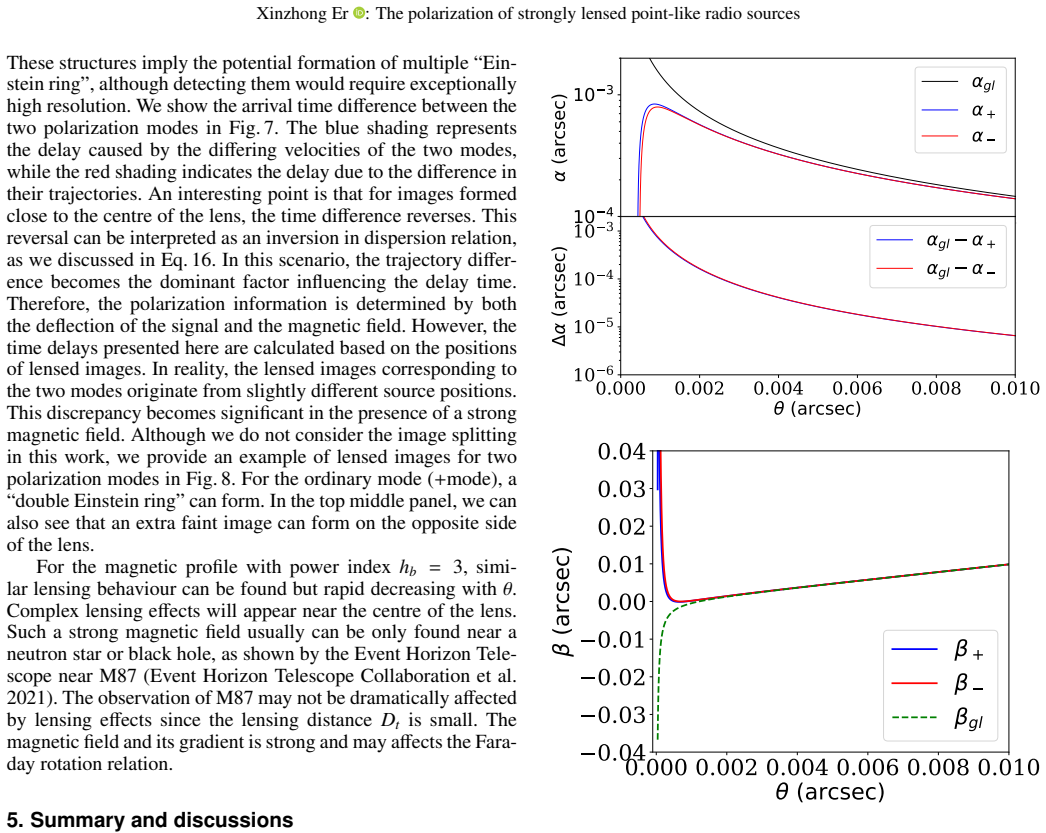
The paper's central claim is that birefringence in a magnetized plasma changes the ray paths themselves when the magnetic field and electron density have gradients, and strong gravitational lensing turns the small path difference into a large geometric delay between the two circular polarization modes. Writing the total deflection as $\hat{\alpha}=\hat{\alpha}_{\rm gl}+\hat{\alpha}_{\rm pl}\pm\hat{\alpha}_B$, the left-right arrival-time difference is $\Delta t_{LR}=(2D_t/c)(\alpha_{\rm gl}\alpha_B+\alpha_{\rm pl}\alpha_B)+\dots$, and the rotation of the linear polarization becomes $\Delta\phi=4\pi\omega D_t(\alpha_{\rm gl}\alpha_B+\alpha_{\rm pl}\alpha_B)/c+2\pi K_eK_b\omega^{-2}\int n_eB\,dz$. In a galaxy-scale singular isothermal sphere lens with a 10 $\mu$G magnetic field, the geometric term is comparable to or stronger than Faraday rotation and has the same $\lambda^2$ frequency dependence, so the standard Faraday relation cannot be used as an accurate estimate of the field. Near a point lens with a strong field, the two modes show different deflection angles, mode-dependent hill-and-hole magnification structure, and a sign reversal of the mode time delay near the lens center.
Load-bearing premise
The load-bearing premise is that the magnetic field stays parallel or antiparallel to the light's direction along the entire path, so the two circular modes never swap and their deflections differ by exactly $\pm\alpha_B$; if the field direction twists along the line of sight, the gradient term driving $\alpha_B$ is suppressed and the claimed generic rotation can disappear.
Editorial extensions
If this is right
- Standard rotation-measure fits of strongly lensed radio sources will absorb the geometric $\lambda^2$ term into the inferred RM, biasing the magnetic-field estimate unless the lensing geometry is included.
- The plasma-deflection part of the geometric rotation scales as $\lambda^4$ rather than $\lambda^2$, giving a multi-frequency diagnostic that is absent for pure Faraday rotation.
- For millisecond-duration sources such as FRBs, the mode time delay near the lens center can approach the pulse width, so lensed bursts may show broadened or split pulses whose components have different circular polarization.
- In the strong-field point-mass model, the two modes can form separate Einstein-ring-like features and additional faint images, with magnification curves that develop mode-dependent hill-and-hole structures.
- Polarization therefore adds a new observable channel for constraining the magnetic field and plasma environment of strong lenses, beyond image positions and total time delays.
Reading between the lines
- A direct test would compare the polarization angles of different images of the same lensed source: Faraday rotation is nearly common to the close paths, while the geometric term changes with image position, so an image-dependent residual would isolate this effect.
- Because the dominant geometric term has the same $\lambda^2$ scaling as Faraday rotation, single-frequency RM measurements cannot reveal it; searching for the effect requires broadband polarimetry or the $\lambda^4$ tail at lower frequencies.
- If the mechanism is real, it should apply to any strongly lensed polarized radio transient, not only FRBs, making lensing-induced geometric rotation a general property of lensing in magnetized plasma rather than a source-specific phenomenon.
- The predicted mode flip in strong fields implies a sharp transition in polarization behavior when $\omega_B^2$ approaches $\omega^2-\omega_e^2$; observing a lensed source across a wide frequency range could test that dispersion-relation inversion.
Editorial analysis
A structured set of objections, weighed in public.
Referee Report
Summary. The manuscript studies the propagation of circular polarization modes in a magnetized plasma under strong gravitational lensing. Starting from a dispersion relation for a cold magnetized plasma, the author derives a mode-dependent deflection term α_B generated by the transverse gradient of n_e B_∥ (Eqs. 11-12), builds a lens equation with gravitational, plasma, and magnetic potentials (Eqs. 21-23), and computes the L-R arrival-time difference and the induced polarization rotation (Eqs. 26-27). In a galaxy-scale SIS toy model with power-law electron density and magnetic field, the geometric terms α_glα_B and α_plα_B are claimed to produce rotation comparable to or stronger than Faraday rotation, with λ² and λ⁴ scalings. A second toy model considers a point mass with a strong magnetic field and explores image splitting, magnification structure, and arrival-time differences between the two modes. The paper concludes that this lensing-induced geometric rotation occurs generically in the presence of magnetic field and plasma density gradients.
Significance. If the geometric rotation term were correct, it would be a genuinely new observable for probing magnetic fields in lens galaxies and a caution for interpreting rotation measures of lensed FRBs. The analytic framework is transparent, the wavelength scalings in Table 1 are internally consistent, and the comparison with Faraday rotation uses a common dispersion relation rather than fitting to the claimed effect. However, the central quantitative claim is not established: the derivation of Eq. 26 neglects the shift of the image position between modes, and the 'generic' conclusion rests on a coherent, non-reversing B_∥ along the entire line of sight. As it stands, the paper is a demonstration of a formalism under idealized assumptions rather than a robust prediction of an observable effect.
major comments (2)
- [§3, Eq. (26)] The derivation of Δt_LR is inconsistent with the lens equation. If the L and R modes have different deflections ±α_B, then for a common source position β they form images at different angular positions θ_L and θ_R. The time-delay difference must be computed from the Fermat potential τ_s(θ) = (1/2)(θ−β)^2 − ψ_s(θ) evaluated at each mode's stationary point. Let τ_0 be the common gravitational-plus-plasma Fermat potential and θ_0 its stationary point. By the envelope theorem, τ_s at the shifted image equals τ_0(θ_0) ± ψ_B(θ_0) + O(α_B²); the term (Dt/2c)(α_L²−α_R²) in Eq. (26) is cancelled by the corresponding change in the Shapiro/potential term t_gl + t_pl. For the SIS toy model, where α_gl is constant, this cancellation is explicit and the L−R delay reduces to 2t_B plus second-order terms, leaving no first-order geometric rotation. Consequently, Eqs. (26)-(27) overstate the lensing-induced geometric rotation, and the claimed λ² and λ⁴ terms comparable to Faraday rotation are not established. The calculation should be redone using mode-dependent image positions for the same source; if the same-trajectory approximation is instead retained, it is incompatible with a nonzero α_L²−α_R².
- [§2.1, after Eq. (6); §5] The conclusion that the geometric rotation 'occurs generically' depends on the assumption, stated as 'crucial' in Section 2.1, that B_∥ keeps a constant sign along the entire ray and that no mode coupling occurs. The gradient integral in Eq. (12) is linear in B_∥; a realistic galaxy-scale line of sight through a magneto-ionic medium with reversals on coherence scales would partially cancel the integral, suppressing α_B by roughly √N for N independent reversals. Since the geometric terms in Eq. (27) are linear in α_B, the claimed dominance over Faraday rotation would be reduced or erased in such fields. The paper's own Section 5 concedes that line-of-sight structures and small-scale density variations could influence the result, but it does not quantify this. Please either provide a quantitative treatment of field-reversal/tangling effects or explicitly restrict the conclusion to the idealized coherent-field model.
minor comments (5)
- [§3, Eq. (28) and surrounding text] The statement 'In our choice, we have DM=100 pc cm⁻³ and RM=810 rad m⁻² at R0=10 kpc' does not follow from the profiles in Eq. (28) with n0=0.01 cm⁻³ and B0=10⁻⁵ G; please specify the integration path and provide the projected values consistently, since these numbers set the normalization of Figs. 1-3.
- [§2, first paragraph of Section 2] The sentence 'we model the electromagnetic waves as as plane' contains a duplicated 'as'.
- [Fig. 4 caption] The caption contains the unresolved reference 'Section??'.
- [Fig. 7 caption] The caption contains the typographical fragment 'textraordinary−t ordinary'.
- [§2.1, Eq. (4)] The first expression for n_{L,R} has a typographical error in the numerator ('ωω²_e' should presumably be 'ω²_e').
Circularity Check
No significant circularity: the geometric-rotation prediction follows from the adopted dispersion relation and independently observed parameters, with no fitted target quantity.
full rationale
The paper's central derivation is self-contained. The geometric rotation in Eq. (27) is obtained by inserting the dispersion-relation deflection (Eqs. 11-12) into the lens time-delay expression (Eqs. 25-26); no parameter is fitted to the claimed rotation. Input quantities (DM, RM, sigma_v, n0, B0, M87 mass and field) are taken from independent observations or standard references. The lambda^2 and lambda^4 scalings follow algebraically from the frequency dependence of alpha_B and alpha_pl. Cited self-work (Er & Mao 2022; Er & Rogers 2019; Tsupko et al. 2020) supplies standard plasma-lensing formalism and the known importance of geometric delay in strong lensing; these are externally published results and do not encode the target rotation. The paper explicitly flags its main limitations: Section 2.1 calls the parallel/antiparallel-field assumption 'crucial,' and Section 5 concedes 'the refraction index employed is a scaler' and that 'variations/small structures in plasma density' could influence results. These are stated assumptions and applicability caveats, not circular reductions of the prediction to its inputs. No equation is equivalent by construction to the claimed result, and no fitted parameter is subsequently renamed as a prediction.
Assumptions & free parameters
free parameters (6)
- Electron density normalization n0 =
0.01 cm^-3 (galaxy); 100 cm^-3 (black hole)
- Magnetic field normalization B0 =
10^-5 G (galaxy); 10 G at R0=100 r_g (black hole)
- Magnetic field power-law index h_b =
1 and 3
- Electron density power-law index h =
2
- Scale radius R0 =
10 kpc (galaxy); 100 r_g (black hole)
- Lens and source redshifts and lens mass =
zd=0.2, zs=0.5, sigma_v=300 km/s; M=6e9 Msun, D=16.7 Mpc
assumptions (5)
- domain assumption Hamilton's geometric optics ray equations with the dispersion relation of Broderick & Blandford (2003, 2004) describe light propagation in a magnetized plasma in curved spacetime.
- domain assumption Weak gravitational field, small deflection angle, and thin-lens approximation hold.
- ad hoc to paper The magnetic field remains parallel or antiparallel to the wave vector along the entire path.
- ad hoc to paper Plasma density and magnetic field are spherically symmetric power laws with a coherent radial field.
- domain assumption The two polarization modes are coherent and their arrival-time difference converts directly into a rotation of linear polarization.
Cite this review
Pith. "Pith review of The polarization of strongly lensed point-like radio sources." pith.science (2026). https://pith.science/paper/GOSPW2DW
@misc{pith2026250605772,
  author       = {Pith},
  title        = {Pith review of: The polarization of strongly lensed point-like radio sources},
  year         = {2026},
  howpublished = {\url{https://pith.science/paper/GOSPW2DW}},
  note         = {Machine review of arXiv:2506.05772}
}
read the original abstract
Aims. The magnetized medium induces birefringence, splitting the light into two distinct wave modes. The differing propagation speeds of the two modes result in different trajectories. Strong gravitational lensing amplifies the birefringence and introduces an additional geometric rotation on top of the Faraday rotation. We compare the geometric rotation with the Faraday rotation. Methods. We construct the lens equation for massive objects in a magnetized plasma environment, and calculate the time delay difference between the two modes using two toy examples. We present that in the strong lensed radio sources, birefringence causes geometric rotation, which is a non-negligible effect, even with a weak magnetic field. Results. In both examples, the geometric delay causes a comparable or stronger rotation than the Faraday rotation and show a similar dependence on the wavelength of the signal. For a point lens with a strong magnetic field, the two wave modes exhibit distinct behaviours. The polarization of lensed sources can provide additional insights into the magnetic field and plasma environment.
Figures


Figures from the paper (4 more)


Reference graph
Works this paper leans on
-
[1]
K., Schulz, R., Kadler, M., et al
Baczko, A. K., Schulz, R., Kadler, M., et al. 2016, A&A, 593, A47
work page 2016
-
[2]
Beck, R. & Wielebinski, R. 2013, in Planets, Stars and Stellar Systems. V olume 5: Galactic Structure and Stellar Populations, ed. T. D. Oswalt & G. Gilmore, V ol. 5, 641
work page 2013
-
[3]
& Tremaine, S
Binney, J. & Tremaine, S. 2008, Galactic Dynamics: Second Edition
2008
-
[4]
Bisnovatyi-Kogan, G. S. & Tsupko, O. Y . 2009, Gravitation and Cosmology, 15, 20
work page 2009
-
[5]
Bisnovatyi-Kogan, G. S. & Tsupko, O. Y . 2010, MNRAS, 404, 1790
work page 2010
-
[6]
Blandford, R. D. & Znajek, R. L. 1977, MNRAS, 179, 433
1977
-
[7]
Breuer, R. A. & Ehlers, J. 1980, Proceedings of the Royal Society of London Series A, 370, 389
work page 1980
- [8]
Show all 38 references
-
[9]
& Blandford, R
Broderick, A. & Blandford, R. 2004, MNRAS, 349, 994
2004
-
[10]
2024, MNRAS, 531, 4155 CHIME/FRB Collaboration, Amiri, M., Andersen, B
Chen, X., Hu, B., Wang, P., et al. 2024, MNRAS, 531, 4155 CHIME/FRB Collaboration, Amiri, M., Andersen, B. C., et al. 2021, ApJS, 257, 59
2024
-
[11]
Cordes, J. M. & Chatterjee, S. 2019, ARA&A, 57, 417
2019
-
[12]
& Mao, S
Er, X. & Mao, S. 2022, MNRAS, 516, 2218
2022
-
[13]
2023, MNRAS, 522, 3965
Er, X., Pen, U.-L., Sun, X., & Li, D. 2023, MNRAS, 522, 3965
2023
-
[14]
& Rogers, A
Er, X. & Rogers, A. 2019, MNRAS, 488, 5651 Event Horizon Telescope Collaboration, Akiyama, K., Algaba, J. C., et al. 2021, ApJ, 910, L13
2019
-
[15]
2023, MNRAS, 520, 2995
Feldbrugge, J. 2023, MNRAS, 520, 2995
2023
-
[16]
& Thomas, J
Gebhardt, K. & Thomas, J. 2009, ApJ, 700, 1690
2009
-
[17]
Gwinn, C. R. 2019, MNRAS, 486, 2809
2019
-
[18]
Han, J. L. 2017, ARA&A, 55, 111
2017
-
[19]
1975, Journal of Plasma Physics, 13, 571
Ichimaru, S. 1975, Journal of Plasma Physics, 13, 571
1975
-
[20]
D., Fish, V
Johnson, M. D., Fish, V . L., Doeleman, S. S., et al. 2015, Science, 350, 1242 Jordán, A., Côté, P., Blakeslee, J. P., et al. 2005, ApJ, 634, 1002
2015
-
[21]
L., Foreman, S., Pen, U.-L., & Zhu, W
Jow, D. L., Foreman, S., Pen, U.-L., & Zhu, W. 2020, MNRAS, 497, 4956
2020
-
[22]
2014, ApJ, 786, 5
Kino, M., Takahara, F., Hada, K., & Doi, A. 2014, ApJ, 786, 5
2014
-
[23]
R., Bailes, M., McLaughlin, M
Lorimer, D. R., Bailes, M., McLaughlin, M. A., Narkevic, D. J., & Crawford, F. 2007, Science, 318, 777
2007
-
[24]
& Bartelmann, M
Narayan, R. & Bartelmann, M. 1996, arXiv:9606001, astro
1996
-
[25]
& Tsupko, O
Perlick, V . & Tsupko, O. Y . 2022, Phys. Rep., 947, 1
2022
-
[26]
Y ., & Bisnovatyi-Kogan, G
Perlick, V ., Tsupko, O. Y ., & Bisnovatyi-Kogan, G. S. 2015, Phys. Rev. D, 92, 104031
2015
-
[27]
Petterson, J. A. 1974, Phys. Rev. D, 10, 3166
1974
-
[28]
1964, MNRAS, 128, 307
Refsdal, S. 1964, MNRAS, 128, 307
1964
-
[29]
2006, in Saas-Fee Advanced Course 33: Gravitational Lensing:
Schneider, P. 2006, in Saas-Fee Advanced Course 33: Gravitational Lensing:
2006
-
[30]
2024, MNRAS, 534, 1143
Shi, X. 2024, MNRAS, 534, 1143
2024
-
[31]
& Cordes, J
Suresh, A. & Cordes, J. M. 2019, ApJ, 870, 29
2019
-
[32]
H., Treu, T., Hilbert, S., et al
Suyu, S. H., Treu, T., Hilbert, S., et al. 2014, ApJ, 788, L35
2014
-
[33]
2013, A&A, 556, A22
Tewes, M., Courbin, F., Meylan, G., et al. 2013, A&A, 556, A22
2013
-
[34]
Tsupko, O. Y . & Bisnovatyi-Kogan, G. S. 2020, MNRAS, 491, 5636
2020
-
[35]
Y ., Bisnovatyi-Kogan, G
Tsupko, O. Y ., Bisnovatyi-Kogan, G. S., Rogers, A., & Er, X. 2020, Classical and Quantum Gravity, 37, 205017
2020
-
[36]
V ., Walker, M
Tuntsov, A. V ., Walker, M. A., Koopmans, L. V . E., et al. 2016, ApJ, 817, 176
2016
-
[37]
2019, International Journal of Modern Physics D, 28, 2040013
Turimov, B., Ahmedov, B., Abdujabbarov, A., & Bambi, C. 2019, International Journal of Modern Physics D, 28, 2040013
2019
-
[38]
G., & Pen, U
Wucknitz, O., Spitler, L. G., & Pen, U. L. 2021, A&A, 645, A44 Article number, page 8 of 8
2021
Reviewed August 7, 2026 · model on record in the stance chip above.
Discussion (0). Sign in to comment.