REVIEW 4 major objections 3 minor 28 references
An Execution Model for RICE
T0 review · 4 major / 3 minor · reviewed 2026-08-07 · deepseek-v4-flash
Pith's one-line read This paper gives RICE's execution model and proves it agrees with Curry's standard semantics on terminating first-order programs.
desk verdict A useful operational model for RICE's backtracking execution, but the advertised conformance statement is only soundness for a first-order fragment, not the completeness the conclusion claims. read the letter →
The pith
A machine-rendered reading of the paper's core claim, the machinery that carries it, and where it could break.
The reading
What carries the argument
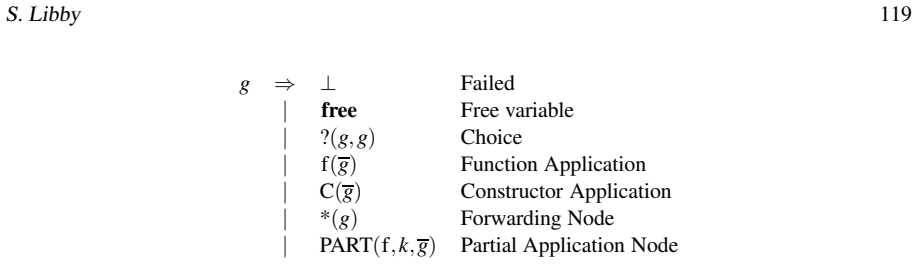
The machinery is a graph of heap nodes (failure, free, choice, constructor, function, forwarding, and partial-application nodes) together with a backtracking stack of rewrite frames. Evaluation is defined by three relations: normalization to a value, head normalization, and backtracking; the case and apply rules are where non-determinism is resolved. The forwarding node *(g) preserves sharing when a function returns one of its parameters, so backtracking can undo rewrites without duplicating subgraphs.
What would settle it
Run the execution model on a terminating higher-order expression such as (id ? not) True and check that the apply and choice rules enumerate both True and False as the standard Curry semantics does; because the conformance proof only covers first-order expressions, any mismatch in the answers, or any divergence, refutes the paper's unrestricted final claim.
Extended reading notes
Core claim
The discovery is that a deterministic backtracking semantics can faithfully implement Curry's nondeterministic natural semantics. Theorem 1 shows that any graph-changing evaluation can be undone by backtracking steps, restoring the original graph up to unreachable bindings. Theorem 2 shows that for first-order expressions with all applications fully applied, every derivation in the new semantics maps to a derivation in the standard natural semantics, with forwarding nodes contracted. The intended upshot, stated as the paper's final claim, is that if a terminating expression evaluates to a value under the standard semantics, it will eventually evaluate to that same value under RICE's semantics.
Load-bearing premise
The conformance proof assumes every expression is first-order and every application is fully applied, yet the paper's final claim drops that restriction; if higher-order or partially applied programs behave differently under the apply rules, the unrestricted claim has no support.
Editorial extensions
If this is right
- For terminating first-order programs, RICE's evaluator and the standard Curry semantics agree on values, so the existing C code generator is justified within that scope.
- Failure becomes an explicit bottom node that propagates until it is discarded, explaining how failed branches are dropped while backtracking.
- Choices are kept as heap nodes and only refined when scrutinized, matching the generated code's tag-dispatch loop.
- The backtracking stack records every graph-changing rewrite, and Theorem 1 certifies that any value can be undone to try the next alternative.
- Higher-order code is not excluded from the model: the apply rules give a defined eval-apply behavior for partial applications, but that part has no conformance proof.
Reading between the lines
- The proof's first-order restriction can likely be lifted by adding an explicit apply counterpart to the natural semantics and showing the eval-apply rules are a simulation; the mapping in the paper gives a direct recipe for that extension.
- Because the search strategy is encoded in the semantics, the number of backtracking steps becomes a measurable quantity, opening the door to complexity bounds and to semantic comparisons of leftmost-first versus fair search.
- The forwarding-node trick suggests that preserving sharing during backtracking is a general requirement for lazy functional logic languages, not just for RICE.
- A natural experiment would be to compile a suite of higher-order Curry programs with RICE and compare their answers against the standard semantics; any mismatch would isolate exactly where the missing proof would need repair.
Editorial analysis
A structured set of objections, weighed in public.
Referee Report
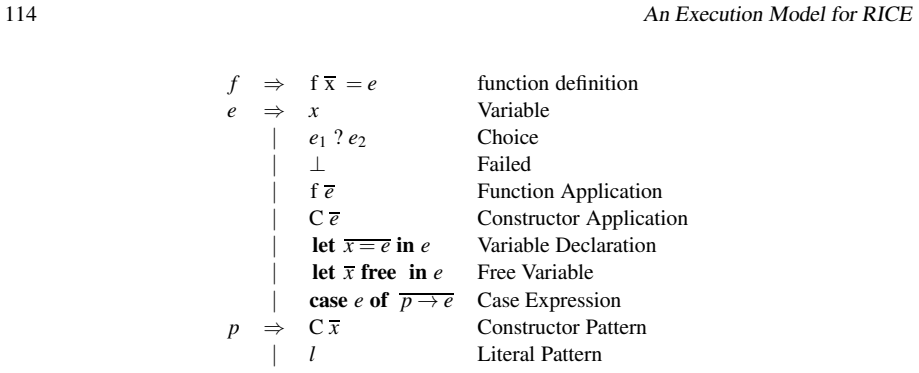
Summary. The paper presents an execution model for the RICE Curry compiler. It defines a restricted FlatCurry syntax organized into blocks, statements, and expressions; represents the heap as a directed graph with nodes for failure, choice, free variables, forwarding, and partial applications; and gives a deterministic operational semantics with an explicit backtracking stack. It then sketches a correspondence between the semantics and generated C code and compares the model to Albert et al.'s natural semantics for Curry. The concluding claim is that for terminating programs, any value derivable in the natural semantics is eventually produced by the RICE execution model.
Significance. The paper addresses a real need: a precise, implementation-level semantics for a Curry compiler based on backtracking rather than pull-tabbing. The graph representation, the backtracking stack, and the explicit case and apply rules in Sections 5-6 are concrete, and the example in Section 7 usefully connects the semantics to RICE's generated C code. If the correctness claim were established, this would be a valuable foundation for reasoning about RICE and its optimizations. As it stands, however, the correctness argument is incomplete: Theorem 2 establishes only a one-way soundness statement for a restricted first-order fragment, and the advertised equivalence/completeness claim in Section 8 is not proved. The paper therefore currently contributes a detailed execution model with an incomplete conformance argument.
major comments (4)
- [§8 (final paragraph)] The final sentence claims that if a terminating expression e evaluates to a value v in the natural semantics, then e will eventually evaluate to v in the RICE semantics. This is a completeness claim, but Theorem 2 proves the opposite implication: it shows that if the RICE semantics evaluates to a constructor or literal v, then the natural semantics can also produce v. Neither Theorem 1 nor Theorem 2 shows that every natural-semantics derivation is reachable by the left-to-right backtracking search; Theorem 1 only says that a completed evaluation can be undone, not that all answers are eventually found. The closing correctness claim is therefore unsupported by the preceding results.
- [§8, first paragraph and Figure 7 (Norm-Choice)] The paper admits: 'Because we are not using a fair evaluation strategy, there will be answers that we may not produce in a finite amount of time.' Together with the left-to-right commitment in (Norm-Choice), (Case-Choice), and (Apply-Choice), this directly conflicts with the final claim unless 'terminating expression' is defined to mean that every branch of the search tree terminates. Under the usual reading of 'terminating' as 'has a value in the natural semantics', an expression whose left branch diverges while a right branch yields v is a counterexample. The paper must either define the restricted class and prove that the backtracking search is complete for it, or remove the completeness claim.
- [§8, Theorem 2] Theorem 2 is stated for the head-normal-form relation ⇓, not for the normal-form relation ⇓N used in the paper's final correctness statement. The proof also assumes that 'all expressions are first order and all applications are fully applied', and the author notes that the natural semantics is not formulated for higher-order expressions. However, the execution model includes apply rules, PART nodes, and higher-order behavior (Figures 5 and 10), and the final claim is stated without restriction. Consequently, conformance for higher-order and partial applications, which is a substantial part of the model's novelty, is not established, and the normal-form evaluation rules such as (Norm-Con) and (Norm-Choice) are not covered by the theorem.
- [§8, Figure 13] The proof says 'The full mapping can be found in Figure 13', but the figure omits several rules used by the execution model: (Case-Con), (Case-ConFree), (Case-Lit), and all apply rules. The text's remarks that the missing cases are 'identical' or 'straightforward' do not supply the required derivations. Since Theorem 2 is the only result connecting the RICE semantics to the natural semantics, the correspondence argument is incomplete as written.
minor comments (3)
- [§2, §7, references] There are several typos and formatting slips, including 'returen' in Section 2, 'Avalible' in reference [23], and 'srutinee'/'scrutinee' in Figure 12; the URL for reference [1] also appears malformed. A copyedit would improve readability.
- [§5 and rules (Fun), (Case-Fun)] The graph notation is not entirely consistent: Figure 5 writes f(g) and C(g) with g a graph, while rules such as (Fun) write f(y) with y a variable; clarifying whether arguments are graph nodes or variable references would prevent confusion when reading the apply rules.
- [§3 and Figures 2, 9] The status of literals is unclear: Section 3 says literals and primitive operations are outside the paper's scope, yet literals appear throughout the syntax and in rules such as (Case-Lit) and (Case-LitFree), and the recalled natural semantics in Figure 2 does not include literal patterns. The paper should state exactly which fragment is being treated.
Circularity Check
No significant circularity: the conformance argument is anchored to the independent natural semantics of Albert et al.; self-citations are not load-bearing.
full rationale
The derivation is not circular. The execution model's rules (Figures 7–10) are defined independently and then related to the natural semantics of Albert et al. [2] via the correspondence mapping in Figure 13; the target semantics is an external, published semantics, not a re-statement of the RICE model. Self-citations to [23] support performance and implementation claims only (e.g., the choice of backtracking over pull-tabbing), and they do not carry the conformance proof. No fitted parameters, self-referential definitions, or uniqueness arguments imported from the author's prior work appear in the derivation. The one notable issue is a correctness gap, not a circular one: the final sentence of Section 8 claims 'If we have a terminating expression e, and e evaluates to a value v in the natural semantics, then it will eventually evaluate to v in our semantics,' which is a completeness statement. However, Theorem 2 proves only the soundness direction and does so under the stated restriction that 'all expressions are first order and all applications are fully applied.' The paper itself concedes earlier in Section 8 that 'there will be answers that we may not produce in a finite amount of time,' and Theorem 1 only shows that backtracking can restore the earlier graph, not that every natural-semantics answer is eventually reached. This hidden scope restriction and the missing completeness proof are correctness risks, but they do not make the derivation circular: the conclusion is not assumed as a premise, it is simply not established by the stated theorems.
Assumptions & free parameters
assumptions (4)
- domain assumption The natural semantics of Curry given by Albert et al. is the correct reference semantics.
- domain assumption Restricted FlatCurry transformations (trivial arguments, one case per function, early lets) preserve Curry semantics.
- ad hoc to paper A graph G can be paired with a heap Gamma in the natural semantics, and forwarding nodes can be contracted without changing meanings.
- ad hoc to paper For terminating programs, the leftmost backtracking strategy is complete.
invented entities (2)
-
Forwarding node *(g)
-
PART node (partial application)
Cite this review
Pith. "Pith review of An Execution Model for RICE." pith.science (2026). https://pith.science/paper/ZVVA6Z6J
@misc{pith2026250605839,
  author       = {Pith},
  title        = {Pith review of: An Execution Model for RICE},
  year         = {2026},
  howpublished = {\url{https://pith.science/paper/ZVVA6Z6J}},
  note         = {Machine review of arXiv:2506.05839}
}
read the original abstract
In this paper, we build on the previous work of the RICE compiler by giving its execution model. We show the restrictions to the FlatCurry language that were made to produce executable code, and present the execution model using operational semantics similar to Launchbury. Finally, we show that the execution model conforms with the standard operational semantics for Curry.
Figures


Figures from the paper (10 more)



Reference graph
Works this paper leans on
- [1]
-
[2]
E. Albert, M. Hanus, F. Huch, J. Oliver & G. Vidal (2005): Operational semantics for declarative multi- paradigm languages. Journal of Symbolic Computation 40(1), pp. 795–829, doi:10.1016/j.jsc.2004.01.001
-
[3]
Antoy (1992): Definitional Trees
S. Antoy (1992): Definitional Trees . In H. Kirchner & G. Levi, editors: Algebraic and Logic Program- ming, Third International Conference, V olterra, Italy, Se ptember 2-4, 1992, Proceedings , Lecture Notes in Computer Science 632, Springer, pp. 143–157, doi:10.1007/BFB0013825
-
[4]
Antoy (1997): Optimal Non-deterministic Functional Logic Computations
S. Antoy (1997): Optimal Non-deterministic Functional Logic Computations . In M. Hanus, J. Heering & K. Meinke, editors: Algebraic and Logic Programming, 6th International Joint C onference, ALP ’97 - HOA ’97, Southampton, UK, September 3-5, 1997, Proceedings , Lecture Notes in Computer Science 1298, Springer, pp. 16–30, doi:10.1007/BFB0027000
- [5]
-
[6]
S. Antoy, M. Hanus, A. Jost & S. Libby (2019): ICurry 12057, pp. 286–307. doi:10.1007/978-3-030-46714-2_18
-
[7]
S. Antoy & A. Jost (2016): A New Functional-Logic Compiler for Curry: Sprite 10184, pp. 97–113. doi:10.1007/978-3-319-63139-4_6
-
[8]
A. W . Appel (2006): Compiling with Continuations (corr . version). Cambridge University Press
work page 2006
Show all 28 references
-
[9]
Augustsson, J
L. Augustsson, J. Breitner, K. Claessen, R. Jhala, S. Pey ton Jones, O. Shivers, G. L. Steele Jr. & T. Sweeney (2023): The V erse Calculus: A Core Calculus for Deterministic Functional Logic Programming. Proceedings of the ACM on Programming Languages 7(ICFP), pp. 417–447, doi...
2023 doi
-
[10]
J. Böhm, M. Hanus & F. Teegen (2021): From Non-determinism to Goroutines: A Fair Implementation of Curry in Go . In N.ò V eltri, N. Benton & S. Ghilezan, editors: PPDP 2021: 23rd International Symposium on Principles and Practice of Declarative Programming, Tal linn, Estonia, ...
2021
-
[11]
Braßel (2010): Implementing Functional Logic Programs by Translation int o Purely Functional Programs
B. Braßel (2010): Implementing Functional Logic Programs by Translation int o Purely Functional Programs . Ph.D. thesis, University of Kiel. Available at http://eldiss.uni-kiel.de/macau/receive/dissertatio n_diss_00007056
2010
-
[12]
Braßel, M
B. Braßel, M. Hanus, B. Peemöller & F. Reck (2011): KiCS2: A New Compiler from Curry to Haskell . In: H. Kuchen, editor: Functional and Constraint Logic Programming, 20th Interna tional Workshop, WFLP 2011, Odense, Denmark, July 19, 2011, Proceedings , Lecture Notes in Compute...
2011 doi
-
[13]
Echahed & J
R. Echahed & J. C. Janodet (1997): On constructor-based graph rewriting systems . Technical Report 985-I, IMAG. Available at ftp://ftp.imag.fr/pub/labo-LEIBNIZ/ OLD-archives/PMP/c-graph-rewriting.ps.gz
1997
-
[14]
Hanus (ed.) (March 04, 2017): PAKCS 1.14.3: The Portland Aachen Kiel Curry System
M. Hanus (ed.) (March 04, 2017): PAKCS 1.14.3: The Portland Aachen Kiel Curry System . Available at http://www.informatik.uni-kiel.de/~pakcs
2017
-
[15]
Flanagan, A
C. Flanagan, A. Sabry, B. F. Duba & M. Felleisen (1993): The Essence of Compiling with Continuations . In R. Cartwright, editor: Proceedings of the ACM SIGPLAN’93 Conference on Programmin g Language Design and Implementation (PLDI), Albuquerque, New Mexico , USA, June 23-25, 1...
1993
-
[16]
Hanus (2013): Functional Logic Programming: From Theory to Curry , pp
M. Hanus (2013): Functional Logic Programming: From Theory to Curry , pp. 123–168. Lecture Notes in Computer Science 7797, Springer, doi:10.1007/978-3-642-37651-1_6
2013 doi
-
[17]
Hußmann (1988): Nondeterministic Algebraic Specifications and Nonconfluen t T erm Rewriting
H. Hußmann (1988): Nondeterministic Algebraic Specifications and Nonconfluen t T erm Rewriting . In J. Grabowski, P . Lescanne & W . Wechler, editors: Algebraic and Logic Programming, International Work- S. Libby 129 shop, Gaussig, GDR, November 14-18, 1988, Proceedings , Lectur...
1988 doi
-
[18]
Johnsson (1985): Lambda Lifting: Treansforming Programs to Recursive Equat ions
T. Johnsson (1985): Lambda Lifting: Treansforming Programs to Recursive Equat ions. In J. Jouan- naud, editor: Functional Programming Languages and Computer Architectu re, FPCA 1985, Nancy, France, September 16-19, 1985, Proceedings , Lecture Notes in Computer Science 201, Spr...
1985 doi
-
[19]
S. L. Peyton Jones (1987): The Implementation of Functional Programming Languages . Prentice-Hall, Inc., Upper Saddle River, NJ, USA
1987
-
[20]
S. L. Peyton Jones & J. Salkild (1989): The Spineless T agless G-Machine. In J. E. Stoy, editor: Proceedings of the fourth international conference on Functional program ming languages and computer architecture, FPCA 1989, London, UK, September 11-13, 1989 , ACM, pp. 184–201, ...
1989
-
[21]
Launchbury (1993): A Natural Semantics for Lazy Evaluation
J. Launchbury (1993): A Natural Semantics for Lazy Evaluation . In: Proceedings of the 20th ACM SIGPLAN-SIGACT Symposium on Principles of Programming Languages, POPL ’93, Association for Com- puting Machinery, New Y ork, NY , USA, p. 144–154, doi:10.1145/158511.158618
1993
-
[22]
Libby (2023): RICE: An Optimizing Curry Compiler
S. Libby (2023): RICE: An Optimizing Curry Compiler . In M. Hanus & D. Inclezan, editors: Prac- tical Aspects of Declarative Languages - 25th Internationa l Symposium, P ADL 2023, Boston, MA, USA, January 16-17, 2023, Proceedings , Lecture Notes in Computer Science 13880, Spri...
2023 doi
-
[23]
Libby (June 21, 2022): Making Curry with Rice: An Optimizing Curry Compiler
S. Libby (June 21, 2022): Making Curry with Rice: An Optimizing Curry Compiler . Ph.D. thesis, Portland State University, doi:10.15760/etd.7964. Avalible at htt ps://github.com/slibby05/rice
2022 doi
-
[24]
W . Lux & H. Kuchen (1999): An Efficient Abstract Machine for Curry . In K. Beiersdörfer, G. En- gels & W . Schäfer, editors: Informatik ’99 - Informatik überwindet Grenzen, 29. Jahres tagung der Gesellschaft für Informatik, Paderborn, 5.-9. Oktober 199 9, Informatik Aktuell, S...
1999 doi
-
[25]
Marlow & S
S. Marlow & S. L. Peyton Jones (2004): Making a fast curry: push/enter vs. eval/apply for higher-o rder languages. In C. Okasaki & K. Fisher, editors: Proceedings of the Ninth ACM SIGPLAN International Conference on Functional Programming, ICFP 2004, Snow Bird , UT, USA, Septe...
2004
-
[26]
Mayr & T
R. Mayr & T. Nipkow (1998): Higher-Order Rewrite Systems and Their Confluence . Theoretical Computer Science 192(1), pp. 3–29, doi:10.1016/S0304-3975(97)00143-6
1998 doi
-
[27]
Mehner, D
S. Mehner, D. Seidel, L. Straßburger & J. V oigtländer (2 014): Parametricity and Proving Free Theorems for Functional-Logic Languages. In O. Chitil, A. King & O. Danvy, editors: Proceedings of the 16th International Symposium on Principles and Practice of Declarative Progra m...
2014
-
[28]
J. C. González Moreno, M. T. Hortalá-González, F. J. Lóp ez-Fraguas & M. Rodríguez-Artalejo (1996): A Rewriting Logic for Declarative Programming . In H. R. Nielson, editor: Programming Languages and Sys- tems - ESOP’96, 6th European Symposium on Programming, Link öping, Swede...
1996 doi
Reviewed August 7, 2026 · model on record in the stance chip above.
Discussion (0). Sign in to comment.