REVIEW 4 major objections 6 minor 25 references
A Chimera method for high-fidelity simulation of turbulent flows
T0 review · 4 major / 6 minor · reviewed 2026-08-07 · deepseek-v4-flash
Pith's one-line read An overlapping-mesh (Chimera) solver that combines a dissipation-free central discretization with selective filtering and sponge-forced interpolation can carry out direct numerical simulation of turbulence in complex geometries, validated…
desk verdict Solid overset-grid solver with a real accuracy gap in the hole-cell forcing; the fourth-order vortex result and the forcing analysis as written are not obviously consistent. read the letter →
The pith
A machine-rendered reading of the paper's core claim, the machinery that carries it, and where it could break.
The reading
What carries the argument
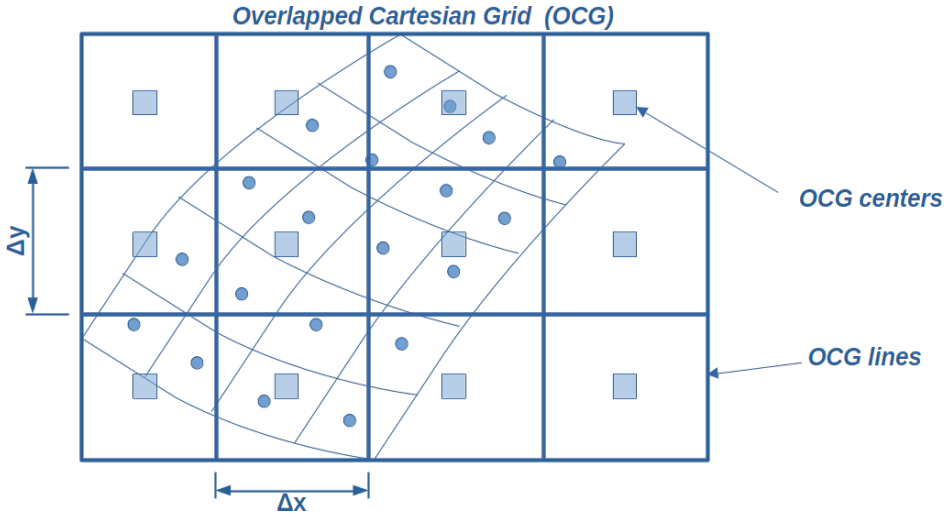
The central objects are the components that let two meshes touch without polluting the flow. (i) A split-form, centrally discretized convective operator in strong conservation form preserves discrete kinetic energy and is the reason the baseline scheme needs no numerical dissipation. (ii) A metric-tensor evaluation, built from a three-dimensional generalization of a free-stream-preserving construction and completed on Chimera faces by linear ghost-point extrapolation, makes the discrete equations satisfy the identity that a uniform flow remains exactly uniform even across blocks. (iii) A selective artificial-dissipation flux, scaled by an oscillation indicator $\varphi$ that is essentially nonzero only where high-order divided differences flip sign, damps saw-tooth modes while keeping the leading error at or above the design order, so the nominal order $2L$ of the central scheme is retained. (iv) A donor-search pipeline — axis-aligned bounding boxes, an overlapped Cartesian grid for quick candidate lookup, a local walk in covariant coordinates, and a size criterion that protects near-wall cells — finds for each hole cell the donor of closest size. (v) A forcing (sponge) term at hole cells exponentially relaxes the solution to the interpolated value with time constant $\delta$, the minimum of the time step and the flow-crossing times of the three mesh spacings, suppressing spurious waves between blocks of very different resolution without deleting cells from the data structure. The fourth-order block-to-block interpolation transfers solution values; the paper's uniform-accuracy claim rests on all five components acting together.
What would settle it
Run the vortex-advection benchmark on overlapping meshes with the overlap region shrunk to the minimum interpolation stencil, and simultaneously run the pipe DNS at a higher Reynolds number (for instance $\mathrm{Re}_b \approx 40\,000$, where reference DNS exist) while doubling $K$: if the measured convergence order drops below four or the mean-velocity and variance profiles develop localized deviations inside the overlap region, the uniform-accuracy and minimal-diffusion claims fail at practical margins.
Extended reading notes
Core claim
The paper claims that an overlapping-mesh solver can deliver DNS-grade turbulence data without the accuracy loss that has historically plagued non-conforming mesh interfaces. The solver combines a kinetic-energy-preserving split-form central discretization with a selective high-order filter that activates only where an oscillation indicator detects saw-tooth modes, and couples blocks through fourth-order interpolation augmented by a forcing term that relaxes hole cells toward their interpolated values on a short time scale. On the homentropic-vortex benchmark the scheme attains its nominal fourth-order convergence rate on rotated Cartesian and distorted curvilinear overlapping meshes; in the pipe DNS at $\mathrm{Re}_b = 5300$ the mean velocity and variance profiles coincide with reference cylindrical-coordinate results, and velocity and vorticity contours cross the overlap region without visible jumps or wiggles; in the propeller DES the computed thrust and torque coefficients match the experimental values and the tip vortex persists over a long downstream distance. On this basis the authors assert that this is, to their knowledge, the first successful validation of turbulent-flow DNS with an overlapping-mesh solver, and that the method opens the door to DNS, LES, and DES in complex and moving geometries.
Load-bearing premise
The load-bearing premise is that the hole-cell forcing term, with its heuristic constants ($\kappa = 0.1$, $K$ between 1 and 10), neither degrades the formal order of accuracy nor adds effective diffusion that contaminates turbulence near overlap boundaries; the supporting evidence is one two-dimensional vortex convergence test and one low-Reynolds-number pipe DNS.
Editorial extensions
If this is right
- Block overlap and non-conforming interfaces do not by themselves reduce accuracy: the vortex benchmark shows the nominal fourth order on both rotated Cartesian and distorted curvilinear overlapping meshes.
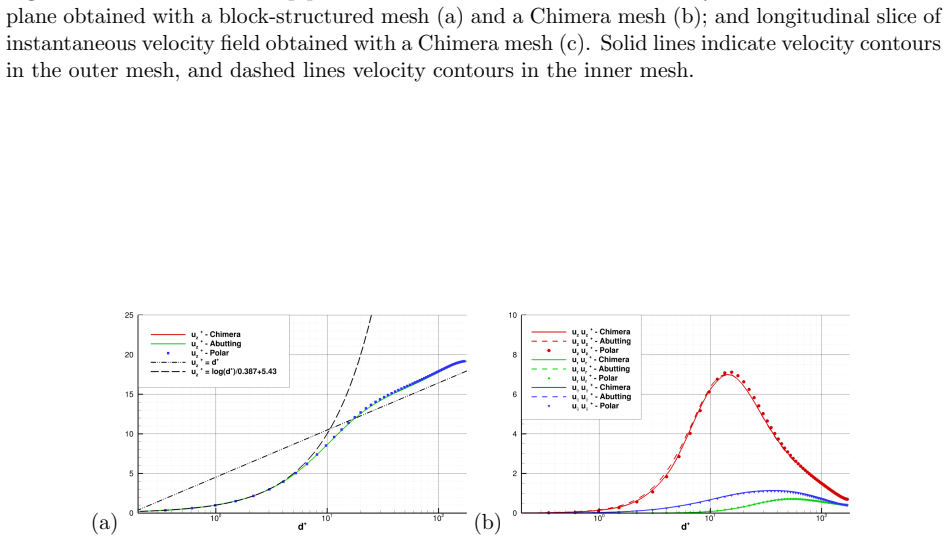
- Pipe-flow DNS at $\mathrm{Re}_b = 5300$ yields mean velocity and variance profiles that match cylindrical-coordinate reference DNS, with no localized spurious bumps in the overlap region.
- Vorticity contours cross the overlap boundary without jumps or wiggles, so the coupling does not visibly act as a numerical low-pass filter on small scales.
- The propeller detached-eddy simulation reproduces experimental thrust and torque and keeps the tip vortex coherent far downstream because numerical diffusion is near zero.
- The same machinery supports DNS, LES, and DES with independently generated blocks, simplifying meshing of complex and moving geometries.
Reading between the lines
- The paper calibrates the free constants ($\kappa = 0.1$, $K$ between 1 and 10) on a small set of tests; a systematic sweep of $K$ and of overlap width in the pipe flow at higher Reynolds number would map where the sponge term starts to act as an effective eddy viscosity.
- The accuracy ordering of the dissipation suggests the same design can be pushed to sixth order or higher by increasing $L$, provided the metric and interpolation formulas are raised in step; nothing in the analysis limits $L$ to two.
- Because the hole-cell forcing term is the same mechanism used in immersed-boundary methods, Chimera blocks could in principle couple structured DNS blocks with immersed-boundary wall treatment, unifying two mesh strategies that are usually kept separate.
- The long-range persistence of the propeller tip vortex implies the method's minimal diffusion could also benefit aeroelastic or acoustic studies that depend on vortex-structure coherence, not only statistical turbulence quantities.
Editorial analysis
A structured set of objections, weighed in public.
Referee Report
Summary. The paper develops a block-structured Chimera solver for high-fidelity turbulent flow simulation. The method uses a dissipation-free central discretization with selective high-order artificial dissipation, a metric-tensor treatment that preserves uniform free-stream flow, efficient hole-cutting and donor-search algorithms, and a sponge-like forcing term at hole cells instead of removing them from the discrete stencil. Validation is reported for advection of a homentropic vortex on overlapping Cartesian and curvilinear meshes, for DNS of turbulent pipe flow at Reb=5300 compared with reference data, and for a DES of flow past the INSEAN E779A propeller compared with experiments. The central claims are that the method preserves uniform nominal accuracy across distorted overlapping meshes and that the pipe computation represents the first successful validation of DNS with an overlapping-mesh solver.
Significance. If fully established, the method would be a practically useful high-accuracy overset approach for complex-geometry turbulence, combining minimal numerical diffusion with smooth block-to-block coupling. The manuscript has genuine strengths: the metric-tensor construction in Appendix A gives an explicit, non-circular derivation of free-stream preservation; the vortex tests show fourth-order convergence on both Cartesian and curvilinear overlapping meshes; the validation targets are external (analytical vortex, published pipe DNS, experimental propeller data); and the fine-grid propeller coefficients agree well with experiment. The heuristic constants (kappa=0.1 and K of order 1-10) are not fitted to those targets, so there is no obvious circularity. However, the load-bearing accuracy and minimal-diffusion claims rest on the hole-cell forcing term whose truncation error is not analyzed, and the 'first DNS on overlapping meshes' claim rests on a single low-Reynolds-number case with only visual comparison of statistics. The significance is therefore conditional on closing those gaps.
major comments (4)
- [Section 2.6 and Section 3.1] The hole-cell forcing term (K/delta_n)(q_n - qhat_n) is introduced without any truncation-error analysis, and the value of K is never reported for any of the runs. For finite K, the relaxed state lags the interpolated value by approximately (delta_n/K) dqhat/dt. With delta_n approximately Delta t and explicit time stepping where Delta t is proportional to h, this lag is O(h/K) at hole cells, which is first-order and would contradict the claimed uniform fourth-order accuracy unless K is effectively large or the forcing is inactive in the vortex test; neither case is documented. Because hole cells are not removed from the stencil, this boundary-data error can enter the fluxes seen by neighboring active cells. The authors should either analyze the forcing error and report K for each simulation, or blank the hole cells so that the interpolation error is genuinely confined to the interpolation order.
- [Abstract and Section 4] The abstract states that the method 'guarantees a uniform order of accuracy even for distorted, overlapping meshes,' but the only accuracy study is the two-dimensional vortex advection at low Mach number. That test uses the inviscid Euler equations, a passive vortex, and periodic background boundaries; it does not exercise the viscous terms, the implicit time integration, or the forcing term in a turbulent-flow setting. The pipe DNS is globally second-order because of the viscous and time discretizations, so the uniform fourth-order claim cannot be inferred from the turbulent validation either. The claim should be restricted to the model problem actually tested, or additional accuracy studies of the full Navier-Stokes system with the Chimera coupling should be provided.
- [Section 3.2 and Section 4] The conclusion that this is 'the first successful validation of DNS for turbulent flows using an overlapping mesh solver' is not supported by the evidence presented. The pipe test is at a single Reynolds number (Re_b=5300), uses only mean velocity and velocity variance profiles for comparison, provides no quantitative error norms, no grid-convergence study of turbulence statistics, no wall-shear or Reynolds-stress budgets, and no discussion of the location or thickness of the overlap region relative to the statistics. These are exactly the quantities needed to establish that the hole-cell forcing and interpolation do not contaminate the turbulence. The authors should either add a quantitative validation with grid refinement and additional statistics, or substantially soften the first-DNS claim.
- [Section 3.3] The propeller study is presented as evidence that the algorithm preserves tip vortices due to 'near absence of numerical dissipation,' but the support is qualitative. Only two grid levels are shown, with no Richardson extrapolation or uncertainty estimate, and the medium-grid KQ differs from experiment by about 10.8% although the fine-grid value is close. The persistence of the tip vortex is evaluated by visual inspection of the lambda_2 criterion, not by quantitative measures such as circulation or vortex-core profiles. This does not invalidate the engineering results, but it cannot carry the claim of minimal numerical diffusion in a three-dimensional turbulent wake.
minor comments (6)
- [Section 1] The phrase 'several spitting of the convective terms' should read 'several splittings of the convective terms.'
- [Section 2.2] The reference to 'equation (2)' at the start of the section should be to equation (1), since equation (2) defines the state and flux vectors.
- [Section 2.6] The forcing equation is displayed without an equation number and without a label; the text later refers to 'equation (2.6)', which is inconsistent with the numbering style used elsewhere in the manuscript.
- [Section 3.2] The text says the simulations were advanced 'for approximately one hundred flow-through times to ensure robust statistical sampling,' but no convergence history or statistical-error estimate for the mean and variance profiles is shown.
- [Figure 15] The left part of Figure 15 is a table of thrust and torque coefficients, but it is presented as a figure; consider placing the coefficient comparison in a table and keeping the vortex visualization as the figure.
- [Section 3.1] Minor typos include 'passively advection' (should be 'passively advected') and the undefined use of 'L/Delta' for mesh resolution in the text; define L and Delta explicitly.
Circularity Check
No significant circularity: the Chimera solver's accuracy and validation claims are benchmarked against external analytical, experimental, and independent reference data, and the self-citations are background methodology rather than load-bearing inputs.
full rationale
The paper's central claims—uniform high-order accuracy, minimal diffusion, and successful DNS on overlapping meshes—are supported by tests whose targets are not defined by the solver itself. The homentropic vortex test in Section 3.1 has an exact analytical solution, and the measured L2 error convergence to fourth order on both Cartesian and curvilinear overlapping meshes is an external benchmark. The pipe DNS in Section 3.2 is compared with prior cylindrical-coordinate DNS data (Pirozzoli et al., 2021; Pirozzoli, 2024), and the propeller case in Section 3.3 is compared with experimental thrust, torque, and wake observations (Felli et al., 2011). The Section 2.6 forcing term is an explicit design element—hole-cell values are relaxed toward interpolated values—rather than a fitted parameter renamed as a prediction, and no reported statistic is defined in terms of the solver's own output. Self-citations to Pirozzoli (2011) and Di Mascio et al. supply the baseline discretization and solver infrastructure, but they are not invoked as uniqueness theorems or as substitutes for the present benchmarks. The skeptic's concern about the unanalyzed truncation error of the K/δ_n forcing term is a correctness risk, not circularity, because no derived quantity reduces by construction to an input of the method.
Assumptions & free parameters
free parameters (2)
- kappa (artificial dissipation coefficient) =
0.1
- K (sponge forcing gain) =
O(1) to O(10), not specified per test
assumptions (5)
- domain assumption The coordinate transformation x_k(xi_j) is locally invertible and sufficiently smooth.
- standard math The split-form central discretization due to Pirozzoli (2011) is stable in curvilinear coordinates.
- domain assumption Fourth-order Chimera interpolation across overlapping blocks does not degrade the formal accuracy of the scheme.
- domain assumption Linear extrapolation of ghost-cell position vectors at Chimera faces preserves the discrete uniform-flow identity.
- ad hoc to paper The forcing term K/delta (q - qhat) damps spurious waves without contaminating turbulent statistics.
Cite this review
Pith. "Pith review of A Chimera method for high-fidelity simulation of turbulent flows." pith.science (2026). https://pith.science/paper/V4UIXCZA
@misc{pith2026250605914,
  author       = {Pith},
  title        = {Pith review of: A Chimera method for high-fidelity simulation of turbulent flows},
  year         = {2026},
  howpublished = {\url{https://pith.science/paper/V4UIXCZA}},
  note         = {Machine review of arXiv:2506.05914}
}
read the original abstract
We develop a block-structured solver for high-fidelity simulation of flows in complex geometries, based on overlapping (Chimera) meshes. The key components of the algorithm are a baseline dissipation-free central discretization and selective high-order filtering, which ensure uniform accuracy and minimal numerical diffusion. These favorable properties are preserved through efficient interpolation across overlapping blocks. Numerical tests demonstrate that the method guarantees a uniform order of accuracy even for distorted, overlapping meshes. Tests conducted for turbulent flow in a pipe show no significant issues at the interfaces or overlapping blocks, highlighting the method's potential for direct numerical simulation (DNS). Finally, we show that the method performs satisfactorily for geometrically complex problems, such as flow past a ship propeller, where it accurately replicates experimental data.
Figures


Figures from the paper (14 more)




Reference graph
Works this paper leans on
-
[1]
write newline
" write newline "" before.all 'output.state := FUNCTION n.dashify 't := "" t empty not t #1 #1 substring "-" = t #1 #2 substring "--" = not "--" * t #2 global.max substring 't := t #1 #1 substring "-" = "-" * t #2 global.max substring 't := while if t #1 #1 substring * t #2 global.max substring 't := if while FUNCTION word.in bbl.in ":" * " " * FUNCTION f...
-
[2]
author S. Orszag , author G. Patterson , title Numerical simulation of three-dimensional homogeneous isotropic turbulence , journal Phys. Rev. Lett. volume 28 ( year 1972 ) pages 76
work page 1972
-
[3]
author J. Kim , author P. Moin , author R. Moser , title Turbulence statistics in fully developed channel flow at low Reynolds number , journal J. Fluid Mech. volume 177 ( year 1987 ) pages 133--166
work page 1987
-
[4]
author S. Pirozzoli , title On the streamwise velocity variance in the near-wall region of turbulent flows , journal J. Fluid Mech. volume 989 ( year 2024 ) pages A5
work page 2024
-
[5]
author S. Hosseini , author R. Vinuesa , author P. Schlatter , author A. Hanifi , author D. Henningson , title Direct numerical simulation of the flow around a wing section at moderate R eynolds number , journal Int. J. Heat Fluid Flow volume 61 ( year 2016 ) pages 117--128
work page 2016
-
[6]
author J. Benek , author J. Steger , author F. Dougherty , title A flexible grid embedding technique with application to the euler equations , in: booktitle 6th computational fluid dynamics conference Danvers , p. pages 1944
work page 1944
-
[7]
author H. Pomin , author S. Wagner , title Navier- S tokes analysis of helicopter rotor aerodynamics in hover and forward flight , journal J. Aircraft volume 39 ( year 2002 ) pages 813--821
work page 2002
-
[8]
author A. Kravchenko , author P. Moin , author R. Moser , title Zonal embedded grids for numerical simulations of wall-bounded turbulent flows , journal J. Comput. Phys. volume 127 ( year 1996 ) pages 412--423
work page 1996
Show all 25 references
-
[9]
Vinokur , title Conservation equations of gasdynamics in curvilinear coordinate systems , journal J.\ Comput.\ Phys
author M. Vinokur , title Conservation equations of gasdynamics in curvilinear coordinate systems , journal J.\ Comput.\ Phys. volume 14 ( year 1974 ) pages 105--125
1974
-
[10]
author S. Pirozzoli , title Stabilized non-dissipative approximations of euler equations in generalized curvilinear coordinates , journal Journal of Computational Physics volume 230 ( year 2011 ) pages 2997--3014
2011
-
[11]
Di Mascio , author G
author A. Di Mascio , author G. Dubbioso , author R. Muscari , title Vortex structures in the wake of a marine propeller operating close to a free surface , journal Journal of Fluid Mechanics volume 949 ( year 2022 ) pages A33
2022
-
[12]
experiments
author L. Verlet , title Computer "experiments" on classical fluids. I . T hermodynamical properties of L ennard- J ones molecules , journal Physical Review volume 159 ( year 1967 ) pages 98
1967
-
[13]
Verzicco , title Immersed boundary methods: Historical perspective and future outlook , journal Annual Review of Fluid Mechanics volume 55 ( year 2023 ) pages 129--155
author R. Verzicco , title Immersed boundary methods: Historical perspective and future outlook , journal Annual Review of Fluid Mechanics volume 55 ( year 2023 ) pages 129--155
2023
-
[14]
Eggels , author F
author J. Eggels , author F. Unger , author M. Weiss , author J. Westerweel , author R. Adrian , author R. Friedrich , author F. Nieuwstadt , title Fully developed turbulent pipe flow: a comparison between direct numerical simulation and experiment , journal J. Fluid Mech. vol...
1994
-
[15]
Pirozzoli , author J
author S. Pirozzoli , author J. Romero , author M. Fatica , author R. Verzicco , author P. Orlandi , title One-point statistics for turbulent pipe flow up to R e _ 6000 , journal J. Fluid Mech. volume 926 ( year 2021 ) pages A28
2021
-
[16]
Di Mascio , author R
author A. Di Mascio , author R. Muscari , author G. Dubbioso , title On the wake dynamics of a propeller operating in drift , journal Journal of fluid mechanics volume 754 ( year 2014 ) pages 263--307
2014
-
[17]
Muscari , author G
author R. Muscari , author G. Dubbioso , author A. Di Mascio , title Analysis of the flow field around a rudder in the wake of a simplified marine propeller , journal Journal of fluid mechanics volume 814 ( year 2017 ) pages 547--569
2017
-
[18]
Magionesi , author G
author F. Magionesi , author G. Dubbioso , author R. Muscari , author A. Di Mascio , title Modal analysis of the wake past a marine propeller , journal Journal of Fluid Mechanics volume 855 ( year 2018 ) pages 469--502
2018
-
[19]
Moin , author J
author P. Moin , author J. Kim , title The structure of the vorticity field in turbulent channel flow. part 1. analysis of instantaneous fields and statistical correlations , journal J. Fluid Mech. volume 155 ( year 1985 ) pages 441--464
1985
-
[20]
Felli , author R
author M. Felli , author R. Camussi , author F. Di Felice , title Mechanisms of evolution of the propeller wake in the transition and far fields , journal Journal of Fluid Mechanics volume 682 ( year 2011 ) pages 5--53
2011
-
[21]
Muscari , author A
author R. Muscari , author A. Di Mascio , author R. Verzicco , title Modeling of vortex dynamics in the wake of a marine propeller , journal Computers & Fluids volume 73 ( year 2013 ) pages 65--79
2013
-
[22]
Spalart , author W
author P. Spalart , author W. Jou , author M. Strelets , author S. Allmaras , title Comments on the feasibility of les for wings, and on a hybrid rans/les approach. 1st afosr int , in: booktitle Symp. Eng. Turb. Modelling and Measurements, May , pp. pages 24--26
-
[23]
Jeong , author F
author J. Jeong , author F. Hussain , title On the identification of a vortex , journal Journal of fluid mechanics volume 285 ( year 1995 ) pages 69--94
1995
-
[24]
author M. R. Visbal , author D. V. Gaitonde , title On the use of higher-order finite-difference schemes on curvilinear and deforming meshes , journal J.\ Comput.\ Phys. volume 181 ( year 2002 ) pages 155--185
2002
-
[25]
Sj \"o green , author H
author B. Sj \"o green , author H. C. Yee , author M. Vinokur , title On high order finite-difference metric discretizations satisfying gcl on moving and deforming grids , journal Journal of Computational Physics volume 265 ( year 2014 ) pages 211--220
2014
Reviewed August 7, 2026 · model on record in the stance chip above.
Discussion (0). Sign in to comment.