REVIEW 3 major objections 3 minor 38 references
Convection Anisotropies of Cosmic Rays in Highly Magnetized Plasma
T0 review · 3 major / 3 minor · reviewed 2026-08-07 · deepseek-v4-flash
Pith's one-line read Parallel diffusion preserves the cosmic-ray anisotropy spectrum's power-law scaling, tying 10 TeV observations to Kolmogorov interstellar turbulence.
desk verdict A natural extension with a credible qualitative conclusion, but Eq. (10) as printed has a normalization error that breaks the derivation of the claimed ℓ^{-γ−1} scaling. read the letter →
The pith
A machine-rendered reading of the paper's core claim, the machinery that carries it, and where it could break.
The reading
What carries the argument
The load-bearing machinery is a spherical-harmonic multipole decomposition of the field-aligned convection term $\mu(\mathbf{B}/B)\cdot\Delta u$, whose angular coupling is governed by Wigner 3j selection rules that allow only neighboring multipoles $\ell' = |\ell\pm 1|$ to correlate. The turbulence statistics enter through spherical-Bessel integrals $J^{(n)}_{LL'}(k\lambda)$ over the omnidirectional spectrum, evaluated by hypergeometric-function identities and then asymptotically in the large-$L$ limit. The key asymptotic relation $\mathbf{B}\mathbf{B}:c_Lc_L = -(1+2/\gamma)\,\mathbf{B}\mathbf{B}:c_Lc_{L+2}$ converts a power-law spectrum $w(k)\propto k^{-\gamma}$ into the diagonal scaling $\overline{C_\ell}\propto\ell^{-\gamma-1}$.
What would settle it
Measure the cosmic-ray angular power spectrum near 10 TeV to multipoles $\ell\gtrsim 50$; a logarithmic slope of $\overline{C_\ell}$ versus $\ell$ that departs from $\gamma+1\simeq 8/3$, or a slope that changes between multipole bands, would refute the claimed diffusion-tensor-independent scaling, and an independent determination of the interstellar turbulence spectral index on 1-20 pc scales that differs from $5/3$ would falsify the Kolmogorov interpretation.
Extended reading notes
Core claim
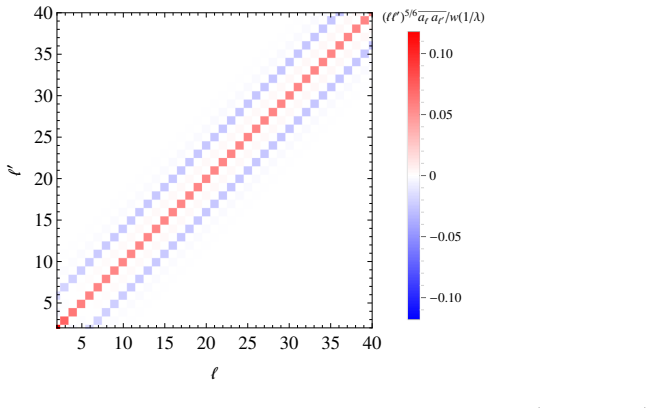
The central discovery is that the multipole scaling of the turbulent-convection anisotropy is robust to whether diffusion is isotropic or confined to field lines. In the strong-field limit, with isotropic pitch-angle scattering and purely parallel transport, the paper derives the two-mode correlation of the spherical-harmonic coefficients from the field-aligned convection term, using the angular-coupling structure of Wigner 3j symbols. The correlation matrix is no longer diagonal, so the anisotropy is statistically anisotropic, but the diagonal part still yields $\overline{C_\ell}\propto\ell^{-\gamma-1}$ in the large-$\ell$ limit, identical to the isotropic-diffusion result. The paper also finds that the parallel-diffusion model concentrates the fluctuation variance toward the field-aligned directions, matching the overall shape of the observed pitch-angle profile for $\ell\ge 2$ anisotropy, and that reproducing the observed spectrum requires a turbulent velocity dispersion of about 50 km/s on 10 pc scales.
Load-bearing premise
The turbulent convection field is taken to be homogeneous and isotropic with a pure power-law omnidirectional spectrum $w(k)\propto k^{-\gamma}$ over the inertial range; if interstellar turbulence on roughly 1-20 pc scales is strongly anisotropic or not a clean power law, the derived scaling $\overline{C_\ell}\propto\ell^{-\gamma-1}$ and the inference of $\gamma=5/3$ from TeV data would not follow.
Editorial extensions
If this is right
- Measured small-scale anisotropy spectra can be read as a direct measurement of the interstellar turbulence spectral index $\gamma$ at pc scales, with no need to model the perpendicular diffusivity.
- The 10 TeV spectrum up to $\ell=30$ is compatible with the Kolmogorov value $\gamma=5/3$; the Kraichnan value $\gamma=3/2$ fits slightly worse.
- Parallel diffusion predicts cylindrical symmetry around the local magnetic field, with fluctuations strongest along the field; this matches the observed $\ell\ge2$ pitch-angle profile in overall shape.
- Because the scalar-spectrum slope is unchanged while its normalization drops relative to isotropic diffusion, the required turbulent velocity dispersion rises to about 50 km/s on 10 pc scales.
Reading between the lines
- If higher-$\ell$ data become available, the clean prediction is that the slope of $\overline{C_\ell}$ should remain $\gamma+1$ across multipole bands; a slope that varies with $\ell$ would indicate the turbulence is not a pure power law on these scales.
- The paper's conclusion that the slope survives more general anisotropic diffusion suggests the anisotropy sky could serve as a turbulence diagnostic even in regions where the magnetic field geometry is poorly known, since only the spectral slope, not the orientation, is needed.
- Adding perpendicular transport would restore the $2\ell$ azimuthal modes that the parallel model lacks, so the ensemble-averaged spectrum should more closely match the observed single-realization spectrum; the paper speculates the slope would be preserved, which could be tested by extending the calculation to a finite perpendicular diffusivity.
Editorial analysis
A structured set of objections, weighed in public.
Referee Report
Summary. This paper extends the turbulent convection model of cosmic-ray small-scale anisotropies from isotropic diffusion to the extreme of purely parallel (field-aligned) diffusion. The authors derive the ensemble-averaged angular power spectrum C_l under the assumption of a power-law turbulence spectrum w(k) ∝ k^{-γ}, and they claim that for l >> 1 the scaling C_l ∝ l^{-γ-1} is unchanged from the isotropic case. They compare the model to the HAWC/IceCube 10 TeV small-scale angular power spectrum up to l = 30, inferring the Kolmogorov index γ = 5/3, and they discuss the statistically anisotropic structure of the fluctuations. The technical core is the Clebsch–Gordan algebra of the dipole–multipole coupling in Eq. (4), the spectral integrals in Eqs. (7)–(13), and the large-l asymptotic in Eq. (14).
Significance. If the central scaling is correct, the result is important: it would make the small-scale cosmic-ray angular power spectrum a robust probe of the interstellar turbulence spectral index, independent of the diffusion tensor structure. The paper offers a concrete analytic framework and a falsifiable prediction (the l^{-γ-1} scaling and the inferred Kolmogorov index). The authors explicitly state the homogeneity and isotropy assumptions and the range of scales over which the fit applies. However, the derivation as printed contains a normalization error in Eq. (10) that breaks the central claim, and the large-l asymptotic is applied at values for which its accuracy has not been demonstrated. These load-bearing issues must be fixed before the significance can be fully assessed.
major comments (3)
- [Section 4, Eq. (10)] Equation (10) does not follow from Eq. (4) with the correct Clebsch–Gordan coefficients. For the c_{l-1} term, the coefficient in a_l is l/√((2l-1)(2l+1)) and for the c_{l+1} term it is (l+1)/√((2l+3)(2l+1)). Squaring gives, for example, a first term l l' c_{l-1} c_{l'-1} / √((2l-1)(2l+1)(2l'-1)(2l'+1)), whereas Eq. (10) quotes l l' √((2l-1)(2l'-1)) c_{l-1} c_{l'-1} / √((2l+1)(2l'+1)), which is larger by a factor (2l-1)(2l'-1). Using Eq. (10) literally together with Eq. (14) yields C_l ∝ l^{1-γ} rather than l^{-γ-1}, contradicting the paper's headline claim. The authors should correct the prefactors or show explicitly that the intended expression still gives the claimed scaling.
- [Section 4, Eq. (14)] The prefactor in the first equality of Eq. (14), (β/(γ+2) − 3β/(γ+2)), simplifies to −2β/(γ+2), which is negative for β > 0. Since the left-hand side B B:B c_L c_L is a variance-like contraction, it should be non-negative; this indicates a typo in the prefactor or in the second term. The authors should correct the expression and verify that its sign and normalization are consistent with Eq. (7).
- [Section 5, Fig. 3] The large-l asymptotic in Eq. (14) is derived for l >> 1, but the model curves in Fig. 3 are compared with data at l ≤ 30, including l values of order a few. The paper should either evaluate C_l exactly using the integrals in Eqs. (7)–(9) or quantify the error of the asymptotic in this l range before using it for the data fit.
minor comments (3)
- [Section 5] The text states that the parallel diffusion model requires σ(10 TeV) ∼ 50 km/s, while the caption of Fig. 3 reports σ(10 TeV) ≈ 23 km/s; please reconcile these numbers.
- [Section 4, after Eq. (13)] The phrase "Merlin transform" should read "Mellin transform."
- [Section 5] There are a few typographical issues, including "HA WC" in the text; a careful proofread is needed.
Circularity Check
No significant circularity: the C_l ∝ l^{−γ−1} scaling is derived from the assumed turbulence power-law index γ via a closed-form integral, and the only fitted quantity (normalization σ) is not the exponent; self-citations are background, not load-bearing.
full rationale
The derivation is self-contained from Eq. (4) through Eq. (14): the Clebsch–Gordan coupling Eq. (4) relates the anisotropy coefficients a_l to the convection field harmonics c_L; Eq. (5) expresses c_L as a transform of the turbulence Fourier amplitude; Eqs. (6)–(9) define the homogeneous isotropic two-point correlation and its integral; Eq. (13) evaluates the inertial-range integral; Eq. (14) gives the large-L asymptotics; and Eq. (11) converts this to the angular power spectrum. The power-law index γ is an assumed property of the turbulence spectrum w(k) ∝ k^{−γ}, and the result C_l ∝ l^{−γ−1} is a genuine consequence of that input rather than a restatement of it. No fitted parameter is relabeled as a prediction: the normalization σ(10 TeV) is adjusted to match data, but the exponent is not fitted and would be the same for any normalization. Citations to Zhang & Liu (2024) supply the isotropic-diffusion baseline and prior model context, but the parallel-diffusion calculation is carried out here with independent mathematical references (Prudnikov et al. 1989; Slater 2008), so they are not load-bearing in the circularity sense. The paper itself candidly notes limitations—the parallel model has only m=0 and thus struggles to reproduce the observed smoothed C_l, and the inertial-range, homogeneous-isotropic turbulence assumption is an idealization—but these are substantive assumptions and acknowledged weaknesses, not circular reasoning. The printed Eq. (10) may contain a normalization typo (the skeptic's point that its coefficients differ from the square of Eq. (4)); that is an internal-algebra/correctness concern about the published equations, not a circularity in which a prediction equals its input by construction. For the circularity question, the correct ledger is 2: only minor non-load-bearing self-citations.
Assumptions & free parameters
free parameters (3)
- velocity dispersion σ(10 TeV) =
≈ 50 km/s
- turbulence spectral index γ =
5/3 (Kolmogorov), also 3/2 considered
- transverse fraction β =
0, 2/3, 1
assumptions (5)
- domain assumption Fluctuation-relaxation equilibrium: Δf = -Δr·∇f - Δp·∂f/∂p
- domain assumption Homogeneous, isotropic, power-law turbulence spectrum w(k) ∝ k^{-γ} over the inertial range
- domain assumption Isotropic pitch-angle scattering, τ = λ/v independent of µ
- domain assumption Distribution depends only on the coordinate along the background magnetic field
- standard math Standard results for Bessel/hypergeometric integrals (Eqs. 9 and 13)
Cite this review
Pith. "Pith review of Convection Anisotropies of Cosmic Rays in Highly Magnetized Plasma." pith.science (2026). https://pith.science/paper/LAPPAV5Y
@misc{pith2026250605923,
  author       = {Pith},
  title        = {Pith review of: Convection Anisotropies of Cosmic Rays in Highly Magnetized Plasma},
  year         = {2026},
  howpublished = {\url{https://pith.science/paper/LAPPAV5Y}},
  note         = {Machine review of arXiv:2506.05923}
}
abstract
Recently, Zhang & Liu (2024) proposed a turbulent convection model for multiscale anisotropies of cosmic rays (CRs), with an assumption of isotropic diffusion such that the anisotropies are statistically isotropic. However, this assumption may be unrealistic for TeV CRs, whose observations have revealed the significance of the local interstellar background magnetic field. To meet the difficulty, the turbulent convection scenario needs to be extended to cover anisotropic diffusion. In this paper, we focus on the parallel diffusion with isotropic pitch-angle scattering, which may be an approximation to the transport process driven by weak hydromagnetic waves in a magnetic flux tube, where fluctuations of the wave velocities lead to the turbulent convection. The consequence is the breaking of the statistical isotropy, while the overall shape of the angular power spectrum, $ \overline{C_\ell}\propto\ell ^{-\gamma -1} $ ($ \ell\gg 1 $), remains similar to that in the isotropic diffusion model, where $ \ell $ are degrees of spherical harmonics, and $ \gamma $ is the turbulence spectral index of the convection field. It is then expected that the power-law index of the TeV CR small-scale angular power spectrum can be explained with the Kolmogorov law $ \gamma =5/3 $, irrespective of the background magnetic field to some extent.
Figures


Reference graph
Works this paper leans on
-
[1]
G., Abraham, K., Ackermann, M., et al
Aartsen, M. G., Abraham, K., Ackermann, M., et al. 2016, ApJ, 826, 220, doi: 10.3847/0004-637X/826/2/220
-
[2]
2011, ApJ, 740, 16, doi: 10.1088/0004-637X/740/1/16
Abbasi, R., Abdou, Y., Abu-Zayyad, T., et al. 2011, ApJ, 740, 16, doi: 10.1088/0004-637X/740/1/16
-
[3]
2025, ApJ, 981, 182, doi: 10.3847/1538-4357/adb1de
Abbasi, R., Ackermann, M., Adams, J., et al. 2025, ApJ, 981, 182, doi: 10.3847/1538-4357/adb1de
-
[4]
U., Alfaro, R., Alvarez, C., et al
Abeysekara, A. U., Alfaro, R., Alvarez, C., et al. 2014, ApJ, 796, 108, doi: 10.1088/0004-637X/796/2/108 —. 2018, ApJ, 865, 57, doi: 10.3847/1538-4357/aad90c —. 2019, ApJ, 871, 96, doi: 10.3847/1538-4357/aaf5cc
-
[5]
Ahlers, M. 2014, Phys. Rev. Lett., 112, 021101, doi: 10.1103/PhysRevLett.112.021101 —. 2016, Phys. Rev. Lett., 117, 151103, doi: 10.1103/PhysRevLett.117.151103
-
[6]
2015, ApJ, 815, L2, doi: 10.1088/2041-8205/815/1/L2 —
Ahlers, M., & Mertsch, P. 2015, ApJ, 815, L2, doi: 10.1088/2041-8205/815/1/L2 —. 2017, Progress in Particle and Nuclear Physics, 94, 184, doi: 10.1016/j.ppnp.2017.01.004
-
[7]
Batchelor, G. K. 1982, The Theory of Homogeneous Turbulence
work page 1982
-
[8]
2025, ApJ, 979, 197, doi: 10.3847/1538-4357/ada441 7
Bian, W., Giacinti, G., & Reville, B. 2025, ApJ, 979, 197, doi: 10.3847/1538-4357/ada441 7
Show all 38 references
-
[9]
2024, ApJ, 961, 87, doi: 10.3847/1538-4357/ad132b
Chakraborty, M., Ahmad, S., Chandra, A., et al. 2024, ApJ, 961, 87, doi: 10.3847/1538-4357/ad132b
2024 doi
-
[10]
2010, ApJ, 710, 853, doi: 10.1088/0004-637X/710/1/853
Chepurnov, A., & Lazarian, A. 2010, ApJ, 710, 853, doi: 10.1088/0004-637X/710/1/853
2010 doi
-
[11]
A., & Gleeson, L
Forman, M. A., & Gleeson, L. J. 1975, Ap&SS, 32, 77, doi: 10.1007/BF00646218
1975 doi
-
[12]
2021, Phys
Fornieri, O., Gaggero, D., Guberman, D., et al. 2021, Phys. Rev. D, 104, 103013, doi: 10.1103/PhysRevD.104. 103013
2021 doi
-
[13]
Giacalone, J., & Jokipii, J. R. 1999, ApJ, 520, 204, doi: 10.1086/307452
1999 doi
-
[14]
Giacinti, G., & Kirk, J. G. 2017, ApJ, 835, 258, doi: 10.3847/1538-4357/835/2/258
2017 doi
-
[15]
2012, Phys
Giacinti, G., & Sigl, G. 2012, Phys. Rev. Lett., 109, 071101, doi: 10.1103/PhysRevLett.109.071101
2012 doi
- [16]
-
[17]
P., Fryer, C
Harding, J. P., Fryer, C. L., & Mendel, S. 2016, ApJ, 822, 102, doi: 10.3847/0004-637X/822/2/102
2016 doi
-
[18]
2014, ApJ, 785, 31, doi: 10.1088/0004-637X/785/1/31
Hussein, M., & Shalchi, A. 2014, ApJ, 785, 31, doi: 10.1088/0004-637X/785/1/31
2014 doi
-
[19]
Jokipii, J. R. 1966, ApJ, 146, 480, doi: 10.1086/148912
1966 doi
-
[20]
A., & Silk, J
Kotera, K., Perez-Garcia, M. A., & Silk, J. 2013, Physics Letters B, 725, 196, doi: 10.1016/j.physletb.2013. 07.010
2013 doi
-
[21]
Kuhlen, M., Phan, V. H. M., & Mertsch, P. 2022, ApJ, 927, 110, doi: 10.3847/1538-4357/ac503b
2022 doi
-
[22]
2024, ApJ, 962, 43, doi: 10.3847/1538-4357/ad198e L´ opez-Barquero, V., Xu, S., Desiati, P., et al
Li, A.-f., Yuan, Q., Liu, W., & Guo, Y.-q. 2024, ApJ, 962, 43, doi: 10.3847/1538-4357/ad198e L´ opez-Barquero, V., Xu, S., Desiati, P., et al. 2017, ApJ, 842, 54, doi: 10.3847/1538-4357/aa74d1
2024 doi
-
[23]
A., Diamond, P
Malkov, M. A., Diamond, P. H., O’C. Drury, L., & Sagdeev, R. Z. 2010, ApJ, 721, 750, doi:10.1088/0004-637X/ 721/1/750
2010 doi
-
[24]
V., & Medvedev, V
Medvedev, M. V., & Medvedev, V. V. 2015, Physics of Plasmas, 22, 091504, doi: 10.1063/1.4928942
2015 doi
-
[25]
Mertsch, P., & Ahlers, M. 2019, J. Cosmology Astropart. Phys., 2019, 048, doi: 10.1088/1475-7516/2019/11/ 048
2019 doi
-
[26]
1989, Integrals and Series
Prudnikov, A., Brychkov, Y., & Marichev, O. 1989, Integrals and Series. Volume 3: More Special Functions. https://www.researchgate.net/publication/268650078_Integrals_and_Series_Volume_3_ More_Special_Functions
1989
-
[27]
2023, ApJ, 942, 13, doi: 10.3847/1538-4357/aca7fc
Qiao, B.-Q., Luo, Q., Yuan, Q., & Guo, Y.-Q. 2023, ApJ, 942, 13, doi: 10.3847/1538-4357/aca7fc
2023 doi
-
[28]
J., & Napolitano, J
Sakurai, J. J., & Napolitano, J. 2020, Modern Quantum Mechanics, doi: 10.1017/9781108587280
2020 doi
-
[29]
A., Adams, F
Schwadron, N. A., Adams, F. C., Christian, E. R., et al. 2014, Science, 343, 988, doi:10.1126/science.1245026
2014 doi
- [30]
-
[31]
Slater, L. J. 2008, Generalized Hypergeometric Functions. https://www.cambridge. org/us/universitypress/subjects/mathematics/real-and-complex-analysis/ generalized-hypergeometric-functions
2008
-
[32]
C., Shalchi, A., & Schlickeiser, R
Tautz, R. C., Shalchi, A., & Schlickeiser, R. 2008, ApJ, 685, L165, doi: 10.1086/592498
2008 doi
-
[33]
S., Jenko, F., Teaca, B., & Schlickeiser, R
Weidl, M. S., Jenko, F., Teaca, B., & Schlickeiser, R. 2015, ApJ, 811, 8, doi: 10.1088/0004-637X/811/1/8
2015 doi
-
[34]
2014, ApJ, 790, 5, doi: 10.1088/0004-637X/790/1/5
Zhang, M., Zuo, P., & Pogorelov, N. 2014, ApJ, 790, 5, doi: 10.1088/0004-637X/790/1/5
2014 doi
-
[35]
2024, ApJ, 964, L1, doi: 10.3847/2041-8213/ad2df4
Zhang, Y., & Liu, S. 2024, ApJ, 964, L1, doi: 10.3847/2041-8213/ad2df4
2024 doi
-
[36]
2022a, ApJ, 938, 106, doi: 10.3847/1538-4357/ac8f28
Zhang, Y., Liu, S., & Wu, D. 2022a, ApJ, 938, 106, doi: 10.3847/1538-4357/ac8f28
-
[37]
2022b, MNRAS, 511, 6218, doi: 10.1093/mnras/stac470
Zhang, Y., Liu, S., & Zeng, H. 2022b, MNRAS, 511, 6218, doi: 10.1093/mnras/stac470
-
[38]
2022, ApJ, 926, 41, doi: 10.3847/1538-4357/ac4416 8
Zhao, B., Liu, W., Yuan, Q., et al. 2022, ApJ, 926, 41, doi: 10.3847/1538-4357/ac4416 8
2022 doi
Reviewed August 7, 2026 · model on record in the stance chip above.
Discussion (0). Sign in to comment.