REVIEW 4 major objections 4 minor 57 references
Implicit Neural Representation-Based MRI Reconstruction Method with Sensitivity Map Constraints
T0 review · 4 major / 4 minor · reviewed 2026-08-07 · deepseek-v4-flash
Pith's one-line read Adding a smoothness penalty on coil sensitivity maps, not just on the image, is what keeps implicit-neural-representation MRI reconstruction accurate when calibration data is scarce.
desk verdict A simple, sensible extension — TV regularization on coil sensitivities in joint INR reconstruction — with consistent but modest gains; the mechanism is asserted rather than measured. read the letter →
The pith
A machine-rendered reading of the paper's core claim, the machinery that carries it, and where it could break.
The reading
What carries the argument
The machinery is a pair of SIREN (sine-activation) multilayer perceptrons, both fed with Fourier-feature-embedded image coordinates $\theta$: one produces the composite image $X_\alpha(\theta)$, the other the per-coil sensitivity maps $S_\beta(\theta)$. The training objective (Eq. 9) is $L_{\mathrm{total}} = L_{DC} + \lambda_1 L_I + \lambda_2 L_S$, where $L_{DC}$ enforces consistency between the forward model $\mathcal{U}\mathcal{F} S_{\beta j} \odot X_\alpha$ and the sampled k-space data $Y_j$, $L_I$ is the image total variation, and $L_S = \|\mathbf{G}(S_\beta)\|_1$ is the sensitivity total variation — the load-bearing new term. At inference, a combined k-space step (Eq. 13) replaces predicted samples with the actually acquired ones before the inverse Fourier transform. The TV penalty carries the argument: it encodes the physical prior that coil sensitivities are spatially smooth, and the paper motivates its choice by comparing against Fourier-sparsity and low-rank sensitivity priors.
What would settle it
Compute ground-truth sensitivities from fully sampled multi-coil data (coil image divided by the sum-of-squares image) and, under a fixed mask such as ACS=8, R=5, run INR-CRISTAL with and without the sensitivity TV term, reporting the relative $\ell^2$ error of the estimated sensitivity maps. If the regularized run does not reduce sensitivity error relative to the unregularized run — while still improving image metrics — the paper's stated mechanism fails; if the sensitivity error falls together with reconstruction error, the mechanism is confirmed. A phantom with a known sharp sensitivity edge would also test whether the TV prior discards genuine sensitivity structure.
Extended reading notes
Core claim
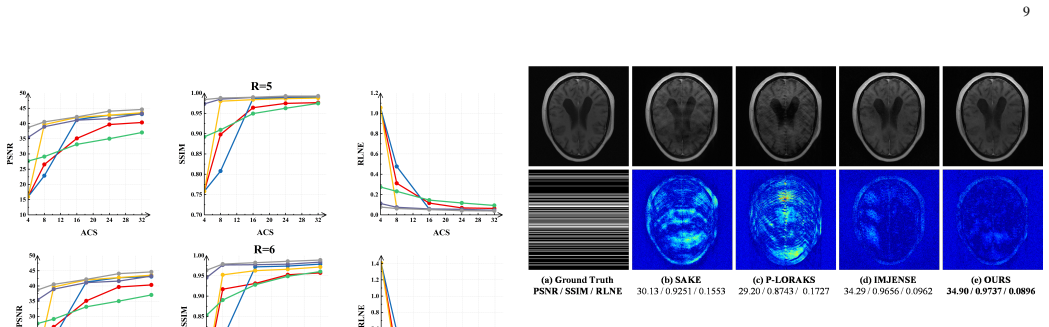
INR-CRISTAL's central claim is that explicit regularization of the coil sensitivity maps — specifically a total-variation penalty on the sensitivity network's output — is what separates a working scan-specific parallel-imaging reconstruction from a degraded one under aggressive undersampling. The paper formulates the task as a joint optimization over two implicit networks, the image network $X_\alpha$ and the sensitivity network $S_\beta$ (Eqs. 6, 8, 9), adding the term $\lambda_2 R(S_\beta)$ on top of data consistency and image total variation. The authors state the conclusion directly: 'INR-CRISTAL provides more accurate coil sensitivity estimates with fewer artifacts, and delivers superior reconstruction performance in terms of artifact removal and structure preservation.' Among candidate constraints — Fourier-domain $\ell^1$ sparsity, nuclear-norm low-rankness, and total variation — the paper finds TV gives the best trade-off of artifact suppression, fidelity, and runtime, and reports this as the first application of a TV constraint to sensitivity maps in this setting. The same formulation also reconstructs without any auto-calibration signal, beating SAKE, P-LORAKS, and IMJENSE under Gaussian undersampling.
Load-bearing premise
The load-bearing assumption is that the total-variation penalty steers the jointly estimated sensitivities toward the true physical coil sensitivities, rather than toward some other smooth image-times-sensitivity split that also fits the measured data; since the paper never quantifies sensitivity error — the maps are only inspected visually (Figs. 1 and 3) — the claimed mechanism that 'better sensitivities drive better images' is not directly measured.
Editorial extensions
If this is right
- With limited ACS lines, the sensitivity TV penalty buys nearly 1.8 dB of PSNR at R=5, ACS=8 on the brain ablation and more than 2 dB at R=6, turning a failed reconstruction into a usable one.
- INR-CRISTAL reports the lowest RLNE across all tested ACS counts and acceleration factors (R=4–6), so the method's value grows exactly where fast imaging is hardest.
- The constraint choice matters: TV beats Fourier-domain $\ell^1$ sparsity and nuclear-norm low-rank on reconstruction metrics and costs far less than the SVD-per-iteration low-rank option.
- ACS-free reconstruction is possible: under Gaussian undersampling without calibration lines, INR-CRISTAL outperforms SAKE, P-LORAKS, and IMJENSE.
- Image and sensitivity TV are separate tuning knobs ($\lambda_1$, $\lambda_2$); the ablation shows the sensitivity term still contributes roughly 0.5 dB even when ACS is plentiful.
Reading between the lines
- The paper ties image-quality gains implicitly to sensitivity accuracy, yet reports no direct sensitivity error metric; a quantitative test of whether the TV-regularized sensitivities are literally closer to ground truth would confirm or break the stated mechanism.
- Because image-times-sensitivity decompositions are ambiguous up to rescaling, the TV prior selects one member of that equivalence class; normalizing sensitivities to unit sum-of-squares and checking whether TV still helps would separate the smoothness prior from magnitude calibration.
- The paper's own stated bottleneck is reconstruction time (two SIREN networks, 1000 iterations); a practical follow-up would warm-start from a low-resolution run or distill the TV-regularized sensitivity maps into a lightweight network to make the method clinically usable.
Editorial analysis
A structured set of objections, weighed in public.
Referee Report
Summary. The paper proposes INR-CRISTAL, a scan-specific implicit neural representation method for parallel MRI reconstruction that jointly estimates the image and coil sensitivity maps and adds an explicit regularization term on the sensitivity maps, with total variation (TV) recommended. The method is evaluated against GRAPPA, pFISTA-SENSE, AC-LORAKS, NERP, and IMJENSE on four datasets, under varying ACS lines and acceleration factors, with ablations comparing L1, low-rank, and TV sensitivity regularization. The central claim is that adding the sensitivity-map regularization, especially with TV, yields more accurate coil sensitivity estimates and better reconstruction quality, particularly when ACS data are limited.
Significance. If the central claim holds, the contribution is a simple and potentially useful extension of INR-based parallel MRI: imposing a physically motivated smoothness constraint on the jointly estimated sensitivity maps improves reconstruction robustness to limited ACS and high acceleration. The paper provides consistent comparative results across four datasets, a Wilcoxon signed-rank analysis on Dataset III, and an ablation table showing consistent PSNR/SSIM gains from the sensitivity constraint. The novelty is incremental—sensitivity-map regularization has been used in optimization-based parallel imaging—but applying it inside a joint INR framework with a full comparison is a reasonable contribution. However, the claimed mechanism (more accurate sensitivity maps) is not directly measured, and several implementation details are missing, which limits the strength of the conclusions.
major comments (4)
- [Section III-C, Eq. (6), Figs. 1 and 3] The load-bearing claim that adding λ2·R(Sβ) leads to 'more accurate coil sensitivity estimates' is not quantitatively verified. Sensitivity maps are only inspected visually, and no sensitivity error metric (e.g., relative L2 error against reference maps after gauge alignment) is reported. This matters because the forward model is invariant under the rescaling (S_j, X) → (S_j/c, cX), while TV(cS) = |c|·TV(S), so the penalty strength selects a gauge rather than necessarily selecting the physically correct sensitivities. The observed PSNR gains could therefore arise from indirect image regularization through the gauge, not from improved sensitivity estimates. Please report a quantitative sensitivity-map error, describe how the gauge ambiguity is handled, and provide the values of λ1 and λ2 used in the reported experiments.
- [Section IV-D] The regularization type (TV) is chosen after comparing L1, low-rank, and TV on the same datasets that are later used for the final performance evaluation. This creates a selection-on-test-data risk: the reported gains of INR-CRISTAL over the ablated variants may partly reflect fitting the regularization choice to the evaluation set. The authors should either use a held-out validation set for the regularization selection or present results for all three regularization types on all datasets so the reader can assess the variance of the comparison.
- [Section V-C, Table II] The ablation evidence for the central mechanism is thin: Table II reports only single reconstruction values on Dataset III at two ACS settings and two acceleration factors, with no error bars, no multiple slices, and no statistical test. The claim that the sensitivity constraint is 'crucial' under limited ACS rests on essentially two numbers (ACS=8, R=5 and R=6). Please extend the ablation to at least one additional dataset and report mean±std over slices, or otherwise temper the strength of the conclusion.
- [Section IV-B and IV-C] Key hyperparameters and their selection procedure are not reported. The paper states that Bayesian optimization was used to tune parameters for all methods, but does not give the ranges or final values for λ1, λ2, the Fourier feature variance σ², or the SIREN frequency parameter w0. Without these values, the comparison is not reproducible, and it is unclear whether the advantage of INR-CRISTAL is robust to reasonable hyperparameter variation. Please report these settings or provide the code/configuration used.
minor comments (4)
- [Eq. (2) vs Eq. (10)] The data consistency term is defined with a squared l2 norm in Eq. (2) but as an l1 norm in Eq. (10). Please unify the notation and clarify which loss is actually minimized in Eq. (9).
- [Eq. (13)] The operator U is described in a confusing and tautological way: 'performing zero-filling at the positions where U samples U, and performing zero-filling at the positions where U samples U'. Please rewrite this definition clearly.
- [Fig. 3 caption] The labels R_L1, R_LR, and R_TV are used in the figure but not defined in the caption; please define them explicitly.
- [Abstract and affiliations] There are several typos and grammatical errors, e.g., 'with much few data' in the abstract, 'Faulty of Applied Science' in the affiliations, and 'supported by supported in part' in the funding footnote. A language edit is recommended.
Circularity Check
No significant circularity: the sensitivity-map TV term is an added loss evaluated against external baselines, not a fitted input renamed as a prediction.
full rationale
The paper's central claim is that adding a sensitivity-map regularization term λ2·R(Sβ) to the joint INR optimization improves coil sensitivity estimation and reconstruction quality. This is implemented as an explicit extra loss term in Eqs. (2), (6), (8), and (9), and its effect is measured by comparing the resulting reconstructions against external methods (GRAPPA, pFISTA-SENSE, AC-LORAKS, NERP, IMJENSE) and against an ablation variant without the sensitivity regularization. No equation in the paper reduces to its own input by construction: the objective is not defined in terms of the final metric, and the regularization strength is a hyperparameter tuned by Bayesian optimization, not a fitted constant that is later relabeled as a prediction. The sensitivity maps are compared visually rather than with a quantitative error metric, and the multiplicative gauge ambiguity between image and sensitivity maps is a genuine validation concern, but these are correctness or evaluation gaps, not circular reasoning. The paper does not rely on a load-bearing self-citation chain; its references to IMJENSE and CineJENSE are external prior works, and the authors' own implementation of a degraded CineJENSE variant is used as a controlled ablation baseline rather than as an imported uniqueness theorem. The novelty claim about first applying TV to sensitivity maps is a contribution statement, not a circular step. Overall, the derivation is self-contained: it adds a physically motivated regularizer, optimizes the resulting loss, and benchmarks the output against independent baselines and standard metrics.
Assumptions & free parameters
free parameters (4)
- λ1 (image TV weight) =
not reported
- λ2 (sensitivity regularization weight) =
not reported
- Fourier feature variance σ² for random matrix B =
not reported
- SIREN frequency parameter w0 =
not reported
assumptions (4)
- domain assumption Coil sensitivity maps are smooth in the image domain and TV regularization is an appropriate constraint.
- domain assumption The forward model Y_j = U F (S_j ⊙ X) accurately describes the acquired k-space data.
- standard math SIREN and Fourier feature embedding can represent both the image and sensitivity maps at the needed resolution.
- domain assumption Ground truth sensitivity maps for qualitative comparison can be obtained by dividing fully sampled coil images by the SOS image.
Cite this review
Pith. "Pith review of Implicit Neural Representation-Based MRI Reconstruction Method with Sensitivity Map Constraints." pith.science (2026). https://pith.science/paper/QXOMVMYB
@misc{pith2026250606043,
  author       = {Pith},
  title        = {Pith review of: Implicit Neural Representation-Based MRI Reconstruction Method with Sensitivity Map Constraints},
  year         = {2026},
  howpublished = {\url{https://pith.science/paper/QXOMVMYB}},
  note         = {Machine review of arXiv:2506.06043}
}
read the original abstract
Magnetic Resonance Imaging (MRI) is a widely utilized diagnostic tool in clinical settings, but its application is limited by the relatively long acquisition time. As a result, fast MRI reconstruction has become a significant area of research. In recent years, Implicit Neural Representation (INR), as a scan-specific method, has demonstrated outstanding performance in fast MRI reconstruction without fully-sampled images for training. High acceleration reconstruction poses a challenging problem, and a key component in achieving high-quality reconstruction with much few data is the accurate estimation of coil sensitivity maps. However, most INR-based methods apply regularization constraints solely to the generated images, while overlooking the characteristics of the coil sensitivity maps. To handle this, this work proposes a joint coil sensitivity map and image estimation network, termed INR-CRISTAL. The proposed INR-CRISTAL introduces an extra sensitivity map regularization in the INR networks to make use of the smooth characteristics of the sensitivity maps. Experimental results show that INR-CRISTAL provides more accurate coil sensitivity estimates with fewer artifacts, and delivers superior reconstruction performance in terms of artifact removal and structure preservation. Moreover, INR-CRISTAL demonstrates stronger robustness to automatic calibration signals and the acceleration rate compared to existing methods.
Figures


Figures from the paper (6 more)



Reference graph
Works this paper leans on
-
[1]
Advances in clinical MRI technology,
M. G. Harisinghaniet al., “Advances in clinical MRI technology,” Science Translational Medicine, vol. 11, no. 523, p. eaba2591, 2019
work page 2019
-
[2]
Sparse MRI: The application of compressed sensing for rapid mr imaging,
M. Lustiget al., “Sparse MRI: The application of compressed sensing for rapid mr imaging,”Magnetic Resonance in Medicine, vol. 58, no. 6, pp. 1182–1195, 2007
work page 2007
-
[3]
Spatiotemporal imagingwith partially separable functions,
Z.-P. Liang, “Spatiotemporal imagingwith partially separable functions,” in2007 4th IEEE International Symposium on Biomedical Imaging: From Nano to Macro. IEEE, 2007, pp. 988–991
work page 2007
-
[4]
A. Deshmaneet al., “Parallel MR imaging,”Journal of Magnetic Resonance Imaging, vol. 36, no. 1, pp. 55–72, 2012
work page 2012
-
[5]
SENSE: sensitivity encoding for fast MRI,
K. P. Pruessmannet al., “SENSE: sensitivity encoding for fast MRI,” Magnetic Resonance in Medicine, vol. 42, no. 5, pp. 952–962, 1999
work page 1999
-
[6]
Generalized autocalibrating partially parallel acquisitions (GRAPPA),
M. A. Griswoldet al., “Generalized autocalibrating partially parallel acquisitions (GRAPPA),”Magnetic Resonance in Medicine, vol. 47, no. 6, pp. 1202–1210, 2002
2002
-
[7]
Joint image reconstruction and sensitivity estimation in SENSE (JSENSE),
L. Ying and J. Sheng, “Joint image reconstruction and sensitivity estimation in SENSE (JSENSE),”Magnetic Resonance in Medicine, vol. 57, no. 6, pp. 1196–1202, 2007
work page 2007
-
[8]
X. Zhanget al., “A guaranteed convergence analysis for the projected fast iterative soft-thresholding algorithm in parallel MRI,”Medical Image Analysis, vol. 69, p. 101987, 2021
work page 2021
Show all 57 references
-
[9]
SPIRiT: iterative self-consistent parallel imaging reconstruction from arbitrary k-space,
M. Lustig and J. M. Pauly, “SPIRiT: iterative self-consistent parallel imaging reconstruction from arbitrary k-space,”Magnetic Resonance in Medicine, vol. 64, no. 2, pp. 457–471, 2010
2010
-
[10]
Partially parallel imaging with localized sen- sitivities (PILS),
M. A. Griswoldet al., “Partially parallel imaging with localized sen- sitivities (PILS),”Magnetic Resonance in Medicine, vol. 44, no. 4, pp. 602–609, 2000
2000
-
[11]
ESPIRiT—an eigenvalue approach to autocalibrating parallel MRI: where SENSE meets GRAPPA,
M. Ueckeret al., “ESPIRiT—an eigenvalue approach to autocalibrating parallel MRI: where SENSE meets GRAPPA,”Magnetic Resonance in Medicine, vol. 71, no. 3, pp. 990–1001, 2014
2014
-
[12]
A faithful deep sensitivity estimation for accelerated magnetic resonance imaging,
Z. Wanget al., “A faithful deep sensitivity estimation for accelerated magnetic resonance imaging,”IEEE Journal of Biomedical and Health Informatics, 2024
2024
-
[13]
AUTO-SMASH: a self-calibrating technique for SMASH imaging,
P. M. Jakobet al., “AUTO-SMASH: a self-calibrating technique for SMASH imaging,”Magnetic Resonance Materials in Physics, Biology and Medicine, vol. 7, pp. 42–54, 1998
1998
-
[14]
Robust uncertainty principles: Exact signal re- construction from highly incomplete frequency information,
E. J. Cand `eset al., “Robust uncertainty principles: Exact signal re- construction from highly incomplete frequency information,”IEEE Transactions on Information Theory, vol. 52, no. 2, pp. 489–509, 2006
2006
-
[15]
Stable signal recovery from incomplete and inaccurate measurements,
E. J. Candeset al., “Stable signal recovery from incomplete and inaccurate measurements,”Communications on Pure and Applied Math- ematics: A Journal Issued by the Courant Institute of Mathematical Sciences, vol. 59, no. 8, pp. 1207–1223, 2006
2006
-
[16]
Low-rank modeling of localk-space neighborhoods (LO- RAKS) for constrained MRI,
J. P. Haldar, “Low-rank modeling of localk-space neighborhoods (LO- RAKS) for constrained MRI,”IEEE Transactions on Medical Imaging, vol. 33, no. 3, pp. 668–681, 2013
2013
-
[17]
Autocalibrated LORAKS for fast constrained MRI reconstruction,
Haldar, Justin P, “Autocalibrated LORAKS for fast constrained MRI reconstruction,” in2015 IEEE 12th International Symposium on Biomed- ical Imaging (ISBI). IEEE, 2015, pp. 910–913
2015
-
[18]
P-LORAKS: low-rank modeling of local k- space neighborhoods with parallel imaging data,
J. P. Haldar and J. Zhuo, “P-LORAKS: low-rank modeling of local k- space neighborhoods with parallel imaging data,”Magnetic Resonance in Medicine, vol. 75, no. 4, pp. 1499–1514, 2016
2016
-
[19]
Linear predictability in magnetic resonance imaging reconstruction: Leveraging shift-invariant fourier structure for faster and better imaging,
J. P. Haldar and K. Setsompop, “Linear predictability in magnetic resonance imaging reconstruction: Leveraging shift-invariant fourier structure for faster and better imaging,”IEEE Signal Processing Maga- zine, vol. 37, no. 1, pp. 69–82, 2020
2020
-
[20]
Calibrationless parallel imaging reconstruction based on structured low-rank matrix completion,
P. J. Shinet al., “Calibrationless parallel imaging reconstruction based on structured low-rank matrix completion,”Magnetic Resonance in Medicine, vol. 72, no. 4, pp. 959–970, 2014
2014
-
[21]
Image reconstruction with low-rankness and self- consistency of k-space data in parallel MRI,
X. Zhanget al., “Image reconstruction with low-rankness and self- consistency of k-space data in parallel MRI,”Medical Image Analysis, vol. 63, p. 101687, 2020
2020
-
[22]
Accelerated MRI reconstruction with separable and enhanced low-rank hankel regularization,
X. Zhanget al., “Accelerated MRI reconstruction with separable and enhanced low-rank hankel regularization,”IEEE Transactions on Medical Imaging, vol. 41, no. 9, pp. 2486–2498, 2022
2022
-
[23]
Accelerating magnetic resonance imaging via deep learning,
S. Wanget al., “Accelerating magnetic resonance imaging via deep learning,” in2016 IEEE 13th International Symposium on Biomedical Imaging (ISBI). IEEE, 2016, pp. 514–517
2016
-
[24]
Image reconstruction by domain-transform manifold learning,
B. Zhuet al., “Image reconstruction by domain-transform manifold learning,”Nature, vol. 555, no. 7697, pp. 487–492, 2018
2018
-
[25]
ADMM-CSNet: A deep learning approach for image compressive sensing,
Y . Yanget al., “ADMM-CSNet: A deep learning approach for image compressive sensing,”IEEE Transactions on Pattern Analysis and Ma- chine Intelligence, vol. 42, no. 3, pp. 521–538, 2018
2018
-
[26]
Physics-driven synthetic data learning for biomedical magnetic resonance: The imaging physics-based data synthesis paradigm for artificial intelligence,
Q. Yanget al., “Physics-driven synthetic data learning for biomedical magnetic resonance: The imaging physics-based data synthesis paradigm for artificial intelligence,”IEEE Signal Processing Magazine, vol. 40, no. 2, pp. 129–140, 2023
2023
-
[27]
pFISTA-SENSE-ResNet for parallel MRI reconstruction,
T. Luet al., “pFISTA-SENSE-ResNet for parallel MRI reconstruction,” Journal of Magnetic Resonance, vol. 318, p. 106790, 2020
2020
-
[28]
Learning a variational network for reconstruction of accelerated MRI data,
K. Hammerniket al., “Learning a variational network for reconstruction of accelerated MRI data,”Magnetic Resonance in Medicine, vol. 79, no. 6, pp. 3055–3071, 2018
2018
-
[29]
Scan-specific artifact reduction in k-space (SPARK) neural networks synergize with physics-based reconstruction to acceler- ate MRI,
Y . Arefeenet al., “Scan-specific artifact reduction in k-space (SPARK) neural networks synergize with physics-based reconstruction to acceler- ate MRI,”Magnetic Resonance in Medicine, vol. 87, no. 2, pp. 764–780, 2022
2022
-
[30]
Undersampled mr image reconstruction using an en- hanced recursive residual network,
L. Baoet al., “Undersampled mr image reconstruction using an en- hanced recursive residual network,”Journal of Magnetic Resonance, vol. 305, pp. 232–246, 2019
2019
-
[31]
MoDL: Model-based deep learning architecture for inverse problems,
H. K. Aggarwalet al., “MoDL: Model-based deep learning architecture for inverse problems,”IEEE Transactions on Medical Imaging, vol. 38, no. 2, pp. 394–405, 2018
2018
-
[32]
Nerf: Representing scenes as neural radiance fields for view synthesis,
B. Mildenhallet al., “Nerf: Representing scenes as neural radiance fields for view synthesis,”Communications of the ACM, vol. 65, no. 1, pp. 99– 106, 2021
2021
-
[33]
NeRP: implicit neural representation learning with prior embedding for sparsely sampled image reconstruction,
L. Shenet al., “NeRP: implicit neural representation learning with prior embedding for sparsely sampled image reconstruction,”IEEE Transactions on Neural Networks and Learning Systems, vol. 35, no. 1, pp. 770–782, 2022
2022
-
[34]
Nerf-sr: High quality neural radiance fields using su- persampling,
C. Wanget al., “Nerf-sr: High quality neural radiance fields using su- persampling,” inProceedings of the 30th ACM International Conference on Multimedia, 2022, pp. 6445–6454
2022
-
[35]
Nex: Real-time view synthesis with neural basis expansion,
S. Wizadwongsaet al., “Nex: Real-time view synthesis with neural basis expansion,” inProceedings of the IEEE/CVF Conference on Computer Vision and Pattern Recognition, 2021, pp. 8534–8543. 11
2021
-
[36]
A scan-specific unsupervised method for parallel MRI reconstruction via implicit neural representation,
R. Fenget al., “A scan-specific unsupervised method for parallel MRI reconstruction via implicit neural representation,” in2023 IEEE 20th International Symposium on Biomedical Imaging (ISBI). IEEE, 2023, pp. 1–5
2023
-
[37]
Neural implicit k-space for binning-free non-cartesian cardiac MR imaging,
W. Huanget al., “Neural implicit k-space for binning-free non-cartesian cardiac MR imaging,” inInternational Conference on Information Processing in Medical Imaging. Springer, 2023, pp. 548–560
2023
-
[38]
IMJENSE: scan-specific implicit representation for joint coil sensitivity and image estimation in parallel MRI,
R. Fenget al., “IMJENSE: scan-specific implicit representation for joint coil sensitivity and image estimation in parallel MRI,”IEEE Transactions on Medical Imaging, 2023
2023
-
[39]
CineJENSE: Simultaneous cine MRI image reconstruction and sensitivity map estimation using neural representa- tions,
Z. Al-Haj Hemidiet al., “CineJENSE: Simultaneous cine MRI image reconstruction and sensitivity map estimation using neural representa- tions,” inInternational Workshop on Statistical Atlases and Computa- tional Models of the Heart. Springer, 2023, pp. 467–478
2023
-
[40]
Implicit neural representation in medical imaging: A comparative survey,
A. Molaeiet al., “Implicit neural representation in medical imaging: A comparative survey,” inProceedings of the IEEE/CVF International Conference on Computer Vision, 2023, pp. 2381–2391
2023
-
[41]
INFusion: Diffusion regularized implicit neural representations for 2D and 3D accelerated MRI reconstruction,
Y . Arefeenet al., “INFusion: Diffusion regularized implicit neural representations for 2D and 3D accelerated MRI reconstruction,”ArXiv Preprint ArXiv:2406.13895, 2024
2024 arXiv
-
[42]
Spatiotemporal implicit neural representation for unsu- pervised dynamic MRI reconstruction,
J. Fenget al., “Spatiotemporal implicit neural representation for unsu- pervised dynamic MRI reconstruction,”IEEE Transactions on Medical Imaging, 2025
2025
-
[43]
Highly accelerated MRI via implicit neural representation guided posterior sampling of diffusion models,
J. Chuet al., “Highly accelerated MRI via implicit neural representation guided posterior sampling of diffusion models,”Medical Image Analysis, vol. 100, p. 103398, 2025
2025
-
[44]
Iterative estimation of MRI sensitivity maps and image based on sense reconstruction method (iSENSE),
A. Majumdar and R. K. Ward, “Iterative estimation of MRI sensitivity maps and image based on sense reconstruction method (iSENSE),” Concepts in Magnetic Resonance Part A, vol. 40, no. 6, pp. 269–280, 2012
2012
-
[45]
JSENSE-Pro: Joint sensitivity estimation and image reconstruction in parallel imaging using pre-learned subspaces of coil sensitivity functions,
L. Tanget al., “JSENSE-Pro: Joint sensitivity estimation and image reconstruction in parallel imaging using pre-learned subspaces of coil sensitivity functions,”Magnetic Resonance in Medicine, vol. 89, no. 4, pp. 1531–1542, 2023
2023
-
[46]
On the spectral bias of neural networks,
N. Rahamanet al., “On the spectral bias of neural networks,” in International Conference on Machine Learning. PMLR, 2019, pp. 5301–5310
2019
-
[47]
Implicit neural representations with periodic acti- vation functions,
V . Sitzmannet al., “Implicit neural representations with periodic acti- vation functions,”Advances in Neural Information Processing Systems, vol. 33, pp. 7462–7473, 2020
2020
-
[48]
Fourier features let networks learn high frequency functions in low dimensional domains,
M. Tanciket al., “Fourier features let networks learn high frequency functions in low dimensional domains,”Advances in Neural Information Processing Systems, vol. 33, pp. 7537–7547, 2020
2020
-
[49]
Image restoration using total variation regularized deep image prior,
J. Liuet al., “Image restoration using total variation regularized deep image prior,” inICASSP 2019-2019 IEEE International Conference on Acoustics, Speech and Signal Processing (ICASSP). Ieee, 2019, pp. 7715–7719
2019
-
[50]
Coil compression for accelerated imaging with Carte- sian sampling,
T. Zhanget al., “Coil compression for accelerated imaging with Carte- sian sampling,”Magnetic Resonance in Medicine, vol. 69, no. 2, pp. 571–582, 2013
2013
-
[51]
fastMRI: A publicly available raw k-space and DICOM dataset of knee images for accelerated MR image reconstruction using machine learning,
F. Knollet al., “fastMRI: A publicly available raw k-space and DICOM dataset of knee images for accelerated MR image reconstruction using machine learning,”Radiology: Artificial Intelligence, vol. 2, no. 1, p. e190007, 2020
2020
-
[52]
fastMRI: An open dataset and benchmarks for accelerated MRI,
J. Zbontaret al., “fastMRI: An open dataset and benchmarks for accelerated MRI,”ArXiv Preprint ArXiv:1811.08839, 2018
2018 arXiv
-
[53]
Adam: A method for stochastic optimization,
D. P. Kingma, “Adam: A method for stochastic optimization,”ArXiv Preprint ArXiv:1412.6980, 2014
2014 arXiv
-
[54]
Image quality assessment: from error visibility to structural similarity,
Z. Wanget al., “Image quality assessment: from error visibility to structural similarity,”IEEE Transactions on Image Processing, vol. 13, no. 4, pp. 600–612, 2004
2004
-
[55]
Magnetic resonance image reconstruction from under- sampled measurements using a patch-based nonlocal operator,
X. Quet al., “Magnetic resonance image reconstruction from under- sampled measurements using a patch-based nonlocal operator,”Medical Image Analysis, vol. 18, no. 6, pp. 843–856, 2014
2014
-
[56]
The Bayesian approach to global optimization,
J. Mockus, “The Bayesian approach to global optimization,” inSystem Modeling and others. Springer, 2005, pp. 473–481
2005
-
[57]
Critical values and probability levels for the wilcoxon rank sum test and the wilcoxon signed rank test,
F. Wilcoxonet al., “Critical values and probability levels for the wilcoxon rank sum test and the wilcoxon signed rank test,”Selected Tables in Mathematical Statistics, vol. 1, pp. 171–259, 1970
1970
Reviewed August 7, 2026 · model on record in the stance chip above.
Discussion (0). Sign in to comment.