REVIEW 3 major objections 5 minor 4 references
Analytic Modeling of CO Surface-Density Profiles in the M31 Molecular Clouds
T0 review · 3 major / 5 minor · reviewed 2026-08-07 · deepseek-v4-flash
Pith's one-line read M31 molecular clouds match isothermal Lane-Emden sphere profiles
desk verdict Solid extension of the DVA method to M31 clouds with a careful covariance formalism, but the Lane-Emden identification is untested against alternative profiles and needs that contrast to carry the physical interpretation. read the letter →
The pith
A machine-rendered reading of the paper's core claim, the machinery that carries it, and where it could break.
The reading
What carries the argument
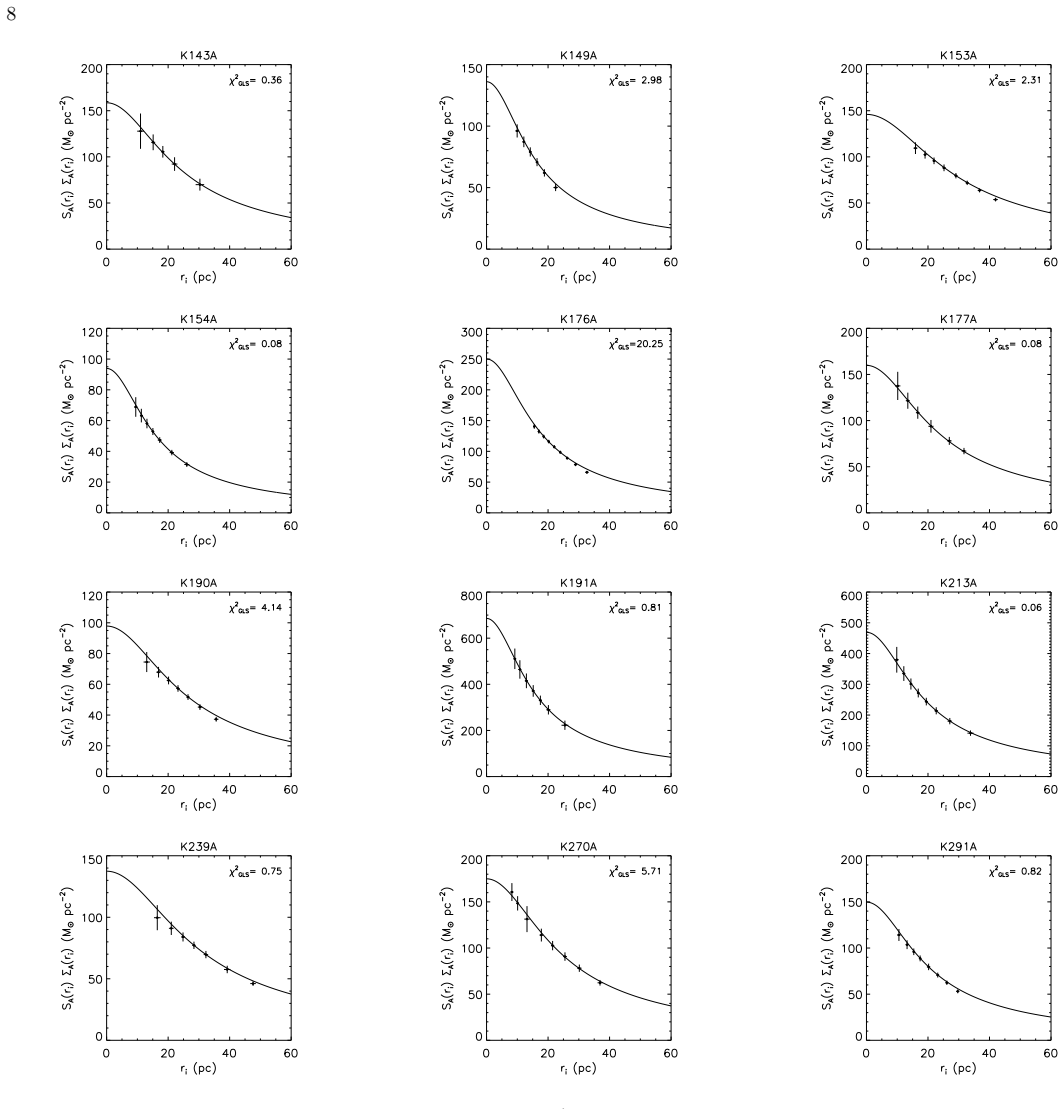
The central object is the isothermal Lane-Emden equation, the hydrostatic equilibrium of a self-gravitating polytropic gas sphere, whose projected surface-density profiles are compared with observations. The comparison is carried out in area-averaged form: both the observational data and the theoretical solutions are reduced to average surface density Sigma_A(r_i) within nested isophotes as a function of effective radius r_i = $\sqrt$(A/pi). The method defines molecular clouds as regions enclosed by isophotes, so the cloud center and peak surface density are not observed directly; instead, the observed profile segment is matched to the theoretical profile by adjusting a vertical and a horizontal scaling factor at each trial position, fitting the curvature of the profile. The statistical machinery is a generalized least-squares statistic $chi^{2}$_GLS that accounts for the covariances between nested data pairs, with uncertainties propagated from the measured variances of isophotal area and mass, including a correlation-length factor for fluctuations along the isophote.
What would settle it
Look at the CO data cubes of the 24 fitted clouds: if a spectral decomposition reveals that many of the clouds contain multiple distinct velocity components along the line of sight whose spatial peaks are not coincident, then the isophote-averaged profiles are superpositions and the Lane-Emden agreement would not describe individual cloud structure. This is testable with the existing interferometric data.
Extended reading notes
Core claim
Using differential virial analysis, which averages CO emission within nested isophotes to produce pairs of average surface density and effective radius, the authors derive radial surface-density profiles for 26 M31 clouds and compare them directly with the projection of isothermal Lane-Emden solutions averaged in the same way. For 24 clouds with at least 10 radial points, the observed curvature of the profiles is consistent with the theoretical solutions; two clouds lacked enough curvature for a unique fit. A generalized least-squares chi-squared statistic, including the full covariance matrix arising from the nested isophotes, yields reduced values of order unity for 23 of the 24 fitted clouds. The authors interpret the agreement as evidence that the mean dynamical state of each cloud is one of self-gravitational equilibrium with a constant effective sound speed, and that the evolutionary timescale of the clouds is longer than the timescale for internal force balance. The same result previously found for Galactic Ring clouds indicates these dynamics are common to both populations.
Load-bearing premise
The analysis assumes that each M31 cloud is a single, isolated, centrally condensed structure whose CO emission peak marks its center, so that the nested-isophote average equals the radial profile of one cloud; if background or foreground CO emission blends multiple clouds along the line of sight, or the peak is not the dynamical center, the measured profile is a superposition and the Lane-Emden comparison is not testing a single cloud's structure.
Editorial extensions
If this is right
- The M31 molecular clouds, like the Milky Way Galactic Ring clouds, are consistent with being in approximate hydrostatic equilibrium described by the isothermal Lane-Emden equation.
- The turbulent processes that set the internal pressure gradient must act on timescales shorter than the cloud's free-fall and crossing timescales, meaning an equilibrium mean state can exist within a dynamically evolving turbulent medium.
- The surface-density profiles of the two cloud populations (Galactic Ring and M31) are similar enough to suggest similar dynamical states across different galactic environments.
- The DVA method with its proper covariance handling can be applied to typical radio spectral-line data where the peak intensity and half-width at half-maximum are not well resolved, extending the reach of analytic profile comparisons.
Reading between the lines
- If the Lane-Emden description holds, the fitted scaling factors for each cloud encode the physical central density and effective radius, so the same data could be used to estimate the distribution of effective sound speeds and external pressures in M31's molecular cloud population without assuming a CO-to-mass conversion.
- The method's insensitivity to absolute CO-to-mass calibration suggests that comparisons of profile shapes across galaxies could serve as a robust diagnostic of cloud dynamical state in environments with very different metallicity or excitation conditions.
- A direct test of the single-cloud assumption would be to apply the same DVA analysis to position-position-velocity cubes, checking whether the nested-isophote profiles remain consistent when restricted to a single velocity component; line-of-sight blending in M31's disk could otherwise contaminate the profiles.
Editorial analysis
A structured set of objections, weighed in public.
Referee Report
Summary. This paper applies the differential virial analysis (DVA) method, in the area-averaged form of Lada et al. (2025), to CO observations of 26 M31 molecular clouds. For each cloud, nested isophotes define effective radii r_i and mean surface densities Sigma_A(r_i). The authors derive the covariance of these quantities, including covariances between surface density and radius and between nested isophotes, and define a generalized least-squares chi^2_GLS statistic. They fit projected isothermal Lane-Emden solutions to 24 clouds (two are excluded for insufficient curvature) using one vertical and one horizontal scaling factor per cloud, and report that 23 of 24 fits have reduced chi^2_GLS/nu of order unity. They interpret this agreement as evidence that the clouds are in approximate hydrostatic equilibrium and that the time scale for establishing force balance is shorter than the evolutionary time scale, and they argue that the M31 profiles resemble those previously reported in Galactic Ring clouds.
Significance. If the central claim holds, the paper provides a statistically careful method for extracting area-averaged surface-density profiles with correlated uncertainties and extends the Lane-Emden comparison to extragalactic clouds. The covariance derivation in Appendix D is a useful technical contribution, and the paper is explicit about the assumptions behind the spherical approximation and area averaging. However, the Lane-Emden identification is currently supported only by consistency, not by discrimination against other smooth centrally concentrated profiles, and the paper does not report the fitted parameters or per-cloud chi^2 values. The physical interpretation in Section 4 therefore rests on a narrower evidentiary base than the abstract suggests.
major comments (3)
- [Section 3 and Section 4] The central claim that the observed profiles agree with the Lane-Emden solution is established only by fitting the Lane-Emden model and showing that reduced chi^2_GLS/nu is of order unity for 23 of 24 clouds. This demonstrates consistency, not identification. The DVA quantity Sigma_A(r_i) is a cumulative area average that smooths small-scale structure, and the two fitted scaling factors per cloud can absorb much of the freedom in normalization and size, so a Gaussian, Plummer, or broken power-law profile might be equally consistent with the same data. The validations cited from Krumholz et al. (2025) tested polytropes and simulations, but not a systematic suite of alternative analytic profiles on the same footing. Because Section 4 interprets the Lane-Emden fit as evidence for a specific physical state (hydrostatic balance and a time-scale ordering), the paper should fit a small set of alternative radial profiles to the same DVA observables with the same GLS covariance and report the resulting chi^2 or information criteria. Without this contrast, the physical conclusion is not warranted.
- [Section 3, Figure 1] The paper excludes two clouds, K297A and K301A, because they "lacked sufficient curvature" to obtain a unique fit, but it does not define a quantitative criterion for sufficient curvature or report the fitted vertical and horizontal scaling factors, their uncertainties, or the individual chi^2_GLS values for the 24 fitted clouds. Without this information, the reader cannot assess whether the two excluded clouds are merely less constraining or actually inconsistent with the model, nor whether the fitted scalings are physically plausible (for example, whether the implied HWHM sizes and peak surface densities are sensible). A table of per-cloud fitted parameters and goodness-of-fit statistics should be added.
- [Appendix D.1] The covariance model in Eqs. (D24)-(D26) assumes independent noise in disjoint annuli between successive isophotes. However, the observational noise is spatially correlated on the beam scale, and the isophote positions are derived from the same beam-smoothed image; Appendix A includes a correlation-length factor for the individual variances, but the cross-contour covariances do not propagate this spatial correlation between adjacent annuli. The authors should justify this approximation or test its effect on chi^2_GLS with noise simulations, since the central goodness-of-fit claim depends on the accuracy of the covariance matrix.
minor comments (5)
- [Section 3] The text contains a typo: "FIgure 1" should be "Figure 1".
- [Section 1] The phrase "differential viral analysis" should read "differential virial analysis"; the same spelling error appears elsewhere in the manuscript.
- [Section 6] The word "equilbrium" should be "equilibrium".
- [Section 2, Eq. (2)] The notation "y=0" in the definition of the theoretical surface density is confusing because y is used as a sky coordinate in Eq. (1); the intended line-of-sight coordinate should be stated more clearly.
- [References] The reference list gives different formats for the same type of source (for example, arXiv e-prints for Krumholz et al. 2025 and Lada et al. 2025); please unify the bibliography style.
Circularity Check
No significant circularity: the Lane-Emden shape comparison is falsifiable, and the same-group citations provide real evidence from polytrope and simulation tests.
full rationale
The paper's central comparison is not circular by construction. The isothermal Lane-Emden model is defined independently (Eq. 2 via the LE equation), and the theoretical DVA observable is obtained by applying the same area-average used on the data (Eq. 5); this is forward-modeling of the observable, not a definition of the model in terms of the data. The fit uses two per-cloud scaling factors (vertical and horizontal), but these set units; the shape and curvature are fixed by the LE solution and can fail, as shown by the two clouds (K297A and K301A) that lack sufficient curvature for a unique fit and by the one cloud with a poor reduced chi-squared. Thus the reported chi-squared_GLS is a genuine goodness-of-fit, not a forced identity. The same-group citations (Keto 2024; Lada et al. 2025; Krumholz et al. 2025) supply the DVA method and prior GR/M31 results, and the polytrope/simulation validation is performed on externally defined targets, so it is real evidence rather than circular support. The main weakness, namely the absence of alternative radial-profile models (Gaussian, Plummer, power law) on the same DVA/GLS footing, limits model identification, but that is an underdetermination and correctness concern, not a circular reduction. No specific circular step meets the quote-and-reduction standard.
Assumptions & free parameters
free parameters (2)
- vertical scaling factor (per cloud) =
not reported; fitted for each of 24 clouds
- horizontal scaling factor (per cloud) =
not reported; fitted for each of 24 clouds
assumptions (5)
- domain assumption The isothermal Lane-Emden equation is the correct description of the mean cloud structure (spherical hydrostatic equilibrium with an isothermal equation of state).
- domain assumption Effective pressure from turbulence is isotropic and can be represented as a scalar pressure P = rho a^2 with a constant effective sound speed.
- domain assumption The gravitational potential is dominated by the cloud's own centrally condensed mass, so non-spherical isophotes do not bias the spherical comparison.
- domain assumption Noise in disjoint annular regions is independent, and the correlation length of isophote fluctuations is l_c = sqrt(2) FWHM.
- domain assumption CO integrated intensity traces the column density of the cloud, and any absolute calibration factor cancels in the differential fit.
Cite this review
Pith. "Pith review of Analytic Modeling of CO Surface-Density Profiles in the M31 Molecular Clouds." pith.science (2026). https://pith.science/paper/5EYIAVRL
@misc{pith2026250606118,
  author       = {Pith},
  title        = {Pith review of: Analytic Modeling of CO Surface-Density Profiles in the M31 Molecular Clouds},
  year         = {2026},
  howpublished = {\url{https://pith.science/paper/5EYIAVRL}},
  note         = {Machine review of arXiv:2506.06118}
}
read the original abstract
We analyze CO observations of molecular clouds in the Andromeda galaxy (M31) with a new method to derive surface-density profiles and compare directly with projected solutions of the isothermal Lane-Emden equation. The observed curvature of the surface-density profiles is consistent with the theoretical solutions. The applicability of the Lane-Emden equation indicates that the time scales of the turbulent processes responsible for an average force balance within the clouds are shorter than the time scales for the evolution of the clouds, for example toward collapse or disruption. The M31 profiles resemble those previously reported in Galactic molecular clouds suggesting similar dynamics across different environments.
Figures

Reference graph
Works this paper leans on
-
[1]
Bertoldi, F., & McKee, C. F. 1992, ApJ, 395, 140, doi: 10.1086/171638 Colombo, D., Hughes, A., Schinnerer, E., et al. 2014, ApJ, 784, 3, doi: 10.1088/0004-637X/784/1/3 Evans, Neal J., I., Heyer, M., Miville-Deschˆ enes, M.-A., Nguyen-Luong, Q., & Merello, M. 2021, ApJ, 920,
doi:10.1086/171638 1992
-
[126]
https://arxiv.org/abs/2107.05750 Heyer, M., Krawczyk, C., Duval, J., & Jackson, J. M. 2009, ApJ, 699,
work page Pith review arXiv 2009
-
[492]
2011, ApJS, 197, 16, doi: 10.1088/0067-0049/197/2/16
https://arxiv.org/abs/1010.2798 Wong, T., Hughes, A., Ott, J., et al. 2011, ApJS, 197, 16, doi: 10.1088/0067-0049/197/2/16
arXiv 2011
-
[1092]
https://arxiv.org/abs/0809.1397 Hughes, A., Meidt, S. E., Colombo, D., et al. 2013, ApJ, 779, 46, doi: 10.1088/0004-637X/779/1/46 Keto, E. 2024, Astronomische Nachrichten, 345, e20240044, doi: 10.1002/asna.20240044 Krumholz, M. R., Lada, C. J., & Forbrich, J. 2025, arXiv e-prints, arXiv:2501.16474, doi: 10.48550/arXiv.2501.16474 Lada, C. J., Forbrich, J.,...
arXiv 2013
Reviewed August 7, 2026 · model on record in the stance chip above.
Discussion (0). Sign in to comment.