REVIEW 4 major objections 5 minor 91 references
Stream DaQ: Stream-First Data Quality Monitoring
T0 review · 4 major / 5 minor · reviewed 2026-08-07 · deepseek-v4-flash
Pith's one-line read Window-based, stream-first data quality monitoring catches temporally localized errors that static and incremental tools miss, and its implementation runs up to 13.8x faster on small windows.
desk verdict A useful streaming data quality framework with an open-source implementation, but the evaluation overstates performance due to asymmetric timing and never tests whether the checks actually detect errors. read the letter →
The pith
A machine-rendered reading of the paper's core claim, the machinery that carries it, and where it could break.
The reading
What carries the argument
The central object is the quality meta-stream: a structured output stream whose entries are tuples of window start time, window end time, a measurement value, and an assessment result, produced by continuously applying stream quality assessments over a sequence of windows. It carries the argument because it turns monitoring from a one-off verdict into a live, downstream-consumable signal, and it is generated by the model's configurable windowing, dynamic constraint adaptation, and compositional check categories (tuple-at-a-time, window context, reference data, dynamically adapted context, and keyed checks).
What would settle it
Inject known errors of controlled duration into a stream, such as five-minute bursts of NULLs, duplicates, or placeholder values, and measure whether windowed checks raise alerts with high precision and recall within the expected window; if the checks miss short-lived errors or fire false alarms on clean windows, the central claim collapses.
Extended reading notes
Core claim
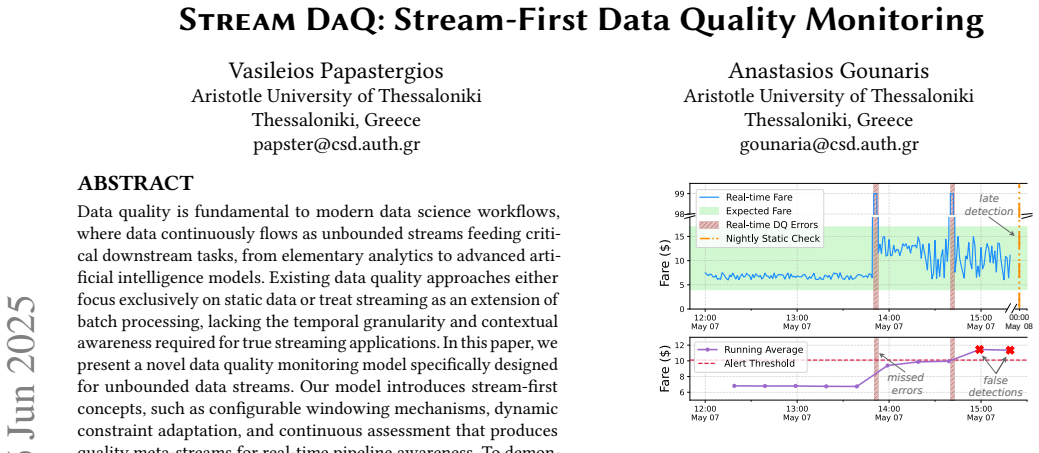
The paper's central claim is that data quality monitoring for unbounded streams should be modeled as a continuous streaming computation: assessments are applied over a sequence of user-configurable windows, constraints can adapt using recent context rather than stream-inception aggregates, and the results flow onward as a quality meta-stream. It argues that this design detects temporally dependent errors, such as bursts of missing values, duplicates, or placeholder fares, that static nightly checks detect too late and incremental running-aggregate checks mask or report after the bad period has ended. The paper further claims that the implementation, Stream DaQ, delivers substantial performance benefits in exactly the real-time scenarios that matter: for small windows it outperforms a production-grade batch-extended baseline by up to 13.8x, and it remains competitive for larger windows while providing a broader, compositionally expressive check suite.
Load-bearing premise
The practical usefulness of the model rests on the unvalidated assumption that quality checks originally designed for static, whole-dataset analysis remain accurate and meaningful when run over short windows of an unbounded stream; the evaluation measures execution time, throughput, and feature coverage, but never injects known errors to test whether the windowed alerts actually detect them.
Editorial extensions
If this is right
- Short-window checks can detect bursts of errors, such as 20% missing destinations in five minutes, that a running average since stream inception would mask or report only after the low-quality period has ended.
- Quality meta-streams can be consumed by downstream systems as real-time awareness signals, enabling alerts, routing of erroneous elements to separate streams, or pausing model updates during detected low-quality intervals.
- Composing check categories yields entity-specific, context-aware constraints, such as per-taxi fare deviations against a rolling two-hour baseline, rather than generic whole-dataset rules.
- Small tumbling and moderately overlapping sliding windows strongly favor the lightweight Python-native design, with improvements up to 13.8x; larger windows and 90% overlap configurations make performance comparable to the batch-oriented distributed baseline.
- The Python-native interface lowers the barrier to integrating continuous quality monitoring into existing data science workflows, including pandas-based preprocessing and Jupyter-based analysis.
Reading between the lines
- If detection quality is confirmed through error-injection experiments, the same window-based template could transfer to other domains where temporal locality matters, such as fraud detection, sensor validation, and network monitoring.
- The comparable performance at 90% sliding-window overlap suggests an incremental sliding-window optimization opportunity; the authors themselves note that incremental processing is a direction for future work.
- The quality meta-stream could plausibly be extended to serve as a gating signal for online learning, telling a model to skip weight updates or to down-weight inputs during windows flagged as low-quality.
- A direct comparison of false-positive rates between windowed checks and static checks on the same stream would test whether the expressive model actually reduces misleading alerts, not just detection latency.
Editorial analysis
A structured set of objections, weighed in public.
Referee Report
Summary. The paper proposes a stream-first data quality monitoring model for unbounded data streams. The model is built around configurable time windows, dynamic constraint adaptation, and a continuous 'quality meta-stream' output, formalized in Definitions 3.1 through 3.4. The authors also present Stream DaQ, an open-source Python framework on Pathway that implements the model and unifies more than 30 quality checks adapted from static tools. The evaluation compares Stream DaQ with a Spark-based Deequ adaptation on replayed Reddit comment data, reporting throughput, latency, and per-window execution time, with claimed speedups up to 13.8x for small windows, plus a qualitative functional comparison with Apache Griffin and Deequ.
Significance. If the performance and utility claims are substantiated, the paper addresses a real gap: most data quality tooling assumes static or incrementally growing data, while streaming pipelines need temporally localized, continuous quality assessment. The formal model is clearly presented, the compositional check categories are expressive, and the open-source implementation with public experiment code is a concrete strength. However, the current evidence is not yet sufficient: the main quantitative comparison uses an asymmetric cost boundary, the results lack any measure of variance, and the central promise of timely, context-aware detection is never tested by injecting known errors. These are fixable within the manuscript's scope, so the work is promising but needs a major revision.
major comments (4)
- [Section 5.1 (Experimental Setup)] The measurement of 'net processing time' is asymmetric: the text states 'For Deequ, we measure net processing time excluding Spark's windowing, while for Stream DaQ the net processing time stands for both windowing and execution of quality checks.' This directly biases the per-window execution-time comparisons and the headline 13.8x speedup in favor of Stream DaQ, since windowing is part of the streaming pipeline for both systems. Please redo the comparison with identical cost boundaries (either include windowing for both or exclude it for both) and report the windowing and check-execution components separately.
- [Section 5.1 (Results)] All reported numbers are averages over five or more runs, but no standard deviations, confidence intervals, or per-run distributions are given, and Figures 4 and 5 show no error bars. The claims of 'significant' performance advantages for small windows and 'comparable' performance for large windows cannot be assessed without a measure of variability. Please report variance or distributional information, and state whether the observed differences are stable across runs and resource configurations.
- [Section 3.1 and Section 5] The paper's central practical claim is 'timely, temporally fine-grained detection' of generic and temporally dependent errors, but Section 5 evaluates only execution time, throughput, latency, and feature coverage. No experiment injects known quality errors into the stream to measure detection rate, false-alarm rate, or time-to-detection. This is load-bearing: a system can process windows quickly while still missing the temporally localized errors it is designed to catch. Please add detection-effectiveness experiments, e.g., injecting missing values, placeholder bursts, duplicates, and out-of-order events, and reporting precision/recall and detection delay for Stream DaQ and the adapted Deequ baseline.
- [Section 5.1 (Evaluation Strategy and Setup)] The comparison workload is not specified precisely. The text says the evaluation 'utilizes only a subset of Stream DaQ's model expressiveness that corresponds to functionality available in Deequ's static data capabilities,' but it does not enumerate which checks were used, how many constraints were active, what thresholds were set, or how the checks were mapped between the two systems. Without this information, the throughput and execution-time results cannot be reproduced or interpreted as a meaningful comparison. Please provide the concrete check configuration used in the experiments.
minor comments (5)
- [Section 2.2.2] There is a typo in 'also knwon as dimensions' — should be 'known'.
- [References] References [6] and [7] are duplicate entries for the same Akidau et al. paper on the dataflow model; one of them should be removed or replaced with the intended distinct citation.
- [Section 5.1 (Main Setup Details)] The text gives five average numbers of records per window (1783, 2276, 5731, 20035, and 45107), but the experimental matrix includes ten window configurations (four tumbling and six sliding); please clarify which configurations these averages correspond to.
- [Table 2] The formatting of Table 2 appears garbled, with stray 'z}|{' artifacts in the column head area; the table should be regenerated so that the columns align correctly.
- [Figures 4 and 5] The axis labels and legends in Figures 4 and 5 are very small, and some y-axis units (e.g., '1e-9 sec' and '0e-4 sec') are hard to read; larger fonts and clearer unit labels would improve interpretability.
Circularity Check
No circular derivation: windowed checks are defined directly, performance is externally benchmarked against Deequ, and the sole self-citation (the authors' survey) is not load-bearing.
full rationale
The paper's formal content is definitional rather than derived-from-data: Definitions 2.3 through 3.4 introduce stream windows, stream quality measurement, assessment, monitoring, and the quality meta-stream as explicit constructions. No quantity is fitted to a subset of data and then reported as a prediction, and no equation is shown to be equivalent to its own input by construction. The performance claims in Section 5 are grounded in an external baseline, Amazon's Deequ, measured on the Reddit Comments dataset; throughput, latency, and execution time are directly measured rather than inferred from the model's assumptions. The Deequ streaming wrapper was written by the same team, which is a benchmarking-fairness risk, but it does not make the measured comparison circular because the baseline implementation is an independently developed production system. The only self-citation that appears in a load-bearing position is reference [51], the authors' own survey, used in Section 4.2 to justify the inventory of 'over 30 fragmented quality checks' drawn from seven named static tools. That citation is not a uniqueness theorem, does not forbid alternatives, and the underlying tools and checks are transparently listed in Table 1, making the claim externally verifiable; it is therefore a minor self-citation rather than a circular step. The paper does not empirically validate detection quality by injecting known errors, so the practical utility claim rests on an untested assumption about false alarms and temporally localized error detection, but that is an evidentiary gap, not circularity: the windowed checks would still behave exactly as defined even if the evaluation were expanded. Overall, the central contributions survive as independent content, and no circular reduction was found.
Assumptions & free parameters
assumptions (4)
- domain assumption Event-time timestamps are present and reliable for every stream element.
- domain assumption Pathway's engine correctly implements the window semantics and reducers used by Stream DaQ.
- domain assumption Static quality checks remain semantically meaningful when restricted to a finite window of an unbounded stream.
- ad hoc to paper The benchmark adaptation of Deequ via Spark Streaming is a fair representation of Deequ's capabilities.
invented entities (1)
-
Quality meta-stream
Cite this review
Pith. "Pith review of Stream DaQ: Stream-First Data Quality Monitoring." pith.science (2026). https://pith.science/paper/BAKCVIVT
@misc{pith2026250606147,
  author       = {Pith},
  title        = {Pith review of: Stream DaQ: Stream-First Data Quality Monitoring},
  year         = {2026},
  howpublished = {\url{https://pith.science/paper/BAKCVIVT}},
  note         = {Machine review of arXiv:2506.06147}
}
read the original abstract
Data quality is fundamental to modern data science workflows, where data continuously flows as unbounded streams feeding critical downstream tasks, from elementary analytics to advanced artificial intelligence models. Existing data quality approaches either focus exclusively on static data or treat streaming as an extension of batch processing, lacking the temporal granularity and contextual awareness required for true streaming applications. In this paper, we present a novel data quality monitoring model specifically designed for unbounded data streams. Our model introduces stream-first concepts, such as configurable windowing mechanisms, dynamic constraint adaptation, and continuous assessment that produces quality meta-streams for real-time pipeline awareness. To demonstrate practical applicability, we developed Stream DaQ, an open-source Python framework that implements our theoretical model. Stream DaQ unifies and adapts over 30 quality checks fragmented across existing static tools into a comprehensive streaming suite, enabling practitioners to define sophisticated, context-aware quality constraints through compositional expressiveness. Our evaluation demonstrates that the model's implementation significantly outperforms a production-grade alternative in both execution time and throughput while offering richer functionality via native streaming capabilities compared to other choices. Through its Python-native design, Stream DaQ seamlessly integrates with modern data science workflows, making continuous quality monitoring accessible to the broader data science community.
Figures


Figures from the paper (2 more)


Reference graph
Works this paper leans on
-
[1]
[n. d.]. Kafka Streams Documentation. https://kafka.apache.org/documentation/ streams/. Accessed: 2025-01-20
2025
-
[2]
Daniel Abadi, Rakesh Agrawal, Anastasia Ailamaki, Magdalena Balazinska, Philip A Bernstein, Michael J Carey, Surajit Chaudhuri, Jeffrey Dean, AnHai Doan, Michael J Franklin, et al. 2016. The beckman report on database research. Commun. ACM 59, 2 (2016), 92–99
2016
-
[3]
Mohamed Abdelaal, Christian Hammacher, and Harald Schöning. 2023. REIN: A Comprehensive Benchmark Framework for Data Cleaning Methods in ML Pipelines. https://doi.org/10.48786/EDBT.2023.43
-
[4]
Ziawasch Abedjan, Lukasz Golab, and Felix Naumann. 2015. Profiling relational data: a survey. The VLDB Journal 24, 4 (Aug. 2015), 557–581. https://doi.org/10. 1007/s00778-015-0389-y
2015
-
[5]
Rakesh Agrawal, Anastasia Ailamaki, Philip A Bernstein, Eric A Brewer, Michael J Carey, Surajit Chaudhuri, AnHai Doan, Daniela Florescu, Michael J Franklin, Hector Garcia-Molina, et al. 2008. The Claremont report on database research. ACM SIGMOD Record 37, 3 (2008), 9–19
2008
-
[7]
Tyler Akidau, Robert Bradshaw, Craig Chambers, Slava Chernyak, Rafael J. Fernández-Moctezuma, Reuven Lax, Sam McVeety, Daniel Mills, Frances Perry, Eric Schmidt, and Sam Whittle. 2015. The dataflow model: a practical approach to balancing correctness, latency, and cost in massive-scale, unbounded, out-of- order data processing. Proc. VLDB Endow. 8, 12 (Au...
arXiv 2015
-
[8]
Michal Bartoszkiewicz, Jan Chorowski, Adrian Kosowski, Jakub Kowalski, Sergey Kulik, Mateusz Lewandowski, Krzysztof Nowicki, Kamil Piechowiak, Olivier Ruas, Zuzanna Stamirowska, and Przemyslaw Uznanski. 2023. Pathway: a fast and flexible unified stream data processing framework for analytical and Machine Learning applications. arXiv:2307.13116 [cs.LG] htt...
work page Pith review arXiv 2023
-
[9]
Carlo Batini, Cinzia Cappiello, Chiara Francalanci, and Andrea Maurino. 2009. Methodologies for Data Quality Assessment and Improvement. Comput. Surveys 41, 3 (2009), 1–52
2009
Show all 91 references
-
[10]
Carlo Batini and Monica Scannapieco. 2016. Data and Information Quality: Dimensions, Principles and Techniques. Springer International Publishing. https: //doi.org/10.1007/978-3-319-24106-7
2016 doi
-
[11]
Eric Breck, Marty Zinkevich, Neoklis Polyzotis, Steven Whang, and Sudip Roy
-
[12]
Hong Cai, Boyi Xu, Lihong Jiang, and Athanasios V Vasilakos. 2017. IoT-based big data storage systems in cloud computing: Perspectives and challenges. IEEE Internet of Things Journal 4, 1 (2017), 75–87
2017
-
[13]
Paris Carbone, Asterios Katsifodimos, Stephan Ewen, Volker Markl, Seif Haridi, and Kostas Tzoumas. 2015. Apache Flink™: Stream and Batch Processing in a Single Engine. IEEE Data Engineering Bulletin 38 (01 2015)
2015
-
[14]
Oscar Castro, Pierrick Bruneau, Jean-Sébastien Sottet, and Dario Torregrossa
-
[15]
Ilyas, Mourad Ouzzani, Paolo Papotti, Nan Tang, and Yin Ye
Xu Chu, John Morcos, Ihab F. Ilyas, Mourad Ouzzani, Paolo Papotti, Nan Tang, and Yin Ye. 2015. KATARA: A Data Cleaning System Powered by Knowledge Bases and Crowdsourcing. In Proceedings of the 2015 ACM SIGMOD International Conference on Management of Data (Melbourne, Victoria...
2015
-
[16]
Ilyas, Mourad Ouzzani, and Nan Tang
Michele Dallachiesa, Amr Ebaid, Ahmed Eldawy, Ahmed Elmagarmid, Ihab F. Ilyas, Mourad Ouzzani, and Nan Tang. 2013. NADEEF: a commodity data cleaning system. In Proceedings of the 2013 ACM SIGMOD International Conference on Management of Data (New York, New York, USA) (SIGMOD ’...
2013
-
[17]
dbt Core GitHub Repository. 2025. dbt Core GitHub Repository. https://github. com/dbt-labs/dbt-core
2025
-
[18]
Jeremy Debattista, SÖren Auer, and Christoph Lange. 2016. Luzzu—A Methodol- ogy and Framework for Linked Data Quality Assessment.J. Data and Information Quality 8, 1, Article 4 (Oct. 2016), 32 pages. https://doi.org/10.1145/2992786
2016 doi
-
[19]
Marcos Dias de Assunção, Alexandre da Silva Veith, and Rajkumar Buyya. 2018. Distributed data stream processing and edge computing: A survey on resource elasticity and future directions. Journal of Network and Computer Applications 103 (2018), 1–17. https://doi.org/10.1016/j.j...
2018 doi
-
[20]
Alberto Diez-Olivan, Javier Del Ser, Diego Galar, and Basilio Sierra. 2019. Data fusion and machine learning for industrial prognosis: Trends and perspectives towards Industry 4.0. Information Fusion 50 (2019), 92–111. https://doi.org/10. 1016/j.inffus.2018.10.005
2019
-
[21]
Lisa Ehrlinger, Bernhard Werth, and Wolfram Wöß. 2023. Automating Data Quality Monitoring with Reference Data Profiles . Springer Nature Switzerland, 24–44. https://doi.org/10.1007/978-3-031-37890-4_2
2023 doi
-
[22]
Lisa Ehrlinger and Wolfram Wöß. 2022. A Survey of Data Quality Measurement and Monitoring Tools. Frontiers in Big Data 5 (2022). https://doi.org/10.3389/ fdata.2022.850611
2022
- [23]
-
[24]
Sedir Mohammed et al. 2025. The effects of data quality on machine learning performance on tabular data. Information Systems 132 (July 2025), 102549. https: //doi.org/10.1016/j.is.2025.102549
2025
-
[25]
Hadi Fadlallah, Rima Kilany, Houssein Dhayne, Rami El Haddad, Rafiqul Haque, Yehia Taher, and Ali Jaber. 2023. Context-aware Big Data Quality Assessment: A Scoping Review. J. Data and Information Quality 15, 3, Article 25 (Aug. 2023), 33 pages. https://doi.org/10.1145/3603707
2023 doi
-
[26]
Donatella Firmani, Barna Saha, and Divesh Srivastava. 2016. Online entity resolution using an Oracle. 9, 5 (Jan. 2016), 384–395. https://doi.org/10.14778/ 2876473.2876474
2016
-
[27]
International Organization for Standardization. 2008. ISO/IEC 25012: Software Engineering: Software Product Quality Requirements and Evaluation (SQuaRE): Data Quality Model . ISO/IEC. https://iso25000.com/index.php/en/iso-25000- standards/iso-25012
2008
-
[28]
Apache Software Foundation. [n. d.]. Apache IoTDB Official Website. https: //iotdb.apache.org/. Accessed: 2025-02-20
2025
-
[29]
Marios Fragkoulis, Paris Carbone, Vasiliki Kalavri, and Asterios Katsifodimos
-
[30]
Mohamed Medhat Gaber, Arkady Zaslavsky, and Shonali Krishnaswamy. 2005. Mining data streams: a review. SIGMOD Rec. 34, 2 (June 2005), 18–26. https: //doi.org/10.1145/1083784.1083789
2005
-
[31]
João Gama, Indrundefined Žliobaitundefined, Albert Bifet, Mykola Pechenizkiy, and Abdelhamid Bouchachia. 2014. A survey on concept drift adaptation. ACM Comput. Surv. 46, 4, Article 44 (March 2014), 37 pages. https://doi.org/10.1145/ 2523813
2014
-
[32]
2023), 507–541
A survey on the evolution of stream processing systems.The VLDB Journal 33, 2 (Nov. 2023), 507–541. https://doi.org/10.1007/s00778-023-00819-8
2023 doi
-
[33]
Tamer Özsu
Lukasz Golab and M. Tamer Özsu. 2010. Data Stream Management . Springer International Publishing. https://doi.org/10.1007/978-3-031-01837-4
2010 doi
-
[34]
Rong Gu, Yang Qi, Tongyu Wu, Zhaokang Wang, Xiaolong Xu, Chunfeng Yuan, and Yihua Huang. 2021. SparkDQ: Efficient generic big data quality management on distributed data-parallel computation. J. Parallel and Distrib. Comput. 156 (2021), 35–49
2021
-
[35]
Gassman, Walter W
Jennifer J. Gassman, Walter W. Owen, Timothy E. Kuntz, Jeffrey P. Martin, and William P. Amoroso. 1995. Data quality assurance, monitoring, and reporting. Controlled Clinical Trials 16, 2 (April 1995), 104–136. https://doi.org/10.1016/ 0197-2456(94)00095-k
1995
-
[36]
TIOBE Programming Community Index. [n. d.]. Apache Griffin’s Official Docker Guide. https://www.tiobe.com/tiobe-index/. Accessed: 2025-02-20
2025
-
[37]
Edward Suh
Mohamed Ismail and G. Edward Suh. 2018. Quantitative Overhead Analysis for Python. In 2018 IEEE International Symposium on Workload Characterization (IISWC). 36–47. https://doi.org/10.1109/IISWC.2018.8573512
2018
-
[38]
Jayavardhana Gubbi, Rajkumar Buyya, Slaven Marusic, and Marimuthu Palaniswami. 2013. Internet of Things (IoT): A vision, architectural elements, and future directions. Future Generation Computer Systems 29, 7 (2013), 1645–1660. https://doi.org/10.1016/j.future.2013.01.010 Incl...
2013 doi
-
[39]
Bojan Karlaš, Babak Salimi, and Sebastian Schelter. 2024. Navigating Data Errors in Machine Learning Pipelines: Identify, Debug, and Learn. In Proceedings of SIGMOD’25. Association for Computing Machinery, New York, NY, USA
2024
-
[40]
Mes, and Maria E
Martijn Koot, Martijn R.K. Mes, and Maria E. Iacob. 2021. A systematic literature review of supply chain decision making supported by the Internet of Things and Big Data Analytics. Computers & Industrial Engineering 154 (April 2021), 107076. https://doi.org/10.1016/j.cie.2020.107076
2021
-
[41]
Kaggle. [n. d.]. New York City Taxi Trip Duration Competition. https://www. kaggle.com/competitions/nyc-taxi-trip-duration. Accessed: 2025-05-27. V. Papastergios and A. Gounaris
2025
-
[42]
Jin Li, David Maier, Kristin Tufte, Vassilis Papadimos, and Peter A. Tucker. 2005. Semantics and evaluation techniques for window aggregates in data streams. In Proceedings of the 2005 ACM SIGMOD International Conference on Management of Data (Baltimore, Maryland) (SIGMOD ’05)...
2005
-
[43]
Python Pandas Library. [n. d.]. Python Pandas Library Official Website and Documentation. https://pandas.pydata.org/. Accessed: 2025-02-20
2025
-
[44]
Franklin, and Ken Gold- berg
Sanjay Krishnan, Jiannan Wang, Eugene Wu, Michael J. Franklin, and Ken Gold- berg. 2016. ActiveClean: interactive data cleaning for statistical modeling. Proc. VLDB Endow. 9, 12 (Aug. 2016), 948–959. https://doi.org/10.14778/2994509. 2994514
2016 doi
-
[45]
Dragut, Arjun Mukherjee, and Weiyi Meng
Qingyuan Liu, Eduard C. Dragut, Arjun Mukherjee, and Weiyi Meng. 2015. FLORIN: a system to support (near) real-time applications on user generated content on daily news. Proc. VLDB Endow. 8, 12 (Aug. 2015), 1944–1947. https: //doi.org/10.14778/2824032.2824107
2015
-
[46]
David Loshin. 2011. Business Impacts of Poor Data Quality . Elsevier, 1–16. https://doi.org/10.1016/b978-0-12-373717-5.00001-4
2011 doi
-
[47]
David Linthicum. 2024. Why companies are leaving the cloud. https://www. infoworld.com/article/2336102/why-companies-are-leaving-the-cloud.html. Ac- cessed: 18/01/2025
2024
-
[48]
Sedir Mohammed, Lou Therese Brandner, Felicia Burtscher, Sebastian Hal- lensleben, Hazar Harmouch, Andreas Hauschke, Jessica Heesen, Stefanie Hilde- brandt, Simon David Hirsbrunner, Julia Keselj, Philipp Mahlow, Marie Massow, Felix Naumann, Frauke Rostalski, Anna Wilken, and A...
2024 doi
-
[49]
Sedir Mohammed, Lisa Ehrlinger, Hazar Harmouch, Felix Naumann, and Divesh Srivastava. 2024. The Five Facets of Data Quality Assessment. arXiv:2403.00526 [cs.DB] https://arxiv.org/abs/2403.00526
2024 arXiv
-
[50]
David Maier, Jin Li, Peter Tucker, Kristin Tufte, and Vassilis Papadimos. 2004. Semantics of Data Streams and Operators . Springer Berlin Heidelberg, 37–52. https://doi.org/10.1007/978-3-540-30570-5_3
2004 doi
- [51]
-
[52]
Yeonsu Park, Byungchul Tak, and Wook-Shin Han. 2023. QaaD (Query-as-a- Data): Scalable Execution of Massive Number of Small Queries in Spark. Proc. ACM Manag. Data 1, 2, Article 134 (June 2023), 26 pages. https://doi.org/10.1145/ 3589279
2023
-
[53]
PYPL PopularitY of Programming Language. [n. d.]. PYPL PopularitY of Pro- gramming Language. https://pypl.github.io/PYPL.html. Accessed: 2025-02-20
2025
-
[54]
Rana, Sheshadri Chatterjee, Yogesh K
Nripendra P. Rana, Sheshadri Chatterjee, Yogesh K. Dwivedi, and Shahriar Akter
-
[55]
Thomas C. Redman. 1998. The impact of poor data quality on the typical enter- prise. Commun. ACM 41, 2 (Feb. 1998), 79–82. https://doi.org/10.1145/269012. 269025
1998 doi
-
[56]
Yuanhui Qiu, Chenguang Fang, Shaoxu Song, Xiangdong Huang, Chen Wang, and Jianmin Wang. 2023. TsQuality: Measuring Time Series Data Quality in Apache IoTDB. Proceedings of the VLDB Endowment 16, 12 (2023), 3982–3985
2023
-
[57]
Apache Griffin GitHub Repository. 2025. Apache Griffin Measures for Stream- ing Data. https://github.com/apache/griffin/blob/master/griffin-doc/measure/ measure-streaming-sample.md
2025
-
[58]
Bytewax GitHub Repository. 2024. Bytewax GitHub Repository. https://github. com/bytewax/bytewax
2024
-
[59]
Deequ GitHub Repository. 2025. Deequ GitHub Repository. https://github.com/ awslabs/deequ
2025
-
[60]
Apache Griffin GitHub Repository. 2025. Apache Griffin GitHub Repository. https://github.com/apache/griffin
2025
-
[61]
Faust (Mirror) GitHub Repository. 2025. Faust GitHub Repository. https://github. com/faust-streaming/faust
2025
-
[62]
Great Expectations GitHub Repository. 2025. Great Expectations GitHub Reposi- tory. https://github.com/great-expectations/great_expectations
2025
-
[63]
MobyDQ GitHub Repository. 2025. MobyDQ GitHub Repository. https://github. com/ubisoft/mobydq
2025
-
[64]
Evidently GitHub Repository. 2025. Evidently GitHub Repository. https://github. com/evidentlyai/evidently
2025
-
[65]
Quix Streams GitHub Repository. 2025. Quix Streams GitHub Repository. https: //github.com/quixio/quix-streams
2025
-
[66]
Soda Core GitHub Repository. 2025. Soda Core GitHub Repository. https: //github.com/sodadata/soda-core
2025
-
[67]
Vincent Restat, Meike Klettke, and Uta Störl. 2023. "FAIR" is not enough–A Metrics Framework to ensure Data Quality through Data Preparation. In BTW
2023
-
[68]
Pathway GitHub Repository. 2025. Pathway GitHub Repository. https://github. com/pathwaycom/pathway
2025
-
[69]
Sebastian Schelter, Dustin Lange, Philipp Schmidt, Meltem Celikel, Felix Biess- mann, and Andreas Grafberger. 2018. Automating Large-Scale Data Quality Verification. Proceedings of the VLDB Endowment 11, 12 (2018), 1781–1794
2018
-
[70]
Christoph Schinninger, Fabian Panse, Constantin Kühne, and Lisa Ehrlinger
-
[71]
Laura Sebastian-Coleman. 2013. Measuring Data Quality for Ongoing Improve- ment: A Data Quality Assessment Framework . Elsevier, Waltham, MA, USA
2013
-
[72]
https://doi.org/10.18420/BTW2023-61
-
[73]
Sebastian Schelter, Stefan Grafberger, Philipp Schmidt, Tammo Rukat, Mario Kiessling, Andrey Taptunov, Felix Biessmann, and Dustin Lange. 2019. Differen- tial Data Quality Verification on Partitioned Data. In2019 IEEE 35th International Conference on Data Engineering (ICDE). 1...
2019
-
[74]
Phanwadee Sinthong, Dhaval Patel, Nianjun Zhou, Shrey Shrivastava, Arun Iyen- gar, and Anuradha Bhamidipaty. 2022. DQDF: Data-Quality-Aware Dataframes. Proceedings of the VLDB Endowment 15, 4 (2022), 949–957
2022
-
[75]
Kalashnikov, and Felix Naumann
Divesh Srivastava, Tobias Bleifuß, Leon Bornemann, Dmitri V. Kalashnikov, and Felix Naumann. 2022. Exploring and Analyzing Change: The Janus Project. In Proceedings of the 31st ACM International Conference on Information & Knowl- edge Management (Atlanta, GA, USA) (CIKM ’22). ...
2022
-
[76]
Strong, Yang W
Diane M. Strong, Yang W. Lee, and Richard Y. Wang. 1997. Data quality in context. Commun. ACM 40, 5 (May 1997), 103–110. https://doi.org/10.1145/253769.253804
1997
-
[77]
James M. Tien. 2017. Internet of Things, Real-Time Decision Making, and Ar- tificial Intelligence. Annals of Data Science 4, 2 (May 2017), 149–178. https: //doi.org/10.1007/s40745-017-0112-5
2017 doi
-
[78]
Flavia Serra, Verónika Peralta, Adriana Marotta, and Patrick Marcel. 2024. Use of Context in Data Quality Management: A Systematic Literature Review. J. Data and Information Quality 16, 3, Article 19 (Oct. 2024), 41 pages. https: //doi.org/10.1145/3672082
2024 doi
-
[79]
Shrey Shrivastava, Dhaval Patel, Anuradha Bhamidipaty, Wesley M Gifford, Stuart A Siegel, Venkata Sitaramagiridharganesh Ganapavarapu, and Jayant R Kalagnanam. 2019. DQA: Scalable, Automated and Interactive Data Quality Advisor. In IEEE International Conference on Big Data (Bi...
2019
-
[80]
Jiannan Wang, Xin Luna Dong, and Michael Stonebraker. 2018. The Data Civilizer System. In Conference on Innovative Data Systems Research (CIDR)
2018
-
[81]
Jianwei Wang, Ying Zhang, Kai Wang, Xuemin Lin, and Wenjie Zhang. 2024. Missing Data Imputation with Uncertainty-Driven Network. Proc. ACM Manag. Data 2, 3, Article 117 (May 2024), 25 pages. https://doi.org/10.1145/3654920
2024 doi
-
[82]
Richard Y. Wang. 1998. A Product Perspective on Total Data Quality Management. Commun. ACM 41, 2 (1998), 58–65
1998
-
[83]
Wang and Diane M
Richard Y. Wang and Diane M. Strong. 1996. Beyond Accuracy: What Data Quality Means to Data Consumers. Journal of Management Information Systems 12 (1996), 5–33. Issue 4
1996
-
[84]
Ankit Toshniwal, Siddarth Taneja, Amit Shukla, Karthik Ramasamy, Jignesh M Patel, Sanjeev Kulkarni, Jason Jackson, Krishna Gade, Maosong Fu, Jake Donham, et al. 2014. Storm@ twitter. In Proceedings of the 2014 ACM SIGMOD international conference on Management of data . 147–156
2014
-
[85]
Rajeshwari U and B Sathish Babu. 2016. Real-time credit card fraud detection using Streaming Analytics. In 2016 2nd International Conference on Applied and Theoretical Computing and Communication Technology (iCATccT). 439–444. https: //doi.org/10.1109/ICATCCT.2016.7912039
2016
-
[86]
Matei Zaharia, Tathagata Das, Haoyuan Li, Timothy Hunter, Scott Shenker, and Ion Stoica. 2013. Discretized streams: fault-tolerant streaming computation at scale. In Proceedings of the Twenty-Fourth ACM Symposium on Operating Systems Principles (Farminton, Pennsylvania) (SOSP ...
2013
-
[90]
Apache Griffin Official Website. 2025. Streaming Use Cases. https://griffin.apache. org/docs/usecases.html
2025
-
[91]
Matei Zaharia, Mosharaf Chowdhury, Tathagata Das, Ankur Dave, Justin Ma, Murphy McCauley, Michael Franklin, Scott Shenker, and Ion Stoica. 2012. Re- silient distributed datasets: A fault-tolerant abstraction for in-memory cluster computing. Proceedings of the 9th USENIX Confer...
2012
-
[2019]
In Proceedings of SysML
Data Validation for Machine Learning. In Proceedings of SysML . https: //mlsys.org/Conferences/2019/doc/2019/167.pdf
2019
-
[2021]
2021), 364–387
Understanding dark side of artificial intelligence (AI) integrated business analytics: assessing firm’s operational inefficiency and competitiveness.European Journal of Information Systems 31, 3 (Aug. 2021), 364–387. https://doi.org/10. 1080/0960085x.2021.1955628
2021
-
[2023]
ACM Comput
Landscape of High-Performance Python to Develop Data Science and Machine Learning Applications. ACM Comput. Surv. 56, 3, Article 65 (Oct. 2023), 30 pages. https://doi.org/10.1145/3617588
2023 doi
-
[2025]
https://doi.org/10.48786/ EDBT.2025.64
Icewafl: A Configurable Data Stream Polluter. https://doi.org/10.48786/ EDBT.2025.64
2025
Reviewed August 7, 2026 · model on record in the stance chip above.
Discussion (0). Continue with ORCID to comment.