REVIEW 3 major objections 5 minor 57 references
Mean Force Emission Theory for Classical Bremsstrahlung in Electron-Ion Plasmas
T0 review · 3 major / 5 minor · reviewed 2026-08-07 · deepseek-v4-flash
Pith's one-line read Classical bremsstrahlung in electron-ion plasmas, from weak to strong coupling, is computed from the potential of mean force plus a Drude collision-frequency model, and the same formula yields absorption and dynamic conductivity.
desk verdict Solid, honest extension of mean force emission theory to electron-ion plasmas, but the validation is partly circular because the potential of mean force comes from the same MD simulations used as the reference. read the letter →
The pith
A machine-rendered reading of the paper's core claim, the machinery that carries it, and where it could break.
The reading
What carries the argument
The load-bearing object is the potential of mean force $w_{ei}(r) = -k_B T \ln g_{ei}(r)$, the canonical average of the electron-ion force at fixed separation, obtained from the electron-ion radial distribution function $g_{ei}(r)$; the paper computes $g_{ei}(r)$ from the MD trajectories, though the definition itself admits experimental or integral-equation sources. At high frequency the machinery is a sum over isolated binary collisions: Newton's equation is integrated in this potential, and the single-collision radiation spectrum $W(\omega, v, b)$ is averaged over impact parameters and a Maxwellian speed distribution. At low frequency it is a Drude-like spectrum built from an exponentially decaying velocity autocorrelation $Z(t) = (k_B T/m_e)\exp(-\nu_{ei} t)$, with the electron-ion collision frequency $\nu_{ei}$ taken from mean force kinetic theory; the combined solution multiplies the high-frequency spectrum onto the low-frequency Drude form. The Kelbg potential $U_K(r)$, which is linear at short range and saturates the force inside the thermal de Broglie wavelength, is what lets the attractive MD simulations run without Coulomb collapse and sets the high-frequency cutoff. The identity that carries the argument to other observables is $j(\omega) = \omega^2 k_B T/(2\pi^2 c^3 \epsilon_0)\,\mathrm{Re}\,\sigma(\omega)$, obtained by writing emission as the Fourier transform of the force autocorrelation function.
What would settle it
A decisive check is to feed the theory a potential of mean force obtained independently of the spectrum it is meant to predict — for example from an Ornstein-Zernike solution with a hypernetted-chain closure, or from a differently seeded simulation — and see whether the high- and low-frequency emission predictions still match the MD spectra. A second, frequency-specific check: compute the spectrum for $\hbar\omega/k_B T$ well above the Kelbg decay frequency $\omega_{\max,K}$ with an exact quantum-mechanical Gaunt factor, since the paper reports a $\propto(\hbar\omega/k_B T)^{-4.1}$ decay there that disagrees with the Born approximation's $\propto(\hbar\omega/k_B T)^{-0.5}$.
Extended reading notes
Core claim
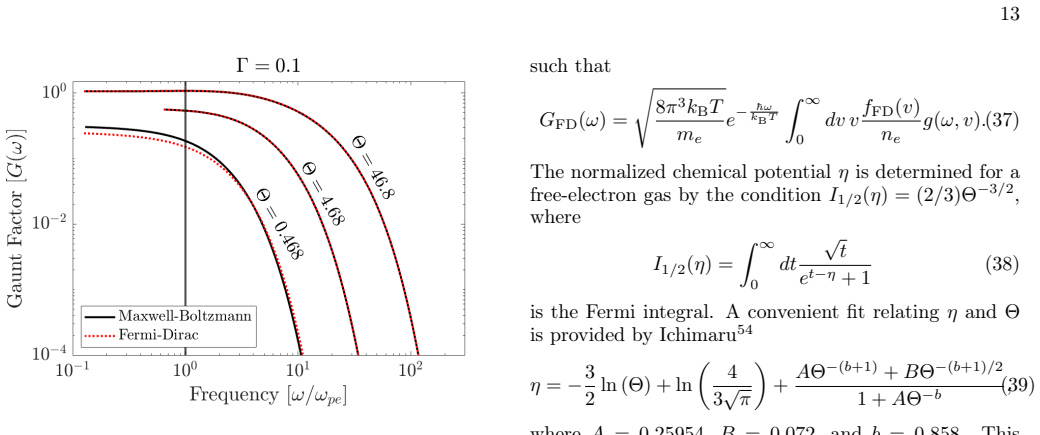
The paper's central claim is that the same mean force emission theory validated on repulsive systems describes electron-ion plasmas: at frequencies above the plasma frequency the emission coefficient is obtained by averaging the single-collision radiation spectrum over impact parameters and speeds in the potential of mean force, and at low frequencies it is reproduced by a Drude form whose collision frequency comes from mean force kinetic theory. Compared with molecular dynamics, the combined model matches the simulated spectra across the coupling strengths $\Gamma = 0.01$ to $1$ and the degeneracies studied, with exceptions the paper identifies: classically bound electron-ion states produce peaks that the two-body theory cannot capture (their locations are predicted by a circular-orbit model), and a peak near the plasma frequency at strong coupling is not produced by the standard Drude low-frequency form, though it also appears in repulsive, bound-state-free simulations and is attributed to correlated free-electron motion. The paper further argues that the emission coefficient, governed by the force autocorrelation function $\langle \dot{\mathbf{J}}(t)\cdot\dot{\mathbf{J}}(0)\rangle$, is related to absorption and to $\mathrm{Re}\,\sigma(\omega)$ by $j(\omega) = \omega^2 k_B T/(2\pi^2 c^3 \epsilon_0)\,\mathrm{Re}\,\sigma(\omega)$, so the framework extends to those transport coefficients. The Kelbg potential is used deliberately as a numerical proxy for quantum mechanics; the paper states it should not be read as an accurate description of physical warm dense matter, particularly at very high frequencies where the predicted decay disagrees with the Born approximation.
Load-bearing premise
The load-bearing assumption is that high-frequency emission can be treated as independent two-body electron-ion collisions moving in the equilibrium potential of mean force, with the surrounding plasma entering only through that equilibrium average; the paper tests this using a potential of mean force extracted from the very same molecular dynamics trajectories that produce the spectrum, not from an independent source, so collective dynamics beyond the average are not separately tested.
Editorial extensions
If this is right
- The same pair distribution function that defines the potential of mean force supplies both the high-frequency binary-collision spectrum and the low-frequency electron-ion collision frequency, so no radiation-specific parameter is needed.
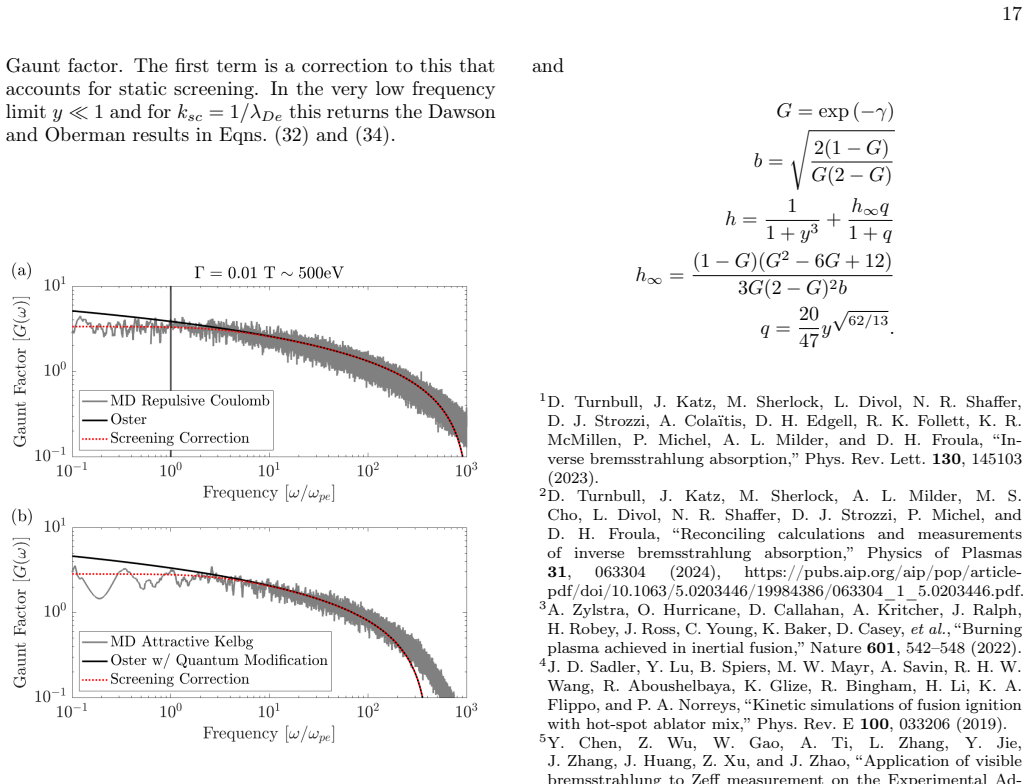
- Screening enters through the potential of mean force and produces a plateau near the plasma frequency that lowers the frequency-averaged Gaunt factor; screening therefore slightly reduces total bremsstrahlung power even in weakly coupled, non-degenerate plasmas.
- Because emission, absorption, and the real part of the dynamic conductivity share one linear-response formula, the conclusions of the study transfer to both transport coefficients, not just radiation.
- The Kelbg potential reproduces the quantum cutoffs inserted by hand into classical Gaunt factors at low frequency, but deviates from the Born approximation at very high frequencies, so the quantum decay of the spectrum is only qualitatively captured.
- The strong-coupling peak near the plasma frequency also appears in repulsive, bound-state-free simulations, indicating it comes from correlated free-electron motion; the standard Drude correction cannot produce it.
Reading between the lines
- The framework suggests a practical route to opacities and electrical conductivities of warm dense matter from static structural data alone, if $g_{ei}(r)$ can be supplied by experiment or by an integral-equation theory; the paper itself only tests the case where the pair distribution comes from the same MD run as the spectrum.
- A cleaner test of the two-body assumption would be to remove classically bound orbits from the MD spectra and check whether the residual free-electron spectrum matches mean force emission theory exactly over the full frequency range, not just where the bound-state peaks are absent.
- The link between the emission spectrum and $\mathrm{Re}\,\sigma(\omega)$ implies an experimentally accessible signature: optical conductivity measurements on a strongly coupled plasma should show the same near-plasma-frequency peak structure as the radiation spectrum, since the paper argues both trace to the same correlated electron motion.
- Replacing the Kelbg potential with a different short-range pseudopotential should shift the high-frequency cutoff but leave the low-frequency and plasma-frequency features unchanged; identifying which spectral features are insensitive to that choice would mark which predictions are stable signatures of the mean force concept.
Editorial analysis
A structured set of objections, weighed in public.
Referee Report
Summary. This paper extends mean force emission theory to attractively interacting electron-ion plasmas. Classical molecular dynamics simulations use a Kelbg pseudopotential for electron-ion interactions to avoid Coulomb collapse, and the bremsstrahlung emission coefficient is computed from the force autocorrelation function. The theory is built from two limits: high-frequency emission from isolated two-body collisions in the potential of mean force w_ei = -k_B T ln g_ei (Sec. IIIA, Eq. (24)) and low-frequency Drude-like emission with a mean-force kinetic-theory collision frequency (Sec. IIIB, Eq. (26)), combined into a comprehensive model by Eq. (27). The results are compared with MD spectra across Gamma = 0.01-1 and Theta = 0.468-468, including a discussion of bound-state peaks, classical and Born Gaunt factors, the plasma-frequency peak at strong coupling, and the relation between emission, absorption, and the real part of the dynamic conductivity via Eq. (14).
Significance. If validated, the framework provides a practical classical route to bremsstrahlung emission, absorption, and dynamic conductivity in strongly coupled plasmas, with the linear-response bridge in Eq. (14) making the conclusions transferable to transport coefficients. The paper's strengths include the explicit check of the autocorrelation formalism against the direct dipole formula (Fig. 7), the analytic screening correction derived in Appendix B, and a transparent qualitative account of Kelbg-scale and bound-state effects. The quantitative support is strongest for weakly coupled cases and for the high- and low-frequency limits. The current validation, however, is partly circular because the potential of mean force is taken from the same MD trajectories that provide the reference spectra; an independent source for w_ei would substantially strengthen the central claim.
major comments (3)
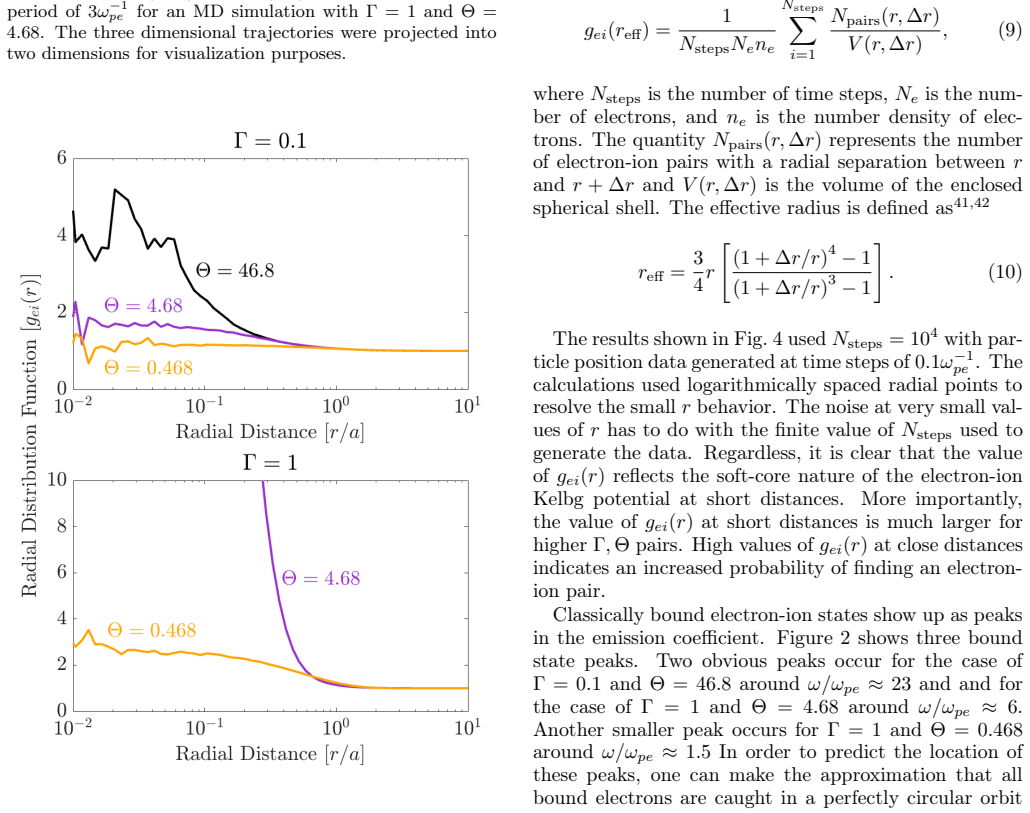
- [Sec. III, Eq. (22)] The main validation is partially circular. In every comparison shown in Figs. 8-10, the potential of mean force used in Eqs. (22)-(24) and in the collision frequency of Sec. IIIB is extracted from the same MD runs that generate the reference spectrum, via Eq. (9) followed by a smoothing spline. Agreement between theory and MD is therefore a consistency test of the mean-force reduction rather than an independent prediction for electron-ion plasmas. The manuscript notes at Eq. (22) that g_ei can be obtained from Ornstein-Zernike theory or hypernetted-chain closure, but it does not perform that independent computation. Please either recompute w_ei from an OZ/HNC closure (or another independent route) at the simulated conditions and repeat the spectral comparison, or provide a sensitivity study showing that the spectra are insensitive to the spline smoothing and to the small-r noise in g_ei. Without one of these, the conclusion that 'the same framework can be applied to describe electron-ion plasmas' is not fully supported.
- [Sec. IIIC, Eq. (27), Fig. 10] At strong coupling the comprehensive model does not reproduce the plasma-frequency peak, and the paper's argument that this peak is due to free-electron collective motion relies mainly on the comparison with the repulsive-Kelbg spectrum. The attractive MD case at Gamma = 1, Theta = 0.468 also contains bound-state contributions (Sec. IIB3), and no decomposition of the MD spectrum into free and bound parts is provided. The claim that the Drude correction 'cannot capture' this peak would be strengthened by isolating the free-electron contribution, for example by recomputing the spectrum from unbound trajectories only, or by a more quantitative comparison with a model that includes the oscillatory force autocorrelation at intermediate timescales.
- [Sec. IV, Eq. (43), Fig. 15] The piecewise model in Eq. (43) is used to compute the frequency-averaged Gaunt factor and the screening-induced reduction of total bremsstrahlung power, but the connection frequency x is never defined or determined. The numerical value of the screening correction in Fig. 15 depends on x, so the quantitative claim that screening 'slightly reduces the total bremsstrahlung power' is not fully specified. Please state how x is chosen (for example, by a continuity condition, a matching frequency, or a fit) and show the sensitivity of G-bar to x over a reasonable range.
minor comments (5)
- [Sec. IIA] The thermostat name should be 'Nosé-Hoover' rather than 'Nose-Hoover', and the text 'data.39.' appears to contain a typographical artifact from reference formatting.
- [Fig. 2 caption] The caption's scaling instructions ('multiplied by 10, 0.02, 10^-9') are easy to misread because the Gamma, Theta pairs are not aligned with the listed factors; a table or explicit per-curve labels would improve clarity.
- [Sec. IIB3, Eqs. (11)-(12)] The orbit-frequency argument in Fig. 5 is qualitative: the shaded 'important frequency' regions are based on a decrease in force and a decrease in bound-electron probability, but no occupancy weighting is given. Please state the weighting used to define the shaded regions or label them explicitly as heuristic ranges.
- [Sec. IVD, Fig. 13] The reported high-frequency decay power law of approximately (hbar omega/k_B T)^-4.1 is given without an error estimate or a stated fitting range; please specify how this exponent was extracted from the MD data.
- [Appendix B, Eq. (B7)] The Barry approximation introduces h, h_infty, q, and G in an order that is slightly confusing; defining all symbols before displaying the approximation would improve readability.
Circularity Check
Validation is partially self-referential: the potential of mean force is extracted from the same MD trajectories that serve as the reference spectrum.
-
fitted input called prediction
[Sec. III, Eqs. (9), (22), (24); Figs. 8-10]
"For the following results, we calculate the electron-ion radial distribution function from MD simulations using Eq. (9). In order to reduce noise the result is processed using a smoothing spline. ... The potential of mean force is related to the electron radial distribution function by wei(r) = -k_B T ln [gei(r)]."
The reference MD spectrum in Figs. 8-10 is computed from the same trajectories (Eqs. 5 and 13) whose electron-ion pair correlation g_ei is inserted into Eq. (22) to define the potential of mean force used in the high-frequency emission model of Eq. (24). No independent source of w_ei is used; the paper only lists Ornstein-Zernike theory as a possible alternative. The agreement is therefore a consistency check of the two-body-in-mean-force reduction, not an independent prediction, because the theory is given the exact equilibrium pair structure of the very system it is then asked to describe. The spline smoothing of the noisy small-r g_ei is an additional manual input affecting the force and hence the high-frequency spectrum.
-
fitted input called prediction
[Sec. IIIB, Eq. (26), Fig. 8]
"The collision frequency is calculated using mean force kinetic theory, where the potential of mean force is obtained from the MD simulations."
The low-frequency Drude emission j_l(omega) in Eq. (26) depends only on the plasma frequency, temperature, and the electron-ion collision frequency nu_ei. That collision frequency is not measured independently but is computed from mean force kinetic theory using the same MD-derived potential of mean force. Consequently, the low-frequency comparison with the MD spectrum inherits the equilibrium structure of the reference simulation. This is not a fit to the spectrum itself, so the reduction is not fully tautological, but it does mean the low-frequency validation does not test the theory against independent structural data.
full rationale
The central derivation is a genuine reduction, not a renaming. Equation (13) expresses the emission coefficient as a force autocorrelation; the high-frequency model replaces this with binary electron trajectories in the potential of mean force (Eqs. 22-24), and the low-frequency model uses a Langevin/Drude velocity autocorrelation with a mean-force collision frequency (Eqs. 25-26). These formulas are not definitionally identical to the MD spectrum: they require solving Newton's equations, averaging over speeds and impact parameters, and they fail to reproduce the bound-state peaks and the strong-coupling plasma-frequency peak, which shows nontrivial content. However, the validation loop is partly closed. In every comparison, w_ei = -k_B T ln g_ei is obtained from the same MD simulation that supplies the reference spectrum, with spline smoothing of noisy small-r data. The paper lists Ornstein-Zernike theory as an alternative source of w_ei but does not perform that independent test. Thus the agreement demonstrates internal consistency of the mean-force two-body reduction but does not yet establish independent predictive power for electron-ion plasmas. No spectral parameter is fitted to the target spectrum itself, and the self-citation to Ref. 12 is used as a derivation reference rather than as a uniqueness theorem, so the circularity is moderate.
Assumptions & free parameters
free parameters (4)
- gamma(T) (Kelbg fit parameter) =
gamma = (x + x^2)/(1 + a x + x^2), a = 1.090, x = sqrt(8*pi*T/315775)
- kmax cutoff in Appendix B =
kmax = 4/(e^(2*gamma) r_L) (classical) or 2/(e^(gamma/2) lambda) (quantum)
- Connection frequency x in piecewise model (Eq. 43) =
Not given explicitly; chosen as the crossing point between Drude and Born Gaunt factors
- Smoothing spline parameter for g_ei(r) =
Not given
assumptions (6)
- domain assumption Electron-ion interactions in the classical MD can be represented by the Kelbg potential, a quantum statistical pseudopotential, without loss of the physics relevant to bremsstrahlung.
- domain assumption The potential of mean force w_ei(r) = -k_B T ln g_ei(r) can be used as the effective interaction in binary collision dynamics to compute the high-frequency emission spectrum.
- domain assumption The electron velocity autocorrelation function decays as a single exponential with rate nu_ei (Langevin/Drude model).
- domain assumption Electron and ion density fluctuations are statistically decoupled, allowing factorization of the quadruple correlation in Eq. (A5).
- domain assumption Ions are static on the timescales contributing to high-frequency emission, so S_ii(k, omega') = S_ii(k) delta(omega').
- domain assumption The system is in thermal equilibrium with a common temperature T_e = T_i, and the electron velocity distribution is Maxwellian in the classical MD (except in the separate Fermi-Dirac discussion).
Cite this review
Pith. "Pith review of Mean Force Emission Theory for Classical Bremsstrahlung in Electron-Ion Plasmas." pith.science (2026). https://pith.science/paper/TWACP222
@misc{pith2026250606177,
  author       = {Pith},
  title        = {Pith review of: Mean Force Emission Theory for Classical Bremsstrahlung in Electron-Ion Plasmas},
  year         = {2026},
  howpublished = {\url{https://pith.science/paper/TWACP222}},
  note         = {Machine review of arXiv:2506.06177}
}
read the original abstract
This work extends the previously developed mean force emission theory to describe electron-ion plasmas. Results are compared to molecular dynamics simulations. The main extensions are to account for the attractive nature of electron-ion interactions and to model short-range quantum effects using the Kelbg potential. By reducing the electron-ion force inside the deBroglie wavelength, the Kelbg potential causes a decay at high frequencies and a decrease in magnitude of the low frequency bremsstrahlung spectrum. The attractive electron-ion interaction also allows for classically bound states that show up as peaks in the emission spectrum. Results show that the Kelbg potential can capture quantum modifications to classical Gaunt factors, but is limited in describing emission at very high frequencies. This work further supports the notion that there is a peak in emission near the plasma frequency at strong coupling that cannot be captured using the common Drude correction. Importantly, the linear response framework used to calculate the bremsstrahlung emission coefficient is related to both the absorption coefficient and the real part of the dynamic electrical conductivity. This means that the conclusions drawn from this study can be applied to these transport coefficients as well. Finally, this work compares the results with commonly used classical and quantum mechanical Gaunt factors, and discusses the impact of a Fermi-Dirac distribution of electrons on emission and why screening slightly reduces the bremsstrahlung power in weakly coupled and non-degenerate plasmas.
Figures


Figures from the paper (13 more)




Reference graph
Works this paper leans on
-
[1]
author author D. Turnbull , author J. Katz , author M. Sherlock , author L. Divol , author N. R. \ Shaffer , author D. J. \ Strozzi , author A. Cola\" tis , author D. H. \ Edgell , author R. K. \ Follett , author K. R. \ McMillen , author P. Michel , author A. L. \ Milder ,\ and\ author D. H. \ Froula ,\ title title Inverse bremsstrahlung absorption , \ h...
-
[2]
author author D. Turnbull , author J. Katz , author M. Sherlock , author A. L. \ Milder , author M. S. \ Cho , author L. Divol , author N. R. \ Shaffer , author D. J. \ Strozzi , author P. Michel ,\ and\ author D. H. \ Froula ,\ title title Reconciling calculations and measurements of inverse bremsstrahlung absorption , \ https://doi.org/10.1063/5.0203446...
-
[3]
Zylstra , author O
author author A. Zylstra , author O. Hurricane , author D. Callahan , author A. Kritcher , author J. Ralph , author H. Robey , author J. Ross , author C. Young , author K. Baker , author D. Casey , et al. ,\ title title Burning plasma achieved in inertial fusion , \ @noop journal journal Nature \ volume 601 ,\ pages 542--548 ( year 2022 ) NoStop
2022
-
[4]
author author J. D. \ Sadler , author Y. Lu , author B. Spiers , author M. W. \ Mayr , author A. Savin , author R. H. W. \ Wang , author R. Aboushelbaya , author K. Glize , author R. Bingham , author H. Li , author K. A. \ Flippo ,\ and\ author P. A. \ Norreys ,\ title title Kinetic simulations of fusion ignition with hot-spot ablator mix , \ https://doi....
-
[5]
author author Y. Chen , author Z. Wu , author W. Gao , author A. Ti , author L. Zhang , author Y. Jie , author J. Zhang , author J. Huang , author Z. Xu ,\ and\ author J. Zhao ,\ title title Application of visible bremsstrahlung to Zeff measurement on the Experimental Advanced Superconducting Tokamak , \ https://doi.org/10.1063/1.4908200 journal journal R...
-
[6]
author author J. N. \ Imamura ,\ title title On the stability properties of whire dwarf radiative shocks. \ https://doi.org/10.1086/163426 journal journal \ volume 296 ,\ pages 128--141 ( year 1985 ) NoStop
-
[7]
author author K. Mukai ,\ title title X-ray emissions from accreting white dwarfs: A review , \ https://doi.org/10.1088/1538-3873/aa6736 journal journal Publications of the Astronomical Society of the Pacific \ volume 129 ,\ pages 062001 ( year 2017 ) NoStop
-
[8]
author author S. Campana , author L. Stella , author G. L. \ Israel , author A. Moretti , author A. N. \ Parmar ,\ and\ author M. Orlandini ,\ title title The quiescent x-ray emission of three transient x-ray pulsars , \ https://doi.org/10.1086/343074 journal journal The Astrophysical Journal \ volume 580 ,\ pages 389 ( year 2002 ) NoStop
Show all 57 references
-
[9]
Zhang , author P
author author P. Zhang , author P. Zucca , author K. Kozarev , author E. Carley , author C. Wang , author T. Franzen , author B. Dabrowski , author A. Krankowski , author J. Magdalenic ,\ and\ author C. Vocks ,\ title title Imaging of the quiet sun in the frequency range of 20...
-
[10]
Nishihara , author A
author author K. Nishihara , author A. Sunahara , author A. Sasaki , author M. Nunami , author H. Tanuma , author S. Fujioka , author Y. Shimada , author K. Fujima , author H. Furukawa , author T. Kato , author F. Koike , author R. More , author M. Murakami , author T. Nishika...
-
[11]
Campos , author S
author author D. Campos , author S. S. \ Harilal ,\ and\ author A. Hassanein ,\ title title The effect of laser wavelength on emission and particle dynamics of Sn plasma , \ https://doi.org/10.1063/1.3493118 journal journal Journal of Applied Physics \ volume 108 ,\ pages 1133...
-
[12]
author author J. P. \ Kinney , author H. J. \ LeFevre , author C. C. \ Kuranz ,\ and\ author S. D. \ Baalrud ,\ title title Mean force emission theory for classical bremsstrahlung in strongly coupled plasmas , \ https://doi.org/10.1063/5.0202211 journal journal Physics of Plas...
-
[13]
author author G. Kelbg ,\ title title Theorie des quanten-plasmas , \ https://doi.org/https://doi.org/10.1002/andp.19634670308 journal journal Annalen der Physik \ volume 467 ,\ pages 219--224 ( year 1963 ) ,\ https://arxiv.org/abs/https://onlinelibrary.wiley.com/doi/pdf/10.10...
1963 doi
-
[14]
author author A. V. \ Filinov , author M. Bonitz ,\ and\ author W. Ebeling ,\ title title Improved kelbg potential for correlated coulomb systems , \ https://doi.org/10.1088/0305-4470/36/22/317 journal journal Journal of Physics A: Mathematical and General \ volume 36 ,\ pages...
-
[15]
Johnson , author C
author author W. Johnson , author C. Guet ,\ and\ author G. Bertsch ,\ title title Optical properties of plasmas based on an average-atom model , \ https://doi.org/https://doi.org/10.1016/j.jqsrt.2005.05.026 journal journal Journal of Quantitative Spectroscopy and Radiative Tr...
2005 doi
-
[16]
author author C. Starrett ,\ title title Kubo–greenwood approach to conductivity in dense plasmas with average atom models , \ https://doi.org/https://doi.org/10.1016/j.hedp.2016.04.001 journal journal High Energy Density Physics \ volume 19 ,\ pages 58--64 ( year 2016 ) NoStop
2016 doi
-
[17]
Shaffer , author N
author author N. Shaffer , author N. Ferris , author J. Colgan , author D. Kilcrease ,\ and\ author C. Starrett ,\ title title Free-free opacity in dense plasmas with an average atom model , \ https://doi.org/https://doi.org/10.1016/j.hedp.2017.02.008 journal journal High Ener...
-
[18]
Bekefi ,\ title title Radiation processes in plasmas , \ @noop journal journal Wiley series in plasma physics \ ( year 1966 ) NoStop
author author G. Bekefi ,\ title title Radiation processes in plasmas , \ @noop journal journal Wiley series in plasma physics \ ( year 1966 ) NoStop
1966
-
[19]
Dawson \ and\ author C
author author J. Dawson \ and\ author C. Oberman ,\ title title High‐Frequency Conductivity and the Emission and Absorption Coefficients of a Fully Ionized Plasma , \ https://doi.org/10.1063/1.1706652 journal journal The Physics of Fluids \ volume 5 ,\ pages 517--524 ( year 19...
-
[20]
Oster ,\ title title Emission, absorption, and conductivity of a fully ionized gas at radio frequencies , \ https://doi.org/10.1103/RevModPhys.33.525 journal journal Rev
author author L. Oster ,\ title title Emission, absorption, and conductivity of a fully ionized gas at radio frequencies , \ https://doi.org/10.1103/RevModPhys.33.525 journal journal Rev. Mod. Phys. \ volume 33 ,\ pages 525--543 ( year 1961 ) NoStop
-
[21]
author author B. M. \ Haines ,\ title title Charged particle transport coefficient challenges in high energy density plasmas , \ https://doi.org/10.1063/5.0197128 journal journal Physics of Plasmas \ volume 31 ,\ pages 050501 ( year 2024 ) ,\ https://arxiv.org/abs/https://pubs...
-
[22]
austlin , author L. F. \ Cao , author T. D\
author author U. Zastrau , author C. Fortmann , author R. R. \ F\"austlin , author L. F. \ Cao , author T. D\"oppner , author S. D\"usterer , author S. H. \ Glenzer , author G. Gregori , author T. Laarmann , author H. J. \ Lee , author A. Przystawik , author P. Radcliffe , aut...
-
[23]
author author S. X. \ Hu , author L. A. \ Collins , author T. R. \ Boehly , author J. D. \ Kress , author V. N. \ Goncharov ,\ and\ author S. Skupsky ,\ title title First-principles thermal conductivity of warm-dense deuterium plasmas for inertial confinement fusion applicatio...
-
[24]
author author L. D. \ Landau \ and\ author E. Lifshitz ,\ title title The classical theory of fields , \ @noop journal journal Course of theoretical physics-Pergamon International Library of Science \ ( year 1971 ) NoStop
1971
-
[25]
Sommerfeld ,\ @noop title Atombau und spektrallinien ,\ Vol
author author A. Sommerfeld ,\ @noop title Atombau und spektrallinien ,\ Vol. volume 1 \ ( publisher F. Vieweg & sohn akt.-ges. ,\ year 1924 ) NoStop
1924
-
[26]
author author J. P. \ Hansen \ and\ author I. R. \ McDonald ,\ title title Microscopic simulation of a hydrogen plasma , \ https://doi.org/10.1103/PhysRevLett.41.1379 journal journal Phys. Rev. Lett. \ volume 41 ,\ pages 1379--1382 ( year 1978 ) NoStop
-
[27]
author author E. H. \ Lieb ,\ title title The stability of matter , \ https://doi.org/10.1103/RevModPhys.48.553 journal journal Rev. Mod. Phys. \ volume 48 ,\ pages 553--569 ( year 1976 ) NoStop
1976 doi
-
[28]
author author A. V. \ Filinov , author V. O. \ Golubnychiy , author M. Bonitz , author W. Ebeling ,\ and\ author J. W. \ Dufty ,\ title title Temperature-dependent quantum pair potentials and their application to dense partially ionized hydrogen plasmas , \ https://doi.org/10....
-
[29]
author author F. R. \ Graziani , author V. S. \ Batista , author L. X. \ Benedict , author J. I. \ Castor , author H. Chen , author S. N. \ Chen , author C. A. \ Fichtl , author J. N. \ Glosli , author P. E. \ Grabowski , author A. T. \ Graf , author S. P. \ Hau-Riege , author...
-
[30]
author author G. B. \ Rybicki \ and\ author A. P. \ Lightman ,\ @noop title Radiative Processes in Astrophysics \ ( publisher John Wiley and Sons, Inc. ,\ year 1979 ) NoStop
1979
-
[31]
Morozov , author H
author author I. Morozov , author H. Reinholz , author G. R\"opke , author A. Wierling ,\ and\ author G. Zwicknagel ,\ title title Molecular dynamics simulations of optical conductivity of dense plasmas , \ https://doi.org/10.1103/PhysRevE.71.066408 journal journal Phys. Rev. ...
-
[32]
author author A. P. \ Thompson , author H. M. \ Aktulga , author R. Berger , author D. S. \ Bolintineanu , author W. M. \ Brown , author P. S. \ Crozier , author P. J. \ in 't Veld , author A. Kohlmeyer , author S. G. \ Moore , author T. D. \ Nguyen , author R. Shan , author M...
-
[33]
author author S. K. \ Tiwari , author N. R. \ Shaffer ,\ and\ author S. D. \ Baalrud ,\ title title Thermodynamic state variables in quasiequilibrium ultracold neutral plasma , \ https://doi.org/10.1103/PhysRevE.95.043204 journal journal Phys. Rev. E \ volume 95 ,\ pages 04320...
-
[34]
author author N. R. \ Shaffer \ and\ author S. D. \ Baalrud ,\ title title The Barkas effect in plasma transport , \ https://doi.org/10.1063/1.5089140 journal journal Physics of Plasmas \ volume 26 ,\ pages 032110 ( year 2019 ) ,\ https://arxiv.org/abs/https://pubs.aip.org/aip...
-
[35]
Devriendt \ and\ author O
author author R. Devriendt \ and\ author O. Poujade ,\ title title Classical molecular dynamic simulations and modeling of inverse bremsstrahlung heating in low Z weakly coupled plasmas , \ https://doi.org/10.1063/5.0091662 journal journal Physics of Plasmas \ volume 29 ,\ pag...
-
[36]
Golubnychiy , author M
author author V. Golubnychiy , author M. Bonitz , author D. Kremp ,\ and\ author M. Schlanges ,\ title title Dynamical properties and plasmon dispersion of a weakly degenerate correlated one-component plasma , \ https://doi.org/10.1103/PhysRevE.64.016409 journal journal Phys. ...
-
[37]
author author G. S. \ Demyanov \ and\ author P. R. \ Levashov ,\ https://arxiv.org/abs/2205.09885 title Derivation of the kelbg potential/functional , \ ( year 2022 ),\ https://arxiv.org/abs/2205.09885 arXiv:2205.09885 [physics.plasm-ph] NoStop
2022 arXiv
-
[38]
Frenkel \ and\ author B
author author D. Frenkel \ and\ author B. Smit ,\ @noop title Understanding molecular simulation: from algorithms to applications \ ( publisher Elsevier ,\ year 2023 ) NoStop
2023
-
[39]
Savitzky \ and\ author M
author author A. Savitzky \ and\ author M. J. \ Golay ,\ title title Smoothing and differentiation of data by simplified least squares procedures. \ @noop journal journal Analytical chemistry \ volume 36 ,\ pages 1627--1639 ( year 1964 ) NoStop
1964
-
[40]
Daligault ,\ title title Diffusion in ionic mixtures across coupling regimes , \ https://doi.org/10.1103/PhysRevLett.108.225004 journal journal Phys
author author J. Daligault ,\ title title Diffusion in ionic mixtures across coupling regimes , \ https://doi.org/10.1103/PhysRevLett.108.225004 journal journal Phys. Rev. Lett. \ volume 108 ,\ pages 225004 ( year 2012 ) NoStop
2012 doi
-
[41]
Mithen \ and\ author M
author author J. Mithen \ and\ author M. J. P. \ Mithen ,\ title Molecular dynamics simulations of the equilibrium dynamics of non-ideal plasmas ,\ @noop Ph.D. thesis ,\ school Oxford University, UK ( year 2012 ) NoStop
2012
-
[42]
author author P. D. \ Poll , author N. W. \ Ashcroft ,\ and\ author H. E. \ DeWitt ,\ title title One-component plasma bridge function , \ https://doi.org/10.1103/PhysRevA.37.1672 journal journal Phys. Rev. A \ volume 37 ,\ pages 1672--1678 ( year 1988 ) NoStop
-
[43]
author author J. J. \ Sakurai \ and\ author J. Napolitano ,\ title title Modern quantum mechanics , \ @noop journal journal Addison-Wesley \ ( year 2011 ) NoStop
2011
-
[44]
\ Hansen \ and\ author I
author author J.-P. \ Hansen \ and\ author I. R. \ McDonald ,\ @noop title Theory of simple liquids: with applications to soft matter \ ( publisher Academic press ,\ year 2013 ) NoStop
2013
-
[45]
Kubo ,\ title title Statistical-mechanical theory of irreversible processes
author author R. Kubo ,\ title title Statistical-mechanical theory of irreversible processes. i. general theory and simple applications to magnetic and conduction problems , \ https://doi.org/10.1143/JPSJ.12.570 journal journal Journal of the Physical Society of Japan \ volume...
-
[46]
Dufty , author J
author author J. Dufty , author J. Wrighton , author K. Luo ,\ and\ author S. Trickey ,\ title title On the kubo-greenwood model for electron conductivity , \ https://doi.org/https://doi.org/10.1002/ctpp.201700102 journal journal Contributions to Plasma Physics \ volume 58 ,\ ...
-
[47]
author author S. D. \ Baalrud \ and\ author J. Daligault ,\ title title Mean force kinetic theory: A convergent kinetic theory for weakly and strongly coupled plasmas , \ https://doi.org/10.1063/1.5095655 journal journal Physics of Plasmas \ volume 26 ,\ pages 082106 ( year 20...
-
[48]
van Leeuwen , author J
author author J. van Leeuwen , author J. Groeneveld ,\ and\ author J. de Boer ,\ title title New method for the calculation of the pair correlation function. i , \ https://doi.org/https://doi.org/10.1016/0031-8914(59)90004-7 journal journal Physica \ volume 25 ,\ pages 792--80...
-
[49]
author author S. D. \ Baalrud \ and\ author J. Daligault ,\ title title Effective potential theory for transport coefficients across coupling regimes , \ https://doi.org/10.1103/PhysRevLett.110.235001 journal journal Phys. Rev. Lett. \ volume 110 ,\ pages 235001 ( year 2013 ) NoStop
-
[50]
Wierling , author T
author author A. Wierling , author T. Millat ,\ and\ author G. R\" o pke ,\ title title Classical bremsstrahlung in a non-ideal plasma with effective interaction , \ https://doi.org/10.1017/S0022377803002538 journal journal Journal of Plasma Physics \ volume 70 ,\ pages 185–19...
-
[51]
author author F. Perrot ,\ title title New approximation for calculating free-free absorption in hot dense plasmas , \ https://doi.org/10.1017/S0263034600010430 journal journal Laser and Particle Beams \ volume 14 ,\ pages 731–748 ( year 1996 ) NoStop
-
[52]
author author J. A. \ Gaunt \ and\ author R. H. \ Fowler ,\ title title Continuous absorption , \ https://doi.org/10.1098/rsta.1930.0005 journal journal Philosophical Transactions of the Royal Society of London. Series A, Containing Papers of a Mathematical or Physical Charact...
1930
-
[53]
author author R. R. \ Johnston ,\ title title Free-free radiative transitions—a survey of theoretical results , \ https://doi.org/https://doi.org/10.1016/0022-4073(67)90001-5 journal journal Journal of Quantitative Spectroscopy and Radiative Transfer \ volume 7 ,\ pages 815--8...
-
[54]
Ichimaru ,\ title title Statistical plasma physics, volume i: Basic principles , \ @noop journal journal CRC Press \ ( year 2004 ) NoStop
author author S. Ichimaru ,\ title title Statistical plasma physics, volume i: Basic principles , \ @noop journal journal CRC Press \ ( year 2004 ) NoStop
2004
-
[55]
author author J. D. \ Huba ,\ @noop title NRL plasma formulary ,\ Vol.\ volume 6790 \ ( publisher Naval Research Laboratory ,\ year 1998 ) NoStop
1998
-
[56]
author author C. A. \ Iglesias \ and\ author S. J. \ Rose ,\ title title Corrections to bremsstrahlung and thomson scattering at the solar center , \ https://doi.org/10.1086/310172 journal journal The Astrophysical Journal \ volume 466 ,\ pages L115 ( year 1996 ) NoStop
-
[57]
Barry , author J.-Y
author author D. Barry , author J.-Y. \ Parlange ,\ and\ author L. Li ,\ title title Approximation for the exponential integral (theis well function) , \ https://doi.org/https://doi.org/10.1016/S0022-1694(99)00184-5 journal journal Journal of Hydrology \ volume 227 ,\ pages 28...
Reviewed August 7, 2026 · model on record in the stance chip above.
Discussion (0). Sign in to comment.