REVIEW 1 major objections 4 minor 25 references
Trees whose path ideals have linear quotients
T0 review · 1 major / 4 minor · reviewed 2026-08-07 · deepseek-v4-flash
Pith's one-line read Tree n-path ideals are linear exactly when a finite obstruction list is absent
desk verdict A clean and likely-true classification of trees whose n-path ideals have linear quotients, but the proof currently rests on a gap in the trimming lemma that looks repairable. read the letter →
The pith
A machine-rendered reading of the paper's core claim, the machinery that carries it, and where it could break.
The reading
What carries the argument
The load-bearing mechanism is the trimming operation. For a tree satisfying condition (F_n)—diameter between n−1 and 2n−1 and none of the forbidden induced subgraphs—trim(G) is the induced subgraph on the closed neighbourhoods of the vertices of a longest path. The key reduction, Lemma 4.5, proves J_n(G)=J_n(trim(G)); trim(G) is a caterpillar tree, so the whole problem reduces to path ideals of caterpillar trees, where the minimal generators have an explicit form. The proof of linear quotients then proceeds by ordering those generators with a carefully chosen lexicographic order and checking that every colon ideal is generated by variables.
What would settle it
Search for a tree G satisfying condition (F_n) together with an n-vertex path having at least one vertex outside the closed neighbourhoods of a chosen diameter path; such a tree would disprove Lemma 4.5, and a computer search over small trees could look for it. A direct computation of reg(J_4(L_{5,3})) or reg(J_n(L_{n,k})) would instead test the regularity estimates in Lemmas 3.3 and 3.4.
Extended reading notes
Core claim
The central discovery is Theorem 5.1: for a tree G and n≥4, the conditions 'J_n(G) has linear quotients', 'J_n(G) has linear resolution', and 'G avoids the forbidden induced subgraphs' coincide. The forbidden list is P_n+P_n for all n≥4, L_{n,k} for k∈[3,(n+1)/2] when n≥5, and additionally L_{5,3} when n=4. The equivalence is established by showing that in the absence of these subgraphs, G satisfies condition (F_n), which forces J_n(G)=J_n(trim(G)) with trim(G) a caterpillar tree; the trimmed ideal is then shown to have linear quotients by a lexicographic ordering of its minimal generators.
Load-bearing premise
The proof depends on Lemma 4.5, which asserts that under condition (F_n) every n-vertex path of G lies inside trim(G); if that statement fails for some tree, the reduction to caterpillar trees—and with it the implication from the forbidden-subgraph condition to linear quotients—does not go through.
Editorial extensions
If this is right
- For any fixed n≥4, deciding whether a tree's n-path ideal has linear quotients or linear resolution becomes a finite check for induced P_n+P_n and L_{n,k}.
- The trimming lemma gives an explicit caterpillar tree that computes the path ideal, so generators of J_n(G) can be listed directly for such trees.
- Since linear quotients implies linear resolution and the theorem gives the reverse implication for trees, the two properties never diverge for n≥4 tree path ideals.
- The classification extends the known n=2 and n=3 results (edge ideals and connected ideals) to every n, with the single exceptional obstruction L_{5,3} appearing only at n=4.
Reading between the lines
- One could test whether the same obstruction list characterizes linear quotients for graphs beyond trees, such as chordal graphs or graphs with a single cycle, using the trimming construction as a starting point.
- The trimming idea may transfer to path ideals of directed graphs or to connected ideals, since the phenomenon that adding edges does not always add generators appears there too.
- The special role of L_{5,3} for n=4 suggests that exceptional small obstructions may arise in other families, and the L_{n,k} family could have further members relevant to other values of n.
Editorial analysis
A structured set of objections, weighed in public.
Referee Report
Summary. The paper studies n-path ideals J_n(G) of trees. For n≥4 it claims a complete classification: J_n(G) has linear quotients if and only if it has linear resolution if and only if G avoids certain induced subgraphs, namely P_n+P_n and L_{n,k} for 3≤k≤(n+1)/2, with the additional exception L_{5,3} for n=4. The proof introduces a trimming operation that, under the avoidance condition, replaces any tree by a caterpillar tree with the same path ideal, and then establishes linear quotients via an explicit lexicographic order on the minimal generators. The necessity direction is shown by regularity computations using Eliahou-Kervaire splittings.
Significance. If the proof is completed, the result would give a clean combinatorial characterization linking linear quotients and linear resolution for path ideals of trees, extending the known cases n=2,3. The trimming reduction is an interesting idea that may be useful beyond this paper. The paper is largely self-contained and the computations with Eliahou-Kervaire splittings are explicit and checkable. The main caveat is that the trimming lemma, which is the key reduction, currently has a gap in one subcase of its proof.
major comments (1)
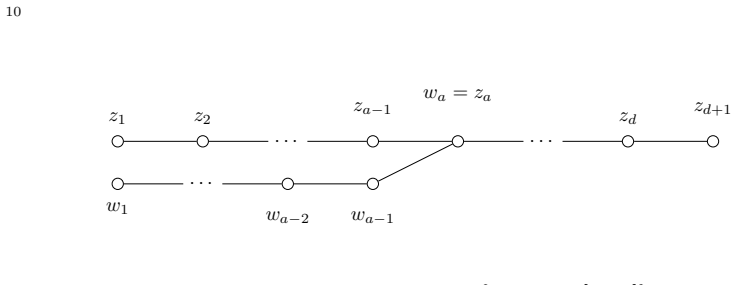
- [Lemma 4.5, Case 2 (Section 4)] The proof of Lemma 4.5, Case 2, asserts that the induced subgraph on the vertex set {z_1,...,z_n} ∪ {w_{s-u+1},...,w_{s-1}} is isomorphic to L_{n,u}. This is not established. Claim 4.6 only proves that the path z_1,...,z_n intersects the diameter path, and after setting w_s=z_u the proof derives u≤s≤(d+2)/2. These inequalities do not determine the direction in which the z-path continues after z_u. If z_{u+1}=w_{s-1}, then the w-vertices in the displayed set already belong to the z-path, and the induced subgraph is a path (or a path with a pendant), not L_{n,u}. For example, with n=6, d=6, s=4, u=4, and z=(z_1,z_2,z_3,w_4,w_3,w_2), all conditions before Case 2 are satisfied and the displayed set induces a 7-vertex path. The proof gives no argument excluding this subcase; it may be that this configuration is forbidden by a different induced L_{n,k}, but the proof does not exhibit one. Since Lemma 4.5 is the only step that reduces an arbitrary tree satisfying (F_n) to a caterpillar tree in the proof of Theorem 5.1, this gap is load-bearing. The subcase appears to be repairable, for instance by using the opposite tail {w_{s+1},...,w_{s+u-1}} when the z-path runs backward along the diameter path, but that argument is not in the manuscript.
minor comments (4)
- [Section 3, Lemma 3.2] The displayed vertex set "y_{2k−n}, y_{n−k+1}, . . . , y_{k−1}" does not define the intended segment; the correct set for the claimed isomorphism is {y_{2k−n},...,y_{k−1}} (followed by reversing the x-path). As printed, the argument is hard to follow.
- [Section 5, Propositions 5.4 and 5.5] The subscript "i−n+3" in "x_{i−n+3,k}" is a typo for "i+n−3"; the same typo appears in subcase (c) of Proposition 5.5. This makes the containment (m':m) ⊆ (...) appear to refer to nonexistent variables.
- [Section 5, proof of Theorem 5.1] The notation "LN_G(x_{n−2}) = LN_G(x_{n+1}) = 0" should read "= ∅" (or "is empty"), since the left-hand side is a set.
- [Introduction, paragraph on path ideals] The statement "J_4(G) = (0) for any star graph G" should specify that the star must have at least n vertices; otherwise, when the vertex count is smaller than n, the statement is vacuously true but the wording may be confusing.
Circularity Check
No circularity: the derivation is self-contained, using external standard results and explicit combinatorial arguments; the trimming step is graph-theoretic, not defined in terms of J_n(G).
full rationale
The paper's central claims do not reduce to their inputs. The implication (1)⇒(2) uses the external Herzog–Hibi theorem (Lemma 2.1), and (2)⇒(3) uses the external Restriction Lemma (Lemmas 2.2, 2.3) together with explicit regularity computations for P_n+P_n and the newly introduced obstructions L_{n,k} (Lemmas 3.1, 3.3, 3.4). The only potentially load-bearing internal step, Lemma 4.5, is not circular: trim(G) is defined purely graph-theoretically as the induced subgraph on the closed neighborhoods of a diameter path, independently of J_n(G), and the equality J_n(G)=J_n(trim(G)) is then argued combinatorially via branching considerations and forbidden induced subgraphs. The subsequent reduction to caterpillar trees is then verified by explicit lex-order colon-ideal checks in Propositions 5.4–5.6. There are no fitted parameters, no predictions statistically forced by a fit, and no load-bearing self-citations. The only self-citation appears in the introduction, where reference [8] is mentioned as related work on regularity of path ideals of caterpillar graphs; it is not used in the proof of the main theorem. The skeptical concern about a possible gap in Case 2 of Lemma 4.5 is a correctness issue, not a circularity issue: even if that argument were incomplete, the claim would not be assumed or defined into existence. This paper is therefore self-contained against external benchmarks and should receive a circularity score of 0.
Assumptions & free parameters
assumptions (4)
- standard math Equigenerated monomial ideals with linear quotients have linear resolution (Lemma 2.1, from [15]).
- standard math Restriction lemmas for linear resolution and linear quotients (Lemmas 2.2 and 2.3).
- standard math Eliahou-Kervaire splitting regularity formulas (Lemma 2.5 and [11, Corollary 2.7]).
- domain assumption Harary-Schwenk theorem: a tree without the subdivided claw L_{5,3} as an induced subgraph is a caterpillar.
Cite this review
Pith. "Pith review of Trees whose path ideals have linear quotients." pith.science (2026). https://pith.science/paper/GLQCRRI2
@misc{pith2026250606209,
  author       = {Pith},
  title        = {Pith review of: Trees whose path ideals have linear quotients},
  year         = {2026},
  howpublished = {\url{https://pith.science/paper/GLQCRRI2}},
  note         = {Machine review of arXiv:2506.06209}
}
abstract
For any integer $n$, we classify all trees whose $n$-path ideals have linear quotients.
Figures


Figures from the paper (5 more)


Reference graph
Works this paper leans on
-
[1]
A. Alilooee and S. Faridi,Graded Betti numbers of path ideals of cycles and lines, J. Algebra Appl.17 (2018), no. 1, 1850011, 17. MR 3741068 1
work page 2018
-
[2]
Ali Alilooee and Sara Faridi,On the resolution of path ideals of cycles, Communications in Algebra43 (2015), 5413–5433. 1
work page 2015
-
[3]
H. Ananthnarayan, Omkar Javadekar, and Aryaman Maithani,Linear quotients of connected ideals of graphs, J Algebr Comb34(2025), no. 61. 2, 7
work page 2025
- [4]
-
[5]
Rachelle R. Bouchat and Tricia Muldoon Brown,Multi-graded betti numbers of path ideals of trees, Journal of Algebra and its Applications16(2017). 1
work page 2017
-
[6]
Rachelle R. Bouchat, Huy T` ai H` a, and Augustine O’keefe,Path ideals of rooted trees and their graded betti numbers, Journal of Combinatorial Theory. Series A118(2011), 2411–2425. 1
work page 2011
-
[7]
Aldo Conca and Emanuela De Negri,M-sequences, graph ideals, and ladder ideals of linear type, J. Algebra 211(1999), no. 2, 599–624. MR 1666661 1
work page 1999
-
[8]
Kanoy Kumar Das, Amit Roy, and Kamalesh Saha,On the path ideals of chordal graphs, arXiv:2405.15897 (2024). 2
arXiv 2024
Show all 25 references
-
[9]
Nursel Erey,Multigraded Betti numbers of some path ideals, Combinatorial structures in algebra and geom- etry, Springer Proc. Math. Stat., vol. 331, Springer, Cham, 2020, pp. 51–65. MR 4143240 1
2020
-
[10]
Fatabbi,On the resolution of ideals of fat points, J
G. Fatabbi,On the resolution of ideals of fat points, J. Algebra242(2001), no. 1, 92–108. MR 1844699 5
2001
-
[11]
Francisco, Huy T` ai H` a, and Adam Van Tuyl,Splittings of monomial ideals, Proceedings of the American Mathematical Society137(2009), no
Christopher A. Francisco, Huy T` ai H` a, and Adam Van Tuyl,Splittings of monomial ideals, Proceedings of the American Mathematical Society137(2009), no. 10, 3271–3282. 5, 7
2009
-
[12]
Ralf Fr¨ oberg,On Stanley-Reisner rings, Banach Center Publications26(1990), 57–70. 1
1990
-
[13]
Hang and T
N.T. Hang and T. Vu,Projective dimension and regularity of 3-path ideals of unicyclic graphs, Graphs and Combinatorics41(2025), no. 18. 2
2025
-
[14]
MR 288047 9, 10
Frank Harary and Allen Schwenk,Trees with hamiltonian square, Mathematika18(1971), 138–140. MR 288047 9, 10
1971
-
[15]
260, Springer- Verlag London, Ltd., London, 2011
J¨ urgen Herzog and Takayuki Hibi,Monomial ideals, Graduate Texts in Mathematics, vol. 260, Springer- Verlag London, Ltd., London, 2011. MR 2724673 4
2011
-
[16]
Scand.95(2004), no
J¨ urgen Herzog, Takayuki Hibi, and Xinxian Zheng,Monomial ideals whose powers have a linear resolution, Math. Scand.95(2004), no. 1, 23–32. MR 2091479 4, 7
2004
-
[17]
2, 277–294, The Roos Festschrift volume, 2
J¨ urgen Herzog and Yukihide Takayama,Resolutions by mapping cones, Homology Homotopy Appl.4(2002), no. 2, 277–294, The Roos Festschrift volume, 2. MR 1918513 1
2002
-
[18]
J¨ urgen Herzog, Somayeh Moradi, Masoomeh Rahimbeigi, and Zhu Guangjun,Homological shift ideals, Col- lect. Math. (2021), 157–174. 4
2021
-
[19]
Ali Soleyman Jahan and Xinxian Zheng,Ideals with linear quotients, J. Combin. Theory Ser. A117(2010), no. 1, 104–110. MR 2557882 1
2010
-
[20]
Dariush Kiani and Sara Saeedi Madani,Betti numbers of path ideals of trees, Communications in Algebra 44(2016), 5376–5394. 1
2016
-
[21]
Rajiv Kumar and Rajib Sarkar,Regularity of 3-path ideals of trees and unicyclic graphs, Bull. Malays. Math. Sci. Soc.47(2024), no. 1, Paper No. 4, 10. MR 4665699 2
2024
-
[22]
Pure Appl
Gennady Lyubeznik,A new explicit finite free resolution of ideals generated by monomials in an R-sequence, J. Pure Appl. Alg.51(1988), 193–195. 5
1988
-
[23]
2, 257–265
Leila Sharifan and Matteo Varbaro,Graded Betti numbers of ideals with linear quotients, Matematiche (Catania)63(2008), no. 2, 257–265. MR 2531666 1
2008
-
[24]
Villarreal,Cohen-Macaulay graphs, Manuscripta Math.66(1990), no
Rafael H. Villarreal,Cohen-Macaulay graphs, Manuscripta Math.66(1990), no. 3, 277–293. MR 1031197 1 19
1990
-
[25]
Algebra32(2004), no
Xinxian Zheng,Resolutions of facet ideals, Comm. Algebra32(2004), no. 6, 2301–2324. MR 2100472 7 Chennai Mathematical Institute, India Email address:chauchitrung1996@gmail.com Chennai Mathematical Institute, India Email address:kanoydas0296@gmail.com; kanoydas@cmi.ac.in Chenna...
2004
Reviewed August 7, 2026 · model on record in the stance chip above.
Discussion (0). Sign in to comment.