REVIEW 2 major objections 5 minor 32 references
Statistical Guarantees in Data-Driven Nonlinear Control: Conformal Robustness for Stability and Safety
T0 review · 2 major / 5 minor · reviewed 2026-08-07 · deepseek-v4-flash
Pith's one-line read Conformal prediction turns any data-driven model into a stability and safety certificate for the true closed loop.
desk verdict A clean, well-executed CR-CLF/CR-CBF construction with sound proofs on the coverage event, but Assumption 1 is doing heavy lifting and the paper needs either a deployment-aware exchangeability argument or a repeated-calibration validation. read the letter →
The pith
A machine-rendered reading of the paper's core claim, the machinery that carries it, and where it could break.
The reading
What carries the argument
The load-bearing object is the conformal quantile Q^Δ, computed from nonconformity scores S_i^Δ = sup_{t∈[0,T]} ‖Δ(ϕ_t(x_{0,i}), u(·))‖ evaluated along calibration trajectories of the true system. This scalar encodes the worst model error over the horizon, and inserting it into the CLF and CBF derivative inequalities creates a robustified condition that can be checked and optimized online. The proofs split the true dynamics as f = f̂ + Δ, apply the Cauchy–Schwarz inequality, and integrate the resulting differential inequality so that on the coverage event the uncertainty term becomes non-positive; the barrier proof uses the same argument with reversed signs.
What would settle it
Repeat the calibration-and-deployment protocol many times: sample a calibration set D^Δ_cal, compute q^Δ, then roll out the CR-CLF policy from a fresh initial state x(0) ∈ D and check whether V(x(t)) exceeds V(x(0))$e^{{−c₃t}}$ for some t ∈ [0,T]; if the observed failure fraction is systematically larger than δ^Δ across independent repetitions, Assumption 1 as applied to the closed-loop trajectory is violated and the theorems no longer apply.
Extended reading notes
Core claim
The paper's central claim is that a single conformal quantile of sup-norm model errors along trajectories can be inserted into the standard CLF and CBF inequalities to produce certificates that hold for the unknown true system. It defines the conformally robust CLF (CR-CLF) by requiring ∂V/∂x · f̂(x,u) + c₃V(x) + ‖∂V/∂x‖q^Δ ≤ 0 for every realized quantile q^Δ, and the conformally robust CBF (CR-CBF) by the symmetric inequality with −‖∂h/∂x‖q^Δ ≥ 0. Theorem 1 states that any locally Lipschitz policy drawn from the resulting admissible set renders finite-horizon exponential stability of the true closed loop with probability at least 1−δ^Δ, provided the new trajectory's nonconformity score is exchangeable with the calibration scores; Theorem 2 gives the analogous finite-horizon safety guarantee. When the robustified conditions are only approximately satisfied, a second conformal layer quantifies the violations and the guarantees degrade to a probabilistic decay bound or a shrunken safety margin.
Load-bearing premise
The load-bearing premise is Assumption 1: the nonconformity score of a newly deployed trajectory remains exchangeable with the calibration scores, even though the deployed controller was built using the very quantile computed from those calibration scores.
Editorial extensions
If this is right
- If Assumption 1 holds, any locally Lipschitz policy satisfying the CR-CLF inequality gives P(V(x(t)) ≤ V(x(0))e^{−c₃t} for all t ∈ [0,T] | x(0) ∈ D) ≥ 1−δ^Δ, hence finite-horizon exponential stability with that probability.
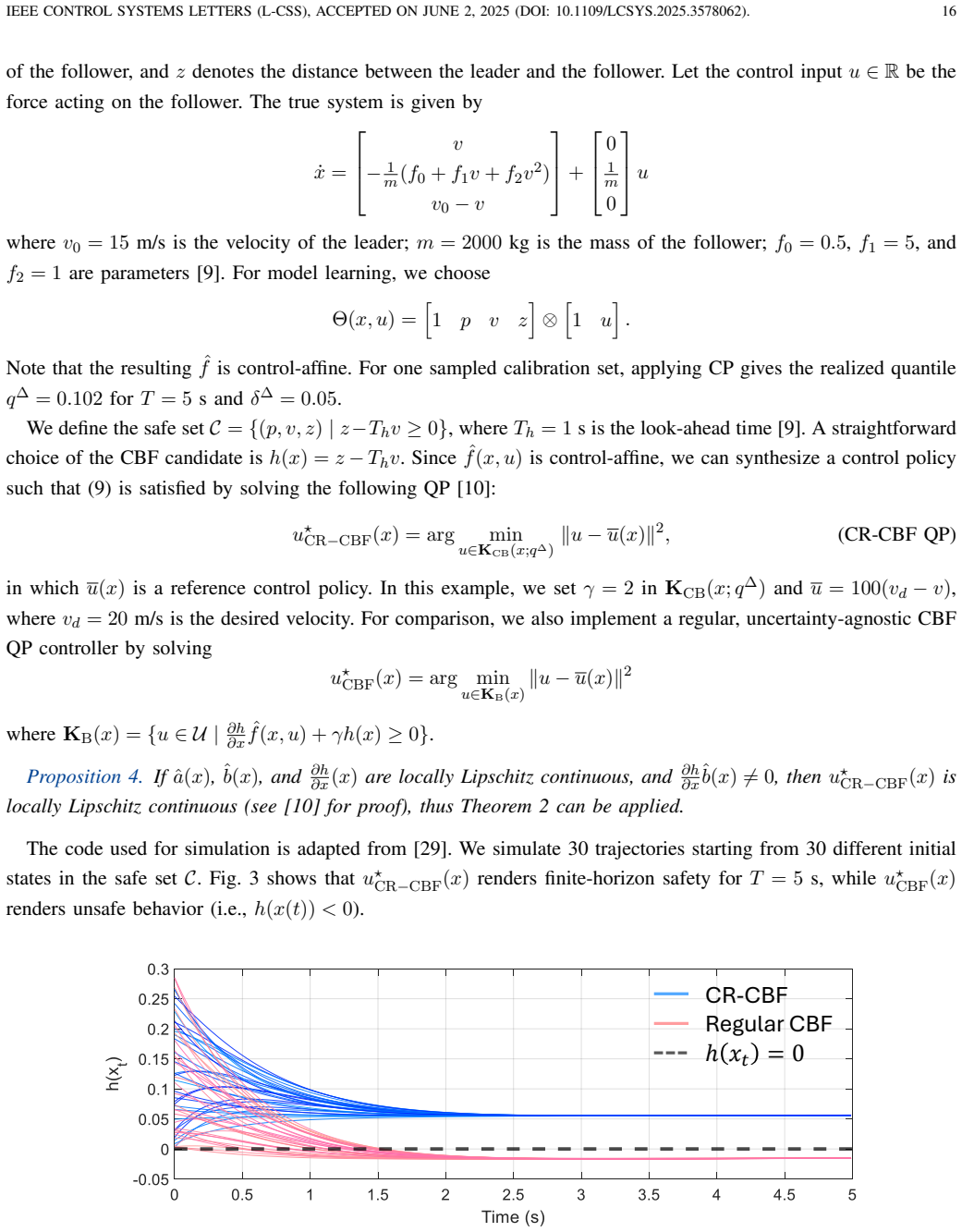
- The same machinery converts a CR-CBF into a safety filter: trajectories starting in the safe set stay there for the whole horizon with probability at least 1−δ^Δ.
- Neither the true dynamics f nor the distribution of the model error needs to be known; only trajectory data under locally Lipschitz inputs are used for calibration.
- Approximate satisfaction of the CR-CLF or CR-CBF condition can be handled by a second conformal layer, yielding a decay bound or shrunken safety margin with probability at least 1−δ^Δ−δ^ρ.
- The controllers are computationally realizable: quadratic programs synthesize them when the learned model is control-affine, and neural networks can learn the certificates directly, as shown on inverted pendulum, adaptive cruise control, Dubins car, and cartpole benchmarks.
Reading between the lines
- I infer that the advertised guarantee should be read as marginal over calibration draws and new trajectories; conditioning on a fixed calibration set gives a Beta-distributed coverage, so a user who reuses one calibration set forever should expect the failure probability to fluctuate around δ^Δ rather than to be bounded pointwise.
- A practical consequence the authors leave implicit: the deployed policy, including its dependence on Q^Δ, must be fixed before the new trajectory is drawn for the exchangeability assumption to be coherent; re-solving the QP against a moving quantile mid-rollout would break the assumption.
- I infer the framework extends naturally to receding-horizon operation by re-calibrating Q^Δ on each window, with a fresh exchangeability assumption per window, giving a per-window failure probability rather than a guarantee for all time.
- The most direct empirical check of Assumption 1 is to repeat the calibration-and-deployment protocol many times and compare the empirical failure rate to δ^Δ; systematic under-coverage would point at the exchangeability premise, not at the Lyapunov or barrier argument.
Editorial analysis
A structured set of objections, weighed in public.
Referee Report
Summary. The paper introduces conformal robustness, a framework that uses conformal prediction to quantify model-uncertainty bounds over a finite horizon and then enforces robustified control Lyapunov and control barrier conditions using those bounds. The main results, Theorem 1 and Theorem 2, claim that any locally Lipschitz policy satisfying the resulting CR-CLF or CR-CBF inequality renders the true closed-loop system finite-horizon exponentially stable or safe with probability at least 1 - delta^Delta, marginal over the calibration set and the newly sampled trajectory. Proposition 1 and Proposition 2 extend the framework to approximated certificates using a second conformal layer. The paper also presents simulations on four benchmark nonlinear systems comparing CR-CLF/CR-CBF controllers with uncertainty-agnostic versions.
Significance. The paper's formulation is clean and the differential-inequality arguments in Theorem 1 and Theorem 2 are correct given the stated assumptions. The idea of translating a conformal quantile into a deterministic robustness margin for CLF/CBF inequalities is a natural and potentially useful contribution, and the framework is genuinely prediction-method-agnostic and does not assume a parametric distribution for the uncertainty. The second-layer conformal treatment of approximation violations in Proposition 1 is a constructive extension. However, the central probabilistic guarantee rests on Assumption 1, an exchangeability condition on trajectory-wise nonconformity scores, which is not justified for the deployed closed-loop policy and is questionable in generic nonlinear systems. The numerical experiments demonstrate path-wise behavior of single realized controllers but do not test the claimed marginal coverage.
major comments (2)
- [Section III-A, Assumption 1] Assumption 1 is load-bearing for Corollary 1, Theorem 1, and Theorem 2, but it is not established for the deployed closed-loop policy. The calibration scores S_i^Delta are generated under arbitrary locally Lipschitz policies, while the new score S_inew^Delta comes from a trajectory under a policy selected from the random admissible set K_CL(x; Q^Delta) (or K_CB(x; Q^Delta)), which depends on the same calibration-derived quantile Q^Delta. Since S_i^Delta = sup_{t in [0,T]} || Delta(phi_t(x0,i), u(·)) || is the supremum of the model error along a state trajectory, its distribution is generally affected by the control policy: a stabilizing policy keeps the state near the origin, while an exploratory policy visits other regions, and a state-dependent model error will have different sup-norm behavior on these trajectories. Exchangeability of the full score vector {S_i^Delta}_{i in I_cal^Delta union {inew}} requires the distribution of the new score to coincide with the distribution of every calibration score, a policy-invariance property that is not guaranteed by the setup and is false for generic nonlinear systems (e.g., Delta(x,u) small near the origin and large away from it, with calibration data collected under an exploratory policy). Remark 4 mentions weighted conformal prediction as a relaxation, but the theorems are proved only under the exact exchangeability in Assumption 1 and no coverage-gap bound is used. The claimed 1-delta^Delta stability and safety guarantees are therefore conditional on an unverified distributional invariance; the paper should either prove Assumption 1 under explicit conditions or replace it with a provable relaxation (e.g., weighted CP with a worst-case coverage-gap bound) and quantify the resulting guarantee.
- [Section IV, Examples 1-4] The numerical experiments do not test the statistical claim. In each example, one calibration dataset is drawn, one realization q^Delta is fixed, and then 30 or 100 trajectories are simulated under the resulting controller. This demonstrates path-wise behavior of a single controller, but the theorems assert a probability of at least 1-delta^Delta marginal over repeated sampling of D_cal^Delta and the newly sampled trajectory. To validate the guarantee, the authors should run a repeated-calibration experiment: resample D_cal^Delta many times, deploy the corresponding CR-CLF/CR-CBF controller, and record the empirical frequency with which the stability or safety condition holds on new trajectories. Without such an experiment, the simulations cannot distinguish the proposed method from an uncertainty-agnostic controller that happens to work on the chosen initial conditions, and they provide no evidence about whether Assumption 1 holds for the benchmarks.
minor comments (5)
- [Section II-C, Lemma 7] The total variation notation d_TV(Z, Z_i) is used for score vectors Z and Z_i but is not defined as a distance between their probability distributions; please clarify the definition.
- [Section III-B, Definition 5 and Theorem 1] The CR-CLF property (6) is required for every realization q^Delta of Q^Delta, but the case studies fix a single realized q^Delta and do not check feasibility of (6) or (9) across the support of Q^Delta; a sentence explaining how the QP feasibility is guaranteed for all realizations (or how the theory is applied path-wise) would help.
- [Section IV-D] The regressor in Example 4 is defined as a tensor product of lists, and the expression is hard to parse; it should be written as an explicit basis or with a clearer definition of the Kronecker product.
- [Abstract] There is a typo in the abstract: 'in aclosed loop' should read 'in a closed loop'.
- [Section IV] The paper says 'The code used for simulation is adapted from [29]' but does not provide a repository, random seeds, or exact hyperparameters for the neural-network training; adding reproducibility details would strengthen the paper.
Circularity Check
No circular derivation found; the central guarantee is a conditional CP-coverage argument, with Assumption 1 as a load-bearing but non-circular exchangeability assumption.
full rationale
The paper's derivation chain is not circular. Lemma 5 (marginal coverage of split conformal prediction) is an external, standard result cited to [18]; the paper does not rely on any self-citation or uniqueness theorem. Corollary 1 is a direct application of Lemma 5 to the trajectory-wise nonconformity scores S_i^Delta in (5), exactly as defined. Theorem 1's proof conditions on the CP coverage event E^Delta = {sup_t ||Delta(phi_t, u)|| <= Q^Delta}; on this event, the CR-CLF condition (6) yields the standard exponential-decay inequality by Cauchy-Schwarz and integration. The same structure holds for Theorem 2 and Propositions 1-2. Thus no equation is equivalent to its input by construction: the CR-CLF/CBF conditions are design constraints and the conformal quantile is an external statistical quantity. The one substantive concern is Assumption 1 (Section III-A), which postulates exchangeability of the scores of 'any newly sampled trajectory' with the calibration scores. This is load-bearing: it is exactly what converts Corollary 1 into the probability statements in Theorems 1 and 2. Because the deployed policy u(x) in K_CL(x; Q^Delta) depends on the calibration-derived Q^Delta, the new trajectory's error distribution is not obviously independent of, or exchangeable with, the calibration data; Assumption 1 states rather than proves the required policy-invariance. Remark 4 acknowledges that weighted CP could relax exchangeability, but the theorems are not proved under that relaxation. This is a missing-justification/validity risk in the statistical reduction, not an instance of circular reasoning: the implication 'Assumption 1 implies Theorem 1' is a genuine conditional derivation, and the CP benchmark is externally sourced. No circularity score beyond 1 is warranted.
Assumptions & free parameters
free parameters (5)
- q^Delta (realized conformal quantile) =
0.196, 0.102, 0.554, 0.144 in the four examples
- c3 =
0.5 (Example 1), 1 (Example 4)
- gamma =
2 (Example 2)
- T =
5 s or 10 s in examples
- delta^Delta and delta^rho =
0.1 and 0.05 in examples
assumptions (5)
- domain assumption Assumption 1: nonconformity scores of calibration and new closed-loop trajectories are exchangeable.
- domain assumption The true dynamics f is locally Lipschitz and a unique solution exists on [0,T] for all x0 in X.
- domain assumption Calibration data D^Delta_cal is noise-free.
- ad hoc to paper Existence of a CR-CLF or CR-CBF satisfying (6) or (9) for every realization q^Delta.
- domain assumption For Propositions 1 and 2, the violation scores are exchangeable with the second-layer calibration set.
Cite this review
Pith. "Pith review of Statistical Guarantees in Data-Driven Nonlinear Control: Conformal Robustness for Stability and Safety." pith.science (2026). https://pith.science/paper/MMA7XBD7
@misc{pith2026250606228,
  author       = {Pith},
  title        = {Pith review of: Statistical Guarantees in Data-Driven Nonlinear Control: Conformal Robustness for Stability and Safety},
  year         = {2026},
  howpublished = {\url{https://pith.science/paper/MMA7XBD7}},
  note         = {Machine review of arXiv:2506.06228}
}
read the original abstract
We present a true-dynamics-agnostic, statistically rigorous framework for establishing exponential stability and safety guarantees of closed-loop, data-driven nonlinear control. Central to our approach is the novel concept of conformal robustness, which robustifies the Lyapunov and zeroing barrier certificates of data-driven dynamical systems against model prediction uncertainties using conformal prediction. It quantifies these uncertainties by leveraging rank statistics of prediction scores over system trajectories, without assuming any specific underlying structure of the prediction model or distribution of the uncertainties. With the quantified uncertainty information, we further construct the conformally robust control Lyapunov function (CR-CLF) and control barrier function (CR-CBF), data-driven counterparts of the CLF and CBF, for fully data-driven control with statistical guarantees of finite-horizon exponential stability and safety. The performance of the proposed concept is validated in numerical simulations with four benchmark nonlinear control problems.
Figures


Figures from the paper (2 more)


Reference graph
Works this paper leans on
-
[1]
V ovk, A
V . V ovk, A. Gammerman, and G. Shafer,Algorithmic Learning in a Random World. Springer, 2005
2005
-
[2]
A tutorial on conformal prediction
G. Shafer and V . V ovk, “A tutorial on conformal prediction.”Journal of Machine Learning Research, vol. 9, no. 3, 2008
2008
-
[3]
A gentle introduction to conformal prediction and distribution-free uncertainty quantification,
A. N. Angelopoulos and S. Bates, “A gentle introduction to conformal prediction and distribution-free uncertainty quantification,”arXiv preprint arXiv:2107.07511, 2021
arXiv 2021
-
[4]
Formal verification and control with conformal prediction,
L. Lindemann, Y . Zhao, X. Yu, G. J. Pappas, and J. V . Deshmukh, “Formal verification and control with conformal prediction,”arXiv preprint arXiv:2409.00536, 2024
arXiv 2024
-
[5]
A lyapunov-like characterization of asymptotic controllability,
E. D. Sontag, “A lyapunov-like characterization of asymptotic controllability,”SICON, vol. 21, no. 3, pp. 462–471, 1983
work page 1983
-
[6]
Stabilization with relaxed controls,
Z. Artstein, “Stabilization with relaxed controls,”Nonlinear Analysis: Theory, Methods & Applications, vol. 7, no. 11, pp. 1163–1173, 1983
1983
-
[7]
R. Freeman and P. Kokotovic,Robust Nonlinear Control Design. Birkh ¨auser, 1996
work page 1996
-
[8]
Constructive safety using control barrier functions,
P. Wieland and F. Allg ¨ower, “Constructive safety using control barrier functions,”Proc. 7th IFAC Symp. Nonlin. Control Syst., vol. 40, no. 12, pp. 462–467, 2007
work page 2007
Show all 32 references
-
[9]
Control barrier function based quadratic programs with application to adaptive cruise control,
A. D. Ames, J. W. Grizzle, and P. Tabuada, “Control barrier function based quadratic programs with application to adaptive cruise control,” inIEEE CDC, 2014, pp. 6271–6278
2014
-
[10]
Control barrier function based quadratic programs for safety critical systems,
A. D. Ames, X. Xu, J. W. Grizzle, and P. Tabuada, “Control barrier function based quadratic programs for safety critical systems,” IEEE TACON, vol. 62, no. 8, pp. 3861–3876, 2017
2017
-
[11]
Robust control barrier functions for constrained stabilization of nonlinear systems,
M. Jankovic, “Robust control barrier functions for constrained stabilization of nonlinear systems,”Automatica, vol. 96, pp. 359–367, 2018
2018
-
[12]
Feedback stabilization of affine in the control stochastic differential systems by the control lyapunov function method,
P. Florchinger, “Feedback stabilization of affine in the control stochastic differential systems by the control lyapunov function method,” inIEEE CDC, 1996, pp. 1047–1052
1996
-
[13]
Control barrier functions for stochastic systems,
A. Clark, “Control barrier functions for stochastic systems,”Automatica, vol. 130, p. 109688, 2021
2021
-
[14]
Episodic learning with control lyapunov functions for uncertain robotic systems,
A. J. Taylor, V . D. Dorobantu, H. M. Le, Y . Yue, and A. D. Ames, “Episodic learning with control lyapunov functions for uncertain robotic systems,” in2019 IEEE/RSJ IROS, 2019, pp. 6878–6884
2019
-
[15]
Learning for safety-critical control with control barrier functions,
A. Taylor, A. Singletary, Y . Yue, and A. Ames, “Learning for safety-critical control with control barrier functions,” inL4DC, 2020, pp. 708–717
2020
-
[16]
Some pac-bayesian theorems,
D. A. McAllester, “Some pac-bayesian theorems,” inProc. 11th Annual Conf. Comput. Learn. theory, 1998, pp. 230–234
1998
-
[17]
The scenario approach to robust control design,
G. Calafiore and M. Campi, “The scenario approach to robust control design,”IEEE TACON, vol. 51, no. 5, pp. 742–753, 2006
2006
-
[18]
Conformal prediction beyond exchangeability,
R. F. Barber, E. J. Candes, A. Ramdas, and R. J. Tibshirani, “Conformal prediction beyond exchangeability,”The Annals of Statistics, vol. 51, no. 2, pp. 816–845, 2023
2023
-
[19]
Adaptive conformal inference under distribution shift,
I. Gibbs and E. Candes, “Adaptive conformal inference under distribution shift,”NeurIPS, vol. 34, pp. 1660–1672, 2021
2021
-
[20]
Safe planning in dynamic environments using conformal prediction,
L. Lindemann, M. Cleaveland, G. Shim, and G. J. Pappas, “Safe planning in dynamic environments using conformal prediction,”IEEE RA-L, vol. 8, no. 8, pp. 5116–5123, 2023
2023
-
[21]
Conformal prediction for uncertainty-aware planning with diffusion dynamics model,
J. Sun, Y . Jiang, J. Qiu, P. Nobel, M. J. Kochenderfer, and M. Schwager, “Conformal prediction for uncertainty-aware planning with diffusion dynamics model,” inNeurIPS, vol. 36, 2023, pp. 80 324–80 337
2023
-
[22]
Adaptive conformal prediction for motion planning among dynamic agents,
A. Dixit, L. Lindemann, S. X. Wei, M. Cleaveland, G. J. Pappas, and J. W. Burdick, “Adaptive conformal prediction for motion planning among dynamic agents,” inL4DC, 2023, pp. 300–314
2023
-
[23]
Uncertainty quantification for learning-based mpc using weighted conformal prediction,
K. Y . Chee, M. A. Hsieh, and G. J. Pappas, “Uncertainty quantification for learning-based mpc using weighted conformal prediction,” inIEEE CDC, 2023, pp. 342–349
2023
-
[24]
Safety-critical control with uncertainty quantification using adaptive conformal prediction,
H. Zhou, Y . Zhang, and W. Luo, “Safety-critical control with uncertainty quantification using adaptive conformal prediction,” inACC, 2024, pp. 574–580
2024
-
[25]
Safe perception-based control under stochastic sensor uncertainty using conformal prediction,
S. Yang, G. J. Pappas, R. Mangharam, and L. Lindemann, “Safe perception-based control under stochastic sensor uncertainty using conformal prediction,” inIEEE CDC, 2023, pp. 6072–6078
2023
-
[26]
Rapidly exponentially stabilizing control lyapunov functions and hybrid zero dynamics,
A. D. Ames, K. Galloway, K. Sreenath, and J. W. Grizzle, “Rapidly exponentially stabilizing control lyapunov functions and hybrid zero dynamics,”IEEE TACON, vol. 59, no. 4, pp. 876–891, 2014
2014
-
[27]
On the stability of systems defined over a finite time interval,
L. Weiss and E. F. Infante, “On the stability of systems defined over a finite time interval,”PNAS, vol. 54, no. 1, pp. 44–48, 1965
1965
-
[28]
Discovering governing equations from data by sparse identification of nonlinear dynamical systems,
S. L. Brunton, J. L. Proctor, and J. N. Kutz, “Discovering governing equations from data by sparse identification of nonlinear dynamical systems,”PNAS, vol. 113, no. 15, pp. 3932–3937, 2016
2016
-
[29]
Cbf-clf-helper 1.0: Library for control barrier function and control lyapunov function based control methods,
J. J. Choi, “Cbf-clf-helper 1.0: Library for control barrier function and control lyapunov function based control methods,” 2020. [Online]. Available: https://github.com/HybridRobotics/CBF-CLF-Helper
2020
-
[30]
Safe control with learned certificates: A survey of neural lyapunov, barrier, and contraction methods for robotics and control,
C. Dawson, S. Gao, and C. Fan, “Safe control with learned certificates: A survey of neural lyapunov, barrier, and contraction methods for robotics and control,”IEEE T-RO, vol. 39, no. 3, pp. 1749–1767, 2023
2023
-
[31]
Neural lyapunov control for nonlinear systems with unstructured uncertainties,
S. Wei, P. Krishnamurthy, and F. Khorrami, “Neural lyapunov control for nonlinear systems with unstructured uncertainties,” inACC, 2023, pp. 1901–1906. IEEE CONTROL SYSTEMS LETTERS (L-CSS), ACCEPTED ON JUNE 2, 2025 (DOI: 10.1109/LCSYS.2025.3578062). 21
2023
-
[32]
Neural lyapunov control,
Y .-C. Chang, N. Roohi, and S. Gao, “Neural lyapunov control,”NeurIPS, vol. 32, 2019
2019
Reviewed August 7, 2026 · model on record in the stance chip above.
Discussion (0). Sign in to comment.