REVIEW 3 major objections 5 minor 35 references
Constraining Nuclear Mass Models Using r-process Observables with Multi-objective Optimization
T0 review · 3 major / 5 minor · reviewed 2026-08-07 · deepseek-v4-flash
Pith's one-line read Applying a Pareto-front search to machine-learned nuclear masses selects the models whose r-process abundances match solar and stellar data and whose neutron separation energies remain physical out to the drip line.
desk verdict Novel selection method, but the headline claim about extrapolation power is not supported by the current evidence; the abundance checks are circular and the Sn check is coupled to the selection. read the letter →
The pith
A machine-rendered reading of the paper's core claim, the machinery that carries it, and where it could break.
The reading
What carries the argument
The engine of the argument is the Pareto Front algorithm, a multi-objective selection rule that keeps a model whenever no other model in the pool beats it on every one of the three objectives at once; the surviving models form the front. Each model is a mixture density network (MDN), a neural network that outputs a probability distribution over mass values rather than a single number, trained on experimental and theoretical masses with some models receiving mass differences as additional training targets. The three objectives are the $\chi^2$ of the predicted masses against the AME2020 dataset, the $\chi^2$ of simulated isobaric abundances against solar r-process residuals, and the $\chi^2$ of simulated elemental abundances against HD 222925 stellar data, with abundances computed by feeding the model's neutron separation energies into the PRISM nucleosynthesis network. The Pareto front does the selection work: it converts a three-dimensional cloud of $\chi^2$ scores into a curved surface of models that each balance the three metrics without sacrificing one for another.
What would settle it
Measure the masses or one-neutron separation energies of very neutron-rich isotopes of tin (or another chain) beyond present experimental reach at a next-generation rare-isotope facility, and compare the Pareto-selected models' predictions against those measurements; if the unselected models reproduce the measured values as well as or better than the selected ones, the claim that the Pareto front tracks extrapolation quality would be refuted.
Extended reading notes
Core claim
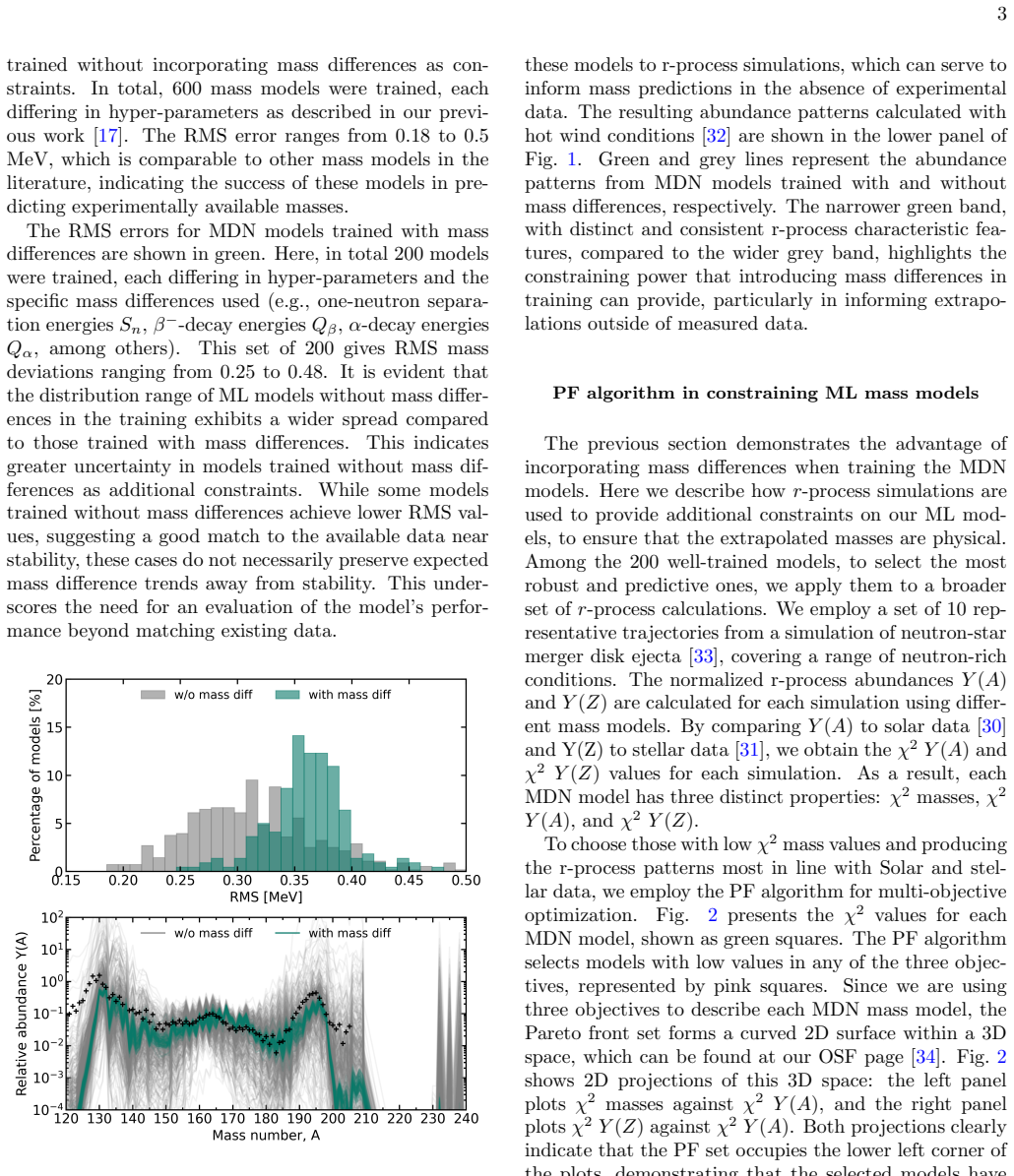
The paper's central claim is that multi-objective selection, not better training alone, is what pushes machine-learned mass models into physically sensible territory beyond the measured chart. Training the models with mass differences such as one-neutron separation energies already narrows the spread of extrapolated r-process abundances; applying the Pareto-front algorithm on top of that selects a subset whose predictions are still tighter. The claim is demonstrated by comparing the full pool of trained models with the Pareto-selected subset: the selected models produce narrower simulated r-process abundance bands around the solar residual pattern, and their one-neutron separation energies along the tin isotopic chain keep a clean odd-even staggering all the way to the drip line, whereas many unselected models lose that staggering in the extrapolated region. The paper takes this as evidence that the selected models track physical trends in exactly the region where experimental data are absent.
Load-bearing premise
The selection only separates good from bad extrapolations if the ten neutron-star merger trajectories and the non-mass nuclear reaction inputs used in the simulations are accurate enough that the difference between simulated and observed r-process abundances is dominated by the mass model's extrapolation error.
Editorial extensions
If this is right
- Pareto-selected mass models yield narrower r-process abundance distributions, shrinking the model-to-model scatter in predicted element yields.
- The selected models preserve physical trends, namely the decreasing slope and odd-even staggering of one-neutron separation energies, out to and beyond the neutron drip line where no experimental anchor exists.
- Training with mass differences such as $S_n$, $Q_\beta$, and $Q_\alpha$ is a necessary first filter; the Pareto front then refines that filter.
- The same multi-objective framework can be applied to any mass-model family or to other nuclear inputs with multiple competing observables.
Reading between the lines
- A natural extension the paper does not pursue is to use the Pareto-selected mass surface as training data or as a regularizing prior for a new round of MDN training, so that r-process constraints are baked into the model rather than applied only as a post-hoc filter.
- Because the three objectives are computed from a fixed set of ten merger disk trajectories, the method's ranking is trajectory-dependent; applying the same selection to a broader and more diverse trajectory ensemble would test how stable the Pareto front is.
- The same selection logic could be reversed to constrain other nuclear inputs that influence r-process abundances, such as beta-decay rates or fission barriers, by replacing the mass objective with whatever quantity those inputs determine.
Editorial analysis
A structured set of objections, weighed in public.
Referee Report
Summary. The paper proposes a multi-objective optimization approach, based on the Pareto Front (PF) algorithm, to select machine-learning (ML) nuclear mass models. The authors train an ensemble of Mixture Density Network (MDN) mass models, with and without mass-difference constraints, and use three objective functions: chi2 to AME2020 experimental masses (f1), chi2 to solar r-process isobaric abundances Y(A) (f2), and chi2 to stellar elemental abundances Y(Z) from HD 222925 (f3). The PF algorithm identifies a set of non-dominated models. The authors then compare the PF-selected models with the full pool, reporting narrower abundance distributions and preserved odd-even staggering in one-neutron separation energies out to the drip line, and conclude that the method selects ML models with reliable extrapolation power.
Significance. If the central claim were supported, this would be a valuable proof-of-concept: coupling r-process observables to ML mass model selection is a creative and potentially powerful idea, and the computational effort is substantial (800 MDN models, PRISM network calculations, 10 merger disk trajectories). The paper is clearly written, the PF method is standard, and the authors share the PF selection data on OSF, aiding reproducibility. However, the evidence presented for 'reliable extrapolation power' is currently circular: the success metrics are the same as the selection objectives, and the independent-looking Sn test is coupled to the abundance objectives because Sn sets the r-process path. The paper therefore does not yet substantiate its abstract's claim; out-of-sample validation is required before the conclusion can be accepted.
major comments (3)
- [Results – PF algorithm in constraining ML mass models; Conclusion] The claim that PF-selected models 'produce narrower distributions of RMS values and r-process abundance patterns' (Conclusion) is a restatement of the selection rule, because the PF set is defined as the models minimizing f2 and f3 (Method, Eqs. 1–4). The comparison in Fig. 3 therefore does not provide independent evidence of extrapolation skill; it simply shows that the algorithm identifies models with low chi2 relative to the same solar and stellar data used in the objectives. To support the abstract's claim of 'reliable extrapolation power,' an out-of-sample test is needed—for example, withhold a subset of mass regions or a subset of the 10 trajectories during selection and evaluate the selected models on the withheld data.
- [PF algorithm in constraining neutron separation energies; Fig. 4; Method] The Sn test is not independent of the selection objectives because Sn directly controls the (n,gamma)-(gamma,n) equilibrium path through photodissociation rates via detailed balance (Method). Models that lose odd-even staggering in Sn will generally produce poor Y(A) and Y(Z) and are therefore preferentially excluded by the f2/f3 objectives; observing OES in the PF set is thus expected from the selection rule. In addition, the MDN models entering the PF analysis were already trained with mass differences, including Sn, as supplementary constraints, so some OES preservation is built in at the training stage. To demonstrate that PF improves the extrapolation of Sn, the authors should compare PF-selected Sn predictions against experimental mass data not used in training (e.g., recently measured masses beyond the training set) or against a high-precision benchmark model not used in the selection.
- [Method; Results] The non-mass inputs (reaction rates from Refs. [25–28], beta-delayed fission, and the 10 merger disk trajectories from Ref. [33]) are held fixed while varying only the mass model. If these inputs carry systematic errors, the PF selection may compensate for them through the mass model rather than selecting models with genuinely better mass extrapolations. The authors should test robustness by repeating the selection with a different trajectory set or by varying the reaction rates, at least for a subset of models, to confirm that the PF set is not merely fitting to the specific non-mass physics chosen.
minor comments (5)
- [Method, Eq. (4)] Equation (4) is used for both mass and abundance chi2, but the text does not specify how sigma_i is defined for Y(A) and Y(Z); please state whether only observational uncertainties are used or whether theoretical/systematic uncertainties are included.
- [Fig. 1 caption; Results] Fig. 1 is described as being calculated under 'hot wind conditions' [32], while the PF analysis uses the 10 merger disk trajectories from Ref. [33]; please clarify which trajectory set is used for Fig. 1 and whether the qualitative conclusions depend on this choice.
- [Fig. 2 and Results] The number of models in the PF set is not reported; please state the size of the selected set in the text or in the Fig. 2 caption.
- [Results] The PF algorithm is applied only to the 200 models trained with mass differences; please justify why the 600 models trained without mass differences are excluded from the PF selection, or discuss whether including them would change the conclusions.
- [Fig. 3] The y-axis label is missing from the abundance panels in Fig. 3; please add labels (e.g., 'Y(A)' and 'Y(Z)') to both panels.
Circularity Check
Main evidence for extrapolation skill is in-sample: the abundance objectives used for Pareto selection are the same metrics cited as success, and the Sn odd-even-staggering check inherits the abundance-selection bias.
-
fitted input called prediction
[Conclusion; also Method and Results, Fig. 3]
"we applied the PF algorithm to select mass models that exhibit lower χ2 values across three key metrics: nuclear masses, isobaric abundances Y (A), and elemental abundances Y (Z). The models chosen by the PF algorithm produce narrower distributions of RMS values and r-process abundance patterns, reflecting more refined predictions, especially in challenging regions of the nuclear landscape, such as deformed nuclei and those near the neutron drip line."
The PF set is selected, via f1, f2, and f3 in the Method, to have low χ2 for masses, Y(A), and Y(Z). The Conclusion and Fig. 3 then present low/narrow distributions of exactly those abundance quantities as evidence of improved extrapolation. The success metric is the selection objective itself: the selected models must, by construction, have smaller f2 and f3 than most of the rejected models. The RMS statement is not literally f1, since f1 is a χ2, but RMS and χ2 mass are closely correlated; in any case no out-of-sample or independently measured quantity is introduced to confirm extrapolation power.
-
other
[Results, subsection 'PF algorithm in constraining neutron separation energies', Fig. 4]
"Not only is it an important quantity relevant to closed-shell signatures, pairing effects, and the boundaries of the nuclear landscape, it also sets the equilibrium r-process path through the calculation of the photo-dissociation rate via detailed balance. ... The PF-selected models, represented by pink lines, show an additional improvement in the extrapolated values. These models exhibit a clear odd-even staggering effect up to and beyond the neutron drip line."
The abundance objectives f2 and f3 are computed from PRISM runs whose (n,gamma)-(gamma,n) equilibrium abundances depend exponentially on neutron separation energies through detailed balance. Selecting models with low f2/f3 therefore systematically favors Sn curves that already preserve the physical odd-even staggering pattern. Showing that the PF-selected models retain OES beyond the drip line is an expected filter artifact, not an independent validation of the mass extrapolation. A truly independent test would require an observable not already used as a selection objective and not directly controlling that objective.
full rationale
The paper's central claim is that Pareto-front selection identifies ML mass models with reliable extrapolation power. The two pieces of evidence offered for that claim are both in-sample with respect to the selection procedure. First, the 'narrower distributions of RMS values and r-process abundance patterns' are restatements of the low f1/f2/f3 values that define the PF selection; Fig. 3 compares the selected models with the full pool on the same Y(A) and Y(Z) metrics used to compute f2 and f3. Second, the Sn odd-even-staggering check is not independent, because Sn enters the (n,gamma)-(gamma,n) equilibrium path exponentially and therefore directly shapes the f2/f3 objectives; conditioning on low abundance χ2 biases the surviving models toward OES-preserving Sn curves. The MDN training procedure and the mass-difference training constraints are not circular, and the self-citations to the authors' earlier MDN papers are not load-bearing for the core argument, since the MDN framework is attributed to Bishop and the comparison is internal. Nonetheless, the primary evidence for 'reliable extrapolation power' reduces, to a substantial degree, to the selection criteria themselves, and no out-of-sample test is provided; hence a circularity score of 6, indicating partial circularity, is warranted.
Assumptions & free parameters
assumptions (5)
- domain assumption The r-process proceeds under (n,gamma)-(gamma,n) equilibrium, so abundances along an isotopic chain depend exponentially on mass differences.
- domain assumption The 10 NSM disk trajectories from Ref. [33] are representative of the r-process conditions that produced the observed solar and stellar abundance patterns.
- domain assumption Solar r-process residuals [30] and the HD 222925 stellar abundances [31] are reliable templates for the r-process pattern.
- domain assumption Other nuclear inputs used in PRISM (reaction rates, beta-delayed neutron emission, fission) are fixed and sufficiently accurate that abundance differences between models come from masses.
- domain assumption The hybrid experimental-theoretical training set, and the MDN architecture, produce a pool of models whose extrapolations span the plausible mass behavior.
Cite this review
Pith. "Pith review of Constraining Nuclear Mass Models Using r-process Observables with Multi-objective Optimization." pith.science (2026). https://pith.science/paper/JVUNQVGV
@misc{pith2026250606464,
  author       = {Pith},
  title        = {Pith review of: Constraining Nuclear Mass Models Using r-process Observables with Multi-objective Optimization},
  year         = {2026},
  howpublished = {\url{https://pith.science/paper/JVUNQVGV}},
  note         = {Machine review of arXiv:2506.06464}
}
read the original abstract
Predicting nuclear masses is a longstanding challenge. One path forward is machine learning (ML) which trains on experimental data, but can suffer large errors when extrapolating toward neutron-rich species. In nature, such masses shape observables for the rapid neutron capture process (r-process), which in principle could inform ML models. Here we introduce a multi-objective optimization approach using the Pareto Front algorithm. We show that this technique, capable of identifying models which generate r-process abundances aligning with both Solar and stellar data, is a promising method to select ML models with reliable extrapolation power.
Figures


Figures from the paper (1 more)

Reference graph
Works this paper leans on
-
[33]
I. U. Roederer, J. E. Lawler, E. A. Den Hartog, V. M. Placco, R. Surman, T. C. Beers, R. Ezzeddine, A. Frebel, 7 T. T. Hansen, K. Hattori, E. M. Holmbeck, and C. M. Sakari, The r-process alliance: A nearly complete r- process abundance template derived from ultraviolet spectroscopy of the r-process-enhanced metal-poor star hd 222925*, The Astrophysical Jo...
work page 2022
-
[1]
⃗u is at least as good as ⃗v in all objectives: ∀i ∈ {1, . . . , N}, fi(⃗u) ≤ fi(⃗v) (1)
-
[2]
⃗u is strictly better than ⃗v in at least one objective: ∃j ∈ {1, . . . , N} : fj(⃗u) < fj(⃗v) (2) To apply this method to ML-based mass model selec- tion, each vector represents the predicted masses across the entire nuclear chart. In this work, we define three objective functions. The first ( f1) evaluates the model’s accuracy in predicting experimental...
-
[3]
C. Aidala, A. Aprahamian, S. Bacca, P. Bedaque, L. Bernstein, J. Carlson, M. Carpenter, K. Chipps, V. Cirigliano, I. Clo¨ et,et al., A New Era of Discovery: The 2023 Long-Range Plan for Nuclear Science (V.1.2), Tech. Rep. (Lawrence Livermore National Laboratory (LLNL), Livermore, CA (United States), 2023)
work page 2023
-
[4]
M. Madurga, R. Surman, I. N. Borzov, R. Grzywacz, K. P. Rykaczewski, C. J. Gross, D. Miller, D. W. Stracener, J. C. Batchelder, N. T. Brewer, L. Cartegni, J. H. Hamilton, J. K. Hwang, S. H. Liu, S. V. Ilyushkin, C. Jost, M. Karny, A. Korgul, W. Kr´ olas, A. Ku´ zniak, C. Mazzocchi, A. J. Mendez, K. Miernik, S. W. Pad- gett, S. V. Paulauskas, A. V. Ramayya...
work page 2012
-
[5]
G. Lorusso, S. Nishimura, Z. Y. Xu, A. Jungclaus, Y. Shimizu, G. S. Simpson, P.-A. S¨ oderstr¨ om, H. Watan- abe, F. Browne, P. Doornenbal, G. Gey, H. S. Jung, B. Meyer, T. Sumikama, J. Taprogge, Z. Vajta, J. Wu, H. Baba, G. Benzoni, K. Y. Chae, F. C. L. Crespi, N. Fukuda, R. Gernh¨ auser, N. Inabe, T. Isobe, T. Ka- jino, D. Kameda, G. D. Kim, Y.-K. Kim, ...
work page 2015
-
[6]
D. Atanasov, P. Ascher, K. Blaum, R. B. Cakirli, T. E. Cocolios, S. George, S. Goriely, F. Herfurth, H. T. Janka, O. Just, M. Kowalska, S. Kreim, D. Kisler, Y. A. Litvi- nov, D. Lunney, V. Manea, D. Neidherr, M. Rosen- busch, L. Schweikhard, A. Welker, F. Wienholtz, R. N. Wolf, and K. Zuber, Precision Mass Measurements of Cd - 131129 and Their Impact on S...
work page Pith review arXiv 2015
-
[7]
M. Vilen, J. M. Kelly, A. Kankainen, M. Brodeur, A. Aprahamian, L. Canete, T. Eronen, A. Jokinen, T. Kuta, I. D. Moore, M. R. Mumpower, D. A. Nesterenko, H. Penttil¨ a, I. Pohjalainen, W. S. Porter, S. Rinta-Antila, R. Surman, A. Voss, and J. ¨Ayst¨ o, Pre- cision mass measurements on neutron-rich rare-earth iso- topes at jyfltrap: Reduced neutron pairing...
work page 2018
Show all 35 references
-
[8]
Lunney, J
D. Lunney, J. M. Pearson, and C. Thibault, Recent trends in the determination of nuclear masses, Reviews of Modern Physics 75, 1021 (2003)
2003
-
[9]
Duflo and A
J. Duflo and A. Zuker, Microscopic mass formulas, Phys. Rev. C 52, R23 (1995)
1995
-
[10]
Koura, T
H. Koura, T. Tachibana, M. Uno, and M. Yamada, Nu- clidic Mass Formula on a Spherical Basis with an Im- proved Even-Odd Term, Progress of Theoretical Physics 113, 305 (2005)
2005
-
[11]
M¨ oller, W
P. M¨ oller, W. D. Myers, H. Sagawa, and S. Yoshida, New finite-range droplet mass model and equation-of-state pa- rameters, Phys. Rev. Lett. 108, 052501 (2012)
2012
-
[12]
Goriely, N
S. Goriely, N. Chamel, and J. M. Pearson, Further explo- rations of skyrme-hartree-fock-bogoliubov mass formu- las. xvi. inclusion of self-energy effects in pairing, Phys. Rev. C 93, 034337 (2016)
2016
-
[13]
A. E. Lovell, A. T. Mohan, and P. Talou, Quantifying uncertainties on fission fragment mass yields with mix- ture density networks, Journal of Physics G: Nuclear and Particle Physics 47, 114001 (2020)
2020
-
[14]
Gao, Y.-J
Z.-P. Gao, Y.-J. Wang, H.-L. L¨ u, Q.-F. Li, C.-W. Shen, and L. Liu, Machine learning the nuclear mass, Nuclear Science and Techniques 32, 109 (2021), arXiv:2105.02445 [nucl-th]
2021 arXiv
-
[15]
Z. M. Niu and H. Z. Liang, Nuclear mass predictions with machine learning reaching the accuracy required by r-process studies, Phys. Rev. C 106, L021303 (2022)
2022
-
[16]
Mumpower, M
M. Mumpower, M. Li, T. M. Sprouse, B. S. Meyer, A. E. Lovell, and A. T. Mohan, Bayesian averaging for ground state masses of atomic nuclei in a machine learn- ing approach, Frontiers in Physics V olume 11 - 2023, 10.3389/fphy.2023.1198572 (2023)
2023
-
[17]
Y¨ uksel, D
E. Y¨ uksel, D. Soydaner, and H. Bahtiyar, Nuclear mass predictions using machine learning models, Phys. Rev. C 109, 064322 (2024)
2024
-
[19]
M. Li, T. M. Sprouse, B. S. Meyer, and M. R. Mumpower, Atomic masses with machine learning for the astrophys- ical r process, Physics Letters B 848, 138385 (2024)
2024
-
[20]
Ngatchou, A
P. Ngatchou, A. Zarei, and A. El-Sharkawi, Pareto multi objective optimization, in Proceedings of the 13th Inter- national Conference on, Intelligent Systems Application to Power Systems(2005) pp. 84–91
2005
-
[21]
Bishop, Mixture density networks, WorkingPaper (As- ton University, 1994)
C. Bishop, Mixture density networks, WorkingPaper (As- ton University, 1994)
1994
-
[22]
M. R. Mumpower, G. C. McLaughlin, R. Surman, and A. W. Steiner, Reverse engineering nuclear properties from rare earth abundances in the r process, Journal of Physics G: Nuclear and Particle Physics 44, 034003 (2017)
2017
-
[23]
Vassh, G
N. Vassh, G. C. McLaughlin, M. R. Mumpower, and R. Surman, Markov chain monte carlo predictions of neutron-rich lanthanide properties as a probe of r-process dynamics, The Astrophysical Journal 907, 98 (2021)
2021
-
[24]
Kajino, W
T. Kajino, W. Aoki, A. Balantekin, R. Diehl, M. Fami- ano, and G. Mathews, Current status of r-process nucle- osynthesis, Progress in Particle and Nuclear Physics107, 109 (2019)
2019
-
[25]
Li and B
M. Li and B. S. Meyer, Dependence of ( n, gamma) − (gamma, n) equilibrium r-process abundances on nuclear physics properties, Phys. Rev. C 106, 035803 (2022)
2022
-
[26]
M. R. Mumpower, T. Kawano, T. M. Sprouse, N. Vassh, E. M. Holmbeck, R. Surman, and P. M¨ oller, beta-delayed fission in r-process nucleosynthesis, The Astrophysical Journal 869, 14 (2018)
2018
-
[27]
M. R. Mumpower, T. Kawano, and P. M¨ oller, Neutron-γ competition for β-delayed neutron emission, Phys. Rev. C 94, 064317 (2016)
2016
-
[28]
M¨ oller, M
P. M¨ oller, M. Mumpower, T. Kawano, and W. Myers, Nuclear properties for astrophysical and radioactive-ion- beam applications (ii), Atomic Data and Nuclear Data Tables 125, 1 (2019)
2019
-
[29]
Kawano, R
T. Kawano, R. Capote, S. Hilaire, and P. Chau Huu-Tai, Statistical hauser-feshbach theory with width-fluctuation correction including direct reaction channels for neutron- induced reactions at low energies, Phys. Rev. C 94, 014612 (2016)
2016
-
[30]
Vassh, M
N. Vassh, M. R. Mumpower, G. C. McLaughlin, T. M. Sprouse, and R. Surman, Coproduction of light and heavy r-process elements via fission deposition, The As- trophysical Journal 896, 28 (2020)
2020
-
[31]
M. Wang, W. Huang, F. Kondev, G. Audi, and S. Naimi, The ame 2020 atomic mass evaluation (ii). tables, graphs and references*, Chinese Physics C 45, 030003 (2021)
2021
-
[32]
H. Beer, F. Corvi, and P. Mutti, Neutron capture of the bottleneck isotopes 138ba and 208pb, s-process studies, and the r-process abundance distribution, The Astro- physical Journal 474, 843 (1997)
1997
-
[34]
Y. Zhu, R. T. Wollaeger, N. Vassh, R. Surman, T. M. Sprouse, M. R. Mumpower, P. M¨ oller, G. C. McLaughlin, O. Korobkin, T. Kawano, P. J. Jaffke, E. M. Holmbeck, C. L. Fryer, W. P. Even, A. J. Couture, and J. Barnes, Californium-254 and Kilonova Light Curves, Astrophys- ical J...
2018 arXiv
-
[35]
O. Just, A. Bauswein, R. A. Pulpillo, S. Goriely, and H.-T. Janka, Comprehensive nucleosynthesis anal- ysis for ejecta of compact binary mergers, Monthly Notices of the Royal Astronomical Society 448, 541 (2015), https://academic.oup.com/mnras/article- pdf/448/1/541/9387243/stv009.pdf
2015
-
[36]
M. Li, M. Mumpower, N. Vassh, R. Surman, PF selections 3D, https://osf.io/7v4qa
Reviewed August 7, 2026 · model on record in the stance chip above.
Discussion (0). Sign in to comment.