REVIEW 1 major objections 6 minor 64 references
RadioGami: Batteryless, Long-Range Wireless Paper Sensors Using Tunnel Diodes
T0 review · 1 major / 6 minor · reviewed 2026-08-07 · deepseek-v4-flash
Pith's one-line read Batteryless paper tags with tunnel-diode oscillators broadcast their own radio signal out to 45.7 meters, readable with a $20 SDR.
desk verdict A credible range/power result that deserves citation, but the interaction-sensing claims are undercut by an unaddressed light-sensitivity confound the authors themselves document. read the letter →
The pith
A machine-rendered reading of the paper's core claim, the machinery that carries it, and where it could break.
The reading
What carries the argument
The load-bearing mechanism is the tunnel diode oscillator (TDO), an oscillator that uses a diode's negative differential resistance to generate a radio-frequency carrier at microwatt power. The tunnel diode is biased in its negative differential resistance region (65 to 200 mV) with a resistor network and combined with an inductor to form a resonant tank, giving an oscillation frequency approximately $f_o = \frac{1}{2\pi}\sqrt{\frac{1 - R_T |g_d|}{L C}}$ per the design equations in the paper. The tag's ground plane is part of that resonant circuit, so mechanical deformation changes its distributed capacitance and inductance and shifts $f_o$. A CSS555-timer-driven NMOS switch gates the oscillator on and off at 60 Hz with a 60 percent duty cycle, cutting average consumption from 49 to 35 microwatts. The receiver side is a software-defined radio with a dipole antenna that records these frequency shifts as SNR peaks.
What would settle it
In a fixed 800 lux environment, deform the tag's ground plane in 0.125 mm steps and record the frequency; then hold the tag flat and sweep illumination from 500 to 1000 lux. If the light-induced shift across 100 lux is comparable to the roughly 98.7 kHz per-step deformation shift, a moving user's shadow could masquerade as an interaction, which would falsify the deformation-only sensing claim.
Extended reading notes
Core claim
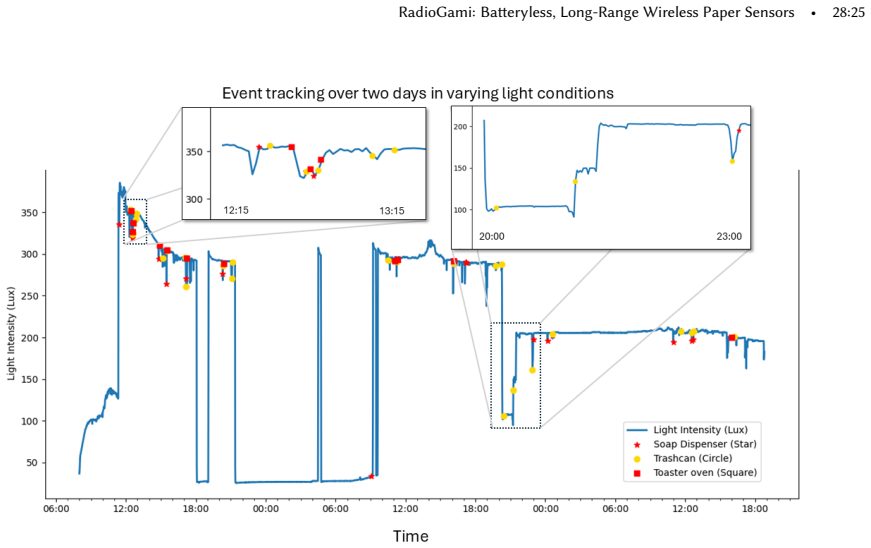
RadioGami is presented as the first tunnel-diode-oscillator (TDO) wireless sensor built on a paper substrate. The paper claims that a 27-component tag, made from copper tape and card stock and powered by photodiodes charging supercapacitors, broadcasts its own RF carrier at 35 microwatts average power and is readable at 45.73 meters by a low-cost SDR. Bending the ground plane, sliding a paper tab, rotating a paper wheel, and compressing Miura or Kresling folds all shift the oscillator frequency, and the paper maps those shifts to distinct interaction states. The contribution is an end-to-end design space: fabrication, power management via intermittent switching, characterization of range and sensitivity, and a 60-hour deployment showing event detection at 30 to 350 lux.
Load-bearing premise
The interaction-sensing claim rests on the assumption that observed frequency changes come from mechanical deformation of the antenna ground plane, yet the tag also shifts frequency with ambient light by a comparable amount, and the application experiments do not isolate light from deformation.
Editorial extensions
If this is right
- With 25 photodiodes and intermittent switching, tags consume 35 microwatts and remain readable to 45.73 meters, while an 11-photodiode configuration drops power to 16 microwatts with a 27.44-meter range.
- Because the tag generates its own carrier, no external RF emitter or dedicated reader is needed; a roughly $20 RTL-SDR with a dipole antenna is the receiver.
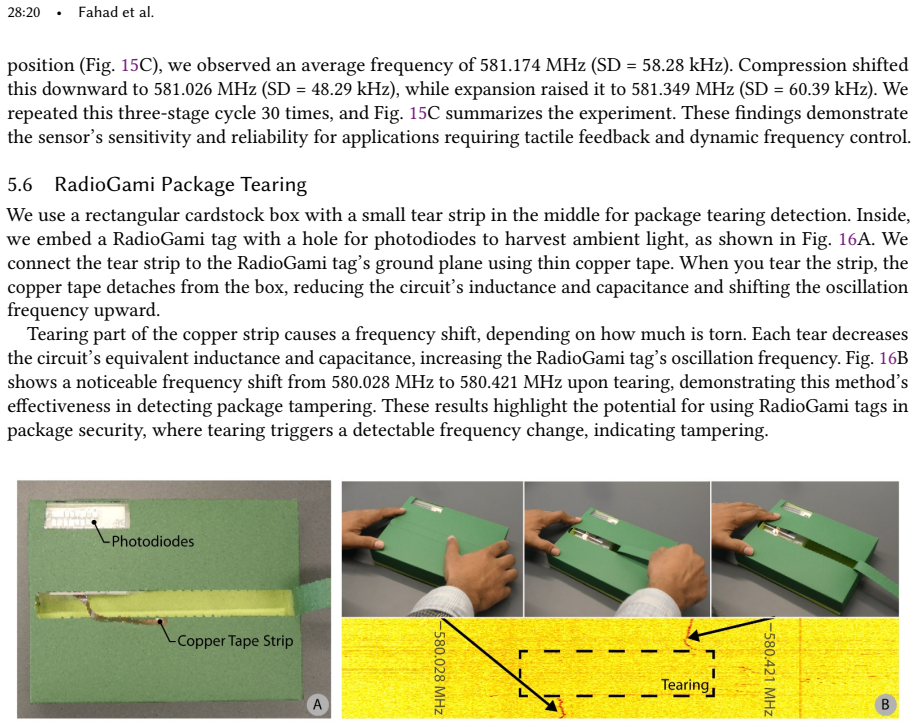
- Slider positions, rotary angles, Miura and Kresling compression states, and package tearing map to repeatable frequency bands, enabling object-status and tamper monitors over a building's distance scale.
- Interaction-activated tags with reed or tilt switches operate at 30 to 350 lux, with mean activation times under one second and an overall miss rate of about 5 percent across a 60-hour deployment of three tags.
- Signals penetrate floor slabs with useful SNR on adjacent floors, and multiple tags can coexist on distinct frequency bands within one SDR's 2.4 MHz receive bandwidth.
Reading between the lines
- The paper leaves open whether the measured interaction frequency shifts are cleanly separable from ambient-light shifts, since the tag's frequency changes by roughly 0.05 to 0.06 MHz per 100 lux and the application experiments do not subtract illumination effects.
- The same light sensitivity could be repurposed as a free environmental sensor: a tag's oscillation frequency alone encodes illuminance, so a deployment could log light level without adding hardware beyond the existing receiver.
- Because TDO tags act as independent transmitters rather than backscatter reflectors, a single SDR could plausibly monitor a much larger population of tags than the three demonstrated, limited mainly by how tightly their frequency bands can be packed.
- The durability data suggest these are disposable or short-lifetime sensors; a one-time-use design could therefore optimize for cost and trace simplicity rather than bending endurance.
Editorial analysis
A structured set of objections, weighed in public.
Referee Report
Summary. RadioGami presents a paper-substrate tunnel-diode-oscillator (TDO) tag that harvests ambient light, transmits in the 575–600 MHz band, and is received by a roughly $20 software-defined radio. The paper claims a 45.73 m operational range at 35 µW, multi-floor signal penetration, and a family of paper mechanisms—rotary encoder, slider, Miura-Ori, Kresling, and package tearing—that shift oscillator frequency through ground-plane deformation. It also introduces an interaction-activated variant for low-light environments and reports a 60-hour deployment across three kitchen objects. The central contributions are claimed as the first long-range, batteryless paper TDO sensors with an ultra-low-power budget and a library of tangible paper sensors.
Significance. If the range and power results hold, RadioGami is a meaningful advance over backscatter-based paper interfaces: it removes the external RF carrier, achieves tens of meters at microwatt power, and uses a low-cost receiver. The measured SNR curves, the component-level power table, the repeated deformation study (N=10), and the 60-hour low-light deployment are concrete empirical assets, and the comparison against PaperID, MARS, and RF Bandaid is useful for positioning the work. The interaction-sensing contribution, however, is currently threatened by the paper's own demonstration that oscillator frequency depends strongly on light level and tilt (Sections 4.4–4.5), and the headline power number needs a total-system accounting. The work is worth pursuing, but the deformation-sensing story requires controlled experiments or a substantial reframing before it can be considered established.
major comments (1)
- [§4.4, §4.5, §5.1–§5.6] The interaction-sensing claims are not yet isolated from the light-induced frequency drift documented in §4.4 (about 0.05–0.06 MHz per 100 lux, R²=0.98) and §4.5 (84.5 kHz per 15° tilt). The state separations in §5 are of the same order: rotary stages are 166–242 kHz apart (§5.2), Miura states are 148–398 kHz apart (§5.4), and Kresling states are 148–175 kHz apart (§5.5). A 100–200 lux change—a user's body, a passing shadow, or a slight reorientation of the tag—can therefore produce frequency shifts comparable to mechanism state changes. Section 5.1 attributes the shifts to ground-plane deformation, but no experiment in §5 logs illumination, enforces constant lux, or includes a no-deformation light-sweep control; the Section 6 deployment likewise states 800 lux only at setup and Table 2 reports no lux trace. Because the interactive mechanisms also bend and tilt the tag, the mechanical capacitance/inductance explanation is not the only viable one. Please add controlled-illumination replication with continuous lux logging and a light-sweep control for at least one mechanism, or explicitly reframe §5 as preliminary and remove it from the central contribution claims.
minor comments (6)
- [§3.3/§3.5] The capacitor labels are inconsistent: §3.3 names C1 as the 0.47 F supercapacitor and C2 as the 0.047 F unit, but §3.5 says the switching circuit is powered by “the 0.047 F supercapacitor, C1.” Please correct the label.
- [§4.4] The text reports a rate of 0.05 MHz per 100 lux, while Figure 8B reports -0.06 MHz per 100 lux; please reconcile the two values.
- [§5.3] The slider experiment reports only the first and last positions in the text; please provide the intermediate frequency values so that per-position separations can be verified.
- [Table 2] The bandwidth column lists one aggregate value per sensor but is not populated per row; please clarify how bandwidth was measured and whether it is the total occupied band.
- [§7.1.1] The deployment reports missed detections but no false positives; for an event-detection system, the false-alarm count is needed to interpret the overall detection rate.
- [Throughout] The range is reported inconsistently as 45.73 m, 45.7 m, and “>45 meters”; please use a single value with uncertainty.
Circularity Check
No circularity: range, power, and frequency-shift numbers are measured outputs, and governing equations are cited to an external GE tunnel diode manual.
full rationale
The paper's load-bearing numbers—the 45.73 m range, 35 µW power, the 0.05–0.06 MHz per 100 lux light sensitivity slope, the 98.74 kHz per deformation step, and the per-state interaction frequencies—are empirically measured, not produced by fitting a parameter and then re-predicting a closely related quantity. The TDO design equations (1)–(2) are credited to the GE Tunnel Diode Manual [36] and are used only as an initial component-selection guide, with explicit empirical fine-tuning; no result is defined in terms of its own conclusion. The switching-circuit equations (3)–(4) are standard 555-timer formulas. The ground-plane deformation sensing principle is attributed to Wang et al. [60], an external source, and Section 5's state frequencies are characterized through N=30 repeated measurements rather than predicted from the model. No load-bearing self-citation appears, nor is any uniqueness theorem imported from the authors' prior work. The ambient-light sensitivity measured in §4.4 (slope -0.06 MHz per 100 lux, R²=0.98) is a genuine threat to attributing §5 interaction shifts to mechanical deformation, but that is an experimental confound/correctness risk, not circularity: the paper does not use the light slope to construct the interaction claims, and the interaction frequencies are not derived from the light response. No circular step can be quoted, so the score is 0.
Assumptions & free parameters
free parameters (5)
- Bias resistors R1 and R2 =
R1 = 1 kOhm, R2 = 470 Ohm
- Intermittent switch timing components R3, R4, CT and bypass diode =
R3 = 1 MOhm, R4 = 33 MOhm, CT = 10 uF, bypass diode for 10% duty
- Photodiode configuration =
11, 25, and 40 photodiodes
- SNR detection threshold =
5 dB
- Oscillator frequency tuning =
575-600 MHz via variable inductor
assumptions (4)
- standard math Standard TDO oscillation equations (Eqs. 1-2) from the GE Tunnel Diode Manual govern component selection.
- domain assumption The MP1X4266 tunnel diode has a stable negative differential resistance region between 65 and 200 mV.
- domain assumption Ground plane deformation changes effective capacitance and inductance, and therefore oscillation frequency, approximately linearly.
- ad hoc to paper A 5 dB SNR threshold corresponds to reliable detection by the SDR receiver pipeline.
Cite this review
Pith. "Pith review of RadioGami: Batteryless, Long-Range Wireless Paper Sensors Using Tunnel Diodes." pith.science (2026). https://pith.science/paper/AOY7IKFL
@misc{pith2026250606473,
  author       = {Pith},
  title        = {Pith review of: RadioGami: Batteryless, Long-Range Wireless Paper Sensors Using Tunnel Diodes},
  year         = {2026},
  howpublished = {\url{https://pith.science/paper/AOY7IKFL}},
  note         = {Machine review of arXiv:2506.06473}
}
abstract
Paper-based interactive RF devices have opened new possibilities for wireless sensing, yet they are typically constrained by short operational ranges. This paper introduces RadioGami, a method for creating long-range, batteryless RF sensing surfaces on paper using low-cost, DIY materials like copper tape, paper, and off-the-shelf electronics paired with an affordable radio receiver (approx. $20). We explore the design space enabled by RadioGami, including sensing paper deformations like bending, tearing, and origami patterns (Miura, Kresling) at ranges up to 45.73 meters. RadioGami employs a novel ultra-low power (35uW) switching circuit with a tunnel diode for wireless functionality. These surfaces can sustainably operate by harvesting energy using tiny photodiodes. We demonstrate applications that monitor object status, track user interactions (rotation, sliding), and detect environmental changes. We characterize performance, sensitivity, range, and power consumption with deployment studies. RadioGami advances sustainable, tangible, and batteryless interfaces for embodied interaction.
Figures


Figures from the paper (21 more)






Reference graph
Works this paper leans on
-
[1]
Gregory D. Abowd. 2020. The Internet of Materials: A Vision for Computational Materials. IEEE Pervasive Comput. 19, 02 (April 2020), 56–62. doi:10.1109/MPRV.2020.2982475
arXiv 2020
-
[2]
AIRSPY. 2024. High Quality Software-Defined Radio, Redefined. https://airspy.com/
work page 2024
-
[3]
José Alberto, Cristina Leal, Cláudio Fernandes, Pedro A. Lopes, Hugo Paisana, Aníbal T. de Almeida, and Mahmoud Tavakoli. 2020. Fully Untethered Battery-Free Biomonitoring Electronic Tattoo with Wireless Energy Harvesting. Scientific Reports 10, 1 (2020), 5539. doi:10.1038/s41598-020-62097-6
-
[4]
Nivedita Arora, Ali Mirzazadeh, Injoo Moon, Charles Ramey, Yuhui Zhao, Daniela C. Rodriguez, Gregory D. Abowd, and Thad Starner. 2021. MARS: Nano-Power Battery-free Wireless Interfaces for Touch, Swipe and Speech Input. In The 34th Annual ACM Symposium on User Interface Software and Technology (UIST ’21) . Association for Computing Machinery, New York, NY...
arXiv 2021
-
[5]
Nivedita Arora, Steven L. Zhang, Fereshteh Shahmiri, Diego Osorio, Yi-Cheng Wang, Mohit Gupta, Zhengjun Wang, Thad Starner, Zhong Lin Wang, and Gregory D. Abowd. 2018. SATURN: A Thin and Flexible Self-powered Microphone Leveraging Triboelectric Nanogenerator. Proceedings of the ACM on Interactive, Mobile, Wearable and Ubiquitous Technologies 2, 2 (July 20...
doi:10.1145/3214263 2018
- [6]
-
[7]
Xingru Chen, Yongkai Li, Xiaoyi Wang, and Hongyu Yu. 2022. Origami Paper-Based Stretchable Humidity Sensor for Textile-Attachable Wearable Electronics. ACS Applied Materials & Interfaces 14, 31 (2022), 36227–36237. doi:10.1021/acsami.2c08245 PMID: 35912486
-
[8]
Chen Cheng, Xin Li, Gang Xu, Yanli Lu, Sze Shin Low, Guang Liu, Long Zhu, Caidong Li, and Qingjun Liu. 2021. Battery-Free, Wireless, and Flexible Electrochemical Patch for In Situ Analysis of Sweat Cortisol via Near Field Communication. Biosensors and Bioelectronics 172 (2021), 112782. doi:10.1016/j.bios.2020.112782
Show all 64 references
-
[9]
Abowd, and HyunJoo Oh
Tingyu Cheng, Zhihan Zhang, Bingrui Zong, Yuhui Zhao, Zekun Chang, Yejun Kim, Clement Zheng, Gregory D. Abowd, and HyunJoo Oh. 2023. SwellSense: Creating 2.5D interactions with micro-capsule paper. In Proceedings of the 2023 CHI Conference on Human Factors in Computing Systems...
2023
-
[10]
Federal Communications Commission. Apr. 25, 1989,. 47 CFR Part 15 – Radio Frequency Devices. https://www.ecfr.gov/current/title- 47/chapter-I/subchapter-A/part-15
1989
-
[11]
Ruiyu Ding, Yi Heng Cheong, Ashiq Ahamed, and Grzegorz Lisak. 2021. Heavy Metals Detection with Paper-Based Electrochemical Sensors. Analytical Chemistry 93, 4 (2021), 1880–1888. doi:10.1021/acs.analchem.0c04247 PMID: 33430590
2021 doi
-
[12]
Tentzeris
Aline Eid, Jimmy Hester, and Manos M. Tentzeris. 2020. A 5.8 GHz Fully-Tunnel-Diodes-Based 20 µW, 88mV, and 48 dB-Gain Fully- Passive Backscattering RFID Tag. In 2020 IEEE/MTT-S International Microwave Symposium (IMS) . IEEE, Los Angeles, CA, USA, 607–610. doi:10.1109/IMS30576...
2020
-
[13]
Chuhan Gao, Yilong Li, and Xinyu Zhang. 2019. LiveTag: Sensing Human-Object Interaction Through Passive Chipless Wi-Fi Tags. GetMobile: Mobile Computing and Communications 22, 3 (Jan. 2019), 32–35. doi:10.1145/3308755.3308766
2019
-
[14]
OSRAM Opto Semiconductors GmbH. 2020. BPW 34 ams OSRAM | Mouser. https://look.ams-osram.com/m/65d547088a09187c/original/ BPW-34.pdf
2020
-
[15]
Morimoto, and Dinesh Bharadia
Agrim Gupta, Daegue Park, Shayaun Bashar, Cedric Girerd, Nagarjun Bhat, Siddhi Mundhra, Tania K. Morimoto, and Dinesh Bharadia
-
[16]
Felix J. H. Hol, Benoit Hubert, Cees Dekker, and Ronald Dekker. 2019. Bacteria-in-paper, a versatile platform to study bacterial ecology. Ecology Letters 22, 3 (2019), 437–447. doi:10.1111/ele.13274
2019 doi
-
[17]
Meng-Ju Hsieh, Jr-Ling Guo, Chin-Yuan Lu, Han-Wei Hsieh, Rong-Hao Liang, and Bing-Yu Chen. 2019. RFTouchPads: Batteryless and Wireless Modular Touch Sensor Pads Based on RFID. In Proceedings of the 32nd Annual ACM Symposium on User Interface Software and Technology (UIST ’19)....
2019
-
[18]
Illuminating Engineering Society. 2025. Lighting Library. https://www.ies.org/standards/lighting-library/ Accessed: 2025-02-01
2025
-
[19]
M-Pulse Microwave Inc. 2024. MP1X4266 Tunnel Diodes. https://www.mpulsemw.com/Tunnel_Diode.htm
2024
-
[20]
Rajat Subhra Karmakar, Jhih-Fong Huang, Chia-Pei Chu, Ming-Han Mai, Jui-I Chao, Ying-Chih Liao, and Yen-Wen Lu. 2024. Origami- Inspired Conductive Paper-Based Folded Pressure Sensor with Interconnection Scaling at the Crease for Novel Wearable Applications. ACS Applied Materia...
2024 doi
-
[21]
Kunihiro Kato, Kaori Ikematsu, Yuki Igarashi, and Yoshihiro Kawahara. 2022. Paper-Woven Circuits: Fabrication Approach for Papercraft-based Electronic Devices. In Proceedings of the Sixteenth International Conference on Tangible, Embedded, and Embodied Interaction (Daejeon, Re...
2022
-
[22]
Smith, and David Wetherall
Bryce Kellogg, Aaron Parks, Shyamnath Gollakota, Joshua R. Smith, and David Wetherall. 2014. Wi-fi backscatter: internet connectivity for RF-powered devices. SIGCOMM Comput. Commun. Rev. 44, 4 (aug 2014), 607–618. doi:10.1145/2740070.2626319
2014
-
[23]
Taeil Kim, Amirhossein Hassanpoor Kalhori, Tae-Ho Kim, Chao Bao, and Woo Soo Kim. 2022. 3D designed battery-free wireless origami pressure sensor. Microsystems & Nanoengineering 8, 1 (2022), 120. doi:10.1038/s41378-022-00465-0
2022 doi
-
[24]
J.D. Kraus. 1949. The Helical Antenna. Proceedings of the IRE 37, 3 (1949), 263–272. doi:10.1109/JRPROC.1949.231279
1949
-
[25]
Sam Lemey, Sam Agneessens, Patrick Van Torre, Kristof Baes, Jan Vanfleteren, and Hendrik Rogier. 2016. Wearable Flexible Lightweight Modular RFID Tag With Integrated Energy Harvester. IEEE Transactions on Microwave Theory and Techniques 64, 7 (2016), 2304–2314. doi:10.1109/TMT...
2016
-
[26]
Carter, Josh Fromm, Scott E
Hanchuan Li, Eric Brockmeyer, Elizabeth J. Carter, Josh Fromm, Scott E. Hudson, Shwetak N. Patel, and Alanson Sample. 2016. PaperID: A Technique for Drawing Functional Battery-Free Wireless Interfaces on Paper. InProceedings of the 2016 CHI Conference on Human Factors in Compu...
2016
-
[27]
Hanchuan Li, Can Ye, and Alanson P. Sample. 2015. IDSense: A Human Object Interaction Detection System Based on Passive UHF RFID. In Proceedings of the 33rd Annual ACM Conference on Human Factors in Computing Systems (CHI ’15) . Association for Computing Machinery, New York, N...
2015
-
[28]
Tianxing Li and Xia Zhou. 2018. Battery-Free Eye Tracker on Glasses. In Proceedings of the 24th Annual International Conference on Mobile Computing and Networking (New Delhi, India) (MobiCom ’18). Association for Computing Machinery, New York, NY, USA, 67–82. doi:10.1145/32415...
2018
-
[29]
Xu Li, Junfei Tian, Gil Garnier, and Wei Shen. 2010. Fabrication of paper-based microfluidic sensors by printing. Colloids and Surfaces B: Biointerfaces 76, 2 (2010), 564–570. doi:10.1016/j.colsurfb.2009.12.023 Epub 2010 Jan 13, PMID: 20097546
2010 doi
-
[30]
Yongkai Li, Weixuan Liu, Yang Deng, Wei Hong, and Hongyu Yu. 2021. Miura-ori enabled stretchable circuit boards. npj Flexible Electronics 5, 1 (2021), 3. doi:10.1038/s41528-021-00099-8
2021 doi
-
[31]
Kurt, Shawn C
Rongzhou Lin, Han-Joon Kim, Sippanat Achavananthadith, Selman A. Kurt, Shawn C. C. Tan, Haicheng Yao, Benjamin C. K. Tee, Jason K. W. Lee, and John S. Ho. 2020. Wireless battery-free body sensor networks using near-field-enabled clothing. Nature Communications 11, 1 (2020), 44...
2020 doi
-
[32]
Hong Liu, Yu Xiang, Yi Lu, and Richard M. Crooks. 2012. Aptamer-based origami paper analytical device for electrochemical detection of adenosine. Angewandte Chemie International Edition 51, 28 (2012), 6925–6928. doi:10.1002/anie.201202929
2012 doi
-
[33]
Linpeng Liu, Zhibin Jiao, Junqiu Zhang, Yuchen Wang, Changchao Zhang, Xiancun Meng, Xiaohu Jiang, Shichao Niu, Zhiwu Han, and Luquan Ren. 2021. Bioinspired, Superhydrophobic, and Paper-Based Strain Sensors for Wearable and Underwater Applications. ACS Applied Materials & Inter...
2021 doi
-
[34]
Vincent Liu, Aaron Parks, Vamsi Talla, Shyamnath Gollakota, David Wetherall, and Joshua R. Smith. 2013. Ambient backscatter: wireless communication out of thin air. In Proceedings of the ACM SIGCOMM 2013 conference on SIGCOMM (SIGCOMM ’13) . Association for Computing Machinery...
2013
-
[35]
Yixin Liu, Hongzheng Li, and Min Zhang. 2021. Wireless Battery-Free Broad-Band Sensor for Wearable Multiple Physiological Measurement. ACS Applied Electronic Materials 3, 4 (2021), 1681–1690. doi:10.1021/acsaelm.0c01143
2021 doi
-
[36]
H. R. Lowry, J. Giorgis, E. Gottlieb, and R. C. Weischedel. 1961. General Electric Tunnel Diode Manual (first edition ed.). General Electric Company, Liverpool, New York. https://archive.org/details/GeTunnelDiodeManual
1961
-
[37]
Muhammad Sarmad Mir, Wenqing Yan, Prabal Dutta, Domenico Giustiniano, and Ambuj Varshney. 2023. TunnelLiFi: Bringing LiFi to Commodity Internet of Things Devices. In Proceedings of the 24th International Workshop on Mobile Computing Systems and Applications (HotMobile ’23). As...
2023
-
[38]
Hadi Moeinnia, Danielle Jaye Agron, Carl Ganzert, Loren Schubert, and Woo Soo Kim. 2024. Wireless pressure monitoring system utilizing a 3D-printed Origami pressure sensor array. npj Flexible Electronics 8, 1 (2024), 21. doi:10.1038/s41528-024-00309-z
2024 doi
-
[39]
Ryuma Niiyama, Xu Sun, Lining Yao, Hiroshi Ishii, Daniela Rus, and Sangbae Kim. 2015. Sticky Actuator: Free-Form Planar Actuators for Animated Objects. In Proceedings of the Ninth International Conference on Tangible, Embedded, and Embodied Interaction (Stanford, California, U...
2015
-
[40]
Masa Ogata and Masaaki Fukumoto. 2015. FluxPaper: Reinventing Paper with Dynamic Actuation Powered by Magnetic Flux. In Proceedings of the 33rd Annual ACM Conference on Human Factors in Computing Systems (Seoul, Republic of Korea) (CHI ’15). Association Proc. ACM Interact. Mob...
2015
-
[41]
Simon Olberding, Sergio Soto Ortega, Klaus Hildebrandt, and Jürgen Steimle. 2015. Foldio: Digital Fabrication of Interactive and Shape-Changing Objects With Foldable Printed Electronics. In Proceedings of the 28th Annual ACM Symposium on User Interface Software & Technology (C...
2015 doi
-
[42]
Philipose, J.R
M. Philipose, J.R. Smith, Bing Jiang, A. Mamishev, S. Roy, and K. Sundara-Rajan. 2005. Battery-free Wireless Identification and Sensing. IEEE Pervasive Computing 4, 1 (Jan. 2005), 37–45. doi:10.1109/MPRV.2005.7
2005 doi
-
[43]
Narjes Pourjafarian, Marion Koelle, Fjolla Mjaku, Paul Strohmeier, and Jürgen Steimle. 2022. Print-A-Sketch: A Handheld Printer for Physical Sketching of Circuits and Sensors on Everyday Surfaces. In Proceedings of the 2022 CHI Conference on Human Factors in Computing Systems ...
2022
-
[44]
Jie Qi and Leah Buechley. 2010. Electronic popables: exploring paper-based computing through an interactive pop-up book. InProceedings of the Fourth International Conference on Tangible, Embedded, and Embodied Interaction (Cambridge, Massachusetts, USA) (TEI ’10). Association ...
2010
-
[45]
Jie Qi and Leah Buechley. 2012. Animating paper using shape memory alloys. In Proceedings of the SIGCHI Conference on Human Factors in Computing Systems (Austin, Texas, USA) (CHI ’12). Association for Computing Machinery, New York, NY, USA, 749–752. doi:10.1145/2207676.2207783
2012
-
[46]
Ramachandran Ramjee, Sumit Roy, and Krishna Chintalapudi. 2016. A Critique of FCC’S TV White Space Regulations. GetMobile: Mobile Comp. and Comm. 20, 1 (July 2016), 20–25. doi:10.1145/2972413.2972421
2016
-
[47]
Smith, and Desney Tan
Vaishnavi Ranganathan, Sidhant Gupta, Jonathan Lester, Joshua R. Smith, and Desney Tan. 2018. RF Bandaid: A Fully-Analog and Passive Wireless Interface for Wearable Sensors. Proceedings of the ACM on Interactive, Mobile, Wearable and Ubiquitous Technologies 2, 2 (July 2018), 7...
2018 doi
-
[48]
Rajashekar Reddy, Manoj Gulati, and Ambuj Varshney
C. Rajashekar Reddy, Manoj Gulati, and Ambuj Varshney. 2023. Beyond Broadcasting: Revisiting FM Frequency-band for Providing Connectivity to Next Billion Devices. In Proceedings of the 11th International Workshop on Energy Harvesting & Energy-Neutral Sensing Systems (ENSsys ’2...
2023
-
[49]
Christian Rendl, David Kim, Sean Fanello, Patrick Parzer, Christoph Rhemann, Jonathan Taylor, Martin Zirkl, Gregor Scheipl, Thomas Rothländer, Michael Haller, and Shahram Izadi. 2014. FlexSense: a transparent self-sensing deformable surface. In Proceedings of the 27th Annual A...
2014
-
[50]
RTL-SDR.COM. 2024. RTL-SDR.COM / HomePage. https://www.rtl-sdr.com/
2024
-
[51]
Moteen Amin Shah, Adithya Bijoy, Manoj Gulati, Wenqing Yan, and Ambuj Varshney. 2023. Going Beyond Backscatter: Rethinking Low-Power Wireless Transmitters using Tunnel Diodes. In Proceedings of the 29th Annual International Conference on Mobile Computing and Networking (Madrid...
2023
-
[52]
Inc Silhouette America. 2024. Silhouette Cameo 4. https://www.silhouetteamerica.com/featured-product/cameo
2024
-
[53]
Smith, Kenneth P
Joshua R. Smith, Kenneth P. Fishkin, Bing Jiang, Alexander Mamishev, Matthai Philipose, Adam D. Rea, Sumit Roy, and Kishore Sundara- Rajan. 2005. RFID-based techniques for human-activity detection. Commun. ACM 48, 9 (Sept. 2005), 39–44. doi:10.1145/1081992.1082018
2005
-
[54]
Nirzaree Vadgama and Jürgen Steimle. 2017. Flexy: Shape-Customizable, Single-Layer, Inkjet Printable Patterns for 1D and 2D Flex Sensing. In Proceedings of the Eleventh International Conference on Tangible, Embedded, and Embodied Interaction (Yokohama, Japan) (TEI ’17). Associ...
2017
-
[55]
Ambuj Varshney and Lorenzo Corneo. 2020. Tunnel emitter: tunnel diode based low-power carrier emitters for backscatter tags. In Proceedings of the 26th Annual International Conference on Mobile Computing and Networking . ACM, London United Kingdom, 1–14. doi:10.1145/3372224.3419199
2020
-
[56]
Ambuj Varshney, Andreas Soleiman, and Thiemo Voigt. 2019. TunnelScatter: Low Power Communication for Sensor Tags using Tunnel Diodes. In The 25th Annual International Conference on Mobile Computing and Networking . ACM, Los Cabos Mexico, 1–17. doi:10.1145/3300061.3345451
2019
-
[57]
Ambuj Varshney, Wenqing Yan, and Prabal Dutta. 2022. Judo: addressing the energy asymmetry of wireless embedded systems through tunnel diode based wireless transmitters. In Proceedings of the 20th Annual International Conference on Mobile Systems, Applications and Services (Mo...
2022
-
[58]
Smith, and Shyamnath Gollakota
Anran Wang, Vikram Iyer, Vamsi Talla, Joshua R. Smith, and Shyamnath Gollakota. 2017. FM backscatter: enabling connected cities and smart fabrics. In Proceedings of the 14th USENIX Conference on Networked Systems Design and Implementation (NSDI’17) . USENIX Association, USA, 2...
2017
-
[59]
Guanyun Wang, Tingyu Cheng, Youngwook Do, Humphrey Yang, Ye Tao, Jianzhe Gu, Byoungkwon An, and Lining Yao. 2018. Printed Paper Actuator: A Low-cost Reversible Actuation and Sensing Method for Shape Changing Interfaces. In Proceedings of the 2018 CHI Conference on Human Factor...
2018
-
[60]
Wei Wang, Yanjun Wang, Shunxi Lou, Shuo Zhang, and Yatian Zhou. 2020. Effect of Ground Plane Deformation on Electrical Performance of Air Microstrip Antennas. International Journal of Antennas and Propagation 2020 (March 2020), 1–12. doi:10.1155/2020/4029780
2020 doi
-
[61]
Michael Wessely, Theophanis Tsandilas, and Wendy E. Mackay. 2018. Shape-Aware Material: Interactive Fabrication with ShapeMe. In Proceedings of the 31st Annual ACM Symposium on User Interface Software and Technology (Berlin, Germany) (UIST ’18). Association for Computing Machi...
2018
-
[62]
Wenqing Yan and Ambuj Varshney. 2022. Enabling L3: low cost, low complexity and low power radio frequency sensing using tunnel diodes. In Proceedings of the 28th Annual International Conference on Mobile Computing And Networking (MobiCom ’22) . Association for Computing Machin...
2022
-
[63]
Dingtian Zhang, Jung Wook Park, Yang Zhang, Yuhui Zhao, Yiyang Wang, Yunzhi Li, Tanvi Bhagwat, Wen-Fang Chou, Xiaojia Jia, Bernard Kippelen, Canek Fuentes-Hernandez, Thad Starner, and Gregory D. Abowd. 2020. OptoSense: Towards Ubiquitous Self- Powered Ambient Light Sensing Sur...
2020 doi
-
[2023]
ForceSticker: Wireless, Batteryless, Thin & Flexible Force Sensors. Proc. ACM Interact. Mob. Wearable Ubiquitous Technol. 7, 1, Article 13 (March 2023), 32 pages. doi:10.1145/3580793
2023 doi
Reviewed August 7, 2026 · model on record in the stance chip above.
Discussion (0). Sign in to comment.