REVIEW 3 major objections 4 minor 1 cited by
MapleGrasp: Mask-guided Feature Pooling for Language-driven Efficient Robotic Grasping
T0 review · 3 major / 4 minor · reviewed 2026-08-07 · deepseek-v4-flash
Pith's one-line read A two-stage language-driven grasping system that pools visual features inside a predicted object mask improves grasp accuracy and training efficiency versus CLIP baselines, supported by a new 219M-grasp dataset.
desk verdict MapleGrasp's dataset is a real contribution, but its central mask-pooling claim lacks the ablation that would support it. read the letter →
The pith
A machine-rendered reading of the paper's core claim, the machinery that carries it, and where it could break.
The reading
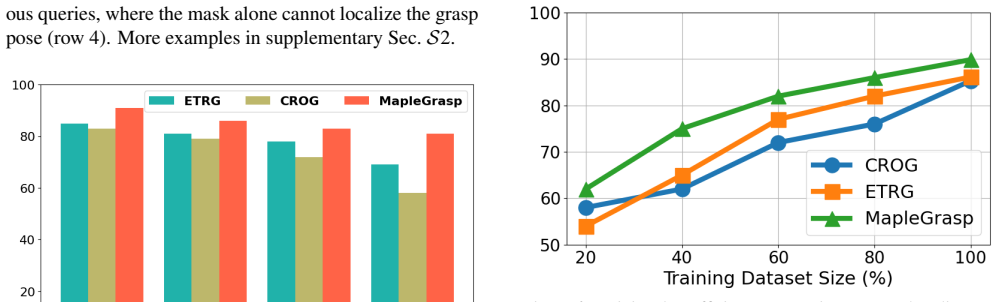
The authors report that this mask pooling improves top-1 grasp accuracy from 82.28% to 88.15% on the OCID-VLG benchmark and cuts training time from 45-50 epochs to 32 epochs. They also built RefGraspNet, a dataset with 219 million six-degree-of-freedom grasp poses on 97,000 real cluttered scenes, using GraspNet-1B's annotations and DeepSeek-VL generated referring expressions. On that dataset the method reaches about 90% top-1 accuracy on seen objects and 77% on unseen objects. In the LIBERO simulator the modular system roughly matches larger vision-language-action models, and on a real Franka arm it reaches 73% success on unseen objects in clutter when combined with a Molmo mask fallback.
The main caveats are that the paper never removes mask pooling to prove it causes the gains, compares against simulator baselines with a narrower success definition, and reports real-robot numbers without error bars. The dataset scale claim of "eight times larger" is also not supported by the table, since the previous largest has 33 million grasps.
Extended reading notes
Core claim
Restricting grasp predictions to mask-pooled regions leads to faster and more efficient training, while achieving better accuracy against previous methods by 7% on the OCID-VLG benchmark (Table 2: top-1 88.15 vs ETRG 82.28, a 7.1% relative gain).
Load-bearing premise
The predicted segmentation mask is accurate enough, especially for unseen objects and multi-attribute referring expressions, that zeroing features outside it does not discard valid grasp hypotheses. The paper itself shows the fragility: substituting a lower-IoU mask (Molmo+SAM, IoU 50-60%) drops top-1 from 88.15 to 78.69 (Table 4, row 1), and mask errors are cited as the cause of failure for occluded or ambiguous queries (Table 3, row 4).
Editorial analysis
A structured set of objections, weighed in public.
Referee Report
Summary. The paper proposes MapleGrasp, a two-stage vision-language grasping pipeline: Stage I predicts a soft object mask from CLIP-based vision-language features, and Stage II multiplies the fused feature map by the predicted mask (fpooled = f ⊙ M) before three heads predict grasp quality, angle, and width maps. A weighted Smooth L1 loss emphasizes graspable regions. The authors introduce RefGraspNet, an automatically annotated 6-DoF dataset with 219M grasp poses and 12.25M referring expressions derived from GraspNet-1B and DeepSeek-VL. They report Top-1 88.15 on OCID-VLG vs 82.28 for ETRG, strong RefGraspNet results, LIBERO comparisons against VLAs, and real Franka trials with 73% unseen-object success.
Significance. If the claims hold, the main contributions are: (1) empirical evidence that restricting grasp prediction to mask-pooled features improves accuracy and training efficiency; (2) RefGraspNet as a large, open language-grasp dataset; and (3) a modular alternative to VLA models with better generalization in low-data settings. The paper is commendable for releasing code, performing real-robot validation, and including cross-dataset evaluation. However, the central mechanism is not yet isolated, and the LIBERO and RefGraspNet evaluations have metric issues that currently prevent full acceptance.
major comments (3)
- [§3.3 and §5.2 (Table 4)] The central claim that mask-guided feature pooling drives the reported gains is not tested because Table 4 contains no direct ablation of the mask multiplication. The mechanism is defined by fpooled = f ⊙ M in §3.3, but none of the four ablation rows removes only that operation: row 1 changes the mask source (Molmo+SAM), row 2 freezes CLIP, row 3 replaces cross-attention with MLP-Mixer, and row 4 changes the loss. A control with fpooled = f, keeping the two-stage curriculum, cross-attention fusion, weighted Smooth L1 loss, and training budget identical, is required to attribute the 7% OCID-VLG improvement over ETRG to mask pooling rather than to the two-stage training or the loss. The same control should be added to Fig. 6 and Table 5 before the efficiency and cross-dataset claims can be attributed to the pooling mechanism.
- [§5.4, Table 6] The LIBERO comparison is not head-to-head because MapleGrasp and the VLA baselines are evaluated under different success criteria. The text defines success as grasping the referred object and lifting it above the ground, whereas the scores reported for Diffusion Policy, Octo, and OpenVLA presumably reflect the standard full task-success metric of LIBERO. The abstract's claim of 'comparable performance to larger Vision-Language-Action models' and the generalization claim in §5.4 require that all methods be scored identically, either by evaluating the VLAs on the same grasp-and-lift criterion or by reporting full task success for MapleGrasp as well. Please also state how the 10 trials per task are selected and whether the same scenes are used for all methods.
- [§3.5 and §4] The 6-DoF evaluation on RefGraspNet may be biased by the evaluation rule itself. In §3.5, success is determined by whether the selected grasp proposal 'corresponds to the ground-truth grasp for the referred object,' and in §3.3 the final grasp is chosen by the same maximum-overlap rule that the method uses. Since RefGraspNet labels are automatically generated with force-closure filtering and overlap-based selection (§4), the metric can reward consistency with the dataset-generation pipeline rather than physical grasp quality. Please define 'corresponds' operationally (e.g., a pose-distance or IoU threshold), and validate the reported gains with an evaluation that does not use the method's own selection rule.
minor comments (4)
- [Abstract and §4] The abstract and §4 state the dataset is 'eight times larger' than existing alternatives, but comparing 219M with GraspAnything++'s 33M grasps gives roughly 6.6x; please clarify the reference dataset and arithmetic.
- [Table 2] Table 2 reports 'Epochs to Conv.' values that vary (e.g., 32 for MapleGrasp, 50 for CROG) while §5.1 says all baselines are trained for 50 epochs; clarify whether these are early-stopping epochs or fixed training budgets.
- [Figure 5] Figure 5 lacks axis labels and error bars, making the accuracy decline across L1–L4 hard to read; please add them.
- [References to supplementary] The paper references supplementary sections S2–S5 but the arXiv version does not include the supplementary file; if the supplement is separate, please state this in the submission.
Circularity Check
No significant circularity: the mask-pooling result is benchmarked against external OCID-VLG labels, and the sole self-citation is a non-load-bearing baseline.
full rationale
The paper's central claim is empirical rather than derivational: MapleGrasp predicts masks in Stage I and then computes f_pooled = f ⊙ M in Stage II before predicting grasp quality, angle, and width maps. The mask is a learned intermediate output, not a fitted parameter that is later relabeled as a prediction, and the grasp maps are supervised by ground-truth quality/angle/width annotations. The headline OCID-VLG improvement (88.15 vs. ETRG 82.28) is measured against an externally created benchmark, not against labels generated by the method. The only overlapping-author citation is HiFi-CS [2], used as a comparison baseline; it does not justify the mask-pooling premise and is therefore not load-bearing. The self-constructed RefGraspNet dataset introduces a possible benchmark-construction confound, and the 6-DoF evaluation reuses a maximum-overlap selection rule similar to the method's, but neither makes the predicted quantity equal to its own input by construction. The skeptic concern that no ablation isolates the mask term alone is an experimental-design limitation, not circularity. No circular step can be exhibited from the paper's own equations or citations.
Assumptions & free parameters
free parameters (3)
- alpha (weighted Smooth L1 scale) =
not reported in main text
- beta (Smooth L1 transition) =
not reported
- force-closure confidence threshold =
70%
assumptions (4)
- domain assumption GraspNet-1B force-closure annotations are a valid ground truth for stable grasping
- domain assumption DeepSeek-VL-generated referring expressions are linguistically natural and unambiguous enough to evaluate open-vocabulary grounding
- domain assumption The maximum-overlap rule between the predicted 2D grasp rectangle and Contact-GraspNet proposals yields the same notion of successful grasp as the ground-truth 6-DoF annotation
- domain assumption CLIP text and image encoders provide sufficient grounding for spatial and attribute referring expressions
Cite this review
Pith. "Pith review of MapleGrasp: Mask-guided Feature Pooling for Language-driven Efficient Robotic Grasping." pith.science (2026). https://pith.science/paper/7XFJWD3U
@misc{pith2026250606535,
  author       = {Pith},
  title        = {Pith review of: MapleGrasp: Mask-guided Feature Pooling for Language-driven Efficient Robotic Grasping},
  year         = {2026},
  howpublished = {\url{https://pith.science/paper/7XFJWD3U}},
  note         = {Machine review of arXiv:2506.06535}
}
read the original abstract
Robotic manipulation of unseen objects via natural language commands remains challenging. Language driven robotic grasping (LDRG) predicts stable grasp poses from natural language queries and RGB-D images. We propose MapleGrasp, a novel framework that leverages mask-guided feature pooling for efficient vision-language driven grasping. Our two-stage training first predicts segmentation masks from CLIP-based vision-language features. The second stage pools features within these masks to generate pixel-level grasp predictions, improving efficiency, and reducing computation. Incorporating mask pooling results in a 7% improvement over prior approaches on the OCID-VLG benchmark. Furthermore, we introduce RefGraspNet, an open-source dataset eight times larger than existing alternatives, significantly enhancing model generalization for open-vocabulary grasping. MapleGrasp scores a strong grasping accuracy of 89\% when compared with competing methods in the RefGraspNet benchmark. Our method achieves comparable performance to larger Vision-Language-Action models on the LIBERO benchmark, and shows significantly better generalization to unseen tasks. Real-world experiments on a Franka arm demonstrate 73% success rate with unseen objects, surpassing competitive baselines by 11%. Code is provided in our github repository.
Figures


Figures from the paper (3 more)


Forward citations
Cited by 1 Pith paper
-
Data Pyramid for Embodied Manipulation
Embodied training data form a five-layer pyramid—real-robot, UMI, ego/exo, simulation, general V–L—ordered by the trade-off between scale and robot alignment, and model capabilities track how those layers are mixed.
Reference graph
Works this paper leans on
-
[1]
Stefan Ainetter and Friedrich Fraundorfer. End-to-end train- able deep neural network for robotic grasp detection and semantic segmentation from rgb. In 2021 IEEE Inter- national Conference on Robotics and Automation (ICRA) , pages 13452–13458, 2021. 2, 6
work page 2021
-
[2]
Vineet Bhat, Prashanth Krishnamurthy, Ramesh Karri, and Farshad Khorrami. Hifi-cs: Towards open vocabulary visual grounding for robotic grasping using vision-language mod- els, 2024. 2, 5, 6
work page 2024
-
[3]
RT-2: Vision-language-action models transfer web knowledge to robotic control
Anthony Brohan, Noah Brown, Justice Carbajal, Yevgen Chebotar, Xi Chen, et al. RT-2: Vision-language-action models transfer web knowledge to robotic control. In arXiv,
-
[4]
Open X-Embodiment: Robotic learning datasets and RT-X models.https://arxiv.org/abs/ 2310.08864, 2023
Open X-Embodiment Collaboration, Abby O’Neill, Abdul Rehman, et al. Open X-Embodiment: Robotic learning datasets and RT-X models.https://arxiv.org/abs/ 2310.08864, 2023. 3
arXiv 2023
-
[5]
Trust the PRoc3s: Solving long-horizon robotics problems with LLMs and constraint satisfaction
Aidan Curtis, Nishanth Kumar, Jing Cao, Tom ´as Lozano- P´erez, and Leslie Pack Kaelbling. Trust the PRoc3s: Solving long-horizon robotics problems with LLMs and constraint satisfaction. In 8th Annual Conference on Robot Learning ,
-
[6]
Smith, Hannaneh Hajishirzi, Ross Girshick, Ali Farhadi, and Aniruddha Kembhavi
Matt Deitke, Christopher Clark, Sangho Lee, Rohun Tri- pathi, Yue Yang, Jae Sung Park, Mohammadreza Salehi, Niklas Muennighoff, Kyle Lo, Luca Soldaini, Jiasen Lu, Taira Anderson, Erin Bransom, Kiana Ehsani, Huong Ngo, YenSung Chen, Ajay Patel, Mark Yatskar, Chris Callison- Burch, Andrew Head, Rose Hendrix, Favyen Bastani, Eli VanderBilt, Nathan Lambert, Y...
work page 2024
-
[7]
Jacquard: A large scale dataset for robotic grasp detection
Amaury Depierre, Emmanuel Dellandr ´ea, and Liming Chen. Jacquard: A large scale dataset for robotic grasp detection. In 2018 IEEE/RSJ International Conference on Intelligent Robots and Systems (IROS), pages 3511–3516, 2018. 2, 5
work page 2018
-
[8]
Graspmolmo: Generalizable task-oriented grasping via large-scale synthetic data genera- tion
Abhay Deshpande, Yuquan Deng, Arijit Ray, Jordi Salvador, Winson Han, Jiafei Duan, Kuo-Hao Zeng, Yuke Zhu, Ranjay Krishna, and Rose Hendrix. Graspmolmo: Generalizable task-oriented grasping via large-scale synthetic data genera- tion. arXiv preprint arXiv:2505.13441, 2025. 2, 4
arXiv 2025
Show all 63 references
-
[9]
Acronym: A large-scale grasp dataset based on simulation
Clemens Eppner, Arsalan Mousavian, and Dieter Fox. Acronym: A large-scale grasp dataset based on simulation. In 2021 IEEE International Conference on Robotics and Au- tomation (ICRA), pages 6222–6227, 2021. 2, 5
2021
-
[10]
GraspNet-1Billion: A large-scale benchmark for general object grasping
Hao-Shu Fang, Chenxi Wang, et al. GraspNet-1Billion: A large-scale benchmark for general object grasping. In Proc. of the IEEE/CVF Conference on Computer Vision and Pat- tern Recognition, 2020. 4, 5
2020
-
[11]
Physically grounded vision-language models for robotic manipulation
Jensen Gao, Bidipta Sarkar, Fei Xia, Ted Xiao, Jiajun Wu, et al. Physically grounded vision-language models for robotic manipulation. In IEEE International Conference on Robotics and Automation, 2024. 1
2024
-
[12]
Rvt2: Learning precise manipulation from few demonstrations
Ankit Goyal, Valts Blukis, Jie Xu, Yijie Guo, Yu-Wei Chao, and Dieter Fox. Rvt2: Learning precise manipulation from few demonstrations. RSS, 2024. 3
2024
-
[13]
Language-grounded dy- namic scene graphs for interactive object search with mobile manipulation
Daniel Honerkamp, Martin B ¨uchner, Fabien Despinoy, Tim Welschehold, , and Abhinav Valada. Language-grounded dy- namic scene graphs for interactive object search with mobile manipulation. IEEE Robotics and Automation Letters, 2024. 2
2024
-
[14]
Inner monologue: Embodied reason- ing through planning with language models
Wenlong Huang, Fei Xia, Ted Xiao, Harris Chan, Jacky Liang, Pete Florence, Andy Zeng, Jonathan Tompson, Igor Mordatch, Yevgen Chebotar, Pierre Sermanet, Tomas Jack- son, Noah Brown, Linda Luu, Sergey Levine, Karol Haus- man, and brian ichter. Inner monologue: Embodied reason- ...
2023
-
[15]
Effi- cient grasping from rgbd images: Learning using a new rect- angle representation
Yun Jiang, Stephen Moseson, and Ashutosh Saxena. Effi- cient grasping from rgbd images: Learning using a new rect- angle representation. In2011 IEEE International Conference on Robotics and Automation, pages 3304–3311, 2011. 2
2011
-
[16]
Prismatic vlms: Investigating the design space of visually-conditioned language models
Siddharth Karamcheti, Suraj Nair, Ashwin Balakrishna, Percy Liang, Thomas Kollar, and Dorsa Sadigh. Prismatic vlms: Investigating the design space of visually-conditioned language models. In International Conference on Machine Learning (ICML), 2024. 3
2024
-
[17]
Openvla: An open-source vision-language-action model
Moo Jin Kim, Karl Pertsch, Siddharth Karamcheti, Ted Xiao, Ashwin Balakrishna, Suraj Nair, Rafael Rafailov, Ethan Fos- ter, Grace Lam, Pannag Sanketi, Quan Vuong, Thomas Kol- lar, Benjamin Burchfiel, Russ Tedrake, Dorsa Sadigh, Sergey Levine, Percy Liang, and Chelsea Finn. Ope...
2024 arXiv
-
[18]
Fine-tuning vision-language-action models: Optimizing speed and suc- cess
Moo Jin Kim, Chelsea Finn, and Percy Liang. Fine-tuning vision-language-action models: Optimizing speed and suc- cess. arXiv preprint arXiv:2502.19645, 2025. 2, 3
2025 arXiv
-
[19]
Segment anything
Alexander Kirillov, Eric Mintun, Nikhila Ravi, Hanzi Mao, Chloe Rolland, et al. Segment anything. In Proc. of the IEEE/CVF International Conference on Computer Vision ,
-
[20]
Antipodal robotic grasping using generative residual convolutional neu- ral network
Sulabh Kumra, Shirin Joshi, and Ferat Sahin. Antipodal robotic grasping using generative residual convolutional neu- ral network. In 2020 IEEE/RSJ International Conference on Intelligent Robots and Systems (IROS), pages 9626–9633,
2020
-
[21]
Ovgnet: A unified visual-linguistic framework for open-vocabulary robotic grasping
Meng Li, Qi Zhao, Shuchang Lyu, Chunlei Wang, Yujing Ma, Guangliang Cheng, and Chenguang Yang. Ovgnet: A unified visual-linguistic framework for open-vocabulary robotic grasping. In 2024 IEEE/RSJ International Confer- ence on Intelligent Robots and Systems (IROS), pages 7507– ...
2024
-
[22]
Ovgnet: A unified visual-linguistic framework for open-vocabulary robotic grasping
Meng Li, Qi Zhao, Shuchang Lyu, Chunlei Wang, Yujing Ma, Guangliang Cheng, and Chenguang Yang. Ovgnet: A unified visual-linguistic framework for open-vocabulary robotic grasping. In 2024 IEEE/RSJ International Confer- ence on Intelligent Robots and Systems (IROS), pages 7507– ...
2024
-
[23]
Vision-language foun- dation models as effective robot imitators
Xinghang Li, Minghuan Liu, Hanbo Zhang, Cunjun Yu, Jie Xu, Hongtao Wu, Chilam Cheang, Ya Jing, Weinan Zhang, Huaping Liu, Hang Li, and Tao Kong. Vision-language foun- dation models as effective robot imitators. InThe Twelfth In- ternational Conference on Learning Representatio...
2024
-
[24]
Xiang Li, Cristina Mata, Jongwoo Park, Kumara Kahat- apitiya, Yoo Sung Jang, Jinghuan Shang, Kanchana Ranas- inghe, Ryan Burgert, Mu Cai, Yong Jae Lee, and Michael S. Ryoo. Llara: Supercharging robot learning data for vision- language policy. In International Conference on Lea...
2025
-
[25]
Ok-robot: What really matters in integrating open-knowledge models for robotics
Peiqi Liu, Yaswanth Orru, Jay Vakil, Chris Paxton, Nur Muhammad Mahi Shafiullah, and Lerrel Pinto. Ok-robot: What really matters in integrating open-knowledge models for robotics. arXiv preprint arXiv:2401.12202, 2024. 2
2024 arXiv
-
[26]
Grounding dino: Marry- ing dino with grounded pre-training for open-set object de- tection
Shilong Liu, Zhaoyang Zeng, et al. Grounding dino: Marry- ing dino with grounded pre-training for open-set object de- tection. arXiv, 2023. 2
2023
-
[27]
Gao, Xi Vin- cent Wang, and Lihui Wang
Sichao Liu, Jianjing Zhang, Robert X. Gao, Xi Vin- cent Wang, and Lihui Wang. Vision-language model-driven scene understanding and robotic object manipulation. In 2024 IEEE 20th International Conference on Automation Science and Engineering (CASE), pages 21–26, 2024. 1
2024
-
[28]
Deepseek-vl: Towards real-world vision- language understanding, 2024
Haoyu Lu, Wen Liu, Bo Zhang, Bingxuan Wang, Kai Dong, Bo Liu, Jingxiang Sun, Tongzheng Ren, Zhuoshu Li, Hao Yang, Yaofeng Sun, Chengqi Deng, Hanwei Xu, Zhenda Xie, and Chong Ruan. Deepseek-vl: Towards real-world vision- language understanding, 2024. 3, 4
2024
-
[29]
Hybrid physical metric for 6-dof grasp pose detection
Yuhao Lu, Beixing Deng, Zhenyu Wang, Peiyuan Zhi, Yali Li, and Shengjin Wang. Hybrid physical metric for 6-dof grasp pose detection. In 2022 International Conference on Robotics and Automation (ICRA), pages 8238–8244, 2022. 2
2022
-
[30]
Vl-grasp: a 6-dof interactive grasp pol- icy for language-oriented objects in cluttered indoor scenes
Yuhao Lu, Yixuan Fan, Beixing Deng, Fangfu Liu, Yali Li, and Shengjin Wang. Vl-grasp: a 6-dof interactive grasp pol- icy for language-oriented objects in cluttered indoor scenes. In 2023 IEEE/RSJ International Conference on Intelligent Robots and Systems (IROS), pages 976–983,...
2023
-
[31]
Graspmamba: A mamba-based language- driven grasp detection framework with hierarchical feature learning
Huy Hoang Nguyen, An Vuong, Anh Nguyen, Ian Reid, and Minh Nhat Vu. Graspmamba: A mamba-based language- driven grasp detection framework with hierarchical feature learning. arXiv preprint arXiv:2409.14403, 2024. 2, 4
2024 arXiv
-
[32]
Lightweight language-driven grasp detection using conditional consis- tency model
Nghia Nguyen, Minh Nhat Vu, Baoru Huang, An Vuong, Ngan Le, Thieu V o, and Anh Nguyen. Lightweight language-driven grasp detection using conditional consis- tency model. In 2024 IEEE/RSJ International Conference on Intelligent Robots and Systems (IROS), pages 13719–13725,
2024
-
[33]
Language-driven 6-dof grasp detection using negative prompt guidance
Toan Nguyen, Minh Nhat Vu, Baoru Huang, An Vuong, Quan Vuong, Ngan Le, Thieu V o, and Anh Nguyen. Language-driven 6-dof grasp detection using negative prompt guidance. In Computer Vision – ECCV 2024: 18th European Conference, Milan, Italy, September 29–October 4, 2024, Proceed...
2024
-
[34]
Graspsam: When segment anything model meets grasp detection
Sangjun Noh, Jongwon Kim, Dongwoo Nam, Seunghyeok Back, Raeyoung Kang, and Kyoobin Lee. Graspsam: When segment anything model meets grasp detection. arXiv preprint arXiv:2409.12521, 2024. 2
2024 arXiv
-
[35]
3d-mvp: 3d multi- view pretraining for robotic manipulation
Shengyi Qian, Kaichun Mo, Valts Blukis, David F Fouhey, Dieter Fox, and Ankit Goyal. 3d-mvp: 3d multi- view pretraining for robotic manipulation. arXiv preprint arXiv:2406.18158, 2024. 3
2024 arXiv
-
[36]
Sayplan: Ground- ing large language models using 3d scene graphs for scalable task planning
Krishan Rana, Jesse Haviland, Sourav Garg, Jad Abou- Chakra, Ian Reid, and Niko Suenderhauf. Sayplan: Ground- ing large language models using 3d scene graphs for scalable task planning. In 7th Annual Conference on Robot Learning,
-
[37]
SAM 2: Segment anything in images and videos
Nikhila Ravi, Valentin Gabeur, Yuan-Ting Hu, Ronghang Hu, Chaitanya Ryali, Tengyu Ma, Haitham Khedr, Roman R¨adle, Chloe Rolland, Laura Gustafson, Eric Mintun, Junt- ing Pan, Kalyan Vasudev Alwala, Nicolas Carion, Chao- Yuan Wu, Ross Girshick, Piotr Dollar, and Christoph Feich...
2025
-
[38]
Sadler, Wei-Lun Chao, and Yu Su
Chan Hee Song, Jiaman Wu, Clayton Washington, Brian M. Sadler, Wei-Lun Chao, and Yu Su. Llm-planner: Few-shot grounded planning for embodied agents with large language models. In Proceedings of the IEEE/CVF International Con- ference on Computer Vision (ICCV), 2023. 2
2023
-
[39]
Grasping in the wild: Learning 6dof closed- loop grasping from low-cost demonstrations
Shuran Song, Andy Zeng, Johnny Lee, and Thomas Funkhouser. Grasping in the wild: Learning 6dof closed- loop grasping from low-cost demonstrations. IEEE Robotics and Automation Letters, 5(3):4978–4985, 2020. 2
2020
-
[40]
Contact-graspnet: Efficient 6-dof grasp gen- eration in cluttered scenes
Martin Sundermeyer, Arsalan Mousavian, Rudolph Triebel, and Dieter Fox. Contact-graspnet: Efficient 6-dof grasp gen- eration in cluttered scenes. 2021. 3, 4
2021
-
[41]
Foundationgrasp: Generalizable task-oriented grasping with foundation models
Chao Tang, Dehao Huang, Wenlong Dong, Ruinian Xu, and Hong Zhang. Foundationgrasp: Generalizable task-oriented grasping with foundation models. IEEE Transactions on Au- tomation Science and Engineering , 22:12418–12435, 2025. 2
2025
-
[42]
Mlp-mixer: An all-mlp ar- chitecture for vision
Ilya O Tolstikhin, Neil Houlsby, Alexander Kolesnikov, Lu- cas Beyer, Xiaohua Zhai, Thomas Unterthiner, Jessica Yung, Andreas Steiner, Daniel Keysers, Jakob Uszkoreit, Mario Lucic, and Alexey Dosovitskiy. Mlp-mixer: An all-mlp ar- chitecture for vision. In Advances in Neural I...
2021
-
[43]
Towards open- world grasping with large vision-language models
Georgios Tziafas and Hamidreza Kasaei. Towards open- world grasping with large vision-language models. In 8th Annual Conference on Robot Learning, 2024. 2
2024
-
[44]
Language-guided robot grasping: Clip-based referring grasp synthesis in clutter
Georgios Tziafas, Yucheng XU, Arushi Goel, Moham- madreza Kasaei, Zhibin Li, and Hamidreza Kasaei. Language-guided robot grasping: Clip-based referring grasp synthesis in clutter. In Proceedings of The 7th Conference on Robot Learning, pages 1450–1466. PMLR, 2023. 2, 4, 5, 6
2023
-
[45]
Language-driven grasp de- tection with mask-guided attention
Tuan Van V o, Minh Nhat Vu, Baoru Huang, An Vuong, Ngan Le, Thieu V o, and Anh Nguyen. Language-driven grasp de- tection with mask-guided attention. In 2024 IEEE/RSJ In- ternational Conference on Intelligent Robots and Systems (IROS), pages 7492–7498, 2024. 2, 4
2024
-
[46]
A. D. Vuong, M. N. Vu, H. Le, B. Huang, H. T. T. Binh, T. V o, A. Kugi, and A. Nguyen. Grasp-anything: Large-scale grasp dataset from foundation models. In 2024 IEEE In- ternational Conference on Robotics and Automation (ICRA), pages 14030–14037, 2024. 2
2024
-
[47]
A. D. Vuong, M. N. Vu, H. Le, B. Huang, H. T. T. Binh, T. V o, A. Kugi, and A. Nguyen. Grasp-anything: Large-scale grasp dataset from foundation models. In 2024 IEEE In- ternational Conference on Robotics and Automation (ICRA), pages 14030–14037, 2024. 2, 5
2024
-
[48]
Gpt-4v(ision) for robotics: Multimodal task planning from human demonstration
Naoki Wake, Atsushi Kanehira, Kazuhiro Sasabuchi, Jun Takamatsu, and Katsushi Ikeuchi. Gpt-4v(ision) for robotics: Multimodal task planning from human demonstration. IEEE Robotics and Automation Letters, 9(11):10567–10574, 2024. 3
2024
-
[49]
Grasp as you say: Language-guided dexterous grasp genera- tion
Yi-Lin Wei, Jian-Jian Jiang, Chengyi Xing, Xian-Tuo Tan, Xiao-Ming Wu, Hao Li, Mark Cutkosky, and Wei-Shi Zheng. Grasp as you say: Language-guided dexterous grasp genera- tion. In Advances in Neural Information Processing Systems, pages 46881–46907. Curran Associates, Inc., 2024. 2
2024
-
[50]
Tidybot: Personal- ized robot assistance with large language models
Jimmy Wu, Rika Antonova, Adam Kan, Marion Lep- ert, Andy Zeng, Shuran Song, Jeannette Bohg, Szymon Rusinkiewicz, and Thomas Funkhouser. Tidybot: Personal- ized robot assistance with large language models. In 2023 IEEE/RSJ International Conference on Intelligent Robots and Syst...
2023
-
[51]
A joint modeling of vision-language-action for target-oriented grasping in clutter
Kechun Xu, Shuqi Zhao, Zhongxiang Zhou, Zizhang Li, Huaijin Pi, Yifeng Zhu, Yue Wang, and Rong Xiong. A joint modeling of vision-language-action for target-oriented grasping in clutter. In 2023 IEEE International Conference on Robotics and Automation (ICRA) , pages 11597–11604,
2023
-
[52]
Instance-wise grasp synthesis for robotic grasping
Yucheng Xu, Mohammadreza Kasaei, Hamidreza Kasaei, and Zhibin Li. Instance-wise grasp synthesis for robotic grasping. arXiv preprint arXiv:2302.07824, 2023. 6
2023 arXiv
-
[53]
Universal instance perception as object discovery and retrieval
Bin Yan, Yi Jiang, Jiannan Wu, Dong Wang, Zehuan Yuan, Ping Luo, and Huchuan Lu. Universal instance perception as object discovery and retrieval. In CVPR, 2023. 2
2023
-
[54]
Ground4act: Leveraging visual-language model for collaborative pushing and grasping in clutter
Yuxiang Yang, Jiangtao Guo, Zilong Li, Zhiwei He, and Jing Zhang. Ground4act: Leveraging visual-language model for collaborative pushing and grasping in clutter. Image and Vi- sion Computing, 151:105280, 2024. 2
2024
-
[55]
A parameter-efficient tuning framework for language-guided object grounding and robot grasping
Houjian Yu, Mingen Li, Alireza Rezazadeh, Yang Yang, and Changhyun Choi. A parameter-efficient tuning framework for language-guided object grounding and robot grasping. arXiv preprint arXiv:2409.19457, 2024. 2, 5, 6
2024 arXiv
-
[56]
Se-resunet: A novel robotic grasp detection method
Sheng Yu, Di-Hua Zhai, Yuanqing Xia, Haoran Wu, and Jun Liao. Se-resunet: A novel robotic grasp detection method. IEEE Robotics and Automation Letters , 7(2):5238–5245,
-
[57]
GLiNER: Generalist model for named entity recognition using bidirectional transformer
Urchade Zaratiana, Nadi Tomeh, Pierre Holat, and Thierry Charnois. GLiNER: Generalist model for named entity recognition using bidirectional transformer. In Proceedings of the 2024 Conference of the North American Chapter of the Association for Computational Linguistics: Human...
2024
-
[58]
Sigmoid loss for language image pre-training
Xiaohua Zhai, Basil Mustafa, Alexander Kolesnikov, and Lucas Beyer. Sigmoid loss for language image pre-training. In Proceedings of the IEEE/CVF International Conference on Computer Vision (ICCV), pages 11975–11986, 2023. 3
2023
-
[59]
Roi-based robotic grasp detection for object overlapping scenes
Hanbo Zhang, Xuguang Lan, Site Bai, Xinwen Zhou, Zhiqiang Tian, and Nanning Zheng. Roi-based robotic grasp detection for object overlapping scenes. In 2019 IEEE/RSJ International Conference on Intelligent Robots and Systems (IROS), pages 4768–4775, 2019. 5
2019
-
[60]
Evf-sam: Early vision-language fusion for text-prompted segment anything model
Yuxuan Zhang, Tianheng Cheng, Rui Hu, Lei Liu, Heng Liu, Longjin Ran, Xiaoxin Chen, Wenyu Liu, and Xing- gang Wang. Evf-sam: Early vision-language fusion for text-prompted segment anything model. arXiv preprint arXiv:2406.20076, 2024. 2
2024 arXiv
-
[61]
Language-guided cat- egory push–grasp synergy learning in clutter by efficiently perceiving object manipulation space
Min Zhao, Guoyu Zuo, Shuangyue Yu, Yongkang Luo, Chunfang Liu, and Daoxiong Gong. Language-guided cat- egory push–grasp synergy learning in clutter by efficiently perceiving object manipulation space. IEEE Transactions on Industrial Informatics, 21(2):1783–1792, 2025. 2
2025
-
[62]
Vlmpc: Vision-language model pre- dictive control for robotic manipulation
Wentao Zhao, Jiaming Chen, Ziyu Meng, Donghui Mao, Ran Song, and Wei Zhang. Vlmpc: Vision-language model pre- dictive control for robotic manipulation. In Robotics: Sci- ence and Systems, 2024. 1
2024
-
[63]
Grasping detection network with uncertainty estima- tion for confidence-driven semi-supervised domain adapta- tion
Haiyue Zhu, Yiting Li, Fengjun Bai, Wenjie Chen, Xiao- cong Li, Jun Ma, Chek Sing Teo, Pey Yuen Tao, and Wei Lin. Grasping detection network with uncertainty estima- tion for confidence-driven semi-supervised domain adapta- tion. In 2020 IEEE/RSJ International Conference on In...
2020
Reviewed August 7, 2026 · model on record in the stance chip above.
Discussion (0). Sign in to comment.