REVIEW 3 major objections 3 minor 28 references
A robust finite element method for linearized magnetohydrodynamics on general domains
T0 review · 3 major / 3 minor · reviewed 2026-08-07 · deepseek-v4-flash
Pith's one-line read A stabilized finite element method solves the linearized magnetohydrodynamics equations on general non-convex domains with less regular solutions, and is proved pressure robust and quasi-robust with respect to both fluid and magnetic…
desk verdict Solid, genuinely new extension of the authors' robust MHD scheme to non-convex domains; the abstract overstates 'less regular solutions' for the velocity, but the core result stands. read the letter →
The pith
A machine-rendered reading of the paper's core claim, the machinery that carries it, and where it could break.
The reading
What carries the argument
The load-bearing object is the stabilized bilinear form $A_{\mathrm{stab}}$ on the discrete spaces $V_h^k = \mathrm{BDM}_k$ ($H(\mathrm{div})$-conforming velocity), $W_h^k = $ Nédélec elements of the second kind ($H(\mathrm{curl})$-conforming magnetic field), and $Q_h^k = $ discontinuous $P_{k-1}$ pressure. The form combines an interior-penalty DG term for the velocity, an upwind term with jump penalization for the advective field $\chi$, and continuous interior penalty terms that penalize jumps of $\Theta \times u$ and of $\mathrm{curl}(u \times \Theta)$; the choice of curling in the CIP term (rather than the full gradient) is what makes the non-convex analysis work. The proof is carried in the stability norm $\|u\|_{\mathrm{stab}} + \|B\|_M$, whose key component is the magneto-advective seminorm $|u|_{\mathrm{curl}} = \gamma^{-1} \sum_E h_E^2 \|\mathrm{curl}_h(u \times \Theta_h)\|^2_E$ with $\gamma = \max\{h, \nu_M\}$; establishing control of this seminorm by an inf-sup argument (Propositions 12–13) is the technical heart, because it lets the error analysis use the Nédélec interpolant of [1] that exists for fields only in $H^r(\mathrm{curl})$, $r > 1/2$.
What would settle it
On a fixed tetrahedral mesh of the L-shaped domain, take the singular magnetic field $B = \nabla(r^{2/3} \sin(2\theta/3))$ from Test 2 and a smooth divergence-free velocity, and compute the stabilized-norm error while $\nu_S$ and $\nu_M$ range from 1 down to $10^{-8}$; if the error does not stay bounded as the diffusion parameters shrink, or if it fails to decrease as $h \to 0$ at the expected rates, the quasi-robustness and convergence claims would be refuted.
Extended reading notes
Core claim
The paper's central discovery is that the convex-domain restriction of the earlier method [6] is not an intrinsic limitation of the stabilized finite element philosophy but a consequence of discretizing the magnetic field with $H^1$-conforming elements. By reformulating the problem in $H(\mathrm{curl})$, using Nédélec elements of the second kind for $B$, BDM elements for the velocity, and switching the CIP stabilization from jumps of the gradient to jumps of $\Theta \times u$ and $\mathrm{curl}(u \times \Theta)$, the scheme becomes pressure robust and quasi-robust in both Reynolds numbers on general Lipschitz polyhedral domains. The analysis proves an inf-sup condition in a norm that controls the magneto-advective term $\mathrm{curl}(u \times \Theta)$; this stronger stability is what frees the convergence proof to use Nédélec interpolants that can handle magnetic fields with corner singularities, such as $B \in H^{2/3}$ on the L-shaped domain. Theorems 19 and 20 then deliver error bounds of order $h^{s-1}$ for the velocity and $h^r$ for the magnetic field, independent of $\nu_S$ and $\nu_M$ in the stabilized norm, and Proposition 22 guarantees convergence without any regularity assumption.
Load-bearing premise
For the proven error rates, the exact velocity solution must be slightly smoother than $H^{3/2}$; below that threshold the paper only guarantees convergence with no rate.
Editorial extensions
If this is right
- The scheme converges at optimal order on non-convex Lipschitz polyhedral domains for solutions with $u \in H^s$ ($s > 3/2$) and $B \in H^r(\mathrm{curl})$ ($r > 1/2$), with error constants independent of $\nu_S$ and $\nu_M$ in the stabilized norm.
- The velocity error is decoupled from the pressure error, so the method will not exhibit pressure locking or spurious pressure modes.
- The discrete magnetic field is divergence-free in the Nédélec sense, so the solenoidal constraint on $B$ is enforced at the discrete level without Lagrange multipliers.
- For solutions below the regularity threshold, the method still converges (velocity in $L^p$, magnetic field in $L^2$ and weakly in $H(\mathrm{curl})$) by Proposition 22, though without a guaranteed rate.
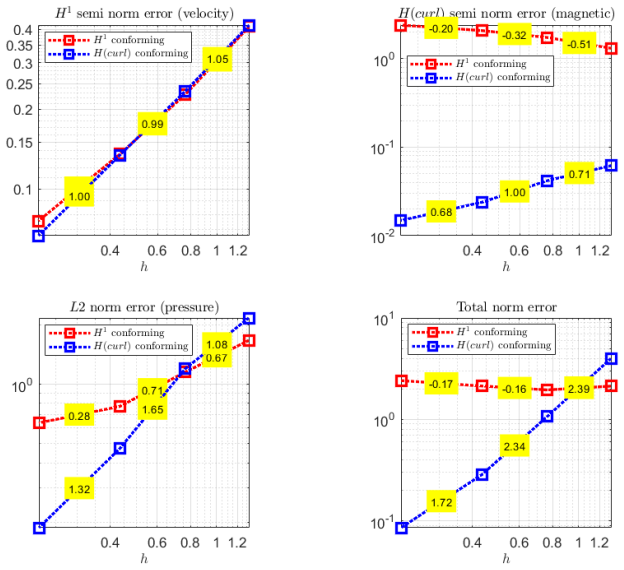
- The earlier $H^1$-conforming scheme fails on non-convex domains in the benchmark, while the present scheme converges, directly demonstrating the claimed improvement.
Reading between the lines
- Because the stability norm already controls the magneto-advective term, a natural next step—not taken in the paper—would be a fully nonlinear or time-dependent extension using the same spaces and a standard time-stepping scheme, with the CIP jumps unchanged.
- The same $H(\mathrm{curl})$-reformulation strategy should rescue other stabilized or mixed methods whose $H^1$-conforming magnetic discretizations degrade on domains with re-entrant corners; the failure is caused by the space, not the stabilization.
- The $\gamma = \max\{h, \nu_M\}$ scaling in the curl seminorm may be improvable: a parameter-weighted norm that remains $h$-independent in the convection-dominated regime would make the quasi-robustness estimate fully explicit as $\nu_M \to 0$.
- The freedom to choose Nédélec interpolants may open the door to hp-adaptive or graded-mesh versions that recover higher rates for the corner singularities in the L-shaped benchmark, which the constant-order analysis does not address.
Editorial analysis
A structured set of objections, weighed in public.
Referee Report
Summary. The paper proposes a stabilized finite element method for the linearized incompressible MHD equations in three dimensions, generalizing the authors' earlier convex-domain method [6] to general (possibly non-convex) Lipschitz polyhedral domains. The velocity is discretized with H(div)-conforming BDM elements, the pressure with discontinuous piecewise polynomials, and the magnetic field with second-kind Nédélec elements in H(curl). Stability is obtained through a symmetric interior penalty term for the viscous part, an upwind term for the fluid convection, and continuous interior penalty terms involving jumps of Θ×u and of its curl. The paper proves an inf-sup condition in a parameter-robust norm (Theorems 15), a priori error estimates for velocity, magnetic field and pressure (Theorems 19 and 20), and a convergence result without regularity assumptions (Proposition 22). Numerical tests on a cube and on an extruded L-shaped domain illustrate the behavior and show that a previous H1-conforming method fails on the non-convex domain when the magnetic field is singular.
Significance. If the technical claims can be made fully rigorous, the method is a genuine advance: it extends the quasi-robust, pressure-robust stabilized framework to non-convex domains, which is relevant for realistic MHD applications where standard H1-conforming magnetic elements are inadequate. The use of H(curl)-based Nédélec elements combined with a DG/upwind stabilization for the velocity is well motivated, and the numerical benchmark on a 3D L-shaped domain with a singular magnetic field is valuable. The paper also contains a detailed proof of the hardest new estimate (Proposition 13), even though that proof currently has gaps. A clear strength is the inclusion of a rate-less convergence result (Proposition 22) under minimal regularity, which shows that the method does not rely on hidden regularity for convergence. However, the advertised novelty of handling 'less regular solutions' is only proven for the magnetic field, not for the velocity, which is a substantive limitation of the claims as stated.
major comments (3)
- [Section 4.2, Assumption (RA1); also Section 5.2, Assumption (RA2)] The abstract's claim that the scheme handles 'less regular solutions' is not supported for the velocity. Assumption (RA1) requires u ∈ H^r(Ω) with r > 3/2, and it is used in Remark 8 for the consistency property (18), in Propositions 12 and 13, and hence in Theorem 15 and Theorems 19–20. On a general non-convex Lipschitz polyhedron, solutions of saddle-point problems can have regularity at or below H^{3/2} near reentrant edges or corners, and the paper gives no argument that solutions of (9) always satisfy (RA1). Proposition 22 only states convergence without a rate. The authors should either extend the error analysis to velocities below H^{3/2} (e.g., by quantifying the consistency error when (18) fails) or, at minimum, revise the abstract and introduction to say explicitly that the low-regularity treatment is for the magnetic field B ∈ H^r(curl), r > 1/2, and discuss the velocity regularity bottleneck. This is not an internal contradiction, but it is a load-bearing discrepancy between the central novelty claim and the proven statements.
- [Section 5.1, Proposition 12] Proposition 12 is the coercivity half of the inf-sup condition and is stated without proof, with only the remark that it follows by a standard DG argument. This is a central load-bearing result for Theorem 15, and the form Astab is not a completely standard DG form: it contains the nonstandard CIP terms (15) with jumps of Θ×u and of curl_h(u×Θ), and the velocity space is H(div)-conforming with face penalization. The authors should provide a proof or a detailed proof sketch, or give a precise reference that covers this exact form, including the use of Remark 11.
- [Section 5.1, Proposition 13, proof] The proof of Proposition 13 contains dimensionally inconsistent displayed inequalities and missing justifications. In the estimate of |σ_M(B_h, H_h)|, the first displayed line after the Cauchy–Schwarz step contains (Σ_E h_E^2 ||B_h||_E^2)^{1/2}, which is bounded by h ||B_h||, not h^{1/2} ||B_h|| as the following line appears to use; the subsequent transition to '≳ −σ_M h^{1/2} ||B_h|| |v_h|_curl' also silently uses γ ≥ h and the relation between p_h and curl_h(v_h × Θ_h), which is not stated. In the estimate of T_{Θ,1}, the displayed sum h_E^2 |Θ| ||v_h||_E is missing the squares on the norms inside the square-root expression. Since Proposition 13 supplies the control of |·|_curl that completes the inf-sup condition, these steps must be rewritten with correct factors and explicit uses of the definition γ = max{h, ν_M} before the proof can be considered valid.
minor comments (3)
- [Equation (19)] In the definition of |u|_cip there is a stray comma before the second sum: it should read μ_J1 Σ_f ||[Θ×u]||^2 + μ_J2 Σ_{f∈Σ_int} h_f^2 ||[curl_h(u×Θ_h)]||^2.
- [Remark 10 and Section 5.1] The paper acknowledges that γ = max{h, ν_M} mixes quantities of different physical dimensions. In the proof of Proposition 13, inequalities such as γ^{-1}h ≤ 1 and h^{1/2}γ^{-1/2} ≤ 1 are used implicitly; these should be stated explicitly at the places where they occur, since they are exactly what makes some of the displayed estimates valid.
- [Section 6, Test 2] The benchmark solution B = ∇r with r = ρ^{2/3} sin(2θ/3) is said to be in [H^{2/3}(Ω)]^3 but not in [H^1(Ω)]^3; the statement is plausible, but the value of the exponent should be checked carefully, as the singular behavior of ∇r near the reentrant edge in three dimensions depends on the polar-angle formulation used.
Circularity Check
No significant circularity: the robustness theorems are a priori bounds verified on manufactured solutions; the self-citations to [6] supply technical lemmas anchored to external references, not the central claim.
full rationale
The central result is not circular. Theorems 19-20 are a priori error bounds whose constants are independent of nuS and nuM; the stabilizing parameters (muJ1=0.05, muJ2=0.01, mua=10 or 20, Section 6) are hand-picked, not fitted, and the benchmarks use manufactured solutions, so no prediction reduces to a fit. The extension to non-convex domains is genuinely new relative to [6]: B is placed in H(curl) with second-kind Nedelec elements, the CIP terms (15) are explicitly 'slightly different from the corresponding ones detailed in [6]', and the Section 5.1 stability proof deliberately departs from [6] because that paper's orthogonality trick 'prevents the use of specific Nedelec interpolants' needed for non-convex magnetic fields. Self-citations to [6] (Prop. 4's averaging operator; the H-hat construction from [6] Lemma 4.2 in Prop. 13; 'same steps of [6]' in Lemmas 17-18; Prop. 22 mimicking Prop. 5.4 of [12], where [12] is the arXiv version of [6]) provide technical machinery also anchored to external works ([11,16], [1], [9,10]); no uniqueness theorem or ansatz is imported to force the method choice, and no fitted parameter is renamed as a prediction. The genuine limitations are non-circular. Assumption RA1 (Section 4.2) requires u in H^r with r>3/2 for consistency (Remark 8, equation (18)), so the advertised 'less regular solutions' is realized only for B in H^r(curl), r>1/2, while u must remain above H^{3/2}; Proposition 22 accordingly concedes only rate-less convergence without these hypotheses. Test 2's magnetic field has r=2/3>1/2 and its velocity is polynomial, so the numerical benchmark satisfies the stated assumptions. Also flagged per the completeness rule: Prop. 12's proof is omitted ('standard argument in DG theory'); the hypotheses of [6] Lemma 4.2 are not restated, a missing-support concern; Remark 10 concedes the dimensional mismatch in gamma=max{h,nuM}; and Prop. 13's proof contains dimensionally inconsistent displays (the T_Theta,1 bound and display (29) mix squared and cubic powers before Young's inequality). These affect scope or rigor, not circularity.
Assumptions & free parameters
free parameters (4)
- mu_a (DG penalty in aS_h) =
10 (k=1) or 20 (k=2) in Test 1; required sufficiently large in theory
- mu_c (upwinding penalty) =
not reported in Section 6
- mu_J1 and mu_J2 (CIP parameters) =
0.05 and 0.01 in Test 1 and Test 2
- gamma = max(h, nu_M) (norm scaling) =
depends on mesh size and nu_M
assumptions (7)
- domain assumption Mesh family is shape regular (MA1)
- domain assumption Mesh agglomeration with stars macroelements for k=1 (MA2)
- domain assumption Advective fields satisfy chi in W1_inf(Omega_h0) and Theta in W2_inf(Omega_h0)
- domain assumption Velocity solution u in H^r(Omega) with r > 3/2 (RA1)
- domain assumption For the error analysis, u in H^s with s > 3/2 and B in H^r(curl) with r > 1/2 (RA2)
- domain assumption G is L2-orthogonal to gradients
- domain assumption Theta satisfies the jump bound (47) for the improved pressure estimate
Cite this review
Pith. "Pith review of A robust finite element method for linearized magnetohydrodynamics on general domains." pith.science (2026). https://pith.science/paper/5FHSM6XW
@misc{pith2026250606685,
  author       = {Pith},
  title        = {Pith review of: A robust finite element method for linearized magnetohydrodynamics on general domains},
  year         = {2026},
  howpublished = {\url{https://pith.science/paper/5FHSM6XW}},
  note         = {Machine review of arXiv:2506.06685}
}
read the original abstract
We propose a new finite element method for linearized Magnetohydrodynamics. The main novelty is that the proposed scheme is able to handle also non-convex domains and less regular solutions. The method is proved to be pressure robust and quasi-robust with respect to both fluid and magnetic Reynolds numbers.
Figures


Figures from the paper (2 more)

Reference graph
Works this paper leans on
-
[6]
L. Beirão da Veiga, F. Dassi, and G. Vacca. Robust finite elements for linearized magne- tohydrodynamics. SIAM Journal on Numerical Analysis, 62(4):1539–1564, 2024
work page 2024
-
[1]
A. Alonso and A. Valli. An optimal domain decomposition preconditioner for low-frequency time-harmonic maxwell equations.Mathematics of Computation, 68(226):607–631, 1999. 21 Figure 3: Numerical results for Test 1, convection dominated case (ν = 10−6)
work page 1999
-
[2]
F. Armero and J. C. Simo. Long-term dissipativity of time-stepping algorithms for an abstract evolution equation with applications to the incompressible MHD and Navier- Stokes equations. Comput. Methods Appl. Mech. Engrg., 131(1-2):41–90, 1996
work page 1996
- [3]
-
[4]
L. Beirão da Veiga, F. Dassi, G. Manzini, and L. Mascotto. The virtual element method for the 3D resistive magnetohydrodynamic model. Math. Models Methods Appl. Sci., 33(3):643–686, 2023
work page 2023
-
[5]
L. Beirão da Veiga, F. Dassi, and G. Vacca. Vorticity-stabilized virtual elements for the oseen equation. Mathematical Models and Methods in Applied Sciences, 31, 11 2021
work page 2021
-
[7]
R. Berton. Magnétohydrodynamique. Masson, 1991
work page 1991
-
[8]
D.Boffi, F.Brezzi, andM.Fortin. Mixed finite element methods and applications, volume44 of Springer Series in Computational Mathematics. Springer, Heidelberg, 2013
work page 2013
Show all 28 references
-
[9]
A note on the derham complex and a discrete compactness property.Applied mathematics letters, 14(1):33–38, 2001
Daniel Boffi. A note on the derham complex and a discrete compactness property.Applied mathematics letters, 14(1):33–38, 2001
2001
-
[10]
Fortin operator and discrete compactness for edge elements.Numerische Mathematik, 87:229–246, 2000
Daniele Boffi. Fortin operator and discrete compactness for edge elements.Numerische Mathematik, 87:229–246, 2000. 22 Figure 4: Numerical results for the second test case corresponding toν = 1
2000
-
[11]
Burman and P
E. Burman and P. Hansbo. Edge stabilization for galerkin approximations of convec- tion–diffusion–reaction problems.Computer Methods in Applied Mechanics and Engineer- ing, 193(15):1437–1453, 2004
2004
-
[12]
Robust finite elements for linearized magneto- hydrodynamics
L Beirão da Veiga, F Dassi, and G Vacca. Robust finite elements for linearized magneto- hydrodynamics. arXiv preprint arXiv:2306.15478, 2023
2023 arXiv
-
[13]
Pressure and convection robust finite elements for magnetohydrodynamics
L Beirão da Veiga, F Dassi, and G Vacca. Pressure and convection robust finite elements for magnetohydrodynamics. submitted, arXiv preprint arXiv:2405.05434, 2024
2024 arXiv
- [14]
-
[15]
X. Dong, Y. He, and Y. Zhang. Convergence analysis of three finite element iterative meth- ods for the 2D/3D stationary incompressible magnetohydrodynamics.Comput. Methods Appl. Mech. Engrg., 276:287–311, 2014
2014
-
[16]
Ern and J
A. Ern and J. Guermond. Finite element quasi-interpolation and best approximation. ESAIM: M2AN, 51(4):1367–1385, 2017
2017
-
[17]
Springer, 2021
Alexandre Ern and Jean-Luc Guermond.Finite Elements I, volume 1084. Springer, 2021
2021
-
[18]
J.-F. Gerbeau. A stabilized finite element method for the incompressible magnetohydro- dynamic equations. Numer. Math., 87(1):83–111, 2000
2000
-
[19]
Greif, D
C. Greif, D. Li, D. Schötzau, and X. Wei. A mixed finite element method with exactly divergence-free velocities for incompressible magnetohydrodynamics. Comput. Methods Appl. Mech. Engrg., 199(45-48):2840–2855, 2010. 23 Figure 5: Numerical results for the second test case corr...
2010
-
[20]
J. L. Guermond and P. D. Minev. Mixed finite element approximation of an MHD prob- lem involving conducting and insulating regions: the 3D case.Numer. Methods Partial Differential Equations, 19(6):709–731, 2003
2003
-
[21]
Hiptmair, L
R. Hiptmair, L. Li, S. Mao, and W. Zheng. A fully divergence-free finite element method for magnetohydrodynamic equations. Math. Models Methods Appl. Sci., 28(4):659–695, 2018
2018
-
[22]
Hiptmair, A
R. Hiptmair, A. Moiola, and I. Perugia. Error analysis of Trefftz-discontinuous Galerkin methods for the time-harmonic Maxwell equations.Math. Comp., 82(281):247–268, 2013
2013
-
[23]
Houston, D
P. Houston, D. Schötzau, and X. Wei. A mixed DG method for linearized incompressible magnetohydrodynamics. J. Sci. Comput., 40(1-3):281–314, 2009
2009
-
[24]
Perugia and D
I. Perugia and D. Schötzau. Thehp-local discontinuous Galerkin method for low-frequency time-harmonic Maxwell equations.Math. Comp., 72(243):1179–1214, 2003
2003
-
[25]
A. Prohl. Convergent finite element discretizations of the nonstationary incompressible magnetohydrodynamics system. M2AN Math. Model. Numer. Anal., 42(6):1065–1087, 2008
2008
-
[26]
Schötzau
D. Schötzau. Mixed finite element methods for stationary incompressible magneto- hydrodynamics. Numer. Math., 96(4):771–800, 2004
2004
-
[27]
TetGen, a delaunay-based quality tetrahedral mesh generator.ACM Transactions on Mathematical Software, 41(2):1–36, 2015
Hang Si. TetGen, a delaunay-based quality tetrahedral mesh generator.ACM Transactions on Mathematical Software, 41(2):1–36, 2015
2015
-
[28]
Wacker, D
B. Wacker, D. Arndt, and G. Lube. Nodal-based finite element methods with local projec- tion stabilization for linearized incompressible magnetohydrodynamics.Comput. Methods Appl. Mech. Engrg., 302:170–192, 2016. 24
2016
Reviewed August 7, 2026 · model on record in the stance chip above.
Discussion (0). Sign in to comment.