REVIEW 4 major objections 7 minor 1 cited by
Optimizing Battery and Line Undergrounding Investments for Transmission Systems under Wildfire Risk Scenarios: A Benders Decomposition Approach
T0 review · 4 major / 7 minor · reviewed 2026-08-07 · deepseek-v4-flash
Pith's one-line read A Benders decomposition framework jointly optimizes battery siting and line undergrounding under many wildfire-risk scenarios, and on the California Test System it prefers burying risky lines over installing batteries.
desk verdict Useful CATS-scale wildfire planning study, but the printed Benders cut is missing its constant term, so the optimality claim does not stand as written. read the letter →
The pith
A machine-rendered reading of the paper's core claim, the machinery that carries it, and where it could break.
The reading
What carries the argument
The central object is the two-stage Benders decomposition of the planning MILP. The master problem (15) is a mixed-integer linear program whose binary variables decide which nodes get batteries ($X^F_i$), the battery energy and power capacities ($X^E_i$ and $X^P_i$), and which risky lines are undergrounded ($X^{UG}_{ij}$); the per-scenario subproblems (14) are linear programs that, for fixed investments, run a DC optimal power flow over the lines left energized under that scenario's wildfire-risk threshold, and their dual variables form Benders optimality cuts that feed back into the master problem. The decomposition makes the problem solvable by separating investment from operation and allowing subproblems to be solved in parallel across scenarios; the big-M constraints (8) let undergrounded lines carry flow even when they would otherwise be de-energized.
What would settle it
A concrete test would be to re-run the year-round optimization with multiple randomly drawn days per month from 2020 data (or data from another year) and with a sensitivity sweep on the value of lost load from $5,000 to $100,000 per MWh and undergrounding cost from $5 million to $10 million per mile, then check whether undergrounding remains preferred and whether the same lines and buses are selected; a second check is whether the 20-iteration solutions actually meet the relative optimality gap $\epsilon$ used in Algorithm 1, since the paper does not report those gaps.
Extended reading notes
Core claim
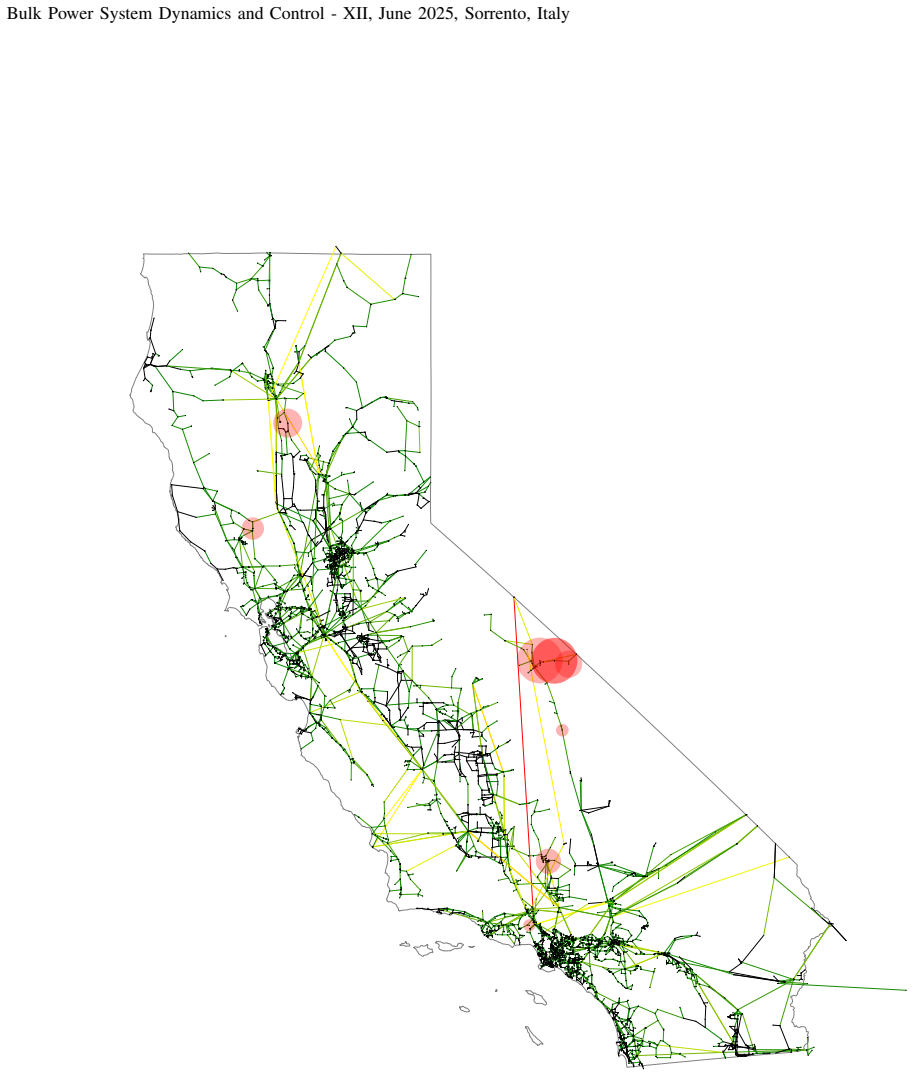
The paper's central claim is that the two-stage Benders decomposition—master problem (15) choosing battery sizes and locations plus undergrounding candidates, with scenario-decomposed linear subproblems (14) that return dual multipliers as Benders cuts—converges to the optimal solution of the planning MILP (12), making what the authors state is the first solution of an infrastructure-resilience investment problem at this scale. Applied to the California Test System with real-world hourly load and renewable data and daily wildfire ignition risk from 2020, the model finds that when both options are available, line undergrounding is preferred over battery installation for most seasons, and that combining both options reduces daily average load shed more than batteries alone (an additional 2,065 MWh per day in the year-round case, cutting daily load-shedding cost by roughly $45.5 million). The year-round scenario set also yields more geographically varied placements than any single seasonal set, which the paper reads as evidence that comprehensive multi-scenario planning changes investment decisions.
Load-bearing premise
The results rest on the assumptions that the twelve representative days (three per season, one per month, all from 2020) capture the year's distribution of wildfire ignition risk, load, and renewable generation, and that the chosen costs—$20,000 per MWh of load shed, $7 million per mile undergrounding, and the battery prices—reflect reality; change any of these and the recommended investments could change.
Editorial extensions
If this is right
- Utilities can apply the algorithm to plan battery and undergrounding investments on a full-scale transmission network across a year of wildfire scenarios, rather than only on small test systems.
- Seasonal-only planning can miss optimal investments; the year-round scenario set selects placements not chosen in any seasonal run, so multi-season scenario coverage changes where investments go.
- When line undergrounding is available as an option, the model prefers it over batteries in most seasons, indicating that battery-only plans may under-deliver on reducing PSPS load shed.
- Combining batteries and undergrounding cuts daily average load shed by about 2,065 MWh compared with batteries alone in the year-round case, at an annualized daily investment cost of about $0.62 million.
- Parallelizing the per-scenario subproblems cuts computation time by roughly 25% for seasonal cases and 60% for the year-round case, which would make adding more scenarios computationally feasible.
Reading between the lines
- If the value-of-lost-load or undergrounding cost assumptions shift, the undergrounding preference could reverse; the paper presents no sensitivity analysis, so the headline preference is conditional on costs that vary by utility and territory.
- The model treats each scenario's 24-hour day as independent with no state-of-charge carryover between days, which likely undervalues batteries that could store energy across consecutive high-risk days; allowing inter-scenario coupling could make batteries more competitive.
- The reported runs stop at a fixed 20-iteration limit without reporting optimality gaps, so the presented portfolios should be read as near-optimal solutions of the stated model rather than certified optima.
- The same two-stage decomposition could be applied to other de-energization-driven resilience problems, such as hurricane hardening or cold-weather load shedding, by swapping the risk data and line-outage model.
Editorial analysis
A structured set of objections, weighed in public.
Referee Report
Summary. The manuscript formulates a two-stage stochastic mixed-integer linear program for investing in battery storage and undergrounding of risky transmission lines under wildfire-ignition risk, with day-long scenarios representing seasonal conditions. The first stage (master) determines investment decisions; the second stage (subproblems) evaluates operations using a DC power flow model. The authors propose a Benders decomposition, implement it on the 8870-bus California Test System with real wildfire risk data, and report investment decisions, load-shed reductions, and computation times. The paper's central claims are that the decomposition converges to the optimal solution of the MILP and that the framework enables large-scale resilience planning.
Significance. If the technical issues were resolved, the paper would offer a useful contribution: a scenario-based expansion-planning framework for a realistic large-scale network, with subproblems that decompose and parallelize over scenarios, and with a case study using a publicly available test system and geographic risk data. The authors should be credited for applying the methodology to a network of unusual size and for grounding the risk model in external data. However, the correctness of the decomposition is essential to the paper's claims, and the current formulation has several load-bearing problems described below.
major comments (4)
- [Section 3.2, Eq. (15c)] The Benders optimality cut as written is missing the constant term that equals the optimal value of the subproblem at the current first-stage solution. In standard Benders decomposition, after solving subproblem (14) with X fixed to \hat X(k), the cut for scenario ω must take the form Z_ω ≥ Q_ω(\hat X(k)) + \hat ν_ω(k)^T (X - \hat X(k)), where Q_ω(\hat X(k)) is the optimal objective value of (14). In the manuscript, the cut is Z_ω ≥ \hat ν_ω(k)^T (X - \hat X(k)), so at X = \hat X(k) the right-hand side is zero, whereas the actual subproblem cost—load shedding, generation, and battery dummy terms—is strictly positive in the numerical results (e.g., Table III). Consequently the master problem (15a) systematically undervalues operational costs, the lower bound computed in Eq. (16a) is not a valid lower bound for the MILP (12), and the stopping criterion in Algorithm 1 cannot certify optimality. This is a load-bearing error for the paper's central optimality claim.
- [Section 3.2 and Algorithm 1] The first iteration of Algorithm 1 solves the master problem (15) without the Benders cuts, i.e., without constraint (15c). Since the variables Z_ω appear only in the objective with positive coefficients and have no lower bounds, the master problem is unbounded below in this first iteration. In a correct Benders implementation one must either initialize with Z_ω ≥ 0 (valid when subproblem costs are nonnegative) or include an initial cut. As written, Algorithm 1 cannot be executed. This is a second load-bearing issue.
- [Section 5 and Algorithm 1] The numerical section states that 'each problem is run until a 20 iteration limit' but reports neither the optimality gap (UB_k - LB_k)/UB_k nor the tolerance ε used in the convergence test. Without these, the tables (Tables I–IV) do not demonstrate that the reported investment plans are optimal for the stated model, even setting aside the cut error. The paper should report the upper and lower bounds at termination for each case.
- [Section 5 (Tables I, IV)] The headline conclusion that the planner prefers undergrounding over batteries rests on a single set of economic parameters: $20,000/MWh for load shed, $7 million/mile for undergrounding, and the specified battery costs. No sensitivity analysis is provided for these values, although the load-shed value is known to vary widely across customer classes and the undergrounding cost varies by terrain. Because the qualitative 'undergrounding preference' is a central result, the paper should include a sensitivity study or, at minimum, a break-even analysis on these parameters.
minor comments (7)
- [Section 2.2.3] The definition of Lrisk as T_{ω∈Ω} Lω \ Lon_ω appears to use an intersection symbol; Section 5 correctly defines it as the union S_{ω∈Ω} Lω \ Lon_ω. Please reconcile the notation.
- [Section 5.3 / Table V] The table is titled 'Per scenario solution time in minutes' but the entries (e.g., 775 minutes for Spring, 3418 minutes for Full Year) appear to be total solution times, not per-scenario times. Clarify the heading and compute per-scenario values if intended.
- [Section 3.3, Eq. (16b)] The upper bound is written with \hat X(k-1), while the subproblem at iteration k evaluates \hat X(k); align the indices so that the upper and lower bounds correspond to the same first-stage solution.
- [Section 2.2.3, Eq. (10)] The load-shed variable in (10) is written as pls_{t,ω} without a bus index, while the same variable appears as pls_{i,t,ω} elsewhere; make the indexing consistent.
- [Section 4] The dummy cost λ in objective (1) is never assigned a numerical value; a small positive value is needed to break the degeneracy that allows simultaneous charging and discharging, and the chosen value should be reported.
- [Section 2.1, Eqs. (2a)-(2b)] The bounds in (2a) and (2b) use symbols X^P and X^E (and upper bars) that are not defined; define them or replace with explicit limits such as 0 and 4.0 p.u. used in Section 4.
- [Section 5.1] The paper selects three representative days per season from 2020 but provides no quantitative argument that these days capture the annual distribution of wildfire risk, load, and renewable generation; a brief justification or a sensitivity check on the scenario set would strengthen the case-study conclusions.
Circularity Check
No circularity: the Benders decomposition is a standard reformulation of MILP (12), and the reported load-shed reductions are computed outputs, not fitted inputs.
full rationale
The paper's central derivation is the decomposition of the planning MILP (12) into master problem (15) and linear subproblems (14). This is a standard Benders equivalence, not a definitional identity: the master's investment variables and the subproblems' operational variables are distinct, and the optimality cut (15c) is meant to carry dual information from the subproblem back to the master. No parameter in the model is fitted to the load-shedding values that are later presented as reductions; the load-shed, generation, battery, and undergrounding costs are fixed constants taken from the cited literature, and Tables II-IV are optimization outputs. The self-citations to [23] and [33] are used as inputs: [33] supplies the wildfire-risk values and the de-energization threshold used to construct scenarios, and [23] motivates the choice of investment options and is later cited as corroboration for the undergrounding preference. Neither citation defines the objective, the constraints, or the optimality criterion in a way that would make a reported result true by construction. The claim of 'first solution at this scale' is a novelty assertion, not a derived result. A separate correctness concern is that the printed Benders cut in Eq. (15c) omits the constant term equal to the subproblem objective at the fixed first-stage solution, so the lower bound (16a) is not tight; this is an algorithmic error, not a circularity, because it does not make any output equal to an input.
Assumptions & free parameters
free parameters (10)
- Cost of load shed (c_ls) =
$20,000 per MWh
- Undergrounding cost (C_UG) =
$7,000,000 per mile
- Battery fixed cost (C_F) =
$100,000 per node
- Battery energy cost (C_E) =
$1,000,000 per MWh
- Battery power cost (C_P) =
$1,000,000 per MW
- Wildfire risk de-energization threshold =
95th percentile
- Maximum battery size per node =
4.0 p.u. (400 MWh/400 MW)
- Battery efficiency and self-discharge (eta, gamma) =
eta=0.95, gamma=0.999958
- Dummy battery operation cost (lambda) =
not specified
- Representative scenario days =
3 per season (one per month)
assumptions (4)
- domain assumption DC power flow (B-theta) is an adequate model of transmission operations for this planning problem.
- domain assumption Lines with risk above the 95th percentile are de-energized in each scenario.
- ad hoc to paper The representative days capture the annual distributions of load, renewables, and wildfire risk.
- domain assumption The subproblem is feasible for every master investment decision, so no Benders feasibility cuts are required.
Cite this review
Pith. "Pith review of Optimizing Battery and Line Undergrounding Investments for Transmission Systems under Wildfire Risk Scenarios: A Benders Decomposition Approach." pith.science (2026). https://pith.science/paper/773SZPWK
@misc{pith2026250606687,
  author       = {Pith},
  title        = {Pith review of: Optimizing Battery and Line Undergrounding Investments for Transmission Systems under Wildfire Risk Scenarios: A Benders Decomposition Approach},
  year         = {2026},
  howpublished = {\url{https://pith.science/paper/773SZPWK}},
  note         = {Machine review of arXiv:2506.06687}
}
read the original abstract
With electric power infrastructure posing an increasing risk of igniting wildfires under continuing climate change, utilities are frequently de-energizing power lines to mitigate wildfire ignition risk, which can cause load shedding. Recent research advocates for installing battery energy storage systems as well as undergrounding risky overhead lines to reduce the load shedding during such de-energizations. Since wildfire ignition risk can exhibit substantial geographic and temporal variations, it is important to plan battery installation and line undergrounding investments while considering multiple possible scenarios. This paper presents a scenario-based framework for optimizing battery installation and line undergrounding investments while considering many scenarios, each consisting of a day-long time series of uncertain parameters for the load demand, renewable generation, and wildfire ignition risks. This problem is difficult to solve due to a large number of scenarios and binary variables associated with the battery placements as well as the lines to be undergrounded. To address the computational challenges, we decompose the problem in a two-stage scheme via a Benders decomposition approach. The first stage is a master problem formulated as a mixed integer linear programming (MILP) model that makes decisions on the locations and sizes of batteries as well as the lines to be undergrounded. The second stage consists of a linear programming model that assesses these battery and line undergrounding decisions as modeled by a DC OPF formulation. We demonstrate the effectiveness of the proposed scheme on a large-scale transmission network with real world data on wildfire ignition risks, load, and renewable generation.
Figures


Figures from the paper (7 more)




Forward citations
Cited by 1 Pith paper
-
Linear and Second-order-cone Valid Inequalities for Problems with Storage
The paper proves families of linear and SOC valid inequalities for battery storage feasible sets, generalizing prior single-period facets and nearly eliminating complementarity violations in set-point tracking.
Reference graph
Works this paper leans on
-
[1]
S. Martinuzzi, A. J. Allstadt, A. M. Pidgeon, C. H. Flather, W. M. Jolly, and V . C. Radeloff, “Future changes in fire weather, spring droughts, and false springs across US National Forests and Grasslands,” Ecological Applications, vol. 29, no. 5, p. e01904, 2019
work page 2019
-
[2]
Fire ignition data,
California Public Utilities Commission, “Fire ignition data,” 2023. [Online]. Available: www.cpuc.ca.gov/industries-and-topics/wildfires
2023
-
[3]
Twenty-first century California, USA, wildfires: Fuel-dominated vs. Wind-dominated fires,
J. E. Keeley and A. D. Syphard, “Twenty-first century California, USA, wildfires: Fuel-dominated vs. Wind-dominated fires,” Fire Ecology , vol. 15, no. 1, p. 24, 2019
work page 2019
-
[4]
Location, timing and extent of wildfire vary by cause of ignition,
A. D. Syphard and J. E. Keeley, “Location, timing and extent of wildfire vary by cause of ignition,” International Journal of Wildland Fire , vol. 24, no. 1, pp. 37–47, 2015
work page 2015
-
[5]
Learn about Public Safety Power Shutofffs,
PG&E, “Learn about Public Safety Power Shutofffs,” 2021. [Online]. Available: https://www.pge.com/en US/residential/outages/ public-safety-power-shuttoff/learn-about-psps.page
work page 2021
-
[6]
California power shutoffs: Deficiencies in data and reporting,
M. Sotolongo, C. Bolon, and S. H. Baker, “California power shutoffs: Deficiencies in data and reporting,” Initiative for Energy Justice, October 2020
work page 2020
-
[7]
G. Wong-Parodi, “Support for public safety power shutoffs in California: Wildfire-related perceived exposure and negative outcomes, prior and current health, risk appraisal and worry,” Energy Research & Social Science, vol. 88, p. 102495, 2022. Bulk Power System Dynamics and Control - XII, June 2025, Sorrento, Italy
work page 2022
-
[8]
10,000-Mile Undergrounding Program,
PG&E, “10,000-Mile Undergrounding Program,” July 2023. [Online]. Available: https://www. pge.com/content/dam/pge/docs/outages-and-safety/safety/ pge-10k-undergrounding-program-city-county-maps-202307.pdf
work page 2023
Show all 52 references
-
[9]
Hardening the electric system,
PG&E, “Hardening the electric system,” 2023. [Online]. Avail- able: https://www.pge.com/assets/pge/docs/outages-and-safety/safety/ fs-system-hardening.pdf
2023
-
[10]
2025 Wildfire Mitigation Plan Update,
SCE, “2025 Wildfire Mitigation Plan Update,” November 2024. [Online]. Available: https://www.sce.com/sites/default/files/AEM/ Wildfire%20Mitigation%20Plan/2023-2025/SCE%202025%20WMP% 20Update%20R1.pdf
2025
-
[11]
Covered Conductor — Everything You Need To Know (Compendium),
——, “Covered Conductor — Everything You Need To Know (Compendium),” November 2024. [Online]. Available: https://www.sce.com/sites/default/files/AEM/Supporting% 20Documents/2023-2025/Covered%20Conductor%20Compendium.pdf
2024
-
[12]
PG&E scraps tree-trimming program once seen as key to fire prevention,
K. Blunt, “PG&E scraps tree-trimming program once seen as key to fire prevention,” The Wall Street Journal , Aug 2023
2023
-
[13]
Undergrounding a safer, stronger and more affordable energy future,
PG&E, “Undergrounding a safer, stronger and more affordable energy future,” August 2024. [Online]. Available: https://www.pge.com/assets/ pge/docs/outages-and-safety/safety/undergrounding-fact-sheet.pdf
2024
-
[14]
Out of sight, out of mind: An updated study on the undergrounding of overhead power lines,
K. L. Hall, “Out of sight, out of mind: An updated study on the undergrounding of overhead power lines,” Edison Electric Institute, Washington, DC, 2012
2012
-
[15]
Resilient by design: Preventing wildfires and blackouts with micro- grids,
W. Yang, S. N. Sparrow, M. Ashtine, D. C. Wallom, and T. Morstyn, “Resilient by design: Preventing wildfires and blackouts with micro- grids,” Applied Energy, vol. 313, p. 118793, 2022
2022
-
[16]
PG&E’s plan to bury power lines and prevent wildfires faces opposition because of high rates,
A. Beam, “PG&E’s plan to bury power lines and prevent wildfires faces opposition because of high rates,” AP News , Oct 2023
2023
-
[17]
Battery energy storage system size determination in renewable energy systems: A review,
Y . Yang, S. Bremner, C. Menictas, and M. Kay, “Battery energy storage system size determination in renewable energy systems: A review,” Renewable and Sustainable Energy Reviews , vol. 91, pp. 109–125, 2018
2018
-
[18]
Transmission-scale battery energy storage systems: A systematic literature review,
K. Marnell, M. Obi, and R. Bass, “Transmission-scale battery energy storage systems: A systematic literature review,” Energies, vol. 12, no. 23, p. 4603, 2019
2019
-
[19]
PG&E, Energy Vault plan largest US utility-scale battery, green hydrogen long-duration storage project,
S. Singer, “PG&E, Energy Vault plan largest US utility-scale battery, green hydrogen long-duration storage project,” Utility Dive, Jan 2023. [Online]. Available: https://www.utilitydive.com/ news/california-wildfires-battery-storage-fuel-cells-hydrogen/639771
2023
-
[20]
CAISO: 1GW dispatch during July wildfire a ‘fabulous moment’ for battery storage amidst 12-fold growth,
C. Murray, “CAISO: 1GW dispatch during July wildfire a ‘fabulous moment’ for battery storage amidst 12-fold growth,” Energy Storage News, March 2022
2022
-
[21]
Influence of battery energy storage systems on transmission grid operation with a significant share of variable renewable energy sources,
S. F. Santos, M. Gough, D. Z. Fitiwi, A. F. P. Silva, M. Shafie-Khah, and J. P. S. Catal ˜ao, “Influence of battery energy storage systems on transmission grid operation with a significant share of variable renewable energy sources,” IEEE Systems Journal , vol. 16, no. 1, March 2022
2022
-
[22]
Unbalanced distribution system expansion and energy storage planning under wildfire risk,
A. Z. Bertoletti and J. C. do Prado, “Unbalanced distribution system expansion and energy storage planning under wildfire risk,” IEEE Access, vol. 11, pp. 125 256–125 266, 2023
2023
-
[23]
Optimizing transmission infrastructure investments to support line de-energization for mitigating wildfire ignition risk,
A. Kody, R. Piansky, and D. K. Molzahn, “Optimizing transmission infrastructure investments to support line de-energization for mitigating wildfire ignition risk,” 11th IREP Symposium on Bulk Power System Dynamics and Control , July 2022
2022
-
[24]
Long duration battery sizing, siting, and operation under wildfire risk using progressive hedging,
R. Piansky, G. Stinchfield, A. Kody, D. K. Molzahn, and J. P. Watson, “Long duration battery sizing, siting, and operation under wildfire risk using progressive hedging,” Electric Power Systems Research , vol. 235, no. 110785, October 2024, 23rd Power Systems Computation Confe...
2024
-
[25]
Partitioning methods for solving mixed variables program- ming problems,
J. Benders, “Partitioning methods for solving mixed variables program- ming problems,” Numerische Mathematik, vol. 4, p. 238–252, December 1962
1962
-
[26]
A. J. Conejo, E. Castillo, R. Minguez, and R. Garcia-Bertrand, Decom- position Techniques in Mathematical Programming: Engineering and Science Applications . Springer Science & Business Media, 2006
2006
-
[27]
The Benders decomposition algorithm: A literature review,
R. Rahmaniani, T. G. Crainic, M. Gendreau, and W. Rei, “The Benders decomposition algorithm: A literature review,” European Journal of Operational Research, vol. 259, no. 3, pp. 801–817, 2017
2017
-
[28]
Optimal planning of dis- tributed energy storage systems in active distribution networks em- bedding grid reconfiguration,
M. Nick, R. Cherkaoui, and M. Paolone, “Optimal planning of dis- tributed energy storage systems in active distribution networks em- bedding grid reconfiguration,” IEEE Transactions on Power Systems , vol. 33, no. 2, pp. 1577–1590, 2017
2017
-
[29]
Resiliency-oriented planning of transmission systems and distributed energy resources,
H. Ranjbar, S. H. Hosseini, and H. Zareipour, “Resiliency-oriented planning of transmission systems and distributed energy resources,” IEEE Transactions on Power Systems , vol. 36, no. 5, pp. 4114–4125, 2021
2021
-
[30]
Expansion planning of active distribution networks achieving their dispatchability via energy storage systems,
J. H. Yi, R. Cherkaoui, M. Paolone, D. Shchetinin, and K. Knezovic, “Expansion planning of active distribution networks achieving their dispatchability via energy storage systems,” Applied Energy , vol. 326, p. 119942, 2022
2022
-
[31]
Optimal co-planning of ESSs and line reinforcement considering the dispatchability of active distribution networks,
——, “Optimal co-planning of ESSs and line reinforcement considering the dispatchability of active distribution networks,” IEEE Transactions on Power Systems , vol. 38, no. 3, pp. 2485–2499, 2022
2022
-
[32]
California test system (CATS): A geographically accurate test system based on the California grid,
S. Taylor, A. Rangarajan, N. Rhodes, J. Snodgrass, B. Lesieutre, and L. A. Roald, “California test system (CATS): A geographically accurate test system based on the California grid,” IEEE Trans. on Energy Markets, Policy and Regulation , vol. 2, no. 1, pp. 107–118, 2024
2024
-
[33]
Quantifying metrics for wildfire ignition risk from geographic data in power shutoff decision-making,
R. Piansky, S. Taylor, N. Rhodes, D. K. Molzahn, L. A. Roald, and J.-P. Watson, “Quantifying metrics for wildfire ignition risk from geographic data in power shutoff decision-making,” 58th Hawaii International Conference on System Sciences (HICSS) , January 2025
2025
-
[34]
Wildland Fire Potential Index,
U.S. Geological Survey, “Wildland Fire Potential Index,”
-
[35]
Dispatching stochastic heterogeneous resources accounting for grid and battery losses,
E. Stai, L. Reyes-Chamorro, F. Sossan, J.-Y . Le Boudec, and M. Paolone, “Dispatching stochastic heterogeneous resources accounting for grid and battery losses,” IEEE Transactions on Smart Grid , vol. 9, no. 6, pp. 6522–6539, 2017
2017
-
[36]
Coordinated day-ahead dis- patch of multiple power distribution grids hosting stochastic resources: An ADMM-based framework,
R. Gupta, S. Fahmy, and M. Paolone, “Coordinated day-ahead dis- patch of multiple power distribution grids hosting stochastic resources: An ADMM-based framework,” Electric Power Systems Research , vol. 212, no. 108555, 2022, 22nd Power Systems Computation Conference (PSCC)
2022
-
[37]
Solving multiperiod OPF problems using an AC-QP algorithm initialized with an SOCP relaxation,
J. F. Marley, D. K. Molzahn, and I. A. Hiskens, “Solving multiperiod OPF problems using an AC-QP algorithm initialized with an SOCP relaxation,” IEEE Transactions on Power Systems , vol. 32, no. 5, pp. 3538–3548, 2016
2016
-
[38]
Linear battery models for power systems analysis,
D. Pozo, “Linear battery models for power systems analysis,” Electric Power Systems Research , vol. 212, no. 108565, 2022, 22nd Power Systems Computation Conference (PSCC)
2022
-
[39]
Equitably allocating wildfire resilience investments for power grids – The curse of aggregation and vulnerability indices,
M. Pollack, R. Piansky, S. Gupta, and D. K. Molzahn, “Equitably allocating wildfire resilience investments for power grids – The curse of aggregation and vulnerability indices,” Applied Energy, vol. 388, no. 125511, June 2025
2025
-
[40]
Value of lost load: An efficient economic indicator for power supply security? A literature review,
T. Schr ¨oder and W. Kuckshinrichs, “Value of lost load: An efficient economic indicator for power supply security? A literature review,” Frontiers in Energy Research , vol. 3, p. 55, 2015
2015
-
[41]
CPUC under- grounding programs description,
California Public Utility Commision, “CPUC under- grounding programs description,” 2019. [Online]. Avail- able: https://www.cpuc.ca.gov/industries-and-topics/electrical-energy/ infrastructure/electric-reliability/undergrounding-program-description
2019
-
[42]
2022 grid energy storage technology cost and performance assessment,
V . Viswanathan, K. Mongird, R. Franks, X. Li, V . Sprenkle, and R. Baxter, “2022 grid energy storage technology cost and performance assessment,” PNNL Technical Report, PNNL-33283 , August 2022
2022
-
[43]
Overview of current development in electrical energy storage technologies and the application potential in power system operation,
X. Luo, J. Wang, M. Dooner, and J. Clarke, “Overview of current development in electrical energy storage technologies and the application potential in power system operation,” Applied Energy, vol. 137, pp. 511– 536, 2015
2015
-
[44]
What drives capacity degradation in utility- scale battery energy storage systems? The impact of operating strategy and temperature in different grid applications,
D. Gr ¨af, J. Marschewski, L. Ibing, D. Huckebrink, M. Fiebrandt, G. Hanau, and V . Bertsch, “What drives capacity degradation in utility- scale battery energy storage systems? The impact of operating strategy and temperature in different grid applications,” Journal of Energy ...
2022
-
[45]
Overhead vs. underground: Information about burying high-voltage transmission lines,
Xcel Energy, “Overhead vs. underground: Information about burying high-voltage transmission lines,” 2014
2014
-
[46]
Gurobi Optimizer Reference Manual,
Gurobi Optimization, LLC, “Gurobi Optimizer Reference Manual,”
-
[47]
[Online]
PACE, Partnership for an Advanced Computing Environment (PACE) . [Online]. Available: http://www.pace.gatech.edu
-
[48]
A Survey of Relaxations and Approximations of the Power Flow Equations,
D. K. Molzahn and I. A. Hiskens, “A Survey of Relaxations and Approximations of the Power Flow Equations,” F oundations and Trends in Electric Energy Systems , vol. 4, no. 1-2, pp. 1–221, February 2019
2019
-
[49]
Long solution times or low solution quality: On trade-offs in choosing a power flow formulation for the optimal power shutoff problem,
E. Haag, N. Rhodes, and L. A. Roald, “Long solution times or low solution quality: On trade-offs in choosing a power flow formulation for the optimal power shutoff problem,” Electric Power Systems Research , vol. 234, p. 110713, 2024, 23rd Power Systems Computation Conference (PSCC)
2024
-
[50]
AC-informed DC optimal transmission switching problems via parameter optimization,
B. Taheri and D. K. Molzahn, “AC-informed DC optimal transmission switching problems via parameter optimization,” arXiv:2411.10528, November 2024
2024 arXiv
-
[2024]
Available: https://www.usgs.gov/fire-danger-forecast/ wildland-fire-potential-index-wfpi
[Online]. Available: https://www.usgs.gov/fire-danger-forecast/ wildland-fire-potential-index-wfpi
-
[2025]
Available: https://www.gurobi.com
[Online]. Available: https://www.gurobi.com
Reviewed August 7, 2026 · model on record in the stance chip above.
Discussion (0). Sign in to comment.