REVIEW 4 major objections 5 minor 71 references
Exploring Length Generalization For Transformer-based Speech Enhancement
T0 review · 4 major / 5 minor · reviewed 2026-08-07 · deepseek-v4-flash
Pith's one-line read Transformer speech enhancement models can be trained on 1- or 2-second clips and still generalize to 20-second noisy utterances, provided attention scores are biased by a learned linear function of frame distance.
desk verdict LearnLin itself is already in the authors' INTERSPEECH 2024 paper; this version's value is the systematic PE comparison, which is solid but lacks error bars, code, and the learned beta values. read the letter →
The pith
A machine-rendered reading of the paper's core claim, the machinery that carries it, and where it could break.
The reading
What carries the argument
The central object is LearnLin, a relative position bias $P^h_{i,j} = \beta_h \cdot |i - j|$ indexed by attention head $h$, with one learnable scalar $\beta_h$ per head shared across all Transformer layers. It injects position information by addition before softmax in the scaled dot-product attention, so the bias directly shapes which time frames attend to which. This single linear distance penalty carries the argument: it is simpler than the sigmoidal DA-Bias, the kernelized KERPLE, the radial-basis TISA, the bucketed T5-Bias, or the Gaussian Gauss-Bias, yet the paper finds it damps the effect of utterance length more effectively across all four training objectives and both causal and non-causal configurations.
What would settle it
Train LearnLin on 1-second clips, record the learned $\beta_h$ values for all heads, and inspect attention maps on 20- and 30-second inputs: if any head's attention saturates on distant frames, becomes nearly uniform, or if the model's PESQ and ESTOI scores on 30-second utterances fall below the no-position-encoding baseline, the claimed length generalization fails.
Extended reading notes
Core claim
The paper's central claim is that a head-wise learnable linear bias on relative frame distance enables Transformer speech enhancement models to extrapolate from short training utterances to much longer test utterances. Specifically, for each attention head $h$, the position bias is $P^h_{i,j} = \beta_h \cdot |i - j|$, where $\beta_h$ is one trainable scalar, shared across layers, and the bias is added to the raw attention scores before softmax. A positive $\beta_h$ makes the head favor long-range dependencies and a negative one favors short-range dependencies, so a few scalars let different heads specialize. In experiments on four training targets (magnitude spectrum, ideal ratio mask, phase-sensitive mask, and complex ideal ratio mask) and five metrics (PESQ, ESTOI, CSIG, CBAK, COVL), the paper reports that LearnLin gives the best or tied-best scores at 5s, 10s, 15s, and 20s test lengths in nearly all settings, and that its margin over other methods grows as the test utterance gets longer.
Load-bearing premise
The load-bearing premise is that a single scalar $\beta_h$ learned only from 1- or 2-second clips, and shared across all layers, continues to produce sensible attention weights at frame distances up to roughly 1,250 that were never seen during training, rather than over-amplifying or suppressing long-range attention.
Editorial extensions
If this is right
- A model trained only on 1-second or 2-second noisy-clean pairs can enhance 20-second utterances with quality scores that match or exceed all seven compared positional encodings, across all four training objectives.
- Absolute position embeddings, both sinusoidal and learned, collapse on long inputs and in some cases score below unprocessed noisy speech, while every relative position encoding generalizes better.
- For LearnLin, longer inputs help rather than hurt: scores at 10s to 20s are generally higher than at the training length, because more context is available to each frame.
- Chunk-based processing with 1-second segments loses context and underperforms full-length extrapolation, even with 50% overlap, so the length-generalization ability itself is what delivers the gains.
- A single scalar per attention head is sufficient; the extra parameters and nonlinearities of TISA, KERPLE, and DA-Bias do not translate into better speech enhancement, and LearnLin's margin over them grows with test length.
Reading between the lines
- Editorial inference: the linear bias is an extrapolation gamble, because the paper does not report the learned $\beta_h$ values; a natural next check is whether heads trained on 1-second clips keep their intended long-range or short-range profiles when evaluated at roughly 1,250 frames, since a large positive slope could make distant frames dominate attention in unintended ways.
- Editorial inference: because speech spectrograms have strong local temporal structure, LearnLin's success suggests a monotonic distance penalty captures most of the position information needed for enhancement, a hypothesis that could be tested by ablating content-based attention and keeping only the distance bias.
- Editorial inference: the same one-scalar-per-head recipe may transfer to other frame-based audio tasks such as speaker separation or speech recognition, where long-context extrapolation is also practically valuable, but the present study only demonstrates results for speech enhancement.
Editorial analysis
A structured set of objections, weighed in public.
Referee Report
Summary. The paper studies whether Transformer-based speech enhancement models trained on short utterances (1s or 2s) can generalize to longer inputs (5s, 10s, 15s, 20s) at test time. It compares seven existing positional encoding methods, including absolute (Sinusoidal, BERT-Pos) and relative (Gauss-Bias, T5-Bias, TISA, DA-Bias, KERPLE, RoPE) schemes, and proposes a new scheme called LearnLin, in which the attention bias for head h is P^h_{i,j} = β_h |i − j| with one learnable scalar per head shared across layers (Eq. 15). The evaluation covers four training objectives (MS, IRM, PSM, cIRM), five metrics (PESQ, ESTOI, CSIG, CBAK, COVL), causal and non-causal configurations, and chunk-based processing. The headline findings are that absolute positional encoding methods collapse on long utterances, relative positional encoding methods are more robust, and LearnLin is usually the best or tied with the best method.
Significance. If the empirical claims are taken at face value, this is a practically useful result: a single scalar per attention head added as a linear relative-distance bias is a very low-cost way to keep Transformer speech enhancement models functional on inputs longer than those seen in training. The paper's strengths are the breadth of the comparison (seven baseline positional encodings, four training objectives, five metrics, causal and chunk settings) and the clear demonstration that absolute positional encodings fail in the length-generalization regime. However, the absence of variance estimates or significance testing, the incomplete cIRM coverage, and the unverified mechanism attributed to LearnLin substantially temper the strength of the 'excellent length generalization' and 'superior' claims. The qualitative ranking visible in the tables is credible, but the quantitative comparative claims need additional support before the paper can be accepted as is.
major comments (4)
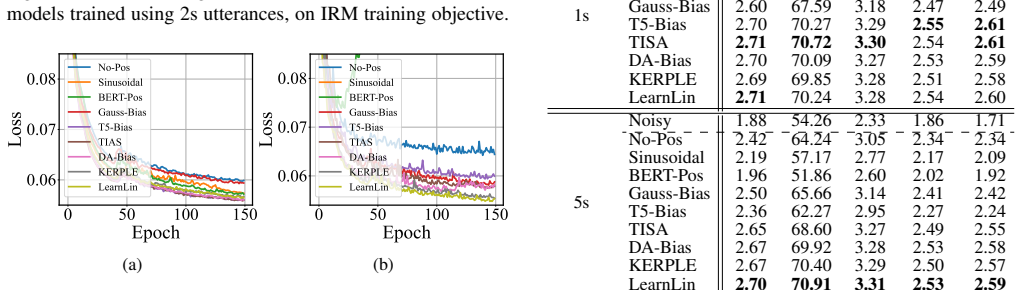
- [§VII-B, Tables II–X] The paper's comparative claims that LearnLin 'always performs best' and is 'superior' are supported only by point estimates. No number of independent runs, standard deviations, confidence intervals, or significance tests are reported. Many of the decisive gaps are within 0.01–0.03 in PESQ, CSIG, or COVL; for example, Table VI (5s row) shows LearnLin PESQ 2.74 vs. DA-Bias 2.73, and Table VIII (5s row) shows TISA PESQ 2.76 vs. LearnLin 2.75 and TISA CSIG 3.41 vs. LearnLin 3.40. With no variance measure, these margins cannot support the stated ranking. Please state the number of independent runs, report variance or confidence intervals, or explicitly discuss effect sizes relative to the uncertainty.
- [§V-B, Eq. (15)] The LearnLin mechanism is asserted but not verified. The paper never reports the learned β_h values, their distribution across heads, their variability across runs, or any diagnostic of attention as a function of relative distance. This matters because the bias is an unbounded linear function of |i − j|: at a 20s input (roughly 1,250 frames), a head with |β_h| ≥ 0.01 would add a bias above 12 to the content logits, potentially dominating the softmax. That the model performs well on 5–20s inputs is indirect evidence that the learned β_h values are benign, but the claimed 'preferences on short- or long-term dependencies' (Section V-B) and the safety of extrapolation are not established. Please report the learned β_h values and include a sensitivity/attention-distance analysis.
- [§VII-B, Tables II–V and VI–VIII] The 'four training objectives' coverage is incomplete. For 1s training, Table V reports cIRM only for test lengths 1s, 10s, and 20s, omitting 5s and 15s; for 2s training, no cIRM table is given at all, since Tables VI–VIII contain only MS, IRM, and PSM. The conclusion that LearnLin is superior across four training objectives therefore goes beyond the reported evidence. The authors should supply the missing cIRM results or qualify the claim to the objectives and lengths actually evaluated.
- [Table VIII, 5s row, and surrounding text] The text states that aside from TISA showing 0.02 CSIG and 0.01 COVL gains over LearnLin at the 5s test length, LearnLin 'always performs best in all other test cases'. The table actually shows TISA also with higher PESQ (2.76 vs. 2.75) and DA-Bias with equal/higher CSIG (3.41 vs. 3.40), and the TISA CSIG gain is 0.01, not 0.02. Please correct this description and re-examine all similar 'always best' statements across Tables VI–VIII.
minor comments (5)
- [§VII-B] The sentence 'Tables VI–IV report the comparison results' should read 'Tables VI–VIII'; the typo appears in the paragraph introducing the 2s training results.
- [Figs. 5–7 and Table VII] Notation is inconsistent: the figure legends use 'TIAS' instead of 'TISA', and Table VII uses 'Gauss. Bias' and 'T5 Bias' while other tables use 'Gauss-Bias' and 'T5-Bias'. Please unify the naming.
- [§III-B, Eq. (6)] The non-causal variant of KERPLE is not described. Equation (6) gives the position bias, but the paper does not state how the original causal formulation is adapted to the non-causal speech enhancement setting. Please specify the exact modification.
- [§VI-B, Table I] Table I reports the number of trainable parameters for BERT-Pos as L'·d_model, but the value of L' used in the experiments is never stated. Please report it, since the parameter count of that baseline depends on it.
- [General] No code or trained checkpoint release is mentioned. Given the density of the tables and the small performance margins, releasing code would substantially improve reproducibility.
Circularity Check
No circular derivation: LearnLin is an empirically evaluated proposal whose length-generalization claim is tested on held-out utterances longer than the training ones.
full rationale
The paper's central claim is that the LearnLin position bias P^h_{i,j} = β_h · |i − j| (Eq. 15) helps Transformer speech enhancement models generalize from 1s/2s training utterances to 5s–20s test utterances. This claim is supported by direct experiments on held-out noisy mixtures scored with PESQ, ESTOI, CSIG, CBAK, and COVL (Tables II–X). No fitted β_h value is folded into a 'prediction'; the β_h parameters are trained only on short clips, and the test results are external measurements, not algebraic consequences of the definition. The observation that LearnLin contains the term w|i−j| from DA-Bias is an algebraic remark, not a derivation of the empirical result. The only self-citation, [17], is used to say 'we extend our previous work' and does not carry any load-bearing assumption. The absence of reported β_h values or attention-distance diagnostics is a verification gap, not circularity. The derivation chain therefore does not reduce to its own inputs.
Assumptions & free parameters
free parameters (1)
- LearnLin head-wise scale beta_h =
8 learned scalars, values not reported
assumptions (2)
- domain assumption Adding a head-wise linear relative-position bias to raw attention scores before softmax is sufficient for length generalization in Transformer speech enhancement.
- domain assumption Attention heads have stable short- or long-range preferences that can be captured by a single signed scalar per head, shared across all layers.
invented entities (1)
-
LearnLin position bias P^h_{i,j} = beta_h * |i - j|
Cite this review
Pith. "Pith review of Exploring Length Generalization For Transformer-based Speech Enhancement." pith.science (2026). https://pith.science/paper/53ZW3QTU
@misc{pith2026250606697,
  author       = {Pith},
  title        = {Pith review of: Exploring Length Generalization For Transformer-based Speech Enhancement},
  year         = {2026},
  howpublished = {\url{https://pith.science/paper/53ZW3QTU}},
  note         = {Machine review of arXiv:2506.06697}
}
read the original abstract
Transformer network architecture has proven effective in speech enhancement. However, as its core module, self-attention suffers from quadratic complexity, making it infeasible for training on long speech utterances. In practical scenarios, speech enhancement models are often required to perform on noisy speech at run-time that is substantially longer than the training utterances. It remains a challenge how a Transformer-based speech enhancement model can generalize to long speech utterances. In this paper, extensive empirical studies are conducted to explore the model's length generalization ability. In particular, we conduct speech enhancement experiments on four training objectives and evaluate with five metrics. Our studies establish that positional encoding is an effective instrument to dampen the effect of utterance length on speech enhancement. We first explore several existing positional encoding methods, and the results show that relative positional encoding methods exhibit a better length generalization property than absolute positional encoding methods. Additionally, we also explore a simpler and more effective positional encoding scheme, i.e. LearnLin, that uses only one trainable parameter for each attention head to scale the real relative position between time frames, which learns the different preferences on short- or long-term dependencies of these heads. The results demonstrate that our proposal exhibits excellent length generalization ability with comparable or superior performance than other state-of-the-art positional encoding strategies.
Figures


Figures from the paper (4 more)


Reference graph
Works this paper leans on
-
[17]
An exploration of length generalization in transformer-based speech enhancement,
Q. Zhang, H. Zhu, X. Qian, E. Ambikairajah, and H. Li, “An exploration of length generalization in transformer-based speech enhancement,” in Proc. INTERSPEECH, 2024, pp. 1725–1729
work page 2024
-
[1]
P. C. Loizou, Speech Enhancement: Theory and Practice , 2nd ed. Boca Raton, FL, USA: CRC Press, Inc., 2013
work page 2013
-
[2]
Suppression of acoustic noise in speech using spectral subtrac- tion,
S. Boll, “Suppression of acoustic noise in speech using spectral subtrac- tion,” IEEE Transactions on acoustics, speech, and signal processing , vol. 27, no. 2, pp. 113–120, 1979
work page 1979
-
[3]
Speech Enhancement Using a Minimum Mean-Square Error Short-Time Spectral Amplitude Estimator,
Y . Ephraim and D. Malah, “Speech Enhancement Using a Minimum Mean-Square Error Short-Time Spectral Amplitude Estimator,” IEEE Trans. Acoust., Speech, Signal Process. , vol. ASSP-32, no. 6, pp. 1109– 1121, Dec. 1984
work page 1984
-
[4]
M. Krawczyk-Becker and T. Gerkmann, “On MMSE-based estimation of amplitude and complex speech spectral coefficients under phase- uncertainty,” IEEE/ACM Trans. Audio, Speech, and Lang. Proc. , vol. 24, no. 12, pp. 2251–2262, 2016
work page 2016
-
[5]
A novel fast nonstationary noise tracking approach based on mmse spectral power estimator,
Q. Zhang, M. Wang, Y . Lu, L. Zhang, and M. Idrees, “A novel fast nonstationary noise tracking approach based on mmse spectral power estimator,” Digital Signal Processing , vol. 88, pp. 41–52, 2019
work page 2019
-
[6]
Speech enhancement based on a priori signal to noise estimation,
P. Scalart and J. V . Filho, “Speech enhancement based on a priori signal to noise estimation,” in Proc. ICASSP, vol. 2, 1996, pp. 629–632
work page 1996
-
[7]
Supervised speech separation based on deep learning: An overview,
D. Wang and J. Chen, “Supervised speech separation based on deep learning: An overview,” IEEE/ACM Transactions on Audio, Speech, and Language Processing, vol. 26, no. 10, pp. 1702–1726, 2018
2018
Show all 71 references
-
[8]
Deep neural network techniques for monaural speech enhancement: state of the art analysis,
P. Ochieng, “Deep neural network techniques for monaural speech enhancement: state of the art analysis,”arXiv preprint arXiv:2212.00369, 2022
2022 arXiv
-
[9]
Speech denoising in the waveform domain with self-attention,
Z. Kong, W. Ping, A. Dantrey, and B. Catanzaro, “Speech denoising in the waveform domain with self-attention,” in Proc. ICASSP , 2022, pp. 7867–7871
2022
-
[10]
Masked multi-head self-attention for causal speech enhancement,
A. Nicolson and K. K. Paliwal, “Masked multi-head self-attention for causal speech enhancement,” Speech Communication, vol. 125, pp. 80– 96, 2020
2020
-
[11]
Monaural speech derever- beration using temporal convolutional networks with self attention,
Y . Zhao, D. Wang, B. Xu, and T. Zhang, “Monaural speech derever- beration using temporal convolutional networks with self attention,” IEEE/ACM Trans. Audio, speech, Lang. Process. , vol. 28, pp. 1598– 1607, 2020
2020
-
[12]
T-GSA: Transformer with gaussian- weighted self-attention for speech enhancement,
J. Kim, M. El-Khamy, and J. Lee, “T-GSA: Transformer with gaussian- weighted self-attention for speech enhancement,” in Proc. ICASSP , 2020, pp. 6649–6653
2020
-
[13]
Noisy-reverberant speech enhancement using denseunet with time-frequency attention
Y . Zhao and D. Wang, “Noisy-reverberant speech enhancement using denseunet with time-frequency attention.” in Proc. INTERSPEECH , 2020, pp. 3261–3265
2020
-
[14]
Ripple sparse self-attention for monaural speech enhancement,
Q. Zhang, H. Zhu, Q. Song, X. Qian, Z. Ni, and H. Li, “Ripple sparse self-attention for monaural speech enhancement,” in Proc. ICASSP , 2023, pp. 1–5
2023
-
[15]
Conformer: Convolution-augmented Transformer for Speech Recognition,
A. Gulati, J. Qin, C.-C. Chiu, N. Parmar, Y . Zhang, J. Yu, W. Han, S. Wang, Z. Zhang, Y . Wu et al. , “Conformer: Convolution-augmented Transformer for Speech Recognition,” 2020, pp. 5036–5040
2020
-
[16]
Exploring length generalization in large language models,
C. Anil, Y . Wu, A. J. Andreassen, A. Lewkowycz, V . Misra, V . V . Ramasesh, A. Slone, G. Gur-Ari, E. Dyer, and B. Neyshabur, “Exploring length generalization in large language models,” in Proc. NeurIPS, 2022
2022
-
[18]
Attention is all you need,
A. Vaswani, N. Shazeer, N. Parmar, J. Uszkoreit, L. Jones, A. N. Gomez, Ł. Kaiser, and I. Polosukhin, “Attention is all you need,” in Proc. NeurIPS, 2017, pp. 5998–6008
2017
-
[19]
Exploring the limits of transfer learning with a unified text-to-text transformer
C. Raffel, N. Shazeer, A. Roberts, K. Lee, S. Narang, M. Matena, Y . Zhou, W. Li, P. J. Liuet al., “Exploring the limits of transfer learning with a unified text-to-text transformer.” J. Mach. Learn. Res. , vol. 21, no. 140, pp. 1–67, 2020
2020
-
[20]
The case for translation-invariant self- attention in transformer-based language models,
U. Wennberg and G. E. Henter, “The case for translation-invariant self- attention in transformer-based language models,” in Proc. ACL-IJCNLP, 2021, pp. 130–140
2021
-
[21]
Kerple: Kernelized relative positional embedding for length extrapolation,
T.-C. Chi, T.-H. Fan, P. J. Ramadge, and A. Rudnicky, “Kerple: Kernelized relative positional embedding for length extrapolation,” Proc. NeurIPS, vol. 35, pp. 8386–8399, 2022
2022
-
[22]
SEGAN: Speech enhancement generative adversarial network,
S. Pascual, A. Bonafonte, and J. Serr `a, “SEGAN: Speech enhancement generative adversarial network,” Proc. INTERSPEECH, pp. 3642–3646, 2017
2017
-
[23]
Raw waveform-based speech enhancement by fully convolutional networks,
S.-W. Fu, Y . Tsao, X. Lu, and H. Kawai, “Raw waveform-based speech enhancement by fully convolutional networks,” in Proc. APSIPA ASC , 2017, pp. 006–012
2017
-
[24]
On loss functions for supervised monaural time-domain speech enhancement,
M. Kolbæk, Z.-H. Tan, S. H. Jensen, and J. Jensen, “On loss functions for supervised monaural time-domain speech enhancement,” IEEE/ACM Trans. Audio, speech, Lang. Process. , vol. 28, pp. 825–838, 2020
2020
-
[25]
End-to-end waveform utterance enhancement for direct evaluation metrics optimiza- tion by fully convolutional neural networks,
S.-W. Fu, T.-W. Wang, Y . Tsao, X. Lu, and H. Kawai, “End-to-end waveform utterance enhancement for direct evaluation metrics optimiza- tion by fully convolutional neural networks,” IEEE/ACM Trans. Audio, Speech, and Lang. Proc. , vol. 26, no. 9, pp. 1570–1584, 2018
2018
-
[26]
Real time speech enhancement in the waveform domain,
A. Defossez, G. Synnaeve, and Y . Adi, “Real time speech enhancement in the waveform domain,” in Proc. INTERSPEECH, 2020
2020
-
[27]
A regression approach to speech enhancement based on deep neural networks,
Y . Xu, J. Du, L.-R. Dai, and C.-H. Lee, “A regression approach to speech enhancement based on deep neural networks,” IEEE/ACM Trans. Audio, Speech, and Lang. Proc. , vol. 23, no. 1, pp. 7–19, 2014
2014
-
[28]
Convolutional-recurrent neural networks for speech enhancement,
H. Zhao, S. Zarar, I. Tashev, and C.-H. Lee, “Convolutional-recurrent neural networks for speech enhancement,” in Proc. ICASSP , 2018, pp. 2401–2405
2018
-
[29]
Gated residual networks with dilated convolutions for monaural speech enhancement,
K. Tan, J. Chen, and D. Wang, “Gated residual networks with dilated convolutions for monaural speech enhancement,” IEEE/ACM transac- tions on audio, speech, and language processing , vol. 27, no. 1, pp. 189–198, 2018
2018
-
[30]
Speech enhancement using multi-stage self-attentive temporal con- volutional networks,
J. Lin, A. J. d. L. van Wijngaarden, K.-C. Wang, and M. C. Smith, “Speech enhancement using multi-stage self-attentive temporal con- volutional networks,” IEEE/ACM Transactions on Audio, Speech, and Language Processing, vol. 29, pp. 3440–3450, 2021
2021
-
[31]
Exploring tradeoffs in models for low- latency speech enhancement,
K. Wilson, M. Chinen, J. Thorpe, B. Patton, J. Hershey, R. A. Saurous, J. Skoglund, and R. F. Lyon, “Exploring tradeoffs in models for low- latency speech enhancement,” in Proc. IWAENC, 2018, pp. 366–370
2018
-
[32]
Learning complex spectral mapping with gated convolutional recurrent networks for monaural speech enhancement,
K. Tan and D. Wang, “Learning complex spectral mapping with gated convolutional recurrent networks for monaural speech enhancement,” IEEE/ACM Transactions on Audio, Speech, and Language Processing , vol. 28, pp. 380–390, 2019
2019
-
[33]
Towards scaling up classification-based speech separation,
Y . Wang and D. Wang, “Towards scaling up classification-based speech separation,” IEEE Trans. Audio, Speech, and Lang. Proc. , vol. 21, no. 7, pp. 1381–1390, 2013
2013
-
[34]
On training targets for super- vised speech separation,
Y . Wang, A. Narayanan, and D. Wang, “On training targets for super- vised speech separation,” IEEE/ACM Trans. Audio, speech, and Lang. Proc., vol. 22, no. 12, pp. 1849–1858, 2014
2014
-
[35]
Complex ratio masking for monaural speech separation,
D. S. Williamson, Y . Wang, and D. Wang, “Complex ratio masking for monaural speech separation,” IEEE/ACM Trans. Audio, Speech, and Lang. Proc., vol. 24, no. 3, pp. 483–492, 2015
2015
-
[36]
Phase- sensitive and recognition-boosted speech separation using deep recurrent neural networks,
H. Erdogan, J. R. Hershey, S. Watanabe, and J. Le Roux, “Phase- sensitive and recognition-boosted speech separation using deep recurrent neural networks,” in Proc. ICASSP, 2015, pp. 708–712
2015
-
[37]
Single-channel speech sep- aration with memory-enhanced recurrent neural networks,
F. Weninger, F. Eyben, and B. Schuller, “Single-channel speech sep- aration with memory-enhanced recurrent neural networks,” in Proc. ICASSP, 2014, pp. 3709–3713
2014
-
[38]
Speech enhancement with lstm recurrent neural networks and its application to noise-robust asr,
F. Weninger, H. Erdogan, S. Watanabe, E. Vincent, J. Le Roux, J. R. Hershey, and B. Schuller, “Speech enhancement with lstm recurrent neural networks and its application to noise-robust asr,” in International Conference on Latent V ariable Analysis and Signal separation , 2015...
2015
-
[39]
Long short-term memory for speaker general- ization in supervised speech separation,
J. Chen and D. Wang, “Long short-term memory for speaker general- ization in supervised speech separation,” The Journal of the Acoustical Society of America , vol. 141, no. 6, pp. 4705–4714, 2017
2017
-
[40]
An empirical evaluation of generic convolutional and recurrent networks for sequence modeling,
S. Bai, J. Z. Kolter, and V . Koltun, “An empirical evaluation of generic convolutional and recurrent networks for sequence modeling,” arXiv preprint arXiv:1803.01271, 2018
2018 arXiv
-
[41]
DeepMMSE: A deep learning approach to mmse-based noise power spectral density estimation,
Q. Zhang, A. Nicolson, M. Wang, K. K. Paliwal, and C. Wang, “DeepMMSE: A deep learning approach to mmse-based noise power spectral density estimation,” IEEE/ACM Transactions on Audio, Speech, and Language Processing , vol. 28, pp. 1404–1415, 2020
2020
-
[42]
Time-frequency attention for monaural speech enhancement,
Q. Zhang, Q. Song, Z. Ni, A. Nicolson, and H. Li, “Time-frequency attention for monaural speech enhancement,” in Proc. ICASSP , 2022, pp. 7852–7856
2022
-
[43]
Deep attention gated dilated temporal convolutional networks with intra-parallel con- volutional modules for end-to-end monaural speech separation
Z. Shi, H. Lin, L. Liu, R. Liu, J. Han, and A. Shi, “Deep attention gated dilated temporal convolutional networks with intra-parallel con- volutional modules for end-to-end monaural speech separation.” in Proc. INTERSPEECH, 2019, pp. 3183–3187
2019
-
[44]
Conv-TasNet: Surpassing ideal time– frequency magnitude masking for speech separation,
Y . Luo and N. Mesgarani, “Conv-TasNet: Surpassing ideal time– frequency magnitude masking for speech separation,” IEEE/ACM trans- actions on audio, speech, and language processing , vol. 27, no. 8, pp. 1256–1266, 2019
2019
-
[45]
A time-frequency attention module for neural speech enhancement,
Q. Zhang, X. Qian, Z. Ni, A. Nicolson, E. Ambikairajah, and H. Li, “A time-frequency attention module for neural speech enhancement,” IEEE/ACM Transactions on Audio, Speech, and Language Processing , vol. 31, pp. 462–475, 2023
2023
-
[46]
SE-Conformer: Time-Domain Speech Enhance- ment Using Conformer,
E. Kim and H. Seo, “SE-Conformer: Time-Domain Speech Enhance- ment Using Conformer,” in Proc. INTERSPEECH, 2021, pp. 2736–2740
2021
-
[47]
DPT-FSNet: Dual-path transformer based full-band and sub-band fusion network for speech enhancement,
F. Dang, H. Chen, and P. Zhang, “DPT-FSNet: Dual-path transformer based full-band and sub-band fusion network for speech enhancement,” in Proc. ICASSP, 2022, pp. 6857–6861. JOURNAL OF LATEX CLASS FILES, VOL. 14, NO. 8, AUGUST 2019 14
2022
-
[48]
Dual-branch attention-in-attention transformer for single-channel speech enhance- ment,
G. Yu, A. Li, C. Zheng, Y . Guo, Y . Wang, and H. Wang, “Dual-branch attention-in-attention transformer for single-channel speech enhance- ment,” in Proc. ICASSP, 2022, pp. 7847–7851
2022
-
[49]
Train short, test long: Attention with linear biases enables input length extrapolation,
O. Press, N. Smith, and M. Lewis, “Train short, test long: Attention with linear biases enables input length extrapolation,” in Proc. ICLR, 2021
2021
-
[50]
CAPE: Encoding relative positions with continuous augmented positional embeddings,
T. Likhomanenko, Q. Xu, G. Synnaeve, R. Collobert, and A. Rogozh- nikov, “CAPE: Encoding relative positions with continuous augmented positional embeddings,” in Proc. NeurIPS, 2021
2021
-
[51]
Location attention for extrapolation to longer sequences,
Y . Dubois, G. Dagan, D. Hupkes, and E. Bruni, “Location attention for extrapolation to longer sequences,” in Proc. ACL, 2020, pp. 403–413
2020
-
[52]
The EOS decision and length extrapolation,
B. Newman, J. Hewitt, P. Liang, and C. D. Manning, “The EOS decision and length extrapolation,” in BlackBoxNLP@EMNLP, 2020
2020
-
[53]
From local structures to size generalization in graph neural networks,
G. Yehudai, E. Fetaya, E. Meirom, G. Chechik, and H. Maron, “From local structures to size generalization in graph neural networks,” in Proc. ICML. PMLR, 2021, pp. 11 975–11 986
2021
-
[54]
BERT: Pre-training of deep bidirectional transformers for language understanding,
J. Devlin, M.-W. Chang, K. Lee, and K. Toutanova, “BERT: Pre-training of deep bidirectional transformers for language understanding,” arXiv preprint arXiv:1810.04805, 2018
2018 arXiv
-
[55]
Efficient transformer-based speech enhancement using long frames and STFT magnitudes,
D. de Oliveira, T. Peer, and T. Gerkmann, “Efficient transformer-based speech enhancement using long frames and STFT magnitudes,” in Proc. INTERSPEECH, 2022, pp. 2948–2952
2022
-
[56]
Attention is all you need in speech separation,
C. Subakan, M. Ravanelli, S. Cornell, M. Bronzi, and J. Zhong, “Attention is all you need in speech separation,” in Proc. ICASSP, 2021, pp. 21–25
2021
-
[57]
Self- attentional acoustic models,
M. Sperber, J. Niehues, G. Neubig, S. St ¨uker, and A. Waibel, “Self- attentional acoustic models,” in Proc. INTERSPEECH, 2018, pp. 3723– 3727
2018
-
[58]
Da-transformer: Distance-aware trans- former,
C. Wu, F. Wu, and Y . Huang, “Da-transformer: Distance-aware trans- former,” in Proc. of Conference of the North American Chapter of the Association for Computational Linguistics: Human Language Technolo- gies, 2021, pp. 2059–2068
2021
-
[59]
Roformer: Enhanced transformer with rotary position embedding,
J. Su, Y . Lu, S. Pan, A. Murtadha, B. Wen, and Y . Liu, “Roformer: Enhanced transformer with rotary position embedding,” arXiv preprint arXiv:2104.09864, 2021
2021 arXiv
-
[60]
Librispeech: an asr corpus based on public domain audio books,
V . Panayotov, G. Chen, D. Povey, and S. Khudanpur, “Librispeech: an asr corpus based on public domain audio books,” in Proc. ICASSP, 2015, pp. 5206–5210
2015
-
[61]
100 nonspeech environmental sounds,
G. Hu, “100 nonspeech environmental sounds,” The Ohio State Univer- sity, Department of Computer Science and Engineering , 2004
2004
-
[62]
Description of the RSG-10 noise database,
H. J. Steeneken and F. W. Geurtsen, “Description of the RSG-10 noise database,” Report IZF 1988-3, TNO Institute for Perception, Soesterberg, The Netherlands , 1988
1988
-
[63]
Smartphone-based real-time classification of noise signals using subband features and random forest classifier,
F. Saki, A. Sehgal, I. Panahi, and N. Kehtarnavaz, “Smartphone-based real-time classification of noise signals using subband features and random forest classifier,” in Proc. ICASSP, 2016, pp. 2204–2208
2016
-
[64]
Automatic switching between noise classi- fication and speech enhancement for hearing aid devices,
F. Saki and N. Kehtarnavaz, “Automatic switching between noise classi- fication and speech enhancement for hearing aid devices,” in Proc. IEEE EMBC, 2016, pp. 736–739
2016
-
[65]
A dataset and taxonomy for urban sound research,
J. Salamon, C. Jacoby, and J. P. Bello, “A dataset and taxonomy for urban sound research,” in Proc. ACM MM , 2014, pp. 1041–1044
2014
-
[66]
MUSAN: A music, speech, and noise corpus,
D. Snyder, G. Chen, and D. Povey, “MUSAN: A music, speech, and noise corpus,” CoRR, vol. abs/1510.08484, 2015
2015 arXiv
-
[67]
The QUT- NOISE-TIMIT corpus for the evaluation of voice activity detection algorithms,
D. B. Dean, S. Sridharan, R. J. V ogt, and M. W. Mason, “The QUT- NOISE-TIMIT corpus for the evaluation of voice activity detection algorithms,” in Proc. INTERSPEECH, 2010, pp. 3110–3113
2010
-
[68]
Interactive speech and noise modeling for speech enhancement,
C. Zheng, X. Peng, Y . Zhang, S. Srinivasan, and Y . Lu, “Interactive speech and noise modeling for speech enhancement,” arXiv preprint arXiv:2012.09408, 2020
2012 arXiv
-
[69]
862.2: Wideband extension to recommendation P. 862 for the assessment of wideband telephone networks and speech codecs. ITU-Telecommunication standardization sector, 2007
R. I.-T. P. ITU, “862.2: Wideband extension to recommendation P. 862 for the assessment of wideband telephone networks and speech codecs. ITU-Telecommunication standardization sector, 2007.”
2007
-
[70]
An algorithm for predicting the intelligibility of speech masked by modulated noise maskers,
J. Jensen and C. H. Taal, “An algorithm for predicting the intelligibility of speech masked by modulated noise maskers,” IEEE/ACM Trans. Audio, Speech, and Lang. Proc. , vol. 24, no. 11, pp. 2009–2022, 2016
2009
-
[71]
Evaluation of objective quality measures for speech enhancement,
Y . Hu and P. C. Loizou, “Evaluation of objective quality measures for speech enhancement,” IEEE Trans. Audio, Speech, and Lang. proc. , vol. 16, no. 1, pp. 229–238, 2007
2007
Reviewed August 7, 2026 · model on record in the stance chip above.
Discussion (0). Sign in to comment.