REVIEW 4 major objections 4 minor 58 references
(In)stability in the Dynamics of the Cross-Country Distribution of Income Per Capita
T0 review · 4 major / 4 minor · reviewed 2026-08-07 · deepseek-v4-flash
Pith's one-line read The paper claims that the cross-country income distribution process was stable and club-forming until 1995, shifted to a convergent single-club regime in the 2000s, and then showed signs of reverting to divergence.
desk verdict A genuine methodological advance for distribution dynamics, but the headline stability finding rests on low-power non-rejections and post hoc period selection. read the letter →
The pith
A machine-rendered reading of the paper's core claim, the machinery that carries it, and where it could break.
The reading
What carries the argument
The central object is the transition kernel $g_\tau(z|x)$: the conditional density that maps a country's relative output per worker $x$ at time $t$ into its distribution at time $t+\tau$. Homogeneity is tested by measuring the distance between kernels estimated on different sub-periods, using $L^1$, $L^2$, $L^\infty$, and Hellinger distances with bootstrap achieved significance levels. First-orderedness is tested via the Chapman-Kolmogorov identity $g_{2\tau}(z|x) = \int g_\tau(z|y)g_\tau(y|x)\,dy$, which compares the directly estimated two-period kernel with the one-period kernel iterated twice. The paper runs these tests for transition lengths $\tau = 5, 10, 15, 20, 25$ years to handle the unknown transition length.
What would settle it
Repeatedly apply the same homogeneity test to 1970-1995 data split at different candidate break years, such as 1980, 1985, or 1990, using a larger unbalanced panel or a more powerful test statistic; if any split rejects homogeneity, the stable early regime claim fails. Alternatively, use the estimated 1970-1995 kernel to forecast the 2000-2010 distribution: a large mismatch between forecast and observed distribution would confirm the regime break, while a close match would weaken it.
Extended reading notes
Core claim
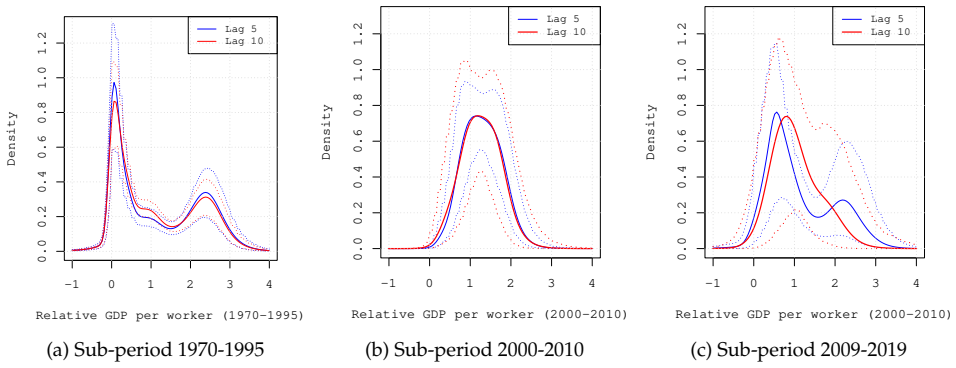
On its own terms, the paper's central discovery is that the stochastic process governing the cross-country distribution of per capita output was not stable over 1970-2019. Rather, the paper finds a first regime in 1970-1995 in which the process is consistent with a time-homogeneous first-order Markov model: for 10-year transitions, the estimated 20-year kernel matches the iterated 10-year kernel, and the ergodic distribution is significantly bimodal, implying two convergence clubs. It then documents a break around the late 1990s: for 5-year and 10-year transitions, the 2000-2010 sub-period produces a significantly unimodal ergodic distribution, implying a single convergence club and absolute convergence. For 2009-2019, the paper finds weaker evidence of a return to bimodal, divergent dynamics. The paper also reports that the instability is concentrated in high- and medium-income countries, while the low-income part of the sample behaves homogeneously throughout.
Load-bearing premise
The load-bearing premise is that the bootstrap tests have enough statistical power to detect a real change in the transition process; the paper's Monte Carlo results show this power is low for samples of about 100 countries, so failing to reject homogeneity in 1970-1995 is weak evidence for stability.
Editorial extensions
If this is right
- If the central claim is correct, studies that estimate a single transition kernel over the entire sample mix two or more regimes and can misstate the ergodic distribution, so regime breaks must be modelled explicitly.
- The 2000-2010 unimodal ergodic distribution provides a mechanism for the recently reported short-term beta-convergence: those findings describe a distinct post-1990s regime, not a permanent property of the data.
- Because the low-income countries show homogeneous dynamics throughout, the convergence episode is better described as a change among high- and medium-income countries than as worldwide catching-up.
- The transition length matters: the 1970-1995 regime satisfies the first-order assumption for 10-year transitions but not for 5-year transitions, so conclusions about convergence clubs depend on which horizon is treated as the natural transition period.
- After 2010, signs of bimodality re-emerge, so the single-convergence-club regime may have been temporary; longer post-2010 data should show whether divergent dynamics have returned.
Reading between the lines
- A natural extension is to fit a regime-switching or mixture-of-kernels model that allows the transition kernel to change at estimated break points; the paper's three sub-periods suggest such a model would fit better than a single kernel.
- The asymmetry across income groups suggests a testable extension: if the late-1990s break is driven by rich-country shocks such as asset-price cycles, then splitting the sample by financial development or export structure should reproduce the effect, whereas low-income countries should show no break.
- The low power of the homogeneity test means 'cannot reject' should be read as 'no evidence against', not 'evidence for'; independent replications with more countries or longer panels after 2010 could confirm or overturn the return-to-divergence claim.
- The same testing machinery could be applied to other distribution-dynamics settings, such as regional income distributions within countries or firm-size distributions, where transition-length uncertainty also exists.
Editorial analysis
A structured set of objections, weighed in public.
Referee Report
Summary. This paper proposes bootstrap-based specification tests for the continuous-state distribution dynamics model of cross-country income, testing time homogeneity by comparing transition kernels estimated over different sub-periods and testing first-order dynamics via the Chapman-Kolmogorov relation between one- and two-period kernels. Using PWT 10.0 data for 102 countries over 1970-2019 and transition lengths of 5, 10, 15, 20, and 25 years, with L1, L2, L∞, and Hellinger distances, the authors report evidence of a homogeneous first-order process in 1970-1995 (for 10-year transitions), a break in the late 1990s, a 2000-2010 period with a unimodal ergodic distribution consistent with recent short-term β-convergence claims, and re-emerging signs of divergence in 2009-2019. The paper includes Monte Carlo studies of size and power and a conditional analysis for low-, medium-, and high-income subgroups.
Significance. The paper addresses a real gap: the homogeneity and Markov-order assumptions are routinely imposed in the distribution dynamics literature and have not been formally tested in the continuous-state setting. If the empirical conclusions survive closer scrutiny of test power, the contribution would be substantial, showing that the long-run implications of the estimated kernels are period-specific, that the recent unconditional-convergence results are regime-specific, and that specification testing should become routine in this literature. The Monte Carlo design, the use of multiple divergence measures, and the explicit acknowledgment that the transition length is unknown are genuine strengths; the paper is also transparent about the low power of the post-2000 first-order findings. The main caveat is that the central early-period homogeneity claim rests on low-power non-rejections, while the abstract states that claim without qualification.
major comments (4)
- [§5.1, Tables 1-3, Table A1] The evidence that the process was time-homogeneous in 1970-1995 is weaker than the abstract implies. The non-rejections among the pre-1995 5-year periods in Table 1 are based on n=102 observations per transition pair, and the paper's own Monte Carlo results (Table A1, sample size 100, θ=0.25) report rejection rates of approximately 0.15 for both L1 and H. A moderate break of the size used in the simulations would therefore be missed in roughly 85% of samples, and the same low power affects the 10-year and 15-year comparisons in Tables 2 and 3. The failure to reject homogeneity in 1970-1995 is thus weak evidence, and the abstract's unqualified statement that the process 'was time-homogeneous and first-order' in that period should be replaced by a power-calibrated statement, such as the minimum break size detectable with 80% power at n=102.
- [§5.1.6, §5.2, Tables 1-5] The three homogeneous sub-periods are selected after inspecting the same pairwise ASL matrices on which the subsequent inference conditions. Table 1 alone involves 45 pairwise comparisons, and no correction for multiple testing is reported. Treating the ASL matrices as exploratory while then testing first-order dynamics and computing ergodic distributions inside the selected periods as confirmatory introduces selection effects. A global test for a structural break at an unknown date, or a multiplicity adjustment such as false discovery rate control, would make the sub-period selection more credible. At minimum, the paper should report how many rejections would be expected under global homogeneity and check that the observed pattern is unlikely to arise by chance.
- [§5.2, Table 6] The first-order conclusion for 1970-1995 is mixed and transition-length dependent. For 5-year transitions, L2 and L∞ reject the first-order null at the 5% level and H does so at the 10% level, while only L1 fails to reject. The conclusion of first-order dynamics therefore rests on the 10-year transition length, for which the homogeneity precondition is itself not well established: Table 2 shows that 1970-1980 versus 1990-2000 is rejected at the 5% level and 1980-1990 versus 1990-2000 is rejected at the 10% level. The abstract and conclusions should be qualified by the transition length and by the weakness of the homogeneity evidence for that length.
- [§5.2, §5.3, Figure 8] Pooling overlapping transitions to obtain 1,632 (5-year) and 612 (10-year) observations for the 1970-1995 period overstates the effective sample size because the triples within each country are serially dependent. The bootstrap resamples from the pooled transition pairs as if they were independent, which likely makes the achieved significance levels too small. This matters for the non-rejections in Table 6 and for the confidence bands in Figure 8. A country-level block bootstrap, or at least a presentation that reports the number of independent countries rather than pooled transition counts, would better reflect the actual information content.
minor comments (4)
- [Unnumbered page, References] There are several typos: 'Aknowledgements' should be 'Acknowledgements', 'Efrom and Tibshirani (1993)' should be 'Efron and Tibshirani (1993)', 'homogenous' should be 'homogeneous' throughout, and 'the the distance' in Section 6 should be corrected.
- [§3, Equations (2)-(6)] The notation for the transition kernel alternates between gτ, gτ,t, and g2τ, and the time subscript disappears from g2τ in Equation (5). The notation should be made uniform, especially in the Chapman-Kolmogorov equation.
- [Figure 8] The caption of panel (c) reads 'Sub-period 2000-2010' but the discussion and the estimates in the panel refer to the 2009-2019 sub-period; the caption should be corrected.
- [§4.2, Equation (11)] The weighting function in Equation (11) is the marginal density estimated from the first period, but for the second transition kernel the relevant marginal is that of the intermediate period. The asymmetry of this weighting choice should be described and justified, even if it is judged not to affect the results.
Circularity Check
No circular derivation found; the paper's tests compare nonparametrically estimated transition kernels and use derived ergodic distributions, with the low-power caveat being a statistical limitation rather than a circular step.
full rationale
The paper's central claims are not circular by construction. The transition kernels are estimated nonparametrically from the joint densities of GDP per worker at different dates (Section 4.1, Eq. 7), and the homogeneity test compares estimated conditional densities from different sub-periods using divergence measures (Section 4.2, Eqs. 9-10) with bootstrap null distributions (Section 4.3). The first-order test similarly compares the estimated two-period kernel with the Chapman-Kolmogorov convolution of the one-period kernel (Section 3, Eq. 6, and Section 4.4); this is a statistical comparison of two estimated objects, not an identity imposed by construction. The ergodic distributions are solved from the estimated kernels via f∞(z)=∫gτ(z|x)f∞(x)dx and are derived objects, not fitted to match the paper's bimodal/unimodal conclusions. The self-citation to Fiaschi and Johnson (2023) is background literature and is not load-bearing for the present results. The main weakness is statistical power: Appendix A, Table A1 shows that for n=100 the homogeneity test has roughly 15-25% power against a moderate break (θ=0.25), and the paper itself acknowledges low power in small samples (Sections 4.5 and 5.2). This is a legitimate inferential limitation, but it does not make the derivation circular. Likewise, the post hoc selection of sub-periods based on homogeneity test results raises specification-search concerns, but the within-period transition dynamics and ergodic distributions are not definitionally equal to the test outcomes. No step in the paper's derivation reduces to its own inputs by definition or by fitted parameters.
Assumptions & free parameters
free parameters (2)
- Kernel bandwidth h (Silverman optimal normal) =
estimated from data for each sample
- Grid range and grid size in density estimation =
range [-1,4], 100x100 grid
assumptions (3)
- domain assumption The cross-country distribution of per capita output has a density that evolves according to a Markov transition kernel.
- domain assumption Kernel density estimators and the bootstrap provide consistent inference at n=102.
- standard math The Chapman-Kolmogorov equations are a valid necessary condition for a first-order Markov process.
Cite this review
Pith. "Pith review of (In)stability in the Dynamics of the Cross-Country Distribution of Income Per Capita." pith.science (2026). https://pith.science/paper/TE7QZ6FW
@misc{pith2026250606755,
  author       = {Pith},
  title        = {Pith review of: (In)stability in the Dynamics of the Cross-Country Distribution of Income Per Capita},
  year         = {2026},
  howpublished = {\url{https://pith.science/paper/TE7QZ6FW}},
  note         = {Machine review of arXiv:2506.06755}
}
read the original abstract
Using a panel of 102 countries from PWT 10.0 covering 1970-2019, we examine the veracity of the assumption that a time-homogeneous, first-order process describes the evolution of the cross-country distribution of per capita output, an assumption often made in studies of the convergence hypothesis employing the distribution dynamics approach pioneered by Quah (1993). To test homogeneity, we compare transition kernels estimated for different time periods and, for those periods exhibiting evidence of homogeneity, we test the first-order assumption using an implication of such a process's Chapman-Kolmogorov equations. Both tests require measurement of the distance between probability distributions which we do with several different metrics, employing bootstrap methods to assess the statistical significance of the observed distances. We find that the process was time-homogeneous and first-order in the 1970-1995 period during which the distribution dynamics imply a bimodal long-run distribution, consistent with convergence clubs. Following the apparent break in the process in the late 1990s, the 2000-2010 distribution dynamics imply a unimodal long-run distribution suggestive of a single convergence club, consistent with recent claims of short-term beta-convergence from the late 1990s and beyond made by Patel et al. (2021) and Kremer et al (2022). After 2010, there is some evidence of a return to non-convergent dynamics similar to those of the 1970-1995 period.
Figures


Figures from the paper (5 more)


Reference graph
Works this paper leans on
-
[1]
Ait-Sahalia, Y. (1996). Testing continuous-time models of the spot interest rate. The Review of Financial Studies\/ 9\/ (2), 385--426
work page 1996
-
[2]
A \"i t-Sahalia, Y., J. Fan, and J. Jiang (2010). Nonparametric test of the markov hypothesis in continuous-time models. The Annals of Statistics\/ 38\/ (5), 3129--3163
work page 2010
-
[3]
Anderson, N. H., P. Hall, and D. M. Titterington (1994). Two-sample test statistics for measuring discrepancies between two multivariate probability density functions using kernel-based density estimates. Journal of Multivariate Analysis\/ 50\/ (1), 41--54
work page 1994
-
[4]
Anderson, T. W. and L. A. Goodman (1957). Statistical inference about markov chains. Annals of Mathematical Statistics\/ 28 , 89--110
work page 1957
-
[5]
Andres, J. and A. Lamo (1995). Dynamics of the income distribution across oecd countries. Technical report, Centre for Economic Performance, LSE
work page 1995
-
[6]
Bandyopadhyay, S. (2004). Twin peaks: distribution dynamics of economic growth across indian states. In A. Shorrocks and R. van der Hoeven (Eds.), Growth, inequality and poverty: prospects for pro-poor growth . Oxford University Press
work page 2004
-
[7]
Bandyopadhyay, S. (2011). Rich states, poor states: convergence and polarisation in india. Scottish Journal of Political Economy\/ 58\/ (3), 414--436
work page 2011
-
[8]
Barseghyan, L. and R. DiCecio (2011). Cross-country income convergence revisited. Economics Letters\/ 113\/ (3), 244--247
work page 2011
Show all 58 references
-
[9]
Bickenbach, F. and E. Bode (2003). Evaluating the markov property in studies of economic convergence. International Regional Science Review\/ 26 , 363--392
2003
-
[10]
Billingsley, P. (1961). Statistical methods in markov chains. Annals of Mathematical Statistics\/ 32 , 12--40
1961
-
[11]
Bulli, S. (2001). Distribution dynamics and cross-country convergence: A new approach. Scottish Journal of Political Economy\/ 48 , 226--243
2001
-
[12]
Chen, B. and Y. Hong (2012). Testing for the markov property in time series. Econometric Theory\/ 28\/ (1), 130--178
2012
-
[13]
Cox, D. R. and H. D. Miller (1977). The Theory of Stochastic Processes . London: Chapman and Hall
1977
-
[14]
Durlauf, S. and D. Quah (1999). The new empirics of economic growth. In J. Taylor and M. Woodford (Eds.), Handbook of Macroeconomics , pp.\ 235--308. Amsterdam: North Holland
1999
-
[15]
Durlauf, S. N. (2009). The rise and fall of cross-country growth regressions. History of Political Economy\/ 41\/ (Suppl\_1), 315--333
2009
-
[16]
Durlauf, S. N., P. A. Johnson, and J. R. W. Temple (2005). Growth econometrics. In P. Aghion and S. N. Durlauf (Eds.), Handbook of Economic Growth , pp.\ 555--677. Amsterdam: North Holland
2005
-
[17]
Efrom, B. and R. J. Tibshirani (1993). An introduction to the bootstrap. Champman and Hall/CRC\/
1993
-
[18]
Feenstra, R. C., R. Inklaar, and M. P. Timmer (2015). The next generation of the penn world table. American Economic Review\/ 105 , 3150--3182
2015
-
[19]
Fiaschi, D. and P. Johnson (2023). Does the cross-country distribution of per capita income evolve according to a homogenous first-order markov process? Mimeo\/
2023
-
[20]
Fiaschi, D. and A. M. Lavezzi (2003a). Distribution dynamics and nonlinear growth. Journal of Economic Growth\/ 8 , 379--401
2003
-
[21]
Fiaschi, D. and A. M. Lavezzi (2003b). On the determinants of growth volatility: a nonparametric approach. Discussion Papers, University of Pisa, Dipartimento di Economia e Management, n. 2003/25
2003
-
[22]
Fiaschi, D. and A. M. Lavezzi (2007a). Appropriate technology in a solovian nonlinear growth model. Oxford Review of Economic Policy\/ 23\/ (1), 115--133
2007
-
[23]
Fiaschi, D. and A. M. Lavezzi (2007b). Nonlinear economic growth: Some theory and cross-country evidence. Journal of Development Economics\/ 84\/ (1), 271--290
2007
-
[24]
Fiaschi, D., A. M. Lavezzi, and A. Parenti (2020). Deep and proximate determinants of the world income distribution. Review of Income and Wealth\/ 66\/ (3), 677--710
2020
-
[25]
Fingleton, B. (1997). Specification and testing of markov chain models: An application to convergence in the European Union . Oxford Bulletin of Economics and Statistics\/ 59 , 385--403
1997
-
[26]
Fischer, M. M. and P. Stumpner (2008). Income distribution dynamics and cross-region convergence in europe: Spatial filtering and novel stochastic kernel representations. Journal of Geographical Systems\/ 10 , 109--139
2008
-
[27]
Fotopoulos, G. (2006). Nonparametric analysis of regional income dynamics: the case of greece. Economics Letters\/ 91\/ (3), 450--457
2006
-
[28]
distributional
Fotopoulos, G. (2008). European union regional productivity dynamics: A “distributional” approach. Journal of Regional Science\/ 48\/ (2), 419--454
2008
-
[29]
Guihenneuc-Jouyaux, C. and C. P. Robert (1998). Discretization of continuous markov chains and markov chain monte carlo convergence assessment. Journal of the American Statistical Association\/ 93\/ (443), 1055--1067
1998
-
[30]
and K.-H
Hall, P. and K.-H. Kang (2001). Bootstrapping nonparametric density estimators with empirically chosen bandwidths. The Annals of Statistics\/ 29\/ (5), 1443--1468
2001
-
[31]
Imam, P. A. and J. R. Temple (2025). Growth interrupted. how crisis delay global convergence. Technical report, IMF Working Papers
2025
-
[32]
Islam, N. (2003). What have we learned from the convergence debate? Journal of Economic Surveys\/ 17 , 309--362
2003
-
[33]
Johnson, P. and C. Papageorgiou (2020). What remains of cross-country convergence? Journal of Economic Literature\/ 58\/ (1), 129--175
2020
-
[34]
Johnson, P. A. (2005). A continuous state space approach to 'convergence by parts'. Economics Letters\/ 86 , 317--321
2005
-
[35]
Johnson, P. A., C. Papageorgiou, M. G. Pittau, and R. Zelli (2024). Lessons from 40 years of cross-country convergence empirics. Forthcoming in Oxford Handbook of Income Distribution and Economic Growth. Oxford University Press
2024
-
[36]
Judd, K. L. (1998). Numerical methods in economics . MIT press
1998
-
[37]
Kemeny, J. G., J. L. Snell, and A. W. Knapp (2012). Denumerable Markov chains: with a chapter of Markov random fields by David Griffeath , Volume 40. Springer Science & Business Media
2012
-
[38]
Onatski, and J
Kremer, M., A. Onatski, and J. Stock (2001). Searching for prosperity. In Carnegie-Rochester Conference Series on Public Policy , Volume 55, pp.\ 275--303. Elsevier
2001
-
[39]
Willis, and Y
Kremer, M., J. Willis, and Y. You (2022). Converging to convergence. NBER macroeconomics annual\/ 36\/ (1), 337--412
2022
-
[40]
Li, Q. (1996). Nonparametric testing of closeness between two unknown distribution functions. Econometric Reviews\/ 15\/ (3), 261--274
1996
-
[41]
Racine, and T
Maasoumi, E., J. Racine, and T. Stengos (2007). Growth and convergence: A profile of distribution dynamics and mobility. Journal of Econometrics\/ 136\/ (2), 483--508
2007
-
[42]
Magrini, S. (1999). The evolution of income disparities among the regions of the european union. Regional Science and Urban Economics\/ 29\/ (2), 257--281
1999
-
[43]
Marron, J. S. and A. Tsybakov (1995). Visual error criteria for qualitative smoothing. Journal of the American Statistical Association\/ 90\/ (430), 499--507
1995
-
[44]
Pardo, L. (2018). Statistical inference based on divergence measures . CRC press
2018
-
[45]
Sandefur, and A
Patel, D., J. Sandefur, and A. Subramanian (2021). The new era of unconditional convergence. Journal of Development Economics\/ 152 , 102687
2021
-
[46]
Pittau, M. G., R. Zelli, and P. A. Johnson (2010). Mixture models, convergence clubs, and polarization. Review of Income and Wealth\/ 56\/ (1), 102--122
2010
-
[47]
Quah, D. (1993). Empirical cross-section dynamics in economic growth. European Economic Review\/ 37\/ (2-3), 426--434
1993
-
[48]
Quah, D. (1999). Convergence as distribution dynamics (with or without growth). In R. Baldwin (Ed.), Market integration, regionalism and the global economy . Cambridge University Press
1999
-
[49]
Quah, D. (2001). Searching for prosperity a comment. In Carnegie-Rochester Conference Series on Public Policy , Volume 55, pp.\ 305--319. Elsevier
2001
-
[50]
Quah, D. T. (1996a). Convergence empirics across economies with (some) capital mobility. Journal of Economic Growth\/ 1 , 95--124
1996
-
[51]
Quah, D. T. (1996b). Empirics for economic growth and convergence. European Economic Review\/ 40\/ (6), 1353--1375
1996
-
[52]
Quah, D. T. (1996c). Twin peaks: growth and convergence in models of distribution dynamics. The Economic Journal\/ 106\/ (437), 1045--1055
1996
-
[53]
Quah, D. T. (1997). Empirics for growth and distribution: stratification, polarization, and convergence clubs. Journal of Economic Growth\/ 2\/ (1), 27--59
1997
-
[54]
Reichlin, L. (1999). Discussion of‘convergence as distribution dynamics’, by danny quah. In R. Baldwin, D. Cohen, A. Sapir, and A. Venables (Eds.), Market integration, regionalism, and the global economy , pp.\ 328--335. Cambridge University Press
1999
-
[55]
Robert, C. and G. Casella (2004). Monte Carlo statistical methods\/ (Second ed.). Springer
2004
-
[56]
Shorrocks, A. F. (1976). Income mobility and the markov assumption. The Economic Journal\/ 86\/ (343), 566--578
1976
-
[57]
Silverman, B. (1986). Density Estimation for Statistics and Data Analysis . London: Chapman and Hall
1986
-
[58]
Su, L. and H. White (2008). A nonparametric hellinger metric test for conditional independence. Econometric Theory\/ 24\/ (4), 829--864
2008
Reviewed August 7, 2026 · model on record in the stance chip above.
Discussion (0). Sign in to comment.