REVIEW 3 major objections 5 minor 90 references
Mind Games! Exploring the Impact of Dark Patterns in Mixed Reality Scenarios
T0 review · 3 major / 5 minor · reviewed 2026-08-07 · deepseek-v4-flash
Pith's one-line read This paper claims that dark patterns—deceptive overlays in mixed reality—significantly reduce user comfort and intention to use MR glasses while increasing reactance and perceived system darkness, across all four patterns and all three…
desk verdict Solid first quantitative study of dark patterns in MR, but the one-stimulus-per-cell design means the category-level claims are weaker than the abstract suggests. read the letter →
The pith
A machine-rendered reading of the paper's core claim, the machinery that carries it, and where it could break.
The reading
What carries the argument
The study's engine is a two-factorial within-subject video study: 13 two-minute videos shot as a first-person city walk, structured as 4 dark patterns (Emotional or Sensory Manipulation, Forced Registration, Hiding Information, Urgency) times 3 augmentation targets (place, product, person), plus one dark-pattern-free baseline. Each pattern was adapted from the meso-level of a published dark-pattern ontology, chosen because that level is context-agnostic and can be interpreted for a specific application type. Participants rated every video on four instruments: a reactance questionnaire, the System Darkness Scale (a validated measure of how manipulative a system feels), a single comfort item, and a two-item intention-to-use scale, allowing the authors to separate the effect of the pattern, the effect of the target, and their interaction against the same baseline of ordinary MR aids such as navigation and weather overlays.
What would settle it
Re-run the study with several independently produced designs per dark-pattern-target pair; if the within-pattern variance in comfort and reactance is as large as the between-pattern differences, the claim that dark patterns themselves—rather than their specific renderings—drive the effects is falsified.
Extended reading notes
Core claim
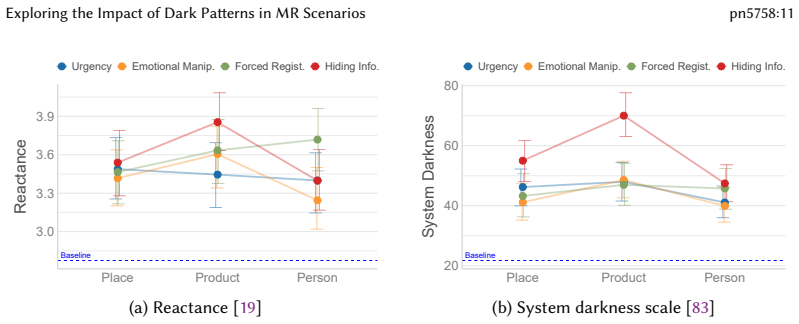
The paper's central claim is that all four dark patterns it tested—Emotional or Sensory Manipulation, Forced Registration, Hiding Information, and Urgency—significantly harm the mixed-reality user experience no matter what real-world object they are attached to. Across 74 participants who each watched 13 videos of a simulated city walk through MR glasses, every pattern scored worse than the baseline on all four measures: higher reactance, higher system darkness, lower comfort, and lower intention to use the glasses. The authors further claim that the impact is most severe when the pattern touches personal identity or money, and that two patterns from different high-level families, Emotional or Sensory Manipulation and Hiding Information, produced similar effects, suggesting that dark-pattern taxonomies should incorporate measured user impact rather than only design technique.
Load-bearing premise
The results are interpreted as effects of the dark pattern category, but each category was shown through one concrete visual design, so a different design might have produced different ratings.
Editorial extensions
If this is right
- Designers of MR applications now have quantitative evidence that these four manipulative tactics reduce users' comfort and willingness to adopt the product, so deploying them is likely to backfire commercially.
- The severe reactions to face-obscuring registration and cart-sneaking suggest that applications targeting personal identity or direct monetary loss will encounter the strongest user resistance.
- The similar user impact of Emotional or Sensory Manipulation and Hiding Information supports moving toward classifications that group dark patterns by how they affect people, not only by how they are built.
- Regulation and automated detection tools for dark patterns, already debated for websites, can now be extended to MR on the basis of measurable user responses rather than speculation.
Reading between the lines
- My inference: the 'She likes you' overlay produced relatively low reactance, so a dark pattern that flatters may slip past users' defenses more easily than an openly obstructive one; an impact-based measure built only on felt resistance could therefore underrate the most effective manipulations.
- My inference: because the effect clusters track the consequence the user experiences (losing money, losing control of personal appearance) rather than the UI tactic, a consequence-based taxonomy would likely generalize to augmented-reality advertising and diminished-reality interfaces, not just the four scenarios tested.
- My inference: the video method probably understates or shifts attention effects compared with a worn headset, so a headset-based replication using the same stimulus designs would be a direct test of whether the reported effect sizes transfer to real MR use.
Editorial analysis
A structured set of objections, weighed in public.
Referee Report
Summary. The paper reports an online within-subject video study (N=74) in which four dark patterns taken from Gray et al.'s meso-level taxonomy were adapted to Mixed Reality and applied to three augmentation targets (place, product, person), plus a baseline condition. The authors measured reactance, System Darkness Scale, comfort, and intention to use, and report that all dark patterns significantly worsen these measures relative to baseline, with Forced Registration on a person and Hiding Information on a product being the most disruptive. They further argue that Emotional or Sensory Manipulation and Hiding Information produce similar user effects and that dark-pattern classifications should be reconsidered on the basis of user impact rather than design technique alone.
Significance. If the pattern-level claims are valid, this is a useful quantitative contribution to a literature that has so far largely relied on qualitative or speculative methods for dark patterns in Mixed Reality. The study uses a clear within-subject design, an a-priori power analysis, appropriate non-parametric repeated-measures analyses (Friedman test with Durbin-Conover post-hoc and Holm correction, ART ANOVA), and reports effect sizes. The inclusion of a baseline condition and attention checks is methodologically sound. The main weakness is that each Dark Pattern × Target cell contains exactly one video, which makes the dark-pattern category inseparable from the concrete visual design; this limits the central generalization to specific stimuli rather than dark-pattern types.
major comments (3)
- [Section 4.1 and Table 1 / Section 3.1.1] The design assigns exactly one video to each Dark Pattern × Augmentation Target cell, so the dark-pattern factor is perfectly confounded with the concrete stimulus design (e.g., Hiding Information on Product is an "added to cart" banner, Urgency is a countdown timer, and Forced Registration on Person is a heart-and-lock occlusion). Consequently, the statement in Section 4.1 that "all dark patterns significantly impact our quantitative measures negatively, regardless of whether they target a place, product, or person" cannot be attributed to the dark-pattern categories. The data support only that these particular 12 video stimuli differ from the baseline. The Section 4.4 caveat that "we explored only one scenario per dark pattern" understates the issue: exemplar-level variance is unidentifiable, so no statistical analysis of the present data can separate pattern effects from exemplar effects. This is load-bearing for the central claim.
- [Section 4.2 and Figures 3a/4b] The claim that Emotional or Sensory Manipulation and Hiding Information have similar impacts and that current classifications should be re-evaluated is based on visual inspection of the interaction plots rather than a statistical equivalence test or a targeted interaction contrast. Furthermore, the exemplars of these two patterns share surface features that the other two patterns' exemplars do not (non-occluding text-based overlays), so the observed similarity is also confounded with the concrete designs. The conclusion that these two categories should be reconsidered is therefore not yet established by the reported analyses.
- [Section 3.4.5 / Section 4.1] For intention to use, only a significant main effect of Dark Pattern is reported; no interaction effect or target-specific post-hoc contrasts are given. The Section 4.1 claim that effects hold "regardless of whether they target a place, product, or person" is thus stronger than the reported evidence for this dependent variable. The authors should either report the missing factorial results or soften the generalization to the measures for which target-level effects were actually examined.
minor comments (5)
- [Section 3.4.1] The text says "we recruited 79 participants but excluded five due to incorrect attention checks" and then refers to "These seven nonsensical attention checks"; the relationship between the seven checks and five excluded participants should be clarified.
- [Reference [49]] The Matsuda Hyper-Reality reference is dated "2026", which appears to be a typo; the correct access/publication date should be verified.
- [Section 3.1.1 / Table 1 / Table 3] The pattern name is inconsistently written as "Emotional or Sensory Manipulation", "Emotional Manipulation", and "Emotional Manipulation or Sensory" across the text and tables; the terminology should be standardized.
- [Section 4.1] The phrase "clearly recognized by users" overstates what the System Darkness Scale measures: the SDS captures perceived system darkness, not recognition or correct identification of dark patterns as in Mildner et al.'s recognition task.
- [Section 3 / Abstract] The design is described as a "4 × 3 + 1 baseline factorial design" and later as a "two-factorial" analysis; it would be clearer to state explicitly that the baseline is not a factor level in the ART analysis but was used only for the separate baseline comparisons.
Circularity Check
No significant circularity; this is an empirical measurement study whose conclusions are statistical summaries of participant ratings, not quantities derived by definition or by fitted inputs.
full rationale
This paper is an empirical within-subject video study, not a derivation, so the standard circularity patterns do not apply. The dark-pattern stimuli are adapted from the external Gray et al. ontology [29]; the outcome measures (reactance scale [19], SDS [83], TAM intention-to-use [84], comfort item [73]) are established instruments, not quantities fitted to the data being 'predicted'. The central claims (Section 4.1: 'all dark patterns significantly impact our quantitative measures negatively') are direct statistical summaries of the collected ratings compared against a baseline, so the conclusion is not equivalent to any input definition: baseline, stimuli, and measures were fixed before data collection. The authors' own acknowledgment (Section 4.4: 'we explored only one scenario per dark pattern ... the observed effects may partly result from the specific design rather than the inherent impact of the dark pattern') concerns stimulus-sampling validity, not circularity. Self-citations such as the comfort item inspired by Rixen et al. [73] and the baseline-augmentation design from Rixen et al. [70] are methodological borrowings that do not carry the central claim; the taxonomy defining the independent variable is Gray et al. [29], outside the author group. Therefore no load-bearing circular step is exhibited, and the appropriate score is 0.
Assumptions & free parameters
assumptions (4)
- domain assumption Video simulation of MR elicits psychological responses comparable to actual MR experiences.
- domain assumption The meso-level dark patterns from Gray et al.'s ontology are transferable to MR contexts.
- domain assumption The System Darkness Scale (SDS), originally designed for web shops, remains valid for MR.
- standard math Friedman test and aligned rank transform ANOVA are appropriate for the repeated-measures non-normal data.
Cite this review
Pith. "Pith review of Mind Games! Exploring the Impact of Dark Patterns in Mixed Reality Scenarios." pith.science (2026). https://pith.science/paper/3QW4MANF
@misc{pith2026250606774,
  author       = {Pith},
  title        = {Pith review of: Mind Games! Exploring the Impact of Dark Patterns in Mixed Reality Scenarios},
  year         = {2026},
  howpublished = {\url{https://pith.science/paper/3QW4MANF}},
  note         = {Machine review of arXiv:2506.06774}
}
read the original abstract
Mixed Reality (MR) integrates virtual objects with the real world, offering potential but raising concerns about misuse through dark patterns. This study explored the effects of four dark patterns, adapted from prior research, and applied to MR across three targets: places, products, and people. In a two-factorial within-subject study with 74 participants, we analyzed 13 videos simulating MR experiences during a city walk. Results show that all dark patterns significantly reduced user comfort, increased reactance, and decreased the intention to use MR glasses, with the most disruptive effects linked to personal or monetary manipulation. Additionally, the dark patterns of Emotional and Sensory Manipulation and Hiding Information produced similar impacts on the user in MR, suggesting a re-evaluation of current classifications to go beyond deceptive design techniques. Our findings highlight the importance of developing ethical design guidelines and tools to detect and prevent dark patterns as immersive technologies continue to evolve.
Figures


Figures from the paper (1 more)

Reference graph
Works this paper leans on
-
[1]
2024.Apple Vision Pro
Apple. 2024.Apple Vision Pro. Retrieved Aug 16, 2024 from https://www.apple.com/apple-vision-pro/
2024
-
[2]
March, 2022
European Data Protection Board. March, 2022. Guidelines 3/2022 on Dark patterns in social media platform in- terfaces: How to recognise and avoid them | European Data Protection Board. https://edpb.europa.eu/our-work- tools/documents/public-consultations/2022/guidelines-32022-dark-patterns-social-media_en Accessed7 09/03/2024
2022
-
[3]
Elise Bonnail, Wen-Jie Tseng, Mark Mcgill, Eric Lecolinet, Samuel Huron, and Jan Gugenheimer. 2023. Memory Manipulations in Extended Reality. InProceedings of the 2023 CHI Conference on Human Factors in Computing Systems. ACM, Hamburg Germany, 1–20. doi:10.1145/3544548.3580988
arXiv 2023
-
[4]
Jolie Bonner, Florian Mathis, Joseph O’Hagan, and Mark Mcgill. 2023. When Filters Escape the Smartphone: Exploring Acceptance and Concerns Regarding Augmented Expression of Social Identity for Everyday AR. In29th ACM Symposium on Virtual Reality Software and Technology. ACM, Christchurch New Zealand, 1–14. doi:10.1145/3611659.3615707
arXiv 2023
-
[5]
H Brignull, M Leiser, C Santos, and K Doshi. 2010. Deceptive patterns – user interfaces designed to trick you. https://www.deceptive.design/
2010
-
[6]
Dimitrios Buhalis, Daniel Leung, and Michael Lin. 2023. Metaverse as a disruptive technology revolutionising tourism management and marketing.Tourism Management97 (Aug. 2023), 104724. doi:10.1016/j.tourman.2023.104724
arXiv 2023
-
[7]
Christoph Bösch, Benjamin Erb, Frank Kargl, Henning Kopp, and Stefan Pfattheicher. 2016. Tales from the Dark Side: Privacy Dark Strategies and Privacy Dark Patterns.Proceedings on Privacy Enhancing Technologies2016, 4 (Oct. 2016), Proc. ACM Hum.-Comput. Interact., Vol. 9, No. 5, Article pn5758. Publication date: September 2025. pn5758:18 Meinhardt et al. ...
-
[8]
Stephane Champely, Claus Ekstrom, Peter Dalgaard, Jeffrey Gill, Stephan Weibelzahl, Aditya Anandkumar, Clay Ford, Robert Volcic, and Helios De Rosario. [n. d.].Package ‘pwr’. https://cran.r-project.org/package=pwr
Show all 90 references
-
[10]
Shruthi Sai Chivukula, Ike Obi, Thomas V Carlock, and Colin M. Gray. 2023. Wrangling Ethical Design Complexity: Dilemmas, Tensions, and Situations. InDesigning Interactive Systems Conference. ACM, Pittsburgh PA USA, 179–183. doi:10.1145/3563703.3596632
2023
-
[11]
Minjoo Cho and Daniel Saakes. 2017. Calm Automaton. InProceedings of the 2017 CHI Conference Extended Abstracts on Human Factors in Computing Systems, Gloria Mark, Susan Fussell, Cliff Lampe, m.c. schraefel, Juan Pablo Hourcade, Caroline Appert, and Daniel Wigdor (Eds.). ACM, ...
2017
-
[12]
Jacob Cohen. 1992. A power primer.Psychological Bulletin112, 1 (1992), 155–159. doi:10.1037/0033-2909.112.1.155
1992 doi
-
[13]
Mark Colley, Julian Britten, Simon Demharter, Tolga Hisir, and Enrico Rukzio. 2022. Feedback Strategies for Crowded Intersections in Automated Traffic — A Desirable Future?. InProceedings of the 14th International Conference on Automotive User Interfaces and Interactive Vehicu...
2022
-
[14]
1982.The social control of technology
David Collingridge. 1982.The social control of technology. Frances Pinter St. Martin’s press, London New York
1982
-
[15]
2022.Bringing Dark Patterns to Light Staff Report
Federal Trade Commission. 2022.Bringing Dark Patterns to Light Staff Report. Technical Report. Federal Trade Commission. https://www.ftc.gov/system/files/ftc_gov/pdf/P214800%20Dark%20Patterns%20Report%209.14.2022%20- %20FINAL.pdf Accessed7 09/03/2024
2022
-
[16]
James Price Dillard and Lijiang Shen. 2005. On the Nature of Reactance and its Role in Persuasive Health Communication. Communication Monographs72, 2 (2005), 144–168. doi:10.1080/03637750500111815
2005 doi
-
[17]
Tobias Drey, Patrick Albus, Simon Der Kinderen, Maximilian Milo, Thilo Segschneider, Linda Chanzab, Michael Rietzler, Tina Seufert, and Enrico Rukzio. 2022. Towards Collaborative Learning in Virtual Reality: A Comparison of Co-Located Symmetric and Asymmetric Pair-Learning. In...
2022
-
[18]
Chloe Eghtebas, Gudrun Klinker, Susanne Boll, and Marion Koelle. 2023. Co-Speculating on Dark Scenarios and Unintended Consequences of a Ubiquitous(ly) Augmented Reality. InProceedings of the 2023 ACM Designing Interactive Systems Conference. ACM, Pittsburgh PA USA, 2392–2407....
2023
-
[19]
Patrick Ehrenbrink and Sebastian Möller. 2018. Development of a reactance scale for human–computer interaction. Quality and User Experience3, 1 (Dec. 2018), 2. doi:10.1007/s41233-018-0016-y
2018 doi
-
[20]
European Commission. 2022. Regulation (EU) 2022/2065 of the European Parliament and of the Council of 19 October 2022 on a Single Market For Digital Services and amending Directive 2000/31/EC (Digital Services Act) (Text with EEA relevance). http://data.europa.eu/eli/reg/2022/2065/oj
2022
-
[21]
Federal Trade Commission. 2022. Bringing Dark Patterns to Light. https://www.ftc.gov/reports/bringing-dark- patterns-light
2022
-
[22]
Guo Freeman, Samaneh Zamanifard, Divine Maloney, and Dane Acena. 2022. Disturbing the Peace: Experiencing and Mitigating Emerging Harassment in Social Virtual Reality.Proceedings of the ACM on Human-Computer Interaction6, CSCW1 (March 2022), 1–30. doi:10.1145/3512932
2022 doi
-
[23]
Kahn, Alan Borning, and Alina Huldtgren
Batya Friedman, Peter H. Kahn, Alan Borning, and Alina Huldtgren. 2013. Value Sensitive Design and Information Systems. InEarly engagement and new technologies: Opening up the laboratory, Neelke Doorn, Daan Schuurbiers, Ibo van de Poel, and Michael E. Gorman (Eds.). Vol. 16. S...
2013 doi
-
[24]
Grand View Research. 2024.Smart Glasses Market Size, Share & Trends Analysis Report By Type (Binocular, Audio), By Operating System (Android, Linux), By Glass Tinting Technology, By Application, By Connectivity, By Region, And Segment Forecasts, 2025 - 2030. Technical Report. ...
2024
-
[25]
Gray and Shruthi Sai Chivukula
Colin M. Gray and Shruthi Sai Chivukula. 2019. Ethical Mediation in UX Practice. InProceedings of the 2019 CHI Conference on Human Factors in Computing Systems. ACM, Glasgow Scotland Uk, 1–11. doi:10.1145/3290605.3300408
2019
-
[26]
Gray, Shruthi Sai Chivukula, Thomas V Carlock, Ziqing Li, and Ja-Nae Duane
Colin M. Gray, Shruthi Sai Chivukula, Thomas V Carlock, Ziqing Li, and Ja-Nae Duane. 2023. Scaffolding Ethics- Focused Methods for Practice Resonance. InProceedings of the 2023 ACM Designing Interactive Systems Conference. ACM, Pittsburgh PA USA, 2375–2391. doi:10.1145/3563657.3596111
2023
-
[27]
Gray, Yubo Kou, Bryan Battles, Joseph Hoggatt, and Austin L
Colin M. Gray, Yubo Kou, Bryan Battles, Joseph Hoggatt, and Austin L. Toombs. 2018. The Dark (Patterns) Side of UX Design. InProceedings of the 2018 CHI Conference on Human Factors in Computing Systems, Regan Mandryk, Mark Proc. ACM Hum.-Comput. Interact., Vol. 9, No. 5, Artic...
2018
-
[28]
Gray, Cristiana Santos, Nataliia Bielova, Michael Toth, and Damian Clifford
Colin M. Gray, Cristiana Santos, Nataliia Bielova, Michael Toth, and Damian Clifford. 2021. Dark Patterns and the Legal Requirements of Consent Banners: An Interaction Criticism Perspective. InProceedings of the 2021 CHI Conference on Human Factors in Computing Systems. ACM, Y...
2021
-
[29]
Gray, Cristiana Teixeira Santos, Nataliia Bielova, and Thomas Mildner
Colin M. Gray, Cristiana Teixeira Santos, Nataliia Bielova, and Thomas Mildner. 2024. An Ontology of Dark Patterns Knowledge: Foundations, Definitions, and a Pathway for Shared Knowledge-Building. InProceedings of the CHI Conference on Human Factors in Computing Systems(, Hono...
2024
-
[30]
Saul Greenberg, Sebastian Boring, Jo Vermeulen, and Jakub Dostal. 2014. Dark patterns in proxemic interactions: a critical perspective. InProceedings of the 2014 conference on Designing interactive systems. ACM, Vancouver BC Canada, 523–532. doi:10.1145/2598510.2598541
2014
-
[31]
Johanna Gunawan, Amogh Pradeep, David Choffnes, Woodrow Hartzog, and Christo Wilson. 2021. A Comparative Study of Dark Patterns Across Web and Mobile Modalities.Proceedings of the ACM on Human-Computer Interaction5, CSCW2 (Oct. 2021), 1–29. doi:10.1145/3479521
2021 doi
-
[32]
Hilda Hadan, Lydia Choong, Leah Zhang-Kennedy, and Lennart E. Nacke. 2024. Deceived by Immersion: A Systematic Analysis of Deceptive Design in Extended Reality.Comput. Surveys(April 2024), 3659945. doi:10.1145/3659945
2024 doi
-
[33]
Carter Jernigan and Behram F.T. Mistree. 2009. Gaydar: Facebook friendships expose sexual orientation.First Monday (Sept. 2009). doi:10.5210/fm.v14i10.2611
2009 doi
-
[34]
Qiao Jin, Yu Liu, Svetlana Yarosh, Bo Han, and Feng Qian. 2022. How Will VR Enter University Classrooms? Multi- stakeholders Investigation of VR in Higher Education. InProceedings of the 2022 CHI Conference on Human Factors in Computing Systems(<conf-loc>, <city>New Orleans</c...
2022 doi
-
[35]
Williamson
Ross Johnstone, Neil McDonnell, and Julie R. Williamson. 2022. When Virtuality Surpasses Reality: Possible Futures of Ubiquitous XR. InCHI Conference on Human Factors in Computing Systems Extended Abstracts. ACM, New Orleans LA USA, 1–8. doi:10.1145/3491101.3516396
2022
-
[36]
Hanseob Kim, TaeHyung Kim, Myungho Lee, Gerard Jounghyun Kim, and Jae-In Hwang. 2020. Don’t Bother Me: How to Handle Content-Irrelevant Objects in Handheld Augmented Reality. InProceedings of the 26th ACM Symposium on Virtual Reality Software and Technology (VRST ’20). ACM, 1–...
2020
-
[37]
Jooyoung Kim. 2021. Advertising in the Metaverse: Research Agenda.Journal of Interactive Advertising21, 3 (Sept. 2021), 141–144. doi:10.1080/15252019.2021.2001273
2021
-
[38]
Minsam Ko, Subin Yang, Joonwon Lee, Christian Heizmann, Jinyoung Jeong, Uichin Lee, Daehee Shin, Koji Yatani, Junehwa Song, and Kyong-Mee Chung. 2015. NUGU: A Group-based Intervention App for Improving Self-Regulation of Limiting Smartphone Use. (2015), 1235–1245. doi:10.1145/...
2015
-
[39]
Oswald Kothgassner, A Felnhofer, N Hauk, E Kastenhofer, J Gomm, and I Krysprin-Exner. 2013. Technology Usage Inven- tory. https://www.ffg.at/sites/default/files/allgemeine_downloads/thematische%20programme/programmdokumente/ tui_manual.pdf.Manual. Wien: ICARUS17, 04 (2013), 90...
2013
-
[40]
Gergely Kotyuk and Levente Buttyan. 2012. A machine learning based approach for predicting undisclosed attributes in social networks. In2012 IEEE International Conference on Pervasive Computing and Communications Workshops. IEEE, Lugano, Switzerland, 361–366. doi:10.1109/PerCo...
2012
-
[41]
Gunawan, David Choffnes, Daniel J Dubois, Woodrow Hartzog, and Christo Wilson
Monica Kowalczyk, Johanna T. Gunawan, David Choffnes, Daniel J Dubois, Woodrow Hartzog, and Christo Wilson
-
[42]
Veronika Krauss, Pejman Saeghe, Alexander Boden, Mohamed Khamis, Mark McGill, Jan Gugenheimer, and Michael Nebeling. 2024. What Makes XR Dark? Examining Emerging Dark Patterns in Augmented and Virtual Reality through Expert Co-Design.ACM Transactions on Computer-Human Interact...
2024 doi
-
[43]
Eun-Ju Lee. 2008. Flattery may get computers somewhere, sometimes: The moderating role of output modality, computer gender, and user gender.International Journal of Human-Computer Studies66, 11 (Nov. 2008), 789–800. doi:10.1016/j.ijhcs.2008.07.009
2008 doi
-
[44]
Jamie Luguri and Lior Jacob Strahilevitz. 2021. Shining a Light on Dark Patterns.Journal of Legal Analysis13, 1 (March 2021), 43–109. doi:10.1093/jla/laaa006
2021 doi
-
[45]
Gray, Arunesh Mathur, and Shruthi Sai Chivukula
Kai Lukoff, Alexis Hiniker, Colin M. Gray, Arunesh Mathur, and Shruthi Sai Chivukula. 2021. What Can CHI Do About Dark Patterns?. InExtended Abstracts of the 2021 CHI Conference on Human Factors in Computing Systems. ACM, Yokohama Japan, 1–6. doi:10.1145/3411763.3441360
2021
-
[46]
Adaptable Commitment Interfaces
Kai Lukoff, Ulrik Lyngs, Karina Shirokova, Raveena Rao, Larry Tian, Himanshu Zade, Sean A. Munson, and Alexis Hiniker. 2023. SwitchTube: A Proof-of-Concept System Introducing “Adaptable Commitment Interfaces” as a Tool for Digital Wellbeing. InProceedings of the 2023 CHI Confe...
2023
-
[47]
Friedman, Eli Lucherini, Jonathan Mayer, Marshini Chetty, and Arvind Narayanan
Arunesh Mathur, Gunes Acar, Michael J. Friedman, Eli Lucherini, Jonathan Mayer, Marshini Chetty, and Arvind Narayanan. 2019. Dark Patterns at Scale: Findings from a Crawl of 11K Shopping Websites.Proceedings of the ACM on Human-Computer Interaction3, CSCW (Nov. 2019), 1–32. do...
2019 doi
-
[48]
Arunesh Mathur, Mihir Kshirsagar, and Jonathan Mayer. 2021. What Makes a Dark Pattern... Dark?: Design Attributes, Normative Considerations, and Measurement Methods. InProceedings of the 2021 CHI Conference on Human Factors in Computing Systems. ACM, Yokohama Japan, 1–18. doi:...
2021
-
[49]
2026.Hyper-Reality
Keiichi Matsuda. 2026.Hyper-Reality. Retrieved Jul 8, 2024 from http://hyper-reality.co/
2026
- [50]
-
[51]
2025.Orion AI Glasses
Meta. 2025.Orion AI Glasses. Retrieved April 16, 2025 from https://about.meta.com/realitylabs/orion/
2025
-
[52]
Abraham Hani Mhaidli and Florian Schaub. 2021. Identifying Manipulative Advertising Techniques in XR Through Scenario Construction. InProceedings of the 2021 CHI Conference on Human Factors in Computing Systems. ACM, Yokohama Japan, 1–18. doi:10.1145/3411764.3445253
2021
-
[53]
Thomas Mildner, Orla Cooney, Anna-Maria Meck, Marion Bartl, Gian-Luca Savino, Philip R Doyle, Diego Garaialde, Leigh Clark, John Sloan, Nina Wenig, Rainer Malaka, and Jasmin Niess. 2024. Listening to the Voices: Describing Ethical Caveats of Conversational User Interfaces Acco...
2024
-
[54]
Doyle, Benjamin R
Thomas Mildner, Merle Freye, Gian-Luca Savino, Philip R. Doyle, Benjamin R. Cowan, and Rainer Malaka. 2023. Defending Against the Dark Arts: Recognising Dark Patterns in Social Media. InProceedings of the 2023 ACM Designing Interactive Systems Conference. ACM, Pittsburgh PA US...
2023
-
[55]
Thomas Mildner and Gian-Luca Savino. 2021. Ethical User Interfaces: Exploring the Effects of Dark Patterns on Facebook. InExtended Abstracts of the 2021 CHI Conference on Human Factors in Computing Systems, Yoshifumi Kitamura, Aaron Quigley, Katherine Isbister, and Takeo Igara...
2021
-
[56]
Doyle, Benjamin R
Thomas Mildner, Gian-Luca Savino, Philip R. Doyle, Benjamin R. Cowan, and Rainer Malaka. 2023. About Engaging and Governing Strategies: A Thematic Analysis of Dark Patterns in Social Networking Services. InProceedings of the 2023 CHI Conference on Human Factors in Computing Sy...
2023
-
[57]
Paul Milgram, Haruo Takemura, Akira Utsumi, and Fumio Kishino. 1995. Augmented reality: a class of displays on the reality-virtuality continuum. InTelemanipulator and Telepresence Technologies, Hari Das (Ed.), Vol. 2351. International Society for Optics and Photonics, SPIE, 28...
1995 doi
-
[58]
Xin Min and Yueyue Qi. 2023. VPModel Pro: New Home Entertainment Experiences for Next-Generation Spatial Computing Platforms. InProceedings of the 2023 7th International Conference on Electronic Information Technology and Computer Engineering. ACM, Xiamen China, 1135–1140. doi...
2023
-
[59]
Alberto Monge Roffarello and Luigi de Russis. 2022. Towards Understanding the Dark Patterns That Steal Our Attention. InExtended Abstracts of the 2022 CHI Conference on Human Factors in Computing Systems (CHI EA ’22). Association for Computing Machinery, New York, NY, USA. doi...
2022
-
[60]
Shohei Mori, Sei Ikeda, and Hideo Saito. 2017. A survey of diminished reality: Techniques for visually concealing, eliminating, and seeing through real objects. 9, 1 (2017), 17. doi:10.1186/s41074-017-0028-1
2017 doi
-
[61]
Nguyen, Duyen T
Tien T. Nguyen, Duyen T. Nguyen, Shamsi T. Iqbal, and Eyal Ofek. 2015. The Known Stranger: Supporting Conversations between Strangers with Personalized Topic Suggestions. InProceedings of the 33rd Annual ACM Conference on Human Factors in Computing Systems. ACM, Seoul Republic...
2015
-
[62]
Midas Nouwens, Ilaria Liccardi, Michael Veale, David Karger, and Lalana Kagal. 2020. Dark Patterns after the GDPR: Scraping Consent Pop-ups and Demonstrating their Influence. InProceedings of the 2020 CHI Conference on Human Factors in Computing Systems. ACM, Honolulu HI USA, ...
2020
-
[63]
Kentrell Owens, Johanna Gunawan, David Choffnes, Pardis Emami-Naeini, Tadayoshi Kohno, and Franziska Roesner
-
[64]
Peck, Laura E
Tabitha C. Peck, Laura E. Sockol, and S. Hancock. 2020. Mind the Gap: The Underrepresentation of Female Participants and Authors in Virtual Reality Research.IEEE Transactions on Visualization and Computer Graphics26 (2020), 1945–1954. doi:10.1109/TVCG.2020.2973498
2020
-
[65]
Stephen A. Rains. 2013. The Nature of Psychological Reactance Revisited: A Meta-Analytic Review.Human Communi- cation Research39, 1 (2013), 47–73. doi:10.1111/j.1468-2958.2012.01443.x
2013
-
[66]
Rauschnabel, Reto Felix, Chris Hinsch, Hamza Shahab, and Florian Alt
Philipp A. Rauschnabel, Reto Felix, Chris Hinsch, Hamza Shahab, and Florian Alt. 2022. What is XR? Towards a Framework for Augmented and Virtual Reality.Computers in Human Behavior133 (Aug. 2022), 107289. doi:10.1016/j. Proc. ACM Hum.-Comput. Interact., Vol. 9, No. 5, Article ...
2022
-
[67]
2021.Dating in the metaverse? Tinder’s CEO expresses interest in entering the virtual reality world
Reuters. 2021.Dating in the metaverse? Tinder’s CEO expresses interest in entering the virtual reality world. Retrieved Jul 9, 2024 from https://www.euronews.com/next/2021/12/03/dating-in-the-metaverse-tinder-s-ceo-expresses-interest- in-entering-the-virtual-reality-wo
2021
-
[68]
Michael Rietzler, Florian Geiselhart, Jan Gugenheimer, and Enrico Rukzio. 2018. Breaking the Tracking: Enabling Weight Perception using Perceivable Tracking Offsets. InProceedings of the 2018 CHI Conference on Human Factors in Computing Systems. ACM, Montreal QC Canada, 1–12. ...
2018
-
[69]
Michael Rietzler, Jan Gugenheimer, Teresa Hirzle, Martin Deubzer, Eike Langbehn, and Enrico Rukzio. 2018. Rethinking Redirected Walking: On the Use of Curvature Gains Beyond Perceptual Limitations and Revisiting Bending Gains. In2018 IEEE International Symposium on Mixed and A...
2018
-
[70]
Jan Ole Rixen, Jan Henry Belz, Luca-Maxim Meinhardt, Jan Gugenheimer, and Enrico Rukzio. 2023. Exploring the Effects of Head-Mounted Augmented Reality on Helping Behaviour. InProceedings of the 22nd International Conference on Mobile and Ubiquitous Multimedia. ACM, Vienna Aust...
2023
-
[71]
Jan Ole Rixen, Mark Colley, Ali Askari, Jan Gugenheimer, and Enrico Rukzio. 2022. Consent in the Age of AR: Investigating The Comfort With Displaying Personal Information in Augmented Reality. InProceedings of the 2022 CHI Conference on Human Factors in Computing Systems(New O...
2022
-
[72]
Jan Ole Rixen, Christian Funk, Enrico Rukzio, and Jan Gugenheimer. 2023. May I Still Define Myself? Exploring How Dissonance in Displaying Personal Information Through Head-Mounted Augmented Reality Can Affect Personal Information Sovereignty. InExtended Abstracts of the 2023 ...
2023
-
[73]
Jan Ole Rixen, Teresa Hirzle, Mark Colley, Yannick Etzel, Enrico Rukzio, and Jan Gugenheimer. 2021. Exploring Augmented Visual Alterations in Interpersonal Communication. InProceedings of the 2021 CHI Conference on Human Factors in Computing Systems. ACM, Yokohama Japan, 1–11....
2021
-
[74]
Lingareddy, and Marshini Chetty
Brennan Schaffner, Neha A. Lingareddy, and Marshini Chetty. 2022. Understanding Account Deletion and Relevant Dark Patterns on Social Media.Proceedings of the ACM on Human-Computer Interaction6, CSCW2 (Nov. 2022), 1–43. doi:10.1145/3555142
2022 doi
-
[75]
Joachim Scholz and Andrew N. Smith. 2016. Augmented reality: Designing immersive experiences that maximize consumer engagement.Business Horizons59, 2 (March 2016), 149–161. doi:10.1016/j.bushor.2015.10.003
2016 doi
-
[76]
S. S. Shapiro and M. B. Wilk. 1965. An Analysis of Variance Test for Normality (Complete Samples).Biometrika52, 3/4 (1965), 591–611. http://www.jstor.org/stable/2333709
1965
-
[77]
Shiwangi Singh, Gurtej Singh, and Sanjay Dhir. 2024. Impact of digital marketing on the competitiveness of the restaurant industry.Journal of Foodservice Business Research27, 2 (March 2024), 109–137. doi:10.1080/15378020.2022. 2077088
2024
-
[78]
Hall, and Michael Nebeling
Maximilian Speicher, Brian D. Hall, and Michael Nebeling. 2019. What is Mixed Reality?. InProceedings of the 2019 CHI Conference on Human Factors in Computing Systems(Glasgow, Scotland Uk)(CHI ’19). Association for Computing Machinery, New York, NY, USA, 1–15. doi:10.1145/3290...
2019
-
[79]
Haimson, and Danielle Lottridge
Katta Spiel, Oliver L. Haimson, and Danielle Lottridge. 2019. How to do better with gender on surveys: a guide for HCI researchers.Interactions26, 4, 62–65. doi:10.1145/3338283
2019 doi
-
[80]
Carolin Stellmacher, André Zenner, Oscar Javier Ariza Nunez, Ernst Kruijff, and Johannes Schöning. 2023. Continuous VR Weight Illusion by Combining Adaptive Trigger Resistance and Control-Display Ratio Manipulation. In2023 IEEE Conference Virtual Reality and 3D User Interfaces...
2023
-
[81]
Angela Todhri and Pascal Knierim. 2024. From Immersion to Manipulation: Exploring the Prevalence of Dark Patterns in Mixed Reality.USENIX Symposium on Usable Privacy and Security (SOUPS)(2024)
2024
-
[82]
Wen-Jie Tseng, Elise Bonnail, Mark McGill, Mohamed Khamis, Eric Lecolinet, Samuel Huron, and Jan Gugenheimer
-
[83]
Christof Van Nimwegen, Kristi Bergman, and Almila Akdag. 2022. Shedding light on assessing Dark Patterns: Introducing the System Darkness Scale (SDS). doi:10.14236/ewic/HCI2022.7
2022 doi
-
[84]
Viswanath Venkatesh and Fred D. Davis. 2000. A Theoretical Extension of the Technology Acceptance Model: Four Longitudinal Field Studies.Management Science46, 2 (Feb. 2000), 186–204. doi:10.1287/mnsc.46.2.186.11926
2000 doi
-
[85]
InCHI Conference on Human Factors in Computing Systems
The Dark Side of Perceptual Manipulations in Virtual Reality. InCHI Conference on Human Factors in Computing Systems. ACM, New Orleans LA USA, 1–15. doi:10.1145/3491102.3517728
-
[86]
Xian Wang, Lik-Hang Lee, Carlos Bermejo Fernandez, and Pan Hui. 2023. The Dark Side of Augmented Reality: Exploring Manipulative Designs in AR.International Journal of Human–Computer Interaction(March 2023), 1–16. doi:10.1080/10447318.2023.2188799 Proc. ACM Hum.-Comput. Intera...
2023
-
[87]
Wobbrock, Leah Findlater, Darren Gergle, and James J
Jacob O. Wobbrock, Leah Findlater, Darren Gergle, and James J. Higgins. 2011. The aligned rank transform for nonparametric factorial analyses using only anova procedures. InProceedings of the SIGCHI Conference on Human Factors in Computing Systems. ACM, Vancouver BC Canada, 14...
2011
-
[88]
Peter-Paul Verbeek. 2015. Toward a theory of technological mediation.Technoscience and postphenomenology: The Manhattan papers189 (2015)
2015
-
[91]
strongly disagree
Jacob O. Wobbrock and Julie A. Kientz. 2016. Research Contributions in Human-Computer Interaction.Interactions23, 3 (apr 2016), 38–44. doi:10.1145/2907069 Proc. ACM Hum.-Comput. Interact., Vol. 9, No. 5, Article pn5758. Publication date: September 2025. Exploring the Impact of...
2016 doi
-
[2022]
InProceedings of the 2022 European Symposium on Usable Security
Exploring Deceptive Design Patterns in Voice Interfaces. InProceedings of the 2022 European Symposium on Usable Security. ACM, Karlsruhe Germany, 64–78. doi:10.1145/3549015.3554213
2022
-
[2023]
InProceedings of the 2023 CHI Conference on Human Factors in Computing Systems
Understanding Dark Patterns in Home IoT Devices. InProceedings of the 2023 CHI Conference on Human Factors in Computing Systems. ACM, Hamburg Germany, 1–27. doi:10.1145/3544548.3581432
2023
Reviewed August 7, 2026 · model on record in the stance chip above.
Discussion (0). Sign in to comment.