REVIEW 3 major objections 7 minor 3 cited by
Separating Angular and Radial Modes with Spherical-Fourier Bessel Power Spectrum on All Scales and Implications for Systematics Mitigation
T0 review · 3 major / 7 minor · reviewed 2026-08-07 · deepseek-v4-flash
Pith's one-line read The paper claims that radially smooth systematics sit almost entirely in the $n=0$ spherical-Fourier-Bessel modes, so one can cut only those modes and keep large-scale radial information that a $k_{\mathrm{min}}$ cut would discard.
desk verdict A careful methods paper with a real plane-parallel bridge for SFB, but the systematics-retention payoff rests on an unproven assumption that real survey systematics are radially broad and smooth. read the letter →
The pith
A machine-rendered reading of the paper's core claim, the machinery that carries it, and where it could break.
The reading
What carries the argument
The central object is the discrete SFB basis $g_{n\ell}(x)Y_{\ell m}(\hat{\mathbf n})$, built from spherical Bessel functions satisfying orthonormality over the survey shell $x_{\min}\le x\le x_{\max}$ with the velocity (Neumann) boundary condition, where the derivative of each radial function vanishes at both boundaries. The identity that carries the argument is Eq. (20), mapping each SFB diagonal mode to the clustering wedge $P(k,\mu)$ at the mode's effective distance, plus the asymptotic $d_{n\ell}\sim k^{-4}$ behavior of the radial overlap integrals of the unit function. Together they translate the familiar Cartesian-wedge picture of systematics onto the curved sky and predict the steep $k^{-8}$ leakage suppression that justifies cutting only the $n=0$ modes.
What would settle it
Take the measured three-dimensional systematic template of a wide-field survey (for example, the stellar density map multiplied by the survey redshift distribution), decompose it into discrete SFB coefficients, and compute the diagonal power ratios $C^S_{\ell nn}/C^S_{\ell 00}$. If the fall-off is shallower than approximately $k^{-4}$ or if the $n=1,2$ entries exceed the local-PNG signal at $k<0.01\,h/\mathrm{Mpc}$, the recommendation to cut only $n=0$ modes fails for that survey.
Extended reading notes
Core claim
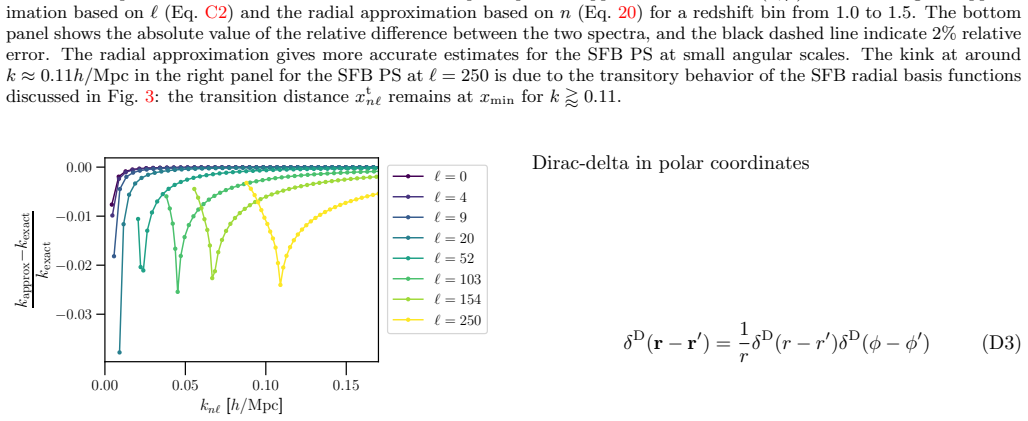
The central discovery is that the two indices of the discrete SFB power spectrum carry separate physical information: $\ell$ labels angular oscillations on the sphere, while $n$ counts radial oscillations of the basis function, and $k_{n\ell}$ is the total wavenumber of the mode rather than a radial wavenumber. Once this is established through the transition distance $x^t_{n\ell}$ and the line-of-sight wavenumber $k_{\parallel,n\ell}=n\pi/(x_{\mathrm{max}}-x^t_{n\ell})$, the paper derives a plane-parallel identification: $C^{\mathrm{approx}}_{\ell nn}=P(k=k_{n\ell},\mu=k_{\parallel,n\ell}/k_{n\ell},x_c=x_{\mathrm{eff},n\ell})$, matching the SFB spectrum to the clustering wedge at percent-level accuracy for small angular scales. The systematics result follows from the radial coefficients $d_{n\ell}=\int dx\,x^2g_{n\ell}(x)$, which decay as $k^{-4}$ under the velocity (Neumann) boundary condition, making the diagonal power of an angular systematic decay as $k^{-8}$; only the $n=0$ and $n=1$ modes stay above a percent of the systematic's own largest mode. Stellar contamination, modeled with a realistic stellar template and a uniform radial distribution, is shown to beat a local-PNG signal only at low $\ell$ and $n=0$, whereas in the monopole power spectrum it forces a cut at roughly $k<0.01\,h/\mathrm{Mpc}$. The paper concludes that SFB mode-selective cleaning is the full-sky generalization of clustering-wedge mitigation and should replace blanket $k_{\mathrm{min}}$ cuts in wide-field 3D clustering analyses.
Load-bearing premise
The localization argument hinges on the velocity boundary condition for the radial basis and on the assumption that real survey systematics are radially broad and smooth; under the alternative potential boundary condition the drop is only $k^{-4}$, and a radially narrow systematic contaminates many more radial modes.
Editorial extensions
If this is right
- A wide-field survey that adopts the SFB power spectrum can remove just the low-$\ell$, $n=0$ modes contaminated by stellar foregrounds and keep the $n=1$ and $n=2$ radial modes at $k<0.01\,h/\mathrm{Mpc}$ that a monopole analysis would discard.
- Because the SFB spectrum is the full-sky generalization of the clustering wedge, existing wedge-based treatments for fiber collisions, astrophysical foregrounds, and interlopers carry over to surveys without a global line of sight.
- Local primordial non-Gaussianity and general-relativistic signals, which scale as $k^{-2}$ in SFB space, remain measurable in higher radial modes even when a radially smooth systematic dominates the lowest modes.
- The plane-parallel mapping permits one-loop effective-field-theory calculations of the Cartesian $P(k,\mu)$ to be converted into SFB power spectra, extending SFB analyses to quasi-linear scales.
Reading between the lines
- A natural follow-up the paper leaves implicit is a Fisher forecast quantifying how much an $n=0$-only cut improves $f_{\rm NL}$ constraints relative to a $k_{\rm min}$ cut; the stellar-contamination example suggests the gain is large.
- The boundary-condition dependence of the leakage suggests one could choose or design radial basis functions to maximize systematics separation rather than treating the Neumann condition as fixed.
- For systematics that are narrow in radius and therefore spread across $n$, the paper's own reasoning points to a hybrid strategy: SFB mode cuts for broad systematics plus real-space masking or deprojection of the narrow radial features.
- The steep $k^{-8}$ versus $k^{-2}$ contrast also implies an empirical pattern test: at fixed $\ell$, measuring the fall-off of the SFB power spectrum across $n$ in data would flag systematics before templates are needed.
Editorial analysis
A structured set of objections, weighed in public.
Referee Report
Summary. The paper studies the discrete spherical Fourier-Bessel (SFB) power spectrum as a tool for separating angular and radial modes. It clarifies that the radial index n labels radial oscillations, defines the LOS Fourier mode k_||,nℓ via the transition distance, and proposes Eq. (20), which approximates the diagonal SFB spectrum by the clustering wedge P(k, μ) at an effective distance. It then analyzes additive angular systematics with separable radial profiles R(x), showing that leakage into higher n modes drops as k^-8 for uniform profiles under the velocity boundary condition and more slowly for other profiles. Using a Gaia-based stellar contamination template, it argues that only n=0 and low-ℓ modes need to be removed in an SFB analysis, whereas a power-spectrum-multipole analysis requires a k_min cut. The paper concludes that SFB permits surgical mode cuts and is a promising framework for systematics mitigation in upcoming surveys.
Significance. If the localization claim holds, this is a substantial methodological contribution: it connects the SFB power spectrum to the familiar clustering wedge formalism, provides an analytic approximation that is validated at percent level at high ℓ, and offers a concrete route to retaining large-scale radial modes for primordial non-Gaussianity and relativistic-effect measurements. The k^-8 scaling is derived analytically and checked against exact SFB computations, and the paper is honest about wide-angle limitations and boundary-condition dependence. The main gap is the empirical support for the radial-profile assumption underlying the practical mode-retention claim; the mathematical framework itself appears sound and non-circular.
major comments (3)
- [Sec. V B, Eq. (27), Fig. 7] The mode-retention recipe "cut n=0 only" is not established as a general consequence of broad radial profiles. For the exponential and broad-Gaussian profiles in Fig. 7 the diagonal systematic drops only as k^-4, not k^-8, and the figure does not give the amplitudes or widths of these profiles, so one cannot determine how many n modes remain above the PNG signal. The paper needs a quantitative selection criterion (for example, the largest n for which C_sys/C_PNG exceeds a given threshold as a function of profile width and amplitude), or an explicit statement that the n=0-only cut has been demonstrated only for the uniform profile used in Fig. 8.
- [Sec. V D, Fig. 8] The stellar contamination example assumes that misclassified stars are uniformly distributed in comoving distance over z=1-1.5. This assumption is load-bearing for the central comparison with the PSM k_min cut, because Fig. 8 shows the n=0-only cut working. In a real z~1 galaxy sample, stars enter through photometric-redshift outliers whose radial PDF can be narrow, and the narrow-Gaussian curve in Fig. 7 shows that such a profile contaminates many n modes at a rate comparable to the PNG k^-2 signal. Please replace the uniform radial assumption with a realistic photo-z outlier distribution for at least one survey, or, if that is outside the present scope, revise the abstract and conclusion so that the mode-retention advantage is claimed only for systematics whose radial profile is known to be broad.
- [Appendix B, Fig. 10; Sec. VI A] The strong k^-8 localization is specific to the velocity (Neumann) boundary condition; under the potential boundary condition the leakage is only k^-4. The paper recommends the velocity BC and gives good reasons, but the abstract's statement that systematics "primarily concentrate in the n=0 modes" is made without this caveat. Since both boundary conditions yield consistent cosmological SFB spectra, an estimator built with the potential BC would not enjoy the advertised strong localization. Please qualify the abstract and the Sec. VI A claim "one can cut the n=0 modes from the analysis to be robust against any systematics with broad radial distributions" by adding "under the velocity boundary condition," or show that the n=0 cut remains valid under the potential BC for a realistic systematic amplitude.
minor comments (7)
- [Fig. 7 caption] Please give the functional forms and widths of the exponential and Gaussian radial profiles; without these the "broad" versus "narrow" distinction cannot be reproduced by the reader.
- [Fig. 9 caption] Typo: "cosmologiucal" should be "cosmological."
- [Appendix D heading] Typo: "Idenitities" should be "Identities."
- [Sec. V D, Fig. 9] The SFB-to-PSM mapping used for Fig. 9 cites Ref. [78] as "in preparation." Since this mapping underpins the PSM comparison, please include the necessary equations in an appendix or cite a published derivation.
- [Sec. V B, after Fig. 7] The suggestion that localized systematics "can be directly mitigated in real space" is not developed; a short explanation of the proposed real-space mitigation and how it would complement the SFB mode cut would strengthen the argument.
- [Sec. IV, Eq. (20) and Fig. 4] For low ℓ the fractional error of Eq. (20) reaches order unity. The text already notes this qualitatively, but a quantitative validity condition (for example, in terms of k_⊥/k_|| or the ratio of angular to radial scales) would help the reader know when the approximation can be used.
- [Sec. IV, Eq. (21)] The effective distance x_eff in Eq. (21) is defined with a general radial selection R(x), but the numerical validation in Sec. IV assumes a uniform R(x). Please state explicitly which figures assume uniform selection and which use a non-uniform R(x).
Circularity Check
No substantive circularity: the SFB-to-wedge mapping and the k^-8 localization scalings are analytic derivations checked against exact computations; only minor self-citations, including the in-preparation Ref. [78], support auxiliary mapping steps without encoding the central result.
full rationale
The paper's central derivation chain is self-contained. Equation (20) is obtained analytically in Appendix A by combining flat-sky angular harmonics (Eqs. A5-A10) with the plane-wave approximation of the SFB radial basis (Eqs. A13-A18); the result is validated against the exact SFB computation in Fig. 4 rather than fitted. The n=0 localization claim follows from the explicit coefficient relation C^S_ell n1 n2 = d_n1 ell d_n2 ell C^S_ell (Eq. 26) with d_n ell ~ k^-4 under the velocity boundary condition (Eq. 25 and Fig. 10), a mathematical property of the chosen basis. The paper transparently shows that the alternative potential boundary condition gives only a k^-4 drop-off (Fig. 10), so the choice is not smuggled in as a forced uniqueness result. The stellar-contamination example is a forward model using a Gaia angular template plus an explicitly stated uniform radial profile, not a fit of the predicted modes. The main self-citations are to the authors' SFB formalism (Refs. [25,28,40,41]) and to the in-preparation Ref. [78] for the auxiliary SFB-to-PSM mapping used only for the monopole comparison in Sec. V D; these do not encode or presuppose the systematics-localization result, so they are not load-bearing. The paper also explicitly acknowledges the narrow-Gaussian limitation (Fig. 7), which is a scope caveat rather than circular reasoning. Overall, no derivation reduces by construction to its own inputs; the score reflects only the presence of minor, non-load-bearing self-citations.
Assumptions & free parameters
free parameters (2)
- Stellar contamination fraction =
2.5% (assumed for illustration)
- Stellar angular power-law index =
-2.3
assumptions (7)
- domain assumption Statistical isotropy and translational invariance for the matter field at fixed redshift (Eq. 3).
- domain assumption Kaiser formula Eq. 7 for the local power spectrum under linear Newtonian RSD.
- domain assumption Systematics enter as additive, uncorrelated contamination in Eq. 22, and the additive part dominates in the density contrast.
- domain assumption Uniform radial selection function for the default numerical demonstrations (Secs. IV and V B).
- domain assumption Velocity (Neumann) boundary condition Eq. 12 is the appropriate choice for the SFB basis.
- domain assumption Representative systematics have broad, smooth radial distributions.
- domain assumption SFB-to-PSM mapping of Refs. [25,78] is valid, with Ref. [78] unpublished.
Cite this review
Pith. "Pith review of Separating Angular and Radial Modes with Spherical-Fourier Bessel Power Spectrum on All Scales and Implications for Systematics Mitigation." pith.science (2026). https://pith.science/paper/HBWSTTZK
@misc{pith2026250606902,
  author       = {Pith},
  title        = {Pith review of: Separating Angular and Radial Modes with Spherical-Fourier Bessel Power Spectrum on All Scales and Implications for Systematics Mitigation},
  year         = {2026},
  howpublished = {\url{https://pith.science/paper/HBWSTTZK}},
  note         = {Machine review of arXiv:2506.06902}
}
abstract
Current and upcoming large-scale structure surveys place stringent requirements on the mitigation of observational systematics in order to achieve their unprecedented constraining power. In this work, we investigate the potential use of the spherical Fourier-Bessel (SFB) power spectrum in controlling systematics, leveraging its capability of disentangling angular and radial scales. We first clarify how the discrete SFB basis describes radial scales via the index $n$ and demonstrate that the SFB power spectrum reduces to the clustering wedge $P(k,\mu)$ in the plane-parallel limit, enabling it to inherit results from past literature based on the clustering wedge. While the parallel and perpendicular Fourier mode $(k_{||}, k_\perp)$ decomposition underlying the wedge is only valid for surveys of small angular coverage with a well-defined global line-of-sight, the SFB basis provides a natural generalization that can be applied to the full sky. Crucially, the separation of angular and radial scales allows systematics to be localized in SFB space. In particular, systematics with broad and smooth radial distributions primarily concentrate in the $n=0$ modes corresponding to the largest radial scales. This localization behavior enables one to selectively remove only particular angular and radial modes contaminated by systematics. This is in contrast to standard 3D clustering analyses of wide-field surveys based on power spectrum multipoles, where systematic effects necessitate the removal of all modes below a given $k_{\rm min}$. Our findings advocate for adopting the SFB basis in 3D clustering analyses where systematics have become a limiting factor.
Figures


Figures from the paper (8 more)


Forward citations
Cited by 3 Pith papers
-
Impact and measurability of linear relativistic effects in galaxy surveys
Neglecting linear GR effects biases f_NL at 1–3σ for Euclid/SPHEREx in SFB forecasts; multi-tracer improves Doppler detection and weakly breaks b_ϕ f_NL degeneracy.
-
Large-scale Modeling of the Observed Power Spectrum Multipoles
Eq. (25) computes Yamamoto power-spectrum multipoles in linear theory as weighted sums of discrete spherical Fourier-Bessel power-spectrum modes, unifying wide-angle, redshift-evolution, window, and integral-constrain...
-
Cosmology with HI Intensity Mapping
SKAO HI intensity mapping forecasts yield competitive LambdaCDM constraints (e.g. H0 to ~0.3 km/s/Mpc optimistic) via power spectrum, BAO, bispectrum and stacking, complementary to CMB and optical surveys.
Reference graph
Works this paper leans on
-
[78]
A. de Mattia and V. Ruhlmann-Kleider, JCAP2019, 036 (2019), arXiv:1904.08851 [astro-ph.CO]
arXiv 2019
-
[1]
The inverse of the above transform is δℓm = r 2l+ 1 4π im Z dϕl 2π e−imϕℓ δ(l).(A5) We will now showδ(l) as defined above is the 2D Fourier modes in the flat-sky case
Angular modes We first define the following weighted sum of the spher- ical harmonic moments δ(l)≡ r 4π 2l+ 1 X m i−mδℓmeimϕℓ ,(A4) wherelis the vector of lengthℓand angleϕ ℓ in the polar coordinates. The inverse of the above transform is δℓm = r 2l+ 1 4π im Z dϕl 2π e−imϕℓ δ(l).(A5) We will now showδ(l) as defined above is the 2D Fourier modes in the fla...
-
[2]
Radial modes We now examine the analytical approximation to the radial basis functions in the SFB basis. Since the SFB basis consists of the eigenfunctions of the Laplacian, the radial basis functions satisfy the radial part of the Helmholtz equation (the Laplacian eigenequation) d dx x2 dgℓ(kx) dx + (kx)2 −ℓ(ℓ+ 1) gℓ(kx) = 0. (A11) In the limit of (kx) 2...
-
[3]
A5 and Eq
Power spectrum Combining the angular approximations of Eq. A5 and Eq. A10 along with the radial approximation of Eq. A18, the SFB mode in Eq. A1 becomes δnℓm ≈ 1 xeff r 2l+ 1 8π∆x im Z dϕl 2π e−imϕℓ Re Z ∞ −∞ dx eik||xδ(k⊥, x) ≈ 1 xeff r l 4π∆x im Z dϕl 2π e−imϕℓ Re[δ(k, xeff )],(A19) where we consider the Fourier-space overdensity field to be measured at...
-
[4]
DESI Collaboration, JCAP2025, 017 (2025), arXiv:2411.12020 [astro-ph.CO]
arXiv 2025
-
[5]
Astrophys.697, A1 (2025), arXiv:2405.13491 [astro-ph.CO]
Euclid Collaboration, Astron. Astrophys.697, A1 (2025), arXiv:2405.13491 [astro-ph.CO]
arXiv 2025
- [6]
-
[7]
ˇZ. Ivezi´ c, S. M. Kahn, J. A. Tyson,et al., Astrophys. J. 873, 111 (2019), arXiv:0805.2366 [astro-ph]
arXiv 2019
Show all 104 references
-
[8]
Eifleret al., Mon
T. Eifleret al., Mon. Not. Roy. Astron. Soc.507, 1514 (2021), arXiv:2004.04702 [astro-ph.CO]
2021 arXiv
-
[9]
Square Kilometre Array Cosmology Science Working Group, D. J. Bacon, R. A. Battye,et al., Publications of the Astronomical Society of Australia37, e007 (2020), arXiv:1811.02743 [astro-ph.CO]
2020 arXiv
-
[10]
Komatsu and D
E. Komatsu and D. N. Spergel, Phys. Rev. D63, 063002 (2001), arXiv:astro-ph/0005036 [astro-ph]
2001 arXiv
-
[11]
Dalal, O
N. Dalal, O. Dore, D. Huterer, and A. Shirokov, Phys. Rev. D77, 123514 (2008), arXiv:0710.4560 [astro-ph]
2008 arXiv
-
[12]
Slosar, C
A. Slosar, C. Hirata, U. Seljak,et al., JCAP2008, 031 (2008), arXiv:0805.3580 [astro-ph]
2008 arXiv
-
[13]
de Putter and O
R. de Putter and O. Dor´ e, Phys. Rev. D95, 123513 (2017), arXiv:1412.3854 [astro-ph.CO]
2017 arXiv
-
[14]
J. Yoo, A. L. Fitzpatrick, and M. Zaldarriaga, Phys. Rev. D80, 083514 (2009), arXiv:0907.0707 [astro- 21 ph.CO]
2009 arXiv
- [15]
-
[16]
Challinor and A
A. Challinor and A. Lewis, Phys. Rev. D84, 043516 (2011), arXiv:1105.5292 [astro-ph.CO]
2011 arXiv
-
[17]
Bonvin and R
C. Bonvin and R. Durrer, Phys. Rev. D84, 063505 (2011), arXiv:1105.5280 [astro-ph.CO]
2011 arXiv
-
[18]
Jeong, F
D. Jeong, F. Schmidt, and C. M. Hirata, Phys. Rev. D 85, 023504 (2012), arXiv:1107.5427 [astro-ph.CO]
2012 arXiv
-
[19]
Rezaie, A
M. Rezaie, A. J. Ross, H.-J. Seo,et al., Mon. Not. R. As- tron. Soc.506, 3439 (2021), arXiv:2106.13724 [astro- ph.CO]
2021 arXiv
-
[20]
Kitanidis, M
E. Kitanidis, M. White, Y. Feng,et al., Mon. Not. R. Astron. Soc.496, 2262 (2020), arXiv:1911.05714 [astro-ph.CO]
2020 arXiv
-
[21]
Rezaie, A
M. Rezaie, A. J. Ross, H.-J. Seo,et al., Mon. Not. R. As- tron. Soc.532, 1902 (2024), arXiv:2307.01753 [astro- ph.CO]
2024 arXiv
-
[22]
Chaussidon, C
E. Chaussidon, C. Y` eche, N. Palanque-Delabrouille, et al., Mon. Not. R. Astron. Soc.509, 3904 (2022), arXiv:2108.03640 [astro-ph.CO]
2022 arXiv
-
[23]
J. P. Corderoet al.(DES), Mon. Not. Roy. Astron. Soc. 511, 2170 (2022), arXiv:2109.09636 [astro-ph.CO]
2022 arXiv
-
[24]
K. C. Chan, S. Avila, A. Carnero Rosell,et al., Phys. Rev. D106, 123502 (2022), arXiv:2210.05057 [astro- ph.CO]
2022 arXiv
-
[25]
Krolewski, J
A. Krolewski, J. Yu, A. J. Ross,et al., JCAP2025, 147 (2025), arXiv:2405.17208 [astro-ph.CO]
2025 arXiv
-
[26]
Chaussidon, C
E. Chaussidon, C. Y` eche, A. de Mattia,et al., JCAP 2025, 029 (2025), arXiv:2411.17623 [astro-ph.CO]
2025 arXiv
-
[27]
Castorina and M
E. Castorina and M. White, Mon. Not. R. Astron. Soc. 476, 4403 (2018), arXiv:1709.09730 [astro-ph.CO]
2018 arXiv
-
[28]
R. Y. Wen, H. S. Grasshorn Gebhardt, C. Hein- rich, and O. Dor´ e, Phys. Rev. D110, 083525 (2024), arXiv:2404.04812 [astro-ph.CO]
2024 arXiv
-
[29]
Yoo and V
J. Yoo and V. Desjacques, Phys. Rev. D88, 023502 (2013), arXiv:1301.4501 [astro-ph.CO]
2013 arXiv
-
[30]
Semenzato, D
F. Semenzato, D. Bertacca, and A. Raccanelli, Phys. Rev. D111, 023522 (2025), arXiv:2406.09545 [astro- ph.CO]
2025 arXiv
-
[31]
R. Y. Wen, H. S. Grasshorn Gebhardt, C. Hein- rich, and O. Dor´ e, Phys. Rev. D110, 123501 (2024), arXiv:2407.02753 [astro-ph.CO]
2024 arXiv
-
[32]
Binney and T
J. Binney and T. Quinn, Monthly Notices of the Royal Astronomical Society249, 678 (1991)
1991
-
[33]
Lahav, Spherical harmonic reconstruction of cos- mic density and velocity fields (1993), arXiv:astro- ph/9309030 [astro-ph]
O. Lahav, Spherical harmonic reconstruction of cos- mic density and velocity fields (1993), arXiv:astro- ph/9309030 [astro-ph]
1993
-
[34]
K. B. Fisher, O. Lahav, Y. Hoffman,et al., Mon. Not. R. Astron. Soc.272, 885 (1995), arXiv:astro- ph/9406009 [astro-ph]
1995
-
[35]
A. F. Heavens and A. N. Taylor, Mon. Not. R. As- tron. Soc.275, 483 (1995), arXiv:astro-ph/9409027 [astro-ph]
1995 arXiv
-
[36]
Tadros, W
H. Tadros, W. E. Ballinger, A. N. Taylor,et al., Monthly Notices of the Royal Astronomical Society305, 527 (1999), https://academic.oup.com/mnras/article- pdf/305/3/527/3053599/305-3-527.pdf
1999
-
[37]
W. J. Percival, D. Burkey, A. Heavens,et al., Mon. Not. R. Astron. Soc.353, 1201 (2004), arXiv:astro-ph/0406513 [astro-ph]
2004 arXiv
-
[38]
T. D. Kitching, A. F. Heavens, A. N. Taylor,et al., Mon. Not. R. Astron. Soc.376, 771 (2007), arXiv:astro- ph/0610284 [astro-ph]
2007
-
[39]
T. D. Kitching, A. F. Heavens, J. Alsing,et al., Mon. Not. R. Astron. Soc.442, 1326 (2014), arXiv:1401.6842 [astro-ph.CO]
2014 arXiv
-
[40]
Leistedt, A
B. Leistedt, A. Rassat, A. R´ efr´ egier, and J. L. Starck, Astron. Astrophys.540, A60 (2012), arXiv:1111.3591 [astro-ph.CO]
2012 arXiv
-
[41]
Samushia, arXiv e-prints , arXiv:1906.05866 (2019), arXiv:1906.05866 [astro-ph.CO]
L. Samushia, arXiv e-prints , arXiv:1906.05866 (2019), arXiv:1906.05866 [astro-ph.CO]
2019 arXiv
-
[42]
B. Khek, H. G. Gebhardt, and O. Dor´ e, Phys. Rev. D 110, 063524 (2024), arXiv:2212.05760 [astro-ph.CO]
2024 arXiv
-
[43]
H. S. Grasshorn Gebhardt and O. Dor´ e, Phys. Rev. D 104, 123548 (2021), arXiv:2102.10079 [astro-ph.CO]
2021 arXiv
-
[44]
H. S. Grasshorn Gebhardt and O. Dor´ e, Phys. Rev. D 109, 083502 (2024), arXiv:2310.17677 [astro-ph.IM]
2024 arXiv
-
[45]
Hu, Phys
W. Hu, Phys. Rev. D62, 043007 (2000), arXiv:astro- ph/0001303 [astro-ph]
2000
-
[46]
Bernardeau, C
F. Bernardeau, C. Pitrou, and J.-P. Uzan, JCAP2011, 015 (2011), arXiv:1012.2652 [astro-ph.CO]
2011 arXiv
-
[47]
W. L. Matthewson and R. Durrer, JCAP2021, 027 (2021), arXiv:2006.13525 [astro-ph.CO]
2021 arXiv
-
[48]
H. S. Grasshorn Gebhardt and D. Jeong, Phys. Rev. D 102, 083521 (2020), arXiv:2008.08706 [astro-ph.CO]
2020 arXiv
-
[49]
Z. Gao, A. Raccanelli, and Z. Vlah, Phys. Rev. D108, 043503 (2023), arXiv:2306.02993 [astro-ph.CO]
2023 arXiv
-
[50]
Z. Gao, Z. Vlah, and A. Challinor, JCAP2024, 003 (2024), arXiv:2307.13768 [astro-ph.CO]
2024 arXiv
-
[51]
J. N. Grieb, A. G. S´ anchez, S. Salazar-Albornoz, et al., Mon. Not. R. Astron. Soc.467, 2085 (2017), arXiv:1607.03143 [astro-ph.CO]
2017 arXiv
-
[52]
N. Hand, Y. Li, Z. Slepian, and U. Seljak, JCAP2017, 002 (2017), arXiv:1704.02357 [astro-ph.CO]
2017 arXiv
-
[53]
Pinol, R
L. Pinol, R. N. Cahn, N. Hand,et al., JCAP2017, 008 (2017), arXiv:1611.05007 [astro-ph.CO]
2017 arXiv
-
[54]
A. Liu, A. R. Parsons, and C. M. Trott, Phys. Rev. D 90, 023018 (2014), arXiv:1404.2596 [astro-ph.CO]
2014 arXiv
-
[55]
Cheng, T.-C
Y.-T. Cheng, T.-C. Chang, J. Bock,et al., Astrophys. J.832, 165 (2016), arXiv:1604.07833 [astro-ph.CO]
2016 arXiv
-
[56]
H. S. Grasshorn Gebhardt, D. Jeong, H. Awan,et al., Astrophys. J.876, 32 (2019), arXiv:1811.06982 [astro- ph.CO]
2019 arXiv
-
[57]
Lidz and J
A. Lidz and J. Taylor, Astrophys. J.825, 143 (2016), arXiv:1604.05737 [astro-ph.CO]
2016 arXiv
-
[58]
A. Liu, Y. Zhang, and A. R. Parsons, Astrophys. J.833, 242 (2016), arXiv:1609.04401 [astro-ph.CO]
2016 arXiv
-
[59]
Scoccimarro, Phys
R. Scoccimarro, Phys. Rev. D92, 083532 (2015), arXiv:1506.02729 [astro-ph.CO]
2015 arXiv
-
[60]
Noorikuhani and R
M. Noorikuhani and R. Scoccimarro, Phys. Rev. D107, 083528 (2023), arXiv:2207.12383 [astro-ph.CO]
2023 arXiv
-
[61]
Zaroubi and Y
S. Zaroubi and Y. Hoffman, Astrophys. J.462, 25 (1996)
1996
-
[62]
Kaiser, Mon
N. Kaiser, Mon. Not. R. Astron. Soc.227, 1 (1987)
1987
-
[63]
Castorina and E
E. Castorina and E. Di Dio, JCAP2022, 061 (2022), arXiv:2106.08857 [astro-ph.CO]
2022 arXiv
-
[64]
Foglieni, M
M. Foglieni, M. Pantiri, E. Di Dio, and E. Castorina, Phys. Rev. Lett.131, 111201 (2023), arXiv:2303.03142 [astro-ph.CO]
2023 arXiv
-
[65]
Yamamoto, M
K. Yamamoto, M. Nakamichi, A. Kamino,et al., Publi- cations of the Astronomical Society of Japan58, 93–102 (2006)
2006
-
[66]
M. S. Cagliari, E. Castorina, M. Bonici, and D. Bianchi, JCAP2024, 036 (2024), arXiv:2309.15814 [astro- ph.CO]
2024 arXiv
-
[67]
Bianchi, H
D. Bianchi, H. Gil-Mar ´ ın, R. Ruggeri, and W. J. Perci- val, Monthly Notices of the Royal Astronomical Society: 22 Letters453, L11–L15 (2015)
2015
-
[68]
Chakraborty and A
P. Chakraborty and A. R. Pullen, Mon. Not. R. As- tron. Soc.488, 1828 (2019), arXiv:1906.05873 [astro- ph.CO]
2019 arXiv
-
[69]
Astrophys.641, A6 (2020), arXiv:1807.06209
Planck Collaboration VI, Astron. Astrophys.641, A6 (2020), arXiv:1807.06209
2020 arXiv
-
[70]
J. N. Benabou, I. Sands, H. S. Grasshorn Geb- hardt,et al., Phys. Rev. D110, 083526 (2024), arXiv:2404.04811 [astro-ph.CO]
2024 arXiv
-
[71]
Chudaykin, M
A. Chudaykin, M. M. Ivanov, O. H. E. Philcox, and M. Simonovi´ c, Phys. Rev. D102, 063533 (2020), arXiv:2004.10607 [astro-ph.CO]
2020 arXiv
-
[72]
D’Amico, L
G. D’Amico, L. Senatore, and P. Zhang, JCAP2021, 006 (2021), arXiv:2003.07956 [astro-ph.CO]
2021 arXiv
-
[73]
Linde, A
D. Linde, A. M. Dizgah, C. Radermacher,et al., JCAP 2024, 068 (2024), arXiv:2402.09778 [astro-ph.CO]
2024 arXiv
-
[74]
S.-F. Chen, Z. Vlah, E. Castorina, and M. White, JCAP 2021, 100 (2021), arXiv:2012.04636 [astro-ph.CO]
2021 arXiv
-
[75]
Berlfein, R
F. Berlfein, R. Mandelbaum, S. Dodelson, and C. Schafer, Mon. Not. Roy. Astron. Soc.531, 4954 (2024), arXiv:2401.12293 [astro-ph.CO]
2024 arXiv
-
[76]
C. Hahn, R. Scoccimarro, M. R. Blanton,et al., Mon. Not. R. Astron. Soc.467, 1940 (2017), arXiv:1609.01714 [astro-ph.CO]
2017 arXiv
-
[77]
Pinon, A
M. Pinon, A. de Mattia, P. McDonald,et al., JCAP 2025, 131 (2025), arXiv:2406.04804 [astro-ph.CO]
2025 arXiv
-
[79]
de Putter, C
R. de Putter, C. Wagner, O. Mena,et al., JCAP2012, 019 (2012), arXiv:1111.6596 [astro-ph.CO]
2012 arXiv
-
[80]
Wadekar and R
D. Wadekar and R. Scoccimarro, Phys. Rev. D102, 123517 (2020), arXiv:1910.02914 [astro-ph.CO]
2020 arXiv
-
[81]
R. Y. Wen, H. S. Grasshorn Gebhardt, C. Heinrich, and O. Dor´ e (2025), in preparation
2025
-
[82]
Astrophys.674, A1 (2023), arXiv:2208.00211 [astro-ph.GA]
Gaia Collaboration, Astron. Astrophys.674, A1 (2023), arXiv:2208.00211 [astro-ph.GA]
2023 arXiv
-
[83]
Astrophys.616, A1 (2018), arXiv:1804.09365 [astro-ph.GA]
Gaia Collaboration, Astron. Astrophys.616, A1 (2018), arXiv:1804.09365 [astro-ph.GA]
2018 arXiv
-
[84]
Astrophys.586, A133 (2016), arXiv:1409.5738 [astro-ph.CO]
Planck Collaboration, Astron. Astrophys.586, A133 (2016), arXiv:1409.5738 [astro-ph.CO]
2016 arXiv
-
[85]
A. J. Ross, S. Ho, A. J. Cuesta,et al., Mon. Not. R. As- tron. Soc.417, 1350 (2011), arXiv:1105.2320 [astro- ph.CO]
2011 arXiv
-
[86]
S. Ho, A. Cuesta, H.-J. Seo,et al., Astrophys. J.761, 14 (2012), arXiv:1201.2137 [astro-ph.CO]
2012 arXiv
-
[87]
Elsner, B
F. Elsner, B. Leistedt, and H. V. Peiris, Mon. Not. R. Astron. Soc.456, 2095 (2016), arXiv:1509.08933 [astro-ph.CO]
2016 arXiv
-
[88]
G. B. Rybicki and W. H. Press, Astrophys. J.398, 169 (1992)
1992
-
[89]
Leistedt, H
B. Leistedt, H. V. Peiris, D. J. Mortlock,et al., Mon. Not. R. Astron. Soc.435, 1857 (2013), arXiv:1306.0005 [astro-ph.CO]
2013 arXiv
-
[90]
Weaverdyck and D
N. Weaverdyck and D. Huterer, Mon. Not. Roy. Astron. Soc.503, 5061 (2021), arXiv:2007.14499 [astro-ph.CO]
2021 arXiv
-
[91]
A. J. Ross, F. Beutler, C.-H. Chuang,et al., Mon. Not. R. Astron. Soc.464, 1168 (2017), arXiv:1607.03145 [astro-ph.CO]
2017 arXiv
-
[92]
Elvin-Poole, M
J. Elvin-Poole, M. Crocce, A. J. Ross,et al., Phys. Rev. D98, 042006 (2018), arXiv:1708.01536 [astro-ph.CO]
2018 arXiv
-
[93]
Rezaie, H.-J
M. Rezaie, H.-J. Seo, A. J. Ross, and R. C. Bunescu, Mon. Not. R. Astron. Soc.495, 1613 (2020), arXiv:1907.11355 [astro-ph.CO]
2020 arXiv
-
[94]
Astrophys.641, A5 (2020), arXiv:1907.12875 [astro-ph.CO]
Planck Collaboration, Astron. Astrophys.641, A5 (2020), arXiv:1907.12875 [astro-ph.CO]
2020 arXiv
-
[95]
Bicep/Keck Collaboration, Phys. Rev. Lett.127, 151301 (2021), arXiv:2110.00483 [astro-ph.CO]
2021
-
[96]
Cunnington, A
S. Cunnington, A. Pourtsidou, P. S. Soares,et al., Mon. Not. R. Astron. Soc.496, 415 (2020), arXiv:2002.05626 [astro-ph.CO]
2020 arXiv
-
[97]
Cunnington, S
S. Cunnington, S. Camera, and A. Pourtsidou, Mon. Not. R. Astron. Soc.499, 4054 (2020), arXiv:2007.12126 [astro-ph.CO]
2020 arXiv
-
[98]
A. Liu, A. R. Parsons, and C. M. Trott, Phys. Rev. D 90, 023019 (2014), arXiv:1404.4372 [astro-ph.CO]
2014 arXiv
-
[99]
Munshi, F
S. Munshi, F. G. Mertens, L. V. E. Koopmans,et al., Astron. Astrophys.693, A276 (2025), arXiv:2407.10686 [astro-ph.CO]
2025 arXiv
-
[100]
Bertacca, A
D. Bertacca, A. Raccanelli, N. Bartolo,et al., Phys. Rev. D97, 023531 (2018), arXiv:1705.09306 [astro- ph.CO]
2018 arXiv
-
[101]
J. N. Benabou, A. Testa, C. Heinrich,et al., Phys. Rev. D109, 103507 (2024), arXiv:2312.15992 [astro-ph.CO]
2024 arXiv
-
[102]
Zaldarriaga and U
M. Zaldarriaga and U. Seljak, Phys. Rev. D55, 1830 (1997), arXiv:astro-ph/9609170 [astro-ph]
1997 arXiv
-
[103]
White, J
M. White, J. E. Carlstrom, M. Dragovan, and W. L. Holzapfel, Astrophys. J.514, 12 (1999), arXiv:astro- ph/9712195 [astro-ph]
1999
-
[104]
Blake and R
C. Blake and R. J. Turner, The Open Journal of Astro- physics7, 87 (2024), arXiv:2408.05660 [astro-ph.CO]
2024 arXiv
Reviewed August 7, 2026 · model on record in the stance chip above.
Discussion (0). Sign in to comment.