REVIEW 4 major objections 6 minor 58 references
The symbolic partition with generalized Koopman analysis
T0 review · 4 major / 6 minor · reviewed 2026-08-07 · deepseek-v4-flash
Pith's one-line read Zero-eigenvalue Koopman left eigenfunctions mark the symbolic partition boundary of chaotic maps, and a generalized Koopman analysis refines that boundary to match published partitions.
desk verdict A heuristic but promising Koopman-based route to symbolic partitions: the zero-mode eigenfunction idea is new and the numerical matches to published boundaries are real, but the central mechanism is a conjecture and the pipeline depends on hand-tuning. read the letter →
The pith
A machine-rendered reading of the paper's core claim, the machinery that carries it, and where it could break.
The reading
What carries the argument
The central object is the Valid Left Eigenfunction with Zero (VLEZ): a left eigenvector $u$ of the finite-dimensional Koopman approximation matrix with eigenvalue $\lambda \approx 0$ (within $10^{-5}$) whose associated left eigenfunction $Ku$ oscillates only in an interior subregion. The argument rests on the Perron–Frobenius picture: left eigenvectors describe density evolution, and $\lambda=0$ means the density vanishes after one iteration, so the oscillation's two lobes must map onto the same region—a folding event—and the pre-image of the folding point lies between them. For maps too complex to yield VLEZ directly, the paper uses Characteristic Left Eigenfunctions (CLE, eigenvalues close to but not equal to zero) to redistribute basis functions and then applies the Generalized Koopman Analysis (GKA), which fits a curve to a localized subregion and uses an affine transformation to put the region and its evolved image on the same footing.
What would settle it
Construct a one-dimensional unimodal map whose folding pre-image falls exactly on the edge between two basis cells and whose computed VLEZ oscillation zero-crossing shifts away from that pre-image as the basis is refined; if such a map exists, the claimed localization mechanism fails. Concretely, one can take the logistic map at $\alpha=3.75$ with a deliberately shifted or non-uniform basis and check whether the zero-crossing points of VLEZ still converge to the critical point's pre-image; a mismatch would falsify the paper's central mechanism.
Extended reading notes
Core claim
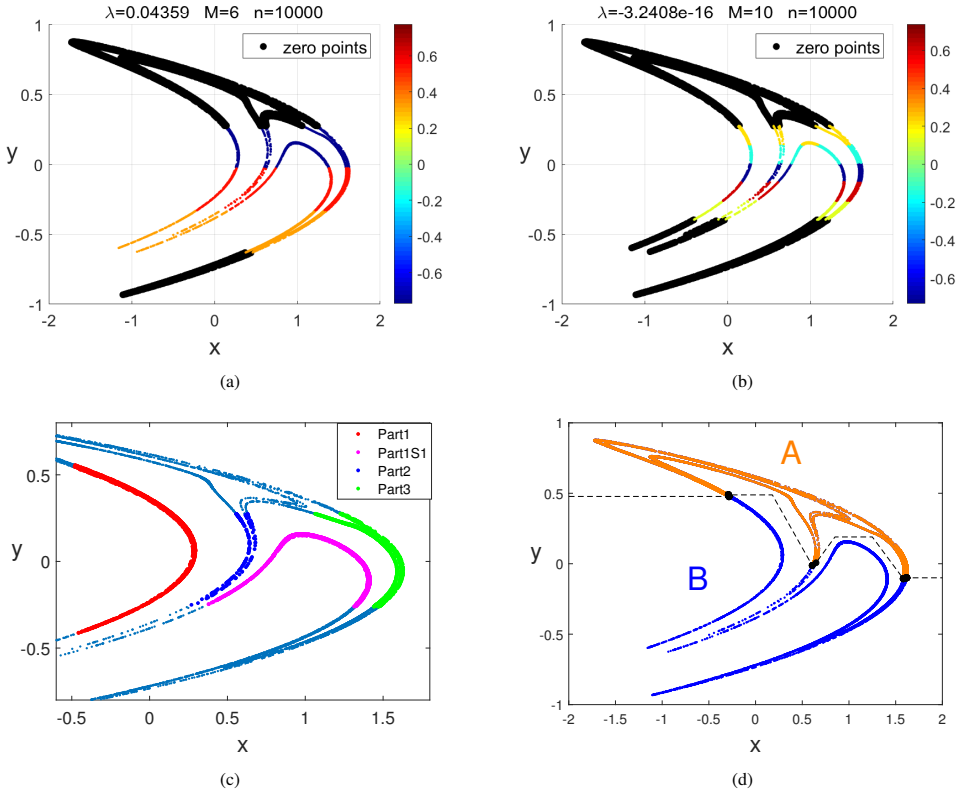
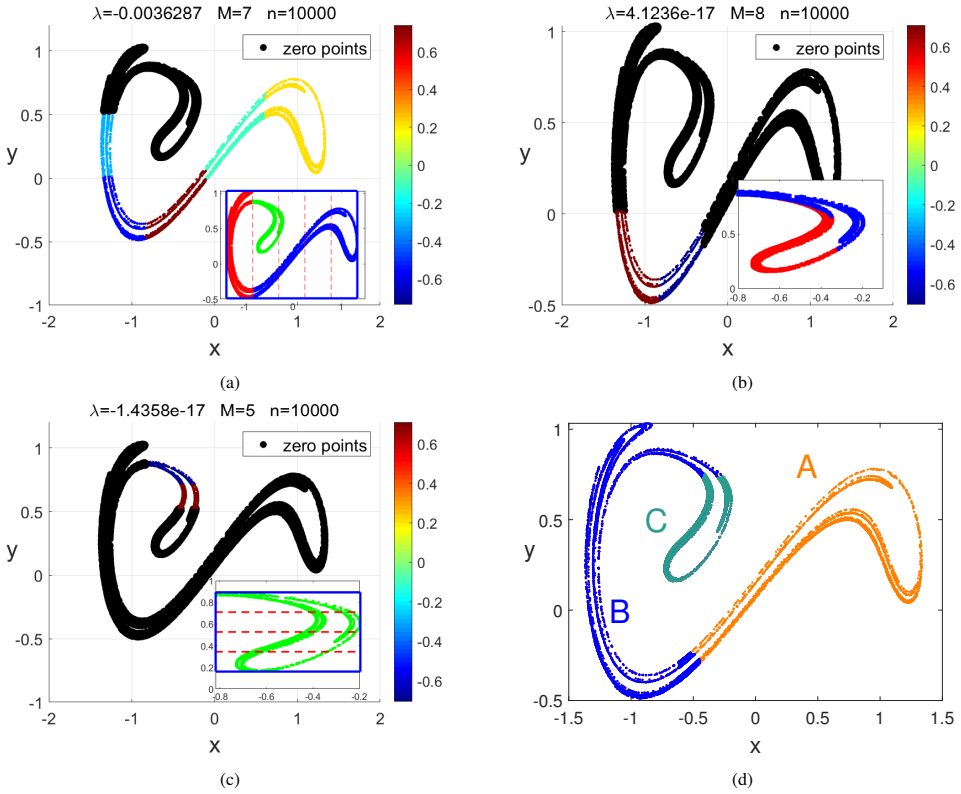
The central claim is that the pre-image of a folding point—the symbolic partition boundary—is carried by a specific spectral object: a Koopman left eigenfunction with eigenvalue zero whose oscillation is confined to an interior subregion. The paper calls this object the Valid Left Eigenfunction with Zero (VLEZ) and argues that because left eigenfunctions evolve densities and a zero eigenvalue makes the density vanish after one iteration, the two lobes of the oscillation must overlap after one step; that overlap is the folding event, so the boundary between the lobes is where the symbolic partition must cut. For maps with multiple or incomplete foldings, where VLEZ does not appear at low resolution, the paper first obtains a Characteristic Left Eigenfunction (CLE) with a small nonzero eigenvalue, uses its oscillation to redistribute the basis functions, and then obtains VLEZ. The refined boundary is produced by Generalized Koopman Analysis (GKA), which fits a curve to a localized attractor region and applies an affine transformation so that the region and its evolved image live in the same coordinate frame; the reported boundaries agree with the published partitions for the Hénon map ($\alpha=1.4, \beta=0.3$ and $\alpha=1.0, \beta=0.54$), the Duffing return map, and a three-dimensional hyperchaotic map, with weak Gaussian noise shifting the positions only within the stated tolerances.
Load-bearing premise
The load-bearing premise is that the oscillation pattern of a zero-eigenvalue Koopman left eigenfunction—demonstrated for the tent map—localizes the pre-image of a folding event for general chaotic maps and basis choices; no proof is given that EDMD left eigenvectors at eigenvalue zero must oscillate exactly across that pre-image.
Editorial extensions
If this is right
- If the VLEZ mechanism is correct, symbolic partitions can be estimated directly from scalar or vector chaotic time series without knowing the dynamical equations.
- The GKA refinement yields boundary positions that match published generating partitions for the Hénon map, the Duffing return map, and a 3D hyperchaotic map, so the method is a viable alternative when stable/unstable manifold or periodic-orbit data are unavailable.
- The method tolerates weak Gaussian observational noise, meaning the same pipeline can be applied to experimental data where generating partitions are formally ill-defined.
- Since the required building blocks are generic (basis functions, EDMD, spectral decomposition), the approach extends to higher-dimensional and continuous-time systems by discretization and Poincaré sections.
Reading between the lines
- If the VLEZ mechanism holds beyond the tested maps, the method offers a data-only route to generating partitions for high-dimensional and hyperchaotic systems, where unstable-manifold and periodic-orbit constructions are impractical.
- The thresholds used to define VLEZ (eigenvalue within $10^{-5}$ of zero, oscillation-to-zero ratio bounds) are empirical; a systematic characterization of when these thresholds fail—for example, the eigenvalue gap closing at higher dimensions—would sharpen the method's applicability.
- Because GKA relies on fitting curves or surfaces and checking $R^2 \ge 0.9$, its success for a new system depends on local geometric regularity of the attractor; a testable extension would be applying GKA to a system whose attractor has cusps or non-smooth folds, where curve fitting would break down.
- The paper's observation that an invalid LEZ (oscillation at the edge) indicates one side of the boundary suggests a possible iterative refinement strategy during data collection, turning VLEZ localization into an online detector for streaming time series.
Editorial analysis
A structured set of objections, weighed in public.
Referee Report
Summary. The paper proposes a data-driven method for constructing symbolic partitions of chaotic time series using left eigenfunctions of a finite-dimensional approximation of the Koopman operator (the KA method). The authors introduce 'Valid Left Eigenfunctions with Zero' (VLEZ), whose interior oscillations are claimed to localize the coarse symbolic boundary, and a 'Generalized Koopman Analysis' (GKA) that refines the boundary via affine transformations and localized basis functions. The method is demonstrated on the logistic and tent maps, a multimodal quartic map, two Hénon maps, the return map of a Duffing oscillator, and a three-dimensional hyperchaotic map, including noisy versions, and the results are compared with previously published symbolic boundaries in Table 1.
Significance. If the central claim holds, the paper offers a new operator-theoretic route to symbolic partitioning that extends the authors' earlier work (Ref. [49]) and is applicable to multivariate and noisy data. The main strength is the empirical agreement with independent literature values: the boundaries in Table 1 match Grassberger–Kantz, Hansen, and Giovannini–Politi results to within about 0.001–0.01, which is a meaningful quantitative validation. The method's reliance on Koopman eigenfunctions rather than unstable periodic orbits or stable/unstable manifolds is a refreshing alternative. However, the work does not provide machine-checked proofs, reproducible code, or a parameter-free derivation; the central mechanism is supported by a single worked example and a set of hand-set thresholds. The significance is therefore conditional on the generality of the VLEZ phenomenon and on the method's reproducibility as a fully specified algorithm.
major comments (4)
- [§2.2.2, Eq. (12)] The central claim that VLEZ oscillations localize the pre-image of the folding point is not established. The only derivation is a hand-computed M=4 tent map example (Eq. (12)), from which the authors infer a general mechanism. For the EDMD matrix in Eq. (7), a zero-eigenvalue left eigenvector satisfies a cancellation condition on the empirical transition matrix; it is not shown why such a signed measure must cancel exactly across the pre-image of the critical point, nor that a VLEZ with the required single interior oscillation exists at finite M for a given map. This is load-bearing because the entire KA/GKA method rests on this equivalence. The authors should either supply a proof for a class of piecewise-linear or smooth unimodal maps, or provide a systematic numerical study across many maps, basis sizes, and initial conditions showing that VLEZ consistently appears and localizes the boundary. Without this, the mechanism remains a conjecture.
- [§2.2.2, threshold definitions] The criteria for VLEZ selection are ad hoc: the eigenvalue tolerance |λ|<10^{-5}, the zero-valued-region tolerance of 1/10 of the oscillation extrema, and the tiny-zero-subregion threshold of 1/5 of the oscillation size are all hand-set. No sensitivity analysis is given to show that the results are stable with respect to these choices, and no principled reason is offered for why these particular values were selected. Since these thresholds are used to decide whether a given left eigenfunction qualifies as a VLEZ, they may be doing a significant amount of the work in matching the known boundaries. I ask the authors to report how the output boundaries in Table 1 vary when each threshold is changed by, say, a factor of two, and to justify the choices or replace them with an automatic selection rule.
- [§2.1, Eq. (9)] Equation (9), written as 'Ku Ũ = λ Ku', is dimensionally inconsistent: K is n×M, u is an M-dimensional left eigenvector, so Ku is n×1 while Ũ is M×M, and the product Ku Ũ is undefined. The intended relation is presumably K(u Ũ) = λ K u, but as written it suggests a confusion between left and right eigenvector conventions. This is not a mere typographical nuisance because it obscures the derivation of the left eigenfunction and should be corrected before publication.
- [§3.1 and §3.2] The method as described requires many manual interventions that are not specified as an algorithm: the text repeatedly states 'we find', 'we set', 'we choose', 'we shrink', and 'we separate into curved-type subregions', and the decisions rely on visual inspection of figures (e.g., 'we find that the continuity of the fractal region cannot be broken when M_x are reset to 1'). The choice of R²>0.9 for a 'curved-type region', the decision to use interpolation with n=100 points, and the selection of 'the complete folding region Part1S3' are not automated. This makes the method difficult to reproduce and weakens the claim that the authors 'propose a practical algorithm'. I strongly recommend that the authors provide a pseudocode or a step-by-step algorithmic description that removes (or explicitly parameterizes) these human choices, so that a reader could apply the method to a new dataset without reference to the expected answer.
minor comments (6)
- [Global] There are numerous typographical and grammatical errors, such as 'Egienfuction' in the Section 2.1 heading, 'Althougth' in the Introduction, and incomplete sentences in the abstract ('The limitations of these methods are heuristic and empirical for the partition the multivariate chaotic state space'). The paper needs a thorough language editing pass.
- [§3.2.2] The parameter is given as 'β=5.4' for the Hénon II map, but the standard value in the literature is β=0.54 (and Eq. (16) uses β=0.3 for Hénon I). This appears to be a typo that makes the comparison in Table 1 ambiguous; please correct it.
- [Table 1] The column structure of Table 1 is confusing: the headers list 'practical boundary' and 'theoretical boundary', but each of these is further split into two rows for the noiseless and noisy cases, and the reader must infer which entries correspond to which noise level. Please redesign the table with explicit row/column labels.
- [§3.2.1 and Fig. 5(c)] The notation 'Part1S1', 'Part1S2', 'Part1S3' for higher iterates is introduced without definition; the reader must deduce that S denotes the one-step evolved region and the number counts iterations. Please define this notation at first use.
- [References] Reference [20] is cited as 'Misha Chai', but the correct author name is M. S. Chai; also, the citation label in the text appears to be 'Chai MS, Lan YH'. Please standardize the citation format.
- [§3.2.4] In the discussion of the three-dimensional hyperchaotic map, the sentence 'the eigenvalue contains an imaginary part, indicating that a significant rotation occurred during the folding process' is not explained; an eigenvalue with an imaginary part is generic for a real matrix, so this observation does not by itself justify the interpretation. Please clarify or remove the speculation.
Circularity Check
No construction-level circularity: the central claim is validated against external benchmarks, and the self-citations are not load-bearing.
full rationale
The paper's central chain, from the EDMD left eigenvectors to the VLEZ oscillation and then to the symbolic boundary, is not circular by construction. The VLEZ selection criteria in Section 2.2.2 are operational (lambda approximately zero, oscillation in an inner subregion, tolerance thresholds) and do not use the known boundary values to select the eigenfunction; the claimed correspondence between the oscillation subregion and the pre-image of the folding point is presented as a conjecture inferred from the hand-computed tent map, not as a definition of the boundary. The final partitions are checked against independent published results (Grassberger and Kantz, Hansen, Giovannini and Politi) that are never used to set any parameter of the algorithm, so the comparisons are genuine external tests. The self-citations to the same group's earlier work [49] and [20] motivate the approach and provide a comparison, but the central mechanism is re-derived in the paper from the tent map example and does not reduce to those citations. I also noted that Eq. (9) has a dimension mismatch and that the threshold choices in Section 2.2.2 are ad hoc; these are correctness and reproducibility concerns, not circularity, and therefore do not raise the circularity score beyond a minor self-citation adjustment.
Assumptions & free parameters
free parameters (6)
- eigenvalue tolerance for VLEZ =
1e-5
- zero-valued region tolerance =
1/10 of oscillation max/min
- tiny zero-valued subregion size threshold =
1/5 of oscillation region
- minimum state point count n =
100
- maximum basis count M =
5n
- coefficient of determination threshold for curved regions =
0.9
assumptions (6)
- domain assumption A finite-dimensional matrix U~ built from basis functions approximates the Koopman operator on the chaotic attractor.
- domain assumption Left eigenvectors of U~ approximate eigenfunctions of the Perron-Frobenius operator, and eigenvalue zero corresponds to density evolution that vanishes after one step.
- standard math The pre-image of the folding point is the symbolic partition boundary for 1D non-invertible maps.
- ad hoc to paper An oscillation (one positive and one negative subregion) in a zero-eigenvalue left eigenfunction indicates a folding event and locates the coarse symbolic boundary.
- domain assumption Affine transformation Eq. (13) preserves the folding structure so that KA applies to the localized transformed region.
- domain assumption For multivariate maps, complete folding is achieved over multiple steps, and the one-step folding is 'primary' with local foldings as interference.
invented entities (2)
-
Valid Left Eigenfunction with Zero (VLEZ)
-
Characteristic Left Eigenfunction (CLE)
Cite this review
Pith. "Pith review of The symbolic partition with generalized Koopman analysis." pith.science (2026). https://pith.science/paper/CTATGNRW
@misc{pith2026250606973,
  author       = {Pith},
  title        = {Pith review of: The symbolic partition with generalized Koopman analysis},
  year         = {2026},
  howpublished = {\url{https://pith.science/paper/CTATGNRW}},
  note         = {Machine review of arXiv:2506.06973}
}
read the original abstract
Symbolic dynamics serves as a crucial tool in the study of chaotic systems, prompting extensive research into various methods for symbolic partitioning. The limitations of these methods are heuristic and empirical for the partition the multivariate chaotic state space. Notably, the use of operator theory in partitioning the multivariable chaotic series into precise symbolic cells has been underexplored. In this paper, we propose a novel symbolic partition method, referred to as Koopman Analysis(KA) method, exploiting Koopman operator theory to address the symbolic partition, especially multivariate chaotic time series. We map the chaotic time series into the basis functions to obtain the approximate representation of the Koopman operator.Then we transpose the Koopman approximate matrix and subsequently perform spectral decomposition to obtain the Koopman left eigenfunctions. We apply KA method to one-dimensional unimodal chaotic map to obtain Koopman left eigenfunctions. Then we find some particular eigenfunctions whose eigenvalues are zero, some of which can be used to identify the symbolic boundary of region composed of chaotic series in that the oscillation coincides with the subregion where the theoretical symbolic boundary is located. We refer to the function as the Valid Left Eigenfunction with Zero(VLEZ). Based on the number of oscillations, we further classify VLEZ into two categories. Then, we modify the KA method applicable to chaotic localized subregion and further propose the Generalized Koopman Analysis (GKA) method. The KA method can be also applied to the multimodal maps, multivariate chaotic maps and hyperchaotic maps and their noisy version. The current work can be well further expand to higher dimensional and more complex time series due to its interpretability and availability.
Figures


Figures from the paper (5 more)



Reference graph
Works this paper leans on
-
[49]
Phase space partition with koopman analysis
Zhang C, Li H, Lan Y. Phase space partition with koopman analysis. Chaos, 32(6), 2022. doi: https://doi.org/10.1063/5.0079812
-
[1]
Symbolic dynamics.American Journal of Mathematics, 60(4):815–866, 1938
Morse M, Hedlund GA. Symbolic dynamics.American Journal of Mathematics, 60(4):815–866, 1938. doi: https://doi.org/10.2307/2371264
doi:10.2307/2371264 1938
-
[2]
Cambridge University Press, 1995
Lind D, Marcus M.An Introduction to Symbolic Dynamics and Coding. Cambridge University Press, 1995
work page 1995
-
[3]
World Scientific, 2nd edition, 2018
HaoBL,ZhengWM.Applied Symbolic Dynamics and Chaos. World Scientific, 2nd edition, 2018
work page 2018
-
[4]
Recurrence plots of dynamical systems.Europhys Lett, 4, 1987
Eckmann JP, Kamphorst SO, Ruelle D. Recurrence plots of dynamical systems.Europhys Lett, 4, 1987. doi: https://doi.org/10.1209/0295-5075/4/9/004
-
[5]
Recurrence plots for the analysis of complex systems.Physics reports, 438(5-6):237–329,
Norbert M, Carmen MR, Marco T, et al. Recurrence plots for the analysis of complex systems.Physics reports, 438(5-6):237–329,
-
[6]
Wiley Series in Telecommunications and Signal Processing, 2017
Cover TM.Elements of Information Theory. Wiley Series in Telecommunications and Signal Processing, 2017
work page 2017
-
[7]
EckmannJP,RuelleD.Ergodictheoryofchaosandstrangeattractors. Rev Mod Phys, 57(3):617, 1985
work page 1985
Show all 58 references
-
[8]
Complex orbits in a second-order digital filter with sinusoidal response.Chaos Soliton Fract, 40(4):1660– 1667, 2009
Yuan LG, Nie DX, Fu XC. Complex orbits in a second-order digital filter with sinusoidal response.Chaos Soliton Fract, 40(4):1660– 1667, 2009. doi: https://doi.org/10.1016/j.chaos.2007.09.048
2009 doi
-
[9]
Topological classification of periodic orbits in the generalized lorenz-type system with diverse symbolic dynamics.Chaos Soliton Fract, 154:111686, 2022
Q, et al Dong CW, Liu HH, Jie. Topological classification of periodic orbits in the generalized lorenz-type system with diverse symbolic dynamics.Chaos Soliton Fract, 154:111686, 2022. doi: https://doi.org/10.1016/j.chaos.2021.111686
2022
-
[10]
Symbolicdynamicsandentropyanalysisof feigenbaum limit sets.Chaos Soliton Fract, 10(7):1135–1150, 1999
KaramanosK,NicolisG. Symbolicdynamicsandentropyanalysisof feigenbaum limit sets.Chaos Soliton Fract, 10(7):1135–1150, 1999. doi: https://doi.org/10.1016/S0960-0779(98)00095-2
1999 doi
-
[11]
Symbolicdynamicsandchaoticsyn- chronization in coupled duffing oscillators.J Nonlinear Math Phys, 15:102–110, 2008
CanecoA,GrácioC,RochaJL. Symbolicdynamicsandchaoticsyn- chronization in coupled duffing oscillators.J Nonlinear Math Phys, 15:102–110, 2008. doi: https://doi.org/10.2991/jnmp.2008.15.s3.11
2008 doi
-
[12]
Symbol sequence statistics in noisy chaotic signal reconstruction.Phys Rev E, 51(5):3871–3889,
Tang XZ, Trac ER, Boozer AD, et al. Symbol sequence statistics in noisy chaotic signal reconstruction.Phys Rev E, 51(5):3871–3889,
-
[13]
Communicating with chaos.Phys Rev Lett, 70 20:3031–3034, 1993
Hayes S, Grebogi C, Ott E. Communicating with chaos.Phys Rev Lett, 70 20:3031–3034, 1993. doi: https://doi.org/10.1103/PhysRevLett.70.3031
1993 doi
-
[14]
Experimental control of chaos for communication.Phys Rev Lett, 73(13):1781, 1994
Hayes S, Grebogi C, Ott E, et al. Experimental control of chaos for communication.Phys Rev Lett, 73(13):1781, 1994. doi: https://doi.org/10.1103/PhysRevLett.73.1781
1994 doi
-
[15]
Symbolic dynamics and computation in model gene networks.Chaos, 11(1):160–160, 2001
Edwards R, Siegelmann HT, Aziza K, et al. Symbolic dynamics and computation in model gene networks.Chaos, 11(1):160–160, 2001. doi: https://doi.org/10.1063/1.1336498
2001 doi
-
[16]
Chaos:classicalandquantum
PredragC,RobertoA,RonnieM,etal. Chaos:classicalandquantum. ChaosBook. org (Niels Bohr Institute, Copenhagen 2005), 69:25, 2005
2005
-
[17]
Generating partitions for the dissipa- tive hénon map.Physics Lett A, 113(5):235–238, 1985
Grassberger P, Kantz H. Generating partitions for the dissipa- tive hénon map.Physics Lett A, 113(5):235–238, 1985. doi: https://doi.org/10.1016/0375-9601(85)90016-7
1985 doi
-
[18]
On the symbolic dynam- ics of the henon map.J Phys A, 22(22):5217, 1989
Grassberger P, Kantz H, Moenig U. On the symbolic dynam- ics of the henon map.J Phys A, 22(22):5217, 1989. doi: https://doi.org/10.1088/0305-4470/22/24/011
1989 doi
-
[19]
A generating partition for the standard map.Phys Rev E, 51(5):R3811, 1995
Christiansen F, Politi A. A generating partition for the standard map.Phys Rev E, 51(5):R3811, 1995. doi: https://doi.org/10.1103/PhysRevE.51.R3811
1995 doi
-
[20]
Symbolicpartitioninchaoticmaps.Chaos,2021
ChaiMS,LanYH. Symbolicpartitioninchaoticmaps.Chaos,2021. doi: https://doi.org/10.1063/5.0042705
2021 doi
-
[21]
Cambridge University Press, 2002
Ott E.Chaos in Dynamical Systems. Cambridge University Press, 2002
2002
-
[22]
Model identification by periodic- orbit analysis for nmr-laser chaos.Phys Lett A, 153(17):2244–2247,
Flepp L, Holzner R, Brun E, et al. Model identification by periodic- orbit analysis for nmr-laser chaos.Phys Lett A, 153(17):2244–2247,
-
[23]
Progress in the analysis of experimental chaos through periodic orbits.Rev Mod Phys, 66(4):1389–1415,
Badii R, Brun E, Finardi M. Progress in the analysis of experimental chaos through periodic orbits.Rev Mod Phys, 66(4):1389–1415,
-
[24]
Estimating generating par- titions of chaotic systems by unstable periodic orbits.Phys Rev E, 61(2):1353, 2000
Davidchack R, Lai YC, Brun E, et al. Estimating generating par- titions of chaotic systems by unstable periodic orbits.Phys Rev E, 61(2):1353, 2000. doi: https://doi.org/10.1103/PhysRevE.61.1353
-
[25]
Combining topologi- cal analysis and symbolic dynamics to describe a strange attractor and its crises.Phys Rev Lett, 73(10):1364–1367, 1994
Lefranc M, Glorieux P, Papoff F, et al. Combining topologi- cal analysis and symbolic dynamics to describe a strange attractor and its crises.Phys Rev Lett, 73(10):1364–1367, 1994. doi: https://doi.org/10.1103/PhysRevLett.73.1364
1994 doi
-
[27]
From template analysis to generating partitions ii: Characterization of the symbolic encodings.Phys- ica D, 144(3):259–278, 2000
Plumecoq J, Lefranc M. From template analysis to generating partitions ii: Characterization of the symbolic encodings.Phys- ica D, 144(3):259–278, 2000. doi: https://doi.org/10.1016/S0167- 2789(00)00083-X
-
[28]
Symbolicdynamicsofone-dimensional maps: Entropies, finite precision, and noise.Int J Theor Phys, 21(6):433–466, 1982
CrutchfieldJP,PackardNH. Symbolicdynamicsofone-dimensional maps: Entropies, finite precision, and noise.Int J Theor Phys, 21(6):433–466, 1982. doi: https://doi.org/10.1007/BF02650178
1982 doi
-
[29]
Symbolic dynamics of noisy chaos
Crutchfield JP, Packard NH. Symbolic dynamics of noisy chaos. Physica D,7(1-3):201–223,1983. doi:https://doi.org/10.1016/0167- 2789(83)90127-6
1983 doi
-
[30]
Estimating good discrete partitions from observed data: symbolic false nearest neighbors.AIP Conf Proc, 91:084102, 2003
Kennel MB, Buhl M. Estimating good discrete partitions from observed data: symbolic false nearest neighbors.AIP Conf Proc, 91:084102, 2003. doi: https://doi.org/10.1103/PhysRevLett.91.084102
2003 doi
-
[31]
Statisticallyrelaxingtogeneratingpartitionsfor observed time-series data.Phys Rev E, 71(4-2):046213, 2005
BuhlM,KennelMB. Statisticallyrelaxingtogeneratingpartitionsfor observed time-series data.Phys Rev E, 71(4-2):046213, 2005. doi: https://doi.org/10.1103/PhysRevE.71.046213
2005 doi
-
[32]
Estimating a generating partition from observed time series: Symbolic shadowing.Phys Rev E, 70(1- 2):016215, 2004
Hirata Y, Judd K, Kilminster D. Estimating a generating partition from observed time series: Symbolic shadowing.Phys Rev E, 70(1- 2):016215, 2004. doi: https://doi.org/10.1103/PhysRevE.70.016215
2004 doi
-
[33]
Estimating optimal partitions for stochastic complex systems.Eur Phys J Spec Topics, 222(2):303–315, 2013
Hirata Y, Aihara K. Estimating optimal partitions for stochastic complex systems.Eur Phys J Spec Topics, 222(2):303–315, 2013. doi: https://doi.org/10.1140/epjst/e2013-01843-x
2013 doi
-
[34]
Empirical generating partitions of driven oscillators using optimized symbolic shadowing.Phys Rev E, 98(3),
Patil NS, Cusumano JP. Empirical generating partitions of driven oscillators using optimized symbolic shadowing.Phys Rev E, 98(3),
-
[35]
The high forecasting complexity of stochas- tically perturbed periodic orbits limits the ability to distinguish them from chaos.Nonlinear Dynam, 102(1):1–16, 2020
Patil NS, Cusumano JP. The high forecasting complexity of stochas- tically perturbed periodic orbits limits the ability to distinguish them from chaos.Nonlinear Dynam, 102(1):1–16, 2020. doi: https://doi.org/10.1007/s11071-020-05920-z
2020 doi
-
[36]
Finding periodic points from short time series.Phys Review E, 56(1):346–350, 1997
Allie S, Mees A. Finding periodic points from short time series.Phys Review E, 56(1):346–350, 1997. doi: https://doi.org/10.1103/PhysRevE.56.346
1997 doi
-
[37]
Detecting unstable periodic orbits of chaotic dynamical systems.Phys Rev Lett, 78(25):4733–4736, 1997
Schmelcher P, Diakonos FK. Detecting unstable periodic orbits of chaotic dynamical systems.Phys Rev Lett, 78(25):4733–4736, 1997. doi: https://doi.org/10.1103/PhysRevLett.78.4733
1997 doi
-
[38]
Hamiltonian systems and transformation in hilbert space.Proc Natl Acad Sci, 17(5):315–318, 1931
Koopman BO. Hamiltonian systems and transformation in hilbert space.Proc Natl Acad Sci, 17(5):315–318, 1931. doi: https://doi.org/10.1073/pnas.17.5.315
1931 doi
-
[39]
Dynamic mode decomposition of numerical and experimental data.J Fluid Mech, 656(10):5–28, 2010
Schmid PJ. Dynamic mode decomposition of numerical and experimental data.J Fluid Mech, 656(10):5–28, 2010. doi: https://doi.org/10.1017/S0022112010001217
2010 doi
-
[40]
A data–driven ap- proximation of the koopman operator: Extending dynamic mode decomposition.J Nonlinear Sci, 25:1307 – 1346, 2014
Williams MO, Kevrekidis IG, Rowley CW. A data–driven ap- proximation of the koopman operator: Extending dynamic mode decomposition.J Nonlinear Sci, 25:1307 – 1346, 2014. doi: https://doi.org/10.1007/s00332-015-9258-5
2014 doi
-
[41]
Spectral analysis of nonlinear flows.J Fluid Mech, 2009
Rowley CW, Mezić I, Bagheri S, et al. Spectral analysis of nonlinear flows.J Fluid Mech, 2009. doi: https://doi.org/10.1017/S0022112009992059
2009 doi
-
[42]
Koopman-mode decomposition of the cylinder wake.J Fluid Mech, 726:596–623, 2013
Bagheri S. Koopman-mode decomposition of the cylinder wake.J Fluid Mech, 726:596–623, 2013. doi: https://doi.org/10.1017/jfm.2013.249
2013 doi
-
[43]
Applications of the dynamic mode decomposition.Theor Comput Fluid Dyn, 25(1-4):249–259, 2011
Schmid PJ, Li L, Juniper MP. Applications of the dynamic mode decomposition.Theor Comput Fluid Dyn, 25(1-4):249–259, 2011. doi: https://doi.org/10.1007/s00162-010-0203-9
2011 doi
-
[44]
Decomposing building system data for model validation and analysis using the koopman operator
Eisenhower B, Maile T, Fischer M, et al. Decomposing building system data for model validation and analysis using the koopman operator. InProceedings of SimBuild Conference 2010.IPBSA,2010
2010
-
[45]
Creating zoning approx- imations to building energy models using the koopman operator
B, Mezić I Georgescu M, Eisenhower. Creating zoning approx- imations to building energy models using the koopman operator. Proceedings of SimBuild, 5(1):40–47, 2012
2012
-
[46]
Nonlinear koopman modes and coherency identi- ficationofcoupledswingdynamics.IEEE T Power Syst,26(4):1894– 1904, 2011
Susuki Y, Mezić I. Nonlinear koopman modes and coherency identi- ficationofcoupledswingdynamics.IEEE T Power Syst,26(4):1894– 1904, 2011. doi: https://doi.org/10.1109/TPWRS.2010.2103369
1904
-
[47]
Nonlinear koopman modes and a precursor to power system swing instabilities.IEEE T Power Syst, 27(3):1182– 1191, 2012
Susuki Y, Mezić I. Nonlinear koopman modes and a precursor to power system swing instabilities.IEEE T Power Syst, 27(3):1182– 1191, 2012. doi: https://doi.org/10.1109/TPWRS.2012.2183625
2012
-
[48]
Koopmanoperator,geometry,andlearning.Dyn Syst,2020
MezićI. Koopmanoperator,geometry,andlearning.Dyn Syst,2020
2020
-
[50]
Maximum hyperchaos in generalized hénon maps.Phys Lett A, 151(6):281–284, 1990
Baier G, Klein M. Maximum hyperchaos in generalized hénon maps.Phys Lett A, 151(6):281–284, 1990. doi: https://doi.org/10.1016/0375-9601(90)90283-T
1990 doi
-
[51]
A two-dimensional mapping with a strange attractor.Commun math Phys, 50(1), 1976
Hénon M. A two-dimensional mapping with a strange attractor.Commun math Phys, 50(1), 1976. doi: https://doi.org/10.1007/BF01608556
1976 doi
-
[52]
Structure of generating partitions for two- dimensional maps.J Phys A, 3097(16):567–576, 1997
Jaeger L, Kantz H. Structure of generating partitions for two- dimensional maps.J Phys A, 3097(16):567–576, 1997
1997
-
[53]
PhD thesis, University of Oslo, 1993
Hansen KT.Symbolic dynamics in chaotic systems. PhD thesis, University of Oslo, 1993
1993
-
[54]
Homoclinic tangencies, generating partitions andcurvatureofinvariantmanifolds.J Phys A,24(8):1837,1991
Giovannini F, Politi A. Homoclinic tangencies, generating partitions andcurvatureofinvariantmanifolds.J Phys A,24(8):1837,1991. doi: https://doi.org/10.1088/0305-4470/24/8/024. Haipeng Li et al.:Preprint submitted to ElsevierPage 14 of 14 0 0.2 0.4 0.6 0.8 1 xn 0 0.2 0.4 0.6 0...
1991 doi
-
[1991]
doi: https://doi.org/10.1103/PhysRevLett.67.2244
-
[1994]
doi: https://doi.org/10.1103/RevModPhys.66.1389
-
[1995]
doi: https://doi.org/10.1103/PhysRevE.51.3871
-
[2007]
doi: https://doi.org/10.1016/j.physrep.2006.11.001
2006 doi
-
[2018]
doi: https://doi.org/10.1103/PhysRevE.98.032211
Reviewed August 7, 2026 · model on record in the stance chip above.
Discussion (0). Sign in to comment.