REVIEW 3 major objections 6 minor 69 references
Candidate red supergiants from Gaia DR3 BPRP spectra: From the Perseus to the Scutum-Crux spiral arms
T0 review · 3 major / 6 minor · reviewed 2026-08-07 · deepseek-v4-flash
Pith's one-line read 335 new red supergiant candidates map the Milky Way's spiral arms
desk verdict Useful new catalog of 335 candidate RSGs, but the 'highly probable' label outruns the paper's own ~58% purity estimate; send to review with revision requests. read the letter →
The pith
A machine-rendered reading of the paper's core claim, the machinery that carries it, and where it could break.
The reading
What carries the argument
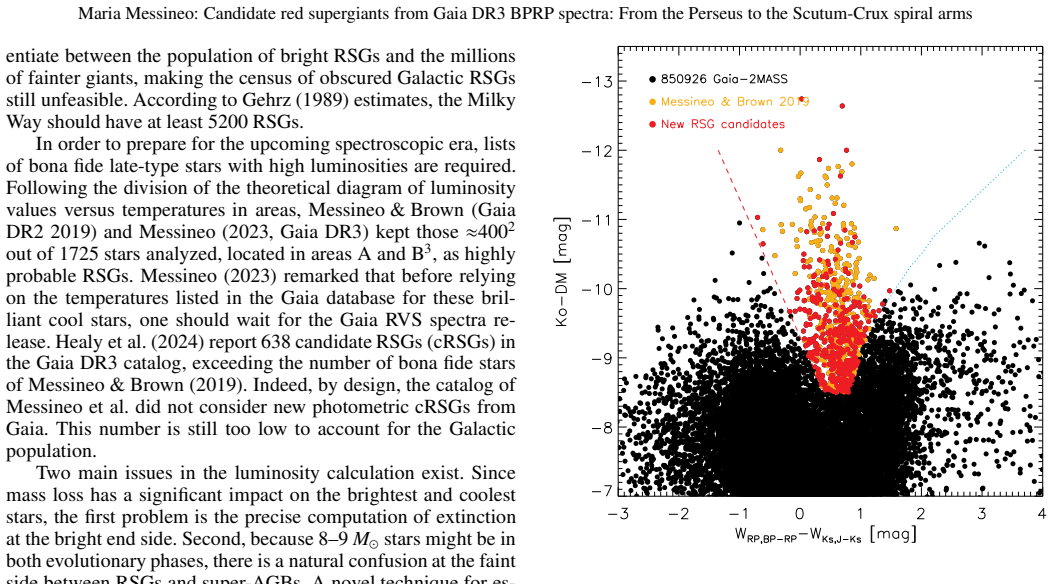
The machinery that carries the argument is a color-magnitude criterion: the absolute $K_s$ magnitude versus the extinction-free color $W_{\rm RP,BP-RP}-W_{K_s,J-K_s}$, with two boundary curves that separate RSGs from O-rich AGB stars on one side and C-rich stars on the other. For the 135 stars without published classifications, spectral types are inferred by dereddening Gaia BPRP spectra under an assumed M1 intrinsic color ($H-K_s=0.22$ mag) and a near-infrared extinction power law of index $-2.1$, then matching the result to reference spectra; temperatures are converted to luminosities through an established TiO-based temperature scale and a set of bolometric corrections. The paper also uses DUSTY radiative-transfer models of the infrared SED to estimate each candidate's circumstellar envelope optical depth at 2.2 $\mu$m, so interstellar extinction can be separated from the total.
What would settle it
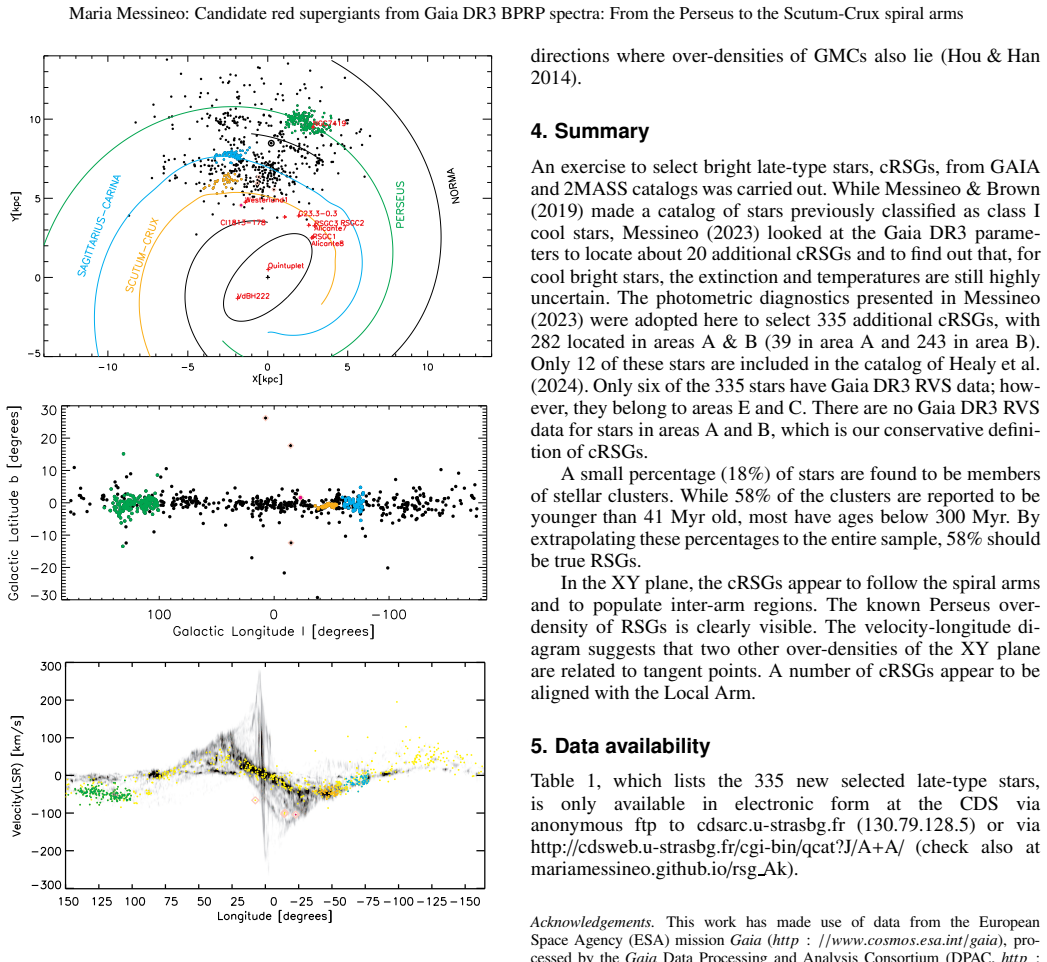
High-resolution spectroscopy of the 135 candidates classified only from BPRP spectra would settle the claim: if a substantial fraction of them show surface gravities typical of ordinary giants rather than supergiants, or radial velocities that do not follow the terminal-velocity ridge near the Scutum-Centaurus tangent at $l\approx-50^\circ$, then part of the reported 40 percent census increase and the new spiral-arm population would be AGB contamination.
Extended reading notes
Core claim
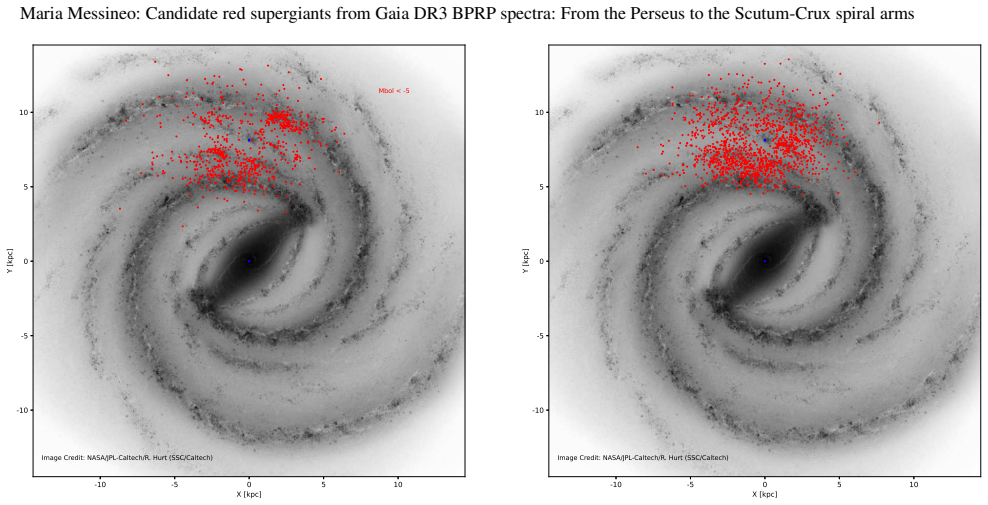
The central claim is that a clean sample of 335 O-rich K/M-type red supergiant candidates can be pulled out of the Gaia DR3 and 2MASS catalogs using extinction-free colors, parallax quality, and spectral typing from BPRP spectra. After correcting for interstellar and circumstellar extinction, 282 candidates fall in the areas of the luminosity-versus-temperature plane reserved for highly probable RSGs, and their bolometric magnitudes are mostly $M_{\rm bol}<-5$ mag. Because only 12 of the 335 stars appear in a recent independent Gaia RSG catalog, the paper concludes that the known census was substantially incomplete. On the Galactic plane, the enlarged sample shows the populous Perseus arm association, a concentration at the Sagittarius arm tangent point, and a previously unseen group of highly probable RSGs at the Scutum-Centaurus arm tangent point.
Load-bearing premise
The selection depends on assigning a fixed intrinsic $H-K_s$ color of 0.22 mag to an M1 star and on dereddening with a near-infrared extinction power law of index $-2.1$; if that zero point or extinction law is wrong, the inferred spectral types, luminosities, and the claimed spiral-arm over-densities shift enough to admit AGB stars into the sample.
Editorial extensions
If this is right
- The Gaia-based census of highly probable red supergiants grows by about 40 percent, giving upcoming spectroscopic surveys a larger target list of bona fide candidates.
- The new stars extend the RSG map deeper into the inner Galaxy, adding a population at the Scutum-Centaurus arm that previous catalogs missed.
- The overlap of only 12 stars with a recent independent RSG catalog indicates that Gaia-based photometric selection is far from saturated.
- The longitude-velocity concentrations at the Sagittarius and Scutum-Centaurus tangent points provide independent anchors for models of Galactic spiral structure.
Reading between the lines
- Because the paper's own cluster-age statistics suggest that only about 58-66 percent of cluster-associated candidates are young enough to be red supergiants, the 40 percent census increase is best read as an upper envelope pending spectroscopic confirmation.
- The same BPRP-matching pipeline could be pushed to fainter magnitudes once future Gaia releases improve parallaxes, which would likely enlarge the Scutum-Centaurus population and possibly reach the near side of the Galactic bar.
- If the fixed M1 zero-point color is revised by future interferometric or spectroscopic studies, the entire sample's spectral types and luminosities can be re-derived without reselecting the stars, so the catalog remains useful even if individual classifications change.
Editorial analysis
A structured set of objections, weighed in public.
Referee Report
Summary. Messineo presents a new sample of 335 candidate red supergiants (cRSGs) selected from Gaia DR3 and 2MASS using photometric color cuts, parallax quality, and an extinction-free Ks criterion. Literature spectral types are supplemented with BPRP-based spectral classification for 135 previously unclassified stars; extinctions are derived from infrared colors and DUSTY envelope models; luminosities are computed with three methods and Monte Carlo errors. Of the 335 stars, 282 fall in areas A and B of the Messineo & Brown luminosity-temperature diagram (39 in area A, 243 in area B). The paper claims this is a roughly 40% increase in the number of highly probable RSGs and identifies, by visual inspection, over-densities associated with the Perseus, Sagittarius, and a new Scutum-Centaurus arm population.
Significance. Strengths: the catalog is useful for planning spectroscopic follow-up and is delivered electronically; only 12 of the 335 candidates overlap with the Healy et al. (2024) catalog, so it adds substantially new candidates; the BPRP-based classification and the Monte Carlo propagation of photometric, distance, and spectral-type errors are clearly described; the comparison of total AKs with the Green et al. (2019) 3D map is a useful external check. If the high purity asserted for the sample were established, the paper would make a valuable contribution to the Galactic RSG census. However, the central claims, namely a 40% increase in highly probable RSGs and a novel Scutum-Centaurus overdensity, depend on sample purity and on a quantitative demonstration that the overdensity is not a selection artifact. These are not yet established by the analyses in Sections 2.4 and 3.
major comments (3)
- [Sections 2.4 and 4] Section 2.4 finds that 18% of the new cRSGs are cluster members and that, among these, only 58% belong to clusters younger than 41 Myr while about 40% are in older clusters likely to contain AGB contaminants. Section 4 then states that 'by extrapolating these percentages to the entire sample, 58% should be true RSGs.' This extrapolation is not justified: the cluster-member subsample is selected by cluster membership and is not representative of the field population, so the field-star AGB contamination rate may differ. The abstract's 'highly probable RSGs' and the '40% increase' claim require a direct estimate of purity for the whole 282-star sample, for example by cross-matching with AGB/Mira or variable-star catalogs, by checking SiO/OH maser emission, or by spectroscopic follow-up of a random subset. Please also state the purity of the 135 BPRP-classified subset separately, since these stars have no independent literature classification.
- [Sections 2.2.1 and 2.3] The BPRP classification of the 135 previously unclassified stars assumes an intrinsic H-Ks=0.22 mag for an M1 star and a single NIR extinction law with index -2.1, with the classification and extinction estimates iterated to convergence. Sections 2.2.1 and 2.3 state that a change of one spectral subtype changes AKs by about 0.03 mag and Mbol by about 0.07-0.09 mag, and that the inferred types are uncertain by up to two subtypes; the implied systematic shifts can reach roughly 0.16 mag in AKs and 0.2 mag in Mbol. This is large enough to move stars across the area B boundary at Mbol=-5.0 mag and to change the membership of the claimed Scutum-Centaurus overdensity. Because the de-reddening and the spectral type are derived iteratively from the same data, agreement with literature types for the known subset does not by itself validate the extinction-law zero point. Please test the robustness of the final sample and of the overdensity to alternative intrinsic colors (for example, H-Ks=0.30 for later M types) and to extinction-law indices in the range -1.9 to -2.1, and report how many stars remain in areas A and B under these variations.
- [Section 3 and Figure 11] The claimed new population in the Scutum-Centaurus arm is identified by visual inspection of the XY and l-v diagrams, with the paper noting 'Despite the small numbers, this appearance shows a remarkable resemblance...'. No significance test, completeness correction, or selection-function model is provided, and the feature is not shown to survive after removing stars likely to be AGBs. Given that the sample is selected through Gaia parallax quality, 2MASS color cuts, and model-dependent extinction corrections, an apparent overdensity could arise from distance uncertainties, extinction gradients, or Galactic selection effects. Please quantify the orange feature relative to a control field or a synthetic/foreground model, and provide the number of stars and their area A/B membership before and after plausible AGB removal.
minor comments (6)
- [Abstract] The abstract ends with the line 'Conclusions.' with no following text; either complete the conclusions or remove this placeholder.
- [Section 2.2.2] The section title 'Envelop extinction' should read 'Envelope extinction'.
- [Section 2.2] The text says spectral types were retrieved for 279 stars, but the listed numbers sum to 280 (185 M + 22 K + 20 C + 32 S + 14 F-G + 7 early-type); please correct the total or one of the individual counts.
- [Figure 4 and text] The red histogram is described in the text as stars with trimmed range mag g fov larger than 0.3 mag, while the figure caption says '< 0.5 mag'; please make the threshold and notation consistent.
- [Section 2.4] The sentence 'all but three cRSGs are younger than 300 Myr' should refer to clusters, not cRSGs, given the preceding discussion of cluster ages.
- [Abstract and Section 2.3] The phrase 'brighter than Mbol=-5 mag' is ambiguous; please use the explicit inequality Mbol < -5 mag, consistent with the area B definition.
Circularity Check
No significant circularity: the new RSG-candidate sample is grounded in external photometry, parallaxes and literature spectral types; the self-citations are methodological calibration, not load-bearing derivations.
full rationale
The paper's central claim is a catalog of 335 bright late-type stars selected from Gaia DR3 and 2MASS, with luminosities obtained from Bailer-Jones distances and three independent bolometric estimates (BC_Ks, trapezoidal SED integration, DUSTY models) that agree to within 0.23 mag. The selection cone, extinction-free color, and NIR extinction law are adopted from the author's prior work (Messineo & Brown 2019; Messineo 2023, 2024), and the envelope-correction factor in Sect. 2.2.2 is fitted so that AKs(int)=AKs(tot)-0.3*tau2.2 agrees with AKs(Bay19) and AKs(Mes24). These are calibration inputs, not predictions, and the resulting correction is small (<=0.27 mag), so they do not force the central sample claims. The BPRP spectral classifications for 135 stars are anchored to reference spectra and validated against 279 stars with literature types. The nearest thing to an internal circularity concern is quantitative, not definitional: Sect. 2.4 reports that only 58% of cluster-associated cRSGs have cluster ages younger than 41 Myr and then extrapolates this to the full sample, which weakens the 'highly probable RSG' label and the '40% increase' wording; the Scutum-Centaurus overdensity is also identified visually without a significance test. These are correctness/purity caveats, not cases where a derived quantity is equal to its input by construction.
Assumptions & free parameters
free parameters (4)
- envelope_extinction_factor =
0.3
- extinction_law_index =
-2.1
- intrinsic_H-Ks_M1 =
0.22 mag
- selection_cone_boundaries
assumptions (5)
- domain assumption Spectral types inferred from BPRP spectra are accurate to within two spectral subtypes
- domain assumption Interstellar extinction can be approximated by total extinction for the majority of the sample
- domain assumption Gaia DR3 parallactic distances from Bailer-Jones et al. (2021) are reliable for these bright, red stars
- domain assumption The definitions of areas A and B (AGB limit at Mbol=-7.1) correctly separate RSGs from AGBs
- domain assumption The Cordes & Lazio (2002) spiral arm model is adequate for interpreting the XY distribution
Cite this review
Pith. "Pith review of Candidate red supergiants from Gaia DR3 BPRP spectra: From the Perseus to the Scutum-Crux spiral arms." pith.science (2026). https://pith.science/paper/IMME3VC7
@misc{pith2026250607097,
  author       = {Pith},
  title        = {Pith review of: Candidate red supergiants from Gaia DR3 BPRP spectra: From the Perseus to the Scutum-Crux spiral arms},
  year         = {2026},
  howpublished = {\url{https://pith.science/paper/IMME3VC7}},
  note         = {Machine review of arXiv:2506.07097}
}
read the original abstract
Context. Our position within the Galactic plane and the dust obscuration make it challenging to retrieve a true picture of the Milky Way's morphology. While the Milky Way has been recognized as a barred spiral galaxy since the 1960s, there is still uncertainty about the exact number of spiral arms it contains. Currently, our understanding of the Galaxy is evolving thanks to the unprecedented detail provided by Gaia's parallactic distances. Aims. To shed light on the spatial distribution of red supergiants (RSGs) on the Disk and their uniformity of parameters across it, a census of Galactic RSGs detected by Gaia is needed. Methods. Candidate RSGs were extracted from the combined Gaia DR3 and 2MASS catalogs using color criteria and parallactic distances. The sample includes 335 stars that were not included in catalogs of previously known RSGs detected by Gaia DR3. Interstellar and circumstellar extinction values were estimated from the infrared bands. Spectral types were collected from Simbad or VIZIER databases and, for 135 candidates, were inferred from the Gaia DR3 BPRP spectra. Stellar luminosities were inferred using photometric measurements and the Gaia DR3 distances. Results. The analysis yielded a genuine sample of O-rich late-type stars, and the calculated luminosities confirm that the sample is mostly made of stars brighter than Mbol=-5 mag. This new sample represents a 40% increase in the number of highly probable RSGs compared to previous studies. When looking at the X and Y distribution on the Galactic plane, beside the populous Perseus associations of RSGs and the Sagittarius group of RSGs, a novel population of highly probable RSGs populating the more distant Scutum-Centaurus arm appears.
Figures


Figures from the paper (7 more)


Reference graph
Works this paper leans on
-
[1]
Abia, C., de Laverny, P ., Romero-G´ omez, M., & Figueras, F. 2022, A&A, 664, A45
work page 2022
-
[2]
2011, in Astronomical Society of the Pacific Conference Series, V ol
Allard, F., Homeier, D., & Freytag, B. 2011, in Astronomical Society of the Pacific Conference Series, V ol. 448, 16th Cambridge Worksho p on Cool
work page 2011
-
[3]
Bailer-Jones, C. A. L., Rybizki, J., Fouesneau, M., Demleit ner, M., & Andrae, R. 2021, AJ, 161, 147
work page 2021
-
[4]
Bayo, A., Rodrigo, C., Barrado Y Navascu´ es, D., et al. 2008, A&A, 492, 277
work page 2008
-
[5]
Bessell, M. S. & Brett, J. M. 1988, PASP , 100, 1134
work page 1988
-
[6]
& Anders, F
Cantat-Gaudin, T. & Anders, F. 2020, A&A, 633, A99
2020
-
[7]
Cantat-Gaudin, T., Jordi, C., V allenari, A., et al. 2018, A&A, 618, A93
work page 2018
-
[8]
A., Clayton, G
Cardelli, J. A., Clayton, G. C., & Mathis, J. S. 1989, ApJ, 345 , 245
1989
Show all 69 references
-
[9]
Caron, G., Mo ffat, A. F. J., St-Louis, N., Wade, G. A., & Lester, J. B. 2003, AJ , 126, 1415
2003
-
[10]
2022, A&A, 661 , A118
Castro-Ginard, A., Jordi, C., Luri, X., et al. 2022, A&A, 661 , A118
2022
-
[11]
2023, ApJS, 266, 36
Chi, H., Wang, F., Wang, W., Deng, H., & Li, Z. 2023, ApJS, 266, 36
2023
-
[12]
2024, AJ, 167, 23 0
Chun, S.-H., Myeong, G., Lee, J.-J., & Oh, H. 2024, AJ, 167, 23 0
2024
-
[13]
L., Meade, M
Churchwell, E., Babler, B. L., Meade, M. R., et al. 2009, PASP , 121, 213
2009
-
[14]
S., Negueruela, I., Crowther, P
Clark, J. S., Negueruela, I., Crowther, P . A., & Goodwin, S. P. 2005, A&A, 434, 949
2005
-
[15]
Cordes, J. M. & Lazio, T. J. W. 2002, arXiv:astro-ph /0207156
2002
-
[16]
M., Skrutskie, M
Cutri, R. M., Skrutskie, M. F., van Dyk, S., et al. 2003, 2MASS All Sky Catalog of point sources
2003
-
[17]
M., Hartmann, D., & Thaddeus, P
Dame, T. M., Hartmann, D., & Thaddeus, P . 2001, ApJ, 547, 792
2001
-
[18]
F., Kudritzki, R.-P ., et al
Davies, B., Figer, D. F., Kudritzki, R.-P ., et al. 2007, ApJ, 671, 781
2007
-
[19]
2013, ApJ, 767 , 3 de Jong, R
Davies, B., Kudritzki, R.-P ., Plez, B., et al. 2013, ApJ, 767 , 3 de Jong, R. S., Bellido-Tirado, O., Chiappini, C., et al. 2012, in Society of Photo- Optical Instrumentation Engineers (SPIE) Conference Seri es, V ol. 8446, Ground-based and Airborne Instrumentation for Astron...
2013
-
[20]
S., Monteiro, H., & Assafin, M
Dias, W. S., Monteiro, H., & Assafin, M. 2018, MNRAS, 478, 5184
2018
-
[21]
& Levesque, E
Dicenzo, B. & Levesque, E. M. 2019, AJ, 157, 167
2019
-
[22]
P ., Price, S
Egan, M. P ., Price, S. D., Kraemer, K. E., et al. 2003, VizieR O nline Data Catalog, 5114 Ekstr¨ om, S., Georgy, C., Eggenberger, P ., et al. 2012, A&A,537, A146
2003
-
[23]
& Gerhard, O
Englmaier, P . & Gerhard, O. 1999, MNRAS, 304, 512
1999
-
[24]
F., MacKenty, J
Figer, D. F., MacKenty, J. W., Robberto, M., et al. 2006, ApJ, 643, 1166 Gaia Collaboration, V allenari, A., Brown, A. G. A., et al. 20 23, A&A, 674, A1
2006
-
[25]
Z., Davies, B., Kudritzki, R., Bergemann, M., & Ple z, B
Gazak, J. Z., Davies, B., Kudritzki, R., Bergemann, M., & Ple z, B. 2014, ApJ, 788, 58
2014
-
[26]
1989, in IAU Symposium, V ol
Gehrz, R. 1989, in IAU Symposium, V ol. 135, Interstellar Dus t, ed. L. J. Allamandola & A. G. G. M. Tielens, 445
1989
-
[27]
Y ., Pitts, P
Gezari, D. Y ., Pitts, P . S., Schmitz, M., & Mead, J. M. 1996, VizieR Online Data Catalog, 2209
1996
-
[28]
M., Schlafly, E., Zucker, C., Speagle, J
Green, G. M., Schlafly, E., Zucker, C., Speagle, J. S., & Finkb einer, D. 2019, ApJ, 887, 93
2019
-
[29]
Gutermuth, R. A. & Heyer, M. 2015, AJ, 149, 64
2015
-
[30]
J., Sevenster, M
Habing, H. J., Sevenster, M. N., Messineo, M., van de V en, G., & Kuijken, K. 2006, A&A, 458, 151
2006
-
[31]
J., Xu, Y ., Wu, Z
Hao, C. J., Xu, Y ., Wu, Z. Y ., et al. 2022, A&A, 660, A4
2022
-
[32]
2024, MNRA S, 529, 3630
Healy, S., Horiuchi, S., Colomer Molla, M., et al. 2024, MNRA S, 529, 3630
2024
-
[33]
Hou, L. G. & Han, J. L. 2014, A&A, 569, A125
2014
-
[34]
Howarth, I. D. 2011, MNRAS, 413, 1515
2011
-
[35]
Hunt, E. L. & Re ffert, S. 2024, A&A, 686, A42
2024
-
[36]
1999, arXiv:astro-ph /9910475
Ivezic, Z., Nenkova, M., & Elitzur, M. 1999, arXiv:astro-ph /9910475
1999
-
[37]
2023, A&A, 674 , A5
Katz, D., Sartoretti, P ., Guerrier, A., et al. 2023, A&A, 674 , A5
2023
-
[38]
1983, A&A, 128, 84
Koornneef, J. 1983, A&A, 128, 84
1983
-
[39]
Levesque, E. M. 2018, ApJ, 867, 155
2018
-
[40]
M., Massey, P ., Olsen, K
Levesque, E. M., Massey, P ., Olsen, K. A. G., et al. 2005, ApJ, 628, 973
2005
-
[41]
2017, in Handbook of Supernovae, ed
Limongi, M. 2017, in Handbook of Supernovae, ed. A. W. Alsabt i & P . Murdin, 513 Ma´ ız Apell´ aniz, J., Pantaleoni Gonz´ alez, M., & Barb´ a, R. H. 2021, A&A, 649, A13
2017
-
[42]
E., Prsa, A., Torres, G., et al
Mamajek, E. E., Prsa, A., Torres, G., et al. 2015, arXiv e-pri nts, arXiv:1510.07674
2015 arXiv
-
[43]
2004, PhD thesis, University of Leiden, Nether lands
Messineo, M. 2004, PhD thesis, University of Leiden, Nether lands
2004
-
[44]
2023, A&A, 671, A148
Messineo, M. 2023, A&A, 671, A148
2023
-
[45]
2024, A&A, 686, A222
Messineo, M. 2024, A&A, 686, A222
2024
-
[46]
& Brown, A
Messineo, M. & Brown, A. G. A. 2019, AJ, 158, 20
2019
-
[47]
& Brown, A
Messineo, M. & Brown, A. G. A. 2021, zenodo
2021
-
[48]
F., et al
Messineo, M., Davies, B., Figer, D. F., et al. 2011, ApJ, 733, 41
2011
-
[49]
F., Kudritzki, R.-P ., et al
Messineo, M., Figer, D. F., Kudritzki, R.-P ., et al. 2021, AJ , 162, 187
2021
-
[50]
J., Menten, K
Messineo, M., Habing, H. J., Menten, K. M., et al. 2005, A&A, 4 35, 575
2005
-
[51]
J., Sjouwerman, L
Messineo, M., Habing, H. J., Sjouwerman, L. O., Omont, A., & M enten, K. M. 2018, A&A, 619, A35
2018
-
[52]
M., et al
Messineo, M., Zhu, Q., Menten, K. M., et al. 2017, ApJ, 836, 65
2017
-
[53]
& Maeder, A
Meynet, G. & Maeder, A. 2000, A&A, 361, 101
2000
-
[54]
Ocker, S. K. & Cordes, J. M. 2024, Research Notes of the Americ an Astronomical Society, 8, 17
2024
-
[55]
B., De Biasi, M
Orellana, R. B., De Biasi, M. S., & Pa´ ız, L. G. 2021, MNRAS, 50 2, 6080
2021
-
[56]
I., Pera, M
Perren, G. I., Pera, M. S., Navone, H. D., & V´ azquez, R. A. 2023, MNRAS, 526, 4107
2023
-
[57]
2023, ApJS, 265, 12
Qin, S., Zhong, J., Tang, T., & Chen, L. 2023, ApJS, 265, 12
2023
-
[58]
J., Menten, K
Reid, M. J., Menten, K. M., Brunthaler, A., et al. 2019, ApJ, 8 85, 131
2019
-
[59]
S., Alfaro, E
Sampedro, L., Dias, W. S., Alfaro, E. J., Monteiro, H., & Moli no, A. 2017, MNRAS, 470, 3937
2017
-
[60]
R., Bland-Hawthorn, J., et al
Sharma, S., Hayden, M. R., Bland-Hawthorn, J., et al. 2022, M NRAS, 510, 734 Skiff, B. A. 2014, VizieR Online Data Catalog, 1
2022
-
[61]
F., Cutri, R
Skrutskie, M. F., Cutri, R. M., Stiening, R., et al. 2006, AJ, 131, 1163
2006
-
[62]
& Tombleson, R
Smith, N. & Tombleson, R. 2015, MNRAS, 447, 598
2015
-
[63]
1999, MNRAS, 304, 389
Suh, K.-W. 1999, MNRAS, 304, 389
1999
-
[64]
M., Dorda, R., Negueruela, I., & Gonz´ alez-Fe rn´ andez, C
Tabernero, H. M., Dorda, R., Negueruela, I., & Gonz´ alez-Fe rn´ andez, C. 2018, MNRAS, 476, 3106
2018
-
[65]
2021, MNRAS, 5 02, 4210
Taniguchi, D., Matsunaga, N., Jian, M., et al. 2021, MNRAS, 5 02, 4210
2021
-
[66]
2025, A& A, 693, A163
Taniguchi, D., Matsunaga, N., Kobayashi, N., et al. 2025, A& A, 693, A163
2025
-
[67]
2022, A&A, 659, A59
Tarricq, Y ., Soubiran, C., Casamiquela, L., et al. 2022, A&A, 659, A59
2022
-
[68]
2022, A&A, 659 , A95 van Groeningen, M
Tsantaki, M., Pancino, E., Marrese, P ., et al. 2022, A&A, 659 , A95 van Groeningen, M. G. J., Castro-Ginard, A., Brown, A. G. A., Casamiquela, L., & Jordi, C. 2023, A&A, 675, A68
2022
-
[69]
2024, ApJ, 976, 139 11
Xia, T.-Y ., Shen, J., Li, Z., et al. 2024, ApJ, 976, 139 11
2024
Reviewed August 7, 2026 · model on record in the stance chip above.
Discussion (0). Sign in to comment.