REVIEW 3 major objections 4 minor 47 references
Rectangular Duals on the Cylinder and the Torus
T0 review · 3 major / 4 minor · reviewed 2026-08-07 · deepseek-v4-flash
Pith's one-line read This paper proves that a cylindrical graph has a cylindrical rectangular dual exactly when it is properly triangulated cylindrical, and that a supplied toroidal regular edge labeling is either unrealizable, orbital, or slanted, each…
desk verdict A clean and substantial step on rectangular duals for cylinder and torus, with one load-bearing verification gap in the cylindrical characterization that needs to be filled before the paper is fully trustworthy. read the letter →
The pith
A machine-rendered reading of the paper's core claim, the machinery that carries it, and where it could break.
The reading
What carries the argument
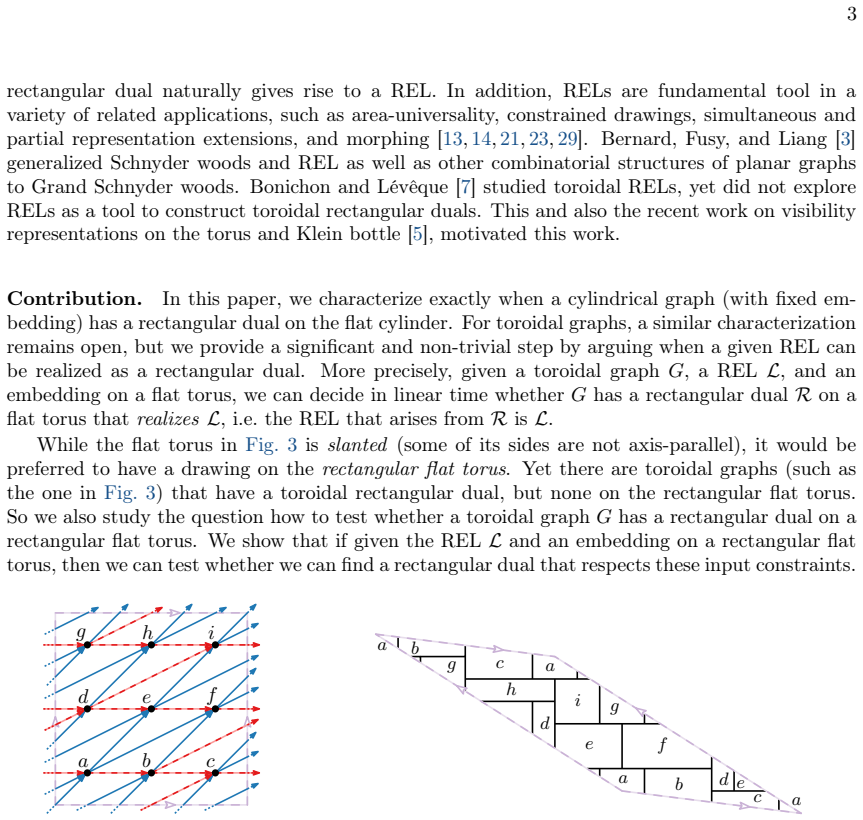
The engine is the regular edge labeling (REL): a two-coloring and orientation of edges recording whether two rectangles touch by horizontal or vertical sides, satisfying at each vertex the cyclic pattern blue-in, red-in, blue-out, red-out. The paper defines properly triangulated cylindrical and toroidal graphs (PTC and PTT) as the exact conditions under which such labelings can exist, translating non-contractibility of loops, parallel edges, and separating triangles into combinatorial constraints. For the torus the deciding tool is a pair of left-first and right-first directed cycles in each color class; Proposition 4 equates an orbital REL with both cycles being orbit-advancing and orbit-enclosing relative to the meridian and horizon. Once the REL is orbital, a feedback closed walk—a weakly simple non-contractible walk crossing every cycle of the dual—is found and used to split the color graph into a cylindrical graph whose dual is acyclic, so that rectangle coordinates come from longest paths in the same way as in the planar algorithm. Slanted RELs are handled by cutting the covering plane into patches and assembling the patch duals into a parallelogram bounded by curves parallel to the meridian and horizon.
What would settle it
Enumerate all small internally triangulated cylindrical graphs and check whether any graph satisfying the PTC conditions nevertheless has no cylindrical rectangular dual; the most likely place to look is the two-leg case of Lemma 4, where the proof relies on an unverified adaptation of the planar removable-set construction.
Extended reading notes
Core claim
On the cylinder, the central claim is that a fixed cylindrical embedding has a rectangular dual on a rectangular flat cylinder if and only if the graph is PTC. The proof constructs the dual in linear time by first building a cylindrical regular edge labeling whose blue graph is acyclic, then extending that labeling to an orbital toroidal REL on a properly triangulated toroidal supergraph, running the toroidal rectangular-dual algorithm, and deleting the added vertices. On the torus, the central claim is the trichotomy of Theorem 5: a supplied toroidal REL is unrealizable when some edge lies on no monochromatic cycle, orbital when every edge lies on a cycle parallel to the corresponding orbit, and slanted when it is realizable but not orbital; this is decided in linear time from left-first and right-first cycles and their algebraic crossing numbers with the meridian and horizon. An orbital REL yields a rectangular dual on a rectangular flat torus in linear time, while a slanted REL yields one on a slanted flat torus in quadratic time. The paper further establishes that realizability is exactly what a toroidal rectangular dual realizing the given REL requires.
Load-bearing premise
The whole cylindrical construction leans on an unproved verification: in the two-leg case of Lemma 4, the removable set found by the planar ordering lemma is claimed to work unchanged for cylindrical graphs with only 'as one easily verifies,' and if that check fails for some graph, the induction that builds the cylindrical edge labeling no longer goes through.
Editorial extensions
If this is right
- As a direct corollary of the cylindrical characterization, a graph can be filtered in linear time: if the PTC conditions hold, a cylindrical rectangular dual on a rectangular flat cylinder is produced; if they fail, none exists.
- For toroidal graphs with a supplied REL and embedding, no search or backtracking is needed: the left-first and right-first cycle test decides in linear time whether a rectangular or slanted flat torus suffices or whether no dual realizes the given REL.
- Because non-contractible separating triangles, parallel edges, and loops are permitted, cylindrical and toroidal rectangular duals exist for a strictly larger class of graphs than planar rectangular duals.
- The proofs are constructive: linear time for cylindrical and orbital-toroidal inputs, quadratic time for slanted-toroidal inputs, with the rectangular dual itself output, not merely a yes-or-no answer.
- The slanted-versus-orbital distinction gives a precise sense in which allowing the flat torus to be slanted is a genuine extra degree of freedom, and the paper's example shows some graphs need it.
Reading between the lines
- The cylinder proof suggests a template the paper does not pursue: the same minimal obstruction set of non-contractible separating triangles, loops, and parallel edges might characterize rectangular duals on other non-planar surfaces such as the projective plane or the Klein bottle.
- The paper leaves open whether every properly triangulated toroidal graph has a realizable REL; because realizability is decidable in linear time, a computational search over small toroidal triangulations with their balanced 4-orientations could quickly test this conjecture.
- For applications that require grid-aligned periodic layouts, the orbital/slanted distinction implies a concrete design choice: either accept slanted fundamental polygons or restrict the input class, and one could quantify the area blow-up when forcing a slanted dual onto a rectangular flat torus.
Editorial analysis
A structured set of objections, weighed in public.
Referee Report
Summary. The paper generalizes planar rectangular duals to two surfaces. For cylindrical graphs it defines properly triangulated cylindrical (PTC) graphs and claims, via Lemma 6 and Theorem 8, that a cylindrical graph admits a cylindrical rectangular dual if and only if it is PTC. For toroidal graphs, it assumes a supplied regular edge labeling (REL) and a fixed embedding on a flat torus, then gives a linear-time trichotomy (Theorem 5) into unrealizable, orbital, and slanted RELs. It constructs rectangular duals on the rectangular flat torus for orbital RELs (Theorem 6) and on a slanted flat torus for slanted RELs (Theorem 7), with quadratic running time in the latter case. The cylindrical result is obtained by first constructing a cylindrical REL (Lemma 5, based on Lemma 4) and then reducing to the toroidal construction of Theorem 6.
Significance. If the proof gaps are closed, this is a substantial contribution: it provides the first complete characterization of cylindrical rectangular duals and the first systematic treatment of toroidal rectangular duals, including the subtle distinction between orbital and slanted flat tori. The main strengths are the crisp PTC characterization, the linear-time recognition of REL types via left-first/right-first cycles, and the explicit constructive algorithms that adapt He's planar algorithm to surfaces. The paper is also honest about the open problem of toroidal graphs without a given REL. However, two load-bearing proof steps are currently asserted rather than fully demonstrated, so the results cannot yet be considered fully established.
major comments (3)
- [Section 4.1, Lemma 4, Case 3] The transfer of Biedl and Derka [6, Lemma 1] to the PTC setting is asserted with 'one easily verifies' and a footnote claiming the proof 'goes through verbatim' as long as all separating triangles contain the pre-specified edge. This is load-bearing because Lemma 5's induction and therefore Theorem 8's sufficiency direction require that G\V' is again PTC. The verification is not a formality: H+ may have separating triangles containing {ci,cj}, while G itself may have loops, parallel edges, and non-contractible separating triangles. To conclude that G\V' is PTC one must check at least that the new outer face f'_t has no chord and no non-consecutive repeated vertex (where f'_t may traverse vertices on the other arc of f_t and possibly the 2-leg center x), that all loops, parallel edges, and separating triangles of G\V' remain non-contractible, and that the degree condition holds at every vertex incident to a parallel edge whose neighbor has a loop after the deletion changes which vertices lie on f'_t. None of these checks appear in the manuscript. Please provide a full proof of the transfer or state the additional hypotheses on G under which the Biedl--Derka proof indeed goes through.
- [Section 3.2, proof of Theorem 7] The final step of the slanted construction replaces the 'bizarrely shaped polygon' Q' by the parallelogram spanned by the four corner points p1,p2,p3,p4 and asserts that Q∩\tilde{R} is the desired toroidal rectangular dual. This step is not justified: the text does not prove that the parallelogram is a fundamental parallelogram of the same flat torus, that it contains exactly one copy of each vertex-rectangle, that its boundary curves are parallel to M and H, or that the no-four-rectangles-share-a-point condition and the full-coverage condition are preserved under this replacement. The runtime analysis also relies on unstated structural bounds, e.g., that each side of Q intersects only O(n) tiles and that each patch is translated only O(n) times in a way compatible with the final O(n|V(G)|) bound. A rigorous proof of the parallelogram step is essential because the entire slanted-torus existence claim rests on it.
- [Section 4.2, Theorem 8] The reduction from cylindrical to toroidal RELs is compressed into two 'one verifies' claims: that the extended graph \hat{G} is PTT and that the assigned colors and directions complete L to a toroidal REL \hat{L}. More importantly, the argument that \hat{L} is 1-orbital for a suitable choice of meridian M uses Lemma 1 to produce a blue cycle and then declares that cycle to be M, but it is not shown that this choice is compatible with the original embedding of G on the cylinder, nor that after deleting R(v_t) and R(v_s) the resulting flat-cylinder representation has the two outer faces bounded by horizontal segments as required by the definition of a cylindrical rectangular dual. Please expand this verification or state precisely which properties of the reduction are being assumed.
minor comments (4)
- [Section 2.1, page 4] Typo: 'Eucledian' should be 'Euclidean'.
- [Section 2.2, PTC definition vs. Section 4 restatement] The degree-condition for PTC graphs is stated slightly differently in Section 2.2 (bulleted list) and in the restatement at the start of Section 4. In particular, the Section 4 version adds 'deg(u)=5 and at least one neighbour of u is not incident to a loop' as a separate case, which is not phrased in the Section 2.2 bullets. Please reconcile the two formulations so the condition is unambiguous.
- [Section 3.1, Figure 10 caption] The phrase 'not1-orbit-advancing' in the caption should read 'not 1-orbit-advancing'.
- [Abstract] The abstract states that for toroidal graphs 'we can test whether the graph has a toroidal rectangular dual if we are additionally given a regular edge labeling' and then states a second test about rectangular flat tori; the second test also requires a supplied REL and a fixed embedding, which is only clarified later in the introduction. Please make the premises in the abstract explicit.
Circularity Check
No circularity: the paper's cylindrical and toroidal characterizations are proved from external published tools and geometric arguments, not from restating their inputs.
full rationale
I walked the derivation chain and found no step in which a claimed prediction or characterization reduces by construction to its own inputs. The cylindrical characterization (PTC graphs admit cylindrical rectangular duals) is proved in two directions: Lemma 6 gives a geometric necessity argument from rectangular duals to the PTC properties, and Lemma 5 plus Theorem 8 gives sufficiency by constructing a cylindrical REL and then reducing to the toroidal construction. Neither direction fits a parameter to the data it claims to predict. The toroidal trichotomy (Theorem 5) is stated for a given REL and embedding; it is a decision procedure whose correctness is argued through Proposition 4, Observation 3, and Lemma 1, none of which presuppose the answer. The construction theorems (Theorems 6 and 7) adapt He's published REL-based algorithm and are not renaming a known empirical pattern. The only self-citation is to Biedl and Derka's (3,1)-canonical ordering, used in Lemma 4 as a prior published lemma; the paper explicitly says it cannot use that work as a black box and re-does and expands the argument. This is real external support, not a self-citation chain that forces the conclusion. The skeptical concern about the 'one easily verifies' transfer in Lemma 4, Case 3, is a potential proof gap or correctness risk, not circularity: no equation or definition in the paper is equivalent to the target result by construction, and no fitted or renamed quantity pre-encodes the answer. Hence the honest finding is no significant circularity.
Assumptions & free parameters
assumptions (4)
- standard math The fundamental group of the flat torus is generated by the meridian and horizon, and the algebraic crossing number of two curves is computed from their homotopy classes as m(C)h(C') - h(C)m(C').
- standard math Biedl and Derka's Lemma 1 provides a (3,1)-canonical-style vertex removal set for 4-connected planar triangulations, and Lemma 4 of this paper extends it to PTC graphs.
- domain assumption The input toroidal graph comes with a fixed embedding on the flat torus and, for the torus results, a given regular edge labeling L that satisfies the REL property.
- domain assumption A rectangular dual is defined with axis-aligned rectangles and the no-four-rectangles-share-a-point condition, and on the cylinder or torus the union fills a strip or the entire flat torus.
Cite this review
Pith. "Pith review of Rectangular Duals on the Cylinder and the Torus." pith.science (2026). https://pith.science/paper/YXPKJ7Q6
@misc{pith2026250607170,
  author       = {Pith},
  title        = {Pith review of: Rectangular Duals on the Cylinder and the Torus},
  year         = {2026},
  howpublished = {\url{https://pith.science/paper/YXPKJ7Q6}},
  note         = {Machine review of arXiv:2506.07170}
}
abstract
A rectangular dual of a plane graph $G$ is a contact representation of $G$ by interior-disjoint rectangles such that (i) no four rectangles share a point, and (ii) the union of all rectangles is a rectangle. In this paper, we study rectangular duals of graphs that are embedded in surfaces other than the plane. In particular, we fully characterize when a graph embedded on a cylinder admits a cylindrical rectangular dual. For graphs embedded on the flat torus, we can test whether the graph has a toroidal rectangular dual if we are additionally given a \textit{regular edge labeling}, i.e. a combinatorial description of rectangle adjacencies. Furthermore we can test whether there exists a toroidal rectangular dual that respects the embedding and that resides on a flat torus for which the sides are axis-aligned. Testing and constructing the rectangular dual, if applicable, can be done efficiently.
Figures


Figures from the paper (20 more)


Reference graph
Works this paper leans on
-
[1]
Kobourov, Sergey Pupyrev, André Schulz, and Torsten Ueckerdt
Jawaherul Alam, David Eppstein, Michael Kaufmann, Stephen G. Kobourov, Sergey Pupyrev, André Schulz, and Torsten Ueckerdt. Contact graphs of circular arcs. In Frank Dehne, Jörg-Rüdiger Sack, and Ulrike Stege, editors,WADS’15, volume 9214 ofLNCS, pages 1–13. Springer, 2015.doi:10.1007/978-3-319-21840-3_1
-
[2]
Beyondlevelplanarity: Cyclic, torus, andsimultaneouslevelplanarity
Patrizio Angelini, Giordano Da Lozzo, Giuseppe Di Battista, Fabrizio Frati, Maurizio Patrig- nani, andIgnazRutter. Beyondlevelplanarity: Cyclic, torus, andsimultaneouslevelplanarity. Theoretical Computer Science, 804:161–170, 2020.doi:10.1016/j.tcs.2019.11.024
-
[3]
Grand-schnyder woods.Annals of Combina- torics, 2024.doi:10.1007/s00026-024-00729-8
Olivier Bernardi, Éric Fusy, and Shizhe Liang. Grand-schnyder woods.Annals of Combina- torics, 2024.doi:10.1007/s00026-024-00729-8
-
[4]
Jayaram Bhasker and Sartaj Sahni. A linear time algorithm to check for the existence of a rectangular dual of a planar triangulated graph.Networks, 17(3):307–317, 1987.doi: 10.1002/net.3230170306
-
[5]
Visibility representations of toroidal and Klein-bottle graphs
Therese Biedl. Visibility representations of toroidal and Klein-bottle graphs. In Patrizio Angelini and Reinhard von Hanxleden, editors,Graph Drawing and Network Visualization (GD), volume 13764, pages 404–417. Springer, 2022.doi:10.1007/978-3-031-22203-0_29
-
[6]
The (3,1)-ordering for 4-connected planar triangulations
Therese Biedl and Martin Derka. The (3,1)-ordering for 4-connected planar triangulations. Journal of Graph Algorithms and Applications, 20(2):347–362, 2016.doi:10.7155/jgaa. 00396
doi:10.7155/jgaa 2016
-
[7]
Nicolas Bonichon and Benjamin Lévêque. A bijection for essentially 4-connected toroidal triangulations.Electronic Journal of Combinatorics, 26(1):1, 2019.doi:10.37236/7897
-
[8]
Adam L. Buchsbaum, Emden R. Gansner, Cecilia Magdalena Procopiuc, and Suresh Venkata- subramanian. Rectangular layouts and contact graphs.ACM Transactions on Algorithms, 4(1):8:1–8:28, 2008.doi:10.1145/1328911.1328919. 32 T. Biedl, P. Kindermann, and J. KlawitterRectangular Duals on the Cylinder and the Torus
Show all 47 references
-
[9]
Canonical ordering for triangulations on the cylinder, with applications to periodic straight-line drawings
Luca Castelli Aleardi, Olivier Devillers, and Éric Fusy. Canonical ordering for triangulations on the cylinder, with applications to periodic straight-line drawings. In Walter Didimo and Maurizio Patrignani, editors,Graph Drawing (GD’12), volume 7704 ofLNCS, pages 376–387. Spr...
2013 doi
-
[10]
Drawinggraphs in the plane with a prescribed outer face and polynomial area
ErinWChambers, DavidEppstein, MichaelTGoodrich, andMaartenLöffler. Drawinggraphs in the plane with a prescribed outer face and polynomial area. InGraph Drawing (GD’10), volume 6502 ofLNCS, pages 129–140. Springer, 2011.doi:10.1007/978-3-642-18469-7_12
2011 doi
-
[11]
How to morph graphs on thetorus
Erin Wolf Chambers, Jeff Erickson, Patrick Lin, and Salman Parsa. How to morph graphs on thetorus. InDánielMarx, editor,ACM-SIAM Symposium on Discrete Algorithms (SODA’21), pages 2759–2778. SIAM, 2021.doi:10.1137/1.9781611976465.164
2021 doi
-
[12]
Detecting weakly simple polygons
Hsien-Chih Chang, Jeff Erickson, and Chao Xu. Detecting weakly simple polygons. In Piotr Indyk, editor,ACM-SIAM Symposium on Discrete Algorithms (SODA’15), pages 1655–1670. SIAM, 2015.doi:10.1137/1.9781611973730.110
2015 doi
-
[13]
Simple algorithms for partial and simultaneous rectangular duals with given contact orientations.Theoretical Computer Science, 919:66–74, 2022.doi:10.1016/j.tcs
Steven Chaplick, Stefan Felsner, Philipp Kindermann, Jonathan Klawitter, Ignaz Rutter, and Alexander Wolff. Simple algorithms for partial and simultaneous rectangular duals with given contact orientations.Theoretical Computer Science, 919:66–74, 2022.doi:10.1016/j.tcs. 2022.03.031
2022 doi
-
[14]
Morphing rectangular duals
Steven Chaplick, Philipp Kindermann, Jonathan Klawitter, Ignaz Rutter, and Alexander Wolff. Morphing rectangular duals. In Patrizio Angelini and Reinhard von Hanxleden, editors, Graph Drawing and Network Visualization (GD’22), volume 13764 ofLNCS, pages 389–403. Springer, 2022...
2022 doi
-
[15]
DoughNets: visualising networks using torus wrapping
Kun-Ting Chen, Tim Dwyer, Kim Marriott, and Benjamin Bach. DoughNets: visualising networks using torus wrapping. In Regina Bernhaupt, Florian ‘Floyd’ Mueller, David Verweij, Josh Andres, Joanna McGrenere, Andy Cockburn, Ignacio Avellino, Alix Goguey, Pernille Bjøn, Shengdong Z...
2020
-
[16]
Devanny, David Eppstein, and Timothy Johnson
Giordano Da Lozzo, William E. Devanny, David Eppstein, and Timothy Johnson. Square- contact representations of partial 2-trees and triconnected simply-nested graphs. In Yoshio Okamoto and Takeshi Tokuyama, editors,International Symposium on Algorithms and Com- putation (ISAAC’...
2017 doi
-
[17]
On triangle con- tact graphs.Combinatorics, Probability and Computing, 3(2):233–246, 1994.doi:10.1017/ S0963548300001139
Hubert de Fraysseix, Patrice Ossona de Mendez, and Pierre Rosenstiehl. On triangle con- tact graphs.Combinatorics, Probability and Computing, 3(2):233–246, 1994.doi:10.1017/ S0963548300001139
1994
-
[18]
A. Dean. A layout algorithm for bar-visibility graphs on the Möbius band. In Joe Marks, editor,Graph Drawing (GD’00), volume 1984 ofLNCS, pages 350–359. Springer, 2000.doi: 10.1007/3-540-44541-2_33
1984 doi
-
[19]
Duncan, Michael T
Christian A. Duncan, Michael T. Goodrich, and Stephen G. Kobourov. Planar drawings of higher-genus graphs.Journal of Graph Algorithms and Applications, 15(1):7–32, 2011. doi:10.7155/jgaa.00215. 33
2011 doi
-
[20]
Triangle-free penny graphs: Degeneracy, choosability, and edge count
David Eppstein. Triangle-free penny graphs: Degeneracy, choosability, and edge count. In Fabrizio Frati and Kwan-Liu Ma, editors,Graph Drawing and Network Visualization (GD’17), volume 10692 ofLNCS, pages 506–513. Springer, 2017.doi:10.1007/978-3-319-73915-1_ 39
2017 doi
-
[21]
Area-universal and constrained rectangular layouts.SIAM Journal on Computing, 41(3):537–564, 2012.doi: 10.1137/110834032
David Eppstein, Elena Mumford, Bettina Speckmann, and Kevin Verbeek. Area-universal and constrained rectangular layouts.SIAM Journal on Computing, 41(3):537–564, 2012.doi: 10.1137/110834032
2012 doi
-
[22]
Planar and toroidal morphs made easier.Journal of Graph Algorithms and Applications, 27(2):95–118, 2023.doi:10.7155/jgaa.00616
Jeff Erickson and Patrick Lin. Planar and toroidal morphs made easier.Journal of Graph Algorithms and Applications, 27(2):95–118, 2023.doi:10.7155/jgaa.00616
2023 doi
-
[23]
Transversal structures on triangulations: A combinatorial study and straight-line drawings.Discrete Mathematics, 309(7):1870–1894, 2009.doi:10.1016/j.disc.2007.12
Éric Fusy. Transversal structures on triangulations: A combinatorial study and straight-line drawings.Discrete Mathematics, 309(7):1870–1894, 2009.doi:10.1016/j.disc.2007.12. 093
2009 doi
-
[24]
Ruben Gabriel and Robert R
K. Ruben Gabriel and Robert R. Sokal. A new statistical approach to geographic variation analysis.Systematic Biology, 18(3):259–278, 1969.doi:10.2307/2412323
1969 doi
-
[25]
Toroidalmaps: Schnyderwoods, orthogonalsurfaces and straight-line representations.Discrete & Computational Geometry, 51(1):67–131, 2014
DanielGonçalvesandBenjaminLévêque. Toroidalmaps: Schnyderwoods, orthogonalsurfaces and straight-line representations.Discrete & Computational Geometry, 51(1):67–131, 2014. doi:10.1007/s00454-013-9552-7
2014 doi
-
[26]
On finding the rectangular duals of planar triangular graphs.SIAM Journal on Computing, 22(6):1218–1226, 1993.doi:10.1137/0222072
Xin He. On finding the rectangular duals of planar triangular graphs.SIAM Journal on Computing, 22(6):1218–1226, 1993.doi:10.1137/0222072
1993 doi
-
[27]
Contact graphs of line segments are np-complete.Discrete Mathematics, 235(1- 3):95–106, 2001.doi:10.1016/S0012-365X(00)00263-6
Petr Hlinený. Contact graphs of line segments are np-complete.Discrete Mathematics, 235(1- 3):95–106, 2001.doi:10.1016/S0012-365X(00)00263-6
2001 doi
-
[28]
Representing graphs by disks and balls (a survey of recognition-complexityresults).Discrete Mathematics, 229(1-3):101–124, 2001.doi:10.1016/ S0012-365X(00)00204-1
Petr Hlinený and Jan Kratochvíl. Representing graphs by disks and balls (a survey of recognition-complexityresults).Discrete Mathematics, 229(1-3):101–124, 2001.doi:10.1016/ S0012-365X(00)00204-1
2001
-
[29]
Regular edge labeling of 4-connected plane graphs and its applications in graph drawing problems.Theoretical Computer Science, 172(1):175–193, 1997.doi:10
Goos Kant and Xin He. Regular edge labeling of 4-connected plane graphs and its applications in graph drawing problems.Theoretical Computer Science, 172(1):175–193, 1997.doi:10. 1016/S0304-3975(95)00257-X
1997
-
[30]
Combinatorial properties of triangle-free rectangle arrangements and the squarability problem
Jonathan Klawitter, Martin Nöllenburg, and Torsten Ueckerdt. Combinatorial properties of triangle-free rectangle arrangements and the squarability problem. In Emilio Di Giacomo and Anna Lubiw, editors,Graph Drawing and Network Visualization (GD’15), pages 231–244. Springer, 20...
2015 doi
-
[31]
Kontaktprobleme der konformen Abbildung.Berichte über die Verhandlungen der Sächsischen Akademie der Wiss
Paul Koebe. Kontaktprobleme der konformen Abbildung.Berichte über die Verhandlungen der Sächsischen Akademie der Wiss. zu Leipzig. Math.-Phys. Klasse 88, pages 141–164, 1936
1936
-
[32]
Rectangular duals of planar graphs.Networks, 15(2):145–157, 1985.doi:10.1002/net.3230150202
Krzysztof Koźmiński and Edwin Kinnen. Rectangular duals of planar graphs.Networks, 15(2):145–157, 1985.doi:10.1002/net.3230150202
1985 doi
-
[33]
Grid intersection and box intersection graphs on sur- faces
Jan Kratochvíl and Teresa Przytycka. Grid intersection and box intersection graphs on sur- faces. In Franz J. Brandenburg, editor,Graph Drawing (GD’95), volume 1027 ofLNCS, pages 365–372. Springer, 1996.doi:10.1007/BFb0021820. 34 T. Biedl, P. Kindermann, and J. KlawitterRectan...
1996 doi
-
[34]
On the characterization of rectangular duals
Vinod Kumar and Krishnendra Shekhawat. On the characterization of rectangular duals. Notes on Number Theory and Discrete Mathematics, 30(1):141–149, 2024.doi:10.7546/ nntdm.2024.30.1.141-149
2024
-
[35]
Leinwand
Yen-Tai Lai and Sany M. Leinwand. A theory of rectangular dual graphs.Algorithmica, 5(4):467–483, 1990.doi:10.1007/BF01840399
1990 doi
-
[36]
Computing a canon- ical polygonal schema of an orientable triangulated surface
Francis Lazarus, Michel Pocchiola, Gert Vegter, and Anne Verroust. Computing a canon- ical polygonal schema of an orientable triangulated surface. In Diane L. Souvaine, ed- itor,Symposium on Computational Geometry (SoCG), pages 80–89. ACM, 2001.doi: 10.1145/378583.378630
2001
-
[37]
Leinwand and Yen-Tai Lai
Sany M. Leinwand and Yen-Tai Lai. An algorithm for building rectangular floor-plans. In 21st Design Automation Conference, pages 663–664, 1984.doi:10.1109/DAC.1984.1585874
1984
-
[38]
Tessellation and visibility representations of maps on the torus.Discrete & Computational Geometry, 19:249–263, 1998.doi:10.1007/PL00009344
Bojan Mohar and Pierre Rosenstiehl. Tessellation and visibility representations of maps on the torus.Discrete & Computational Geometry, 19:249–263, 1998.doi:10.1007/PL00009344
1998 doi
-
[39]
Kobourov
Sabrina Nusrat and Stephen G. Kobourov. The state of the art in cartograms.Computer Graphics Forum, 35(3):619–642, 2016.doi:10.1111/cgf.12932
2016 doi
-
[40]
Graph theoretic representation of architectural arrangement.Architectural Research and Teaching, pages 161–172, 1973
Philip Steadman. Graph theoretic representation of architectural arrangement.Architectural Research and Teaching, pages 161–172, 1973
1973
-
[41]
Springer-Verlag, 1980
John Stillwell.Classical topology and combinatorial group theory, volume 72 ofGraduate Texts in Mathematics. Springer-Verlag, 1980
1980
-
[42]
On triangle cover contact graphs.Computational Geometry: Theory and Applications, 69:31– 38, 2018.doi:10.1016/J.COMGEO.2017.11.001
ShaheenaSultana, IqbalHossain, SaidurRahman, NazmunNessaMoon, andTahsinaHashem. On triangle cover contact graphs.Computational Geometry: Theory and Applications, 69:31– 38, 2018.doi:10.1016/J.COMGEO.2017.11.001
2018 doi
-
[43]
Tamassia and I
R. Tamassia and I. Tollis. Representations of graphs on a cylinder.SIAM Journal of Discrete Mathematics, 4(1):139–149, 1991.doi:10.1137/0404014
1991 doi
-
[44]
Depth-first search and linear graph algorithms.SIAM Journal on Computing, 1(2):146–160, 1972.doi:10.1137/0201010
Robert Tarjan. Depth-first search and linear graph algorithms.SIAM Journal on Computing, 1(2):146–160, 1972.doi:10.1137/0201010
1972 doi
-
[45]
Interval representations of planar graphs.Journal of Combinatorial Theory, Series B, 40(1):9–20, 1986.doi:10.1016/0095-8956(86)90061-4
Carsten Thomassen. Interval representations of planar graphs.Journal of Combinatorial Theory, Series B, 40(1):9–20, 1986.doi:10.1016/0095-8956(86)90061-4
1986 doi
-
[46]
On diagrams representing maps.Journal of the London Mathematical Society, 28(3):336–342, 1953.doi:10.1112/jlms/s1-28.3.336
Peter Ungar. On diagrams representing maps.Journal of the London Mathematical Society, 28(3):336–342, 1953.doi:10.1112/jlms/s1-28.3.336
1953 doi
-
[47]
Gary K. H. Yeap and Majid Sarrafzadeh. Sliceable floorplanning by graph dualization.SIAM Journal on Discrete Mathematics, 8(2):258–280, 1995.doi:10.1137/S0895480191266700
1995 doi
Reviewed August 7, 2026 · model on record in the stance chip above.
Discussion (0). Sign in to comment.