REVIEW 2 major objections 7 minor 24 references
Joint Channel and Symbol Estimation for Communication Systems with Movable Antennas
T0 review · 2 major / 7 minor · reviewed 2026-08-07 · deepseek-v4-flash
Pith's one-line read A movable-antenna uplink receiver can estimate the channel and decode all users' symbols at once, without training pilots, by fitting the received signal to a PARAFAC2 tensor model.
desk verdict Solid PARAFAC2 modeling for movable-antenna semi-blind reception, but the paper never resolves a per-user diagonal scaling ambiguity, so the reported NMSE/SER curves are not well-defined. read the letter →
The pith
A machine-rendered reading of the paper's core claim, the machinery that carries it, and where it could break.
The reading
What carries the argument
The machinery is the PARAFAC2 tensor decomposition, a variant of PARAFAC that allows the first-mode factor matrix to vary per frontal slice while constraining its cross-product to remain constant. Here the frontal slices are Y_p = S_p H D_p(C) X, with correspondences A_p = S_p H, B = X^T, C = C. This decomposition makes the received data a bilinear function of H and X, so the joint estimation problem splits into two linear least-squares subproblems solved alternately, a procedure known as bilinear alternating least squares (BALS).
What would settle it
Run Algorithm 1 on noise-free data generated from (9) with a known random H, X, C, and S_p, initializing X randomly. If the recovered pair does not satisfy \hat{H} = H \$Lambda^{{-1}}$ and \hat{X} = \Lambda X for a common diagonal \Lambda, or if the objective \sum_p \|Y_p - S_p \hat{H} D_p(C) \hat{X}\|$_F^{2}$ does not monotonically decrease, then the central claim of reliable joint estimation without pilots fails.
Extended reading notes
Core claim
The central claim is that the received signal model Y_p = S_p H D_p(C) X, where S_p is a port-switching matrix, H is the multi-user channel, C is a block coding matrix, and X is the symbol matrix, is a rank-R PARAFAC2 decomposition of the third-order tensor Y. Under this model, the pair (H, X) can be recovered semi-blindly by a bilinear alternating least squares (BALS) receiver that alternates between solving linear least-squares problems for H and X. The paper shows the identifiability conditions T M P ≥ N K and P M ≥ K that guarantee uniqueness in the least-squares sense, and verifies via Monte Carlo simulation that the receiver achieves low symbol error rates even when the number of antenna ports (and hence channel coefficients) is large.
Load-bearing premise
The load-bearing premise is that alternating least squares, started from a random initial symbol matrix, converges to a solution close enough to the true (H, X), and that the inherent scaling ambiguity - multiplying H by a diagonal matrix and X by its inverse leaves Y_p unchanged - is resolved or harmless in the evaluation; the paper does not prove convergence or specify a normalization, without which reported NMSE and SER are not well defined.
Editorial extensions
If this is right
- Spectral efficiency improves because no pilot block is needed; data decoding can begin during the channel estimation stage.
- The identifiability constraints K ≤ min(T M P / N, P M) give system designers a rule for choosing block count, antennas, and ports.
- Channel estimation accuracy degrades as the number of ports N grows, because more coefficients are estimated, while symbol recovery stays nearly insensitive to N.
- The method tolerates high spatial compression (M RF chains much smaller than N ports), supporting cost-efficient hardware.
Reading between the lines
- A natural extension the paper leaves implicit is using the estimated channel's sparse structure (few dominant paths in movable-antenna channels) to reduce the number of parameters and improve NMSE at high port counts.
- The PARAFAC2 formulation suggests a direct link to blind source separation: with C designed as a truncated DFT, the block-varying switching matrices S_p act as a spatial multiplexing code, so other PARAFAC2 fitting algorithms could replace BALS for faster convergence.
- If the diagonal scaling ambiguity is resolved by a deterministic initialization or a normalization step, the receiver could be extended to online tracking of time-varying channels, since each new block updates only S_p and C.
- The reported insensitivity of symbol error rate to N suggests a trade-off worth quantifying: increase ports for downlink beamforming freedom while paying a channel-estimation cost.
Editorial analysis
A structured set of objections, weighed in public.
Referee Report
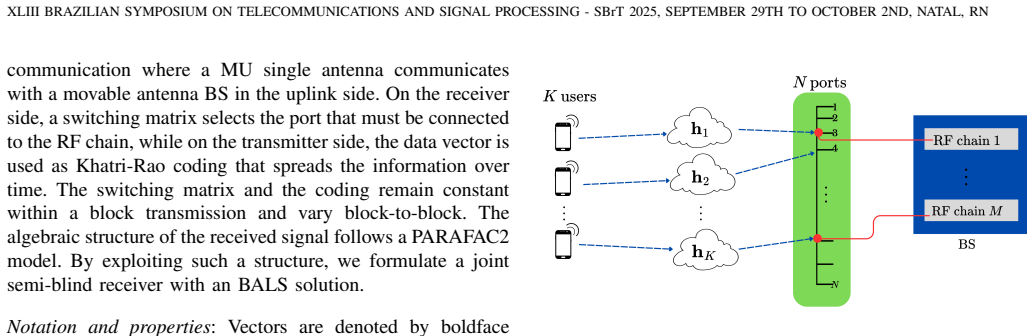
Summary. This manuscript addresses joint channel and symbol estimation for the uplink of a multiuser system whose base station is equipped with a movable-antenna array: M RF chains select among N ports via a block-varying binary switching matrix S_p, and K single-antenna users spread their T-symbol blocks using known block-coding coefficients C. The received signal is written as frontal slices Y_p = S_p H D_p(C) X + Z_p and is shown to follow a PARAFAC2 decomposition, leading to the correspondences in (10). The proposed receiver (Algorithm 1) alternates two least-squares updates, (18)-(19) for the channel matrix H and (20)-(21) for the symbol matrix X, and the paper reports simulated NMSE and SER in Figures 3-6. The algebraic core of the paper is correct, but the model admits an unreported per-user diagonal scaling ambiguity, so the reported error metrics and the claimed joint estimation results are not well-defined as stated.
Significance. If the identifiability gap described in the major comments is closed, the paper makes a moderate but useful contribution: it brings the PARAFAC2 machinery to movable-antenna systems through a two-time-scale switching structure, and the resulting receiver is simple and amenable to the usual tensor-based analysis. On the credit side, the derivation of the LS updates (13), (18), and (21) is correct, the PARAFAC2 correspondence in (10) is valid, the per-iteration complexity is stated clearly, and the qualitative finding that channel NMSE degrades as the number of ports N grows (Figures 3 and 6) is plausible. The main weakness is that the model's scaling invariance is not addressed, which currently blocks reproduction of the numerical claims; the results are also preliminary, with only a pilot-assisted LS baseline for comparison.
major comments (2)
- [§IV–§VI, Eqs. (9), (18)–(21)] The bilinear model Y_p = S_p H D_p(C) X in (9) is invariant under the transformation (H, X) → (HΛ, Λ^{-1}X) for every nonsingular diagonal Λ ∈ ℂ^{K×K}, because diagonal matrices commute and D_p(C) is diagonal. Both LS subproblems are equivariant under this family: if X = Λ^{-1}X_true, the H-update in (19) returns H_trueΛ when W in (17) has full column rank, and the X-update in (21) returns Λ^{-1}X_true when Z has full column rank. Hence every member of this family is a fixed point of Algorithm 1. The inequalities in §V (TMP ≥ NK and PM ≥ K) only make the two linear subproblems overdetermined; they do not remove the scaling ambiguity. Because §VI reports NMSE for Ĥ (Figures 3, 5, 6) and SER for X̂ (Figure 4) without stating any normalization or pilot-based disambiguation (and neither exists in Algorithm 1), the reported error metrics are not well-defined and the numerical results cannot be reproduced as described. This directly affects the paper's central claim of joint channel and symbol estimation.
- [§II and §V] The identifiability discussion is incomplete and in tension with the model. Section II recalls that PARAFAC2 uniqueness holds under the constraint A_p^T A_p = Φ for all p, but with the correspondence A_p = S_p H from (10) this requires H^T S_p^T S_p H to be constant across p, which is not verified and generically fails because S_p^T S_p is the N×N orthogonal projector onto the row space of S_p and changes from block to block. The standard PARAFAC2 uniqueness results therefore do not carry over to the proposed model. Section V instead equates identifiability with the overdeterminedness conditions TMP ≥ NK and PM ≥ K; these conditions concern unique solvability of the linear subproblems (18) and (20), not identifiability of the bilinear pair (H, X), as the diagonal scaling invariance makes plain. The concluding sentence of §V, which states that the parameter choices ensure uniqueness of the estimated parameters, is consequently not justified. The authors should either prove identifiability under explicit constraints (for example, a small number of pilots or unit-norm/phase constraints on the factors) or explicitly characterize the remaining ambiguities and how the receiver resolves them.
minor comments (7)
- [§III, Eq. (4)] For M < N the binary matrix S ∈ ℝ^{M×N} cannot satisfy exactly one unity element in each row and column, since that would force M = N; the intended condition is one unit per row and at most one unit per column (a selection matrix), and the paper should state it that way.
- [§V] The section heading 'Indentifiability' should read 'Identifiability'.
- [§VI and Algorithm 1] Several experimental details are missing: the SNR ranges on the horizontal axes of Figures 3–6, the convergence threshold δ and the maximum number of iterations of Algorithm 1, the random initialization procedure for X, and the definition of the NMSE/SER averaging (in particular whether per-user scaling/phase alignment was applied before computing the metrics).
- [Introduction and References] The introduction cites the same reference twice as '[9], [9], [10]', and reference [13] duplicates reference [10] in the bibliography; reference [19] also has an incomplete author list.
- [§VI] The anticipated spectral-efficiency gain from avoiding pilots is mentioned twice but is never quantified; a preliminary quantitative statement would support the claimed advantage.
- [Abstract and §VI] The abstract's 'remarkable results' and the conclusion's 'competitive performance' are supported only by comparisons with a pilot-assisted LS channel estimator and a fixed-antenna case; a comparison with at least one existing semi-blind or tensor-based receiver would make the performance claims more persuasive.
- [§II and §III] The same symbol X is used for the PARAFAC2 tensor in (3) and for the K×T symbol matrix in Section III, which may confuse readers; the tensor in (3) should use a different symbol.
Circularity Check
No circular derivation: model, LS updates, and simulations are self-contained; the scaling ambiguity is an identifiability caveat, not a circular step.
full rationale
The derivation chain is self-contained and non-circular. The received-signal model in (5)-(9) is assembled from standard physical assumptions (block fading, port switching matrix S_p, and per-block diagonal coding D_p(C)); the PARAFAC2 identification in (10) is a direct algebraic relabeling of (9) and does not presuppose the estimates. The BALS receiver solves two ordinary least-squares problems (18)-(21) whose sensing matrices are formed from the data and the currently fixed factor; this is a standard fitting procedure, not a fitted parameter dressed as a prediction. The identifiability discussion in Section V is parametric (TMP >= NK and PM >= K) and cites external tensor literature [20]-[23], with self-citations [9]-[17] appearing only as background on tensor receivers, not as load-bearing support for the central claim. A real identifiability caveat exists: the model has the exact invariance Y_p = S_p H D_p(C) X = S_p (H Lambda) D_p(C) (Lambda^{-1} X) for any diagonal Lambda, and Algorithm 1 and Section V do not specify a normalization, so the reported NMSE/SER values are not uniquely defined unless an implicit scaling convention is used. That is a reproducibility and identifiability flaw, not a circular derivation: no equation in the paper reduces a prediction to an input fit, and no load-bearing argument reduces to the authors' prior work by citation. Therefore no circular step is identified.
Assumptions & free parameters
assumptions (5)
- standard math Kronecker product identities (1)-(2) and the vec identity vec(ABC) = (C^T tensor A)vec(B) are valid.
- domain assumption Block fading: the channel H is constant across P blocks, while the switching matrix S_p and the coding vector c_p vary per block.
- domain assumption The receiver has perfect knowledge of the coding matrix C and the switching matrices S_p for p = 1, ..., P.
- domain assumption The received tensor Y follows the exact PARAFAC2 structure with no model mismatch, and the joint decomposition is unique up to the stated ambiguities.
- ad hoc to paper The BALS algorithm converges from a random initialization to a stationary point close enough to the true factors.
Cite this review
Pith. "Pith review of Joint Channel and Symbol Estimation for Communication Systems with Movable Antennas." pith.science (2026). https://pith.science/paper/IKCWRCPJ
@misc{pith2026250607183,
  author       = {Pith},
  title        = {Pith review of: Joint Channel and Symbol Estimation for Communication Systems with Movable Antennas},
  year         = {2026},
  howpublished = {\url{https://pith.science/paper/IKCWRCPJ}},
  note         = {Machine review of arXiv:2506.07183}
}
read the original abstract
Communication systems aided by movable antennas have been the subject of recent research due to their potentially increased spatial degrees of freedom offered by optimizing the antenna positioning at the transmitter and/or receiver. In this context, a topic that deserves attention is channel estimation. Conventional methods reported recently rely on pilot-assisted strategies to estimate the channel coefficients. In this work, we address the joint channel and symbol estimation problem for an uplink multi-user communication system, where the base station is equipped with a movable antenna array. A semi-blind receiver based on the PARAFAC2 model is formulated to exploit the tensor decomposition structure for the received signals, from which channel and symbol estimates can be jointly obtained via an alternating estimation algorithm. Compared with reference schemes, our preliminary numerical simulations yield remarkable results for the proposed method.
Figures


Figures from the paper (3 more)


Reference graph
Works this paper leans on
-
[3]
Channel estimation for movable-antenna MIMO systems via tensor decomposition,
R. Zhang, L. Cheng, W. Zhang, X. Guan, Y . Cai, W. Wu, and R. Zhang, “Channel estimation for movable-antenna MIMO systems via tensor decomposition,”IEEE Wireless Commun. Lett., vol. 13, no. 11, pp. 3089–3093, 2024
2024
-
[1]
Fixed and movable antenna technology for 6G integrated sensing and communication,
Y . Zeng, Z. Dong, H. Wang, L. Zhu, Z. Hong, Q. Jiang, D. Wang, S. Jin, and R. Zhang, “Fixed and movable antenna technology for 6G integrated sensing and communication,” 2024. [Online]. Available: https://arxiv.org/abs/2407.04404
arXiv 2024
-
[2]
Historical review of fluid antenna and movable antenna,
L. Zhu and K.-K. Wong, “Historical review of fluid antenna and movable antenna,” 2024. [Online]. Available: https://arxiv.org/abs/2401.02362
arXiv 2024
-
[4]
Successive bayesian reconstructor for channel estimation in fluid antenna systems,
Z. Zhang, J. Zhu, L. Dai, and R. W. Heath, “Successive bayesian reconstructor for channel estimation in fluid antenna systems,”IEEE Trans. Wireless Commun., vol. 24, no. 3, pp. 1992–2006, 2025
work page 1992
-
[5]
Movable antennas for wireless communi- cation: Opportunities and challenges,
L. Zhu, W. Ma, and R. Zhang, “Movable antennas for wireless communi- cation: Opportunities and challenges,”IEEE Communications Magazine, vol. 62, no. 6, pp. 114–120, 2024
2024
-
[6]
Channel estimation for movable antenna communication systems: A framework based on compressed sensing,
Z. Xiao, S. Cao, L. Zhu, Y . Liu, B. Ning, X.-G. Xia, and R. Zhang, “Channel estimation for movable antenna communication systems: A framework based on compressed sensing,”IEEE Trans. Wireless Com- mun., vol. 23, no. 9, pp. 11 814–11 830, 2024
2024
-
[7]
Compressed sensing based channel estimation for movable antenna communications,
W. Ma, L. Zhu, and R. Zhang, “Compressed sensing based channel estimation for movable antenna communications,”IEEE Commun. Lett., vol. 27, no. 10, pp. 2747–2751, 2023
2023
-
[8]
Fluid antenna with linear mmse channel estimation for large-scale cellular networks,
C. Skouroumounis and I. Krikidis, “Fluid antenna with linear mmse channel estimation for large-scale cellular networks,”IEEE Trans. Commun., vol. 71, no. 2, pp. 1112–1125, 2023
work page 2023
Show all 24 references
-
[9]
Parafac-paratuck semi-blind receivers for two-hop cooperative mimo relay systems,
L. R. Ximenes, G. Favier, A. L. F. de Almeida, and Y . C. B. Silva, “Parafac-paratuck semi-blind receivers for two-hop cooperative mimo relay systems,”IEEE Trans. Signal Process., vol. 62, no. 14, pp. 3604– 3615, 2014
2014
-
[10]
Tensor space-time-frequency coding with semi-blind receivers for mimo wireless communication systems,
G. Favier and A. L. F. de Almeida, “Tensor space-time-frequency coding with semi-blind receivers for mimo wireless communication systems,” IEEE Trans. Signal Process., vol. 62, no. 22, pp. 5987–6002, 2014
2014
-
[11]
PARAFAC- based unified tensor modeling for wireless communication systems with application to blind multiuser equalization,
A. L. F. de Almeida, G. Favier, and J. C. M. Mota, “PARAFAC- based unified tensor modeling for wireless communication systems with application to blind multiuser equalization,”Signal Process., vol. 87, no. 2, pp. 337–351, 2007
2007
-
[12]
A constrained factor decomposition with application to MIMO antenna systems,
A. L. F. de Almeida, G. Favier, and J. C. M. Mota, “A constrained factor decomposition with application to MIMO antenna systems,”IEEE Trans. Signal Process., vol. 56, no. 6, pp. 2429–2442, 2008
2008
-
[13]
Tensor space-time-frequency coding with semi-blind receivers for MIMO wireless communication systems,
G. Favier and A. L. F. de Almeida, “Tensor space-time-frequency coding with semi-blind receivers for MIMO wireless communication systems,” IEEE Trans. Signal Process., vol. 62, no. 22, pp. 5987–6002, 2014
2014
-
[14]
Semi-blind receivers for non-regenerative cooperative MIMO communications based on nested PARAFAC modeling,
L. R. Ximenes, G. Favier, and A. L. F. de Almeida, “Semi-blind receivers for non-regenerative cooperative MIMO communications based on nested PARAFAC modeling,”IEEE Trans. Signal Process., vol. 63, no. 18, pp. 4985–4998, 2015
2015
-
[15]
Parafac-based channel estimation for intelligent reflective surface assisted mimo system,
G. T. de Araújo and A. L. F. de Almeida, “Parafac-based channel estimation for intelligent reflective surface assisted mimo system,” in 2020 IEEE 11th Sensor Array and Multichannel Signal Processing Workshop (SAM), 2020, pp. 1–5
2020
-
[16]
Tensor decompositions in wireless communications and MIMO radar,
H. Chen, F. Ahmad, S. V orobyov, and F. Porikli, “Tensor decompositions in wireless communications and MIMO radar,”IEEE J. Sel. Topics Signal Process., vol. 15, no. 3, pp. 438–453, 2021
2021
-
[17]
Channel estimation for intelligent reflecting surface assisted MIMO systems: A tensor modeling approach,
G. T. de Araújo, A. L. F. de Almeida, and R. Boyer, “Channel estimation for intelligent reflecting surface assisted MIMO systems: A tensor modeling approach,”IEEE J. Sel. Topics Signal Process., vol. 15, no. 3, pp. 789–802, Apr 2021
2021
-
[18]
Parafac2 receivers for orthogonal space-time block codes,
M. Sorensen, P. Comon, S. Icart, and L. Deneire, “Parafac2 receivers for orthogonal space-time block codes,” in2009 IEEE International Conference on Communications, 2009, pp. 1–5
2009
-
[19]
Closed-form channel estimation for mimo space—time coded systems using a fourth-order tensor-based receiver,
G. T. Araújo and A. L. Almeida, “Closed-form channel estimation for mimo space—time coded systems using a fourth-order tensor-based receiver,” vol. 37, no. 3, p. 1343–1357, Mar. 2018
2018
-
[20]
Parafac2: Mathematical and technical notes,
R. A. Harshmanet al., “Parafac2: Mathematical and technical notes,” UCLA working papers in phonetics, vol. 22, no. 3044, p. 122215, 1972
1972
-
[21]
Foundations of the PARAFAC procedure: Models and conditions for an “explanatory
R. A. Harshman, “Foundations of the PARAFAC procedure: Models and conditions for an “explanatory” multi-modal factor analysis,”UCLA Working Papers in Phonetics, vol. 16, pp. 1–84, 1970
1970
-
[22]
Tensor decompositions and applications,
T. G. Kolda and B. W. Bader, “Tensor decompositions and applications,” SIAM Review, vol. 51, no. 3, pp. 455–500, 2009
2009
-
[23]
Some uniqueness results for parafac2,
J. ten Berge and H. Kiers, “Some uniqueness results for parafac2,” Psychometrika, vol. 61, no. 1, pp. 123–132, Mar. 1996
1996
-
[24]
Tensor decompositions, alternating least squares and other tales,
P. Comon, X. Luciani, and A. L. F. de Almeida, “Tensor decompositions, alternating least squares and other tales,”Journal of Chemometrics, vol. 23, no. 7-8, pp. 393–405, 2009
2009
Reviewed August 7, 2026 · model on record in the stance chip above.
Discussion (0). Sign in to comment.