REVIEW 4 major objections 5 minor 20 references
Dirac spectral flow and Floer theory of hyperbolic three-manifolds
T0 review · 4 major / 5 minor · reviewed 2026-08-07 · deepseek-v4-flash
Pith's one-line read Dirac crossing signs fix Floer homology of hyperbolic 3-manifolds
desk verdict Genuinely new geometric computation of piercing sequences for hyperbolic 3-manifolds, with the Floer dictionary deferred to an unpublished companion; conditional but worth refereeing carefully. read the letter →
The pith
A machine-rendered reading of the paper's core claim, the machinery that carries it, and where it could break.
The reading
What carries the argument
The main technical tool is the odd Selberg trace formula for the family of Dirac operators D_{Bτ}, together with its derivative in τ. The derivative formula (14) expresses a weighted sum of eigenvalue derivatives as a geometric sum over closed geodesics involving spin-c holonomies; Lemma 2.1 bounds each individual derivative by 2π C_Y, where C_Y is the minimal $C^{0}$ norm of a closed one-form representing the generator of $H^{1}$(Y;Z). Combining this with Fourier-analytic test functions (the sixth or eighth convolution power of the interval indicator) gives certified intervals containing a unique small eigenvalue and proves its derivative never vanishes, establishing transversality. The piercing sequence — the ordered list of ± signs of these transverse crossings around the circle — is the object that carries the Floer homology.
What would settle it
Compute the Floer homology of a listed manifold by an independent method, such as a surgery exact triangle or a Heegaard Floer package, and compare with the predicted 0 or R (or R⊕R for #10867); a mismatch would indicate that either the piercing sequence computation or the dictionary from [Lin24b] is wrong. Alternatively, numerically evaluate the derivative of the small eigenvalue at the certified crossing point of, say, the self-conjugate spin-c structure on #357 and search for a sign change of s'_0(τ) or a zero, which would contradict transversality.
Extended reading notes
Core claim
The central claim is that the Floer homology of a spectrally large b1=1 hyperbolic three-manifold with a torsion spin-c structure is governed by the one-parameter family of Dirac operators associated to flat spin-c connections, not by curvature or irreducible solutions. Generically the kernel locus K consists of finitely many points with signs; the sequence of signs around the circle is the piercing sequence. The authors prove, for a dozen census manifolds, that K is transverse and exactly two or four points, compute the piercing sequence using a derivative of the odd Selberg trace formula, and then apply the dictionary that turns the piercing sequence into explicit chain complexes. The resulting Floer homology groups are the first examples with non-trivial homology for hyperbolic manifolds, including a rank-two example on #10867.
Load-bearing premise
The load-bearing premise is the unpublished result [Lin24b], which asserts that under Conditions 1 and 2 one can perturb the Seiberg-Witten equations so that the Floer chain complex is explicitly the one described from the piercing sequence; the present paper cites this dictionary without proving it.
Editorial extensions
If this is right
- For every manifold in Table 1, the twisted Floer homology HM_*(Y,s; Γ_η) is now known to be 0 or R, and for #10867 it is R⊕R; these are the first non-trivial computations on hyperbolic three-manifolds.
- The method converts the Main Question into finitely many numerical checks on the length spectrum for any spectrally large b1=1 manifold, with the practical caveat that the required cutoff R grows quickly.
- When the piercing sequence has four crossings, the reduced Floer homology HM_*(Y,s) itself is non-trivial (Z in degree -1 in the example), so the phenomenon is not an artifact of local coefficients.
- The dictionary in Section 1 shows that the piercing sequence determines not only homology groups but the whole chain complex and the action of γ ∈ H1(Y;Z)/tors.
Reading between the lines
- If the dictionary from [Lin24b] is correct, the same recipe would determine Floer homology for every spectrally large fibered census manifold whose length spectrum is computed to the needed cutoff, making the Main Question effectively decidable within that class.
- The lower bound C_Y ≥ π·Th(Y)/vol(Y) (Remark A.1) suggests that manifolds with large Thurston norm relative to volume cannot be spectrally large, which would bound the reach of the method.
- One could test the transversality assumption numerically for the non-self-conjugate spin-c structures on #10867, predicting trivial homology; a failure there would pinpoint the limit of the approach.
Editorial analysis
A structured set of objections, weighed in public.
Referee Report
Summary. The paper studies the correspondence between hyperbolic geometry and monopole Floer homology for closed oriented hyperbolic three-manifolds Y with b1=1 and torsion spin-c structures s. It proposes to determine HM_*(Y,s;Γ_η) and the corresponding chain complexes from the 'piercing sequence' of transverse eigenvalue crossings of the family of Dirac operators D_{Bτ} around the circle of flat connections. The main theorems assert explicit Floer chain complexes for a list of census manifolds (Theorem 1) and for the manifold #10867 (Theorem 2), with Floer homology equal to 0, R, or R^2 depending on whether the piercing sequence is empty, (+,−), or (+,−,+,−). The proof combines the spectral-largeness condition λ_1^*>2, interval certificates for small eigenvalues, an odd Selberg trace formula and its derivative to prove transversality, and an a priori derivative bound via an explicit constant C_Y. The Floer-theoretic dictionary that converts a piercing sequence into a chain complex is cited to the unpublished preprint [Lin24b]; the geometric computations of the piercing sequences themselves are the main new contribution presented here.
Significance. If the dictionary from [Lin24b] is correct, the paper achieves a notable first: explicit monopole Floer chain complexes with nontrivial homology for hyperbolic three-manifolds, computed from geometric data such as geodesic lengths, spin-c holonomies, and the norm bound C_Y. The technique of differentiating the family of Selberg trace formulas in the spin-c parameter in order to prove transversality of Dirac eigenvalue crossings is new and likely to be useful beyond these examples. The explicit interval certificates, the use of spectral density bounds, and the careful treatment of C_Y are strengths, and the results give concrete, falsifiable predictions linking spectral geometry to Floer homology. However, the central Floer conclusions are not self-contained in this manuscript, and the proof of Theorem 1 as written covers only a subset of the listed manifolds in detail. The significance is therefore conditional, although the geometric part stands on its own.
major comments (4)
- [Section 1 (Examples 1.1–1.3; Remark 1.2)] Theorems 1 and 2 rest on the assertion, cited to the unpublished preprint [Lin24b], that under Conditions 1 and 2 the piercing sequence completely determines the Floer chain complex. This is the load-bearing step of the paper, but no statement of this dictionary is proved here, and Examples 1.1–1.3 simply quote the output. In particular, the claimed vanishing of the irreducible contribution B_u^s in Remark 1.2, the tower grading shifts, and the treatment of non-self-conjugate spin-c structures are all asserted rather than demonstrated. If [Lin24b] is not available or contains a subtlety (for example irreducible solutions created by the perturbation, or different grading shifts for non-self-conjugate structures), the Floer conclusions of Theorems 1 and 2 do not follow even though the piercing-sequence computations are correct. The manuscript should either prove the relevant cases of the dictionary in an appendix or state Theorems 1 and 2 as conditional on a precise theorem in a publicly available companion paper.
- [Theorem 1 / Section 5] Theorem 1 asserts results for all twelve manifolds in Table 1, but the body of the paper gives detailed piercing-sequence computations only for the self-conjugate and a conjugate pair on #357, for #3250, and for #10867 (the latter being Theorem 2). No piercing-sequence data, interval certificates, or even summary tables are provided for #356, #381, #734, #735, #790, #882, #1155, #1280, #1284, or #3673. The sentence in the introduction that the strategy 'can be applied' is not a proof of a numerical theorem. The authors should include the computed piercing sequences for all spin-c structures appearing in Theorem 1, or at least the certification data for each manifold, or restrict the theorem to the cases actually worked out.
- [Section 5.2] The proof of transversality for #3250 is incomplete as written. After stating that the strategy proves s_0'(τ)≠0 on [0.4467,0.4480], the text says 'focusing for simplicity on the midpoint τ0' and verifies the inequality (23) only at τ0=0.44735. A bound at a single point does not rule out a second crossing or a tangency elsewhere in the interval. To establish Condition 2 for this spin-c structure, the authors need uniform bounds over the whole interval (as they do for #357 and #10867) or an explicit argument that the midpoint check suffices.
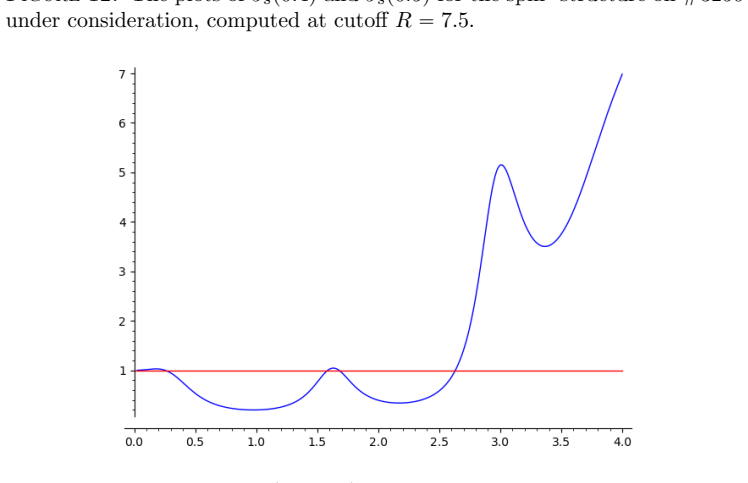
- [Section 4.2 / Remark 4.2] The tail estimates used in proving the inequalities behind (23) are not fully specified. Remark 4.2 states that the infinite sum can be bounded explicitly by evaluating the first forty terms and bounding the remainder using S_Y, but the text does not give the actual tail bound, the values of S_Y, or the required numerical data. Since these bounds are the certificates for transversality in Sections 4 and 5, the reader cannot verify the numerical proofs. Please provide the precise inequalities and the certified numerical values, or a reproducible script, used to obtain numbers such as 0.0470 in Section 4.3 and 0.7099 in Section 5.2.
minor comments (5)
- [Equation (14)] Please check the displayed sign in Equation (14): with the stated convention φτ(γ)=e^{2πi τ [γ]}φ0(γ), differentiating cos(φτ(γ)) introduces a minus sign; the later absolute-value estimates in the paper are insensitive to this, but the displayed identity should be correct as written.
- [Example 1.3] The notation T_+^{⊕2}⟨−1⟩ in Example 1.3 would benefit from a short explanation of how the grading shift acts on a direct sum of towers and how the listed chain complex is obtained from the two maxima/two minima Morse picture.
- [Section 3.2] The conclusion that the interval contains exactly one small eigenvalue is justified by 'simply looking at plots' and continuity; please replace this with the interval-based Step 1 and Step 2 certificates at several points or with a uniform argument over the interval.
- [References] Since the main theorems depend on [Lin24b], that reference should include a public identifier or version once available; as it stands, the reader cannot access the companion result.
- [Throughout] Minor typographical issues: 'spin c' is sometimes written with a visible space, and there are a few missing superscripts in phrases such as 'spin^c structure' in the abstract and introduction.
Circularity Check
The Floer chain-complex dictionary is imported from the unpublished same-author preprint [Lin24b], making Theorems 1-2 conditional, while the geometric piercing-sequence computations are independent.
-
self citation load bearing
[Section 1, after Definition 1.1; quoted output used in Examples 1.1-1.3 and Theorems 1-2.]
"In [Lin24b] it is shown how to suitably perturb the Seiberg-Witten equations to achieve transversality while not introducing irreducible solutions when Conditions 1 and 2 hold. ... A consequence of this is that one can compute the Floer chain complex in a completely explicit fashion; the key phenomenon that gives rise to interesting Floer homology is that the presence of points of K causes the various towers associated to reducible critical points to shift in grading because of spectral flow."
Theorems 1 and 2 assert explicit Floer chain complexes (0, R, or R⊕R) determined by the piercing sequence, but the implication 'piercing sequence ⇒ Floer chain complex' is not proved here. Section 1 cites the unpublished, same-author preprint [Lin24b] for it, and Examples 1.1-1.3 simply state the outputs. Sections 3-5 only certify Conditions 1 and 2 and compute piercing sequences from hyperbolic data; they do not derive the Floer dictionary. Thus the central Floer conclusions are forced by a self-citation chain rather than by an argument in this paper. If [Lin24b]'s perturbation or grading-shift claims fail, Theorems 1-2 would not follow even though the geometric computations are correct.
full rationale
The genuinely new and self-contained part of the paper is the geometric side: using the published LL21/LL22b trace formulas, SnapPy data, and the Appendix A bound on C_Y to certify spectral largeness, locate intervals with small Dirac eigenvalues, and prove single transverse crossings, thereby computing piercing sequences for the listed census manifolds. That part is not circular, and it does not depend on the Floer conclusions. The step connecting piercing sequences to Floer chain complexes, however, is delegated to [Lin24b], an unpublished preprint by the first author; Examples 1.1-1.3 are stated consequences, not proved here. This is a load-bearing self-citation, so the Floer outputs of Theorems 1 and 2 are conditional on [Lin24b]. I score this 4 rather than higher because the cited dictionary has explicit hypotheses (Conditions 1 and 2) independent of the target Floer groups and the paper verifies those hypotheses on the geometric side; there is no fitted parameter renamed as a prediction and no definitional identity forcing the result. The earlier same-author trace formulas are published mathematical tools used as inputs, not circular support.
Assumptions & free parameters
free parameters (4)
- Length spectrum cutoff R =
7, 7.5, 8.5 depending on example
- Test functions H6, K7, K8 with scaling =
H6 = (1/2 1_{[-1,1]})^{*6}; K7 = x(1/2 1_{[-1,1]})^{*7}; K8 scaled by 1.0625
- Spectral density interval centers nu =
2.5, 2.7, 1.9541, 2.2941, 2.4741, 2.7041, varying by example
- C_Y optimization seeds =
not specified
assumptions (6)
- domain assumption Selberg trace formulas for Dirac operators on hyperbolic 3-manifolds with flat spin-c connections, including the differentiated odd formula (14).
- domain assumption Spectral largeness lambda_1^* > 2 rules out irreducible Seiberg-Witten solutions.
- ad hoc to paper The dictionary from piercing sequence to monopole Floer chain complexes, under Conditions 1 and 2, holds.
- domain assumption Census manifolds under consideration are branched double covers of links in S^3, and the covering involution acts as -1 on H^1(Y;Z) = Z.
- standard math Rellich's theorem and Kato perturbation theory apply to the family D_{B_tau} = D_{B_0} + 2 pi i tau rho(alpha).
- ad hoc to paper The tail of the infinite spectral sums in the derivative trace formula can be bounded explicitly as stated in Remark 4.2.
Cite this review
Pith. "Pith review of Dirac spectral flow and Floer theory of hyperbolic three-manifolds." pith.science (2026). https://pith.science/paper/PBXRFEH3
@misc{pith2026250607238,
  author       = {Pith},
  title        = {Pith review of: Dirac spectral flow and Floer theory of hyperbolic three-manifolds},
  year         = {2026},
  howpublished = {\url{https://pith.science/paper/PBXRFEH3}},
  note         = {Machine review of arXiv:2506.07238}
}
abstract
We study the interplay between hyperbolic geometry and monopole Floer homology for a closed oriented three-manifold $Y$ with $b_1=1$ equipped with a torsion spin$^c$ structure $\mathfrak{s}$. We show that, under favorable circumstances, one can completely describe the Floer theory of $(Y,\mathfrak{s})$ purely in terms of geometric data such as the lengths and holonomies of closed geodesics. In particular, we perform the first computations of monopole Floer chain complexes with non-trivial homology for hyperbolic three-manifolds. The examples we consider admit no irreducible solutions to the Seiberg-Witten equations, and the non-triviality of the Floer homology groups is a consequence of the geometry of the $1$-parameter family of Dirac operators associated to flat spin$^c$ connections. The main technical challenge is to understand explicitly how the Dirac eigenvalues with small absolute value cross the value zero in this family; we tackle this using Fourier analytic tools via the corresponding $1$-parameter family of odd Selberg trace formulas and its derivative.
Figures


Figures from the paper (13 more)




Reference graph
Works this paper leans on
-
[1]
M. F. Atiyah, V. K. Patodi, and I. M. Singer. Spectral asymmetry and R iemannian geometry. III . Math. Proc. Cambridge Philos. Soc. , 79(1):71--99, 1976
work page 1976
-
[2]
Jeffrey F. Brock and Nathan M. Dunfield. Norms on the cohomology of hyperbolic 3-manifolds. Invent. Math. , 210(2):531--558, 2017
work page 2017
-
[3]
Booker and Andreas Str\"ombergsson
Andrew R. Booker and Andreas Str\"ombergsson. Numerical computations with the trace formula and the S elberg eigenvalue conjecture. J. Reine Angew. Math. , 607:113--161, 2007
work page 2007
-
[4]
Peter Buser. Geometry and spectra of compact R iemann surfaces . Modern Birkh\"auser Classics. Birkh\"auser Boston, Ltd., Boston, MA, 2010. Reprint of the 1992 edition
work page 2010
-
[5]
Snappy, a computer program for studying the geometry and topology of 3-manifolds
Marc Culler, Nathan Dunfield, Matthias Goerner, and Jeff Weeks. Snappy, a computer program for studying the geometry and topology of 3-manifolds
-
[6]
Eigenvalues in R iemannian geometry , volume 115 of Pure and Applied Mathematics
Isaac Chavel. Eigenvalues in R iemannian geometry , volume 115 of Pure and Applied Mathematics . Academic Press, Inc., Orlando, FL, 1984. Including a chapter by Burton Randol, With an appendix by Jozef Dodziuk
work page 1984
-
[7]
Computing the twisted l^2 -euler characteristic
Jacopo Chen. Computing the twisted l^2 -euler characteristic. to appear in Groups Geom. Dyn. , 2023
work page 2023
-
[8]
A census of closed hyperbolic 3-manifolds
Craig Hodgson and Jeff Weeks. A census of closed hyperbolic 3-manifolds
Show all 20 references
-
[9]
Perturbation theory for linear operators
Tosio Kato. Perturbation theory for linear operators . Classics in Mathematics. Springer-Verlag, Berlin, 1995. Reprint of the 1980 edition
1995
-
[10]
Monopoles and three-manifolds , volume 10 of New Mathematical Monographs
Peter Kronheimer and Tomasz Mrowka. Monopoles and three-manifolds , volume 10 of New Mathematical Monographs . Cambridge University Press, Cambridge, 2007
2007
-
[11]
okova G eometry- T opology C onference 2015 , pages 39--80. G\
Francesco Lin. Lectures on monopole F loer homology. In Proceedings of the G \"okova G eometry- T opology C onference 2015 , pages 39--80. G\"okova Geometry/Topology Conference (GGT), G\"okova, 2016
2015
-
[12]
Monopole F loer homology and invariant theta characteristics
Francesco Lin. Monopole F loer homology and invariant theta characteristics. J. Lond. Math. Soc. (2) , 109(5):Paper No. e12895, 27, 2024
2024
-
[13]
Topology of the D irac equation on spectrally large three-manifolds
Francesco Lin. Topology of the D irac equation on spectrally large three-manifolds. preprint , 2024
2024
-
[14]
Closed geodesics and fr yshov invariants of hyperbolic three-manifolds
Francesco Lin and Michael Lipnowski. Closed geodesics and fr yshov invariants of hyperbolic three-manifolds. to appear in JEMS , 2021
2021
-
[15]
Monopole F loer homology, eigenform multiplicities, and the S eifert- W eber dodecahedral space
Francesco Lin and Michael Lipnowski. Monopole F loer homology, eigenform multiplicities, and the S eifert- W eber dodecahedral space. Int. Math. Res. Not. IMRN , (9):6540--6560, 2022
2022
-
[16]
The S eiberg- W itten equations and the length spectrum of hyperbolic three-manifolds
Francesco Lin and Michael Lipnowski. The S eiberg- W itten equations and the length spectrum of hyperbolic three-manifolds. J. Amer. Math. Soc. , 35(1):233--293, 2022
2022
-
[17]
An introduction to G eometric T opology
Bruno Martelli. An introduction to G eometric T opology
-
[18]
Elliptic operators, topology and asymptotic methods , volume 395 of Pitman Research Notes in Mathematics Series
John Roe. Elliptic operators, topology and asymptotic methods , volume 395 of Pitman Research Notes in Mathematics Series . Longman, Harlow, second edition, 1998
1998
-
[19]
J. J. Sakurai and Jim Napolitano. Modern quantum mechanics
-
[20]
A combinatorial formulation for the S eiberg- W itten invariants of 3 -manifolds
Vladimir Turaev. A combinatorial formulation for the S eiberg- W itten invariants of 3 -manifolds. Math. Res. Lett. , 5(5):583--598, 1998
1998
Reviewed August 7, 2026 · model on record in the stance chip above.
Discussion (0). Sign in to comment.