REVIEW 2 major objections 6 minor 86 references
ALMA-JELLY I: High Resolution CO(2-1) Observations of Ongoing Ram Pressure Stripping in NGC 4858 Reveal Asymmetrical Gas Tail Formation and Fallback
T0 review · 2 major / 6 minor · reviewed 2026-08-07 · deepseek-v4-flash
Pith's one-line read A Coma cluster galaxy's ram pressure wind creates an asymmetric molecular tail, and some of the gas it pushes out falls back inward.
desk verdict Solid single-galaxy ALMA study of ram-pressure stripping in NGC 4858; the fallback claim is plausible but rests on the near-side tail geometry, which has dust support but is not airtight. read the letter →
The pith
A machine-rendered reading of the paper's core claim, the machinery that carries it, and where it could break.
The reading
What carries the argument
The load-bearing objects are the ram pressure torque $\vec{\tau} = \vec{r} \times \vec{F}_{\rm ram}$ acting on molecular clouds in a rotating disk and a four-quadrant azimuthal decomposition of CO flux and velocity residuals aligned with the wind and rotation directions. The torque argument explains why the side rotating into the wind loses angular momentum and is driven inward, while the side rotating with the wind gains angular momentum and is driven outward. The quadrant analysis places nearly all outer CO gas in the trailing-side, rotating-into-wind quadrant, and the residual velocity map reveals the blueshifted stripping signatures and the redshifted fallback feature. A differential ram pressure ratio $R = 1 - (V_{\rm ICM} - v)^2/(V_{\rm ICM} + v)^2 \approx 0.23$ quantifies the uneven wind strength across the disk.
What would settle it
Run the same wind-tunnel simulation with the tail placed behind the disk instead of in front and compare the sign of the predicted velocity residuals with the observed CO map: the paper's assignment of blueshifted gas to outward stripping and of the redshifted inner-tail feature to fallback reverses if the near-side assumption is wrong, so a geometry-independent measurement of the tail's near/far side (for example, resolved CO absorption against the radio continuum tail) would settle whether the fallback claim holds.
Extended reading notes
Core claim
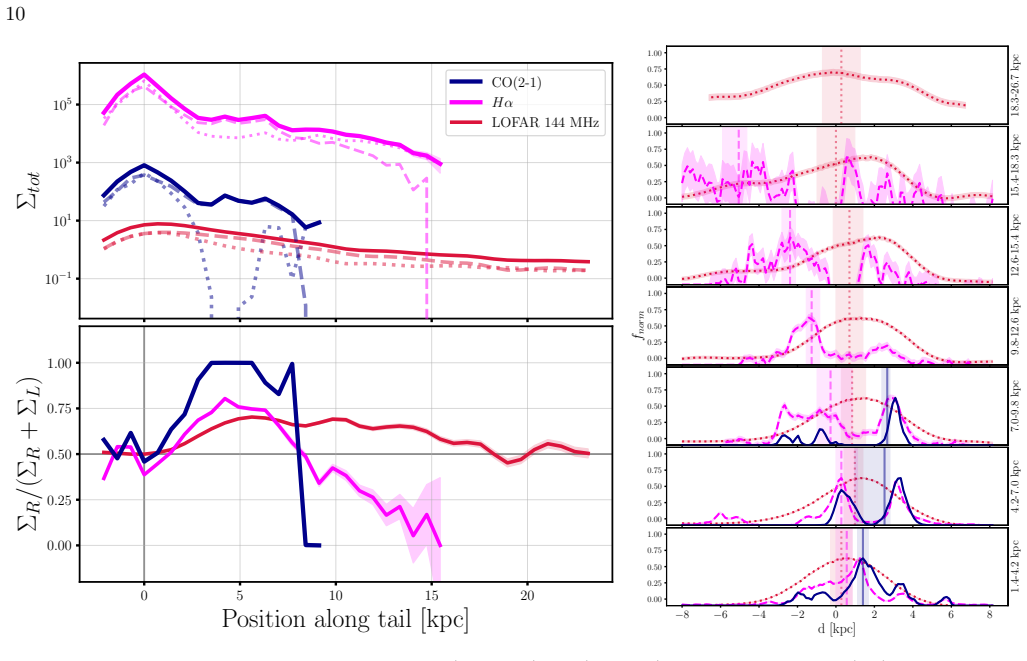
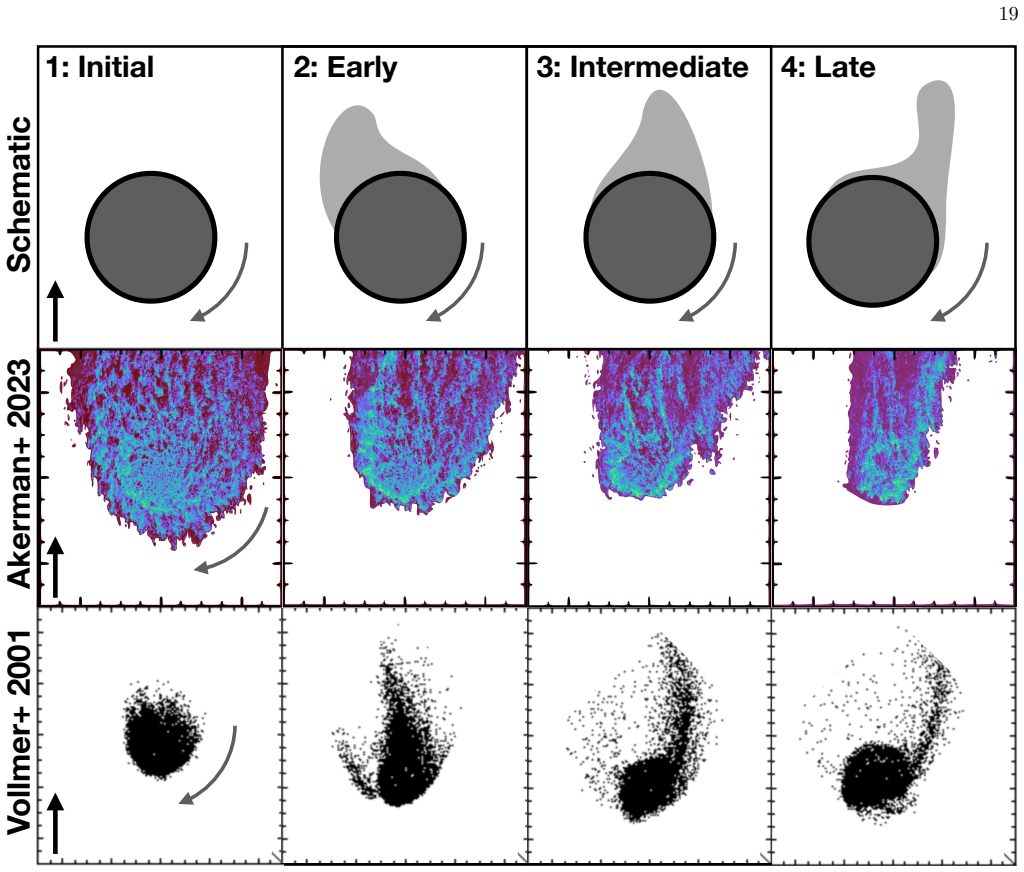
NGC 4858 is undergoing strong, ongoing ram pressure at a highly inclined disk-wind angle, and this produces a distinctly asymmetric molecular tail. After subtracting a simple circular-velocity model from the CO velocity field, the paper identifies blueshifted residuals marking gas accelerated by the wind—along the southern leading edge of the disk, in northern disk clumps, and in the two “bunny ear” tail arms—and one large redshifted feature near the base of the tail that it interprets as molecular clouds falling back into the disk. More than 90% of the CO flux beyond the gas truncation radius lies in the trailing-side quadrant that rotates into the wind, and the two tail arms appear to be stripped spiral-arm segments at different stages of a four-phase inner-tail evolution. The paper concludes that ram pressure torques, which push gas outward on the side rotating with the wind and inward on the side rotating into the wind, are the mechanism that forms such asymmetric inner tails.
Load-bearing premise
The paper assumes the stripped tail lies on the near side of the disk, in front of the stellar body, so that blueshifted residuals mean outward motion and redshifted residuals mean infall; if the tail were behind the disk, those assignments would reverse.
Editorial extensions
If this is right
- In highly inclined ram pressure events, the inner gas tail should be lopsided, concentrated on the side rotating into the wind, rather than forming a symmetric head-tail structure.
- Gas can be pushed out of the disk without escaping the galaxy; some of it falls back, so instantaneous stripping rates overestimate the mass a galaxy permanently loses.
- The two “bunny ear” tail arms are probably spiral-arm segments stripped at different times, meaning pre-existing spiral structure steers where the inner tail develops.
- Ram pressure torques that drive gas inward can feed the galaxy center, offering a path to enhanced nuclear activity in stripped galaxies.
- Stellar complexes near the stripping radius can take on head-tail shapes as the wind ablates their gas, so the effects of ram pressure are visible in stellar as well as gaseous structure.
Reading between the lines
- Editorial inference: the same torque mechanism predicts that other near-edge-on stripping events should consistently show their inner tails on the side rotating into the wind, so a survey of cluster galaxies with resolved CO maps could test whether this lopsidedness is universal.
- Editorial inference: if the redshifted feature is truly fallback, the returning molecular gas should rejoin the star-forming disk and trigger a second, younger stellar population in that region, which resolved stellar photometry could reveal.
- Editorial inference: the near-side placement of the tail is the hinge of the stripping-versus-fallback interpretation; a geometry measurement that placed the tail behind the disk would flip which residuals count as outward and which as inward.
Editorial analysis
A structured set of objections, weighed in public.
Referee Report
Summary. This paper presents new ALMA CO(2-1) observations at ~1" resolution of the Coma cluster jellyfish galaxy NGC 4858, supplemented by Subaru H-alpha and HST broadband imaging. The authors identify an asymmetric inner molecular gas tail concentrated in the quadrant rotating into the ram-pressure wind, measure a highly inclined disk-wind angle of phi_DW = 75^{+10}_{-27}, and, after subtracting a simple circular-velocity model, report blueshifted residual-velocity features that they interpret as ram-pressure acceleration and a redshifted feature that they interpret as molecular gas falling back toward the disk. They further discuss ram-pressure torques as the driver of the asymmetric inner tail, compare the observed morphology and kinematics to wind-tunnel and sticky-particle simulations, and report head-tail morphologies in stellar complexes within the disk. The central claims are the detection of fallback in an inclined ram-pressure stripping event and the torque-driven formation of asymmetric inner tails.
Significance. The paper is observationally strong and timely. The CO(2-1) data are of high quality, and the residual-velocity analysis is accompanied by explicit robustness tests in Appendix C showing that the main non-circular features survive large changes in the assumed rotation curve. If the fallback interpretation is correct, NGC 4858 becomes one of the best nearby examples connecting inclined ram pressure, asymmetric inner-tail formation, and gas re-accretion, and it would provide direct support for torque-driven evolution seen in simulations. The multi-wavelength overlays and the comparison with Akerman et al. (2023) and Vollmer et al. (2001) strengthen the paper. The authors are also transparent about several degeneracies, such as the vertical-versus-radial ambiguity of some residual velocities and the possible contribution of pre-existing spiral structure; this transparency is a genuine strength. However, one of these degeneracies, the near-side versus far-side location of the stripped tail, is load-bearing for the headline fallback claim, and the paper's current treatment of that point is not yet fully quantitative.
major comments (2)
- [Section 6; Section 6.5; Appendix B; Eq. (A4)] The fallback interpretation of the redshifted feature ID 6 depends on the assumption, introduced at the start of Section 6, that the stripped CO tail lies on the near side of the stellar disk. The only quantitative argument against the far-side alternative is the sentence in Section 6 that a far-side tail would require a total cluster velocity above 5000 km/s; this limit is asserted rather than derived. Since Appendix A already builds the 3D geometry relating V_rad, V_pos, theta_tail, theta_maj, and inclination (Eq. A4), I ask the authors to derive the maximum allowed V_tot for a far-side tail within that framework, including the quoted uncertainties in V_pos and the tail/disk angles, or to rephrase the abstract and Section 8 fallback claim as explicitly conditional on the near-side geometry. This is load-bearing because reversing the near/far side reverses the sign of the inferred vertical and radial motions in Table 2, which would remove the fallback component of the central claim.
- [Section 7.2, Eq. (6)] The torque asymmetry calculation in Eq. (6) is used to support the paper's emphasis on ram-pressure torques, but the definitions of v and the orientation convention are not specified. If v is the local rotational speed, its projection onto the wind direction, rather than its full magnitude, should enter the comparison with V_ICM; the numerical value R = 0.23 should then be recomputed with that projection. The text should also state whether V_ICM is the ICM speed in the galaxy frame after any bow-shock reduction, since the following sentence allows this quantity to be reduced. Without these definitions, the quantitative strength of the torque argument is hard to evaluate.
minor comments (6)
- [Table 1 and Section 2.1] The molecular gas mass is listed as 2.0 x 10^9 M_sun in Table 1 but is derived as 1.5 +/- 0.1 x 10^9 M_sun in Section 2.1, which then uses 1.5 x 10^9 M_sun to compute M_H2/M* = 0.31; please reconcile the table value with the text value.
- [Section 7.1] The quoted disk-wind angle phi_DW = 75^{+10}_{-27} is asymmetric, but the text says the uncertainty on V_tot is taken to be the Coma velocity dispersion, which is a symmetric quantity; please specify how the upper and lower bounds were propagated from the uncertainty distributions, for example by Monte Carlo or analytic error propagation.
- [Appendix C] Please state explicitly whether the two alternative rotation curves were used with the same Vsys, inclination, position angle, and x0/y0 as the fiducial model; the text describes the comparison as a test of the rotation curve alone, but the figures show full velocity models and residual maps.
- [Abstract and Section 2] The abstract and Section 2 contain 'complimentary' where 'complementary' is meant, and the title in the draft shows spacing artifacts such as 'ALMA-JELL Y I', 'T ail', and 'F allback'; these should be corrected in the final version.
- [Figure 16] The caption does not give the simulation time of each snapshot; since the text in Section 7.4 refers to a 400-500 Myr timescale, please add the epochs to the caption so the evolutionary phase comparison is quantitative.
- [Section 5.1 and Section 7.2] Section 5.1 quotes Vmax = 165 km/s from the Tully-Fisher relation, while Section 7.2 uses 160 km/s as the maximum rotation speed in the torque calculation; please use a single value or state which value is used in Eq. (6).
Circularity Check
No significant circularity: the fallback claim rests on minor-axis redshifted residuals that are insensitive to the fitted rotation curve, and the near-side tail geometry is a stated assumption, not a definitional loop.
full rationale
The central claims — an asymmetric inner CO tail concentrated in the trailing-side quadrant rotating into the wind, and redshifted gas near the tail base interpreted as fallback — do not reduce by construction to the model inputs. The residual map is computed by subtracting a circular-velocity model (Section 5.1, Eq. 5) whose V_max = 165 km/s comes from the external Tully-Fisher relation and whose transition radius r_t = 2.4 kpc is fitted to the 3DBarolo data; however, the key fallback feature (ID 6) lies on the kinematic minor axis, where cos(theta) = 0 in Eq. 5, so the model velocity equals V_sys there regardless of the rotation curve shape. The paper explicitly tests a flat rotation curve and one with twice the Tully-Fisher V_max (Appendix C, Figures 18-19) and states that 'features residing along the kinematic minor axis (such as the inner-tail redshifted feature) are insensitive to any changes in the rotation curve,' so the fallback residual is not forced by the fitted parameters. The load-bearing assumption is the near-side location of the tail (Section 6: 'We assume for all of these features that the tail is in front of the disk'), which converts the observed redshift into inward fallback rather than outward motion on the far side; this is a stated geometric assumption supported by dust reddening (Figure 12) and a consistency argument on the total cluster-centric velocity, not a definitional loop, and the paper candidly notes the residual vertical/radial degeneracy ('Though we cannot determine whether vertical or radial motions are more important'). The disk-wind angle phi_DW = 75(+10/-27) is a geometric estimate (Appendix A) built from measured stellar-disk parameters, the LOFAR-determined outer tail angle, and an NFW-based total velocity with large stated uncertainties; it does not feed back into the quadrant definitions or the residual interpretation, so no self-referential loop connects it to the fallback claim. Self-citations (Cramer et al. 2021 for NGC 4921 fallback; Jachym et al. 2009 for edge-on stripping efficiency) provide comparison and simulation context but are not load-bearing, since the identification of fallback in NGC 4858 rests directly on the ALMA CO kinematics. No step in the paper makes a prediction that is equivalent to its own input by construction, and the manuscript's explicit limitation statements (velocity uncertainties in Section 7.1, vertical/radial degeneracy in Section 6.5) weigh against any concealed circularity.
Assumptions & free parameters
free parameters (1)
- r_t (transition radius of URC rotation curve) =
2.4 kpc
assumptions (5)
- domain assumption The galaxy rotates clockwise based on the orientation of its spiral arms.
- domain assumption The stripped gas tail is on the near side of the disk relative to the observer.
- domain assumption The radio continuum tail direction represents the local ram pressure wind direction.
- domain assumption The Coma cluster mass distribution follows an NFW profile with the adopted mass and concentration.
- domain assumption The pre-stripping gas motions are well described by a simple circular velocity model.
Cite this review
Pith. "Pith review of ALMA-JELLY I: High Resolution CO(2-1) Observations of Ongoing Ram Pressure Stripping in NGC 4858 Reveal Asymmetrical Gas Tail Formation and Fallback." pith.science (2026). https://pith.science/paper/ZNICUTYM
@misc{pith2026250607262,
  author       = {Pith},
  title        = {Pith review of: ALMA-JELLY I: High Resolution CO(2-1) Observations of Ongoing Ram Pressure Stripping in NGC 4858 Reveal Asymmetrical Gas Tail Formation and Fallback},
  year         = {2026},
  howpublished = {\url{https://pith.science/paper/ZNICUTYM}},
  note         = {Machine review of arXiv:2506.07262}
}
abstract
We present new CO(2-1) observations (resolution $\sim1" = 460$pc) of the Coma cluster jellyfish galaxy NGC 4858 obtained from the ALMA-JELLY large program. Analyzing this data alongside complimentary Subaru H$\alpha$ and HST (F600LP / F350LP) observations, we find numerous structural and kinematic features indicative of the effects from strong, inclined ram pressure, including an asymmetric inner gas tail. We estimate a highly-inclined disk-wind angle of $\phi_{DW} = 75^{+10}_{-27}$. By subtracting a simple circular velocity model, we find (1): gas clumps that are being accelerated by ram pressure, and (2): signatures of gas clumps that had been previously pushed out of the disk but are now falling inwards. We also discuss head-tail morphologies in star complexes within the stellar disk that appear to be RPS-influenced. Lastly, we compare this galaxy to state-of-the-art galaxy ``wind tunnel'' simulations. We find that this galaxy is one of the best nearby examples of strong and inclined ram pressure gas stripping, and of gas that is perturbed by ram pressure but not fully stripped and falls back. We emphasize the importance of torques due to ram pressure in highly-inclined interactions, which help drive gas inwards on the side rotating against the wind, contributing to the formation of asymmetric inner RPS tails.
Figures


Figures from the paper (15 more)






Reference graph
Works this paper leans on
-
[1]
, " * write output.state after.block = add.period write newline
ENTRY address archivePrefix author booktitle chapter doi edition editor eprint howpublished institution journal key month number organization pages publisher school series title misctitle type volume year version url label extra.label sort.label short.list INTEGERS output.state before.all mid.sentence after.sentence after.block FUNCTION init.state.consts ...
-
[2]
write newline
" write newline "" before.all 'output.state := FUNCTION format.url url empty "" new.block "" url * "" * if FUNCTION format.eprint eprint empty "" archivePrefix empty "" archivePrefix "arXiv" = new.block " " eprint * " " * new.block " " eprint * " " * if if if FUNCTION format.doi doi empty "" " " doi * " " * if FUNCTION format.pid doi empty eprint empty ur...
-
[3]
4000 \@twopowertwo=
thebibliography [1] 20pt to REFERENCES 6pt =0pt -12pt 10pt plus 3pt =0pt =0pt =1pt plus 1pt =0pt =0pt -12pt =13pt plus 1pt =20pt =13pt plus 1pt \@M =10000 =-1.0em =0pt =0pt 0pt =0pt =1.0em @enumiv\@empty 10000 10000 `\.\@m \@noitemerr \@latex@warning Empty `thebibliography' environment \@ifnextchar \@reference \@latexerr Missing key on reference command E...
2021
-
[4]
0 fC\ y|
thebibliography [1] 20pt to REFERENCES 6pt =0pt \@twocolumntrue 12pt -12pt 10pt plus 3pt =0pt =0pt =1pt plus 1pt =0pt =0pt -12pt =13pt plus 1pt =20pt =13pt plus 1pt \@M =10000 =-1.0em =0pt =0pt 0pt =0pt =1.0em @enumiv\@empty 10000 10000 `\.\@m \@noitemerr \@latex@warning Empty `thebibliography' environment \@ifnextchar \@reference \@latexerr Missing key o...
2017
-
[5]
Abadi, M. G., Moore, B., & Bower, R. G. 1999, Monthly Notices of the Royal Astronomical Society, 308, 947, 10.1046/j.1365-8711.1999.02715.x
arXiv 1999
-
[6]
Abramson, A., & Kenney, J. D. P. 2014, The Astronomical Journal, 147, 63, 10.1088/0004-6256/147/3/63
-
[7]
Akerman, N., Tonnesen, S., Poggianti, B. M., Smith, R., & Marasco, A. 2023, The Astrophysical Journal, 948, 18, 10.3847/1538-4357/acbf4d
-
[8]
Alam, S., Albareti, F. D., Prieto, C. A., et al. 2015, The Astrophysical Journal Supplement Series, 219, 12, 10.1088/0067-0049/219/1/12
Show all 86 references
-
[9]
M., Lim, P
Astropy Collaboration , Price-Whelan, A. M., Lim, P. L., et al. 2022, The Astrophysical Journal, 935, 167, 10.3847/1538-4357/ac7c74
2022 doi
-
[10]
D., Wolfire, M., & Leroy, A
Bolatto, A. D., Wolfire, M., & Leroy, A. K. 2013, Annual Review of Astronomy and Astrophysics, 51, 207, 10.1146/annurev-astro-082812-140944
2013 doi
-
[11]
2022, The Astronomy and Astrophysics Review, 30, 3, 10.1007/s00159-022-00140-3
Boselli, A., Fossati, M., & Sun, M. 2022, The Astronomy and Astrophysics Review, 30, 3, 10.1007/s00159-022-00140-3
2022 doi
-
[12]
2006, Publications of the Astronomical Society of the Pacific, 118, 517, 10.1086/500691
Boselli, A., & Gavazzi, G. 2006, Publications of the Astronomical Society of the Pacific, 118, 517, 10.1086/500691
2006 doi
-
[13]
C., Fossati, M., et al
Boselli, A., Cuillandre, J. C., Fossati, M., et al. 2016, Astronomy and Astrophysics, 587, A68, 10.1051/0004-6361/201527795
2016 doi
-
[14]
2021, Astronomy & Astrophysics, 646, A139, 10.1051/0004-6361/202039046
Boselli, A., Lupi, A., Epinat, B., et al. 2021, Astronomy & Astrophysics, 646, A139, 10.1051/0004-6361/202039046
2021 doi
-
[15]
2024, astropy/photutils: 1.13.0, Zenodo, 10.5281/zenodo.12585239
Bradley, L., Sipőcz, B., Robitaille, T., et al. 2024, astropy/photutils: 1.13.0, Zenodo, 10.5281/zenodo.12585239
2024 doi
-
[16]
D., Thorp, M., et al
Brown, T., Roberts, I. D., Thorp, M., et al. 2023, The Astrophysical Journal, 956, 37, 10.3847/1538-4357/acf195
2023 doi
-
[17]
H., Balkowski, C., & Kotanyi, C
Cayatte, V., van Gorkom, J. H., Balkowski, C., & Kotanyi, C. 1990, The Astronomical Journal, 100, 604, 10.1086/115545
1990 doi
-
[18]
2020, Monthly Notices of the Royal Astronomical Society, 496, 4654, 10.1093/mnras/staa1868
Chen, H., Sun, M., Yagi, M., et al. 2020, Monthly Notices of the Royal Astronomical Society, 496, 4654, 10.1093/mnras/staa1868
2020 doi
-
[19]
H., Kenney, J
Chung, A., van Gorkom, J. H., Kenney, J. D. P., Crowl, H., & Vollmer, B. 2009, The Astronomical Journal, 138, 1741, 10.1088/0004-6256/138/6/1741
2009 doi
-
[20]
2021, Publications of the Astronomical Society of Australia, 38, e035, 10.1017/pasa.2021.18
Cortese, L., Catinella, B., & Smith, R. 2021, Publications of the Astronomical Society of Australia, 38, e035, 10.1017/pasa.2021.18
2021 doi
-
[21]
J., Kenney, J
Cramer, W. J., Kenney, J. D. P., Cortes, J. R., et al. 2020, The Astrophysical Journal, 901, 95, 10.3847/1538-4357/abaf54
2020 doi
-
[22]
J., Kenney, J
Cramer, W. J., Kenney, J. D. P., Sun, M., et al. 2019, The Astrophysical Journal, 870, 63, 10.3847/1538-4357/aaefff
2019 doi
-
[23]
J., Kenney, J
Cramer, W. J., Kenney, J. D. P., Tonnesen, S., et al. 2021, The Astrophysical Journal, 921, 22, 10.3847/1538-4357/ac1793
2021 doi
-
[24]
M., & Fraternali, F
Di Teodoro, E. M., & Fraternali, F. 2015, Monthly Notices of the Royal Astronomical Society, 451, 3021, 10.1093/mnras/stv1213
2015 doi
-
[25]
N., & Edge, A
Ebeling, H., Stephenson, L. N., & Edge, A. C. 2014, The Astrophysical Journal, 781, L40, 10.1088/2041-8205/781/2/L40
2014 doi
-
[26]
2012, Astronomy & Astrophysics, 544, A128, 10.1051/0004-6361/201219933
Fossati, M., Gavazzi, G., Boselli, A., & Fumagalli, M. 2012, Astronomy & Astrophysics, 544, A128, 10.1051/0004-6361/201219933
2012 doi
-
[27]
Gallego, J., Zamorano, J., Rego, M., Alonso, O., & Vitores, A. G. 1996, Astronomy and Astrophysics Supplement Series, 120, 323, 10.1051/aas:1996297
1996 doi
-
[28]
2001, The Astrophysical Journal, 563, L23, 10.1086/338389
Gavazzi, G., Boselli, A., Mayer, L., et al. 2001, The Astrophysical Journal, 563, L23, 10.1086/338389
2001 doi
-
[29]
L., Boselli, A., & Yoshida, M
Gavazzi, G., Consolandi, G., Gutierrez, M. L., Boselli, A., & Yoshida, M. 2018, Astronomy and Astrophysics, 618, A130, 10.1051/0004-6361/201833427
2018 doi
-
[30]
R., Yan, R., & Tinker, J
Geha, M., Blanton, M. R., Yan, R., & Tinker, J. L. 2012, The Astrophysical Journal, 757, 85, 10.1088/0004-637X/757/1/85
2012 doi
-
[31]
M., Tomičić, N., et al
George, K., Poggianti, B. M., Tomičić, N., et al. 2023, Monthly Notices of the Royal Astronomical Society, 519, 2426, 10.1093/mnras/stac3593
2023 doi
-
[32]
Giovanelli, R., & Haynes, M. P. 1985, The Astrophysical Journal, 292, 404, 10.1086/163170
1985 doi
-
[33]
E., & Gott, III, J
Gunn, J. E., & Gott, III, J. R. 1972, The Astrophysical Journal, 176, 1, 10.1086/151605
1972 doi
-
[34]
2013, The Astrophysical Journal Supplement Series, 208, 19, 10.1088/0067-0049/208/2/19
Hinshaw, G., Larson, D., Komatsu, E., et al. 2013, The Astrophysical Journal Supplement Series, 208, 19, 10.1088/0067-0049/208/2/19
2013 doi
-
[35]
2019, The Astrophysical Journal, 886, 133, 10.3847/1538-4357/ab4a18
Iye, M., Tadaki, K.-i., & Fukumoto, H. 2019, The Astrophysical Journal, 886, 133, 10.3847/1538-4357/ab4a18
2019 doi
-
[36]
Jedrzejewski, R. I. 1987, Monthly Notices of the Royal Astronomical Society, 226, 747, 10.1093/mnras/226.4.747
1987 doi
-
[37]
2023, The Astrophysical Journal, 957, 85, 10.3847/1538-4357/acfc22
Jian, H.-Y., Lin, L., Hsieh, B.-C., et al. 2023, The Astrophysical Journal, 957, 85, 10.3847/1538-4357/acfc22
2023 doi
-
[38]
2009, Astronomy and Astrophysics, 500, 693, 10.1051/0004-6361/200811469
Jáchym, P., Köppen, J., Palouš, J., & Combes, F. 2009, Astronomy and Astrophysics, 500, 693, 10.1051/0004-6361/200811469
2009 doi
-
[39]
Jáchym, P., Kenney, J. D. P., Sun, M., et al. 2019, The Astrophysical Journal, 883, 145, 10.3847/1538-4357/ab3e6c
2019 doi
-
[40]
Kenney, J. D. P., Abramson, A., & Bravo-Alfaro, H. 2015, The Astronomical Journal, 150, 59, 10.1088/0004-6256/150/2/59
2015 doi
-
[41]
Kenney, J. D. P., & Koopmann, R. A. 1999, The Astronomical Journal, 117, 181, 10.1086/300683
1999 doi
-
[42]
Kenney, J. D. P., Wilson, C. D., Scoville, N. Z., Devereux, N. A., & Young, J. S. 1992, The Astrophysical Journal, 395, L79, 10.1086/186492
1992 doi
-
[43]
A., & Kenney, J
Koopmann, R. A., & Kenney, J. D. P. 2004, The Astrophysical Journal, 613, 866, 10.1086/423191
2004 doi
-
[44]
2018, Monthly Notices of the Royal Astronomical Society, 479, 4367, 10.1093/mnras/sty1610
Köppen, J., Jáchym, P., Taylor, R., & Palouš, J. 2018, Monthly Notices of the Royal Astronomical Society, 479, 4367, 10.1093/mnras/sty1610
2018 doi
-
[45]
2020, The Astrophysical Journal, 905, 31, 10.3847/1538-4357/abc3b8
Lee, J., Kimm, T., Katz, H., et al. 2020, The Astrophysical Journal, 905, 31, 10.3847/1538-4357/abc3b8
2020 doi
-
[46]
K., Walter, F., Bigiel, F., et al
Leroy, A. K., Walter, F., Bigiel, F., et al. 2009, The Astronomical Journal, 137, 4670, 10.1088/0004-6256/137/6/4670
2009 doi
-
[47]
K., Hughes, A., Liu, D., et al
Leroy, A. K., Hughes, A., Liu, D., et al. 2021, The Astrophysical Journal Supplement Series, 255, 19, 10.3847/1538-4365/abec80
2021 doi
-
[48]
L., & Mamon, G
Lokas, E. L., & Mamon, G. A. 2003, Monthly Notices of the Royal Astronomical Society, 343, 401, 10.1046/j.1365-8711.2003.06684.x
2003
-
[49]
2016, Monthly Notices of the Royal Astronomical Society, 455, 2994, 10.1093/mnras/stv2508
McPartland, C., Ebeling, H., Roediger, E., & Blumenthal, K. 2016, Monthly Notices of the Royal Astronomical Society, 455, 2994, 10.1093/mnras/stv2508
2016 doi
-
[50]
2002, Publications of the Astronomical Society of Japan, 54, 833, 10.1093/pasj/54.6.833
Miyazaki, S., Komiyama, Y., Sekiguchi, M., et al. 2002, Publications of the Astronomical Society of Japan, 54, 833, 10.1093/pasj/54.6.833
2002 doi
-
[51]
C., Serra, P., van der Hulst, T., et al
Molnár, D. C., Serra, P., van der Hulst, T., et al. 2022, Astronomy and Astrophysics, 659, A94, 10.1051/0004-6361/202142614
2022 doi
-
[52]
M., et al
Moretti, A., Paladino, R., Poggianti, B. M., et al. 2020, The Astrophysical Journal, 897, L30, 10.3847/2041-8213/ab9f3b
2020 doi
-
[53]
Parkash, V., Brown, M. J. I., Jarrett, T. H., & Bonne, N. J. 2018, The Astrophysical Journal, 864, 40, 10.3847/1538-4357/aad3b9
2018 doi
-
[54]
M., Moretti, A., Gullieuszik, M., et al
Poggianti, B. M., Moretti, A., Gullieuszik, M., et al. 2017, The Astrophysical Journal, 844, 48, 10.3847/1538-4357/aa78ed
2017 doi
-
[55]
M., Gullieuszik, M., Tonnesen, S., et al
Poggianti, B. M., Gullieuszik, M., Tonnesen, S., et al. 2019, Monthly Notices of the Royal Astronomical Society, 482, 4466, 10.1093/mnras/sty2999
2019 doi
-
[56]
S., & Trager, S
Popping, G., Somerville, R. S., & Trager, S. C. 2014, Monthly Notices of the Royal Astronomical Society, 442, 2398, 10.1093/mnras/stu991
2014 doi
-
[57]
2024, adrn/gala: v1.8.1, Zenodo, 10.5281/zenodo.10449846
Price-Whelan, A., Wagg, T., Sipőcz, B., et al. 2024, adrn/gala: v1.8.1, Zenodo, 10.5281/zenodo.10449846
2024 doi
-
[58]
L., et al
Radovich, M., Poggianti, B., Jaffé, Y. L., et al. 2019, Monthly Notices of the Royal Astronomical Society, 486, 486, 10.1093/mnras/stz809
2019 doi
-
[59]
D., Weeren, R
Roberts, I. D., Weeren, R. J. v., McGee, S. L., et al. 2021, Astronomy & Astrophysics, 652, A153, 10.1051/0004-6361/202141118
2021 doi
-
[60]
D., van Weeren, R
Roberts, I. D., van Weeren, R. J., Lal, D. V., et al. 2024, Astronomy and Astrophysics, 683, A11, 10.1051/0004-6361/202347977
2024 doi
-
[61]
S., Ebeling, H., & Sun, M
Roediger, E., Bruggen, M., Owers, M. S., Ebeling, H., & Sun, M. 2014, Monthly Notices of the Royal Astronomical Society, 443, L114, 10.1093/mnrasl/slu087
2014 doi
-
[62]
2006, Monthly Notices of the Royal Astronomical Society, 369, 567, 10.1111/j.1365-2966.2006.10335.x
Roediger, E., & Brüggen, M. 2006, Monthly Notices of the Royal Astronomical Society, 369, 567, 10.1111/j.1365-2966.2006.10335.x
2006
-
[63]
2023, Monthly Notices of the Royal Astronomical Society, 525, 3849, 10.1093/mnras/stad2576
Samuel, J., Pardasani, B., Wetzel, A., et al. 2023, Monthly Notices of the Royal Astronomical Society, 525, 3849, 10.1093/mnras/stad2576
2023 doi
-
[64]
A., & Wilkinson, A
Sellwood, J. A., & Wilkinson, A. 1993, Reports on Progress in Physics, 56, 173, 10.1088/0034-4885/56/2/001
1993 doi
-
[65]
W., Röttgering, H
Shimwell, T. W., Röttgering, H. J. A., Best, P. N., et al. 2017, Astronomy & Astrophysics, 598, A104, 10.1051/0004-6361/201629313
2017 doi
-
[66]
J., Lucey, J
Smith, R. J., Lucey, J. R., Hammer, D., et al. 2010, Monthly Notices of the Royal Astronomical Society, 408, 1417, 10.1111/j.1365-2966.2010.17253.x
2010
-
[67]
J., Zahid, H
Sohn, J., Geller, M. J., Zahid, H. J., et al. 2017, The Astrophysical Journal Supplement Series, 229, 20, 10.3847/1538-4365/aa653e
2017 doi
-
[68]
M., Manrique, A., García-Gómez, C., et al
Solanes, J. M., Manrique, A., García-Gómez, C., et al. 2001, The Astrophysical Journal, 548, 97, 10.1086/318672
2001 doi
-
[69]
M., Downes, D., Radford, S
Solomon, P. M., Downes, D., Radford, S. J. E., & Barrett, J. W. 1997, The Astrophysical Journal, 478, 144, 10.1086/303765
1997 doi
-
[70]
2023, Monthly Notices of the Royal Astronomical Society, 527, 5829, 10.1093/mnras/stad3607
Sparre, M., Pfrommer, C., & Puchwein, E. 2023, Monthly Notices of the Royal Astronomical Society, 527, 5829, 10.1093/mnras/stad3607
2023 doi
-
[71]
2010, The Astrophysical Journal, 708, 946, 10.1088/0004-637X/708/2/946
Sun, M., Donahue, M., Roediger, E., et al. 2010, The Astrophysical Journal, 708, 946, 10.1088/0004-637X/708/2/946
2010 doi
-
[72]
2021, Nature Astronomy, 6, 270, 10.1038/s41550-021-01516-8
Sun, M., Ge, C., Luo, R., et al. 2021, Nature Astronomy, 6, 270, 10.1038/s41550-021-01516-8
2021 doi
-
[73]
2020, The Astronomical Journal, 159, 218, 10.3847/1538-3881/ab6988
Taylor, R., Köppen, J., Jáchym, P., et al. 2020, The Astronomical Journal, 159, 218, 10.3847/1538-3881/ab6988
2020 doi
-
[74]
2022, Publications of the Astronomical Society of the Pacific, 134, 114501, 10.1088/1538-3873/ac9642
Team, C., Bean, B., Bhatnagar, S., et al. 2022, Publications of the Astronomical Society of the Pacific, 134, 114501, 10.1088/1538-3873/ac9642
2022 doi
-
[75]
Tonnesen, S., & Bryan, G. L. 2009, The Astrophysical Journal, 694, 789, 10.1088/0004-637X/694/2/789
2009 doi
-
[77]
2021, The Astrophysical Journal, 911, 68, 10.3847/1538-4357/abe7e2
---. 2021, The Astrophysical Journal, 911, 68, 10.3847/1538-4357/abe7e2
2021 doi
-
[78]
L., & van Gorkom, J
Tonnesen, S., Bryan, G. L., & van Gorkom, J. H. 2007, Environmentally- Driven Evolution of Simulated Cluster Galaxies , 10.1086/523034
2007 doi
-
[79]
2020, Monthly Notices of the Royal Astronomical Society, 497, 4145, 10.1093/mnras/staa274
Troncoso-Iribarren, P., Padilla, N., Santander, C., et al. 2020, Monthly Notices of the Royal Astronomical Society, 497, 4145, 10.1093/mnras/staa274
2020 doi
-
[80]
B., & Fisher, J
Tully, R. B., & Fisher, J. R. 1977, Astronomy and Astrophysics, 54, 661. https://ui.adsabs.harvard.edu/abs/1977A&A....54..661T
1977
-
[81]
C., & Allen, R
van der Kruit, P. C., & Allen, R. J. 1978, Annual Review of Astronomy and Astrophysics, 16, 103, 10.1146/annurev.aa.16.090178.000535
1978
-
[82]
Vollmer, B., Cayatte, V., Balkowski, C., & Duschl, W. J. 2001, The Astrophysical Journal, 561, 708, 10.1086/323368
2001 doi
-
[83]
M., et al
Vulcani, B., Moretti, A., Poggianti, B. M., et al. 2024, Astronomy and Astrophysics, 682, A117, 10.1051/0004-6361/202348135
2024 doi
-
[84]
R., Tinker, J
Wetzel, A. R., Tinker, J. L., & Conroy, C. 2012, Monthly Notices of the Royal Astronomical Society, 424, 232, 10.1111/j.1365-2966.2012.21188.x
2012
-
[85]
2017, The Astrophysical Journal, 839, 65, 10.3847/1538-4357/aa68e3
Yagi, M., Yoshida, M., Gavazzi, G., et al. 2017, The Astrophysical Journal, 839, 65, 10.3847/1538-4357/aa68e3
2017 doi
-
[86]
2010, The Astronomical Journal, 140, 1814, 10.1088/0004-6256/140/6/1814
Yagi, M., Yoshida, M., Komiyama, Y., et al. 2010, The Astronomical Journal, 140, 1814, 10.1088/0004-6256/140/6/1814
2010 doi
-
[87]
Zhu, J., Tonnesen, S., & Bryan, G. L. 2023, The Astrophysical Journal, 960, 54, 10.3847/1538-4357/acfe6f
2023 doi
Reviewed August 7, 2026 · model on record in the stance chip above.
Discussion (0). Sign in to comment.