REVIEW 3 major objections 4 minor 26 references
Subgame Perfect Nash Equilibria in Large Reinsurance Markets
T0 review · 3 major / 4 minor · reviewed 2026-08-07 · deepseek-v4-flash
Pith's one-line read This paper claims that in a large sequential reinsurance market, pricing each unit of tail risk at the second-lowest true preference, with insurers distributing business generously among tied cheapest reinsurers, is a Subgame Perfect Nash…
desk verdict Solid sufficiency construction for many-to-many reinsurance SPNE with an overreaching 'characterization' claim and an imposed tie-breaking rule; worth refereeing after modest revision. read the letter →
The pith
A machine-rendered reading of the paper's core claim, the machinery that carries it, and where it could break.
The reading
What carries the argument
The machinery has two linked pieces. Indemnities are written through their marginal indemnification: $I^*_{ij}(x)=\int_0^x \gamma^*_{ij}(z)\,dz$ for a $[0,1]$-valued function $\gamma^*_{ij}$, which turns the insurer's optimization into a pointwise choice at each loss level $z$. The second piece is the second-lowest true preference, $\bar\tau_i$, the pointwise second-lowest of the collection $\{\tau_{i,0},\tau_{i,1},\ldots,\tau_{i,m}\}$, where $\tau_{i,0}=\alpha_i$ is insurer $i$'s own Choquet capacity and $\tau_{i,j}=(1+\theta_j)\tau_j$ is reinsurer $j$'s loaded valuation of the tail event $\{X_i>z\}$. The class $\beth$ fixes the lowest price charged to insurer $i$ at $\bar\tau_i$, requires at least two reinsurers to charge that price, and requires at least one of the true-lowest-preference reinsurers to be among them. The class $\aleph$ imposes 'generous distribution': when several reinsurers tie at the lowest price, the insurer gives the contract to the cheapest one with the smallest true preference. Together these make the reinsurer's profit from each tail risk exactly its negative surplus $\min\{\tau_{i,j}(X_i>z)-\bar\tau_i(X_i>z),0\}$, a quantity the proof shows cannot be improved by any unilateral price change.
What would settle it
Take one insurer and two risk-neutral reinsurers whose loaded true preferences satisfy $\tau_{i,1}(X_i>z)<\tau_{i,2}(X_i>z)=\bar\tau_i(X_i>z)$ on a set of positive measure, and alter the insurer's tie-break so coverage on that set goes to reinsurer 2 instead of reinsurer 1. If reinsurer 1 can deviate to a price just below $\bar\tau_i$ on that set and strictly reduce its post-transfer risk, then the $\beth\times\aleph$ equilibrium conclusion fails without the generous tie-break; this is the concrete deviation that Assumption 3.4 excludes.
Extended reading notes
Core claim
The central claim is that the class $\beth\times\aleph$ -- pricing at the second-lowest true preference, with ties at the lowest price and generous distribution -- characterizes Subgame Perfect Nash Equilibria in two cases of economic interest. Theorem 3.7 covers the case where each reinsurer's Choquet capacity is a probability measure, so each reinsurer evaluates a portfolio of contracts by expectation. Theorem 3.8 covers the case where the insurers' initial risks are comonotone, so comonotone additivity makes the reinsurer's problem decompose by insurer. In both cases, Theorem 3.12 shows that the equilibrium strategy induces an allocation that is Pareto optimal and individually rational. The paper's own proof shows that the reinsurer's post-transfer risk under the equilibrium pricing scheme equals the sum over tail risks of the negative part of the gap between the reinsurer's true preference and the second-lowest preference, and that no unilateral price deviation can make this quantity smaller.
Load-bearing premise
The load-bearing premise is Assumption 3.4: whenever several reinsurers charge the same lowest price, each insurer must award the coverage to the one with the lowest true preference, and this 'generous' tie-breaking rule is imposed on the model rather than derived from preferences or rationality.
Editorial extensions
If this is right
- If the result holds, a reinsurer's equilibrium price for each unit of tail risk is pinned down by the second-lowest true preference, so no reinsurer can extract more than the second-best outside option; price competition is the mechanism that makes insurers strictly better off.
- The same characterization holds in both the risk-neutral-reinsurer and comonotone-loss cases, so the qualitative prediction of second-lowest pricing and Pareto-optimal allocation is available under two economically different assumptions about aggregate risk.
- SPNE allocations are Pareto optimal and individually rational, so the sequential game does not force an efficiency loss; the efficiency of the single-policyholder model survives when both sides of the market have many agents.
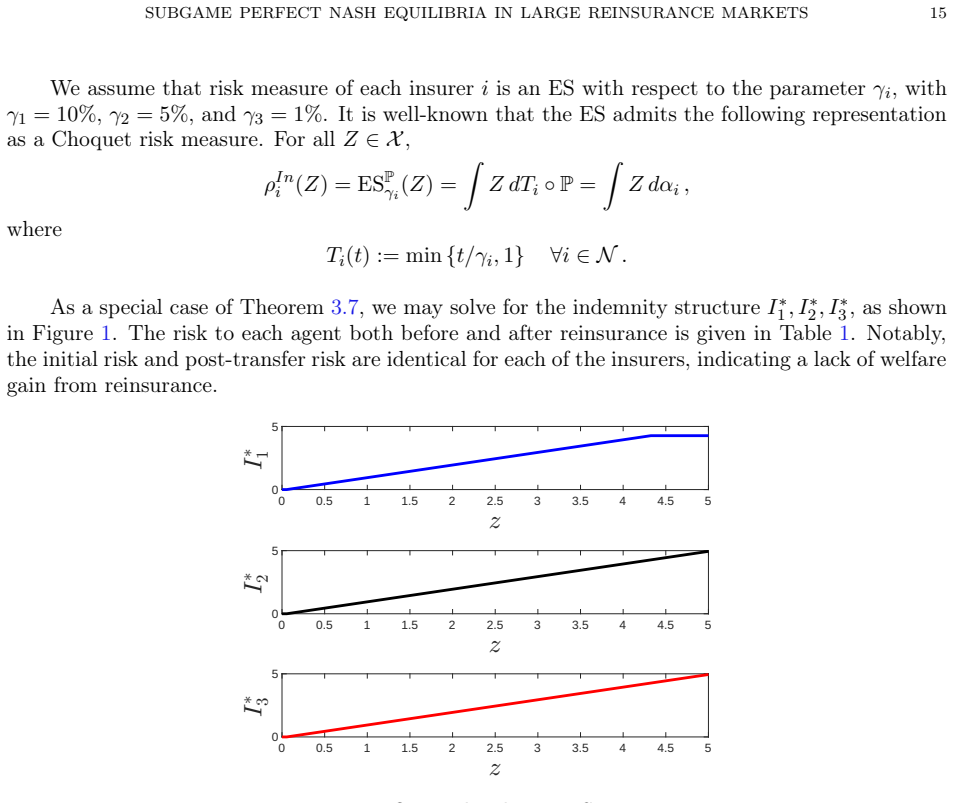
- In the paper's numerical example, adding a second reinsurer moves every insurer from zero welfare gain to a strictly positive welfare gain, while both reinsurers remain at or just above their participation constraint, the opposite of the monopoly Stackelberg outcome.
- Equilibrium premia are Choquet integrals evaluated at the indemnity functions selected by generous distribution, giving a fully computable recipe for equilibrium contracts once capacities are specified.
Reading between the lines
- We infer that the second-lowest true preference is a nonlinear analogue of Bertrand competition under heterogeneous beliefs: the marginal price is the loser's willingness to pay, so the number of reinsurers matters through the second-lowest bid rather than the most aggressive one.
- We infer that the generous-distribution tie-break is the fragile hinge of the whole construction; the proof uses it to make the low-preference reinsurer's profit exactly zero at the equilibrium price, so replacing it with a different tie-break rule would plausibly change the SPNE set or break Pareto optimality.
- We infer that the comonotone result can be read as a worst-case pricing theorem: a reinsurer who knows only the marginals of the losses can price as if losses moved together, and the same equilibrium characterization holds, suggesting an empirical comparison of equilibrium prices under known versus worst-case dependence.
- We infer that the framework leaves room for a converse: showing that every SPNE must belong to $\beth\times\aleph$ under the two assumptions, or exhibiting SPNEs outside that class, would complete the characterization rather than leave it one-directional.
Editorial analysis
A structured set of objections, weighed in public.
Referee Report
Summary. This paper studies a sequential-move reinsurance market with multiple insurers on the demand side and multiple reinsurers on the supply side, where all agents have Choquet risk measures and pricing uses Choquet-integral premium principles. The market is modeled as a Stackelberg-type game in which reinsurers set pricing capacities first and insurers choose indemnity functions afterward. The authors introduce a backward-induction lemma (Lemma 3.1) that decomposes subgame perfect Nash equilibria (SPNEs) into insurer optimality at every price vector and a reduced Nash equilibrium among reinsurers. Using a 'marginal indemnification' representation, they describe the insurers' optimal responses (Proposition 3.2) and, under an additional tie-breaking assumption ('generous distribution', Assumption 3.4), define a class ℵ of insurer strategies. They then define a class ℶ of reinsurer pricing vectors (Definition 3.6) and claim to characterize SPNEs by the set ℶ×ℵ when reinsurers are risk neutral (Theorem 3.7) or when risks are comonotone (Theorem 3.8). They also characterize Pareto-optimal allocations (Proposition 3.11) and show that the constructed equilibria induce Pareto-optimal allocations (Theorem 3.12). A numerical example compares the monopoly (Stackelberg) outcome with the competitive outcome and demonstrates a welfare gain for insurers from competition.
Significance. The paper makes a useful step by extending the single-insurer models of Zhu et al. (2023) and Ghossoub and Zhu (2024) to multiple insurers and multiple reinsurers. The backward-induction decomposition and the marginal-indemnification characterization are clean and well suited to Choquet preferences. The sufficiency theorems are proved in detail, and the numerical example concretely illustrates the welfare effect of supply-side competition. The authors are transparent about Assumption 3.4, and the proofs are self-contained apart from the cited single-insurer results. However, the central claim of 'characterizing' SPNEs is not supported by the theorems, which only establish that every profile in ℶ×ℵ is an SPNE. Moreover, the construction depends critically on the tie-breaking assumption, which is not a consequence of the economic primitives. As a sufficiency or construction result, the paper is credible; as a characterization, it overreaches.
major comments (3)
- [Theorems 3.7 and 3.8 (Sections 3.2-3.3)] The paper's abstract and introduction state that Theorems 3.7 and 3.8 'characterize' the SPNEs of the market, but both theorems assert only that any strategy in ℶ×ℵ is an SPNE; no converse is proved. Lemma 3.1 gives an 'if and only if' decomposition, yet the proofs of Theorems 3.7 and 3.8 use only the forward direction, and Appendix A does not derive necessary conditions that an arbitrary SPNE must belong to ℶ×ℵ. Consequently, the set ℶ×ℵ could be a proper subset of the SPNEs, and the paper's language in the abstract, the paragraph preceding Theorem 3.7 ('Our main result provides a characterization of SPNEs'), and Section 5 overstates what is shown. To support a characterization claim, the authors would need to prove that every SPNE lies in ℶ×ℵ (or in a natural extension) under the stated assumptions; alternatively, they should reframe the results as a construction of a family of SPNEs and adjust the title, abstract, and conclusion accordingly.
- [Assumption 3.4 and Appendix A.1] Assumption 3.4 (with Definition 3.3) imposes that each insurer always selects an optimal indemnity that distributes generously among equally priced reinsurers. This tie-breaking rule is not derived from the Choquet preferences or the extensive form of the game; it is an additional equilibrium-selection constraint. The deviation argument in the proof of Theorem 3.7 (Appendix A.1) relies throughout on the implications 'unique lowest price implies γ_ij=1' and 'not lowest price implies γ_ij=0'. These implications hold only when the insurer uses the generous tie-break. If an insurer used any other optimal tie-break (for example, splitting coverage among tied reinsurers or favoring a different reinsurer), the same price vector ν* need not be an SPNE, and the welfare conclusions of Theorem 3.12 could fail. The paper should either motivate Assumption 3.4 as a standard refinement, or show that the results are robust across all optimal tie-breaking rules.
- [Equations (4) and the role of additivity] The multi-insurer extension in Theorems 3.7 and 3.8 is obtained through additivity of the reinsurers' risk measures under risk neutrality or comonotonicity. In the proof of Theorem 3.7, Equation (4) is obtained 'by repeatedly applying (Zhu et al., 2023, Proposition 3.9) for each i', and the comonotone case in Theorem 3.8 uses comonotone additivity. As a result, the 'large market' results do not involve cross-insurer strategic interaction beyond summation, and the equilibrium set is effectively a product of single-insurer equilibria. The authors should state this explicitly and explain what genuinely new economic phenomenon is captured beyond the aggregation and the welfare example, so that the contribution relative to Zhu et al. (2023) is clear.
minor comments (4)
- [Definition 3.3] Definition 3.3 states 'for almost all z∈[0,1]', but the indemnity functions are defined on [0,M]; this should be [0,M].
- [Definition 3.6(2)] Definition 3.6(2) says that 'there are always at least two reinsurers charging a price equal to the second-lowest true preference', but the formal condition allows k=0, i.e., the tie may involve the insurer's own retention rather than another reinsurer. The wording should be adjusted to clarify that the tie may involve the null provider (retention).
- [Theorem 3.8 proof] In the proof of Theorem 3.8, the notation I*_{ij}(ν*_{i1},...,ν*_{im}) appears before the full strategy tuple is defined; this is a minor notational issue.
- [Table 2] Table 2 reports a post-transfer risk for Reinsurer 2 of -0.000993, which is very close to zero; a brief comment on numerical precision would be helpful.
Circularity Check
No significant circularity: the 'SPNE' theorems are conditional sufficiency results built on explicit assumptions and external single-insurer theorems; the aggregation step is new.
full rationale
The paper's derivation chain does not reduce to its own inputs. Proposition 3.2 is imported from Boonen and Ghossoub (2021), a published theorem for a single insurer and multiple reinsurers; applying it insurer-by-insurer is valid because insurer problems separate under fixed prices. Definition 3.3 and Assumption 3.4 explicitly restrict attention to 'generous' tie-breaking, and the set ℶ is then defined by independent price conditions in Definition 3.6. Theorems 3.7 and 3.8 prove only the forward direction: every profile in ℶ×ℵ is an SPNE, not that every SPNE lies in ℶ×ℵ, so the word 'characterize' in the abstract and introduction overstates the logical content. That overstatement is a scope and correctness issue, not a circularity. The proof of Theorem 3.7 invokes (Zhu et al., 2023, Proposition 3.9) to evaluate the per-contract payoff under generous distribution; this is a load-bearing citation to work with overlapping authorship, but it is a published theorem with fixed assumptions that do not include the multi-insurer conclusion, and the paper supplies the additional aggregation argument via separability under risk-neutrality or comonotonicity. Theorem 3.12 similarly applies (Zhu et al., 2023, Theorems 4.4 and 4.12) per insurer and then sums; again, the cited results are independent support rather than restatements of the target theorem. No equation is defined in terms of, or fitted to, the conclusion it is used to prove.
Assumptions & free parameters
assumptions (6)
- standard math Boonen and Ghossoub (2021), Theorem 3.1: characterization of optimal indemnities for one insurer facing multiple reinsurers.
- standard math Zhu et al. (2023), Proposition 3.9: baseline reinsurer payoff formula under generous distribution.
- standard math Zhu et al. (2023), Theorems 4.4 and 4.12: individual rationality and Pareto optimality in the single-insurer market.
- ad hoc to paper Assumption 3.4: insurers always select an optimal indemnity that distributes generously among equally priced reinsurers.
- domain assumption Assumption 2.1: the aggregate indemnity of each insurer is 1-Lipschitz and non-decreasing (no double coverage).
- standard math For the comonotone case, the underlying probability space is atomless so a comonotone vector with given marginals exists (Föllmer and Schied, 2011, Lemma A.23).
Cite this review
Pith. "Pith review of Subgame Perfect Nash Equilibria in Large Reinsurance Markets." pith.science (2026). https://pith.science/paper/AESCTUD5
@misc{pith2026250607291,
  author       = {Pith},
  title        = {Pith review of: Subgame Perfect Nash Equilibria in Large Reinsurance Markets},
  year         = {2026},
  howpublished = {\url{https://pith.science/paper/AESCTUD5}},
  note         = {Machine review of arXiv:2506.07291}
}
read the original abstract
We consider a model of a reinsurance market consisting of multiple insurers on the demand side and multiple reinsurers on the supply side, thereby providing a unifying framework and extension of the recent literature on optimality and equilibria in reinsurance markets. Each insurer has preferences represented by a general Choquet risk measure and can purchase coverage from any or all reinsurers. Each reinsurer has preferences represented by a general Choquet risk measure and can provide coverage to any or all insurers. Pricing in this market is done via a nonlinear pricing rule given by a Choquet integral. We model the market as a sequential game in which the reinsurers have the first-move advantage. We characterize the Subgame Perfect Nash Equilibria in this market in some cases of interest, and we examine their Pareto efficiency. In addition, we consider two special cases of our model that correspond to existing models in the related literature, and we show how our findings extend these previous results. Finally, we illustrate our results in a numerical example.
Figures


Reference graph
Works this paper leans on
-
[1]
Allais, M. (1953): L' \'E xtension des Th \'e ories de l' \'E quilibre \'E conomique General et du Rendement Social au Cas du Risque , Econometrica, 21, 269--290
work page 1953
-
[2]
Arrow, K. (1953): L e R \^ole des V aleurs B oursi\`eres pour la R \'epartition la M eilleure des R isques, Colloques Internationaux du CNRS, XL, 41--48, english version: ``The Role of Securities in the Optimal Allocation of Risk-Bearing'', Review of Economic Studies, 1964, 31(2):91–96
work page 1953
-
[3]
Baton, B. and J. Lemaire (1981 a ): T he B argaining S et of a R einsurance M arket, ASTIN Bulletin, 12, 101--114
work page 1981
-
[4]
--- -.1pt --- -.1pt --- (1981 b ): T he C ore of a R einsurance M arket, ASTIN Bulletin, 12, 57--71
work page 1981
-
[5]
Boonen, T. J. and M. Ghossoub (2021): Optimal Reinsurance with Multiple Reinsurers: Distortion Risk Measures, Distortion Premium Principles, and Heterogeneous Beliefs, Insurance: Mathematics and Economics, 101, 23--37
work page 2021
-
[6]
Pareto Optima in Reinsurance Contracting, European Journal of Operational Research, 307, 382--391
--- -.1pt --- -.1pt --- (2023): Bowley vs. Pareto Optima in Reinsurance Contracting, European Journal of Operational Research, 307, 382--391
work page 2023
-
[7]
(1962): E quilibrium in a R einsurance M arket, Econometrica, 30, 424--444
Borch, K. (1962): E quilibrium in a R einsurance M arket, Econometrica, 30, 424--444
work page 1962
-
[8]
Cao, J., D. Li, V. R. Young, and B. Zou (2022): Stackelberg Differential Game for Insurance under Model Ambiguity , Insurance: Mathematics and Economics, 106, 128--145
work page 2022
Show all 26 references
-
[9]
and R.-A
Carlier, G. and R.-A. Dana (2003): Pareto Efficient Insurance Contracts when the Insurer's Cost Function is Discontinuous, Economic Theory, 21, 871--893
2003
-
[10]
Chan, F.-Y. and H. U. Gerber (1985): The Reinsurer's Monopoly and the Bowley Solution , ASTIN Bulletin, 15, 141--148
1985
-
[11]
Chen, L. and Y. Shen (2018): On a New Paradigm of Optimal Reinsurance: a Stochastic S tackelberg Differential Game between an Insurer and a Reinsurer , ASTIN Bulletin, 48, 905--960
2018
-
[12]
Cheung, K. C., S. C. P. Yam, and Y. Zhang (2019): Risk-Adjusted Bowley Reinsurance under Distorted Probabilities, Insurance: Mathematics and Economics, 86, 64--72
2019
-
[13]
(1959): T heory of V alue , New York: Wiley
Debreu, G. (1959): T heory of V alue , New York: Wiley
1959
-
[14]
F \"o llmer, H. and A. Schied (2011): Stochastic Finance: An Introduction in Discrete Time, Walter de Gruyter
2011
-
[15]
Ghossoub, M. and M. B. Zhu (2024): Stackelberg Equilibria with Multiple Policyholders, Insurance: Mathematics and Economics, 116, 189--201
2024
-
[16]
(1992): E conomic T heory of R isk E xchanges: A R eview, in G.\ Dionne (ed.), Contributions to Insurance Economics , Kluwer Academic publishers
Gollier, C. (1992): E conomic T heory of R isk E xchanges: A R eview, in G.\ Dionne (ed.), Contributions to Insurance Economics , Kluwer Academic publishers
1992
-
[17]
--- -.1pt --- -.1pt --- (2000): O ptimal I nsurance D esign: W hat C an W e D o W ith and W ithout E xpected U tility? in G.\ Dionne (ed.), Handbook of Insurance , Kluwer Academic publishers
2000
-
[18]
--- -.1pt --- -.1pt --- (2013): T he E conomics of O ptimal I nsurance D esign, in G.\ Dionne (ed.), Handbook of Insurance -- 2^ nd ed.\ , Springer
2013
-
[19]
(1977): \'E change de R isques entre A ssureurs et T h\'eorie des J eux, ASTIN Bulletin, 9, 155--180
Lemaire, J. (1977): \'E change de R isques entre A ssureurs et T h\'eorie des J eux, ASTIN Bulletin, 9, 155--180
1977
-
[20]
--- -.1pt --- -.1pt --- (1991): Cooperative Game Theory and its Insurance Applications , ASTIN Bulletin, 21, 17--40
1991
-
[21]
Li, D. and V. R. Young (2021): Bowley Solution of a Mean--Variance Game in Insurance , Insurance: Mathematics and Economics, 98, 35--43
2021
-
[22]
Louberg\'e, H. and G. Dionne (2025): Developments in Risk and Insurance Economics: The Past 50 Years , in G.\ Dionne (ed.), Handbook of Insurance -- 3^ rd ed.\ -- Vol.\ 1 , Kluwer Academic publishers
2025
-
[23]
Zamir, and E
Maschler, M., S. Zamir, and E. Solan (2020): Game Theory , Cambridge University Press
2020
-
[24]
(1992): Risk E xchange I : A U nification of S ome E xisting R esults, Scandinavian Actuarial Journal, 1992, 15--39
Taylor, G. (1992): Risk E xchange I : A U nification of S ome E xisting R esults, Scandinavian Actuarial Journal, 1992, 15--39
1992
-
[25]
(1968): T he T heory of S yndicates, Econometrica, 36, 119--132
Wilson, R. (1968): T he T heory of S yndicates, Econometrica, 36, 119--132
1968
-
[26]
Zhu, M. B., M. Ghossoub, and T. J. Boonen (2023): Equilibria and Efficiency in a Reinsurance Market, Insurance: Mathematics and Economics, 113, 24--49
2023
Reviewed August 7, 2026 · model on record in the stance chip above.
Discussion (0). Sign in to comment.