REVIEW 2 major objections 4 minor 53 references
On the stationary Navier-Stokes equations in distorted pipes under energy-stable outflow boundary conditions
T0 review · 2 major / 4 minor · reviewed 2026-08-07 · deepseek-v4-flash
Pith's one-line read The paper claims that stationary incompressible pipe flow with an energy-stable directional do-nothing outlet condition admits weak solutions for data of arbitrary size, and unique solutions for small data.
desk verdict Solid n=3 proof of unrestricted solvability for a directional do-nothing outlet condition, but the n=2 case has a trace-exponent gap that needs fixing. read the letter →
The pith
A machine-rendered reading of the paper's core claim, the machinery that carries it, and where it could break.
The reading
What carries the argument
The central mechanism is the directional do-nothing outlet condition $\eta\frac{\partial u}{\partial\nu}-p\nu+\frac{1}{2}[u\cdot\nu]^{-}(u-W_*)=\sigma_*\nu$, whose quadratic outlet term provides energy stability and, together with the reference flow $W_*$, generates the sign terms used in the contradiction. The technical hinge is Corollary 2.1: a harmonic divergence-free vector field that vanishes on the inlet and walls has zero normal component of its normal derivative on the flat outlet, a property established by reducing to straight-cylinder geometry in Lemmas 2.2 and 2.3. That property is combined with Bernoulli's law for the limiting Euler flow, which makes the limiting pressure constant on the walls, and with the representation $W_*=\psi_*\nu$ on the outlet, to force the final sign contradiction. The Leray-Schauder principle then converts the a priori bound into existence, while Lemma 2.4's divergence inversion supplies the pressure associated to a velocity field.
What would settle it
Search for a harmonic divergence-free vector field $v\in W^{2,3/2}(\Omega;\mathbb{R}^n)$ in an admissible domain with $v=0$ on $\Gamma_I\cup\Gamma_W$; if such a field had $\frac{\partial v}{\partial\nu}\cdot\nu\neq 0$ somewhere on $\Gamma_O$, Corollary 2.1 would be false and the contradiction proof would collapse. A more decisive test would be to build a domain differing only by a curved outlet and exhibit data for which system (1.3) has no weak solution, which would show the flat-outlet assumption is not merely technical.
Extended reading notes
Core claim
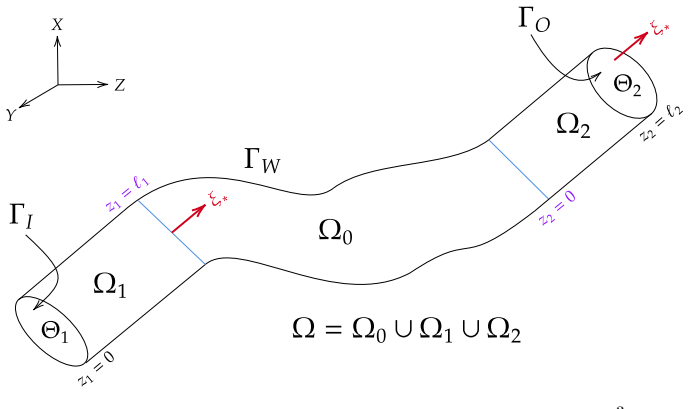
On the paper's own terms, the central claim is Theorem 3.2: for admissible domains in dimensions two and three, meaning bounded pipes whose inlet and outlet are flat cross-sections of two cylinders sharing the same axis, and for any inflow in the Lions-Magenes class with nonnegative flux, any square-integrable body force, and any outlet traction, the boundary-value problem (1.3) has at least one weak solution in the sense of Definition 3.1. The solution is written as a reference flow plus a perturbation vanishing on the inlet and walls, and existence follows from the Leray-Schauder principle once a uniform a priori bound is known. The bound is achieved by contradiction: scaling an allegedly unbounded sequence yields a nontrivial stationary Euler solution, Bernoulli's law forces its pressure to be constant on the connected inlet-wall component, a harmonic solenoidal-field property makes the outlet pressure non-positive, and testing the Euler equation with the reference flow yields the required sign contradiction. No smallness condition is needed for existence; Theorem 4.1 adds uniqueness when the data are small.
Load-bearing premise
The load-bearing premise is that the inlet and outlet are flat cross-sections of straight cylinders aligned along the same axis; if the outlet is curved or oblique, the harmonic-field sign property that drives the contradiction can fail, as the annulus example in Remark 2.1 illustrates.
Editorial extensions
If this is right
- Stationary viscous flow in a two- or three-dimensional pipe with the directional do-nothing outlet condition exists for inflows and forces of arbitrary size, removing the small-data restriction attached to the classical do-nothing condition.
- Every weak solution carries a uniquely determined pressure and, by Theorem 3.1, is regular enough that the system and boundary conditions hold in strong sense.
- Under a smallness condition on the data, the weak solution is unique, so near equilibrium the model is well-posed as well as solvable.
- The argument extends, as stated in Remark 1.1, to pipes with several rectangular or cylindrical inlets and outlets, widening the range of computationally relevant geometries covered.
Reading between the lines
- The flat-outlet geometry is likely essential: the annulus example in Remark 2.1 shows the harmonic-field sign property can fail on curved boundaries, so extending existence to oblique or curved outlets would probably require a different a priori bound.
- A quantitative byproduct of the proof, were the constants tracked, would be an explicit although astronomically large bound on the velocity norm in terms of the data, which could inform numerical stopping criteria.
- Because the directional do-nothing term penalizes backflow, the theorem gives theoretical support to DDN-based CFD codes in hemodynamics and aerodynamics even at high Reynolds numbers, provided the outlet is modeled as flat.
- The uniqueness threshold in Theorem 4.1 is unlikely to be sharp; a natural numerical experiment is to search for multiple steady states at intermediate data sizes, as in other Navier-Stokes outflow problems.
Editorial analysis
A structured set of objections, weighed in public.
Referee Report
Summary. The paper studies the stationary Navier-Stokes equations in bounded two- and three-dimensional pipe-like domains with an assigned inlet velocity, no-slip walls, and a directional do-nothing (DDN) outflow condition. The main result, Theorem 3.2, claims unrestricted existence of weak solutions for arbitrary data in W^{3/2,2} inflow class and L^2 forcing, without smallness restrictions, for n=2 and n=3. The proof uses the Leray-Schauder principle and an a priori estimate obtained by contradiction: assuming unbounded Leray-Schauder branches, the authors pass to an Euler limit, invoke Bernoulli's law to obtain a constant pressure on the inlet/wall portion, use a harmonic-field property at the outlet to get a sign condition, and then seek a contradiction by testing the Euler equation with the reference flow. Section 4 proves uniqueness under a smallness condition, conditional on the existence result. The paper also contains auxiliary results on reference-flow construction, divergence inversion, and regularity of weak solutions.
Significance. If Theorem 3.2 were valid, it would be a substantial contribution: it would establish unrestricted solvability for the stationary Navier-Stokes system under an energy-stable directional do-nothing outflow condition, a problem for which only small-data results were previously available in this setting. The paper is clearly written, the auxiliary lemmas are coherent, and the proof strategy is transparent and does not rely on fitted parameters or circular assumptions. However, the central contradiction argument in Theorem 3.2 depends on a specific integrability claim that is false, and the failure affects both dimensions. Consequently, the main existence theorem is not established by the proof given in the manuscript. The uniqueness theorem in Section 4 remains a conditional result that inherits the existence gap.
major comments (2)
- [§3, Eq. (3.35)-(3.36)] The trace-space contradiction is invalid. The proof claims that if bq*>0, then the double integral in (3.35) is bounded below by (bq*)^{3/2} ∫_{ΓW}∫_{ΓO} |ξ1-ξ2|^{-(n-1/2)} dξ1 dξ2 = +∞. This integrability assertion is false for both n=2 and n=3. For n=2, ΓO and ΓW meet only at two corner points; in local coordinates near a corner with ξ1=(s,0) on ΓO and ξ2=(0,t) on ΓW, the integral behaves like ∫_0^ε∫_0^ε (s^2+t^2)^{-3/4} ds dt, which is finite (in polar coordinates it is ∫ ρ^{-1/2} dρ). For n=3, ΓO and ΓW meet along a curve; with coordinates ξ1=(ρ,t) on ΓO and ξ2=(τ,t') on ΓW, the relevant integral behaves like ∫_{ρ,τ∈[0,ε]}∫_{|u|≤ε} (ρ^2+τ^2+u^2)^{-5/4} dρ dτ du, which is also finite (spherical coordinates give ∫ r^{-1/2} dr). Thus a trace bq that equals bq* on ΓI∪ΓW and has different values on ΓO is admissible in W^{1/3,3/2}(∂Ω), so (3.35) does not force bq*≤0. The subsequent sign contradiction (3.36)-(3.38) cannot be executed, and Theorem 3.2 is unproved for n=2 and n=3. The repairs in Remarks 3.2-3.3 cover only straight rectangular or cylindrical domains, not general admissible distorted pipes.
- [§3, Theorem 3.2 and §4, Theorem 4.1] Because the a priori bound in Theorem 3.2 depends directly on the invalid trace contradiction, the existence of a weak solution for arbitrary data is not established. Theorem 4.1 invokes Theorem 3.2 for existence, so its uniqueness statement is at present conditional on an unproved existence result. The uniqueness argument in Theorem 4.1 itself appears coherent, but it cannot compensate for the failure of the main existence proof.
minor comments (4)
- [§2, Lemma 2.1] In the proof of Lemma 2.1, the citation '(2.14)' appears before equation (2.14) is introduced; the intended reference is likely to the definition of Z_0 or to equation (2.13). Please correct the cross-reference.
- [§3, Eq. (3.21)] When passing from (3.20) to (3.21), the boundary integral is dropped because its sign is favorable; this deserves an explicit comment, as the displayed 'so that' is terse and the sign of the term ((v_λ+W_*)·ν + [(v_λ+W_*)·ν]^-) is nonnegative.
- [§3, Theorem 3.1] Theorem 3.1 relies on the external regularity results [40, Theorem 3.1] and [3, Corollary A.3] for Stokes systems with mixed boundary conditions in nonsmooth domains. Since these results are not reproduced, a sentence stating their exact hypotheses (for example, Lipschitz domains with right-angle edges) would improve the verifiability of the proof.
- [Throughout] The notation W^{3/2,2}_+(ΓI;R^n) is defined via functions in W^{3/2,2}(∂Ω;R^n) supported on ΓI; the phrase 'restrictions to ΓI of vector fields having non-negative flux' is slightly ambiguous because the flux is defined as -∫_{ΓI} g·ν ≥ 0. Clarifying the sign convention at first use would help the reader.
Circularity Check
No circularity: the existence proof is self-contained and the self-citations are contextual rather than load-bearing.
full rationale
The paper's central claim, Theorem 3.2, is an unrestricted existence theorem proved by the Leray–Schauder principle with an a priori estimate obtained by contradiction: one rescales a hypothetical unbounded sequence of solutions, passes to a limiting Euler solution, applies Bernoulli's law, uses the harmonic-field property from Corollary 2.1, and derives a sign contradiction. None of these steps assumes the theorem being proved. The reference flow W* is constructed in Lemma 2.1 via a standard Stokes lifting, not extracted from the equation being solved; it is an input to the weak formulation, not a disguised solution. The regularity input for the Stokes system with mixed boundary conditions comes from external results [40, Theorem 3.1] and [3, Corollary A.3], and the Bernoulli law is cited from [25, Lemma 4] (with [2, Theorem 2.2] and [26, Theorem 1]); none of these is a self-citation. The self-citations [18], [42], [43], and [48] appear only in the introduction as background references for prior work on related boundary conditions and pipe flows, not as premises of the proof. Corollary 2.1 is derived in the paper from Lemmas 2.2–2.3 rather than imported as an assumption. The reader-supplied concern about a possible gap in the n=2 trace-space contradiction is a correctness issue (finite kernel integral at corners), not a circularity issue, because it does not make any prediction or derivation equivalent to its inputs by construction. There are no fitted parameters, no quantity called a prediction that is actually an input, and no uniqueness or other theorem imported from the authors' own prior work to force the conclusion. The paper is therefore not circular.
Assumptions & free parameters
assumptions (7)
- standard math Leray-Schauder fixed-point principle
- standard math Steady Stokes regularity with mixed Dirichlet/Neumann boundary conditions on nonsmooth domains
- standard math Bernoulli law for stationary Euler solutions with vanishing velocity on a boundary component
- standard math Bogovskii-type divergence inversion on Lipschitz domains
- standard math Unique continuation for harmonic functions
- domain assumption Admissible pipe geometry: straight cylindrical inlet and outlet sharing one axis direction ξ*, with flat cross-sectional inlet/outlet
- domain assumption Lions-Magenes inflow class with nonnegative flux
Cite this review
Pith. "Pith review of On the stationary Navier-Stokes equations in distorted pipes under energy-stable outflow boundary conditions." pith.science (2026). https://pith.science/paper/ZOXYXTB2
@misc{pith2026250607331,
  author       = {Pith},
  title        = {Pith review of: On the stationary Navier-Stokes equations in distorted pipes under energy-stable outflow boundary conditions},
  year         = {2026},
  howpublished = {\url{https://pith.science/paper/ZOXYXTB2}},
  note         = {Machine review of arXiv:2506.07331}
}
read the original abstract
The steady motion of a viscous incompressible fluid in distorted pipes, of finite length, is modeled through the Navier-Stokes equations with mixed boundary conditions: the inflow is given by an arbitrary member of the Lions-Magenes class with positive influx, and the fluid motion is subject to a directional do-nothing boundary condition on the outlet, together with the standard no-slip assumption on the remaining walls of the domain. Existence of a weak solution to such Navier-Stokes system is proved without any restriction on the data (that is, inlet velocity and external force) by means of the Leray-Schauder Principle, in which the required a priori estimate is obtained by a contradiction argument that employs Bernoulli's law for solutions of the stationary Euler equations, as well as some properties of harmonic divergence-free vector fields. Under a suitable smallness assumption on the data, we also prove the unique solvability of the boundary-value problem.
Figures


Figures from the paper (3 more)


Reference graph
Works this paper leans on
-
[1]
C. J. Amick. Steady solutions of the Navier-Stokes equations in unbounded channels and pipes. Annali della Scuola Normale Superiore di Pisa - Classe di Scienze, 4(3):473–513, 1977
work page 1977
-
[2]
C. J. Amick. Existence of solutions to the nonhomogeneous steady Navier-Stokes equations.Indiana University Mathematics Journal, 33(6):817–830, 1984
work page 1984
-
[3]
M. Beneˇ s. A note on regularity and uniqueness of natural convection with effects of viscous dissi- pation in 3D open channels.Zeitschrift f¨ ur angewandte Mathematik und Physik, 65:961–975, 2014
work page 2014
-
[4]
M. Beneˇ s and P. Kuˇ cera. Solutions to the Navier–Stokes equations with mixed boundary conditions in two-dimensional bounded domains.Mathematische Nachrichten, 289(2-3):194–212, 2016
work page 2016
-
[5]
C. Bertoglio, A. Caiazzo, Y. Bazilevs, M. Braack, M. Esmaily, V. Gravemeier, A. L. Marsden, O. Pironneau, I. E. Vignon-Clementel, and W. A. Wall. Benchmark problems for numerical treat- ment of backflow at open boundaries.International Journal for Numerical Methods in Biomedical Engineering, 34(2):e2918, 2018
work page 2018
- [6]
-
[7]
M. Braack and P. B. Mucha. Directional do-nothing condition for the Navier-Stokes equations. Journal of Computational Mathematics, pages 507–521, 2014
work page 2014
-
[8]
H. B. Bradley.Petroleum Engineering Handbook. Society of Petroleum Engineers, Richardson, Texas, 1987
work page 1987
Show all 53 references
-
[9]
C.-H. Bruneau. Boundary conditions on artificial frontiers for incompressible and compressible Navier-Stokes equations.ESAIM: Mathematical Modelling and Numerical Analysis, 34(2):303–314, 2000
2000
-
[10]
Bruneau and P
C.-H. Bruneau and P. Fabrie. New efficient boundary conditions for incompressible Navier-Stokes equations: a well-posedness result.ESAIM: Mathematical Modelling and Numerical Analysis, 30(7):815–840, 1996
1996
-
[11]
Cattabriga
L. Cattabriga. Su un problema al contorno relativo al sistema di equazioni di Stokes.Rendiconti del Seminario Matematico della Universit` a di Padova, 31:308–340, 1961
1961
-
[12]
Conca, F
C. Conca, F. Murat, and O. Pironneau. The Stokes and Navier-Stokes equations with boundary conditions involving the pressure.Japanese Journal of Mathematics, 20(2):279–318, 1994. 24
1994
-
[13]
Dautray and J.-L
R. Dautray and J.-L. Lions.Mathematical Analysis and Numerical Methods for Science and Tech- nology - Volume 2: Functional and Variational Methods. Springer Science & Business Media, 1999
1999
-
[14]
S. Dong. A convective-like energy-stable open boundary condition for simulations of incompressible flows.Journal of Computational Physics, 302:300–328, 2015
2015
-
[15]
Fursikov and R
A. Fursikov and R. Rannacher. Optimal Neumann control for the two-dimensional steady-state Navier-Stokes equations. InNew Directions in Mathematical Fluid Mechanics, pages 193–221. Springer, 2009
2009
-
[16]
G. P. Galdi.An Introduction to the Mathematical Theory of the Navier-Stokes Equations: Steady- State Problems. Springer Science & Business Media, 2011
2011
-
[17]
G. P. Galdi, A. M. Robertson, R. Rannacher, and S. Turek.Hemodynamical Flows: Modeling, Analysis and Simulation (Oberwolfach Seminars). Springer Science & Business Media, 2008
2008
-
[18]
Gazzola, M
F. Gazzola, M. V. Korobkov, X. Ren, and G. Sperone. The steady Navier-Stokes equations in a system of unbounded channels with sources and sinks.arXiv preprint arXiv:2505.14642, 2025
2025 arXiv
-
[19]
Gilbarg and N
D. Gilbarg and N. S. Trudinger.Elliptic Partial Differential Equations of Second Order, volume
-
[20]
Girault and P.-A
V. Girault and P.-A. Raviart.Finite Element Methods for Navier-Stokes Equations: Theory and Algorithms, volume 5. Springer Science & Business Media, 2012
2012
-
[21]
P. M. Gresho. Some current CFD issues relevant to the incompressible Navier-Stokes equations. Computer Methods in Applied Mechanics and Engineering, 87(2-3):201–252, 1991
1991
-
[22]
Grisvard.Elliptic Problems in Nonsmooth Domains
P. Grisvard.Elliptic Problems in Nonsmooth Domains. Society for Industrial and Applied Mathe- matics, Philadelphia, 2011
2011
-
[23]
J. G. Heywood, R. Rannacher, and S. Turek. Artificial boundaries and flux and pressure conditions for the incompressible Navier–Stokes equations.International Journal for Numerical Methods in Fluids, 22(5):325–352, 1996
1996
-
[24]
V. John. Higher order finite element methods and multigrid solvers in a benchmark problem for the 3D Navier–Stokes equations.International Journal for Numerical Methods in Fluids, 40(6):775–798, 2002
2002
-
[25]
L. V. Kapitanskii and K. Pileckas. Spaces of solenoidal vector fields in boundary value problems for the Navier-Stokes equations in regions with noncompact boundaries.Matematicheskii Institut imeni Steklova Trudy, 159:5–36, 1983
1983
-
[26]
M. V. Korobkov. Bernoulli law under minimal smoothness assumptions.Doklady Mathematics, 83(1):107–110, 2011
2011
-
[27]
M. V. Korobkov, K. Pileckas, and R. Russo. Solution of Leray’s problem for stationary Navier-Stokes equations in plane and axially symmetric spatial domains.Annals of Mathematics, 181(2):769–807, 2015
2015
-
[28]
M. V. Korobkov, K. Pileckas, and R. Russo. Solvability in a finite pipe of steady-state Navier– Stokes equations with boundary conditions involving Bernoulli pressure.Calculus of Variations and Partial Differential Equations, 59(1):1–22, 2020
2020
-
[29]
M. V. Korobkov, K. Pileckas, and R. Russo.The Steady Navier-Stokes System: Basics of the Theory and the Leray Problem. Springer, 2024. 25
2024
-
[30]
Kraˇ cmar and J
S. Kraˇ cmar and J. Neustupa. A weak solvability of a steady variational inequality of the Navier– Stokes type with mixed boundary conditions.Nonlinear Analysis: Theory, Methods & Applications, 47(6):4169–4180, 2001
2001
-
[31]
Kraˇ cmar and J
S. Kraˇ cmar and J. Neustupa. Modeling of the unsteady flow through a channel with an artificial outflow condition by the Navier–Stokes variational inequality.Mathematische Nachrichten, 291(11- 12):1801–1814, 2018
2018
-
[32]
O. A. Ladyzhenskaya.The Mathematical Theory of Viscous Incompressible Flow, volume 76. Gordon and Breach, New York, 1969
1969
-
[33]
O. A. Ladyzhenskaya and V. A. Solonnikov. Determination of the solutions of Navier-Stokes sta- tionary boundary-value problems with infinite dissipation in unbounded regions.Doklady Akademii Nauk USSR, 249(4):828–831, 1979
1979
-
[34]
Landau and E
L. Landau and E. Lifshitz.Theoretical Physics: Fluid Mechanics, volume 6. Pergamon Press, 1987
1987
-
[35]
Lanzend¨ orfer and J
M. Lanzend¨ orfer and J. Hron. On multiple solutions to the steady flow of incompressible fluids subject to do-nothing or constant traction boundary conditions on artificial boundaries.Journal of Mathematical Fluid Mechanics, 22(1):1–18, 2020
2020
-
[36]
J. Leray. ´Etude de diverses ´ equations int´ egrales non lin´ eaires et de quelques probl` emes que pose l’hydrodynamique.Journal de Math´ ematiques Pures et Appliqu´ ees, 12:1–82, 1933
1933
-
[37]
V. G. Maz’ya and J. Rossmann.Elliptic Equations in Polyhedral Domains. American Mathematical Society, 2010
2010
-
[38]
S. A. Nazarov and M. Specovius-Neugebauer. Artificial boundary conditions for the Stokes and Navier-Stokes equations in domains that are layer-like at infinity.Zeitschrift f¨ ur Analysis und ihre Anwendungen, 27(2):125–155, 2008
2008
-
[39]
Neˇ cas.Direct Methods in the Theory of Elliptic Equations
J. Neˇ cas.Direct Methods in the Theory of Elliptic Equations. Springer Science & Business Media, 2011
2011
-
[40]
Neustupa
T. Neustupa. The maximum regularity property of the steady Stokes problem associated with a flow through a profile cascade inL r-framework.Applications of Mathematics, 68(2):171–190, 2022
2022
-
[41]
Neustupa
T. Neustupa. Existence of a steady flow through a rotating radial turbine with an arbitrarily large inflow and an artificial boundary condition on the outflow.Zeitschrift f¨ ur Angewandte Mathematik und Mechanik, 103(10):e202200439, 2023
2023
-
[42]
Nogueira and A
P. Nogueira and A. L. Silvestre. Regularized directional do-nothing boundary conditions for the Navier-Stokes equations: Analytical and numerical study.Applied Mathematics and Computation, 499:129398, 2025
2025
-
[43]
Nogueira, A
P. Nogueira, A. L. Silvestre, and J. Tiago. Steady Navier–Stokes equations with regularized direc- tional do-nothing boundary condition: Optimal boundary control for a velocity tracking problem. Applied Mathematics & Optimization, 91(1):24, 2025
2025
-
[44]
K. A. Ott and R. M. Brown. The mixed problem for the Laplacian in Lipschitz domains.Potential Analysis, 38(4):1333–1364, 2013
2013
-
[45]
Pileckas
K. Pileckas. Spaces of solenoidal vectors.Trudy Matematicheskogo Instituta imeni V. A. Steklova, 159:137–149, 1983
1983
-
[46]
Pileckas
K. Pileckas. Navier–Stokes system in domains with cylindrical outlets to infinity. Leray’s problem. InHandbook of Mathematical Fluid Dynamics, volume 4, pages 445–647. Elsevier Amsterdam, 2007. 26
2007
-
[47]
Rannacher
R. Rannacher. A short course on numerical simulation of viscous flow: discretization, optimization and stability analysis.Discrete & Continuous Dynamical Systems-S, 5(6):1147, 2012
2012
-
[48]
G. Sperone. On the steady motion of Navier–Stokes flows past a fixed obstacle in a three-dimensional channel under mixed boundary conditions.Annali di Matematica Pura ed Applicata (1923-), 200(5):1961–1985, 2021
1923
-
[49]
G. Talenti. Best constant in Sobolev inequality.Annali di Matematica Pura ed Applicata, 110:353– 372, 1976
1976
-
[50]
von K´ arm´ an.Aerodynamics: Selected Topics in the Light of their Historical Development
T. von K´ arm´ an.Aerodynamics: Selected Topics in the Light of their Historical Development. Courier Corporation, 2004
2004
-
[51]
Yosida.Functional Analysis
K. Yosida.Functional Analysis. Springer Science & Business Media, 1995
1995
-
[52]
Zeidler.Nonlinear Functional Analysis and its Applications I: Fixed-Point Theorems
E. Zeidler.Nonlinear Functional Analysis and its Applications I: Fixed-Point Theorems. Springer Science & Business Media, 2013. Alessio F alocchi Dipartimento di Matematica Dipartimento di Eccellenza MUR 2023-2027 Politecnico di Milano Piazza Leonardo da Vinci 32 20133 Milan -...
2013
-
[224]
Springer Science & Business Media, 2001
2001
Reviewed August 7, 2026 · model on record in the stance chip above.
Discussion (0). Continue with ORCID to comment.