REVIEW 2 major objections 4 minor 26 references
p-adic congruences in iterated derivatives of the Weierstrass elliptic function
T0 review · 2 major / 4 minor · reviewed 2026-08-07 · deepseek-v4-flash
Pith's one-line read Weierstrass derivatives obey p-adic Kummer congruences.
desk verdict The Witten♯ moment formulas rest on a wrong identification of y; the Todd case is fine, but Main Theorem A is unsupported as written. read the letter →
The pith
A machine-rendered reading of the paper's core claim, the machinery that carries it, and where it could break.
The reading
What carries the argument
The decisive objects are the sharp construction and the neper-moment formalism. Starting from an orientation $\omega\colon MU\to R$ with coordinate $\xi$ and formal group law $+_F$, the sharped orientation $\omega^\sharp\colon MU\to R^{tT}$ is the one with coordinate $\xi^\sharp=\xi\gamma/(\xi+_F\gamma)$, where $\gamma$ is the inverted local parameter on the Tate fixed-point spectrum $R^{tT}$. The paper computes the associated sharped exponential $\exp_{\omega^\sharp}(x)$ in terms of the Witten exponential, which is encoded by the Weierstrass $\sigma$-function, and extracts the nepers $N_n^\omega$ from $\log(x/\exp_\omega(x))$. The moments $M_n^\omega=(1-c^n)(\mathrm{id}-\psi_p/p)(N_n^\omega)$ are then p-adically integral by the moment theorem of [AHR], and unwinding the formulas gives the elliptic-function expressions of Main Theorem A. The same machinery with the Todd orientation supplies Main Theorem B.
What would settle it
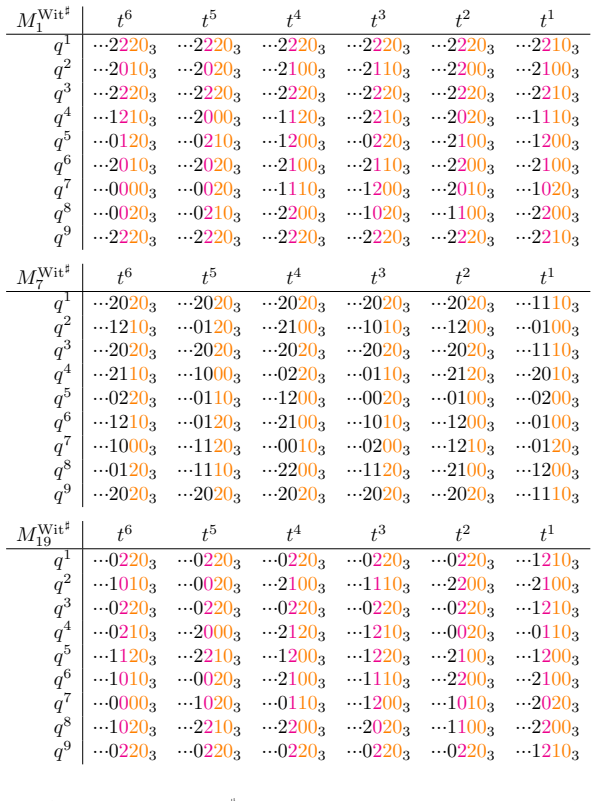
Pick $p=3$ and $c=1+p=4$, take $n=1$ and $n=3$ in the Main Theorem A formulas, and test the moment identity forced by $(r^3-r)/3$: $M_3^{Wit\sharp}\equiv M_1^{Wit\sharp}\pmod 3$ in $\mathbb{Z}JqK((t))^{\wedge}_3$. Checking this against the displayed expansions to any fixed degree is finite, and one failed coefficient would disprove the theorem.
Extended reading notes
Core claim
Main Theorem A asserts that for any $c\in\mathbb{Z}_p^\times\setminus\{\pm 1\}$ there is a p-adic moment sequence valued in $\mathbb{Z}JqK((t))^{\wedge}_p$ whose terms, for $n\ge 1$, are exactly the displayed combinations of $(1-c^n)$, the difference $G_2(q)-pG_2(q^p)$ of second Eisenstein series, and differences of iterated derivatives $\wp_q^{(n-2)}$ evaluated at $\log(1-t)/(-2\pi i)$ and at $p\log(1-t)/(-2\pi i)$, with the $n=1$ and $n=2$ terms carrying extra logarithmic and Eisenstein contributions. A p-adic moment sequence is a sequence $M_n$ with the property that for every rational polynomial $f(r)=\sum_n a_n r^n$ taking $\mathbb{Z}_p^\times$ into $\mathbb{Z}_p$, the sum $\sum_n a_nM_n$ is integrally valued in the coefficient ring; this packages a family of Kummer congruences, for instance $M_p\equiv M_1\pmod p$. The proof computes the nepers of the sharped Witten orientation, applies the operation $\mathrm{id}-\psi_p/p$, and invokes the general theorem that an $\mathbb{E}_\infty$ orientation of a $K(1)$-local ring produces a p-adic moment sequence from its moments.
Load-bearing premise
Everything hinges on the assertion that the Witten orientation can be promoted to a strictly commutative, E-infinity map of spectra; the paper cites a similar case in [AHR] but gives no proof for this exact promotion, and the congruence conclusion needs it.
Editorial extensions
If this is right
- For every p-adically integer-valued test polynomial $f$, the combination $\sum_n a_nM_n^{Wit\sharp}$ lies in $\mathbb{Z}JqK((t))^{\wedge}_p$; in particular $M_p^{Wit\sharp}\equiv M_1^{Wit\sharp}\pmod p$ holds.
- The terms of vanishing t-degree in Main Theorem A match the measure of [Kat77, Lemma 3.5.6], and the terms of vanishing q-degree match the measure of [Lan90, Section 4.3], so the new sequence contains these classical p-adic measures as special slices.
- The Todd-orientation version in Main Theorem B produces a moment sequence built from iterated finite differences, recovering the classical Bernoulli-number moment sequence as the underlying Todd case.
- Because the sharp construction preserves $\mathbb{E}_\infty$ structures, the same proof gives p-adic moment sequences from any other $\mathbb{E}_\infty$ orientation, including the string orientation of tmf and Morava $E$-theories.
Reading between the lines
- A direct p-adic proof may be possible: since the formulas are explicit, one could try to verify the Kummer congruences by q-expansion manipulations alone, which would decouple the number-theoretic conclusion from the homotopy-theoretic input.
- The object behind Main Theorem A is likely a p-adic measure valued in Jacobi forms; identifying it with the construction of [Sof97] would connect the sharped elliptic genus to existing p-adic interpolation of Jacobi forms.
- Applying the same moment computation to the $\sigma$-orientation of tmf would test whether the congruences persist in spectra with torsion, where $KU^{Tate}$-valued invariants cannot see everything.
Editorial analysis
A structured set of objections, weighed in public.
Referee Report
Summary. The paper claims two p-adic moment-sequence theorems. Main Theorem B gives explicit moments for the sharped Todd orientation in terms of finite differences and the element t, while Main Theorem A gives explicit moments for the sharped Witten orientation, expressed through differences of the second Eisenstein series and iterated derivatives of the Weierstrass elliptic function evaluated at q and q^p. The proofs combine the sharp construction of Ando–French–Ganter, the recent E-infinity orientation theorem of Carmeli–Luecke, and the Ando–Hopkins–Rezk theorem that E-infinity orientations of K(1)-local rings produce p-adic moment sequences. The paper is written as a short application note, with the main computational work in Sections 3.1 and 3.2.
Significance. If the two main theorems are correct, this is an attractive new application of E-infinity orientation theory to concrete p-adic congruences, and the explicit formulas give elliptic-function witnesses to Kummer congruences that are not obviously accessible by elementary means. The paper is clearly organized, and the computational parts for the Todd sharp orientation in Section 3.1 are convincing. The paper also profits from stating precise moment formulas rather than only existence statements, and the accompanying tables provide useful empirical confirmation. However, the proof of the main Witten sharp calculation currently rests on two load-bearing inputs that are either identified incorrectly or asserted without proof: the coordinate identification in Section 3.2 and the E-infinity structure on the Witten orientation in Remark 2.21. Both must be addressed before the central claim can be regarded as established.
major comments (2)
- [§3.2, Definition 2.11] At the beginning of Section 3 the authors set 2πiα = y = −log(1−t), i.e. t = 1−e^{−y}. Definition 2.11, however, defines the sharped exponential from an element y satisfying exp_ω(y) = γ. For ω = ω_Wit, after the degree-zero normalization t = βγ this condition reads t = (1−e^{−y})∏_{j≥1}(1−e^{−y}q^j)(1−e^{y}q^j)/(1−q^j)^2, not t = 1−e^{−y}. The expansion in the proof of Main Theorem A of log(exp_Wit(x+y)/exp_Wit(y)) in terms of ℘_q(log(1−t)/(−2πi)) is therefore not the logarithm associated to the sharped Witten orientation as defined, unless the infinite product is 1 in ZJqK((t))^∧_p. The authors need either to use the y that actually solves exp_Wit(y) = γ and recompute the moments, or to prove that the product factor is trivial in the relevant completed ring. Because the explicit formulas in Main Theorem A are the central claim, this gap is load-bearing.
- [Remark 2.21] Remark 2.21 asserts that ω_Wit: MU → (KU^Tate)^∧_p admits an E-infinity structure by changing the target in [AHR, Proposition 10.10] or by obstruction theory, but no proof or reference is supplied. Theorem 2.18, which is the source of the moment-sequence property, requires an E-infinity orientation. The cited Proposition 10.10 is stated for an MU⟨6⟩-orientation, and the passage from MU⟨6⟩ to MU together with the target replacement needs argument. Please supply a complete proof or a precise citation that covers the Witten orientation itself.
minor comments (4)
- [Definition 2.6] The text says 'cf. Theorem 2.4' but the intended reference is Example 2.4, where the additive orientation is discussed.
- [§3.1 and §3.2] Several cross-references are to the wrong numbered item: 'Theorem 2.7' should be 'Example 2.7', 'Theorem 2.11' should be 'Definition 2.11', and in the proof of Main Theorem A 'Theorem 2.2' should be 'Example 2.2' and 'Theorem 3.3' should be 'Lemma 3.3'.
- [Figure 4] The caption of Figure 4 repeats the sentence 'Congruences here relate the colored digits across different tables rather than within columns.'
- [Title figure and figures] The large table of binary expansions at the top of the paper is not referenced in the text, and the figure captions refer to colors that are not described for grayscale printing; please add a pointer and a color description.
Circularity Check
No circularity: the target moment formulas are computed from nepter series via a fixed linear operator, not assumed as inputs; the cited E-infinity inputs are external general theorems.
full rationale
The derivation chain is not circular. Main Theorem A obtains each M_n^{Wit♯} as (1−c^n)(id − ψ_p/p)(N_n^{Wit♯}), where the nepers N_n^{Wit♯} are computed in Section 3.2 from the sharped Witten exponential formula log(x/exp_Wit(x)) + log(exp_Wit(x+y)/exp_Wit(y)). No quantity appearing in the conclusion is fed back as an input: the explicit ℘-derivative and Eisenstein-series expressions are outputs of expanding known generating functions, and the p-adic moment-sequence property is imported from the external Theorem 2.18 (AHR Theorem 6.1). The CL25 theorem that the sharp construction preserves E∞ orientations is a general homotopy-theoretic result whose assumptions do not include the target congruences, so even though it involves the first author, it is not a restatement or fitted version of the claimed moments. The possible correctness gaps flagged in the manuscript — Remark 2.21's unproved extension of AHR Proposition 10.10 to the full Witten orientation, and the Section 3.2 identification y = −log(1−t) versus Definition 2.11's defining condition exp_Wit(y) = γ — are mathematical-support or computation issues, not circularity: even if they invalidate the displayed formulas, the conclusion is not definitionally equal to the inputs. Hence a score of 0 is appropriate for circularity.
Assumptions & free parameters
assumptions (4)
- domain assumption The sharp construction preserves E-infinity orientations (Theorem 2.13, from [CL25, Theorem 5.14]).
- domain assumption An E-infinity orientation of a K(1)-local ring flat over KU_p^ produces a p-adic moment sequence (Theorem 2.18, from [AHR, Theorem 6.1]).
- ad hoc to paper The Witten orientation ω_Wit: MU → (KU^Tate)^_p admits an E-infinity structure (Remark 2.21).
- domain assumption The target rings (KU^{tT})^_p and (KU^{tT,Tate})^_p are flat over KU_p^ and K(1)-local.
Cite this review
Pith. "Pith review of p-adic congruences in iterated derivatives of the Weierstrass elliptic function." pith.science (2026). https://pith.science/paper/HGNH2ZIU
@misc{pith2026250607420,
  author       = {Pith},
  title        = {Pith review of: p-adic congruences in iterated derivatives of the Weierstrass elliptic function},
  year         = {2026},
  howpublished = {\url{https://pith.science/paper/HGNH2ZIU}},
  note         = {Machine review of arXiv:2506.07420}
}
abstract
We use homotopy theoretic methods to prove congruence relations of number theoretic interest. Specifically, we use the theory of $\mathbb E_\infty$ complex orientations to establish $p$-adic K\"ummer congruences among iterated derivatives of the Weierstrass elliptic function. The machinery of Ando, Hopkins, and Rezk was developed with the intended application of taking congruence relations as input and producing $\mathbb E_\infty$-orientations as output. We run their machine in reverse, using as input the recent results of Carmeli and the first author on the existence of $\mathbb E_\infty$-orientations of Tate fixed-point objects.
Figures


Figures from the paper (1 more)

Reference graph
Works this paper leans on
-
[1]
J. F. Adams. Stable homotopy and generalised homology . Chicago Lectures in Mathematics. University of Chicago Press, Chicago, Ill.-London, 1974
1974
-
[2]
Matthew Ando, Christopher P. French, and Nora Ganter. The J acobi orientation and the two-variable elliptic genus. Algebr. Geom. Topol. , 8(1):493--539, 2008
work page 2008
-
[3]
Matthew Ando, Michael J. Hopkins, and Charles Rezk. Multiplicative orientations of ko --theory and the spectrum of topological modular forms. https://rezk.web.illinois.edu/koandtmf.pdf
-
[4]
Algebraic theories of power operations
William Balderrama. Algebraic theories of power operations. J. Topol. , 16(4):1543--1640, 2023
work page 2023
-
[5]
R. R. Bruner, J. P. May, J. E. McClure, and M. Steinberger. H ring spectra and their applications , volume 1176 of Lecture Notes in Mathematics . Springer-Verlag, Berlin, 1986
work page 1986
-
[6]
R. Burklund, T. Schlank, and A. Yuan. The chromatic nullstellensatz. Ann. Math , 2024
work page 2024
-
[7]
Tate-valued Characteristic Classes
Shachar Carmeli and Kiran Luecke. Tate-valued characteristic classes, 2025, 2503.12134
work page Pith review arXiv 2025
-
[8]
The theory of J acobi forms , volume 55 of Progress in Mathematics
Martin Eichler and Don Zagier. The theory of J acobi forms , volume 55 of Progress in Mathematics . Birkh\" a user Boston, Inc., Boston, MA, 1985
work page 1985
Show all 26 references
-
[9]
J. P. C. Greenlees and J. P. May. Generalized T ate cohomology. Mem. Amer. Math. Soc. , 113(543):viii+178, 1995
1995
-
[10]
Hirzebruch
F. Hirzebruch. Topological methods in algebraic geometry , volume Band 131 of Die Grundlehren der mathematischen Wissenschaften . Springer-Verlag New York, Inc., New York, enlarged edition, 1966
1966
-
[11]
Topological modular forms with level structure
Michael Hill and Tyler Lawson. Topological modular forms with level structure. Invent. Math. , 203(2):359--416, 2016
2016
-
[12]
Hopkins and Tyler Lawson
Michael J. Hopkins and Tyler Lawson. Strictly commutative complex orientation theory. Math. Z. , 290(1-2):83--101, 2018
2018
-
[13]
Exotic multiplications on periodic complex bordism
Jeremy Hahn and Allen Yuan. Exotic multiplications on periodic complex bordism. J. Topol. , 13(4):1839--1852, 2020
2020
-
[14]
Nicholas M. Katz. The E isenstein measure and p -adic interpolation. Amer. J. Math. , 99(2):238--311, 1977
1977
-
[15]
p -adic numbers, p -adic analysis, and zeta-functions , volume 58 of Graduate Texts in Mathematics
Neal Koblitz. p -adic numbers, p -adic analysis, and zeta-functions , volume 58 of Graduate Texts in Mathematics . Springer-Verlag, New York, second edition, 1984
1984
-
[16]
Cyclotomic fields I and II , volume 121 of Graduate Texts in Mathematics
Serge Lang. Cyclotomic fields I and II , volume 121 of Graduate Texts in Mathematics . Springer-Verlag, New York, second edition, 1990. With an appendix by Karl Rubin
1990
-
[17]
Topological E lliptic G enera I -- T he mathematical foundation, 2025, 2412.02298
Ying-Hsuan Lin and Mayuko Yamashita. Topological E lliptic G enera I -- T he mathematical foundation, 2025, 2412.02298
2025 arXiv
-
[18]
Peter May
J. Peter May. E ring spaces and E ring spectra , volume Vol. 577 of Lecture Notes in Mathematics . Springer-Verlag, Berlin-New York, 1977. With contributions by Frank Quinn, Nigel Ray, and J rgen Tornehave
1977
-
[19]
Universal B ernoulli numbers and the S 1 -transfer
Haynes Miller. Universal B ernoulli numbers and the S 1 -transfer. In Current trends in algebraic topology, P art 2 ( L ondon, O nt., 1981) , volume 2 of CMS Conf. Proc. , pages 437--449. Amer. Math. Soc., Providence, RI, 1982
1981
-
[20]
Mazur and J
B. Mazur and J. Tate. The p -adic sigma function. Duke Math. J. , 62(3):663--688, 1991
1991
-
[21]
On topological cyclic homology
Thomas Nikolaus and Peter Scholze. On topological cyclic homology. Acta Math. , 221(2):203--409, 2018
2018
-
[22]
Formal geometry and bordism operations , volume 177 of Cambridge Studies in Advanced Mathematics
Eric Peterson. Formal geometry and bordism operations , volume 177 of Cambridge Studies in Advanced Mathematics . Cambridge University Press, Cambridge, 2019
2019
-
[23]
The units of a ring spectrum and a logarithmic cohomology operation
Charles Rezk. The units of a ring spectrum and a logarithmic cohomology operation. J. Amer. Math. Soc. , 19(4):969--1014, 2006
2006
-
[24]
Silverman
Joseph H. Silverman. Advanced topics in the arithmetic of elliptic curves , volume 151 of Graduate Texts in Mathematics . Springer-Verlag, New York, 1994
1994
-
[25]
p -adic aspects of J acobi forms
Adriana Sofer. p -adic aspects of J acobi forms. J. Number Theory , 63(2):191--202, 1997
1997
-
[26]
Note on the L andweber- S tong elliptic genus
Don Zagier. Note on the L andweber- S tong elliptic genus. In Elliptic curves and modular forms in algebraic topology ( P rinceton, NJ , 1986) , volume 1326 of Lecture Notes in Math. , pages 216--224. Springer, Berlin, 1988
1986
Reviewed August 7, 2026 · model on record in the stance chip above.
Discussion (0). Continue with ORCID to comment.