REVIEW 3 major objections 5 minor 29 references
Chiral Diffraction from Aperiodic Monotile Lattice
T0 review · 3 major / 5 minor · reviewed 2026-08-07 · deepseek-v4-flash
Pith's one-line read The paper reports the first experimental diffraction study of a lattice generated by the aperiodic 'hat' monotile: the diffraction pattern is chiral, matches a parameter-free Fourier transform, and shows circular-polarization dependence…
desk verdict First optical diffraction from the Smith hat monotile is a solid structural result, but the circular polarization claim needs controls before it can carry the paper's conclusions. read the letter →
The pith
A machine-rendered reading of the paper's core claim, the machinery that carries it, and where it could break.
The reading
What carries the argument
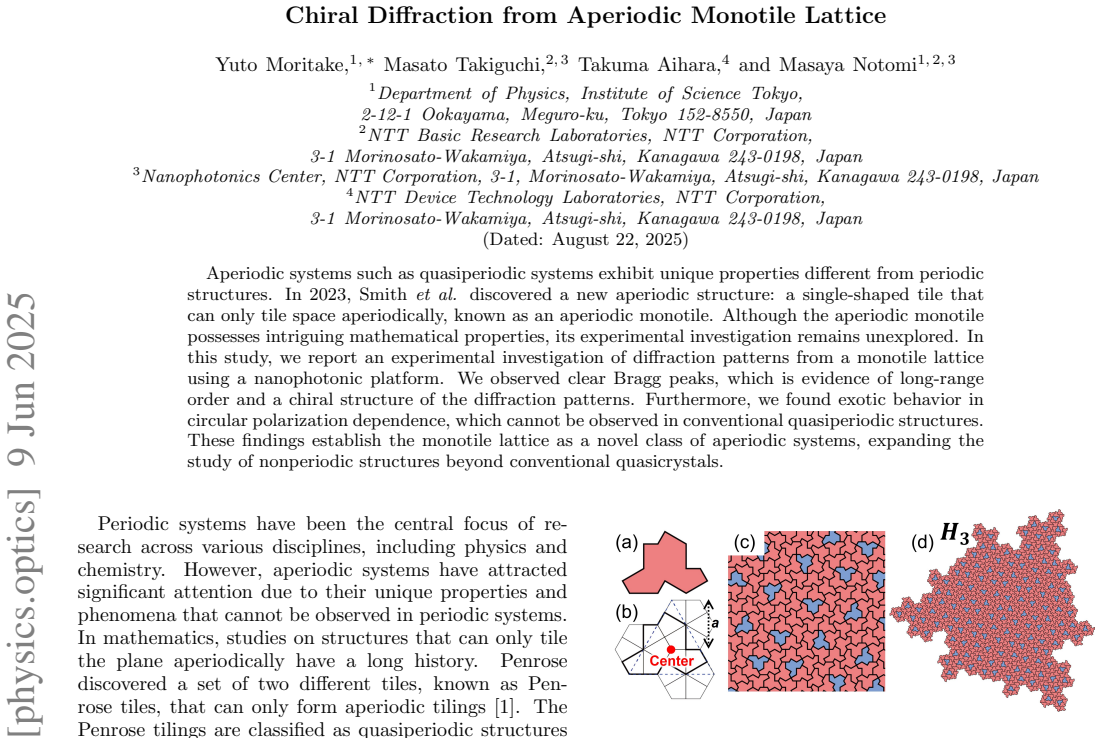
The central object is the monotile lattice: the point set formed by the centers of hat tiles in the hat tiling, with a pseudo-period $a$ inherited from the underlying honeycomb frame. The argument is carried by the inflation rule for the H, P, T, and F metatiles, whose successive application twists the tiling relative to the honeycomb frame; the twist ratio approaches the golden mean $\phi$, yielding the analytic tilt angle $\theta_{\mathrm{chiral}} = \arccos((3\phi-1)/4) \approx 15.52^\circ$ for the diffraction asterisks. The comparison between measured patterns and the computed Fourier intensity $I = |\sum_i \exp[2\pi i (k_x x_i + k_y y_i)]|^2$ provides the parameter-free match that grounds the claim.
What would settle it
Fabricate an inversion-symmetric lattice, such as a honeycomb lattice, with the same silicon-nitride process and measure the same $\eta$ map under identical LCP/RCP illumination: if nonzero red and blue regions appear there, the polarization dependence is not unique to the monotile lattice. Alternatively, insert a calibrated quarter-wave plate to flip the true handedness and check that every $\eta$ peak changes sign; any failure would indicate a system-level artifact.
Extended reading notes
Core claim
The paper establishes that a lattice formed by placing points at the centers of hat tiles in the aperiodic hat tiling is a long-range-ordered, chiral structure whose reciprocal-space diffraction is quantitatively captured by the Fourier transform of the point set. The chirality appears as a tilting of the six-fold diffraction asterisks, and the tilt angle $\theta_{\mathrm{chiral}} = \arccos((3\phi-1)/4) \approx 15.52^\circ$ follows from the Fibonacci-like twisting of the metatiles under inflation, with $\phi = (1+\sqrt{5})/2$. Measured patterns and their mirrored counterparts show the corresponding reversal of chirality. Under circularly polarized illumination, the difference map $\eta = (I_{\mathrm{LCP}} - I_{\mathrm{RCP}})/(I_{\mathrm{LCP}} + I_{\mathrm{RCP}})$ shows red and blue regions that swap when the structure is mirrored and that vary with the lattice pseudo-period, a response the authors attribute to the lattice's lack of inversion symmetry.
Load-bearing premise
The load-bearing premise is that the circular-polarization difference maps reflect an intrinsic property of the monotile lattice rather than an artifact of imperfect alignment, unequal LCP/RCP illumination or detector response, or the 5x5 smoothing used for display.
Editorial extensions
If this is right
- Because the measured Bragg peaks match the computed Fourier transform, the monotile lattice can be treated as a long-range-ordered aperiodic structure whose diffraction pattern is predictable from the point set alone.
- The analytic tilt angle $\theta_{\mathrm{chiral}} = \arccos((3\phi-1)/4)$ gives a design rule for the orientation of the chiral diffraction pattern for any generation of the hat tiling.
- Mirroring the structure reverses both the pinwheel chirality and the sign of the circular-polarization difference map, so the handedness of the optical response is controlled by choosing the original or mirrored tiling.
- The observed circular-polarization dependence, tied by the paper to the absence of inversion symmetry, is absent in conventional inversion-symmetric quasiperiodic lattices, making the monotile lattice a distinct photonic platform.
- The self-similar, golden-mean-scaled features in the diffraction pattern indicate that the monotile lattice shares scale-invariant structure with other quasiperiodic systems.
Reading between the lines
- If the $\eta$ maps survive a polarization calibration, a natural next step is to test higher-generation tilings (H7, H8) and confirm that the asterisk tilt converges to $\theta_{\mathrm{chiral}}$ while the meandering weak peaks persist, which would validate the inflation-limit derivation beyond H6.
- Because the polarization dependence changes with pseudo-period $a$, the effect is not purely topological but depends on diffractive phase; this suggests the lattice parameter can be engineered to tune or enhance circular dichroism.
- The same silicon-nitride hole platform could be extended to circular-polarization-resolved transmission or emission measurements, potentially yielding chiral light-matter interactions without three-dimensional chirality.
- A full electromagnetic simulation of the finite lattice, including the actual hole shapes, would separate the lattice-geometry contribution to $\eta$ from single-hole scattering contributions.
Editorial analysis
A structured set of objections, weighed in public.
Referee Report
Summary. This manuscript reports the first experimental diffraction study of a nanophotonic realization of the Smith hat aperiodic monotile lattice. Holes are etched into a SiN film at the tile centers, and reflection diffraction patterns are measured for 532-nm laser illumination and for white light. The measured diffraction patterns show sharp peaks and a chiral pinwheel structure that are reproduced by a parameter-free Fourier transform of the H6 lattice-point set (Eq. 1, Fig. 3). The authors derive an analytical tilt angle θchiral = arccos((3ϕ−1)/4) ≈ 15.52° from the Fibonacci/golden-mean twist of the metatile inflation. They also measure η = (ILCP − IRCP)/(ILCP + IRCP) maps under left- and right-circularly polarized incidence and report a handedness-dependent diffraction pattern for the monotile lattice but not for inversion-symmetric structures. They conclude that the monotile lattice is a new class of aperiodic systems with properties beyond conventional quasicrystals.
Significance. The structural part of the paper is a valuable experimental contribution: the parameter-free Fourier calculation reproducing both peak positions and relative intensities, the comparison of the H6 and mirrored H6-bar lattices showing chirality reversal in the diffraction pattern, and the analytic θchiral prediction are concrete, falsifiable results. If the circular-polarization effect were confirmed, it would open a new direction for aperiodic nanophotonics. At present, however, the polarization-dependence claim is not supported to the same standard: it lacks polarization calibration, control experiments, and error analysis, and the sample geometry introduces a z-mirror asymmetry that is not addressed. The paper's central novelty therefore rests on evidence that is not yet at the level of the structural results.
major comments (3)
- [Eq. (3), Fig. 5] The claim that the monotile lattice shows a circular-polarization dependence 'which cannot be observed in conventional quasiperiodic structures' is not supported by the present evidence. The η maps of Fig. 5 are computed from uncalibrated LCP/RCP intensities; no polarization calibration, no control measurement on an inversion-symmetric lattice such as honeycomb or Penrose, and no error bars or repeated-measurement statistics are reported. The 5×5 moving-average filter can itself produce or alter the spatial correlation of the red and blue regions. In addition, because the sample is a 350-nm-thick SiN film on a Si substrate, the reflection geometry breaks the z-mirror symmetry that would otherwise forbid LCP/RCP differences at normal incidence; the observed η is therefore not attributable to the in-plane chirality of the monotile lattice without additional controls.
- [Eq. (2), Fig. 4] The analytic prediction θchiral = arccos((3ϕ−1)/4) ≈ 15.52° is an attractive result, but the main text does not define the triangle construction or show how the Fibonacci-side lengths determine the angle; the reader is referred only to the Supplementary Information. The comparison in Fig. 4(c) is visual rather than quantitative. Please provide the geometric construction in the main text or a precise supplementary derivation, and quantify the agreement, for example by fitting the angular positions of the asterisk peaks and reporting the residual with respect to the predicted angle.
- [Fig. 5 and following paragraph] The text states that the red/blue η patterns change with lattice constant a and interprets this as evidence that the effect depends on 'other parameters, such as the structure's periodicity and the diffraction angle.' This is internally consistent with a polarization artifact or a form-factor effect, yet the abstract and conclusion attribute the effect to the lattice's chirality alone. The manuscript should either provide the calibration and control data needed to exclude instrumental artifacts or substantially qualify the claim that the effect is intrinsic to the monotile lattice.
minor comments (5)
- [Fig. 3 and Fig. 4] The text references Fig. 3(f) and Fig. 4(f), but neither figure contains a panel (f); the intended panels should be identified.
- [Fig. 5 caption] The caption of Fig. 5 contains garbled panel references, including '((e))' twice; it should read that (b) and (c) are the positive and negative parts of (a), and similarly for (e) and (f).
- [Throughout] There are several typographical errors, including 'infulation', 'waveneumber', 'gonlden mean', and 'comparizon'.
- [Eq. (1), Fig. 3] Equation (1) treats the holes as point scatterers; since the actual holes have radius 100 nm, including the hole form factor in the Fourier calculation would strengthen the claimed quantitative agreement of relative intensities in Fig. 3.
- [Introduction] The phrase 'quasi-periodicity of the monotile lattice' is used loosely; the hat tiling is aperiodic, and whether it is quasiperiodic in the strict sense should be stated with the appropriate definition.
Circularity Check
No significant circularity: the structural predictions are parameter-free forward calculations from the constructed lattice, and the chiral tilt angle is derived from the inflation geometry rather than fitted.
full rationale
The paper's central structural claims do not reduce to their inputs by construction. The diffraction calculation in Eq. (1) places delta functions at the fabricated monotile-lattice points and Fourier transforms them; this is a forward, parameter-free simulation used to validate that the fabricated structure matches the intended tiling, not a fitted parameter renamed as a prediction. The chiral tilt angle theta_chiral = arccos((3*phi - 1)/4) follows from the Fibonacci-triangle geometry of the metatile inflation rule and is then compared visually with the measured asterisk alignment; no adjustable parameter is involved. The circular-polarization eta maps in Eq. (3) are an experimental observable whose interpretation rests on a symmetry argument; while the paper lacks polarization calibration, control samples, and error analysis, that is an evidentiary limitation rather than a circularity, and no self-citation chain or uniqueness theorem is invoked to force the conclusion. Self-citations in the reference list are background only and not load-bearing. Therefore no circular step of any of the enumerated kinds can be exhibited from the manuscript text.
Assumptions & free parameters
assumptions (3)
- domain assumption The diffraction amplitude is well approximated by Eq. (1), a scalar Fourier transform of point scatterers placed at hat-tile centers, with hole shape and multiple scattering neglected.
- ad hoc to paper The observed LCP/RCP intensity differences in Fig. 5 are intrinsic to the monotile lattice and not apparatus artifacts.
- domain assumption The tilt angle of the diffraction asterisk equals the metatile twisting angle theta_chiral from the Fibonacci triangle.
Cite this review
Pith. "Pith review of Chiral Diffraction from Aperiodic Monotile Lattice." pith.science (2026). https://pith.science/paper/IVVRJ2G7
@misc{pith2026250607561,
  author       = {Pith},
  title        = {Pith review of: Chiral Diffraction from Aperiodic Monotile Lattice},
  year         = {2026},
  howpublished = {\url{https://pith.science/paper/IVVRJ2G7}},
  note         = {Machine review of arXiv:2506.07561}
}
read the original abstract
Aperiodic systems such as quasiperiodic systems exhibit unique properties different from periodic structures. In 2023, Smith et al. discovered a new aperiodic structure: a single-shaped tile that can only tile space aperiodically, known as an aperiodic monotile. Although the aperiodic monotile possesses intriguing mathematical properties, its experimental investigation remains unexplored. In this study, we report an experimental investigation of diffraction patterns from a monotile lattice using a nanophotonic platform. We observed clear Bragg peaks, which is evidence of long-range order and a chiral structure of the diffraction patterns. Furthermore, we found exotic behavior in circular polarization dependence, which cannot be observed in conventional quasiperiodic structures. These findings establish the monotile lattice as a novel class of aperiodic systems, expanding the study of nonperiodic structures beyond conventional quasicrystals.
Figures


Figures from the paper (2 more)


Reference graph
Works this paper leans on
-
[1]
R. Penrose, The role of aesthetics in pure and applied mathematical research, Bulletin of the Institute of Math- ematics and its Applications 10, 266 (1974)
work page 1974
-
[2]
J.-B. Suck, M. Schreiber, and P. H¨ aussler,Quasicrystals An Introduction to Structure, Physical Properties, ans Applications (Springer, 2002)
work page 2002
-
[3]
Shechtman, I
D. Shechtman, I. Blech, D. Gratias, and J. W. Cahn, Metallic phase with long-range orientational order and no translational symmetry, Phys. Rev. Lett.53, 1951 (1984)
1984
-
[4]
Z. Vardeny, A. Nahata, and A. Agrawal, Optics of pho- tonic quasicrystals, Nature Photonics 7, 177 (2013)
work page 2013
-
[5]
W. Steurer and D. Sutter-Widmer, Photonic and phononic quasicrystals, Journal of Physics D: Applied Physics 40, R229 (2007)
work page 2007
-
[6]
E. Maci´ a, Exploiting aperiodic designs in nanophotonic devices, Reports on Progress in Physics 75, 036502 (2012)
work page 2012
-
[7]
C. Jin, B. Cheng, B. Man, Z. Li, D. Zhang, S. Ban, and B. Sun, Band gap and wave guiding effect in a quasiperi- odic photonic crystal, Applied Physics Letters 75, 1848 (1999)
work page 1999
- [8]
Show all 29 references
-
[9]
Zhang, Z.-Q
X. Zhang, Z.-Q. Zhang, and C. T. Chan, Absolute pho- tonic band gaps in 12-fold symmetric photonic quasicrys- tals, Phys. Rev. B 63, 081105 (2001)
2001
-
[10]
M. C. Rechtsman, H.-C. Jeong, P. M. Chaikin, 5 FIG. 5. η maps, which show dependence of the handedness of the incidence circularly polarized light, in k space for a = 700 nm. (a)-(c) H6 and (d)-(f) ¯H6. (b) ((e)) and (c) ((e)) are positive and negative parts of (a) ((d)) the η...
2008
-
[11]
Notomi, H
M. Notomi, H. Suzuki, T. Tamamura, and K. Edagawa, Lasing action due to the two-dimensional quasiperiodic- ity of photonic quasicrystals with a penrose lattice, Phys. Rev. Lett. 92, 123906 (2004)
2004
-
[12]
Nozaki and T
K. Nozaki and T. Baba, Quasiperiodic photonic crys- tal microcavity lasers, Applied Physics Letters 84, 4875 (2004)
2004
-
[13]
Mahler, A
L. Mahler, A. Tredicucci, F. Beltram, C. Walther, J. Faist, H. E. Beere, D. A. Ritchie, and D. S. Wiersma, Quasi-periodic distributed feedback laser, Nature Pho- tonics 4, 165 (2010)
2010
-
[14]
M. S. Vitiello, M. Nobile, A. Ronzani, A. Tredicucci, F. Castellano, V. Talora, L. Li, E. H. Linfield, and A. G. Davies, Photonic quasi-crystal terahertz lasers, Nature Communications 5, 5884 (2014)
2014
-
[15]
Yulevich, E
I. Yulevich, E. Maguid, N. Shitrit, D. Veksler, V. Kleiner, and E. Hasman, Optical mode control by geometric phase in quasicrystal metasurface, Phys. Rev. Lett.115, 205501 (2015)
2015
-
[16]
C. Xu, R. Zhao, X. Zhang, et al., Quasicrystal metasur- face for dual functionality of holography and diffraction generation, eLight 4, 9 (2024)
2024
-
[17]
Arjas, J
K. Arjas, J. M. Taskinen, R. Heilmann, et al., High topo- logical charge lasing in quasicrystals, Nature Communi- cations 15, 9544 (2024)
2024
-
[18]
Y. E. Kraus, Y. Lahini, Z. Ringel, M. Verbin, and O. Zil- berberg, Topological states and adiabatic pumping in quasicrystals, Phys. Rev. Lett. 109, 106402 (2012)
2012
-
[19]
Smith, J
D. Smith, J. S. Myers, C. S. Kaplan, and C. Goodman- Strauss, An aperiodic monotile, Combinatorial Theory 4, 10.5070/C64163843 (2024)
2024 doi
-
[20]
Schirmann, S
J. Schirmann, S. Franca, F. Flicker, and A. G. Grushin, Physical properties of an aperiodic monotile with graphene-like features, chirality, and zero modes, Phys. Rev. Lett. 132, 086402 (2024)
2024
-
[21]
C. S. Kaplan, M. O’Keeffe, and M. M. J. Treacy, Pe- riodic diffraction from an aperiodic monohedral tiling, Acta Crystallographica Section A 80, 72 (2024)
2024
-
[22]
Okabe, K
Y. Okabe, K. Niizeki, and Y. Araki, Ising model on the aperiodic smith hat, Journal of Physics A: Mathematical and Theoretical 57, 125004 (2024)
2024
-
[23]
X. Jin, B. Ni, G. Chu, C. Sun, B. Xu, L. Hou, J. J. Hou, C. Zhong, X. Liu, and J. Xiong, Silicon artificial neurons for uniform signal transmission and amplification, Optics Communications 569, 130781 (2024)
2024
-
[24]
Xiao and C
Y.-X. Xiao and C. T. Chan, Obstacle-insensitive eigen- fields due to boundary condition–symmetry compatibil- ity, Phys. Rev. B 110, 075435 (2024)
2024
-
[25]
Singh and F
S. Singh and F. Flicker, Exact solution to the quan- tum and classical dimer models on the spectre aperiodic monotiling, Phys. Rev. B 109, L220303 (2024)
2024
-
[26]
B. H. Sun and X. L. Guo, Mechanics of topological high- entropy structures made out of ‘einstein’ puzzle pieces, Preprints 10.20944/preprints202407.1532.v1 (2024)
2024
-
[27]
D. J. Clarke, F. Carter, I. Jowers, and R. J. Moat, An isotropic zero poisson’s ratio metamaterial based on the aperiodic ‘hat’ monotile, Applied Materials Today 35, 101959 (2023)
2023
-
[28]
Smith, J
D. Smith, J. S. Myers, C. S. Kaplan, and C. Goodman- Strauss, A chiral aperiodic monotile, Combinatorial The- ory 4, 10.5070/C64264241 (2024). 6
2024 doi
-
[29]
Pan, X.-F
Y. Pan, X.-F. Sun, G.-B. Zhang, Q.-L. Li, Y.-N. Kong, T.-F. Zhao, and X.-Z. Gao, Two-dimensional quasi- periodic diffraction properties of the scalar and vector optical fields, Photonics 10, 10.3390/photonics10091045 (2023)
2023 doi
Reviewed August 7, 2026 · model on record in the stance chip above.
Discussion (0). Sign in to comment.