REVIEW 4 major objections 6 minor 72 references
Intense THz s-SNOM for nonlinearity engineering in nanoscale
T0 review · 4 major / 6 minor · reviewed 2026-08-07 · deepseek-v4-flash
Pith's one-line read A terahertz near-field tip generates and images third harmonics in a Dirac semimetal film.
desk verdict A real technical advance—low-repetition high-power THz s-SNOM with near-field THG imaging—but the scaling evidence and quantitative estimates need more care before the strong claims are accepted. read the letter →
The pith
A machine-rendered reading of the paper's core claim, the machinery that carries it, and where it could break.
The reading
What carries the argument
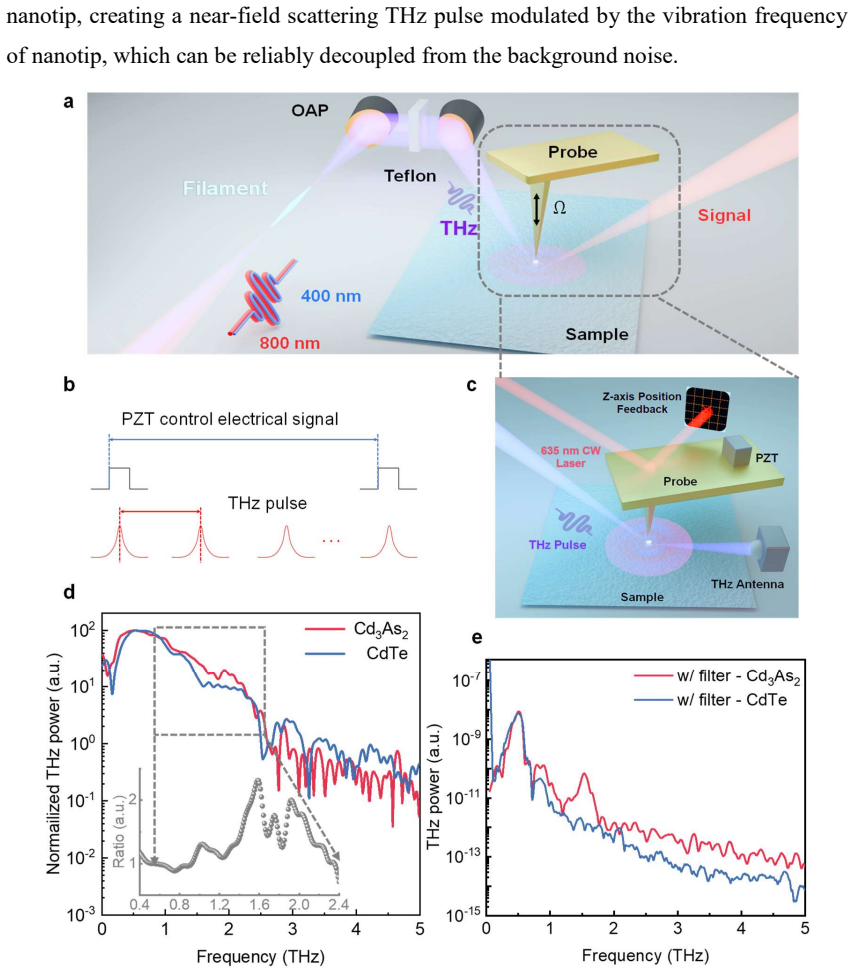
The central object is the intense THz s-SNOM junction: an aluminum-coated AFM tip with roughly 10 nm radius held about 50 nm above the sample concentrates the incident THz field to an estimated 350 kV/cm. The synchronization mechanism is synchronous sampling, in which the tip's tapping vibration is phase-locked to the 1 kHz THz pulse train so the weak near-field scattering signal is modulated at the tip frequency and recovered by lock-in demodulation. The theoretical mechanism is the Boltzmann time-evolution equation for the Dirac-electron distribution in momentum space; the field-driven intraband current then radiates the third harmonic, so the measured power law is the signature of third-order nonlinearity.
What would settle it
Retract the tip to a distance much larger than the near-field region while keeping the 0.5 THz pump fixed and measure the 1.5 THz signal; if the harmonic intensity does not drop sharply with tip-sample separation, the third harmonic is not generated by the localized tip field and the central mechanism fails.
Extended reading notes
Core claim
The paper claims that high-peak-power THz pulses can be delivered to a nanoscale near-field junction and can drive a measurable third-order nonlinear response in a Dirac semimetal, producing a clear 1.5 THz component from a 0.5 THz pump with a power law $I_{3f}\propto I_f^{2.94}$. It attributes this to nonequilibrium intraband dynamics of Dirac electrons in the 100 nm Cd3As2 film, and demonstrates nonlinear near-field imaging with resolution of about 200 nm ($\lambda/3000$), where the nonlinear contrast between Cd3As2 and sapphire is much stronger than the linear contrast. The authors estimate a field conversion coefficient $\gamma_3 L \simeq 1.4\times10^{-2}$ and an effective third-order susceptibility of about $1.4\times10^{-9}\ \mathrm{m^2/V^2}$, consistent with prior Dirac-material values.
Load-bearing premise
The numbers for conversion efficiency and susceptibility assume a simulated field enhancement at the tip and nearly equal scattering efficiency at 0.5 and 1.5 THz, and the Boltzmann scattering time used in the model is not disclosed, so the absolute efficiencies are the most fragile part of the claim.
Editorial extensions
If this is right
- Near-field THz nonlinear measurements can now be made with low-repetition high-peak-power sources, not only with continuous-wave or high-repetition THz sources.
- The 1.5 THz harmonic provides a material-specific nanoscale contrast channel: Cd3As2 is bright while sapphire is nearly dark, with an amplitude ratio around 45.
- The power-law dependence $I_{3f}\propto I_f^{2.94}$ supports treating the near-field nonlinearity as a third-order process driven by the localized THz field.
- Because the filament source is broadband and can be filtered, the method can select the pump frequency to match the material's band structure or conductivity response.
Reading between the lines
- A decisive control experiment would be to measure the 1.5 THz signal with the tip held far from the sample; the harmonic should vanish if it is truly generated in the near-field junction.
- The methods cite the source of the Drude-model material parameters as Reference [29], but that reference concerns near-field microscopy rather than Cd3As2 optical constants, so the numerical estimates of field enhancement and susceptibility currently rest on an unsupported citation.
- The same phase-locked sampling scheme could be adapted to other low-repetition high-field THz sources, potentially extending nanoscale nonlinear THz spectroscopy to electron-accelerator and plasma sources.
- Because the resolution is set mainly by tip geometry, a sharper tip with a higher-precision AFM should preserve the nonlinear contrast while approaching few-nanometer resolution.
Editorial analysis
A structured set of objections, weighed in public.
Referee Report
Summary. The paper reports an intense THz scattering-scanning near-field optical microscope (s-SNOM) that combines high-peak-power, low-repetition-rate (1 kHz) THz pulses from two-color femtosecond laser filaments with a tapping-mode AFM through a synchronous sampling scheme. The authors observe a 1.5 THz spectral component from a 100 nm Cd3As2 film when pumping at 0.5 THz, absent from a CdTe reference, and attribute it to third-harmonic generation (THG) driven by nonequilibrium intraband dynamics of Dirac electrons. They further report near-field THG imaging with a spatial resolution of about 200 nm (λ/3000) and estimate a local field enhancement of about sixfold, a conversion coefficient, and an effective third-order susceptibility. The theoretical modeling uses a Boltzmann equation with a scattering time τ to compute the harmonic response.
Significance. If the central claims hold, the paper would demonstrate a valuable technical advance: extending THz s-SNOM to nonlinear excitation using high-peak-power, low-repetition-rate THz pulses, enabling nanoscale THz nonlinear spectroscopy and imaging with deep subwavelength resolution. The raw observation of a narrowband 1.5 THz component that appears only for Cd3As2 and not for CdTe is a concrete, falsifiable result, and the synchronous-sampling implementation is a plausible solution to the repetition-rate mismatch problem. However, the quantitative claims (field enhancement, conversion efficiency, and χ^(3)) rest on uncalibrated scattering-efficiency assumptions and full-wave simulations, and the scaling evidence relies on a tip-sample distance scan rather than a pump-intensity scan. These issues currently prevent the paper from being accepted as strong evidence for the specific THG mechanism and its stated efficiency.
major comments (4)
- [§4 (Figure 4e)] The central scaling evidence for THG, the power law I_3f ∝ I_f^2.94, is obtained by varying the nanotip-sample distance rather than the pump intensity. The text states that the fluence dependence was obtained by 'adjusting the local electric field intensity at the tip apex through the nanotip-sample distance.' Changing the gap simultaneously changes the local field at 0.5 THz, the near-field coupling at both 0.5 and 1.5 THz, and the harmonic collection efficiency. A distance-dependent near-field transfer function can produce an apparent cubic relation between the detected 1.5 THz signal and a simulated 0.5 THz local field even in the absence of an intrinsic I^3 nonlinearity. The raw observation of a 1.5 THz component is more robust, but the claim of 'convincing third harmonic generation' rests substantially on this exponent. Please provide a fixed-gap pump-fluence scan, or a quantitative model that separates the distance-dependent scattering transfer from the intrinsic nonlinearity, and report the uncertainty on the exponent.
- [§3 (Eq. 2) and Methods] The Boltzmann transport calculation uses a scattering time τ whose value is not disclosed anywhere in the manuscript. Equation (2) is solved with the experimental THz field as input, so if τ (or the relaxation model) was adjusted to match the measured 1.5 THz harmonic amplitude, the theoretical 'prediction' is partly a fit and the agreement in Figure 3 is not an independent confirmation of the THG mechanism. Please state the value of τ, how it was determined, and show the sensitivity of the calculated third-harmonic amplitude to τ (e.g., a variation over a physically plausible range).
- [§2 (scattering-efficiency assumption)] The extraction of the absolute conversion efficiency and of χ^(3) assumes that the scattering efficiencies at 0.5 and 1.5 THz are nearly equal, with reference to extended Figure S5. However, extended Figure S5 is described as surface current density distributions, not as a frequency-dependent scattering-efficiency calibration of the tip-sample system. The quantitative estimates (sixfold field enhancement, conversion coefficient, and χ^(3)) also depend on a Drude-model full-wave simulation that is not validated against an independent measurement. Please provide a direct calibration of the relative scattering efficiency (for example, a measurement on a reference sample with a known non-resonant response at both frequencies) and propagate uncertainties into the quoted values.
- [Throughout (Results)] No error bars, repeated measurements, or statistical analysis are reported for the key quantitative statements: the near-field spectra, the exponent 2.94 in Figure 4e, the field enhancement factor of ~6, the conversion coefficient, and χ^(3). Without uncertainty estimates, the claimed agreement between experiment and theory (exponent 2.94 vs. 3.0, and the absolute harmonic amplitude) cannot be evaluated. Please add error bars or at least state the number of independent measurements and the spread.
minor comments (6)
- [Figure 1 references] Figure references in the text are inconsistent: the spectra shown in Figure 1d/e are sometimes referred to as 'Figure 1c' and the inset as 'Inset of Figure 1c'; please renumber or re-reference consistently.
- [§2, conversion-efficiency equation] The equation for the conversion efficiency in §2 is garbled in the text ('m mf fE L Eγ= ...'); please typeset it with clear definitions of k_m, L, and all units.
- [Methods, reference [29]] In the Methods, the dielectric constants of Cd3As2 are said to be taken from Reference [29], but Reference [29] in the reference list is a different paper (Wang et al.); please correct the reference.
- [Extended Figure S5] Extended Figure S5 caption should explicitly state what is plotted and how it demonstrates the claim of equal scattering efficiencies at 0.5 and 1.5 THz.
- [Abstract and Conclusion] The abstract says 'power-law dependence of the THz harmonics and theoretical calculation reveals a convincing third harmonic generation'; consider softening 'convincing' until the scaling evidence is made more direct.
- [§3, duplicated sentence] The duplicated sentence in §3 ('Especially, at the peak of the THz field ... maximum current density') should be removed.
Circularity Check
No construction-level circularity; the central THG observation is experiment-independent, and the main caveats (undisclosed scattering time and distance-based fluence scaling) are correctness risks rather than self-referential derivations.
full rationale
The paper's central experimental claim—a 1.5 THz near-field scattering component from Cd3As2 when pumped at 0.5 THz—is based on measured spectra and is not generated by the model. The Boltzmann calculation is a forward simulation: Equation (2) states that the incident field E(t) is defined with the experimental THz field, and Equations (3)–(5) compute a third-harmonic field from the resulting nonlinear current. No equation in the paper defines the measured THG amplitude as the input of that calculation, so the theory is not equivalent to the experiment by construction. The main self-citations are refs. 29/38 (Dai et al., with overlapping authorship), used to justify the 0.5 THz pump frequency and to supply Drude-model parameters for the full-wave simulation; these are external material characterizations that do not by themselves produce the THG observation. The undisclosed scattering time tau and the extraction of chi^(3) from a simulated near-field enhancement make the absolute theory-experiment comparison uncertain, but this is a parameter-disclosure and calibration issue, not a demonstrated fit-renamed-as-prediction. Finally, the "fluence dependence" in Figure 4e was obtained by varying tip-sample distance ("Adjusting the local electric field intensity at the tip apex interacted with Cd3As2 film through the nanotip-sample distance"), so the exponent 2.94 is not a true pump-intensity scan and may be influenced by distance-dependent near-field coupling and scattering efficiencies; this is a caveat on the scaling evidence, but it does not make the measured THG itself an input-derived construct. Overall, the derivation chain is not circular at the construction level.
Assumptions & free parameters
free parameters (1)
- scattering time tau =
not stated in text
assumptions (5)
- domain assumption Cd3As2 has massless Dirac dispersion with linear bands up to ~1 eV
- domain assumption Interband transitions are Pauli-blocked at room temperature for THz photons
- domain assumption Relaxation-time approximation with a single scattering time tau describes the driven electron distribution
- domain assumption Near-field scattering amplitude is proportional to the induced dipole moment, and the dipole moment is related to the surface current density via Eqs (6)-(7)
- domain assumption Pump field depletion and phase mismatch are negligible for the 100 nm Cd3As2 film
Cite this review
Pith. "Pith review of Intense THz s-SNOM for nonlinearity engineering in nanoscale." pith.science (2026). https://pith.science/paper/FGCVDKKU
@misc{pith2026250607615,
  author       = {Pith},
  title        = {Pith review of: Intense THz s-SNOM for nonlinearity engineering in nanoscale},
  year         = {2026},
  howpublished = {\url{https://pith.science/paper/FGCVDKKU}},
  note         = {Machine review of arXiv:2506.07615}
}
read the original abstract
Terahertz (THz) nonlinear optics offer powerful tools to investigate and manipulate electronic dynamics in condensed matter. Confining high-peak-power THz pulses within near field can effectively generates extremely localized electromagnetic fields in spatio-temporal, enabling to precisely explore and control carrier transient dynamics from THz nonlinearity perspective. However, the combination of the high peak power THz pulses and the near-field optic techniques remains challenging due to the incompatibility between low repetition THz pulses and typical near-field demodulation schemes. Here, we construct high peak power THz scattering scanning near-field microscopy (THz s-SNOM) by combining THz pulses emitted from two-color femtosecond laser filaments with a tapping mode atomic force microscopy (AFM) and explore efficient THz third harmonics generation (THG) from the Cd3As2 film in nanoscale. The power-law dependence of the THz harmonics and theoretical calculation reveals a convincing third harmonic generation that is attributed to the nonequilibrium intraband dynamics driven by the strong THz pulses. Especially, the nanoscopic near-field THz third harmonic imaging with resolution of 200 nm ({\lambda}/3000) of 3D Dirac semimetal are demonstrated. The high peak power THz s-SNOM can provide a great platform for exploring and manipulating the nonlinear physics, carrier dynamics and quantum coherent phenomena driven by the localized THz field with nanoscale resolution, thereby guiding the development of the integrated high-performance nonlinear photonic devices.
Figures


Figures from the paper (1 more)

Reference graph
Works this paper leans on
-
[1]
Brabec, T. & Krausz, F. Intense few-cycle laser fields: Frontiers of nonlinear optics. Rev. Mod. Phys. 72, 545 (2000)
work page 2000
- [2]
-
[3]
Lind, A. J. et al. Mid-infrared frequency comb generation and spectroscopy with few-cycle pulses and χ (2) nonlinear optics. Phys. Rev. Lett. 124, 133904 (2020)
work page 2020
-
[4]
Novoselov, K. S. et al. Two-dimensional gas of massless Dirac fermions in graphene. Nature. 438, 197–200 (2005)
work page 2005
-
[5]
Castro Neto, A. H., Guinea, F., Peres, N. M., Novoselov, K. S. & Geim, A. K. The electronic properties of graphene. Rev. Mod. Phys. 81, 109–162 (2009)
work page 2009
-
[6]
Schubert, O. et al. Sub-cycle control of terahertz high-harmonic generation by dynamical Bloch oscillations. Nat. Photon. 8, 119–123 (2014)
work page 2014
-
[7]
Ghimire, S. et al. Observation of high-order harmonic generation in a bulk crystal. Nat. Phys. 7, 138–141 (2011)
work page 2011
-
[8]
Liu, H. et al. High-harmonic generation from an atomically thin semiconductor. Nat. Phys. 13, 262–265 (2017)
work page 2017
Show all 72 references
-
[9]
& Tanaka, K
Yoshikawa, N., Tamaya, T. & Tanaka, K. High-harmonic generation in graphene enhanced by elliptically polarized light excitation. Science. 356, 736–738 (2017)
2017
-
[10]
Yao, Z. et al. Probing subwavelength in-plane anisotropy with antenna-assisted infrared nano-spectroscopy. Nat. Commun. 12, 2649 (2021)
2021
-
[11]
Alonso-González, P. et al. Acoustic terahertz graphene plasmons revealed by photocurrent nanoscopy. Nat. Nanotechnol.12, 31–35 (2017)
2017
-
[12]
& Kim, T.-T
Seo, C. & Kim, T.-T. Terahertz near-field spectroscopy for various applications. J. Korean Phys. Soc. (2022)
2022
-
[13]
L., Jelic, V., Hillenbrand, R
Cocker, T. L., Jelic, V., Hillenbrand, R. & Hegmann, F. A. Nanoscale terahertz scanning probe microscopy. Nat. Photon. 15, 558–569 (2021)
2021
-
[14]
& Basov, D
Hillenbrand, R., Abate, Y., Liu, M., Chen, X. & Basov, D. N. Visible-to-THz near-field nanoscopy. Nat. Rev. Mater. (2025)
2025
-
[15]
Guo, X. et al. Terahertz nanospectroscopy of plasmon polaritons for the evaluation of doping in quantum devices. Nanophotonics 12, 1865–1875 (2023)
2023
-
[16]
Chen, S. et al. Real-space observation of ultraconfined in-plane anisotropic acoustic terahertz plasmon polaritons. Nat. Mater. 22, 860–866 (2023)
2023
-
[17]
& Seo, M
Kang, J.-H., Kim, D.-S. & Seo, M. Terahertz wave interaction with metallic nanostructures. Nanophotonics 7, 763–793 (2018)
2018
-
[18]
Guan, F. et al. Compensating losses in polariton propagation with synthesized complex frequency excitation. Nat. Mater. 23, 506–511 (2024)
2024
-
[19]
Guan, F. et al. Overcoming losses in superlenses with synthetic waves of complex frequency. Science 381, 766–771 (2023)
2023
-
[20]
Chen, X. et al. Modern scattering-type scanning near-field optical microscopy for advanced material research. Adv. Mater. 31, 1804774 (2019)
2019
-
[21]
McLeod, A. et al. Nanotextured phase coexistence in the correlated insulator V2O3. Nat. Phys. 13, 80–86 (2017)
2017
-
[22]
& Mittleman, D
Pizzuto, A., Ma, P. & Mittleman, D. M. Near-field terahertz nonlinear optics with blue light. Light Sci. Appl. 12, 96 (2023)
2023
-
[23]
Frenzel, M. et al. Nonlinear terahertz control of the lead halide perovskite lattice. Sci. Adv. 9, eadg3856 (2023)
2023
-
[24]
Zhao, Z. et al. Applications of ultrafast nano-spectroscopy and nano-imaging with tip-based microscopy. eLight 5, 1 (2025)
2025
-
[25]
& Hillenbrand, R
Maissen, C., Chen, S., Nikulina, E., Govyadinov, A. & Hillenbrand, R. Probes for Ultrasensitive THz Nanoscopy. ACS Photon. 6, 1279–1288 (2019)
2019
-
[26]
& Takeuchi, O
Shigekawa, H., Yoshida, S. & Takeuchi, O. Spectroscopy: Nanoscale terahertz spectroscopy. Nat. Photon. 8, 815 (2014)
2014
-
[27]
Kehr, S. et al. Anisotropy Contrast in Phonon-Enhanced Apertureless Near-Field Microscopy Using a Free-Electron Laser. Phys. Rev. Let. 100, 256403 (2008)
2008
-
[28]
Scattering-type scanning near-field optical microscopy with low-repetition-rate pulsed light source through phase-domain sampling
Wang, H. Scattering-type scanning near-field optical microscopy with low-repetition-rate pulsed light source through phase-domain sampling. Nat. Commun.7, 13212 (2016)
2016
-
[29]
Wang, H., Wang, L., Jakob, D. S. & Xu, X. G. Tomographic and Multimodal Scattering- Type Scanning Near-field Optical Microscopy with Peak Force Tapping Mode. Nat Commun. 9, 2005 (2018)
2018
-
[30]
Liu, Z. et al. Discovery of a three-dimensional topological Dirac semimetal, Na3Bi. Science 343, 864–867 (2014)
2014
-
[31]
Young, S. M. et al. Dirac semimetal in three dimensions. Phys. Rev. Let. 108, 140405 (2012)
2012
-
[32]
J., Kim, Y., Rappe, A
Wieder, B. J., Kim, Y., Rappe, A. & Kane, C. Double Dirac semimetals in three dimensions. Phys. rev. let. 116, 186402 (2016)
2016
-
[33]
Zhou, R. et al. Recent advances in photonics of three-dimensional Dirac semimetal Cd3As2. Adv. Photon. Nexus. 1, 024001–024001 (2022)
2022
-
[34]
Zhang, C. et al. Ultrahigh conductivity in Weyl semimetal NbAs nanobelts. Nat. Mater. 18, 482–488 (2019)
2019
-
[35]
Chen, Z. et al. Defect-induced helicity dependent terahertz emission in Dirac semimetal PtTe2 thin films. Nat. Commun. 15, 2605 (2024)
2024
-
[36]
Plankl, M. et al. Subcycle contact-free nanoscopy of ultrafast interlayer transport in atomically thin heterostructures. Nat. Photon. 15, 594–600 (2021)
2021
-
[37]
Jing, R. et al. Terahertz response of monolayer and few-layer WTe2 at the nanoscale. Nat. Commun. 12, 5594 (2021)
2021
-
[38]
Dai, Z. et al. High mobility 3D Dirac semimetal (Cd3As2) for ultrafast photoactive terahertz photonics. Adv. Funct. Mater. 31, 2011011 (2021)
2021
-
[39]
Hafez, H. A. et al. Extremely efficient terahertz high-harmonic generation in graphene by hot Dirac fermions. Nature 561, 507–511 (2018)
2018
-
[40]
& Reis, D
Ghimire, S. & Reis, D. A. High-harmonic generation from solids. Nat. Phys. 15, 10–16 (2019)
2019
-
[41]
Yu, Z. et al. 0.35% THz pulse conversion efficiency achieved by Ti:sapphire femtosecond laser filamentation in argon at 1 kHz repetition rate. Opto-Electron Adv. 5, 210065–210065 (2022)
2022
-
[42]
Yu, Z. et al. Anti-Correlated Plasma and THz Pulse Generation during Two-Color Laser Filamentation in Air. Ultrafast Sci. 2022, 1–7 (2022)
2022
-
[43]
J., Hornett, S
Constant, T. J., Hornett, S. M., Chang, D. E. & Hendry, E. All-optical generation of surface plasmons in graphene. Nat. Phys. 12, 124–127 (2016)
2016
-
[44]
Johnston, M. B. Superfocusing of terahertz waves. Nat. Photon. 1, 14–15 (2007)
2007
-
[45]
Mastel, S. et al. Understanding the Image Contrast of Material Boundaries in IR Nanoscopy Reaching 5 nm Spatial Resolution. ACS Photon. 5, 3372–3378 (2018)
2018
-
[46]
Hu, X. et al. Terahertz s-SNOM Imaging of a Single Cell with Nanoscale Resolution. Nano Lett. 24, 7757–7763 (2024)
2024
-
[47]
Moon, K. et al. Subsurface Nanoimaging by Broadband Terahertz Pulse Near-Field Microscopy. Nano Lett. 15, 549–552 (2015)
2015
-
[48]
Chen, X. et al. THz Near-Field Imaging of Extreme Subwavelength Metal Structures. ACS Photon. 7, 687–694 (2020)
2020
-
[49]
Sternbach, A. J. et al. Inhomogeneous Photosusceptibility of VO 2 Films at the Nanoscale. Phys. Rev. Lett. 132, 186903 (2024)
2024
-
[50]
Huber, M. A. et al. Ultrafast Mid-Infrared Nanoscopy of Strained Vanadium Dioxide Nanobeams. Nano Lett. 16, 1421–1427 (2016)
2016
-
[51]
Zhang, J. et al. Terahertz Nanoimaging of Graphene. ACS Photonics 5, 2645–2651 (2018)
2018
-
[52]
Wagner, M. et al. Ultrafast and Nanoscale Plasmonic Phenomena in Exfoliated Graphene Revealed by Infrared Pump−Probe Nanoscopy. Nano Letters.14(2): 894-900 (2014)
2014
-
[53]
Pizzuto, A. et al. Nonlocal Time-Resolved Terahertz Spectroscopy in the Near Field. ACS Photon. 8, 2904–2911 (2021)
2021
-
[54]
Yao, Z. et al. Nanoimaging and Nanospectroscopy of Polaritons with Time Resolved s ‐ SNOM. Adv. Opt. Mater. 8, 1901042 (2020)
2020
-
[55]
Cocker, T. L. et al. An ultrafast terahertz scanning tunnelling microscope. Nat. Photon. 7, 620–625 (2013)
2013
-
[56]
Yoshida, S. et al. Terahertz Scanning Tunneling Microscopy for Visualizing Ultrafast Electron Motion in Nanoscale Potential Variations. ACS Photon. 8, 315–323 (2021)
2021
-
[57]
Kimura, K. et al. Ultrafast on-demand exciton formation in a single-molecule junction by tailored terahertz pulses. Science 387, 1077–1082 (2025)
2025
-
[58]
Sheng, S. et al. Terahertz spectroscopy of collective charge density wave dynamics at the atomic scale. Nat. Phys. 1–6 (2024)
2024
-
[59]
Jelic, V. et al. Ultrafast terahertz control of extreme tunnel currents through single atoms on a silicon surface. Nat. Phys. 13, 591–598 (2017)
2017
-
[60]
Superconductivity in iron compounds
Stewart, G. Superconductivity in iron compounds. Rev. Mod. Phys. 83, 1589–1652 (2011)
2011
-
[61]
& Klein, M
Sooryakumar, R. & Klein, M. Raman scattering by superconducting-gap excitations and their coupling to charge-density waves. Phys. rev. let. 45, 660 (1980)
1980
-
[62]
& Millis, A
Sun, Z. & Millis, A. J. Transient trapping into metastable states in systems with competing orders. Phys. rev. X 10, 021028 (2020)
2020
-
[63]
A., Volkov, P
Müller, M. A., Volkov, P. A., Paul, I. & Eremin, I. M. Collective modes in pumped unconventional superconductors with competing ground states. Phys. rev. B 100, 140501 (2019)
2019
-
[64]
Kozina, M. et al. Terahertz-driven phonon upconversion in SrTiO3. Nat. Phys. 15, 387–392 (2019)
2019
-
[65]
Riddles in perovskite research
Martiradonna, L. Riddles in perovskite research. Nat. Mater. 17, 377–377 (2018)
2018
-
[66]
Liu, Z. et al. Ultrafast Control of Excitonic Rashba Fine Structure by Phonon Coherence in the Metal Halide Perovskite CH3NH3PbI3. Phys. Rev. Lett. 124, 157401 (2020)
2020
-
[67]
Manipulating hyperbolic transient plasmons in a layered semiconductor
Fu, R. Manipulating hyperbolic transient plasmons in a layered semiconductor. Nat. Commun. (2024)
2024
-
[68]
Zhang, X. et al. Ultrafast anisotropic dynamics of hyperbolic nanolight pulse propagation. Sci. Adv. 9, eadi4407 (2023)
2023
-
[69]
Zeng, K. et al. Synthesized complex-frequency excitation for ultrasensitive molecular sensing. eLight 4, 1 (2024)
2024
-
[70]
Grating-graphene metamaterial as a platform for terahertz nonlinear photonics
Deinert, Jan-Christoph, et al. Grating-graphene metamaterial as a platform for terahertz nonlinear photonics. ACS nano 15.1 (2020): 1145-1154
2020
-
[71]
Efficient terahertz harmonic generation with coherent acceleration of electrons in the Dirac semimetal Cd3As2
Cheng, Bing, et al. Efficient terahertz harmonic generation with coherent acceleration of electrons in the Dirac semimetal Cd3As2. Phys. Rev. Let. 124.11 (2020): 117402
2020
-
[72]
Non-perturbative terahertz high-harmonic generation in the three- dimensional Dirac semimetal Cd3As2
Kovalev, Sergey, et al. Non-perturbative terahertz high-harmonic generation in the three- dimensional Dirac semimetal Cd3As2. Nat. Com. 11.1 (2020): 2451. Acknowledgements This work is supported by the funding support from National Natural Science Foundation of China (W2412044...
2020
Reviewed August 7, 2026 · model on record in the stance chip above.
Discussion (0). Sign in to comment.