REVIEW 3 major objections 5 minor 1 cited by
Towards a Unified Benchmark for Arabic Pronunciation Assessment: Quranic Recitation as Case Study
T0 review · 3 major / 5 minor · reviewed 2026-08-07 · deepseek-v4-flash
Pith's one-line read This paper introduces QuranMB.v1, the first publicly available benchmark for mispronunciation detection in Modern Standard Arabic using Qur'anic recitation, and reports that the strongest baseline—a multilingual HuBERT model trained on…
desk verdict Useful first benchmark for Arabic MDD, but its test set is built from the same confusion matrix as the training data, so the reported F1 measures an in-distribution error model rather than real-world generalization. read the letter →
The pith
A machine-rendered reading of the paper's core claim, the machinery that carries it, and where it could break.
The reading
What carries the argument
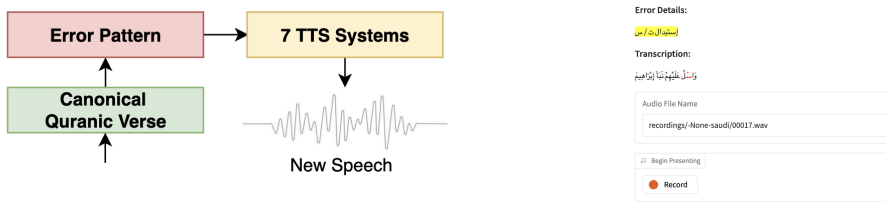
The load-bearing object is QuranMB.v1, the test benchmark itself, together with the error-generation protocol used to build it: a confusion matrix derived from phoneme-similarity data maps each Arabic character or diacritic to likely mispronounced counterparts, including deletions. The same matrix is used to corrupt canonical transcripts before TTS rendering, yielding the 52-hour synthetic training corpus; this symmetry is what makes the controlled errors fully annotated. The recognition pipeline is a frozen self-supervised encoder whose layer-weighted features feed a two-layer Bi-LSTM with CTC loss, with greedy decoding producing phoneme sequences that are compared against phonetizer-derived targets. The evaluation follows the standard TA/TR/FA/FR and CD/ED categorization, with F1 on the reject class as the headline metric.
What would settle it
Record a second test set in which Arabic speakers read the same verses freely without being told which errors to produce, have experts annotate the resulting mispronunciations, and run the same best model on it. If its F1 drops far below 29.88% or the distribution of error pairs diverges from the confusion matrix, the benchmark's claim to represent realistic MSA mispronunciations would be falsified.
Extended reading notes
Core claim
The paper's central claim is that Qur'anic recitation, read in Modern Standard Arabic without tajweed constraints, is a workable case study for benchmarking Arabic mispronunciation detection, and that a publicly released test set plus a reproducible training pipeline can support fair comparisons. The authors assert that their synthetic TTS corpus, generated by randomly modifying four characters or diacritics per canonical transcript according to a confusion matrix derived from phoneme similarity data, is competitive with wild-collected speech for training MDD models: mHuBERT trained on the combined corpus attains the best F1 (29.88%), and even TTS-only training beats several English-only SSL baselines trained on real speech. They also claim the 68-phoneme inventory, which merges emphatic-context vowel variants into single phonemes and marks gemination by doubled symbols, is appropriate for the task.
Load-bearing premise
The whole evaluation rests on a table of which Arabic sounds are commonly swapped for which; if that table does not reflect how real speakers actually mispronounce Modern Standard Arabic, both the synthetic training data and the scripted test errors are unrealistic.
Editorial extensions
If this is right
- Future Arabic mispronunciation detection systems can be compared on a stable public test set instead of private, ad hoc evaluations.
- Because synthetic TTS-only training already rivals real-speech-only training for some baselines, controlled synthetic mispronunciation data is a credible route around annotation scarcity.
- Multilingual self-supervised pretraining transfers to Arabic better than English-only pretraining in these experiments, so subsequent CAPT work should start from multilingual encoders.
- The reported F1 below 30% means current models falsely accept most mispronunciations, so data curation and specialized modeling, not just larger pretraining, are the near-term levers.
- The 68-phoneme inventory and the evaluation protocol become reusable infrastructure for other Arabic pronunciation tasks, including future extensions to Tajweed-oriented checking.
Reading between the lines
- Because the same confusion matrix appears to generate both the synthetic training errors and the scripted test errors, the reported F1 may be optimistic relative to natural, unscripted mispronunciations; a benchmark containing spontaneously occurring errors would be needed to test that transfer.
- The benchmark deliberately reads MSA without Tajweed rules, so it measures segmental errors such as consonant substitutions rather than prosodic recitation mistakes; researchers applying it to recitation quality should not expect it to cover those.
- The protocol of cueing speakers with highlighted modified text likely produces non-spontaneous, carefully timed errors, which could make the test either easier or harder than natural errors in ways the current numbers do not reveal.
- Extending the same confusion-matrix and TTS pipeline to second-language learners would require enlarging the phoneme inventory with non-Arabic sounds, as the authors themselves note for future work.
Editorial analysis
A structured set of objections, weighed in public.
Referee Report
Summary. The paper introduces QuranMB.v1, a benchmark test set for mispronunciation detection and diagnosis (MDD) in Modern Standard Arabic using Qur'anic recitation. It consists of 98 verses read by 18 native Arabic speakers who were instructed to produce specific pronunciation errors selected from a confusion matrix. The authors also build a 52-hour synthetic training corpus by modifying canonical vowelized transcripts with simulated errors and synthesizing speech with seven TTS voices. Several SSL-based baseline models (Wav2vec2, HuBERT, WavLM, mHuBERT) are evaluated under three training configurations, with the best reported result being an F1 of 29.88% for mHuBERT trained on combined real and synthetic data. The paper claims this is the first publicly available benchmark for Arabic mispronunciation detection in the Qur'anic recitation setting.
Significance. The contribution is timely and potentially useful: public MDD resources for Arabic are scarce, and the paper provides a documented pipeline spanning a specialized phoneme set, TTS-based error augmentation, a test set, and baseline evaluations. The release of QuranMB.v1, if actually public and properly validated, would give the community a controlled starting point for Arabic MDD research. However, the benchmark's external validity is currently unestablished because the test errors are generated from the same confusion matrix used to synthesize training data, and because no natural learner errors or expert annotations are involved. The baseline performance numbers should therefore be interpreted as measuring a model's fit to the authors' simulated error distribution, not its ability to detect natural Arabic mispronunciations.
major comments (3)
- [Sections 2.2 and 2.4] Both the synthetic training errors (Section 2.2) and the test-set ground truth (Section 2.4) are generated by selecting characters or diacritics and replacing them using the same confusion matrix derived from the authors' prior work [17]. The test errors are additionally acted by native speakers instructed to produce those specific substitutions, so the test set does not contain independently observed learner mispronunciations. Consequently, the F1 scores in Table 2 (e.g., 29.88 for mHuBERT on CMV-Ar+TTS) measure agreement with the authors' simulated error model, not performance on naturally occurring errors. The manuscript should either validate the confusion matrix against expert-annotated real learner errors, use a held-out set of natural errors for testing, or explicitly limit the benchmark's claims to controlled synthetic-error scenarios.
- [Section 2.3] The test set contains no naturally occurring mispronunciations: all errors are deliberately produced by native Arabic speakers following displayed instructions. There is no reported quality check of whether the speakers actually produced the intended substitutions, no inter-speaker consistency analysis, and no expert phonetician annotation of the recordings. This makes it difficult to know whether the ground-truth labels correspond to the acoustics in the audio. Please add quality-control statistics, such as agreement between intended and perceived errors or re-annotation of a subset by experts, and describe how the recorded speech was verified against the intended error patterns.
- [Sections 2.1, 2.2, and 2.4] The abstract and contributions claim that QuranMB.v1 is the 'first publicly available test set' and state that all models and datasets are available at the Hugging Face link, but the body repeatedly uses the future tense: the CMV-Ar corpus 'will be made publicly available' (Section 2.1), the TTS dataset 'will be publicly available' (Section 2.2), and the confusion dictionary 'will be publicly available' (Section 2.4). This inconsistency makes the central release claim unverifiable. Please provide stable identifiers (e.g., dataset card, DOI) and state the current accessibility, license, and access terms for QuranMB.v1 and the training corpora.
minor comments (5)
- [Section 2.2] The sentence 'we randomly select four characters and/or diacritics and modify them based on a predefined confusion pairs matrix' is underspecified; please describe the exact sampling procedure, whether the number of modified tokens is fixed per transcript, and how the confusion matrix probabilities are applied, as this is essential for reproducibility.
- [Section 3.4, Eq. (1)] The definitions of Precision and Recall are nonstandard, and the roles of 'True Reject' and 'False Reject' should be clarified in the text. A brief justification that these quantities are computed only over the error-detection decision would help readers interpret Table 2.
- [Table 2] The table caption contains the misspelling 'mispronunications.' Additionally, the columns TA, FR, FA, CD, and ED are used in the caption without definitions; please define all abbreviations in the caption or in the text.
- [Section 2.5] The paper mentions that Arabic has 34 phonemes in the Introduction but then defines a phoneme inventory of 68 phonemes. Please clarify how the 68-phoneme set relates to the 34-phoneme description, particularly whether it includes geminated variants, emphatic variants, and positional allophones.
- [Section 3.1] The SSL model variants include English-only and multilingual models, but no Arabic-specific pre-trained model. If no suitable Arabic SSL model exists, state this explicitly; otherwise, its absence from the baselines should be justified.
Circularity Check
QuranMB.v1 test labels are generated with the same confusion matrix used to synthesize the TTS training data, so the reported F1 measures self-consistency with the authors' error model rather than natural mispronunciation.
-
self definitional
[Sections 2.2, 2.3, and 2.4]
"Given a canonical transcript, we randomly select four characters and/or diacritics and modify them based on a predefined confusion pairs matrix. The construction of this matrix is specified in Section 2.4. The confusion matrix is derived from phoneme similarity data extracted from [17]. The speakers were instructed to read the text in MSA at their normal tempo, disregarding Qur'anic tajweed rules, while deliberately producing the specified pronunciation errors."
The same confusion matrix (from [17]) is used in Section 2.2 to generate synthetic training errors and, through the recording instructions in Section 2.3, to define the gold errors in QuranMB.v1. Therefore the Table 2 F1 score measures how well a model trained on that matrix's error distribution detects that same matrix's errors; it is not an estimate of performance on naturally occurring learner mispronunciations. The test set's ground truth is defined by the very error model used to train the model, making the reported benchmark performance self-referential by construction.
-
self citation load bearing
[Section 2.4, reference [17]]
"The confusion matrix is derived from phoneme similarity data extracted from [17], ensuring that substitutions align with natural mispronunciation tendencies."
[17] is the authors' own SpeechBlender paper, and it is the only justification offered for the claim that the substitutions align with natural mispronunciation tendencies. No independent, expert-annotated corpus of real L2 Arabic mispronunciations is used to validate this matrix within the present paper. The conclusion's statement that future work requires 'collection of diverse datasets, including L2 speakers' concedes that the current test set is not grounded in natural learner errors. Thus the central premise that QuranMB.v1 represents realistic MSA mispronunciations rests on an unvalidated self-citation.
full rationale
The paper contributes a real recorded speech corpus, a phoneme set, and an evaluation pipeline, and the low F1 scores are honestly reported; the work is not wholly circular. However, the evaluation loop is closed: the gold labels for QuranMB.v1 are constructed by applying the same confusion matrix, sourced from the authors' prior work [17], that also generates the synthetic TTS training data. Consequently, the headline F1=29.88 reflects agreement with the authors' simulated error model, and the benchmark's external validity for natural MSA mispronunciations is untested. The future-tense statements about release also mean the 'publicly available' status is not yet verifiable, though that is a verifiability issue rather than circularity. Because the central claim of a usable benchmark depends on this unvalidated, self-sourced error model, a moderate circularity score is warranted.
Assumptions & free parameters
free parameters (3)
- modified characters per transcript =
4
- confusion matrix entries =
not reported (derived from [17])
- number of TTS voices =
7 (5 male, 2 female)
assumptions (4)
- domain assumption Common Voice MSA speech aligns with linguistically driven transcript vowelization after in-house vowelization
- ad hoc to paper The confusion matrix derived from [17] reflects realistic mispronunciation patterns for MSA/Quranic recitation
- domain assumption Halabi's phonetizer produces correct phoneme sequences for vowelized MSA
- domain assumption Reading MSA without tajweed while producing targeted errors is a meaningful proxy for Quranic recitation MDD
Cite this review
Pith. "Pith review of Towards a Unified Benchmark for Arabic Pronunciation Assessment: Quranic Recitation as Case Study." pith.science (2026). https://pith.science/paper/V5MTD3C7
@misc{pith2026250607722,
  author       = {Pith},
  title        = {Pith review of: Towards a Unified Benchmark for Arabic Pronunciation Assessment: Quranic Recitation as Case Study},
  year         = {2026},
  howpublished = {\url{https://pith.science/paper/V5MTD3C7}},
  note         = {Machine review of arXiv:2506.07722}
}
read the original abstract
We present a unified benchmark for mispronunciation detection in Modern Standard Arabic (MSA) using Qur'anic recitation as a case study. Our approach lays the groundwork for advancing Arabic pronunciation assessment by providing a comprehensive pipeline that spans data processing, the development of a specialized phoneme set tailored to the nuances of MSA pronunciation, and the creation of the first publicly available test set for this task, which we term as the Qur'anic Mispronunciation Benchmark (QuranMB.v1). Furthermore, we evaluate several baseline models to provide initial performance insights, thereby highlighting both the promise and the challenges inherent in assessing MSA pronunciation. By establishing this standardized framework, we aim to foster further research and development in pronunciation assessment in Arabic language technology and related applications.
Figures

Forward citations
Cited by 1 Pith paper
-
Automatic Pronunciation Error Detection and Correction of the Holy Quran's Learners Using Deep Learning
The authors release a rule-based Quran Phonetic Script, an 890-hour expert recitation dataset, and a multi-head CTC model that achieves 0.16% average phoneme error rate on held-out reciters.
Reference graph
Works this paper leans on
-
[17]
wav2vec 2.0: A framework for self-supervised learning of speech representations,
A. Baevski, Y. Zhou, A. Mohamed, and M. Auli, “wav2vec 2.0: A framework for self-supervised learning of speech representations,” in Advances in Neural Infor- mation Processing Systems , H. Larochelle, M. Ranzato, R. Hadsell, M. Balcan, and H. Lin, Eds., vol. 33. Curran Associates, Inc., 2020, pp. 12 449–12 460
work page 2020
-
[1]
Introduction Computer-aided Pronunciation Training (CAPT) has be- come an essential tool for self-directed language learners by providing real-time feedback through systematic eval- uation and correction of pronunciation errors [1]. CAPT systems leverage advances in speech technology, curricu- lum management, and learner assessment to guide learn- ers tow...
-
[2]
Dataset Curation Due to the limited availability of phonetically labeled Arabic speech, we employed two complementary strate- gies for our training corpus. First, we collected an in- the-wild dataset of non-dialectal Arabic speech, assuming that speakers follow standardized vowelization rules, and automatically vowelized the corresponding transcription. a...
arXiv 2025
-
[3]
We have used simi- lar setup as described in the SUPERB [19] to train the model
Methodology Our framework for MDD leverages self-supervised learn- ing (SSL)-based speech models with subsequent temporal modeling, as depicted in Figure 3. We have used simi- lar setup as described in the SUPERB [19] to train the model. In SUPERB, the SSL models weights are frozen. 2https://huggingface.co/spaces/IqraEval/ArabicPhoneme Table 1: Data confi...
-
[4]
Key trends emerge in mul- tilingual capability, synthetic data utility, and task complexity
Results and Analysis Table ?? summarizes the performance of SSL- based MDD models across dataset configurations on QuranMB.v1 test set. Key trends emerge in mul- tilingual capability, synthetic data utility, and task complexity. 4.1. Multilingual vs Monolingual SSL models The multilingual mHuBERT model consistently outper- forms monolingual SSL variants a...
-
[5]
Conclusion In this work, we have introduced the first comprehen- sive public benchmark for MSA pronunciation detection, providing detailed documentation of our data curation methodology, specialized phoneme set, and data augmen- tation approaches. The release of QuranMB.v1, our test dataset, represents a significant contribution as the first publicly avai...
-
[6]
Acknowledgment We thank the Saudi Data and Artificial Intelligence Au- thority (SDAIA) for hosting the Winter School where this work took place, and for the generous computing resources provided
-
[7]
The good- ness of pronunciation algorithm: a detailed performance study,
S. Kanters, C. Cucchiarini, and H. Strik, “The good- ness of pronunciation algorithm: a detailed performance study,” 2009
work page 2009
Show all 34 references
-
[8]
Multitask learning for arabic dialects identification and machine translation,
M. Dhleima, M. C. Tourad, C. A. A. Telmoud, A. Ab- delmounaim, and M. F. Nanne, “Multitask learning for arabic dialects identification and machine translation,” in International Conference on Artificial Intelligence and its Applications in the Age of Digital Transformation . S...
2024
-
[9]
The ef- fectiveness of computer assisted pronunciation training for foreign language learning by children,
A. Neri, O. Mich, M. Gerosa, and D. Giuliani, “The ef- fectiveness of computer assisted pronunciation training for foreign language learning by children,” Computer As- sisted Language Learning , vol. 21, no. 5, pp. 393–408, 2008
2008
-
[10]
Beyond orthography: Automatic recovery of short vowels and dialectal sounds in arabic,
Y. E. Kheir, H. Mubarak, A. Ali, and S. A. Chowd- hury, “Beyond orthography: Automatic recovery of short vowels and dialectal sounds in arabic,” arXiv preprint arXiv:2408.02430, 2024
2024 arXiv
-
[11]
Phonetic rules in arabic script,
M. M. Al-Ghamdi, H. Al-Muhtasib, and M. Elshafei, “Phonetic rules in arabic script,” Journal of King Saud University-Computer and Information Sciences , vol. 16, pp. 85–115, 2004
2004
-
[12]
Improv- ing mispronunciation detection and diagnosis for non- native learners of the arabic language,
N. Alrashoudi, H. Al-Khalifa, and Y. Alotaibi, “Improv- ing mispronunciation detection and diagnosis for non- native learners of the arabic language,” Discover Com- puting, vol. 28, no. 1, p. 1, 2025
2025
-
[13]
Automatic speech recognition (asr) systems for learning arabic lan- guage and al-quran recitation: a review,
N. O. Balula, M. Rashwan, and S. Abdou, “Automatic speech recognition (asr) systems for learning arabic lan- guage and al-quran recitation: a review,” International Journal of Computer Science and Mobile Computing , vol. 10, no. 7, pp. 91–100, 2021
2021
-
[14]
Phone-level pronunciation scoring and assessment for interactive language learning,
S. M. Witt and S. J. Young, “Phone-level pronunciation scoring and assessment for interactive language learning,” Speech communication, vol. 30, no. 2-3, pp. 95–108, 2000
2000
-
[15]
Common voice: A massively-multilingual speech corpus,
R. Ardila, M. Branson, K. Davis, M. Henretty, M. Kohler, J. Meyer, R. Morais, L. Saunders, F. M. Tyers, and G. Weber, “Common voice: A massively-multilingual speech corpus,” arXiv preprint arXiv:1912.06670 , 2019
1912 arXiv
-
[16]
Computer-assisted pronunciation train- ing—speech synthesis is almost all you need,
D. Korzekwa, J. Lorenzo-Trueba, T. Drugman, and B. Kostek, “Computer-assisted pronunciation train- ing—speech synthesis is almost all you need,” Speech Communication, vol. 142, pp. 22–33, 2022
2022
-
[18]
This phonetizer was optimized for phonetic coverage in speech synthesis
developed for vowelized MSA. This phonetizer was optimized for phonetic coverage in speech synthesis. It employs a greedy algorithm to minimize the size of the speech corpus while maintaining comprehensive phonetic and prosodic coverage. The phonetic vocabulary includes diphon...
-
[19]
The mgb-2 challenge: Arabic multi- dialect broadcast media recognition,
A. Ali, P. Bell, J. Glass, Y. Messaoui, H. Mubarak, S. Re- nals, and Y. Zhang, “The mgb-2 challenge: Arabic multi- dialect broadcast media recognition,” in 2016 IEEE Spo- ken Language Technology Workshop (SLT). IEEE, 2016, pp. 279–284
2016
-
[20]
To obtain the phoneme sequence during inference, CTC greedy decoding is used
loss on phoneme sequence. To obtain the phoneme sequence during inference, CTC greedy decoding is used. 3.1. SSL Model Variants We investigate both monolingual and multilingual SSL variants. Our base experiments use 94M-parameter models: English-only Wav2vec2 [9], HuBERT [21],...
-
[21]
A novel framework for mispronunciation detection of ara- bic phonemes using audio-oriented transformer models,
S ¸. S. C ¸ alık, A. K¨ u¸ c¨ ukmanisa, and Z. H. Kilimci, “A novel framework for mispronunciation detection of ara- bic phonemes using audio-oriented transformer models,” Applied Acoustics, vol. 215, p. 109711, 2024
2024
-
[22]
Empirical study on mis- pronunciation detection for tajweed rules during quran recitation,
Y. S. Alsahafi and M. Asad, “Empirical study on mis- pronunciation detection for tajweed rules during quran recitation,” in 2024 6th ICCI . IEEE, 2024, pp. 39–45
2024
-
[23]
Development of automated tajweed checking system for children in learning quran,
M. A. Rahman, I. A. A. Kassim, T. A. Rahman, and S. Z. M. Muji, “Development of automated tajweed checking system for children in learning quran,” Evo- lution in Electrical and Electronic Engineering , vol. 2, no. 1, pp. 165–176, 2021
2021
-
[24]
Quran recitation recog- nition using end-to-end deep learning,
A. A. Harere and K. A. Jallad, “Quran recitation recog- nition using end-to-end deep learning,” arXiv preprint arXiv:2305.07034, 2023
2023 arXiv
-
[25]
Speechblender: Speech augmentation framework for mispronunciation data generation,
Y. E. Kheir, S. A. Chowdhury, A. Ali, H. Mubarak, and S. Afzal, “Speechblender: Speech augmentation framework for mispronunciation data generation,” arXiv preprint arXiv:2211.00923, 2022
2022 arXiv
-
[26]
Phonetic inventory for an arabic speech corpus,
N. Halabi and M. Wald, “Phonetic inventory for an arabic speech corpus,” in LREC’16, 2016, pp. 734–738
2016
-
[27]
Superb: Speech processing universal perfor- mance benchmark,
S. wen Yang, P.-H. Chi, Y.-S. Chuang, C.-I. J. Lai, and K. L. et al., “Superb: Speech processing universal perfor- mance benchmark,” in Interspeech 2021, 2021, pp. 1194– 1198
2021
-
[28]
Connectionist temporal classification: labelling unseg- mented sequence data with recurrent neural networks,
A. Graves, S. Fern´ andez, F. Gomez, and J. Schmidhuber, “Connectionist temporal classification: labelling unseg- mented sequence data with recurrent neural networks,” in ICML, ser. ICML ’06. NY, USA: Association for Computing Machinery, 2006, p. 369–376. [Online]. Available: ...
2006
-
[29]
Hubert: Self-supervised speech representation learning by masked prediction of hidden units,
W. Hsu, B. Bolte, Y. Tsai, K. Lakhotia, R. Salakhutdi- nov, and A. Mohamed, “Hubert: Self-supervised speech representation learning by masked prediction of hidden units,” IEEE/ACM Trans. Audio, Speech and Lang. Proc., vol. 29, p. 3451–3460, oct 2021. [Online]. Available: https...
2021
-
[30]
Wavlm: Large-scale self-supervised pre-training for full stack speech processing,
S. Chen, C. Wang, Z. Chen, Y. Wu, S. Liu, Z. Chen, J. Li, N. Kanda, T. Yoshioka, X. Xiao, J. Wu, L. Zhou, S. Ren, Y. Qian, Y. Qian, J. Wu, M. Zeng, X. Yu, and F. Wei, “Wavlm: Large-scale self-supervised pre-training for full stack speech processing,” IEEE Journal of Selected T...
2022
-
[31]
mhubert-147: A compact multilingual hubert model,
M. Zanon Boito, V. Iyer, N. Lagos, L. Besacier, and I. Calapodescu, “mhubert-147: A compact multilingual hubert model,” in Interspeech 2024, 2024, pp. 3939–3943
2024
-
[32]
A large-scale evaluation of speech foundation models,
S.-w. Yang, H.-J. Chang, Z. Huang, A. T. Liu, C.-I. Lai, H. Wu, J. Shi, X. Chang, H.-S. Tsai, W.-C. Huang et al., “A large-scale evaluation of speech foundation models,” IEEE/ACM Transactions on Audio, Speech, and Lan- guage Processing, 2024
2024
-
[33]
Cnn-rnn-ctc based end-to-end mispronunciation detection and diagnosis,
W.-K. Leung, X. Liu, and H. Meng, “Cnn-rnn-ctc based end-to-end mispronunciation detection and diagnosis,” in ICASSP 2019. IEEE, 2019, pp. 8132–8136
2019
-
[34]
Mispronunciation detec- tion and diagnosis in l2 english speech using multidistri- bution deep neural networks,
K. Li, X. Qian, and H. Meng, “Mispronunciation detec- tion and diagnosis in l2 english speech using multidistri- bution deep neural networks,” IEEE/ACM Transactions on Audio, Speech, and Language Processing , vol. 25, no. 1, pp. 193–207, 2016
2016
Reviewed August 7, 2026 · model on record in the stance chip above.
Discussion (0). Sign in to comment.