REVIEW 5 major objections 6 minor 1 cited by
Deep Equivariant Multi-Agent Control Barrier Functions
T0 review · 5 major / 6 minor · reviewed 2026-08-07 · deepseek-v4-flash
Pith's one-line read Equivariant safety filters let drone swarms scale from 8 to 512 agents with zero retraining.
desk verdict A useful but incomplete symmetry-aware CBF framework; the main theorem assumes a symmetry that the obstacle experiments do not actually have. read the letter →
The pith
A machine-rendered reading of the paper's core claim, the machinery that carries it, and where it could break.
The reading
What carries the argument
Group canonicalization: each node carries a local frame $(g_v, f_v)$, and Lemma 4 rewrites any equivariant function as $f(g, x) = \psi_g h(\phi_{g^{-1}}(x))$, so an off-the-shelf graph transformer can be made $G$-equivariant by wrapping it in (de)canonicalizing group actions. The same wrapping makes the CBF $G$-invariant, and Lemmas 2 and 3 ensure that the safety constraints are preserved under group transformations and that any valid CBF can be symmetrized.
What would settle it
Train the equivariant CBF on environments where obstacles and targets are not transformed with the robots (so Assumption 3 fails), then test on a rotated or translated obstacle layout; if safety or success rates drop sharply relative to the symmetric case, the load-bearing assumption is violated. For the Haar-average claim, compute the averaged CBF for a translation-only symmetry on an unbounded plane: if the integral does not converge, Lemma 3 cannot hold as stated for non-compact groups.
Extended reading notes
Core claim
For a homogeneous multi-agent system with $G$-equivariant dynamics, a $G$-invariant cost, and a valid $G$-invariant CBF, the optimal solution of the min-norm safety filter of Equation 7 is $G$-equivariant (Theorem 2). This means the learnable policy and CBF can be restricted, respectively, to $G$-equivariant and $G$-invariant functions without loss of optimality while shrinking the hypothesis class and improving sample efficiency. The paper further shows experimentally that a $G$-equivariant graph transformer trained on 8 quadrotors with $SE(2)\times \mathbb{R}$ symmetry achieves safety, reach, and success rates that degrade only mildly when applied zero-shot to swarms of up to 512 agents, whereas non-equivariant baselines degrade sharply.
Load-bearing premise
The graph topology—who is whose neighbor—must remain unchanged when every robot and object is transformed by the same symmetry; if this fails, the equivariant safety certificate can be invalid. A second fragile premise is the use of a normalized Haar average over the non-compact group $SE(2)\times\mathbb{R}$ in Lemma 3.
Editorial extensions
If this is right
- The optimal safety filter is provably equivariant, so restricting policy networks to equivariant functions sacrifices nothing in the achievable safety-liveness trade-off.
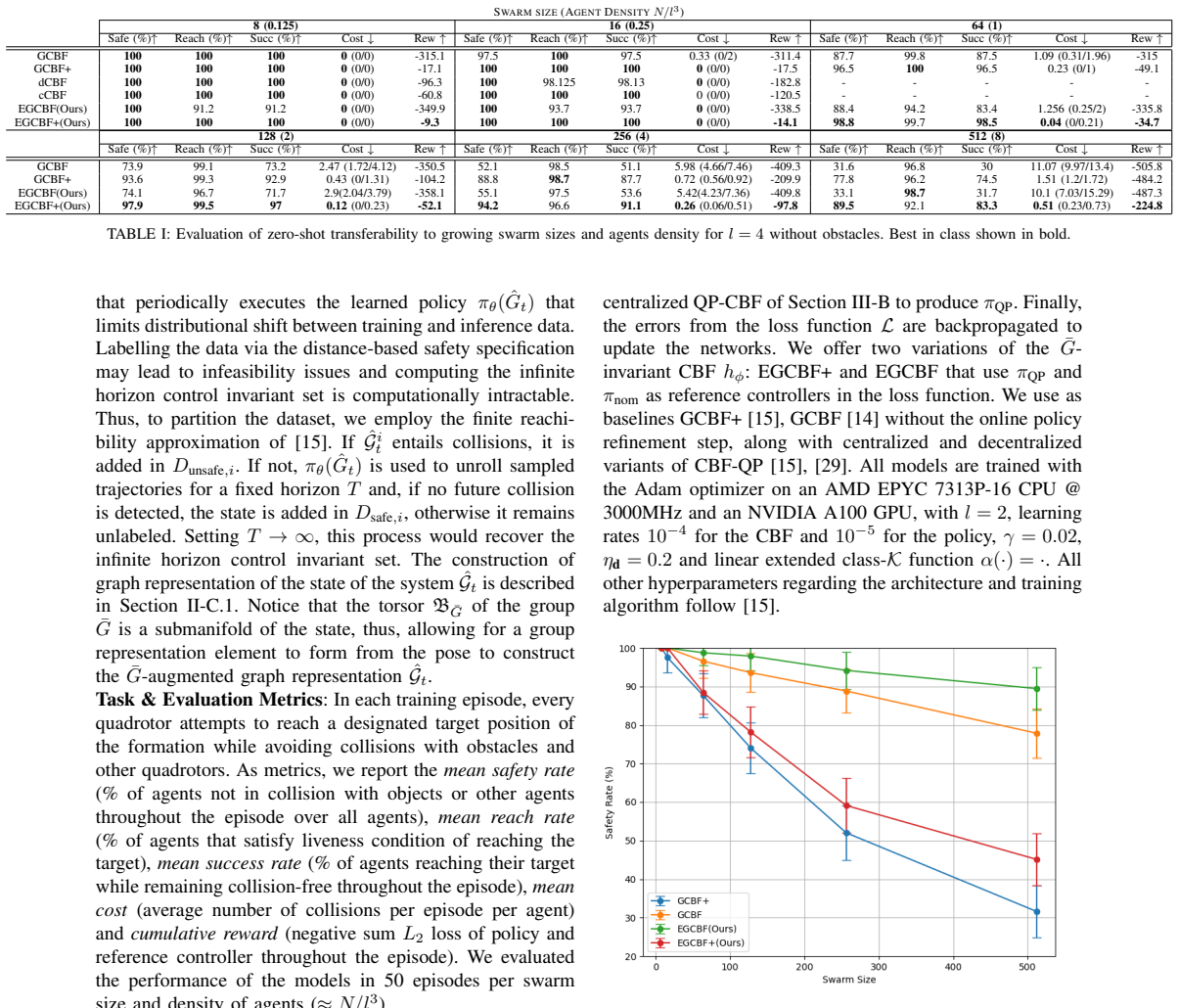
- Symmetry-enhanced CBFs keep high safety and success rates when swarm size grows from 8 to 512 and density increases by 6400%, while non-equivariant baselines degrade sharply.
- Equivariant parametrization reduces the hypothesis class and required demonstrations, leading to faster convergence during training.
- The equivariant architecture is group-modular: the same wrapping applies to any Lie group compatible with the robot's state manifold, not just permutations.
Reading between the lines
- The zero-shot scaling result suggests that locally defined geometric symmetries are a sufficient inductive bias for compositional generalization in safe multi-agent control; a testable corollary is that equivariant networks should also generalize to unseen obstacle densities, not just swarm sizes.
- Because Lemma 3 asserts every valid CBF can be symmetrized by group averaging, the paper implicitly predicts that a trained non-equivariant CBF, averaged over the group, remains a valid certificate; measuring the safety violation rate of that averaged certificate on transformed states would test this directly.
- The static-obstacle experiments preserve symmetry only if obstacles are transformed alongside robots; in fixed environments, the practical benefit may require treating obstacles as part of a $G$-invariant augmented graph or using a subgroup that leaves the obstacle configuration invariant.
Editorial analysis
A structured set of objections, weighed in public.
Referee Report
Summary. The paper proposes to embed intrinsic geometric symmetries into learned graph-based control barrier functions (CBFs) and distributed policies for multi-agent navigation. It formalizes conditions under which optimal safety-filtered policies are equivariant (Theorems 1 and 2), introduces a group-modular equivariant graph transformer via canonicalization (Lemma 4), and presents simulation results showing zero-shot transfer of safety and success rates from 8-agent training swarms to swarms of up to 512 agents, both with and without obstacles. The central claim is that enforcing symmetries in the CBF and policy architecture improves safety, scalability, sampling efficiency, and generalization.
Significance. If correct, the paper would provide a principled and modular way to bake geometric symmetries into learned safety certificates for multi-agent systems, with a plausible mechanism for zero-shot generalization to larger and denser swarms. The paper is clear in its problem formulation, the proposed equivariant architecture is simple and adaptable, and the experimental scale (up to 512 agents) is substantially larger than many prior works in this area. The main strengths are the explicit theoretical motivation for equivariant CBF parametrizations, the concrete canonicalization construction that can wrap existing non-equivariant networks, and the extensive zero-shot scalability evaluation. However, the theoretical support has gaps for the obstacle-inclusive experiments, a key lemma is not proven for the non-compact symmetry group used, and the experimental claims lack uncertainty quantification.
major comments (5)
- [Section IV, Assumption 3 and Section V-B] Theorem 2 and the associated safety guarantees require the graph topology and the safe set to be G-invariant (Assumption 3). In the obstacle-inclusive experiments of Section V-B, obstacles are fixed in the world frame, while the group action transforms the robot states. Under such a transformation, distances from robots to obstacles change, so the safe set S_N^r defined in Section II-C.2 is not G-invariant and the neighbor relation to obstacle nodes is not preserved. The statement in Assumption 3 that objects are 'transformed similarly to i's state' describes a global coordinate-frame transformation of the whole scene, not a symmetry of the fixed-obstacle deployment protocol actually tested. Consequently, the theoretical framework does not cover Figure 2. The authors should either restrict the symmetry claims to obstacle-free settings, or modify the obstacle experiments so that obstacle configurations are obtained as group transformations of a canonical configuration, and then justify Assumption 3 for that protocol.
- [Section IV-A, Lemma 3] The proof of Lemma 3 uses a normalized Haar average 1/|G| ∫_G h(ϕ_g x) dµ(g). For the group \bar G = R^3 × S^1 used in Section V, the Haar measure is infinite and cannot be normalized; the expression 1/|G| is undefined. Even for a compact group, the proof claims that ∫_G α(h(ϕ_g x)) dµ(g) is an extended class-K function of \hat h(x), but an integral of α composed with h over an orbit is not in general a function of the orbit average of h. The lemma is therefore unproven, and the statement that there always exists an equivalent G-invariant valid CBF is unsupported. The authors should remove the lemma or replace it with a correct statement and proof under appropriate compactness and regularity assumptions.
- [Section V-B, Table I] Table I reports no error bars, standard deviations, or number of training seeds, making it impossible to assess the statistical significance of the reported differences. The claim that 'the symmetry-enhanced EGCBF+ outperforms the baselines across all sizes-densities' is not supported by the table: at N=8, EGCBF has reach and success rates of 91.2% versus 100% for GCBF, and at N=64, N=256, and N=512, EGCBF+ has lower reach rates than GCBF+ (99.7 vs 100, 96.6 vs 98.7, and 92.1 vs 96.2, respectively). The authors should provide multi-seed results with variance, and temper or refine the claimed dominance accordingly.
- [Section IV-A.2, Theorem 2 proof] The proof of Theorem 2 relies on the assertion that 'the group actions preserve norms' when rewriting ||⊕_k ψ_g(π(x_Q)) − ⊕_k ψ_g(π_nom(x_Q))|| as ||π(x_Q) − π_nom(x_Q)||. For the action ψ_g(u) = (gτ, F_3) defined in Section V, where g ∈ \bar G contains a translation component λ ∈ R^3, this norm-preservation property is false unless the action on U is purely rotational. The paper does not specify a norm on U that is invariant under this action, and the notation suggests an affine action on the torque vector. The equivariance argument for the QP solution is therefore incomplete as written.
- [Section IV-A.2, Theorem 1] Theorem 1 states that the optimal nominal policy π*(x_i(t)) is G-equivariant, but the proof implicitly transforms the target \hat x along with the state, since the cost T is only invariant under the simultaneous group action on x and \hat x. The actual policy in the system is a function of the full augmented graph, including target nodes, and the equivariance should be stated for that graph input to match the architecture and the rest of the paper. As written, the theorem's statement and proof are mismatched with the problem formulation.
minor comments (6)
- [Section II-C.1] The definition of E* is notationally confusing: E* = {(i,l) | ∀i∈I_N, l∈I_N+N} mixes agent indices and graph node indices; please clarify how target-node edges are indexed.
- [Section III, Definition 3] In Definition 3, the safe set is written as x^{N_{\hat R_i} ∪ {i}} ∈ S^r_{N,i} while the inner set is defined as {x^{N_{\hat R_i}} ∈ X^{|N_i|+1} ...}; the superscripts and the cardinality |N_i|+1 do not match the notation used elsewhere.
- [Section IV-A, Lemma 3 proof] The sentence 'This proof and can extended for the the multi-agent CBF terminology' contains a typo and a grammatical error; it should read 'This proof can be extended to the multi-agent CBF setting.'
- [Section V-B, Table I caption] The 'Cost' column entries such as '0(0/0)' and '1.256 (0.25/2)' are not explained; please define what the parenthetical numbers denote (e.g., min/max or standard deviation).
- [Section V, Figure 1 caption] The caption refers to 'contours' of the CBF, but the figure is not included or is not described; please either include the contour plot or adjust the caption.
- [Section II-A, Definition 1] Definition 1 states ϕ_g ◦ ϕ_h = ϕ_{g·h}, which for a left action should be ϕ_g ◦ ϕ_h = ϕ_{gh}; the current statement is inconsistent with standard convention and with the later use of the action.
Circularity Check
No significant circularity: the equivariance theorems are derived from explicit invariance/equivariance assumptions, and the reported generalization gains are empirical rather than fitted; minor self-citations and an acknowledged symmetry-mismatch limitation do not make the argument circular.
full rationale
The derivation chain is self-contained in the sense relevant to circularity. Theorem 1 proves equivariance of the nominal optimal policy from G-equivariant dynamics and a G-invariant cost, while Theorem 2 proves equivariance of the QP-CBF-filtered policy from Lemma 2, which in turn is proven from Definition 7's explicit G-invariance of h and the equivariance of the dynamics. These are genuine implications of the stated assumptions, not restatements of the conclusions. The empirical scalability claims in Section V-B (Table I and Figure 2) are measured zero-shot outcomes of an architecture whose equivariance is enforced a priori; no safety metric or generalization value is fitted as a parameter in the loss, so the reported 'prediction' is not forced by construction. The self-citations in the paper ([25], [28]) are background or methodological inspiration and are not load-bearing: the group-canonicalization construction is proved in Lemma 4 and implemented in Section IV-B.2 without depending on [28]'s results. Two limitations should be flagged, but as correctness risks rather than circularity. First, Assumption 3 (G-invariant graph topology) is asserted for Euclidean-distance neighborhoods, yet the obstacle-inclusive experiments keep obstacles fixed in the world frame rather than transforming the entire scene, so Theorem 2's premises are not exactly matched in the Figure 2 protocol. Second, the Conclusion explicitly concedes the open question: 'But what if the dynamics and the assumed safe set have different symmetries? We leave this question for future work.' These gaps affect whether the theorem covers the experiments, but they do not make any claimed prediction equivalent to its inputs. Accordingly, the circularity score is low.
Assumptions & free parameters
assumptions (6)
- domain assumption Assumption 1: Parameter R is sufficiently large so that Problem 1 is always feasible once obstacles are discovered.
- domain assumption Assumption 2: Safety of node i is only affected by nodes in its R-neighborhood.
- domain assumption Assumption 3: The topology of the graph representation is G-invariant under the group action.
- domain assumption The robot dynamics are G-equivariant under the subgroup R^3 x S^1, but not under full SE(3).
- domain assumption The safety specification c(alpha, beta) = ||alpha - beta|| - r is G-invariant, so the safe set is G-invariant.
- ad hoc to paper Normalized Haar averaging preserves validity of CBFs (Lemma 3).
Cite this review
Pith. "Pith review of Deep Equivariant Multi-Agent Control Barrier Functions." pith.science (2026). https://pith.science/paper/FQPGN4UY
@misc{pith2026250607755,
  author       = {Pith},
  title        = {Pith review of: Deep Equivariant Multi-Agent Control Barrier Functions},
  year         = {2026},
  howpublished = {\url{https://pith.science/paper/FQPGN4UY}},
  note         = {Machine review of arXiv:2506.07755}
}
read the original abstract
With multi-agent systems increasingly deployed autonomously at scale in complex environments, ensuring safety of the data-driven policies is critical. Control Barrier Functions have emerged as an effective tool for enforcing safety constraints, yet existing learning-based methods often lack in scalability, generalization and sampling efficiency as they overlook inherent geometric structures of the system. To address this gap, we introduce symmetries-infused distributed Control Barrier Functions, enforcing the satisfaction of intrinsic symmetries on learnable graph-based safety certificates. We theoretically motivate the need for equivariant parametrization of CBFs and policies, and propose a simple, yet efficient and adaptable methodology for constructing such equivariant group-modular networks via the compatible group actions. This approach encodes safety constraints in a distributed data-efficient manner, enabling zero-shot generalization to larger and denser swarms. Through extensive simulations on multi-robot navigation tasks, we demonstrate that our method outperforms state-of-the-art baselines in terms of safety, scalability, and task success rates, highlighting the importance of embedding symmetries in safe distributed neural policies.
Figures


Forward citations
Cited by 1 Pith paper
-
Leveraging Equivariances and Symmetries in the Control Barrier Function Synthesis
Symmetries in system dynamics and constraints let safety (barrier) functions be inferred across the whole state space from values on a small subset, and let partially known barrier functions seed new ones for asymmetr...
Reference graph
Works this paper leans on
-
[1]
Collision avoidance ver- ification of multiagent systems with learned policies,
Z. Dong, S. Omidshafiei, and M. Everett, “Collision avoidance ver- ification of multiagent systems with learned policies,”IEEE Control Systems Letters, vol. 8, pp. 652–657, 2024
work page 2024
-
[2]
Multi-vehicle collision avoidance via hamilton-jacobi reachability and mixed integer program- ming,
M. Chen, J. C. Shih, and C. J. Tomlin, “Multi-vehicle collision avoidance via hamilton-jacobi reachability and mixed integer program- ming,” inCDC, pp. 1695–1700, 2016
work page 2016
-
[3]
Sampling-based path planning for uav collision avoidance,
Y . Lin and S. Saripalli, “Sampling-based path planning for uav collision avoidance,”IEEE Transactions on Intelligent Transportation Systems, vol. 18, no. 11, pp. 3179–3192, 2017
work page 2017
-
[4]
Chance-constrained collision avoidance for mavs in dynamic environments,
H. Zhu and J. Alonso-Mora, “Chance-constrained collision avoidance for mavs in dynamic environments,”IEEE Robotics and Automation Letters, vol. 4, no. 2, pp. 776–783, 2019
2019
-
[5]
Decentralized non- communicating multiagent collision avoidance with deep reinforce- ment learning,
Y . F. Chen, M. Liu, M. Everett, and J. P. How, “Decentralized non- communicating multiagent collision avoidance with deep reinforce- ment learning,” inICRA, pp. 285–292, 2017
work page 2017
-
[6]
Scalable constrained policy optimization for safe multi-agent reinforcement learning,
L. Zhang, L. Li, W. Wei, H. Song, Y . Yang, and J. Liang, “Scalable constrained policy optimization for safe multi-agent reinforcement learning,” inNeurIPS, 2024
work page 2024
-
[7]
Control barrier function based quadratic programs for safety critical systems,
A. D. Ames, X. Xu, J. W. Grizzle, and P. Tabuada, “Control barrier function based quadratic programs for safety critical systems,”IEEE Transactions on Automatic Control, vol. 62, 2016
work page 2016
-
[8]
Nonsmooth barrier func- tions with applications to multi-robot systems,
P. Glotfelter, J. Cort ´es, and M. Egerstedt, “Nonsmooth barrier func- tions with applications to multi-robot systems,”IEEE control systems letters, vol. 1, no. 2, pp. 310–315, 2017
work page 2017
Show all 29 references
-
[9]
Distributed implementation of control barrier functions for multi-agent systems,
X. Tan and D. V . Dimarogonas, “Distributed implementation of control barrier functions for multi-agent systems,”IEEE Control Systems Letters, vol. 6, pp. 1879–1884, 2022
2022
-
[10]
Control barrier functions for multi-agent systems under conflicting local signal temporal logic tasks,
L. Lindemann and D. V . Dimarogonas, “Control barrier functions for multi-agent systems under conflicting local signal temporal logic tasks,”IEEE Control Systems Letters, vol. 3, no. 3, pp. 757–762, 2019
2019
-
[11]
Trust-based rate-tunable control barrier functions for non-cooperative multi-agent systems,
H. Parwana, A. Mustafa, and D. Panagou, “Trust-based rate-tunable control barrier functions for non-cooperative multi-agent systems,” in2022 IEEE 61st Conference on Decision and Control (CDC), pp. 2222–2229, 2022
2022
-
[12]
Learning control barrier functions from expert demonstrations,
A. Robey, H. Hu, L. Lindemann, H. Zhang, D. V . Dimarogonas, S. Tu, and N. Matni, “Learning control barrier functions from expert demonstrations,” inCDC, 2020
2020
-
[13]
Learning safe multi-agent control with decentralized neural barrier certificates,
Z. Qin, K. Zhang, Y . Chen, J. Chen, and C. Fan, “Learning safe multi-agent control with decentralized neural barrier certificates,” in International Conference on Learning Representations, 2021
2021
-
[14]
Neural graph control barrier func- tions guided distributed collision-avoidance multi-agent control,
S. Zhang, K. Garg, and C. Fan, “Neural graph control barrier func- tions guided distributed collision-avoidance multi-agent control,” in Conference on Robot Learning, pp. 2373–2392, PMLR, 2023
2023
-
[15]
Gcbf+: A neural graph control barrier function framework for distributed safe multi-agent control,
S. Zhang, O. So, K. Garg, and C. Fan, “Gcbf+: A neural graph control barrier function framework for distributed safe multi-agent control,” IEEE Transactions on Robotics, pp. 1–20, 2025
2025
-
[16]
Provably safe online multi-agent navigation in unknown environments,
Z. Gao, G. Yang, J. Bayrooti, and A. Prorok, “Provably safe online multi-agent navigation in unknown environments,” in8th Annual Conference on Robot Learning, 2024
2024
-
[17]
Fast, expressive $\mathrm{SE}(n)$ equivariant networks through weight-sharing in position-orientation space,
E. J. Bekkers, S. Vadgama, R. Hesselink, P. A. V . der Linden, and D. W. Romero, “Fast, expressive $\mathrm{SE}(n)$ equivariant networks through weight-sharing in position-orientation space,” inThe Twelfth International Conference on Learning Representations, 2024
2024
-
[18]
Multi- agent mdp homomorphic networks,
E. van der Pol, H. van Hoof, F. A. Oliehoek, and M. Welling, “Multi- agent mdp homomorphic networks,” 2022
2022
-
[19]
Boost- ing sample efficiency and generalization in multi-agent reinforcement learning via equivariance,
J. McClellan, N. Haghani, J. Winder, F. Huang, and P. Tokekar, “Boost- ing sample efficiency and generalization in multi-agent reinforcement learning via equivariance,” 2024
2024
-
[20]
E(n) equivariant graph neural networks,
V . G. Satorras, E. Hoogeboom, and M. Welling, “E(n) equivariant graph neural networks,” inICML, 2021
2021
-
[21]
Se(3)- transformers: 3d roto-translation equivariant attention networks,
F. B. Fuchs, D. E. Worrall, V . Fischer, and M. Welling, “Se(3)- transformers: 3d roto-translation equivariant attention networks,” in NeurIPS, 2020
2020
-
[22]
Scalable multi-agent reinforcement learning through intelligent information aggregation,
S. Nayak, K. Choi, W. Ding, S. Dolan, K. Gopalakrishnan, and H. Balakrishnan, “Scalable multi-agent reinforcement learning through intelligent information aggregation,” ICML’23, 2023
2023
-
[23]
Control barrier functions: Theory and applications,
A. D. Ames, S. Coogan, M. Egerstedt, G. Notomista, K. Sreenath, and P. Tabuada, “Control barrier functions: Theory and applications,” inECC 2019, pp. 3420–3431, 2019
2019
-
[24]
Robustness of con- trol barrier functions for safety critical control,
X. Xu, P. Tabuada, J. W. Grizzle, and A. D. Ames, “Robustness of con- trol barrier functions for safety critical control,”IF AC-PapersOnLine, vol. 48, pp. 54–61, 2015. Analysis and Design of Hybrid Systems
2015
-
[25]
Graph neural networks for multi-robot active information acquisition,
M. Tzes, N. Bousias, E. Chatzipantazis, and G. J. Pappas, “Graph neural networks for multi-robot active information acquisition,” in 2023 IEEE International Conference on Robotics and Automation (ICRA), pp. 3497–3503, IEEE, 2023
2023
-
[26]
e(3)-equivariant actor-critic methods for cooperative multi-agent reinforcement learning,
D. Chen and Q. Zhang, “e(3)-equivariant actor-critic methods for cooperative multi-agent reinforcement learning,” 2024
2024
-
[27]
Be- yond canonicalization: How tensorial messages improve equivariant message passing,
P. Lippmann, G. Gerhartz, R. Remme, and F. A. Hamprecht, “Be- yond canonicalization: How tensorial messages improve equivariant message passing,” inICLR, 2025
2025
-
[28]
Symmetries-enhanced multi-agent reinforcement learning,
N. Bousias, S. Pertigkiozoglou, K. Daniilidis, and G. Pappas, “Symmetries-enhanced multi-agent reinforcement learning,” 2025
2025
-
[29]
Safety barrier certificates for collisions-free multirobot systems,
L. Wang, A. D. Ames, and M. Egerstedt, “Safety barrier certificates for collisions-free multirobot systems,”IEEE Transactions on Robotics, vol. 33, no. 3, pp. 661–674, 2017
2017
Reviewed August 7, 2026 · model on record in the stance chip above.
Discussion (0). Sign in to comment.