REVIEW 4 major objections 4 minor 111 references
Main-sequence Turnoff Stars as Probes of the Ancient Galactic Relic: Chemo-dynamical Analysis of a Pilot Sample
T0 review · 4 major / 4 minor · reviewed 2026-08-07 · deepseek-v4-flash
Pith's one-line read This paper claims that main-sequence turnoff stars reveal distinct chemical histories for the accreted GSE galaxy and the Milky Way's in situ population, with GSE showing an alpha-knee in Mg at [Fe/H] = -1.60 ± 0.06 and the first…
desk verdict New MSTO-based GSE chemistry with a genuinely new r-process pattern, but membership bookkeeping keeps it conditional. read the letter →
The pith
A machine-rendered reading of the paper's core claim, the machinery that carries it, and where it could break.
The reading
What carries the argument
The argument is carried by three working pieces. The first is the main-sequence turnoff (MSTO) star itself: because these stars have not yet undergone the first dredge-up, their surface abundances record the composition of the gas from which they formed, making them clean chemical fossils. The second is the action-angle classification: using a model Milky Way potential, the authors compute radial action JR and z-angular momentum Lz, then assign stars to GSE (JR > 30 kpc km/s, |Lz| < 500 kpc km/s) or in situ (JR < 15 kpc km/s, Lz > 0) following prior work, isolating the two populations whose element ratios are then compared. The third is the alpha-knee itself — the metallicity at which [alpha/Fe] begins to fall as type Ia supernovae begin contributing iron — which serves as a clock for the star-formation history of the GSE progenitor. For the r-process claim, the load-bearing object is the abundance pattern of the r-II star J0722 compared against the solar r-process residual pattern, with the >3 sigma Pr deviation flagged as the notable anomaly.
What would settle it
Compute the [Mg/Fe] trend for the same stars after reclassifying them with a simulation-calibrated membership model or an updated Milky Way potential; if the downturn at [Fe/H] ~ -1.6 vanishes or shifts by more than ~0.1 dex, the claimed GSE alpha-knee is an artifact of the adopted action-space cuts.
Extended reading notes
Core claim
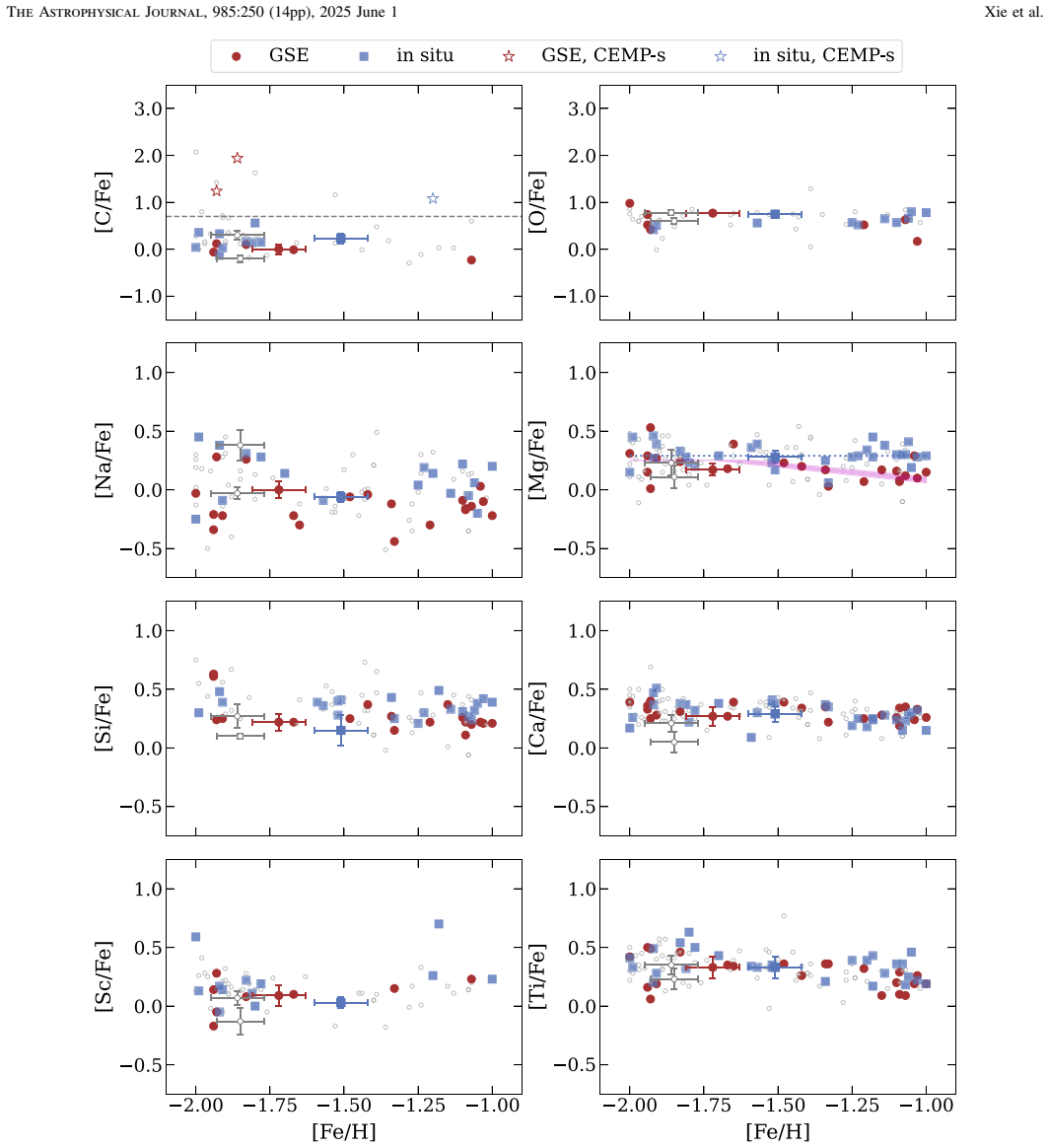
The central claim is that the accreted GSE population and the Milky Way's in situ population differ systematically in their chemical evolution, and that these differences are readable in MSTO stars. Specifically, GSE stars show a pronounced downturn ('alpha-knee') in [Mg/Fe] beginning at [Fe/H] = -1.60 ± 0.06, with a fitted slope of -0.280 ± 0.013 above that metallicity, whereas the alpha-element abundances of in situ stars remain almost constant through [Fe/H] = -1.0. The paper further reports tentative downturns in [Si/Fe] and [Ti/Fe] for GSE at the same metallicity, a drop in [Zn/Fe] and [Ni/Fe] for GSE above [Fe/H] ≈ -1.6 with no such drop in situ, an overall enhancement of [Eu/Fe] in GSE with a median of 0.55, and a [Ba/Eu] ratio that rises with metallicity in GSE while staying nearly constant for in situ stars. In addition, the paper presents the first r-process abundance pattern for an r-II GSE star, J0722, which is consistent with the solar r-process pattern for elements from Sr through Gd except for Pr, which is enhanced by over 3 sigma. The Li plateau, however, is the same for both populations (A(Li) ≈ 2.17), indicating that the star formation environment does not set the Spite plateau.
Load-bearing premise
The classification of stars as GSE versus in situ rests on adopted cuts in radial action and angular momentum (JR > 30 kpc km/s and |Lz| < 500 for GSE; JR < 15, Lz > 0 for in situ) applied to orbits in a chosen Milky Way potential, so the chemical differences reported between the two populations depend on those membership boundaries being correct.
Editorial extensions
If this is right
- If the alpha-knee at [Fe/H] = -1.60 ± 0.06 holds, the GSE progenitor experienced type Ia supernova enrichment at lower metallicity than the Milky Way, implying a less massive or more slowly star-forming galaxy.
- The constant in situ [Mg/Fe] across -2.0 < [Fe/H] < -1.0 shows that the Milky Way's own star formation had not yet reached the alpha-knee in this metallicity range.
- The rising [Ba/Eu] with metallicity in GSE, but not in situ, implies that a delayed s-process source contributed progressively more barium in the GSE progenitor.
- The Li plateau being identical in GSE and in situ stars supports the view that the Spite plateau is independent of the galactic birth environment.
- The r-process pattern of J0722 matching the solar r-process pattern (except Pr) suggests that r-process nucleosynthesis operates similarly in the GSE progenitor and the Milky Way.
Reading between the lines
- Applying the same MSTO chemo-dynamical approach to Thamnos, Sequoia, and Helmi stream stars, once larger samples exist, could reveal whether each accreted system had a distinct alpha-knee metallicity and hence a different star-formation timescale.
- The >3 sigma Pr deviation in J0722 could be a real nucleosynthetic difference in the r-process site of the GSE progenitor or an atomic-data artifact; measuring Pr in additional GSE r-II stars with high-resolution spectra would tell which.
- The sharp action-space cuts used here may misclassify stars near the boundaries, so future work with simulation-calibrated membership probabilities could sharpen the alpha-knee measurement and possibly move its position by more than the quoted error.
- The decreases in [Zn/Fe] and [Ni/Fe] in GSE at [Fe/H] > -1.6, coincident with the Mg knee, provide a testable prediction that chemical evolution models should reproduce the same three elements turning over at the same metallicity.
Editorial analysis
A structured set of objections, weighed in public.
Referee Report
Summary. The paper presents a chemo-dynamical analysis of 167 main-sequence turnoff stars (four new CFHT/ESPaDOnS targets and 163 SAGA literature stars) in the range -2.0 < [Fe/H] < -1.0. Using actions computed in the McMillan (2017) potential, the authors assign stars to GSE, in situ, and other substructures, then compare abundance ratios between GSE and in situ populations. The main results are: a Mg alpha-knee in GSE at [Fe/H] ~ -1.60 +/- 0.06 with slope -0.280 +/- 0.013 while in situ Mg remains flat; a similar Li plateau A(Li) ~ 2.17 for both populations; lower Zn and Ni in GSE at [Fe/H] > -1.6; Eu enhancement and an increasing [Ba/Eu] trend in GSE; and the first reported full r-process pattern for a GSE r-II star (J0722), consistent with the solar r-process pattern except for Pr.
Significance. If correct, the Mg-knee metallicity and the [Ba/Eu] trend would support the picture that the GSE progenitor was less massive than the Milky Way and experienced SNe Ia at lower metallicity, and the J0722 pattern would argue for a broadly universal r-process. The paper's strengths include the use of MSTO stars (which avoid first dredge-up contamination), the careful line-by-line abundance analysis of the four CFHT stars, Monte Carlo propagation of action uncertainties, and an explicit acknowledgment in Section 4 that the substructure criteria are debated and that sample sizes are limited. These strengths are, however, offset by the conditional nature of the membership assignment, which underpins every chemical comparison, and by the heterogeneous literature abundances without homogenization. The results are plausible and broadly consistent with earlier work, but the paper's central claims are not yet demonstrated at the level of robustness claimed.
major comments (4)
- [Abstract; Section 2.3; Section 4] The number of GSE and in situ stars is inconsistent across the manuscript: the Abstract reports GSE=35 and in situ=31, while Section 2.3 and the Conclusions report GSE=31 and in situ=35. Because every abundance comparison is defined by these labels, this is not a cosmetic typo; the paper must state which counts are correct and rerun any affected statistics, or the labels cannot be considered reliable.
- [Section 2.3] Membership is assigned from hard cuts on actions calculated in a single axisymmetric potential, with no table of per-star actions or membership probabilities and no test of sensitivity to the adopted potential or thresholds. This is load-bearing because each chemical claim is defined by these labels. The concern is concrete: one program star with JR ~ 18 kpc km/s fails the in situ criterion but is assigned to in situ 'due to the planar orbital properties and the in situ chemical features'; using chemistry to assign the label and then comparing chemistry between the labeled groups is circular for that star. The authors should provide the action values for all stars, test alternative potentials and threshold choices, and show that the Mg-knee and [Ba/Eu] results survive when membership is treated probabilistically.
- [Section 2.2; Section 3.3; Figures 7-10] The literature sample is compiled from SAGA without homogenization of analysis methods, and the literature points in Figures 7-10 are plotted without error bars. The quoted Mg-knee parameters (knee at -1.60 +/- 0.06, slope -0.280 +/- 0.013) are therefore fitted to a dataset whose inter-study zero-point offsets are unquantified. The manuscript's assertion that these uncertainties 'do not significantly affect' the discussion is not demonstrated; at minimum, the fit should be repeated on a single-analysis subsample or with systematic offsets added in quadrature.
- [Section 3.7; Figure 12] The claim of the first GSE r-process pattern rests entirely on J0722's membership. If that star's classification is revised under the sensitivity tests requested above, the claim collapses; the paper should state J0722's actions, membership probability, and the robustness of its assignment to potential choice. Additionally, the comparison with the solar r-process pattern is made after shifting to match Eu, so the 'except Pr' statement needs a quantitative statement of which other elements are within their combined uncertainties.
minor comments (4)
- [Section 3.3 and Abstract] The Abstract says 'the alpha-elements of in-situ stars remain nearly constant', while Section 3.3 reports a clear constant trend only for Mg and only 'tentative offsets' for Si and Ti; please restrict the claim to Mg or provide fitted trends for all alpha-elements.
- [Figure 7 caption] The caption says 'Symbols with and without error bars are stars from CFHT observation and the SAGA database, respectively'; this convention is not consistently stated in later figures and should be repeated or a legend added.
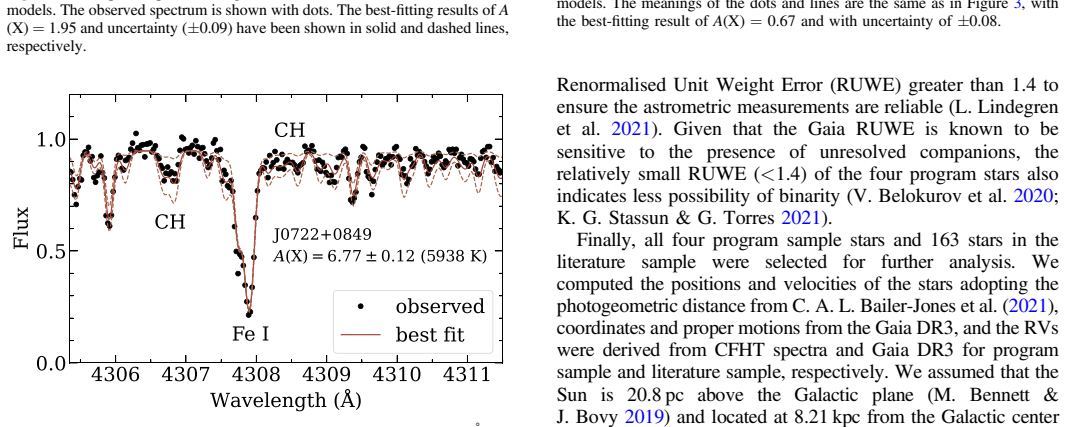
- [Section 2.1.3 and Table 3] The sentence about S/N contains a typo ('S /Ni s higher than 100'), and Table 3 uses 'L' and '...' for several elements without an explicit explanation of what these entries mean; please define all symbols in the table note.
- [Section 3.5] The number strings such as '10 (V),2 2 (Cr),1 8 (Mn)' appear to have spacing or formatting errors; please correct the typesetting.
Circularity Check
Classification is otherwise dynamical, but one in-situ star is assigned by its chemistry and then counted as chemical evidence, making that object's contribution to the in-situ chemical trends circular.
-
self definitional
[Section 2.3 (in situ classification), feeding Sections 3.3 and Conclusions point 2]
"We note that one star in the program sample has JR ~ 18 kpc km s^-1, which does not meet the criteria we adopted for in situ stars. However, due to the planar orbital properties (z_max ~ 0.5 kpc) and the in situ chemical features, we treat this star as in situ in this work."
This star fails the adopted dynamical in-situ criterion (JR < 15) and is admitted into the in-situ sample on the basis of its 'in situ chemical features'. The in-situ chemical trends, including the flat [Mg/Fe] relation that is contrasted with the GSE alpha-knee, are then computed from the in-situ sample that contains this star. For this object, the chemical conclusion is therefore built into the membership definition: it is labeled in-situ because it looks chemically in-situ, and then counted as evidence that in-situ stars look chemically distinct. The paper does not identify the star or provide per-star actions, so the size of the induced bias in the [Mg/Fe], [Zn/Fe], and [Ba/Eu] comparisons cannot be audited.
full rationale
The paper's main chemical comparisons (Mg alpha-knee, Zn/Ni declines, Ba/Eu trends) are derived from GSE and in-situ samples that are, apart from one manually reassigned program star, defined by dynamical action cuts (JR, Lz, Jz) adopted from prior work. Those cuts are not fitted to the abundance differences being claimed, so the central results are not predictions of inputs by construction. The alpha-knee position and slope are fitted outputs, not assumed constraints, and the r-II pattern of J0722 is an observed abundance pattern for one dynamically classified member. The genuinely circular element is the single star in Section 2.3 that fails the in-situ action criterion yet is assigned to in-situ 'due to ... the in situ chemical features'; that star then contributes to the in-situ abundance trends, so for that object the chemical comparison is self-definitional. The paper also has an internal label-count inconsistency (abstract: GSE 35 / in situ 31; body and conclusions: GSE 31 / in situ 35), which is an audit/correctness concern rather than circularity, and the authors themselves note that the adopted substructure criteria are debated. Because the circular step involves only one star and the classification framework is otherwise independent of the abundance measurements, the appropriate score is low: 2.
Assumptions & free parameters
free parameters (1)
- GSE Mg alpha-knee metallicity and slope =
-1.60 +/- 0.06, slope -0.280 +/- 0.013
assumptions (4)
- domain assumption The adopted GSE and in situ selection criteria in action-angle space cleanly separate the two populations.
- domain assumption MSTO stars preserve their birth chemical abundances because they have not undergone first dredge-up.
- domain assumption Abundances compiled in the SAGA database from different literature sources are comparable without homogenization.
- domain assumption The adopted axisymmetric Milky Way potential and solar constants are adequate for computing actions and energies.
Cite this review
Pith. "Pith review of Main-sequence Turnoff Stars as Probes of the Ancient Galactic Relic: Chemo-dynamical Analysis of a Pilot Sample." pith.science (2026). https://pith.science/paper/LZUU6IUT
@misc{pith2026250607758,
  author       = {Pith},
  title        = {Pith review of: Main-sequence Turnoff Stars as Probes of the Ancient Galactic Relic: Chemo-dynamical Analysis of a Pilot Sample},
  year         = {2026},
  howpublished = {\url{https://pith.science/paper/LZUU6IUT}},
  note         = {Machine review of arXiv:2506.07758}
}
abstract
The main-sequence turnoff (MSTO) stars well preserve the chemical properties where they were born, making them ideal tracers for studying the stellar population. We perform a detailed chemo-dynamical analysis on moderately metal-poor ($-2.0<\mathrm{[Fe/H]}<-1.0$) MSTO stars to explore the early accretion history of the Milky Way. Our sample includes four stars observed with high-resolution spectroscopy using CFHT/ESPaDOnS and 163 nearby MSTO stars selected from the SAGA database with high-resolution results. Within the action-angle spaces, we identified Gaia-Sausage-Enceladus (GSE, 35), stars born in the Milky Way (in situ, 31), and other substructures (21). We find that both GSE and in-situ stars present a similar Li plateau around $A(\mathrm{Li)}\sim 2.17$. GSE shows a clear $\alpha$-knee feature in Mg at $\mathrm{[Fe/H]}\sim-1.60\pm 0.06$, while the $\alpha$-elements of in-situ stars remain nearly constant within the metallicity range. The iron-peak elements show little difference between GSE and in-situ stars except for Zn and Ni, which decrease in GSE at $\mathrm{[Fe/H]}>-1.6$, while they remain constant in in-situ stars. Among heavy elements, GSE shows overall enhancement in Eu, with [Ba/Eu] increasing with the metallicity, while this ratio remains almost constant for in-situ stars, suggesting the contribution of longer time-scale sources to the $s$-process in GSE. Moreover, for the first time, we present the $r$-process abundance pattern for an extremely $r$-process enhanced ($r$-II) GSE star, which appears consistent with the solar $r$-process pattern except for Pr. Further investigation of larger GSE samples using high-resolution spectra is required to explore the reason for the significantly higher Pr in the GSE r-II star.
Figures


Figures from the paper (9 more)




Reference graph
Works this paper leans on
-
[1]
R., Stancliffe, R
Abate, C., Pols, O. R., Stancliffe, R. J., et al. 2015, A&A, 581, A62
2015
-
[2]
S., Belokurov, V., Myeong, G
Aguado, D. S., Belokurov, V., Myeong, G. C., et al. 2021, ApJL, 908, L8
2021
-
[3]
M., Lind, K., Asplund, M., Barklem, P
Amarsi, A. M., Lind, K., Asplund, M., Barklem, P. S., & Collet, R. 2016, MNRAS, 463, 1518
2016
-
[4]
M., Spite, M., Korotin, S
Andrievsky, S. M., Spite, M., Korotin, S. A., et al. 2009, A&A, 494, 1083
2009
-
[5]
C., Christlieb, N., et al
Aoki, W., Beers, T. C., Christlieb, N., et al. 2007, ApJ, 655, 492
2007
-
[6]
C., Lee, Y
Aoki, W., Beers, T. C., Lee, Y. S., et al. 2013, AJ, 145, 13
2013
-
[7]
2022, ApJ, 931, 146
Aoki, W., Li, H., Matsuno, T., et al. 2022, ApJ, 931, 146
2022
-
[8]
M., Lee, Y
Arentsen, A., Placco, V. M., Lee, Y. S., et al. 2022, MNRAS, 515, 4082
2022
Show all 111 references
-
[9]
J., & Scott, P
Asplund, M., Grevesse, N., Sauval, A. J., & Scott, P. 2009, ARA&A, 47, 481
2009
-
[10]
L., Nissen, P
Asplund, M., Lambert, D. L., Nissen, P. E., Primas, F., & Smith, V. V. 2006, ApJ, 644, 229
2006
-
[11]
W., Koposov, S
Belokurov, V., Erkal, D., Evans, N. W., Koposov, S. E., & Deason, A. J. 2018, MNRAS, 478, 611
2018
-
[12]
2020, MNRAS, 496, 1922
Belokurov, V., Penoyre, Z., Oh, S., et al. 2020, MNRAS, 496, 1922
2020
-
[13]
2019, MNRAS, 482, 1417
Bennett, M., & Bovy, J. 2019, MNRAS, 482, 1417
2019
-
[14]
Borghs, G., de Bisschop, P., van Hove, M., & Silverans, R. E. 1983, HyInt, 15, 177
1983
-
[15]
S., Kravtsov, A
Bullock, J. S., Kravtsov, A. V., & Weinberg, D. H. 2001, ApJ, 548, 33
2001
-
[16]
J., Fattahi, A., Callingham, T
Carrillo, A., Deason, A. J., Fattahi, A., Callingham, T. M., & Grand, R. J. J. 2024, MNRAS, 527, 2165
2024
-
[17]
2022, MNRAS, 513, 1557
Carrillo, A., Hawkins, K., Jofré, P., et al. 2022, MNRAS, 513, 1557
2022
-
[18]
Castelli, F., & Kurucz, R. L. 2003, in IAU Symp. 210, Modeling of Stellar Atmospheres, ed. N. Piskunov, W. W. Weiss, & D. F. Gray (San Francisco, CA: ASP ), A20
2003
-
[19]
2020, MmSAI, 91, 153 Chieffi, A., Limongi, M., & Straniero, O
Cescutti, G., Molaro, P., & Fu, X. 2020, MmSAI, 91, 153 Chieffi, A., Limongi, M., & Straniero, O. 1998, ApJ, 502, 737
2020
-
[20]
G., Baugh, C
Cole, S., Lacey, C. G., Baugh, C. M., & Frenk, C. S. 2000, MNRAS, 319, 168
2000
-
[21]
2019, ApJ, 883, 107
Conroy, C., Bonaca, A., Cargile, P., et al. 2019, ApJ, 883, 107
2019
-
[22]
2018, A&A, 620, A146 da Silva, L., Girardi, L., Pasquini, L., et al
Cseh, B., Lugaro, M., D ’Orazi, V., et al. 2018, A&A, 620, A146 da Silva, L., Girardi, L., Pasquini, L., et al. 2006, A&A, 458, 609 De Silva, G. M., Freeman, K. C., Bland-Hawthorn, J., et al. 2015, MNRAS, 449, 2604
2018
-
[23]
F., Catala, C., Landstreet, J
Donati, J. F., Catala, C., Landstreet, J. D., & Petit, P. 2006, in ASP Conf. Ser. 358, Solar Polarization 4, ed. R. Casini & B. W. Lites (San Francisco, CA: ASP), 362
2006
-
[24]
K., Feltzing, S., Sahlholdt, C
Feuillet, D. K., Feltzing, S., Sahlholdt, C. L., & Casagrande, L. 2020, MNRAS, 497, 109 François, P., Depagne, E., Hill, V., et al. 2007, A&A, 476, 935
2020
-
[25]
2018, ARNPS, 68, 237
Frebel, A. 2018, ARNPS, 68, 237
2018
-
[26]
Frebel, A., & Ji, A. P. 2023, arXiv: 2302.09188
2023 arXiv
-
[27]
E., Gilmore, G., & Wyse, R
Frebel, A., Norris, J. E., Gilmore, G., & Wyse, R. F. G. 2016, ApJ, 826, 110 Gaia Collaboration, Vallenari, A., Brown, A. G. A., et al. 2023, A&A, 674, A1
2016
-
[28]
H., Kozhurina-Platais, V., & Chandar, R
Goudfrooij, P., Puzia, T. H., Kozhurina-Platais, V., & Chandar, R. 2009, AJ, 137, 4988
2009
-
[29]
C., et al
Gudin, D., Shank, D., Beers, T. C., et al. 2021, ApJ, 908, 79
2021
-
[30]
M., Grevesse, N., Biemont, E., & Whaling, W
Hannaford, P., Lowe, R. M., Grevesse, N., Biemont, E., & Whaling, W. 1982, ApJ, 261, 736
1982
-
[31]
T., Andersen, J., Nordström, B., et al
Hansen, T. T., Andersen, J., Nordström, B., et al. 2016, A&A, 588, A3
2016
-
[32]
D., et al
Haywood, M., Di Matteo, P., Lehnert, M. D., et al. 2018, ApJ, 863, 113
2018
-
[33]
2020, ARA&A, 58, 205
Helmi, A. 2020, ARA&A, 58, 205
2020
-
[34]
H., et al
Helmi, A., Babusiaux, C., Koppelman, H. H., et al. 2018, Natur, 563, 85
2018
-
[35]
Helmi, A., White, S. D. M., de Zeeuw, P. T., & Zhao, H. 1999, Natur, 402, 53
1999
-
[36]
2014, CoSka, 43, 518
Henden, A., & Munari, U. 2014, CoSka, 43, 518
2014
-
[37]
M., Hansen, T
Holmbeck, E. M., Hansen, T. T., Beers, T. C., et al. 2020, ApJS, 249, 30
2020
-
[38]
P., Mackereth, J
Horta, D., Schiavon, R. P., Mackereth, J. T., et al. 2023, MNRAS, 520, 5671
2023
-
[39]
A., Gilmore, G., & Irwin, M
Ibata, R. A., Gilmore, G., & Irwin, M. J. 1994, Natur, 370, 194
1994
-
[40]
N., Aoki, W., & Chiba, M
Ishigaki, M. N., Aoki, W., & Chiba, M. 2013, ApJ, 771, 67
2013
-
[41]
1999, ApJS, 125, 439 13 The Astrophysical Journal, 985:250 (14pp), 2025 June 1 Xie et al
Iwamoto, K., Brachwitz, F., Nomoto, K., et al. 1999, ApJS, 125, 439 13 The Astrophysical Journal, 985:250 (14pp), 2025 June 1 Xie et al
1999
-
[42]
2017, A&A, 604, A106
Jean-Baptiste, I., Di Matteo, P., Haywood, M., et al. 2017, A&A, 604, A106
2017
-
[43]
P., & Frebel, A
Ji, A. P., & Frebel, A. 2018, ApJ, 856, 138
2018
-
[44]
2012, MNRAS, 425, 3162
Kang, W., & Lee, S.-G. 2012, MNRAS, 425, 3162
2012
-
[45]
2023, A&A, 674, A5
Katz, D., Sartoretti, P., Guerrier, A., et al. 2023, A&A, 674, A5
2023
-
[46]
I., & Lugaro, M
Kobayashi, C., Karakas, A. I., & Lugaro, M. 2020, ApJ, 900, 179
2020
-
[47]
2006, ApJ, 653, 1145
Kobayashi, C., Umeda, H., Nomoto, K., Tominaga, N., & Ohkubo, T. 2006, ApJ, 653, 1145
2006
-
[48]
J., Hansen, C
Koch-Hansen, A. J., Hansen, C. J., & McWilliam, A. 2021, A&A, 653, A2
2021
-
[49]
Starkenburg, T. K. 2019, A&A, 631, L9
2019
-
[50]
2022, ApJ, 931, 147
Li, H., Aoki, W., Matsuno, T., et al. 2022, ApJ, 931, 147
2022
-
[51]
P., Naidu, R
Limberg, G., Ji, A. P., Naidu, R. P., et al. 2024, MNRAS, 530, 2512
2024
-
[52]
S., & Belyaev, A
Lind, K., Asplund, M., Barklem, P. S., & Belyaev, A. K. 2011,A&A, 528, A103
2011
-
[53]
2021, A&A, 649, A4
Lindegren, L., Bastian, U., Biermann, M., et al. 2021, A&A, 649, A4
2021
-
[54]
T., Schiavon, R
Mackereth, J. T., Schiavon, R. P., Pfeffer, J., et al. 2019, MNRAS, 482, 3426
2019
-
[55]
D., Broby Nielsen, P., Ferguson, A
Mackey, A. D., Broby Nielsen, P., Ferguson, A. M. N., & Richardson, J. C. 2008, ApJL, 681, L17
2008
-
[56]
R., Schiavon, R
Majewski, S. R., Schiavon, R. P., Frinchaboy, P. M., et al. 2017, AJ, 154, 94
2017
-
[57]
S., et al
Mashonkina, L., Christlieb, N., Barklem, P. S., et al. 2010, A&A, 516, A46
2010
-
[58]
2019, ApJL, 874, L35
Matsuno, T., Aoki, W., & Suda, T. 2019, ApJL, 874, L35
2019
-
[59]
2021, A&A, 650, A110
Matsuno, T., Hirai, Y., Tarumi, Y., et al. 2021, A&A, 650, A110
2021
-
[60]
2003, Ap&SS, 284, 539
Matteucci, F. 2003, Ap&SS, 284, 539
2003
-
[61]
1990, ApJ, 365, 539
Matteucci, F., & Brocato, E. 1990, ApJ, 365, 539
1990
-
[62]
McMillan, P. J. 2017, MNRAS, 465, 76
2017
-
[63]
W., Sneden, C., & Searle, L
McWilliam, A., Preston, G. W., Sneden, C., & Searle, L. 1995, AJ, 109, 2757 Meléndez, J., Casagrande, L., Ramírez, I., Asplund, M., & Schuster, W. J. 2010, A&A, 515, L3
1995
-
[64]
1997, MNRAS, 292, L1
Molaro, P., Bonifacio, P., & Pasquini, L. 1997, MNRAS, 292, L1
1997
-
[65]
L., et al
Monty, S., Belokurov, V., Sanders, J. L., et al. 2024, MNRAS, 533, 2420
2024
-
[66]
A., Lane, J
Monty, S., Venn, K. A., Lane, J. M. M., Lokhorst, D., & Yong, D. 2020, MNRAS, 497, 1236
2020
-
[67]
C., Belokurov, V., Aguado, D
Myeong, G. C., Belokurov, V., Aguado, D. S., et al. 2022, ApJ, 938, 21
2022
-
[68]
C., Evans, N
Myeong, G. C., Evans, N. W., Belokurov, V., Sanders, J. L., & Koposov, S. E. 2018, ApJL, 856, L26
2018
-
[69]
C., Vasiliev, E., Iorio, G., Evans, N
Myeong, G. C., Vasiliev, E., Iorio, G., Evans, N. W., & Belokurov, V. 2019, MNRAS, 488, 1235
2019
-
[70]
P., Conroy, C., Bonaca, A., et al
Naidu, R. P., Conroy, C., Bonaca, A., et al. 2020, ApJ, 901, 48
2020
-
[71]
P., Conroy, C., Bonaca, A., et al
Naidu, R. P., Conroy, C., Bonaca, A., et al. 2021, ApJ, 923, 92
2021
-
[72]
E., Chen, Y
Nissen, P. E., Chen, Y. Q., Carigi, L., Schuster, W. J., & Zhao, G. 2014, A&A, 568, A25
2014
-
[73]
E., & Schuster, W
Nissen, P. E., & Schuster, W. J. 2010, A&A, 511, L10
2010
-
[74]
E., & Schuster, W
Nissen, P. E., & Schuster, W. J. 2011, A&A, 530, A15
2011
-
[75]
E., & Schuster, W
Nissen, P. E., & Schuster, W. J. 2012, A&A, 543, A28
2012
-
[76]
2013, ARA&A, 51, 457
Nomoto, K., Kobayashi, C., & Tominaga, N. 2013, ARA&A, 51, 457
2013
-
[77]
P., Frebel, A., Naidu, R
Ou, X., Ji, A. P., Frebel, A., Naidu, R. P., & Limberg, G. 2024, ApJ, 974, 232
2024
-
[78]
2023, A&A, 673, A86 Ramírez, I., & Meléndez, J
Pagnini, G., Di Matteo, P., Khoperskov, S., et al. 2023, A&A, 673, A86 Ramírez, I., & Meléndez, J. 2005, ApJ, 626, 465
2023
-
[79]
U., Lawler, J
Roederer, I. U., Lawler, J. E., Den Hartog, E. A., et al. 2022, ApJS, 260, 27
2022
-
[80]
P., Lugaro, M., Pereira, C
Roriz, M. P., Lugaro, M., Pereira, C. B., et al. 2021, MNRAS, 507, 1956
2021
-
[81]
G., Norris, J
Ryan, S. G., Norris, J. E., & Beers, T. C. 1999, ApJ, 523, 654
1999
-
[82]
2010, A&A, 522, A26 Schönrich, R., Binney, J., & Dehnen, W
Sbordone, L., Bonifacio, P., & Caffau, E. 2010, A&A, 522, A26 Schönrich, R., Binney, J., & Dehnen, W. 2010, MNRAS, 403, 1829
2010
-
[83]
D., Martell, S
Simpson, J. D., Martell, S. L., Buder, S., et al. 2021, MNRAS, 507, 43
2021
-
[84]
F., Cutri, R
Skrutskie, M. F., Cutri, R. M., Stiening, R., et al. 2006, AJ, 131, 1163
2006
-
[85]
J., Lawler, J
Sneden, C., Cowan, J. J., Lawler, J. E., et al. 2003, ApJ, 591, 936
2003
-
[86]
Sneden, C. A. 1973, PhD thesis, Univ. Texas, Austin
1973
-
[87]
S., Kraft, R
Sobeck, J. S., Kraft, R. P., Sneden, C., et al. 2011, AJ, 141, 175
2011
-
[88]
1982, A&A, 115, 357
Spite, F., & Spite, M. 1982, A&A, 115, 357
1982
-
[89]
G., & Torres, G
Stassun, K. G., & Torres, G. 2021, ApJL, 907, L33
2021
-
[90]
2006, AJ, 132, 1645
Steinmetz, M., Zwitter, T., Siebert, A., et al. 2006, AJ, 132, 1645
2006
-
[91]
2017, PASJ, 69, 76
Suda, T., Hidaka, J., Aoki, W., et al. 2017, PASJ, 69, 76
2017
-
[92]
2008, PASJ, 60, 1159
Suda, T., Katsuta, Y., Yamada, S., et al. 2008, PASJ, 60, 1159
2008
-
[93]
X., Woosley, S
Timmes, F. X., Woosley, S. E., Hartmann, D. H., et al. 1995, ApJ, 449, 204
1995
-
[94]
1993, in ASP Conf
Tody, D. 1993, in ASP Conf. Ser. 52, Astronomical Data Analysis Software and Systems II, ed. R. J. Hanisch, R. J. V. Brissenden, & J. Barnes (San
1993
-
[95]
2009, ARA&A, 47, 371
Tolstoy, E., Hill, V., & Tosi, M. 2009, ARA&A, 47, 371
2009
-
[96]
2004, ApJ, 601, 864
Travaglio, C., Gallino, R., Arnone, E., et al. 2004, ApJ, 601, 864
2004
-
[97]
1995, MNRAS, 277, 945
Tsujimoto, T., Nomoto, K., Yoshii, Y., et al. 1995, MNRAS, 277, 945
1995
-
[98]
2019, MNRAS, 482, 1525
Vasiliev, E. 2019, MNRAS, 482, 1525
2019
-
[99]
White, S. D. M., & Frenk, C. S. 1991, ApJ, 379, 52
1991
-
[100]
White, S. D. M., & Rees, M. J. 1978, MNRAS, 183, 341
1978
-
[101]
E., & Weaver, T
Woosley, S. E., & Weaver, T. A. 1995, ApJS, 101, 181
1995
-
[102]
2022, Natur, 603, 599
Xiang, M., & Rix, H.-W. 2022, Natur, 603, 599
2022
-
[103]
Yamada, S., Suda, T., Komiya, Y., Aoki, W., & Fujimoto, M. Y. 2013, MNRAS, 436, 1362
2013
-
[104]
C., Placco, V
Yoon, J., Beers, T. C., Placco, V. M., et al. 2016, ApJ, 833, 20
2016
-
[105]
C., Tian, D., & Whitten, D
Yoon, J., Beers, T. C., Tian, D., & Whitten, D. D. 2019, ApJ, 878, 97
2019
-
[106]
C., & Huang, Y
Yuan, Z., Chang, J., Beers, T. C., & Huang, Y. 2020, ApJL, 898, L37
2020
-
[107]
2024, ApJ, 966, 174
Zhang, R., Matsuno, T., Li, H., et al. 2024, ApJ, 966, 174
2024
-
[108]
2019, PASJ, 71, 89
Zhang, S., Li, H., Zhao, G., Aoki, W., & Matsuno, T. 2019, PASJ, 71, 89
2019
-
[109]
2006, ChJAA, 6, 265
Zhao, G., Chen, Y.-Q., Shi, J.-R., et al. 2006, ChJAA, 6, 265
2006
-
[110]
2012, RAA, 12, 723
Zhao, G., Zhao, Y.-H., Chu, Y.-Q., Jing, Y.-P., & Deng, L.-C. 2012, RAA, 12, 723
2012
-
[111]
M., et al
Zolotov, A., Willman, B., Brooks, A. M., et al. 2009, ApJ, 702, 1058 14 The Astrophysical Journal, 985:250 (14pp), 2025 June 1 Xie et al
2009
Reviewed August 7, 2026 · model on record in the stance chip above.
Discussion (0). Sign in to comment.