REVIEW 3 major objections 5 minor 37 references
Control strategies and trends to equilibrium for kinetic models of opinion dynamics driven by social activity
T0 review · 3 major / 5 minor · reviewed 2026-08-07 · deepseek-v4-flash
Pith's one-line read Inactivity drives opinion polarization, and a balanced control strategy steers the population to consensus through a Beta-type equilibrium.
desk verdict A genuinely new kinetic model linking social activity to opinion dynamics, with a clean polarization/consensus dichotomy; the main convergence theorem is real but conditional on an unproved L^q regularity assumption that the paper itself flags. read the letter →
The pith
A machine-rendered reading of the paper's core claim, the machinery that carries it, and where it could break.
The reading
What carries the argument
The carrying object is the relative-entropy method applied to a time-dependent local equilibrium. For the Fokker-Planck equation (44), the authors define $h_{eq}(t,w)$ as a Beta distribution whose exponents depend on the instantaneous mean opinion $m_w(t)$ (equivalently on parameters $b_1(t),b_2(t)$), so that the flux $Q_p(h)+Q_\ell(h)$ vanishes at $h_{eq}$. The relative entropy $H(h\mid h_{eq})$ has a nonnegative entropy production controlled from below by the squared Hellinger distance, while the explicit time derivative of $h_{eq}$ contributes only an exponentially decaying error because $m_w(t)\to\mu_\ell$ at rate $e^{-\tau t}$. Integrating the differential inequality gives $L^1$ relaxation $O(t^{-1/2})$. A companion $L^q$ estimate, proved under the consensus-formation condition $\tau_q<\tau$, controls the logarithmic boundary terms that otherwise would require the uniform-in-time $L^q$ assumption.
What would settle it
Simulate equation (44) for parameters in the polarization regime (one equilibrium exponent negative) with a compactly supported initial datum, and check whether the solution leaves $L^q(I)$ for every $q>1$ in finite time; if yes, Theorem 2's hypothesis fails. Independently, measure $\|h(t,\cdot)-h_\infty\|_{L^1(I)}$ at long times: a decay slower than $t^{-1/2}$ would refute the stated rate.
Extended reading notes
Core claim
The central claim is Theorem 2: if $h(t,w)$ solves the Fokker-Planck equation (44) — the reduced opinion equation for the controlled model with both peer interactions and leaders — and if $h\in L^\infty(\mathbb{R}_+,L^q(I))$ for some $q>1$, then $\|h(t,\cdot)-h_\infty\|_{L^1(I)}=O(t^{-1/2})$ as $t\to+\infty$. The limit $h_\infty$ is the Beta distribution (47), whose parameters are fixed by the leaders' mean opinion $\mu_\ell$ and by the balance between compromise and self-thinking. Before this, the paper proves the controlled activity marginal converges to a Dirac delta at $A_c^*>\gamma$, so every agent becomes active in finite time; after that transient the opinion marginal obeys the reduced equation. The authors also show the population's mean opinion converges to $\mu_\ell$ exponentially, and that the local equilibrium $h_{eq}(t,w)$ — a Beta density tracking the current mean opinion — converges to $h_\infty$ exponentially. The stated $L^1$ rate follows by the triangle inequality.
Load-bearing premise
Theorem 2 assumes the opinion distribution never becomes too concentrated — it must stay in some $L^q$ space uniformly for all time — and the paper proves this only under extra consensus-formation constraints, so the convergence result stands or falls on that unproved-in-general bound.
Editorial extensions
If this is right
- With leaders present, the final opinion distribution depends on the leaders' mean opinion and on the compromise/self-thinking balance, while the initial population opinion influences only the transient.
- Under the controlled dynamics all agents become active in finite time, so the reduced opinion Fokker-Planck model is valid after a finite transient.
- If the control is misbalanced ($a_p$ too large), the strategy can decrease the number of active agents instead of increasing it.
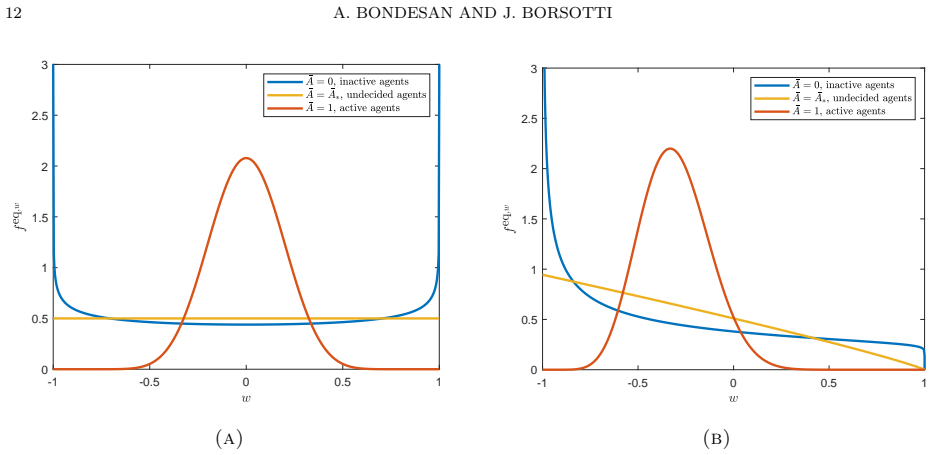
- For the uncontrolled model no global equilibrium exists once the activity marginal can drift, so polarization among inactive agents is a persistent phenomenon.
- Under the theorem's hypothesis, the time-dependent coefficient does not slow relaxation: the $O(t^{-1/2})$ rate matches the constant-coefficient Wright-Fisher opinion equation.
Reading between the lines
- A testable sociological extension: in online discussion data, sort users by interaction frequency and compare empirical opinion distributions per activity band with the model's Beta-type partial equilibria; the model predicts a sharp threshold activity below which polarization appears.
- The local-equilibrium technique should transfer to other opinion models in which a slowly drifting moment (such as a moving average opinion) enters the drift of a Fokker-Planck equation, giving explicit rates without requiring constant coefficients.
- Because agents become active in finite time, an intervention that temporarily raises interaction propensity among inactive agents could permanently move the population into the consensus regime; the control need not be maintained forever.
- Rerunning the same entropy decomposition on a graphon-structured population, with the leaders' fixed mean replaced by a local mean field, would likely produce analogous local-equilibrium Beta distributions with graphon-weighted exponents.
Editorial analysis
A structured set of objections, weighed in public.
Referee Report
Summary. The paper introduces a kinetic model for opinion dynamics in which each agent carries an opinion w in I=[-1,1] and a social activity level A in R. Through a quasi-invariant limit of binary interactions it derives Fokker-Planck-type equations (13) for the full distribution, with agent-agent and agent-leader contributions. The authors study macroscopic observables, derive Beta-type partial equilibria whose exponents are used to classify polarization versus consensus, propose a control strategy on the activity variable, and then analyze the large-time behavior of the marginals g(t,A) and h(t,w). The main results are: Proposition 3 and Corollary 2 on the activity marginal converging to a Dirac delta under the control; Proposition 5 proving convergence of the mean opinion to the leaders' mean; Theorem 1 on L^1 convergence of h(t,w) to a Beta equilibrium in the controlled all-active case; Theorem 2, the headline result, giving O(t^{-1/2}) convergence to the equilibrium (47) for the time-dependent Fokker-Planck equation (44) under an a priori L^∞(R+,L^q) assumption; and Propositions 6, 7 and Lemma 2 on nonnegativity, uniqueness and a related analyticity condition.
Significance. The topic is timely and the model is a natural kinetic generalization of Moussaïd's activity-based opinion model. The paper contains genuinely useful elements: the control conditions (29)-(32) are derived, not fitted; the transient activity dynamics are solved explicitly in formulas (39)-(41); and the relative-entropy strategy for a time-dependent-coefficient Wright-Fisher-type equation with Beta equilibria is a plausible extension of [2,19]. The polarization-versus-consensus interpretation based on the exponents of partial equilibria (22)-(24) is also conceptually attractive. However, the central convergence theorem is conditional on an unproved a priori regularity assumption, and the main applied claim about polarization emerging among inactive agents rests on partial equilibria whose attractiveness is not proved. If the regularity issue is repaired and the claims are realigned with what is proved, the paper would be a solid contribution; in its present form the most visible claims outrun the proofs.
major comments (3)
- [§4.2, Theorem 2 and inequality (52)] Theorem 2 is stated for any solution h of (44) satisfying h∈L∞(R+,Lq(I)) for some q>1, but this hypothesis is load-bearing and is not established for the parameter range covered by the statement. It is used exactly at inequality (52) to control the time-dependent term T2 in the relative entropy inequality (53). Lemma 1 provides only the exponentially growing bound (62), and Remark 5 merely says the proof can be adapted when condition (63) holds, without stating or proving the adapted theorem. In the polarization regime the equilibrium (47) lies in Lq only for q<q* in (48), and no uniform-in-time Lq bound for the solution is available. Thus Theorem 2 as written does not deliver the advertised strong convergence for the interesting polarization parameters; the authors should either prove the required regularity in a stated parameter regime or reformulate Theorem 2 explicitly as a conditional statement about a class of solutions with that a priori regularity, and move the consensus-regime result proved in Remarks 5 and 6 into a theorem with its hypotheses clearly listed.
- [§2.3, equations (22)-(24) and Abstract] The paper's main applied claim, that polarization arises among inactive agents while active agents reach consensus, is based on the signs of the exponents of the partial equilibria (22)-(24). No theorem shows that solutions of the full model approach these partial equilibria, and the later rigorous convergence results concern the marginal h under the all-active reduction, with Theorem 2 itself conditional. Consequently the abstract's statement that the paper shows polarization can arise among low-activity agents is stronger than what is proved. The authors should either prove a statement about the large-time behavior of the full model or explicitly qualify the polarization/consensus discussion as an analysis of formal partial equilibria, with the rigorous results limited to the reduced settings of Section 4.
- [§4.2, proof of Theorem 2, equations (60) and (63)] Even apart from the unproved Lq hypothesis, the convergence argument has a gap in the control of the difference (C∞-C(t))/C(t). After equation (60) the authors need to bound (1-w)^{b1(t)-b1∞}-1, and in the delicate case ξ<0 they assert that for t sufficiently large a function of the form log(1-w)(1-w)^{sξe^{-τt}} belongs to Lq′(I). The existence of a uniform threshold T is not proved, nor is it shown that the exponential rate is preserved uniformly in the parameter s involved in the integral representation. Moreover, this part of the proof also uses heq∈L∞(R+,Lq(I)), which again depends on the same unproved regularity assumption or on the additional restrictions (63). The final O(t^{-1/2}) conclusion therefore needs a completed estimate before Theorem 2 can be considered proved.
minor comments (5)
- [§3.2 and §4.1, displayed formulas] Several displayed equations contain corrupted or unreadable symbols, in particular the formulas for dρi/dt and dρa/dt in Section 3.2 and the explicit characteristic solutions in the proof of Proposition 4. The manuscript must be typeset cleanly so that the conditions (29)-(32) and the characteristic calculations can be verified by a reader.
- [§2.1, equation (11) onward] The quasi-invariant limit is presented as formal, which is acceptable if stated clearly, but the phrase 'additional terms cancel out assuming ⟨|η|^3⟩<∞' leaves several second-order terms and the remainder without a displayed estimate; the authors should either give the details in an appendix or state explicitly that the Fokker-Planck equations are the formal mean-field limits used as the model from that point onward.
- [§2, notation for a_•] The notation a_• (or a●) is used before it is defined; the authors should introduce it as a placeholder for a_p and a_ℓ explicitly at its first occurrence in Section 2.
- [§3, equation (26)] The control interaction uses λ^c_A in the microscopic update but λ_c in the Fokker-Planck operator (28); the notation should be made consistent.
- [§5, Conclusions] There is a grammatical error at 'The proof of our this result involved the use of the relative entropy method'; it should read 'The proof of this result involved...'.
Circularity Check
No circularity: the model, control conditions, and convergence theorems are derived from the stated microscopic rules, and the acknowledged L^q gap is a conditional limitation, not a circularity.
full rationale
The paper is self-contained at the level of its claimed derivations. The controlled Fokker–Planck equation (27) and the marginal equation (44) are obtained by explicit quasi-invariant limits from the binary interactions (2), (3), and the control-strategy conditions (29)–(32) are computed from the signs of the fluxes (C_i, C_a). The convergence results are not fitted: Theorem 1 imports the known O(t^{-1/2}) Wright–Fisher relaxation from external sources [19,20], while Theorem 2 is proved internally via relative entropy estimates, with the local equilibrium h_eq(t,w) constructed from the same coefficients that define (44) and with h_eq→h∞ following from the exponential convergence of m_w(t) to μ_ℓ. The paper explicitly flags that the a priori assumption h∈L∞(R+,L^q(I)) in Theorem 2 is not generally proved, that Lemma 1 only gives an exponentially growing bound, and that recovering the needed integrability requires the extra constraint (63); this is an honest conditional gap, not a reduction of the theorem to its assumptions by construction. The self-citation [4] is used for nonnegativity preservation and as a template for Lemma 1, but the relevant arguments are restated or adapted in the paper and are not load-bearing for the central convergence theorem. No parameter is fitted to a target output, no known result is merely renamed, and no uniqueness claim is imported from the authors' prior work.
Assumptions & free parameters
free parameters (4)
- a_p =
a_p = ω_p/2 + ε (Eq. 4)
- λ_c =
λ_c (often set to λ_A)
- θ =
θ ∈ (0,1) satisfying (31) when λ_c = λ_A
- ν_p and ν_ℓ (ratios σ^2/λ) =
unspecified positive constants
assumptions (7)
- domain assumption Binary interaction rules (2)-(3) with interaction probability P(Ã=1)=Āω+ε define the microscopic dynamics.
- domain assumption The quasi-invariant limit produces the Fokker-Planck equation (13) via Taylor expansion and vanishing remainder.
- domain assumption Restriction to G≡1 and D(w)=√(1-w²) for the partial equilibrium analysis and for the convergence theorems.
- domain assumption Initial distribution has compact support in A and w.
- ad hoc to paper The marginal solution h(t,w) belongs to L^∞(R+, L^q(I)) for some q>1 (Theorem 2).
- ad hoc to paper Additional no-flux boundary conditions (61): h(t,±1)=0 and (1-w²)h^{q-1}∂_w h=0 at the boundaries (Lemma 1).
- standard math m_A(t) is analytical in Propositions 1 and 2.
Cite this review
Pith. "Pith review of Control strategies and trends to equilibrium for kinetic models of opinion dynamics driven by social activity." pith.science (2026). https://pith.science/paper/UKKAXH3M
@misc{pith2026250607840,
  author       = {Pith},
  title        = {Pith review of: Control strategies and trends to equilibrium for kinetic models of opinion dynamics driven by social activity},
  year         = {2026},
  howpublished = {\url{https://pith.science/paper/UKKAXH3M}},
  note         = {Machine review of arXiv:2506.07840}
}
read the original abstract
We introduce new kinetic equations modeling opinion dynamics inside a population of individuals, whose propensity to interact with each other is described by their level of social activity. We show that opinion polarization can arise among agents with a low activity level, while active ones develop a consensus, highlighting the importance of social interactions to prevent the formation of extreme opinions. Moreover, we present a realistic control strategy aimed at reducing the number of inactive agents and increasing the number of socially active ones. At last, we prove several (weak and strong) convergence to equilibrium results for such controlled model. In particular, by considering additional interactions between individuals and opinion leaders capable of steering the average opinion of the population, we use entropy method-like techniques to estimate the relaxation toward equilibrium of solutions to a Fokker-Planck equation with time-dependent coefficients.
Figures

Reference graph
Works this paper leans on
-
[1]
G. Albi, M. Bongini, F. Rossi, and F. Solombrino. Leader formation with mean-field birth and death models. Math. Models Methods Appl. Sci., 29(4):633–679, 2019.https://doi.org/10.1142/S0218202519400025
-
[2]
F. Auricchio, G. Toscani, and M. Zanella. Trends to equilibrium for a nonlocal Fokker–Planck equation.Appl. Math. Lett., 145:108746, 2023.https://doi.org/10.1016/j.aml.2023.108746
-
[3]
M. Bisi, G. Spiga, and G. Toscani. Kinetic models of conservative economies with wealth redistribution.Commun. Math. Sci., 7(4):901–916, 2009.https://doi.org/10.4310/cms.2009.v7.n4.a5
-
[4]
Bondesan, G
A. Bondesan, G. Toscani, and M. Zanella. Kinetic compartmental models driven by opinion dynamics: Vaccine hesitancy and social influence.Math. Mod. Meth. Appl. S., 34(6):1043–1076, 2024.https://doi.org/10.1142/ S0218202524400062
2024
-
[5]
C. Borgs, J.T. Chayes, H. Cohn, and Y. Zhao. AnL p theory of sparse graph convergence II: LD convergence, quotients and right convergence.Ann. Probab., 46(1):337–396, 2018.https://doi.org/10.1214/17-AOP1187
-
[6]
C. Borgs, J.T. Chayes, H. Cohn, and Y. Zhao. AnL p theory of sparse graph convergence I: Limits, sparse random graph models, and power law distributions.Trans. Amer. Math. Soc., 372(5):3019–3062, 2019.https: //doi.org/10.1090/tran/7543
-
[7]
L. Boudin and F. Salvarani. A kinetic approach to the study of opinion formation.M2AN Math. Model. Numer. Anal., 43(3):507–522, 2009.https://doi.org/10.1051/m2an/2009004
-
[8]
Cercignani.The Boltzmann equation and its applications, volume 67 ofApplied Mathematical Sciences
C. Cercignani.The Boltzmann equation and its applications, volume 67 ofApplied Mathematical Sciences. Springer-Verlag, New York, 1988.https://doi.org/10.1007/978-1-4612-1039-9
Show all 37 references
-
[9]
Chen and D.W
L. Chen and D.W. Stroock. The fundamental solution to the Wright–Fisher equation.SIAM J. Math. Anal., 42(2):539–567, 2010.https://doi.org/10.1137/090764207
2010 doi
-
[10]
Cordier, L
S. Cordier, L. Pareschi, and G. Toscani. On a kinetic model for a simple market economy.J. Stat. Phys., 120:253–277, 2005.https://doi.org/10.1007/s10955-005-5456-0
2005 doi
-
[11]
Della Marca, N
R. Della Marca, N. Loy, and A. Tosin. An SIR-like kinetic model tracking individuals’ viral load.Netw. Heterog. Media, 17(3):467–494, 2022.https://doi.org/10.3934/nhm.2022017
2022 doi
-
[12]
Dimarco, B
G. Dimarco, B. Perthame, G. Toscani, and M. Zanella. Kinetic models for epidemic dynamics with social heterogeneity.J. Math. Biol., 83(1):Paper No. 4, 32, 2021.https://doi.org/10.1007/s00285-021-01630-1
2021 doi
-
[13]
D¨ uring, J
B. D¨ uring, J. Franceschi, M.-T. Wolfram, and M. Zanella. Breaking consensus in kinetic opinion formation models on graphons.J. Nonlinear Sci., 34(79), 2024.https://doi.org/10.1007/s00332-024-10060-4
2024 doi
-
[14]
D¨ uring and M.-T
B. D¨ uring and M.-T. Wolfram. Opinion dynamics: inhomogeneous Boltzmann-type equations modelling opinion leadership and political segregation.Proc. A., 471(2182):20150345, 21, 2015.https://doi.org/10.1098/rspa. 2015.0345
2015
-
[15]
Epstein and R
C.L. Epstein and R. Mazzeo. Wright–Fisher diffusion in one dimension.SIAM J. Math. Anal., 42(2):568–608, 2010.https://doi.org/10.1137/090766152
2010 doi
-
[16]
Epstein and R
C.L. Epstein and R. Mazzeo.Degenerate diffusion operators arising in population biology, volume 185 ofAn- nals of Mathematics Studies. Princeton University Press, Princeton, NJ, 2013.https://doi.org/10.1515/ 9781400846108
2013
-
[17]
T. J. Feddersen and W. Pesendorfer. Abstention in elections with asymmetric information and diverse preferences. Am. Polit. Sci. Rev., 93(2):381–398, 1999.https://doi.org/10.2307/2585402
1999 doi
-
[18]
Feltrin and G
P. Feltrin and G. Ieraci. Facilitating voting and electoral participation in Italy. On some possible measures to contrast involuntary and imposed abstentionism.Rivista di Digital Politics, 1:29–48, 2023.https://www. rivisteweb.it/doi/10.53227/107475
2023 doi
-
[19]
Furioli, A
G. Furioli, A. Pulvirenti, E. Terraneo, and G. Toscani. Fokker-Planck equations in the modelling of socio- economic phenomena.Math. Models Methods Appl. Sci., 27(1):115–158, 2017.https://doi.org/10.1142/ S0218202517400048
2017
-
[20]
Furioli, A
G. Furioli, A. Pulvirenti, E. Terraneo, and G. Toscani. Wright–Fisher-type equations for opinion formation, large time behavior and weighted logarithmic-Sobolev inequalities.Ann. Inst. H. Poincar´ e C Anal. Non Lin´ eaire, 36(7):2065–2082, 2019.https://doi.org/10.1016/j.anihpc...
2019 doi
-
[21]
Furioli, A
G. Furioli, A. Pulvirenti, E. Terraneo, and G. Toscani. Non-Maxwellian kinetic equations modeling the dynam- ics of wealth distribution.Math. Models Methods Appl. Sci., 30(4):685–725, 2020.https://doi.org/10.1142/ S0218202520400023
2020
-
[22]
Galam, Y
S. Galam, Y. Gefen (Feigenblat), and Y. Shapir. Sociophysics: A new approach of sociological collective behaviour: I. Mean-behaviour description of a strike.Journal of Mathematical Sociology, 9(1):1–13, 1982. https://doi.org/10.1080/0022250X.1982.9989929
1982
-
[23]
Glasscock
D. Glasscock. What is . . . a graphon?Notices Amer. Math. Soc., 62(1):46–48, 2015.http://dx.doi.org/10. 1090/noti1204
2015
-
[24]
Gualandi and G
S. Gualandi and G. Toscani. Human behavior and lognormal distribution. A kinetic description.Math. Models Methods Appl. Sci., 29(4):717–753, 2019.https://doi.org/10.1142/S0218202519400049. 36 A. BONDESAN AND J. BORSOTTI
2019 doi
-
[25]
Legnante and P
G. Legnante and P. Segatti. Intermittent abstentionism and multi-level mobilisation in Italy.Modern Italy, 14(2):167–181, 2009.https://doi.org/10.1080/13532940902871802
2009 doi
-
[26]
Moussa ¨ ıd
M. Moussa ¨ ıd. Opinion formation and the collective dynamics of risk perception.PLOS ONE, 8(12):e84592, 2013. https://doi.org/10.1371/journal.pone.0084592
2013 doi
-
[27]
Ochrombel
R. Ochrombel. Simulation of Sznajd sociophysics model with convincing single opinions.Int. J. Mod. Physics. C, 12(7):1091, 2001.https://doi.org/10.1142/S0129183101002346
2001 doi
-
[28]
Pareschi and G
L. Pareschi and G. Toscani.Interacting Multiagent Systems: Kinetic Equations and Monte Carlo Methods. Oxford University Press, 2013.https://global.oup.com/academic/product/ interacting-multiagent-systems-9780199655465?cc=it&lang=en&
2013
-
[29]
Pareschi and G
L. Pareschi and G. Toscani. Wealth distribution and collective knowledge: a Boltzmann approach.Philos. Trans. R. Soc. Lond. Ser. A Math. Phys. Eng. Sci., 372:20130396, 2014.https://doi.org/10.1098/rsta.2013.0396
2014
-
[30]
Pareschi, G
L. Pareschi, G. Toscani, A. Tosin, and M. Zanella. Hydrodynamic models of preference formation in multi-agent societies.J. Nonlinear Sci., 29(6):2761–2796, 2019.https://doi.org/10.1007/s00332-019-09558-z
2019 doi
-
[31]
Stauffer
D. Stauffer. Percolation and galam theory of minority opinion spreading.Int. J. Mod. Physics. C, 13(7):975–977, 2002.https://doi.org/10.1142/S0129183102003735
2002 doi
-
[32]
Stauffer and P
D. Stauffer and P. Oliveira. Persistence of opinion in the Sznajd consensus model: Computer simulation.Eur. Phys. J. B, 30:587–592, 2002.https://doi.org/10.1140/epjb/e2002-00418-0
2002 doi
-
[33]
Sznajd-Weron and J
K. Sznajd-Weron and J. Sznajd. Opinion evolution in closed community.Int. J. Mod. Physics. C, 11(6):1157– 1165, 2000.https://doi.org/10.1142/S0129183100000936
2000 doi
-
[34]
G. Toscani. Kinetic models of opinion formation.Commun. Math. Sci., 4(3):481–496, 2006.https://doi.org/ 10.4310/cms.2006.v4.n3.a1
2006 doi
-
[35]
Ulsh¨ ofer, F
C. Ulsh¨ ofer, F. Renkewitz, and T. Betsch. The influence of narrative v. statistical information on perceiving vaccination risks.Med. Decis. Making, 31(5):742–753, 2011.https://doi.org/10.1177/0272989X11400419
2011 doi
-
[36]
Weidlich
W. Weidlich. Sociodynamics––a systematic approach to mathematical modelling in the social sciences.Chaos Solitons Fract., 18(3):431–437, 2003.https://doi.org/10.1016/S0960-0779(02)00666-5
2003 doi
-
[37]
M. Zanella. Kinetic models for epidemic dynamics in the presence of opinion polarization.Bull. Math. Biol., 85(5):1–29, 2023.https://doi.org/10.1007/s11538-023-01147-2. Andrea Bondesan Department of Mathematical, Physical and Computer Sciences University of Parma Parco Area de...
2023 doi
Reviewed August 7, 2026 · model on record in the stance chip above.
Discussion (0). Sign in to comment.