Stability and Extension of Steady and Ranging Persistence
Pith reviewed 2026-05-19 10:32 UTC · model grok-4.3
The pith
Steady and ranging persistence extend to general objects through category theory, enabling stability analysis and feature characterization.
A machine-rendered reading of the paper's core claim, the machinery that carries it, and where it could break.
Core claim
By employing category theory, steady and ranging persistence are lifted to general objects, and the features that induce balanced forms of these persistences are characterized. Stability is studied for the resulting constructions, with concrete illustration on hypergraphs.
What carries the argument
Category-theoretic extension of steady and ranging persistence, which carries the definitions, stability results, and the feature characterization.
Load-bearing premise
The extension of steady and ranging persistence via category theory preserves the necessary structure to support a well-defined stability analysis and feature characterization.
What would settle it
Observation of a specific feature on hypergraphs where the induced persistence fails to be balanced despite satisfying the characterization conditions, or where stability does not hold as predicted.
Figures



read the original abstract
Persistent homology is a topological data analysis tool that has been widely generalized, extending its scope beyond the field of topology. Among its extensions, steady and ranging persistence were developed to study a wide variety of graph properties. Precisely, given a feature of interest on graphs, it is possible to build two types of persistence (steady and ranging persistence) that follow the evolution of the feature along graph filtrations. This study extends steady and ranging persistence to other objects using category theory and investigates the stability of such persistence. In particular, a characterization of the features that induce balanced steady and ranging persistence is provided. The main results of this study are illustrated using a practical implementation for hypergraphs.
Editorial analysis
A structured set of objections, weighed in public.
Referee Report
Summary. The manuscript extends steady and ranging persistence—originally defined for graphs via filtrations tracking a feature of interest—to general objects in a categorical setting. It investigates stability of the resulting persistence modules and supplies a characterization of those features that produce balanced steady and ranging persistence. The main results are illustrated by a concrete implementation on hypergraphs.
Significance. If the categorical extension preserves the requisite functoriality and the stability bounds hold without extra axioms, the work would meaningfully broaden the scope of persistence-based methods beyond graphs to hypergraphs and other structured objects. The provision of a practical hypergraph implementation and the explicit characterization of balanced features are concrete strengths that could support reproducible follow-up work.
major comments (2)
- [§3] §3 (Categorical Extension): the construction defines feature maps as functors but does not verify that these functors commute with the filtration functors for arbitrary objects in the target category, so that the interleaving distance (or bottleneck stability) remains controlled under small perturbations of the feature. This verification is load-bearing for the claim of a well-defined stability analysis outside the hypergraph case.
- [§5] §5 (Characterization of balanced features): the stated characterization is shown to hold for the hypergraph implementation, yet the general categorical statement does not include an explicit check that the balance condition is preserved when the underlying category lacks the limits or colimits needed to form the persistence modules. Without this, the characterization risks being restricted to the illustrated examples rather than applying to the general extension asserted in the abstract.
minor comments (2)
- [§2] The notation distinguishing steady from ranging persistence could be introduced with a small commutative diagram in §2 to aid readers unfamiliar with the graph case.
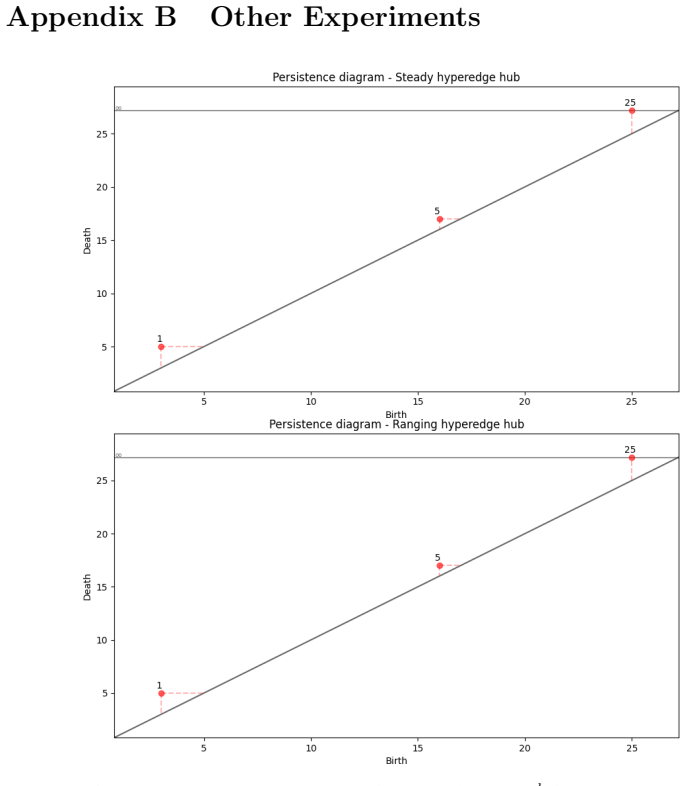
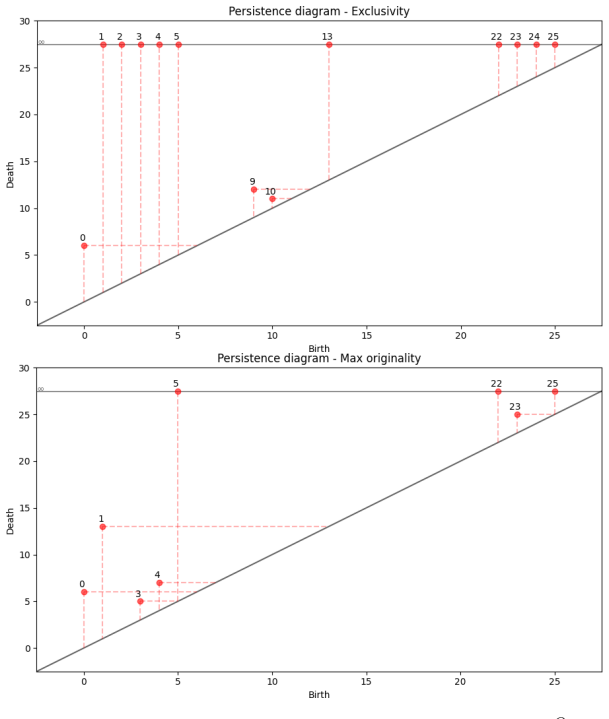
- [Figure 4] Figure 4 (hypergraph example) would benefit from an explicit legend indicating which bars correspond to steady versus ranging persistence.
Simulated Author's Rebuttal
We thank the referee for the careful reading of the manuscript and the constructive comments. We address each major comment point by point below and indicate the revisions made to strengthen the presentation.
read point-by-point responses
-
Referee: [§3] §3 (Categorical Extension): the construction defines feature maps as functors but does not verify that these functors commute with the filtration functors for arbitrary objects in the target category, so that the interleaving distance (or bottleneck stability) remains controlled under small perturbations of the feature. This verification is load-bearing for the claim of a well-defined stability analysis outside the hypergraph case.
Authors: We appreciate the referee drawing attention to this point. In the categorical extension of §3, feature maps are defined as functors, and the commutation with filtration functors follows from the naturality of the steady and ranging constructions with respect to the underlying category. To make this explicit and to confirm that the interleaving distance remains controlled for arbitrary objects (without extra axioms), we have added a new lemma in the revised §3 that verifies the required commutation diagrams hold generally. This supports the stability analysis beyond the hypergraph case while preserving the functoriality of the original definitions. revision: yes
-
Referee: [§5] §5 (Characterization of balanced features): the stated characterization is shown to hold for the hypergraph implementation, yet the general categorical statement does not include an explicit check that the balance condition is preserved when the underlying category lacks the limits or colimits needed to form the persistence modules. Without this, the characterization risks being restricted to the illustrated examples rather than applying to the general extension asserted in the abstract.
Authors: We agree that greater clarity on categorical assumptions is helpful. The characterization of balanced features in §5 is proved using the limits and colimits that exist in the categories under consideration (including those needed to form the persistence modules). The hypergraph case provides a concrete check, but the general statement already presupposes these structures. In the revision we have added an explicit remark at the beginning of §5 stating that the result applies in any category possessing the requisite limits and colimits, thereby clarifying the scope without restricting the generality claimed in the abstract. revision: yes
Circularity Check
No circularity: derivation relies on independent categorical constructions
full rationale
The paper defines steady and ranging persistence on graphs, then uses category theory to extend the constructions to general objects before characterizing features that yield balanced versions and proving stability. No quoted step reduces a claimed prediction or characterization to a fitted parameter, self-citation, or definitional tautology; the extension and stability results are presented as consequences of functoriality and interleaving-distance arguments rather than being presupposed by the inputs. The hypergraph illustrations serve only as verification, not as the source of the general claims. This is a standard self-contained mathematical development.
Axiom & Free-Parameter Ledger
Reference graph
Works this paper leans on
-
[1]
Persistent homology based bottleneck distance in hyper- graph products
Archana Babu and Sunil John. Persistent homology based bottleneck distance in hyper- graph products. Applied Network Science, 9, 04 2024
work page 2024
-
[2]
Mattia G. Bergomi and Massimo Ferri. Exploring graph and digraph persistence. Algo- rithms, 16(10), 2023
work page 2023
-
[3]
Bergomi, Massimo Ferri, and Antonella Tavaglione
Mattia G. Bergomi, Massimo Ferri, and Antonella Tavaglione. Steady and ranging sets in graph persistence. Journal of Applied and Computational Topology , 7:33 – 56, 2020
work page 2020
-
[4]
Bergomi, Massimo Ferri, Pietro Vertechi, and Lorenzo Zuffi
Mattia G. Bergomi, Massimo Ferri, Pietro Vertechi, and Lorenzo Zuffi. Beyond topological persistence: Starting from networks. Mathematics, 9(23), 2021
work page 2021
-
[5]
Mattia G. Bergomi and Pietro Vertechi. Rank-based persistence. Theory and Applications of Categories, 35(9):228–260, 2020
work page 2020
-
[6]
Mul- tidimensional size functions for shape comparison
Silvia Biasotti, Andrea Cerri, Patrizio Frosini, Daniela Giorgi, and Claudia Landi. Mul- tidimensional size functions for shape comparison. Journal of Mathematical Imaging and Vision, 32:161–179, 10 2008
work page 2008
-
[7]
The embedded homology of hypergraphs and applications, 2016
St´ ephane Bressan, Jingyan Li, Shiquan Ren, and Jie Wu. The embedded homology of hypergraphs and applications, 2016. 20
work page 2016
-
[8]
Metrics for generalized persistence modules
Peter Bubenik, Vin de Silva, and Jonathan Scott. Metrics for generalized persistence modules. Foundations of Computational Mathematics , 15(6):1501–1531, October 2014
work page 2014
-
[9]
Peter Bubenik and Jonathan A. Scott. Categorification of persistent homology. Discrete and Computational Geometry , 51(3):600–627, jan 2014
work page 2014
-
[10]
The theory of multidimensional persistence
Gunnar Carlsson and Afra Zomorodian. The theory of multidimensional persistence. Discrete and Computational Geometry , 42:71–93, 06 2007
work page 2007
-
[11]
Gunnar E. Carlsson and Vin de Silva. Zigzag persistence. Foundations of Computational Mathematics, 10:367–405, 2008
work page 2008
-
[12]
Fr´ ed´ eric Chazal, David Cohen-Steiner, Marc Glisse, Leonidas J. Guibas, and Steve Y. Oudot. Proximity of persistence modules and their diagrams. SCG ’09, page 237–246, New York, NY, USA, 2009. Association for Computing Machinery
work page 2009
-
[13]
Stability of persistence diagrams
David Cohen-Steiner, Herbert Edelsbrunner, and John Harer. Stability of persistence diagrams. volume 37, pages 263–271, 06 2005
work page 2005
-
[14]
Hyperbard (dataset), June 2022
Corinna Coupette, Jilles Vreeken, and Bastian Rieck. Hyperbard (dataset), June 2022
work page 2022
-
[15]
Natural pseudo-distance and opti- mal matching between reduced size functions
Michele D’Amico, Patrizio Frosini, and Claudia Landi. Natural pseudo-distance and opti- mal matching between reduced size functions. Acta Applicandae Mathematicae, 109:527– 554, 2008
work page 2008
-
[16]
W. D¨ orfler and D. A. Waller. A category-theoretical approach to hypergraphs. Archiv der Mathematik, 34(1):185–192, Dec 1980
work page 1980
-
[17]
Alexander Grigor’yan, Yong Lin, Yuri V. Muranov, and Shing-Tung Yau. Path complexes and their homologies. Journal of Mathematical Sciences , 248:564–599, 2020
work page 2020
-
[18]
Muranov, and Rolando Jim´ enez
Alexander Grigor’yan, Yuri V. Muranov, and Rolando Jim´ enez. Homology of digraphs. Mathematical Notes, 109:712 – 726, 2021
work page 2021
-
[19]
Alexander Grigor’yan, Yuri V. Muranov, and Shing-Tung Yau. Graphs associated with simplicial complexes. Homology, Homotopy and Applications , 16:295–311, 2014
work page 2014
- [20]
-
[21]
The theory of the interleaving distance on multidimensional persistence modules
Michael Lesnick. The theory of the interleaving distance on multidimensional persistence modules. Foundations of Computational Mathematics , 15(3):613–650, March 2015
work page 2015
-
[22]
Xiang Liu, Huitao Feng, Jie Wu, and Kelin Xia. Persistent spectral hypergraph based machine learning (psh-ml) for protein-ligand binding affinity prediction. Briefings in Bioinformatics, 22(5):bbab127, 04 2021
work page 2021
-
[23]
Xiang Liu, Huitao Feng, Jie Wu, and Kelin Xia. Computing hypergraph homology. Foundations of Data Science , 6(2):172–194, 2024
work page 2024
-
[24]
Hypergraphs: an introduction and review
Xavier Ouvrard. Hypergraphs: an introduction and review. CoRR, abs/2002.05014, 2020
-
[25]
Generalized persistence diagrams
Amit Patel. Generalized persistence diagrams. Journal of Applied and Computational Topology, 1(3–4):397–419, May 2018
work page 2018
-
[26]
HyperNetX: A Python package for model- ing complex network data as hypergraphs
Brenda Praggastis, Sinan Aksoy, Dustin Arendt, Mark Bonicillo, Cliff Joslyn, Emilie Purvine, Madelyn Shapiro, and Ji Young Yun. HyperNetX: A Python package for model- ing complex network data as hypergraphs. Journal of Open Source Software , 9(95):6016, March 2024
work page 2024
-
[27]
Measuring originality in science
Sotaro Shibayama and Jian Wang. Measuring originality in science. Scientometrics, 122, 10 2019
work page 2019
-
[28]
Jaap Van Oosten. Basic Category Theory . University of Aarhus. Basic Research in Computer Science [BRICS], Aarhus, DK, 1995
work page 1995
-
[29]
Steady and ranging persistence for hypergraphs
Yann-Situ. Steady and ranging persistence for hypergraphs. https://github.com/ Yann-Situ/Hypergraph-Steady-Ranging-Persistence , 2024. Appendix A Proofs A.1 Proofs of Section 2 Proof of Lemma 2.2. =⇒ There exist ( ϕw : Fw → Gw+ϵ)w∈R and ( ψw : Gw → Fw+ϵ)w∈R two families of monomorphisms such that for any w ∈ R, the diagrams of Definition 7 commute. 21 Den...
work page 2024
-
[30]
χ(V ) ⊂ V ′. Indeed, let u ∈ V . ι is a hypergraph monomorphism so we have ι(u) ∈ V ′′. As ι(u) = ι′(χ(u)), this gives ι′(χ(u)) ∈ V ′′, which implies χ(u) ∈ V ′ because ι′ is a hypergraph monomorphism
-
[31]
χ(E) ⊂ E′ using the same argument
-
[32]
u ∈ e =⇒ χ(u) ∈ χ(e). Indeed, let u ∈ e. We have ι(u) ∈ ι(e) so ι′(χ(u)) ∈ ι′(χ(e)). As ι′ is a monomorphism of Hgph≤ m, we obtain χ(u) ∈ χ(e). Finally, we show that χ ∈ morph(Hgph≤ m). As ι and ι′ are in morph( Hgph≤ m) we have: χ(u) ∈ χ(e) = ⇒ ι′(χ(u)) ∈ ι′(χ(e)) = ⇒ ι(u) ∈ ι(e) = ⇒ u ∈ e. Similarly, if ι and ι′ are monomorphisms of Hgph= m, we obtain χ...
discussion (0)
Sign in with ORCID, Apple, or X to comment. Anyone can read and Pith papers without signing in.