REVIEW 4 major objections 6 minor 60 references
JWST interferometric imaging reveals the dusty disk obscuring the supermassive black hole of the Circinus galaxy
T0 review · 4 major / 6 minor · reviewed 2026-08-07 · deepseek-v4-flash
Pith's one-line read Using JWST's aperture-masking interferometry, this paper shows that 87% of the 3–5 micron emission from the Circinus galaxy's hidden black hole comes from a 2×5 parsec dusty structure in the funnel of an equatorial disk, while the dusty…
desk verdict Genuinely new AMI/JWST images of Circinus reveal a 2x5 pc NIR structure and North arc, but an internal gap on F430M line contamination and a marginal model discrimination keep the 'disk feeding the AGN' conclusion from being fully secure. read the letter →
The pith
A machine-rendered reading of the paper's core claim, the machinery that carries it, and where it could break.
The reading
What carries the argument
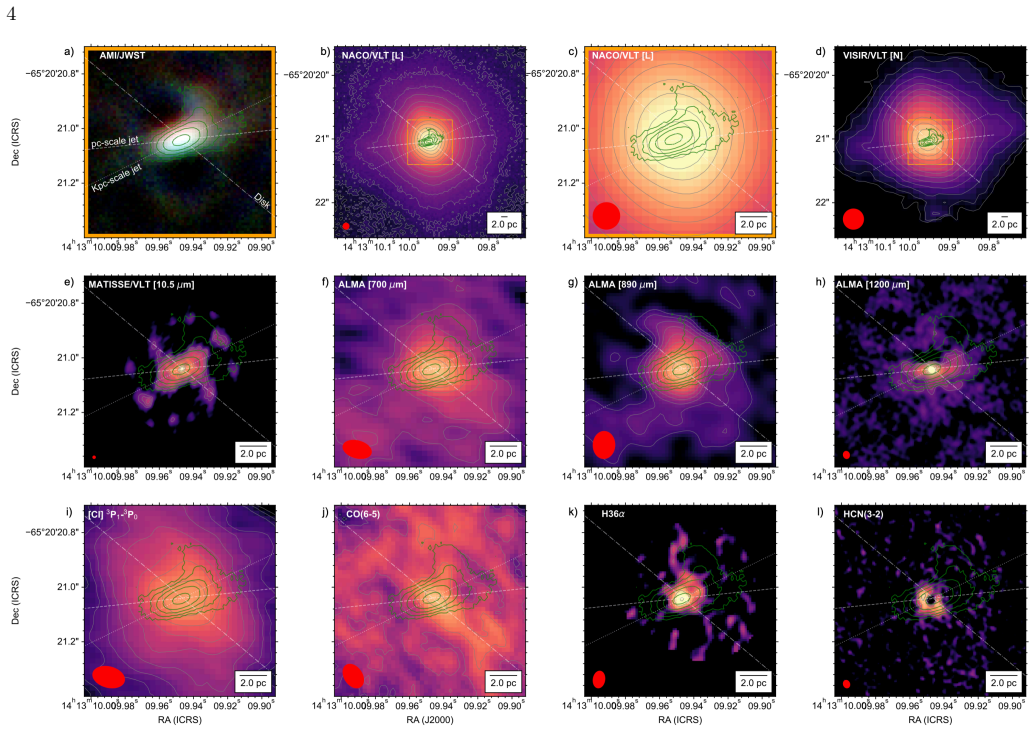
Aperture-masking interferometry on JWST's NIRISS instrument is the central mechanism: a seven-hole non-redundant mask across the 6.5 m primary turns the telescope into an interferometer, and from measured squared visibilities and closure phases the images are reconstructed at about 0.1 arcsecond resolution, twice that of direct imaging, while suppressing the telescope's blur pattern and large-scale starlight. This mechanism brings out the faint structures—the 2×5 pc funnel emission, the north arc, and the near-infrared holes—that are then compared with archival sub-millimeter continuum and gas-tracer maps and with radiative-transfer torus models to separate disk from wind.
What would settle it
Measure the fraction of non-continuum emission inside each AMI filter using spatially resolved spectroscopy of the inner 10 pc of Circinus, for example with JWST NIRSpec IFU or MIRI MRS spectra, by comparing narrow-band photometry at 3.8, 4.3, and 4.8 microns on the observed spectrum with a continuum-only baseline; if the F430M non-continuum fraction is close to the template-based value near 29% rather than the claimed <10%, the derived 450 K temperature and the 87% disk-dominated flux split must be re-evaluated.
Extended reading notes
Core claim
On its own terms, the paper establishes that the 3–5 micron excess of Circinus is dominated not by an outflow but by directly heated dust in the funnel of an edge-on, clumpy torus. The AMI images at 3.8, 4.3, and 4.8 microns show an extended 2×5 pc component at a position angle of about −70°, contributing 87+5−7% of the total flux; a 'north arc' contributing <1%, cospatial with the [CI], CO(6-5), and H36α outflows; and low-surface-brightness dust beyond 5 pc along the pc-scale jet contributing 12+4−6%. The regions where near-infrared emission is missing ('Holes') coincide with the optically thick equatorial disk traced by 700 micron dust, HCN(3-2), CO(6-5), and the water maser disk. Fitting 1–1000 micron SEDs with four torus geometries, the paper finds that clumpy torus models best describe the central 2×5 pc SED, and radiative-transfer images from the best-fit model reproduce the observed 3.8-to-700 micron morphology with a 5×3 pc disk. It therefore concludes that most of the dust mass in the central 10 pc lies in an equatorial disk feeding the supermassive black hole, with the dusty outflow and jet-heated narrow-line-region dust as minor contributors.
Load-bearing premise
The central claim assumes that the 3.8, 4.3, and 4.8 micron images are dominated by continuum dust emission; if the 4.3 micron filter is substantially contaminated by carbon-monoxide or carbon-dioxide-ice spectral features, the derived dust temperatures, the 87% flux share for the disk, and the preference for the clumpy torus model would all be biased.
Editorial extensions
If this is right
- The 3–5 micron excess that has been debated for this AGN is identified as torus-funnel dust: the dominant structure is the same elongated component seen at 8–13 microns, not starlight or a dusty wind.
- Because the 700 micron dust, HCN(3-2), CO(6-5), and the maser disk all lie along the equatorial axis while the near-infrared images show holes there, the obscuring torus is an optically thick equatorial disk whose cold dust mass feeds the black hole.
- The dusty outflow contributes less than 1% of the near-infrared continuum and is spatially tied to the molecular and ionized outflows, so the wind scenario can explain only a minor fraction of the hot-dust emission.
- The remaining 12% of emission from beyond 5 pc along the pc-scale jet direction requires dust heated by the jet or AGN in the narrow-line region, separate from the torus component.
- Clumpy torus models with a compact 5×3 pc disk reproduce the observed morphology from 3.8 to 700 microns, whereas wind-dominated and smooth monolithic models fail the sub-millimeter data.
Reading between the lines
- A direct test of the disk-versus-wind picture would be to repeat this interferometric imaging on other nearby type 2 AGNs; if the pattern is general, one expects compact elongated near-infrared structures aligned with the torus funnel and outflow components contributing only a few percent.
- Because the 4.3 micron filter may carry a larger spectral-feature contribution than the other two filters, spatially resolved spectroscopy between 3.8 and 4.8 microns could check whether the 450 K temperature and the 87% flux split survive; the morphological gap between the near-infrared and 700 micron emission would likely remain.
- The paper's joint mapping of 3–10 micron thermal dust, 700–1200 micron cold dust, and molecular and ionized gas tracers provides a general recipe for separating accretion from outflow in AGN that could be applied to larger samples with the same or future instruments.
Editorial analysis
A structured set of objections, weighed in public.
Referee Report
Summary. The paper presents JWST/NIRISS aperture-masking interferometric (AMI) images of the Circinus galaxy at 3.8, 4.3, and 4.8 μm. Image reconstruction with SQUEEZE, supported by bootstrapping and synthetic-observable checks, reveals an extended 2×5 pc component at PA ≈ −64°, a 'North arc' contributing <1% of the flux and cospatial with outflow tracers, and 'Holes' coincident with the 700 μm disk. From a 2D Gaussian decomposition, 87% of the 3.8–4.8 μm emission is assigned to the central extended component, with dust temperatures of about 450 K, 730 K, and 420 K for the central component, North arc, and extended NLR/jet component, respectively. Fitting the 1–1000 μm SED with four torus models, the authors report a statistical preference for the clumpy torus over the CAT3D-WIND model, and use HyperCAT synthetic images to argue that the observed morphology is reproduced by a clumpy torus whose dust mass lies in an equatorial disk feeding the SMBH.
Significance. The observational material is novel and the image reconstruction appears careful: the use of two epochs with ~83° uv rotation, bootstrapping to assess feature significance, and comparison of synthetic or reconstructed visibilities with the data are all appropriate and well documented. The multi-filter consistency of the North arc at >16σ and its spatial correlation with [CI], H36α, and CO(6-5) outflows are valuable and likely robust. If the disk-vs-wind conclusion is correct, this is an important step in resolving the long-standing question of the origin of the 3–5 μm excess in AGN, and the demonstration of NIRISS AMI on an extragalactic source is a technical milestone. The main limitations are in the photometric calibration of line contamination and the marginal statistical preference between the clumpy torus and the wind model, both of which bear directly on the central claim.
major comments (4)
- [Methods: 'Emission line contribution'; main text 'NEW JWST INTERFEROMETRIC OBSERVATIONS'] The main text states that 'emission lines have small contributions, <10%, within the AMI filters,' but the Methods section reports continuum fractions of 94%, 71%, and 84% in F380M, F430M, and F480M for type 2 AGN templates, implying up to ~29% non-continuum flux in F430M from the 12CO band and CO2 ice features. The 71% value is described as a lower limit because the NGC 3256 template has stronger features than typical AGN, but the derivation of <10% from these numbers is not shown. Because the F430M photometry (Table 1) is an input to the blackbody temperature estimates, the aperture photometry, and the SED fits in Table 2, unaccounted line/ice contamination could bias the derived dust temperatures and the model comparison that prefers the clumpy torus. Please provide a direct measurement or an explicit calculation of the line contribution in the Circinus AMI filters, or treat F430M as non-continuum and propagate the resulting corrections through the SED analysis.
- [Table 2 and 'Origin of the central continuum emission'] The reported discrimination between the clumpy torus and CAT3D-WIND is marginal: for the PSF aperture, χ2_ALL=3.64 for clumpy vs 3.69 for CAT3D-WIND, a difference of 0.05 on what appears to be an absolute χ2 (not explicitly stated as reduced or normalized by the number of data points). No confidence interval, Δχ2 significance, or model-comparison statistic (e.g., AIC/BIC) is given. Given that the AMI photometry may carry systematic errors from line/ice contamination, this difference cannot support the strong claim that most of the dust mass is located in an equatorial disk. The authors should quantify the significance of the model preference and show that it is robust to line-contamination corrections, aperture choices, and the assumptions in the SED construction.
- [Fig. 3 and Methods: 'Torus models'] The synthetic HyperCAT images shown in Fig. 3 are generated from the best-fit clumpy model that was itself fitted to the same 1–1000 μm SED that includes the AMI/JWST photometry, so the agreement in Fig. 3b–d is not an independent validation of the model. In addition, the tilt angle of 50° is chosen to be 'cospatial with the orientation along the lack of emission' in the AMI images, which means the 'Holes' are matched partly by construction. Please provide a quantitative comparison between the synthetic and observed surface brightness distributions (e.g., image-plane residuals or χ2), or fit the tilt angle as a free parameter and report its posterior distribution.
- [Appendix Table 2 and Fig. 9 (aperture dependence)] The model preference is aperture-dependent: for the 8 pc aperture, the smooth torus is preferred (χ2_ALL=3.02 versus 6.54 for clumpy), whereas the clumpy model is preferred at the smaller apertures that define the central 2×5 pc component. The paper acknowledges this and attributes it to diffuse extended emission at >4 pc, but the central claim about the dust mass distribution relies specifically on the small-aperture fit. Please demonstrate that the small-aperture preference is not an artifact of the chosen aperture or the exclusion of the North arc and NLR emission, and state explicitly how the large-aperture smooth-torus preference affects the 'disk feeding' conclusion.
minor comments (6)
- [Methods: 'Flux calibration' and Eq. A1] The text defines F^T_obj(u=0,v=0,λ) as the total flux of the zero-baseline in units of counts and then gives '(i.e., ADU: analog diginal unit)'; correct the typo 'diginal' and ensure the units in Eq. A1 are consistent (Jy, ADU, and the normalization of the reconstructed image).
- [Methods: 'Archival observations'] The beam size for H36α is given as '29×24 mas ◦', which appears to be missing a position-angle value or unit; check this and similar beam-size entries for consistency.
- [Main text: 'NEW JWST INTERFEROMETRIC OBSERVATIONS'] The sentence 'Both observations ensure a ~90° rotation of the uv-plane' should be more precise: the two epochs provide a ~83° rotation, as stated in the Methods, with the 90° being the requested target.
- [Table 1 and 'Origin of the central continuum emission'] Column (e) 'Contribution ext. emission' gives 13%, 13%, and 11% for F380M, F430M, and F480M, while the text quotes 12+4/−6% for the >5 pc emission; clarify how the Gaussian-removal residual and the separately measured 'North arc' combine to give these percentages.
- [Table 2] The χ2 values are presented without the number of data points or degrees of freedom; please state whether these are reduced χ2 values and add the number of photometric points used in each fit.
- [Methods: 'WCS correction'] The WCS registration assumes the peak pixel of the reconstructed image is the AGN position and then aligns to the 1200 μm ALMA peak; this should be stated as an assumption with an estimated uncertainty on the registration, especially since the AMI images are resolved and the peak may be offset from the true nucleus by up to a fraction of the beam.
Circularity Check
No significant circularity: the conclusion rests on new AMI/JWST data and external ALMA/gas-tracer observations, with model-image comparisons using an explicitly chosen tilt rather than a derived prediction.
full rationale
The derivation chain is observational and self-contained. The AMI/JWST images are new interferometric data; the decomposition into a central 2x5 pc component, the North arc, and extended emission is obtained by fitting 2D Gaussians and aperture photometry to those images, and the dust temperatures are blackbody fits to the measured fluxes. These are data reductions, not definitions of the conclusion. The 1-1000 um SED model comparison fits four independent model families (Smooth, clumpy, 2-phase clumpy, CAT3D-WIND) to photometry that includes external ALMA sub-mm points; the reported preference for clumpy is a chi-square ranking, not an identity, and the competition with CAT3D-WIND is acknowledged. The HyperCAT synthetic images are generated from the best-fit clumpy parameters with a tilt angle that the paper explicitly states is 'cospatial with the orientation along the lack of emission in our AMI/JWST observations'; because the orientation is an assumed alignment rather than a predicted observable, the subsequent statement that the observed morphology 'can be reproduced' is an illustration/fit, not a circular prediction. The central mass-in-disk claim does not reduce to that illustration: it is independently supported by the external 700 um ALMA disk, the HCN(3-2) and CO(6-5) gas geometry, and the maser disk orientation. Self-citations (e.g., Lopez-Rodriguez et al. 2018; Nikutta et al. 2021a,b) support the general radiative-transfer point that sub-mm traces torus dust mass, but the sub-mm data themselves are external ALMA observations, and no load-bearing step depends on a self-citation chain or an imported uniqueness theorem. The internal tension between the main-text '<10%' line-contribution statement and the Methods continuum fractions (94%, 71%, 84% for F430M) is a calibration/correctness concern, not a circularity: the AMI photometry is not defined in terms of the disk-vs-wind conclusion. Therefore the paper shows no significant circularity.
Assumptions & free parameters
free parameters (8)
- clumpy torus N0 (mean number of clouds radially across equatorial plane) =
4 (with AMI/JWST psf aperture, 4+3/-1)
- clumpy torus sigma (half-opening angle) =
<70 deg
- clumpy torus Y = R_out/R_in =
<95 (small-aperture fits)
- clumpy torus q (radial density power-law index) =
1.6 to 1.7
- clumpy torus tau_V (edge-on optical depth per cloud at 0.55 um) =
20 to 30
- E(B-V) foreground dust screen =
<0.11 to <0.19 mag
- Torus model inclination i =
90 deg (fixed)
- HyperCAT sky tilt angle =
50 deg
assumptions (7)
- domain assumption The 3.8-4.8 um images are dominated by thermal continuum dust emission with line contribution <10%.
- domain assumption The peak of the AMI interferogram and reconstructed image is the AGN position, used to assign WCS.
- domain assumption Archival maps (ALMA, MATISSE, VISIR) can be aligned and compared pixel-to-pixel despite different beams, astrometric frames, and epochs.
- domain assumption The clumpy torus model family adequately represents the nuclear dust distribution.
- domain assumption Distance to Circinus is 4.2 Mpc, so 0.1 arcsec equals 2 pc.
- domain assumption Non-thermal synchrotron contributes less than 50% at 700 um, making 700 um a dust tracer.
- domain assumption SQUEEZE image reconstruction with Laplacian and L0 regularization recovers true morphology.
Cite this review
Pith. "Pith review of JWST interferometric imaging reveals the dusty disk obscuring the supermassive black hole of the Circinus galaxy." pith.science (2026). https://pith.science/paper/EGJWLKQW
@misc{pith2026250608077,
  author       = {Pith},
  title        = {Pith review of: JWST interferometric imaging reveals the dusty disk obscuring the supermassive black hole of the Circinus galaxy},
  year         = {2026},
  howpublished = {\url{https://pith.science/paper/EGJWLKQW}},
  note         = {Machine review of arXiv:2506.08077}
}
abstract
The dusty and molecular torus is one of the most elusive structures surrounding supermassive black holes, yet its importance is unequivocal for understanding feedback and accretion mechanisms. The torus and accretion disk feed the inspiraling gas onto the supermassive black hole (SMBH) and launch outflows, fundamentally connecting the SMBH activity to the host galaxy. This scenario situates the torus as the interface between the AGN and its host galaxy with a flow cycle of molecular gas and dust of a few parsecs in size. Here, we utilize a novel aperture-masking interferometric mode onboard the JWST, achieving twice the previously possible resolution, and bringing out the fainter features that clearly show the torus being the critical interface for feeding material from galaxy scales into the SMBH. We also identify that $<1$% of the emission arises from an arc structure composed of hot dust entrained in a molecular and ionized outflow. The rest of the emission, $12$%, is associated with dust heated by the AGN and/or radio-jet at large scales. Combined with continuum data, gas tracers, and torus models, our study shows that most of the dust mass is located in the equatorial axis in the form of a disk feeding the AGN.
Figures


Figures from the paper (7 more)


Reference graph
Works this paper leans on
-
[1]
, " * write output.state after.block = add.period write newline
ENTRY address archivePrefix author booktitle chapter doi edition editor eprint howpublished institution journal key month number organization pages publisher school series title misctitle type volume year version url label extra.label sort.label short.list INTEGERS output.state before.all mid.sentence after.sentence after.block FUNCTION init.state.consts ...
-
[2]
write newline
" write newline "" before.all 'output.state := FUNCTION format.url url empty "" new.block "" url * "" * if FUNCTION format.eprint eprint empty "" archivePrefix empty "" archivePrefix "arXiv" = new.block " " eprint * " " * new.block " " eprint * " " * if if if FUNCTION format.doi doi empty "" " " doi * " " * if FUNCTION format.pid doi empty eprint empty ur...
-
[3]
thebibliography [1] 20pt to REFERENCES 6pt =0pt \@twocolumntrue 12pt -12pt 10pt plus 3pt =0pt =0pt =1pt plus 1pt =0pt =0pt -12pt =13pt plus 1pt =20pt =13pt plus 1pt \@M =10000 =-1.0em =0pt =0pt 0pt =0pt =1.0em @enumiv\@empty 10000 10000 `\.\@m \@noitemerr \@latex@warning Empty `thebibliography' environment \@ifnextchar \@reference \@latexerr Missing key o...
work page 2017
-
[4]
Alonso-Herrero , A., Ramos Almeida , C., Mason , R., et al. 2011, title Torus and Active Galactic Nucleus Properties of Nearby Seyfert Galaxies: Results from Fitting Infrared Spectral Energy Distributions and Spectroscopy , , 736, 82, 10.1088/0004-637X/736/2/8210.48550/arXiv.1105.2368
-
[5]
Baron , F., Monnier , J. D., & Kloppenborg , B. 2010, title A novel image reconstruction software for optical/infrared interferometry , in Society of Photo-Optical Instrumentation Engineers (SPIE) Conference Series, Vol. 7734, Optical and Infrared Interferometry II, ed. W. C. Danchi , F. Delplancke , & J. K. Rajagopal , 77342I, 10.1117/12.857364
-
[6]
Cresci , G., Marconi , A., Zibetti , S., et al. 2015, title The MAGNUM survey: positive feedback in the nuclear region of NGC 5643 suggested by MUSE , , 582, A63, 10.1051/0004-6361/20152658110.48550/arXiv.1508.04464
-
[7]
Donnelly , G. P., Lai , T. S. Y., Armus , L., et al. 2025, title A Spectroscopically Calibrated Prescription for Extracting PAH Flux from JWST MIRI Imaging , arXiv e-prints, arXiv:2501.19397, 10.48550/arXiv.2501.19397
-
[8]
Doyon , R., Hutchings , J. B., Beaulieu , M., et al. 2012, title The JWST Fine Guidance Sensor (FGS) and Near-Infrared Imager and Slitless Spectrograph (NIRISS) , in Society of Photo-Optical Instrumentation Engineers (SPIE) Conference Series, Vol. 8442, Space Telescopes and Instrumentation 2012: Optical, Infrared, and Millimeter Wave, ed. M. C. Clampin , ...
Show all 60 references
-
[9]
2016, title The HORIZON-AGN simulation: morphological diversity of galaxies promoted by AGN feedback , , 463, 3948, 10.1093/mnras/stw2265
Dubois , Y., Peirani , S., Pichon , C., et al. 2016, title The HORIZON-AGN simulation: morphological diversity of galaxies promoted by AGN feedback , , 463, 3948, 10.1093/mnras/stw2265
2016 doi
-
[10]
F., Jones , K
Elmouttie , E., Haynes , R. F., Jones , K. L., et al. 1995, title The polarized radio lobes of the Circinus galaxy , , 275, L53, 10.1093/mnras/275.1.L53
1995 doi
-
[11]
F., Jones , K
Elmouttie , M., Haynes , R. F., Jones , K. L., Sadler , E. M., & Ehle , M. 1998, title Radio continuum evidence for nuclear outflow in the Circinus galaxy , , 297, 1202, 10.1046/j.1365-8711.1998.01592.x
1998
-
[12]
T., Blandford , R
Emmering , R. T., Blandford , R. D., & Shlosman , I. 1992, title Magnetic Acceleration of Broad Emission-Line Clouds in Active Galactic Nuclei , , 385, 460, 10.1086/170955
1992 doi
-
[13]
2006, title Revisiting the infrared spectra of active galactic nuclei with a new torus emission model , , 366, 767, 10.1111/j.1365-2966.2006.09866.x
Fritz , J., Franceschini , A., & Hatziminaoglou , E. 2006, title Revisiting the infrared spectra of active galactic nuclei with a new torus emission model , , 366, 767, 10.1111/j.1365-2966.2006.09866.x
2006
-
[14]
F., Impellizzeri , C
Gallimore , J. F., Impellizzeri , C. M. V., Aghelpasand , S., et al. 2024, title The Discovery of Polarized Water Vapor Megamaser Emission in a Molecular Accretion Disk , , 975, L9, 10.3847/2041-8213/ad864f
2024 doi
-
[15]
W., Jaffe , W., et al
G \'a mez Rosas , V., Isbell , J. W., Jaffe , W., et al. 2022, title Thermal imaging of dust hiding the black hole in NGC 1068 , , 602, 403, 10.1038/s41586-021-04311-710.48550/arXiv.2112.13694
2022 doi
-
[16]
2022, title Torus and polar dust dependence on active galactic nucleus properties , , 667, A140, 10.1051/0004-6361/202244230
Garc \' a-Bernete , I., Gonz \'a lez-Mart \' n , O., Ramos Almeida , C., et al. 2022, title Torus and polar dust dependence on active galactic nucleus properties , , 667, A140, 10.1051/0004-6361/202244230
2022 doi
-
[17]
2024 a , title The Galaxy Activity, Torus, and Outflow Survey (GATOS)
Garc \' a-Bernete , I., Alonso-Herrero , A., Rigopoulou , D., et al. 2024 a , title The Galaxy Activity, Torus, and Outflow Survey (GATOS). III. Revealing the inner icy structure in local active galactic nuclei , , 681, L7, 10.1051/0004-6361/202348266
2024 doi
-
[18]
R., et al
Garc \' a-Bernete , I., Rigopoulou , D., Donnan , F. R., et al. 2024 b , title The Galaxy Activity, Torus, and Outflow Survey (GATOS): V. Unveiling PAH survival and resilience in the circumnuclear regions of AGNs with JWST , , 691, A162, 10.1051/0004-6361/202450086
2024 doi
-
[19]
Garc \' a-Burillo , S., Hicks , E. K. S., Alonso-Herrero , A., et al. 2024, title Deciphering the imprint of active galactic nucleus feedback in Seyfert galaxies: Nuclear-scale molecular gas deficits , , 689, A347, 10.1051/0004-6361/202450268
2024 doi
-
[20]
2024, title JWST detection of extremely excited outflowing CO and H _ 2 O in VV 114 E SW: A possible rapidly accreting IMBH , , 682, A182, 10.1051/0004-6361/202348469
Gonz \'a lez-Alfonso , E., Garc \' a-Bernete , I., Pereira-Santaella , M., et al. 2024, title JWST detection of extremely excited outflowing CO and H _ 2 O in VV 114 E SW: A possible rapidly accreting IMBH , , 682, A182, 10.1051/0004-6361/202348469
2024 doi
-
[21]
2019, title Exploring the Mid-infrared SEDs of Six AGN Dusty Torus Models
Gonz \'a lez-Mart \' n , O., Masegosa , J., Garc \' a-Bernete , I., et al. 2019, title Exploring the Mid-infrared SEDs of Six AGN Dusty Torus Models. I. Synthetic Spectra , , 884, 10, 10.3847/1538-4357/ab3e6b
2019 doi
-
[22]
2023, title The role of grain size in active galactic nuclei torus dust models , , 676, A73, 10.1051/0004-6361/202345858
Gonz \'a lez-Mart \' n , O., Ramos Almeida , C., Fritz , J., et al. 2023, title The role of grain size in active galactic nuclei torus dust models , , 676, A73, 10.1051/0004-6361/202345858
2023 doi
-
[23]
J., Booth , R
Greenhill , L. J., Booth , R. S., Ellingsen , S. P., et al. 2003, title A Warped Accretion Disk and Wide-Angle Outflow in the Inner Parsec of the Circinus Galaxy , , 590, 162, 10.1086/374862
2003 doi
-
[24]
D., & Gelman, A
Homan, M. D., & Gelman, A. 2014, title The No-U-turn sampler: adaptively setting path lengths in Hamiltonian Monte Carlo, J. Mach. Learn. Res., 15, 1593–1623
2014
-
[25]
H \"o nig , S. F. 2019, title Redefining the Torus: A Unifying View of AGNs in the Infrared and Submillimeter , , 884, 171, 10.3847/1538-4357/ab459110.48550/arXiv.1909.08639
2019
-
[26]
F., & Kishimoto , M
H \"o nig , S. F., & Kishimoto , M. 2017, title Dusty Winds in Active Galactic Nuclei: Reconciling Observations with Models , , 838, L20, 10.3847/2041-8213/aa6838
2017 doi
-
[27]
F., Torrey , P., Faucher-Gigu \`e re , C.-A., Quataert , E., & Murray , N
Hopkins , P. F., Torrey , P., Faucher-Gigu \`e re , C.-A., Quataert , E., & Murray , N. 2016, title Stellar and quasar feedback in concert: effects on AGN accretion, obscuration, and outflows , , 458, 816, 10.1093/mnras/stw28910.48550/arXiv.1504.05209
2016
-
[28]
W., Meisenheimer , K., Pott , J
Isbell , J. W., Meisenheimer , K., Pott , J. U., et al. 2022, title The dusty heart of Circinus. I. Imaging the circumnuclear dust in N-band , , 663, A35, 10.1051/0004-6361/202243271
2022 doi
-
[29]
W., Pott , J
Isbell , J. W., Pott , J. U., Meisenheimer , K., et al. 2023, title The dusty heart of Circinus. II. Scrutinizing the LM-band dust morphology using MATISSE , , 678, A136, 10.1051/0004-6361/202347307
2023 doi
-
[30]
2023, title Supermassive black hole feeding and feedback observed on subparsec scales , Science, 382, 554, 10.1126/science.adf0569
Izumi , T., Wada , K., Imanishi , M., et al. 2023, title Supermassive black hole feeding and feedback observed on subparsec scales , Science, 382, 554, 10.1126/science.adf0569
2023 doi
-
[31]
C., & Latham , V
Jennison , R. C., & Latham , V. 1959, title The brightness distribution within the radio sources Cygnus A (19N4A) and Cassiopeia A (23N5A) , , 119, 174, 10.1093/mnras/119.2.174
1959 doi
-
[32]
F., Antonucci , R., et al
Kishimoto , M., H \"o nig , S. F., Antonucci , R., et al. 2009, title Exploring the inner region of type 1 AGNs with the Keck interferometer , , 507, L57, 10.1051/0004-6361/20091351210.48550/arXiv.0911.0666
2009
- [33]
-
[34]
M., Hankins , M
Lau , R. M., Hankins , M. J., Sanchez-Bermudez , J., et al. 2024, title A First Look with JWST Aperture Masking Interferometry: Resolving Circumstellar Dust around the Wolf Rayet Binary WR 137 beyond the Rayleigh Limit , , 963, 127, 10.3847/1538-4357/ad192c
2024 doi
-
[35]
2023, title On the Origin of Radio-loudness in Active Galactic Nuclei Using Far-infrared Polarimetric Observations , , 951, 31, 10.3847/1538-4357/accb96
Lopez-Rodriguez , E., Kishimoto , M., Antonucci , R., et al. 2023, title On the Origin of Radio-loudness in Active Galactic Nuclei Using Far-infrared Polarimetric Observations , , 951, 31, 10.3847/1538-4357/accb96
2023 doi
-
[36]
J., et al
Lopez-Rodriguez , E., Packham , C., Jones , T. J., et al. 2015, title Near-infrared polarimetric adaptive optics observations of NGC 1068: a torus created by a hydromagnetic outflow wind , , 452, 1902, 10.1093/mnras/stv1410
2015 doi
-
[37]
2018, title The Emission and Distribution of Dust of the Torus of NGC 1068 , , 859, 99, 10.3847/1538-4357/aabd7b
Lopez-Rodriguez , E., Fuller , L., Alonso-Herrero , A., et al. 2018, title The Emission and Distribution of Dust of the Torus of NGC 1068 , , 859, 99, 10.3847/1538-4357/aabd7b
2018 doi
-
[38]
Moorwood , A. F. M., Lutz , D., Oliva , E., et al. 1996, title 2.5-45 m SWS spectroscopy of the Circinus Galaxy. , , 315, L109
1996
-
[39]
Mor , R., Netzer , H., & Elitzur , M. 2009, title Dusty Structure Around Type-I Active Galactic Nuclei: Clumpy Torus Narrow-line Region and Near-nucleus Hot Dust , , 705, 298, 10.1088/0004-637X/705/1/29810.48550/arXiv.0907.1654
2009
-
[40]
2017, title The many routes to AGN feedback , Frontiers in Astronomy and Space Sciences, 4, 42, 10.3389/fspas.2017.00042
Morganti , R. 2017, title The many routes to AGN feedback , Frontiers in Astronomy and Space Sciences, 4, 42, 10.3389/fspas.2017.00042
2017
-
[41]
M., Ivezi \'c , Z ., & Elitzur , M
Nenkova , M., Sirocky , M. M., Ivezi \'c , Z ., & Elitzur , M. 2008 a , title AGN Dusty Tori. I. Handling of Clumpy Media , , 685, 147, 10.1086/590482
2008 doi
-
[42]
M., Nikutta , R., Ivezi \'c , Z ., & Elitzur , M
Nenkova , M., Sirocky , M. M., Nikutta , R., Ivezi \'c , Z ., & Elitzur , M. 2008 b , title AGN Dusty Tori. II. Observational Implications of Clumpiness , , 685, 160, 10.1086/590483
2008 doi
-
[43]
2021 a , title Hypercubes of AGN Tori (HYPERCAT)
Nikutta , R., Lopez-Rodriguez , E., Ichikawa , K., et al. 2021 a , title Hypercubes of AGN Tori (HYPERCAT). I. Models and Image Morphology , , 919, 136, 10.3847/1538-4357/ac06a6
2021 doi
-
[44]
2021 b , title Hypercubes of AGN Tori (HYPERCAT)
Nikutta , R., Lopez-Rodriguez , E., Ichikawa , K., et al. 2021 b , title Hypercubes of AGN Tori (HYPERCAT). II. Resolving the Torus with Extremely Large Telescopes , , 923, 127, 10.3847/1538-4357/ac2949
2021 doi
- [45]
-
[46]
A., Young , J
Pauls , T. A., Young , J. S., Cotton , W. D., & Monnier , J. D. 2005, title A Data Exchange Standard for Optical (Visible/IR) Interferometry , , 117, 1255, 10.1086/444523
2005 doi
-
[47]
Pei , Y. C. 1992, title Interstellar Dust from the Milky Way to the Magellanic Clouds , , 395, 130, 10.1086/171637
1992 doi
-
[48]
2024, title The CO-to-H _ 2 conversion factor of molecular outflows
Pereira-Santaella , M., Gonz \'a lez-Alfonso , E., Garc \' a-Bernete , I., Garc \' a-Burillo , S., & Rigopoulou , D. 2024, title The CO-to-H _ 2 conversion factor of molecular outflows. Rovibrational CO emission in NGC 3256-S resolved by JWST/NIRSpec , , 681, A117, 10.1051/000...
2024 doi
-
[49]
A., & Krolik , J
Pier , E. A., & Krolik , J. H. 1993, title Infrared Spectra of Obscuring Dust Tori around Active Galactic Nuclei. II. Comparison with Observations , , 418, 673, 10.1086/173427
1993 doi
-
[50]
A., Reunanen , J., Tristram , K
Prieto , M. A., Reunanen , J., Tristram , K. R. W., et al. 2010, title The spectral energy distribution of the central parsecs of the nearest AGN , , 402, 724, 10.1111/j.1365-2966.2009.15897.x
2010
-
[51]
A., Meisenheimer , K., Marco , O., et al
Prieto , M. A., Meisenheimer , K., Marco , O., et al. 2004, title Unveiling the Central Parsec Region of an Active Galactic Nucleus: The Circinus Nucleus in the Near-Infrared with the Very Large Telescope , , 614, 135, 10.1086/423422
2004 doi
-
[52]
Readhead , A. C. S., Nakajima , T. S., Pearson , T. J., et al. 1988, title Diffraction-Limited Imaging with Ground-Based Optical Telescopes , , 95, 1278, 10.1086/114724
1988 doi
-
[53]
V., & Fonnesbeck , C
Salvatier , J., Wieckia , T. V., & Fonnesbeck , C. 2016, PyMC3: Python probabilistic programming framework ,, Astrophysics Source Code Library, record ascl:1610.016
2016
-
[54]
Sanchez-Bermudez , J., Alberdi , A., Sch \"o del , R., & Sivaramakrishnan , A. 2022, title CASSINI-AUTOMAP: a novel image reconstruction algorithm for infrared interferometry , in Society of Photo-Optical Instrumentation Engineers (SPIE) Conference Series, Vol. 12183, Optical ...
2022 doi
-
[55]
P., et al
Sivaramakrishnan , A., Tuthill , P., Lloyd , J. P., et al. 2023, title The Near Infrared Imager and Slitless Spectrograph for the James Webb Space Telescope. IV. Aperture Masking Interferometry , , 135, 015003, 10.1088/1538-3873/acaebd
2023 doi
-
[56]
Stalevski , M., Asmus , D., & Tristram , K. R. W. 2017, title Dissecting the active galactic nucleus in Circinus - I. Peculiar mid-IR morphology explained by a dusty hollow cone , , 472, 3854, 10.1093/mnras/stx2227
2017 doi
-
[57]
Stalevski , M., Tristram , K. R. W., & Asmus , D. 2019, title Dissecting the active galactic nucleus in Circinus - II. A thin dusty disc and a polar outflow on parsec scales , , 484, 3334, 10.1093/mnras/stz220
2019 doi
-
[58]
Tristram , K. R. W., Meisenheimer , K., Jaffe , W., et al. 2007, title Resolving the complex structure of the dust torus in the active nucleus of the Circinus galaxy , , 474, 837, 10.1051/0004-6361:20078369
2007 doi
-
[59]
Tristram , K. R. W., Impellizzeri , C. M. V., Zhang , Z.-Y., et al. 2022, title ALMA imaging of the cold molecular and dusty disk in the type 2 active nucleus of the Circinus galaxy , , 664, A142, 10.1051/0004-6361/202243535
2022 doi
-
[60]
B., Rizzi , L., Shaya , E
Tully , R. B., Rizzi , L., Shaya , E. J., et al. 2009, title The Extragalactic Distance Database , , 138, 323, 10.1088/0004-6256/138/2/323
2009 doi
Reviewed August 7, 2026 · model on record in the stance chip above.
Discussion (0). Sign in to comment.