REVIEW 5 major objections 5 minor 52 references
Congestion-Aware Path Selection for Load Balancing in AI Clusters
T0 review · 5 major / 5 minor · reviewed 2026-08-07 · deepseek-v4-flash
Pith's one-line read Hopper, a host-only load balancer that probes alternative paths when RTT rises, cuts average and tail flow completion times by up to 20% and 14% versus random-switching host-based schemes.
desk verdict Hopper is a credible host-based RDMA load balancer; its FCT gains are plausible in the tested scenarios but the missing threshold sensitivity analysis keeps the headline from being load-bearing. read the letter →
The pith
A machine-rendered reading of the paper's core claim, the machinery that carries it, and where it could break.
The reading
What carries the argument
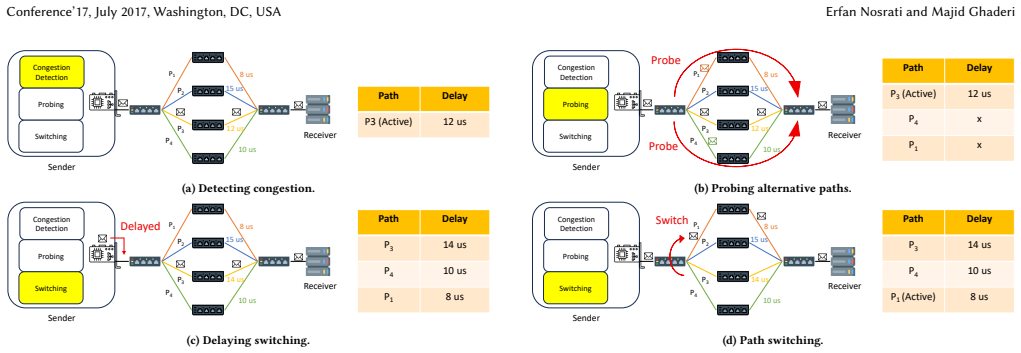
The load-bearing object is Hopper's RTT-gated control loop, which combines four pieces: congestion detection via a moving-average RTT with two thresholds; power-of-two-choices probing that examines two randomly chosen unexplored paths through queue pairs bound to distinct UDP source ports, with a TTL cache to avoid revisiting recently probed paths; condition-gated switching that moves the flow only when a probed path's RTT is lower by a margin (δ_rtt) than the current path; and delay-based out-of-order control, in which a linear RTT-trend estimator computes a switch delay proportional to the RTT difference so packets on the new path do not overtake in-flight packets on the old path. Together these let a host redirect standard ECMP hashing by changing the UDP source port, requiring no switch or NIC hardware changes.
What would settle it
In the paper's own simulation setup, change only the base link latency from 1 µs to 0.5 µs (halving base RTT to 4 µs) while keeping all Table 1 thresholds fixed; if Hopper's average-FCT improvement over the random-switching baseline drops below the reported 20% or reverses, the central claim is conditional on tuned thresholds rather than on the mechanism.
Extended reading notes
Core claim
The paper's central claim is that informed path selection, not just congestion-triggered switching, is what makes host-based load balancing work for RDMA. Hopper keeps a moving average of the active path's RTT; when that average exceeds a threshold, it creates two queue pairs bound to distinct UDP source ports and probes two randomly chosen unexplored paths. If the active path's RTT then exceeds a second threshold and one probed path beats it by a configurable margin, Hopper switches the flow to that path, and it delays the switch by an amount derived from a linear estimate of the RTT difference so that in-flight packets on the old path arrive before the first packets on the new path, keeping reordering within the RNIC's limited buffer. The paper shows this mechanism outperforms the random-switching host baseline on datacenter and ML training workloads, and that at moderate load the remaining gap to switch-based in-network reordering is small.
Load-bearing premise
The claimed gains rest on the hand-tuned thresholds in Table 1—probe at 1.5x base RTT, switch at 2.5x, probe TTL 4x, improvement margin 80%—transferring to other AI cluster topologies, workloads, and link speeds; the paper only says they 'found to work well in our setup.'
Editorial extensions
If this is right
- AI clusters can obtain most of the benefit of in-network load balancing through a host-side software change, without programmable switches or new NIC hardware.
- Hopper's gains concentrate exactly where ECMP fails hardest: the large, synchronized flows of collective communication (AllReduce, AllGather, ReduceScatter) that dominate ML training.
- Because Hopper switches only when a clearly better path exists, it avoids the tail-latency penalty of random switching onto an equally congested path.
- The delay-based switching keeps out-of-order packets within the RNIC's reordering threshold, so the technique scales to the limited on-chip memory of commercial RDMA NICs.
- On asymmetric topologies, Hopper's informed probing steers traffic to high-bandwidth paths, cutting testbed training time by about half compared with the random-switching baseline.
Reading between the lines
- The fixed thresholds in Table 1 (1.5x, 2.5x, 4x base RTT, 80% margin) are likely load-, topology-, and speed-dependent; making them adaptive to measured base RTT would be a natural next step the paper does not explore.
- Hopper's probe-to-path mapping relies on the assumption that a UDP source port maps stably to one ECMP path; deployments with dynamic hashing or re-routing would need periodic re-profiling, which the paper mentions only as a testbed practice.
- The power-of-two-choices limit could be raised under sustained asymmetry, and ECN could be fused with RTT as a proactive probe trigger; the paper notes ECN could signal congestion earlier but leaves that for future work.
- If Hopper's control logic were embedded in a collective communication library rather than the user-space testbed prototype, it could coordinate path choices across the many QPs of a single collective, potentially improving global balance beyond per-flow decisions.
Editorial analysis
A structured set of objections, weighed in public.
Referee Report
Summary. The paper presents Hopper, a host-based load-balancing mechanism for RDMA traffic in AI clusters. Hopper uses per-flow RTT measurements to detect congestion on the current path, probes two randomly chosen alternative paths when RTT exceeds a threshold, and switches the flow to a better path found via power-of-two-choices probing, while delaying the switch based on RTT differences to limit out-of-order packets. The authors evaluate Hopper through ns-3 simulations under datacenter and ML-training workloads and through a testbed with asymmetric path bandwidths. They report that Hopper reduces average and 99th-percentile FCT slowdown by up to 20% and 14%, respectively, compared to the host-based FlowBender baseline, and that it approaches switch-based ConWeave at moderate load.
Significance. If Hopper's benefits are robust, the paper would make a useful practical contribution: it proposes a load balancer that requires no switch modifications, only RNIC capabilities already present in modern hardware, and it includes both simulation and testbed evidence. The paper is honest about several limitations: it explicitly cautions that 10MB flow results in the Hadoop workload are unstable, it acknowledges that switch-based ConWeave outperforms Hopper at high load, and it provides a parameter table rather than hiding its configuration. These transparency measures are commendable. However, the central empirical claim rests on a small set of hand-tuned thresholds and a single simulation/testbed configuration, with no sensitivity analysis or confidence intervals, which currently limits the strength of the conclusions that can be drawn.
major comments (5)
- [§4.1.1, Table 1] The four central thresholds (th_probe=1.5x, th_cong=2.5x, ttl_probe=4.0x, delta_rtt=80%) are stated to 'work well in our setup' with no sensitivity analysis. Hopper's decision logic is a cascade of threshold comparisons on RTT measurements, so the reported 20%/14% improvements could be specific to these values and the particular 100G leaf-spine, DCQCN parameters, and load levels. The authors should provide a parameter sweep (e.g., varying each threshold around the chosen value at 50% and 80% load) or a principled calibration rule tied to base RTT and network scale. Without this, the reader cannot distinguish a robust mechanism from a configuration that was fitted to the evaluated scenarios.
- [§4.2.1, Figs. 6] The testbed experiments are repeated only five times and reported as averages, with no error bars, confidence intervals, or per-run data. Given the large FCT slowdown values (p95 and p99 in the range 10-30 in some conditions), the differences between Hopper and FlowBender could plausibly be within run-to-run variability. The authors should report variance or use a statistical test to support the claimed improvements (e.g., 45% average and 77.2% p99 improvements with 1MB chunks).
- [§4.2.1, §3.2] Hopper's testbed relies on pre-profiling to map specific source ports to distinct paths. This mapping is assumed stable, but in a production AI cluster, ECMP rehashing, link failures, or topology changes could invalidate the mapping, causing the probing QPs to collide on the same path or to miss available paths. The paper should discuss how Hopper detects and recovers from stale port-to-path mappings, or why this assumption is safe for its intended deployment.
- [§4.1.2, Fig. 3] The paper cautions that the 10MB-flow results for the Hadoop workload are 'not stable,' yet the same section states that Hopper outperforms FlowBender by up to 19.6% in p99 tail slowdown. If the maximum improvement is taken from the unstable 10MB data point, the headline claim is not supported. The authors should identify exactly which flow-size bin and load level produce each maximum (7.8%, 19.6%, and the ML-workload 20%/14%) and exclude or clearly flag unstable bins from those maxima.
- [§4.2.1] The testbed compares Hopper against a 'simplified software version' of FlowBender in which congestion is inferred from RTT increases instead of the original ECN-based signal. This modifies the baseline's detection mechanism to match Hopper's own signal, potentially disadvantaging FlowBender if ECN would have reacted earlier under DCQCN. The authors should justify this modification or present a version with ECN-based FlowBender, especially since the simulations use the original FlowBender.
minor comments (5)
- [§1] The word 'scalbility' in the first paragraph is a typo; it should be 'scalability.'
- [§4.1.1] The phrase 'we also implement and extended version of IRN' should read 'an extended version.'
- [§4.1.2] The text says Hopper improves average FCT by up to 7.8% for Hadoop workload, but Fig. 3 appears to show larger differences at some flow sizes; please clarify how the percentage is computed (e.g., relative reduction in slowdown, and whether it is per-bin or overall).
- [§2] The motivation section would benefit from a citation for the claim that hardware timestamping is supported by commodity RNICs; references are given later in §5 but the connection is not explicit.
- [Appendix C] The caption '99 th' should be '99th' for consistency with the other figures.
Circularity Check
No significant circularity: Hopper's FCT improvements are empirical measurements from ns-3 and testbed comparisons, not derived by construction from its own definitions, fitted parameters, or self-citations.
full rationale
The paper is an empirical systems paper rather than a mathematical derivation, and I find no circular step that reduces a claimed result to its own inputs. The core claim is that Hopper improves average and p99 FCT slowdown compared to FlowBender, CONGA, and ConWeave; this is supported by ns-3 simulations and a hardware testbed, with the comparisons measured after running the mechanisms. Table 1 lists parameters such as th_probe=1.5x base RTT and th_cong=2.5x base RTT, and the text notes they 'are found to work well in our setup.' That is parameter tuning without sensitivity analysis, which is a robustness concern rather than circularity: the FCT improvements are not algebraic consequences of these thresholds, and the paper does not rename a fitted value as a prediction. The authors do not rely on their own prior work for any load-bearing premise; the reference list contains no self-citations by Nosrati or Ghaderi, and no uniqueness theorem or ansatz is imported from the authors' earlier papers. The design reuses well-known components (RTT measurement, power-of-two-choices probing, ECMP switching) with external citations, but the novelty claim is the host-based combination, and the evaluation is self-contained against external baselines and workloads. Accordingly, the appropriate finding is no significant circularity.
Assumptions & free parameters
free parameters (6)
- th_probe =
1.5 x base RTT (12 us in the workflow example)
- th_cong =
2.5 x base RTT
- ttl_probe =
4.0 x base RTT
- delta_rtt =
80%
- alpha (EWMA smoothing) =
not clearly stated (Table 1 shows a garbled value)
- testbed chunk size =
1 MB chosen as good trade-off (also tested at 10 MB)
assumptions (5)
- domain assumption Host-measured RTT is a reliable per-path congestion signal for RDMA flows
- domain assumption Modern RNICs can support the QP creation and limited reordering required by probing without significant performance loss
- domain assumption ECMP hashing based on UDP source port maps flows to distinct stable paths
- domain assumption The ConWeave ns-3 simulation framework, topology, and DCQCN parameters are representative of production AI clusters
- ad hoc to paper The RTT of the last in-flight packet can be estimated by linear extrapolation of the current RTT trend
Cite this review
Pith. "Pith review of Congestion-Aware Path Selection for Load Balancing in AI Clusters." pith.science (2026). https://pith.science/paper/5SZWLW4O
@misc{pith2026250608132,
  author       = {Pith},
  title        = {Pith review of: Congestion-Aware Path Selection for Load Balancing in AI Clusters},
  year         = {2026},
  howpublished = {\url{https://pith.science/paper/5SZWLW4O}},
  note         = {Machine review of arXiv:2506.08132}
}
read the original abstract
Fast training of large machine learning models requires distributed training on AI clusters consisting of thousands of GPUs. The efficiency of distributed training crucially depends on the efficiency of the network interconnecting GPUs in the cluster. These networks are commonly built using RDMA following a Clos-like datacenter topology. To efficiently utilize the network bandwidth, load balancing is employed to distribute traffic across multiple redundant paths. While there exists numerous techniques for load-balancing in traditional datacenters, these are often either optimized for TCP traffic or require specialized network hardware, thus limiting their utility in AI clusters. This paper presents the design and evaluation of Hopper, a new load-balancing technique optimized for RDMA traffic in AI clusters. Operating entirely at the host level, Hopper requires no specialized hardware or modifications to network switches. It continuously monitors the current path for congestion and dynamically switches traffic to a less congested path when congestion is detected. Furthermore, it incorporates a lightweight mechanism to identify alternative paths and carefully controls the timing of path switching to prevent excessive out-of-order packets. We evaluated Hopper using ns-3 simulations and a testbed implementation. Our evaluations show that Hopper reduces the average and 99-percentile tail flow completion time by up to 20% and 14%, respectively, compared to state-of-the-art host-based load balancing techniques.
Figures


Figures from the paper (6 more)




Reference graph
Works this paper leans on
-
[1]
Mohammad Alizadeh, Tom Edsall, Sarang Dharmapurikar, Ramanan Vaidyanathan, Kevin Chu, Andy Fingerhut, Vinh The Lam, Francis Ma- tus, Rong Pan, Navindra Yadav, and George Varghese. 2014. CONGA: distributed congestion-aware load balancing for datacenters. InProceedings of the 2014 ACM Conference on SIGCOMM(Chicago, Illinois, USA)(SIGCOMM ’14). Association f...
work page 2014
-
[2]
InfiniBand Trade Association. 2007. Infiniband Architecture Specifications. https: //www.infinibandta.org/ibta-specification/
work page 2007
-
[3]
Jiamin Cao, Yu Guan, Kun Qian, Jiaqi Gao, Wencong Xiao, Jianbo Dong, Binzhang Fu, Dennis Cai, and Ennan Zhai. 2024. Crux: GPU-Efficient Communication Scheduling for Deep Learning Training. InProceedings of the Conference of the ACM Special Interest Group on Data Communication(Sydney, NSW, Australia) (ACM SIGCOMM ’24). Association for Computing Machinery, ...
work page 2024
-
[4]
Chuhao Chen, Jiarui Ye, Yongbo Gao, Sen Liu, and Yang Xu. 2024. HFˆ2T: Host- Based Flowlet Fine-Tuning for RDMA Load Balancing. InProceedings of the 8th Asia-Pacific Workshop on Networking(Sydney, Australia)(APNet ’24). Association for Computing Machinery, New York, NY, USA, 9–15
work page 2024
-
[5]
Xiaoqi Chen, Shay Vargaftik, and Ran Ben Basat. 2024. When ML Training Cuts Through Congestion: Just-in-Time Gradient Compression via Packet Trimming. InProceedings of the 23rd ACM Workshop on Hot Topics in Networks(Irvine, CA, USA)(HotNets ’24). Association for Computing Machinery, New York, NY, USA, 177–185
work page 2024
-
[6]
NVIDIA Corporation. 2025. NVIDIA Collective Communications Library (NCCL). https://developer.nvidia.com/nccl. Accessed: 2025-05-29
work page 2025
-
[7]
Charlie Hu, and Ramana Rao Kompella
Advait Dixit, Pawan Prakash, Y. Charlie Hu, and Ramana Rao Kompella. 2013. On the impact of packet spraying in data center networks. In2013 Proceedings IEEE INFOCOM. 2130–2138
work page 2013
-
[8]
Adithya Gangidi, Rui Miao, Shengbao Zheng, Sai Jayesh Bondu, Guilherme Goes, Hany Morsy, Rohit Puri, Mohammad Riftadi, Ashmitha Jeevaraj Shetty, Jingyi Yang, Shuqiang Zhang, Mikel Jimenez Fernandez, Shashidhar Gandham, and Hongyi Zeng. 2024. RDMA over Ethernet for Distributed Training at Meta Scale. InProceedings of the ACM SIGCOMM 2024 Conference(Sydney,...
work page 2024
Show all 52 references
-
[9]
Brighten Godfrey, Yashar Ganjali, and Amin Firoozshahian
Soudeh Ghorbani, Zibin Yang, P. Brighten Godfrey, Yashar Ganjali, and Amin Firoozshahian. 2017. DRILL: Micro Load Balancing for Low-latency Data Center Networks. InProceedings of the Conference of the ACM Special Interest Group on Data Communication(Los Angeles, CA, USA)(SIGCO...
2017
-
[10]
Junzhi Gong, Tong Yang, Haowei Zhang, Hao Li, Steve Uhlig, Shigang Chen, Lorna Uden, and Xiaoming Li. 2018. HeavyKeeper: An Accurate Algorithm for Finding Top-k Elephant Flows. In2018 USENIX Annual Technical Conference (USENIX ATC 18). USENIX Association, Boston, MA, 909–921
2018
-
[11]
Hamilton, Navendu Jain, Srikanth Kandula, Changhoon Kim, Parantap Lahiri, David A
Albert Greenberg, James R. Hamilton, Navendu Jain, Srikanth Kandula, Changhoon Kim, Parantap Lahiri, David A. Maltz, Parveen Patel, and Sudipta Sengupta. 2009. VL2: a scalable and flexible data center network. InProceedings of the ACM SIGCOMM 2009 Conference on Data Communicat...
2009
-
[12]
Christian Hopps. 2000. Analysis of an Equal-Cost Multi-Path Algorithm. RFC 2992
2000
-
[13]
IEEE. 2008. 802.1Qbb – Priority-based Flow Control. https://1.ieee802.org/dcb/ 802-1qbb/
2008
-
[14]
Intel Corporation. 2025. Intel®Ethernet Network Adapter E810-2CQDA2 Specifi- cations. https://www.intel.com/content/www/us/en/products/sku/210969/intel- ethernet-network-adapter-e8102cqda2/specifications.html. Accessed: 2025-06- 02
2025
-
[15]
Abdul Kabbani, Balajee Vamanan, Jahangir Hasan, and Fabien Duchene. 2014. FlowBender: Flow-level Adaptive Routing for Improved Latency and Through- put in Datacenter Networks. InProceedings of the 10th ACM International on Conference on Emerging Networking Experiments and Tech...
2014
-
[16]
Anuj Kalia, Michael Kaminsky, and David Andersen. 2019. Datacenter RPCs can be General and Fast. In16th USENIX Symposium on Networked Systems Design and Implementation (NSDI 19). USENIX Association, Boston, MA, 1–16
2019
-
[17]
Naga Katta, Aditi Ghag, Mukesh Hira, Isaac Keslassy, Aran Bergman, Changhoon Kim, and Jennifer Rexford. 2017. Clove: Congestion-Aware Load Balancing at the Virtual Edge. InProceedings of the 13th International Conference on Emerging Networking EXperiments and Technologies(Inch...
2017
-
[18]
Gautam Kumar, Nandita Dukkipati, Keon Jang, Hassan M. G. Wassel, Xian Wu, Behnam Montazeri, Yaogong Wang, Kevin Springborn, Christopher Alfeld, Michael Ryan, David Wetherall, and Amin Vahdat. 2020. Swift: Delay is Simple and Effective for Congestion Control in the Datacenter. ...
2020
-
[19]
Yanfang Le, Rong Pan, Peter Newman, Jeremias Blendin, Abdul Kabbani, Vipin Jain, Raghava Sivaramu, and Francis Matus. 2024. STrack: A Reliable Multipath Transport for AI/ML Clusters. arXiv:2407.15266
2024 arXiv
-
[20]
Shen Li, Yanli Zhao, Rohan Varma, Omkar Salpekar, Pieter Noordhuis, Teng Li, Adam Paszke, Jeff Smith, Brian Vaughan, Pritam Damania, and Soumith Chintala
-
[21]
Yuliang Li, Rui Miao, Hongqiang Harry Liu, Yan Zhuang, Fei Feng, Lingbo Tang, Zheng Cao, Ming Zhang, Frank Kelly, Mohammad Alizadeh, and Minlan Yu
-
[22]
Linux RDMA. 2025. RDMA core userspace libraries and daemons. https://github. com/linux-rdma/rdma-core. Accessed: 2025-05-16
2025
-
[23]
Minfei Long, Jiangping Han, Wentao Wang, Jiayu Yang, and Kaiping Xue. 2024. LSCC: Link-Segmented Congestion Control for RDMA in Cross-Datacenter Net- works. In2024 IEEE/ACM 32nd International Symposium on Quality of Service (IWQoS). 1–10. https://doi.org/10.1109/IWQoS61813.202...
2024
-
[24]
Yuanwei Lu, Guo Chen, Bojie Li, Kun Tan, Yongqiang Xiong, Peng Cheng, Jian- song Zhang, Enhong Chen, and Thomas Moscibroda. 2018. Multi-Path Transport for RDMA in Datacenters. In15th USENIX Symposium on Networked Systems Design and Implementation (NSDI 18). USENIX Association,...
2018
-
[25]
Radhika Mittal, Vinh The Lam, Nandita Dukkipati, Emily Blem, Hassan Wassel, Monia Ghobadi, Amin Vahdat, Yaogong Wang, David Wetherall, and David Zats
-
[26]
Radhika Mittal, Alexander Shpiner, Aurojit Panda, Eitan Zahavi, Arvind Krishna- murthy, Sylvia Ratnasamy, and Scott Shenker. 2018. Revisiting network support for RDMA. InProceedings of the 2018 Conference of the ACM Special Interest Group on Data Communication(Budapest, Hungar...
2018
-
[27]
ns-3 Project. 2025. ns-3: A Discrete-Event Network Simulator. https://www. nsnam.org/. Accessed: 2025-05-02
2025
-
[28]
NVIDIA. 2024. ZTR-RTT Congestion Control Algorithm Overview v1.0. https://docs.nvidia.com/networking/display/ ztrrttcongestioncontrolalgorithmoverviewv10 Accessed: 2025-05-16
2024
-
[29]
NVIDIA. [n.d.]. ConnectX-5 SmartNIC Adapter. https://www.nvidia.com/en- sg/networking/ethernet/connectx-5/. Accessed: 2025-05-28
2025
-
[30]
NVIDIA. [n.d.]. ConnectX-6 SmartNIC Adapter. https://www.nvidia.com/en- sg/networking/ethernet/connectx-6/. Accessed: 2025-05-28
2025
-
[31]
DPDK Project. 2025. Data Plane Development Kit (DPDK). https://www.dpdk. org/. Accessed: 2025-05-02
2025
-
[32]
SONiC Project. 2025. Software for Open Networking in the Cloud. https:// sonicfoundation.dev/. Accessed: 2025-06-28
2025
-
[33]
Kun Qian, Yongqing Xi, Jiamin Cao, Jiaqi Gao, Yichi Xu, Yu Guan, Binzhang Fu, Xuemei Shi, Fangbo Zhu, Rui Miao, Chao Wang, Peng Wang, Pengcheng Zhang, Xianlong Zeng, Eddie Ruan, Zhiping Yao, Ennan Zhai, and Dennis Cai
-
[34]
Mubashir Adnan Qureshi, Yuchung Cheng, Qianwen Yin, Qiaobin Fu, Gautam Kumar, Masoud Moshref, Junhua Yan, Van Jacobson, David Wetherall, and Abdul Kabbani. 2022. PLB: congestion signals are simple and effective for network load balancing. InProceedings of the Conference of the...
2022
-
[35]
2024.Conges- tion Signaling (CSIG)
Abhiram Ravi, Nandita Dukkipati, Naoshad Mehta, and Jai Kumar. 2024.Conges- tion Signaling (CSIG). Internet-Draft draft-ravi-ippm-csig-01. Internet Engineer- ing Task Force. https://datatracker.ietf.org/doc/draft-ravi-ippm-csig/01/ Work in Progress
2024
-
[36]
Arjun Roy, Hongyi Zeng, Jasmeet Bagga, George Porter, and Alex C. Snoeren
-
[37]
Cha Hwan Song, Xin Zhe Khooi, Raj Joshi, Inho Choi, Jialin Li, and Mun Choon Chan. 2023. Network Load Balancing with In-network Reordering Support for RDMA. InProceedings of the Conference of the ACM Special Interest Group on Data Communication(New York, NY, USA)(ACM SIGCOMM ’...
2023
-
[38]
Erico Vanini, Rong Pan, Mohammad Alizadeh, Parvin Taheri, and Tom Edsall
-
[39]
Zirui Wan, Jiao Zhang, Mingxuan Yu, Junwei Liu, Jun Yao, Xinghua Zhao, and Tao Huang. 2024. BiCC: Bilateral Congestion Control in Cross-datacenter RDMA Networks. InIEEE INFOCOM 2024 - IEEE Conference on Computer Communications. 1381–1390. https://doi.org/10.1109/INFOCOM52122.2...
2024
-
[40]
Zilong Wang, Layong Luo, Qingsong Ning, Chaoliang Zeng, Wenxue Li, Xinchen Wan, Peng Xie, Tao Feng, Ke Cheng, Xiongfei Geng, Tianhao Wang, Weicheng Ling, Kejia Huo, Pingbo An, Kui Ji, Shideng Zhang, Bin Xu, Ruiqing Feng, Tao Ding, Kai Chen, and Chuanxiong Guo. 2023. SRNIC: A S...
2023
-
[41]
Inside the Social Network’s (Datacenter) Network.SIGCOMM Comput. Commun. Rev.45, 4 (Aug. 2015), 123–137
2015
-
[42]
Yunhong Xu, Keqiang He, Rui Wang, Minlan Yu, Nick Duffield, Hassan Wassel, Shidong Zhang, Leon Poutievski, Junlan Zhou, and Amin Vahdat. 2022. Hashing Design in Modern Networks: Challenges and Mitigation Techniques. In2022 USENIX Annual Technical Conference (USENIX ATC 22). US...
2022
-
[43]
Hong Zhang, Junxue Zhang, Wei Bai, Kai Chen, and Mosharaf Chowdhury. 2017. Resilient Datacenter Load Balancing in the Wild. InProceedings of the Conference of the ACM Special Interest Group on Data Communication(Los Angeles, CA, USA)(SIGCOMM ’17). Association for Computing Mac...
2017
-
[44]
Jiao Zhang, Yuqing Wang, Xiaolong Zhong, Mingxuan Yu, Haoyu Pan, Yali Zhang, Zixuan Guan, Biyao Che, Zirui Wan, Tian Pan, and Tao Huang. 2024. PACC: A Proactive CNP Generation Scheme for Datacenter Networks.IEEE/ACM Trans. Netw.32, 3 (Feb. 2024), 2586–2599. https://doi.org/10....
2024
-
[45]
Yanli Zhao, Andrew Gu, Rohan Varma, Liang Luo, Chien-Chin Huang, Min Xu, Less Wright, Hamid Shojanazeri, Myle Ott, Sam Shleifer, Alban Desmaison, Can Balioglu, Pritam Damania, Bernard Nguyen, Geeta Chauhan, Yuchen Hao, Ajit Mathews, and Shen Li. 2023. PyTorch FSDP: Experiences...
2023 arXiv
-
[46]
Yibo Zhu, Haggai Eran, Daniel Firestone, Chuanxiong Guo, Marina Lipshteyn, Yehonatan Liron, Jitendra Padhye, Shachar Raindel, Mohamad Haj Yahia, and Ming Zhang. 2015. Congestion Control for Large-Scale RDMA Deployments. In Proceedings of the 2015 ACM Conference on Special Inte...
2015
-
[47]
William Won, Taekyung Heo, Saeed Rashidi, Srinivas Sridharan, Sudarshan Srinivasan, and Tushar Krishna. 2023. ASTRA-sim2.0: Modeling Hierarchical Networks and Disaggregated Systems for Large-model Training at Scale. In2023 IEEE International Symposium on Performance Analysis o...
2023
-
[2015]
InProceedings of the 2015 ACM Conference on Special Interest Group on Data Communication(Lon- don, United Kingdom)(SIGCOMM ’15)
TIMELY: RTT-based Congestion Control for the Datacenter. InProceedings of the 2015 ACM Conference on Special Interest Group on Data Communication(Lon- don, United Kingdom)(SIGCOMM ’15). Association for Computing Machinery, New York, NY, USA, 537–550
2015
-
[2017]
In14th USENIX Symposium on Networked Systems Design and Implementation (NSDI 17)
Let It Flow: Resilient Asymmetric Load Balancing with Flowlet Switching. In14th USENIX Symposium on Networked Systems Design and Implementation (NSDI 17). USENIX Association, Boston, MA, 407–420
-
[2019]
InProceedings of the ACM Special Interest Group on Data Communication(Beijing, China)(SIGCOMM ’19)
HPCC: high precision congestion control. InProceedings of the ACM Special Interest Group on Data Communication(Beijing, China)(SIGCOMM ’19). Association for Computing Machinery, New York, NY, USA, 44–58
-
[2020]
arXiv:2006.15704 [cs.DC] https://arxiv.org/abs/2006.15704
PyTorch Distributed: Experiences on Accelerating Data Parallel Training. arXiv:2006.15704 [cs.DC] https://arxiv.org/abs/2006.15704
2006 arXiv
-
[2024]
InProceedings of the ACM SIGCOMM 2024 Conference(Sydney, NSW, Australia) (ACM SIGCOMM ’24)
Alibaba HPN: A Data Center Network for Large Language Model Training. InProceedings of the ACM SIGCOMM 2024 Conference(Sydney, NSW, Australia) (ACM SIGCOMM ’24). Association for Computing Machinery, New York, NY, USA, 691–706
2024
Reviewed August 7, 2026 · model on record in the stance chip above.
Discussion (0). Sign in to comment.