REVIEW 4 major objections 5 minor 34 references
AffectMachine-Pop: A controllable expert system for real-time pop music generation
T0 review · 4 major / 5 minor · reviewed 2026-08-07 · deepseek-v4-flash
Pith's one-line read AffectMachine-Pop, a rule-based expert system, composes retro-pop music at specified arousal and valence levels, and a 24-participant listening study found listeners' mean ratings track the target settings closely ($R^2 = 0.93$ for…
desk verdict A transparent rule-based pop music generator with credible but provisional validation; the R²s are real but rest on aggregated point-means. read the letter →
The pith
A machine-rendered reading of the paper's core claim, the machinery that carries it, and where it could break.
The reading
What carries the argument
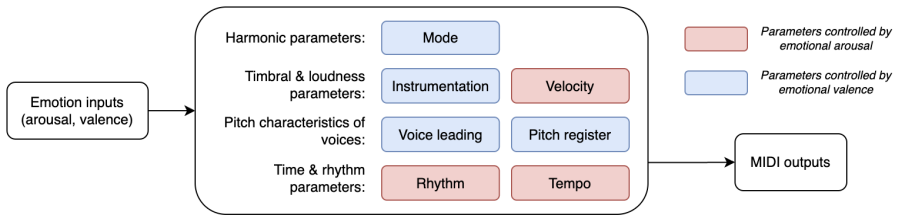
The load-bearing mechanism is a parametric mapping from Russell's valence-arousal plane onto musical features: a directed probabilistic chord graph selects chord sequences driven by a per-bar valence array; tempo follows a logarithmic relation with arousal over the range $[36,130]$ bpm; MIDI attack velocity is set by $60 + 15 \times \text{arousal}$; separate voice-leading transition matrices for low ($V \le 0.5$) and high ($V > 0.5$) valence shape the melody; rhythmic patterns and note density are chosen by arousal region; and pitch-register ascent is governed by valence with a probability $p = \text{val}$ of inversion increase. Together these rules translate any (valence, arousal) pair into a deterministic MIDI score realized with five virtual instruments (percussion, bass guitar, electric guitar, violin section, French horn), and they can be re-evaluated bar by bar to adapt the music in near real time.
What would settle it
Generate music at a held-out point on the valence-arousal plane not among the 13 sampled (for example, valence 0.65 and arousal 0.35), have a fresh group of listeners rate it on the same 9-point Self-Assessment Manikin scales, and compare the mean normalized ratings with the target; the system's claim is falsified if the linear correspondence found at the sampled points does not extend, for instance if the mean ratings at such held-out points are systematically offset by more than the error observed in the original study.
Extended reading notes
Core claim
The paper reports that AffectMachine-Pop generates continuous, non-repetitive pop music whose emotional character is set by two input numbers, valence and arousal, and that listeners perceive roughly the intended emotion: averaged ratings across the 13 sampled points regress on the target settings with $R^2 = 0.93$ (valence) and $R^2 = 0.86$ (arousal). The authors also describe an asymmetric crossover effect: arousal settings influence perceived valence at extreme combinations, while perceived arousal is largely independent of valence settings, consistent with earlier findings in rule-based affective music systems. This is a validation of perceived emotion, not of emotion induction; the paper states that inducing emotions in listeners is left to future work.
Load-bearing premise
The central claim rests on the assumption that averaging ratings from 24 listeners and three musical instantiations at each of 13 sampled points gives a reliable estimate of the emotion the system expresses at that point, so that the high $R^2$ values on these aggregated points would carry over to the rest of the continuous valence-arousal plane.
Editorial extensions
If this is right
- If the system reliably hits target valence and arousal, it can serve as an interactive tool that adapts music in real time to user input or physiological signals such as heart rate or EEG.
- Because generation is rule-based and deterministic, a designer can trace why a given excerpt sounds a certain way, an auditable control that black-box generative models do not offer.
- The system avoids reliance on pre-existing recordings for training, sidestepping copyright concerns while still producing stylistically coherent retro-pop.
- The pop style and continuous valence-arousal traversal make it suitable for emotion-regulation applications aimed at general audiences, including middle-aged and older adults who favor 1960s-70s pop.
- The empirically observed crossover between arousal settings and perceived valence provides a specific target for future versions to compensate for, improving accuracy at extreme corners of the valence-arousal plane.
Reading between the lines
- An untested extension: because the mapping rules are explicit functions of arousal and valence, the system can be probed at any unsampled point in the valence-arousal plane without retraining; a natural next experiment is to confirm linearity on a denser grid of points.
- The logarithmic tempo law implies that equal steps in arousal are more perceptually distinct at low tempos, which could let designers choose arousal quantization steps that sound perceptually uniform.
- The paper validates perceived emotion only; the stronger claim for therapy is emotion induction, so a plausible next study is to measure skin conductance or self-reported mood before and after listening to test whether the target emotion transfers to the listener's own state.
- The component-wise architecture suggests the crossover effect could be modeled by treating perceived valence as a function of both valence and arousal parameters, then inverting that function at the input stage to pre-compensate for the observed bias.
Editorial analysis
A structured set of objections, weighed in public.
Referee Report
Summary. The paper presents AffectMachine-Pop, a rule-based expert system for generating retro-pop music with specified valence and arousal values. The system uses hand-crafted probabilistic chord progressions, voice-leading matrices, tempo and velocity mappings, and rhythmic patterns to map points in Russell's two-dimensional valence-arousal space to musical parameters. The authors report a listening study with 24 participants who rated 39 musical excerpts (13 V-A target points, three instantiations each) using the Self-Assessment Manikin. They report a strong linear correspondence between target parameter settings and averaged listener ratings, with R^2 = 0.93 for valence and R^2 = 0.86 for arousal, and interpret this as confirming the system's ability to generate affective music at target levels. The paper also claims real-time generation capability and discusses applications in interactive music and biofeedback/neurofeedback systems.
Significance. If the central claim holds, the paper is a useful contribution to affective music generation: it offers a transparent, rule-based alternative to black-box neural models, with no reliance on copyrighted training data, and it explicitly addresses controllability along arousal and valence dimensions. The authors are candid about the system's design choices and about limitations such as sample size. The listening study, however, is currently the weakest link: the headline R^2 values are computed on a small number of aggregated points, and the paper does not report the variance across the three instantiations at each point or across participants. Because the system is stochastic and the paper itself acknowledges that particular stimuli 'may have deviated from the system's typical output,' the evidence as presented does not yet support the strong conclusion that the system reliably produces music 'at target levels' across the continuous V-A plane. With additional statistical analysis and a more complete report of per-stimulus results, the contribution would be substantially strengthened.
major comments (4)
- [Results and Discussion (Figure 3, regression analysis)] The central evidence for controllability is a regression fit to 13 point means, each averaged over 24 participants and 3 Monte Carlo instantiations. This aggregation discards the variance across instantiations and participants. Because the system is probabilistic, the three stimuli at each target point are not guaranteed to express the same emotion; the paper itself notes that the A = 0.5 stimuli 'may have deviated from the system's typical output.' The reported R^2 therefore represents an ecological correlation and does not establish that individual excerpts, or even the per-point means, are near target levels. Please report per-stimulus means with standard errors or prediction intervals, a variance decomposition (participant versus instantiation), and ideally a mixed-effects model with target as a fixed effect and stimulus/participant as random effects.
- [Results and Discussion (comparative analysis)] The manuscript does not report whether the regression slope and intercept differ from the identity line (rating = target). An R^2 of 0.93 or 0.86 shows a strong linear trend but not that ratings match the intended levels, especially given the systematic deviations described in the text: the valence plateau for target values above 0.75 and the arousal dip around A = 0.5. These deviations are explained post hoc rather than quantified. Please provide the fitted slope, intercept, confidence intervals, and, if possible, a test of whether the relation is consistent with identity; otherwise the claim of generating music 'at target levels' is overstated.
- [Musical Stimuli Generation and Experimental Procedure] The generality of the validation is limited by the sampling of both stimuli and listeners. The 13 V-A points are not specified in this paper; the reader is referred to prior work, which makes the validation not self-contained. Only 13 points are used to represent the continuous valence-arousal plane, and the three instantiations per point are too few to estimate generation variability. The participant sample (N = 24, mean age 23.0, university students) is small and homogeneous. The conclusion that the system controls emotion across the entire V-A plane is not supported by the current data. Please list the exact 13 coordinates, justify their coverage of the space, and report per-point variability across instantiations and participants.
- [Abstract, Conclusion, and System Description (real-time claims)] The title and abstract claim 'real-time' music generation, and the introduction states that the system features 'near real-time adaptability,' but no latency measurement, timing benchmark, or demonstration of continuous re-parameterization during playback is provided. If real-time operation is part of the contribution, please report a technical measurement or at least an architecture-level latency estimate; otherwise, the real-time claim should be softened or explicitly labeled as a design goal rather than a validated property.
minor comments (5)
- [Experimental Procedure] The text reads 'To access whether our system accurately expresses the desired emotions'; this should be 'To assess whether.' Also, 'plataeu' should be 'plateau' in the Results section.
- [Equation (2) and Figure 3] Please clarify whether the normalization in Eq. (2) was applied to each participant's ratings individually or to the pooled raw ratings, and state the exact mapping from the 9-point SAM scale to the normalized [0, 1] range in the figure axes.
- [Musical Stimuli Generation] The manuscript states an average stimulus duration of 32.6 seconds but later describes low-arousal stimuli as 4 bars ranging from 27 to 34 seconds; please clarify whether the 32.6-second average is computed over all 39 excerpts and explain the duration variability more precisely.
- [System Description (Tempo)] The tempo range is reported as [36, 130] bpm with a logarithmic mapping to arousal, but no equation is given. Since tempo is a primary manipulation, please provide the exact mapping or a reference to where it is specified.
- [Conclusion / Future Work] The paper focuses on perceived emotion and explicitly defers induced emotion to future work. The introduction and conclusion would benefit from clearer wording that the validation concerns perceived emotion only, so that readers do not infer that the system has been shown to reliably induce emotional states in listeners.
Circularity Check
No significant circularity: the system's rules are hand-tuned from prior literature, and the validation uses independent listener ratings; the self-citations are not load-bearing.
full rationale
The paper does not derive its predictions from its inputs by construction. AffectMachine-Pop's emotion-to-music mappings are explicitly hand-crafted: tempo is set as a logarithmic function of arousal, MIDI velocity follows velocity = 60 + (aro*15), inversion probabilities are defined directly from valence, and chord/rhythm patterns were composed by experts. None of these parameters were fitted to the listening-study ratings. The central validation is an external empirical study: 24 participants rated 39 generated excerpts (three per each of 13 target valence-arousal points) using the Self-Assessment Manikin. The reported R-squared values (0.93 for valence, 0.86 for arousal) are descriptive linear fits between mean normalized ratings and target parameter settings, not fitted system parameters renamed as predictions. The self-citations to Agres, Dash, and Chua (2023) and Ehrlich et al. (2019) supply prior system components, voice-leading details, and the V-A point selection, but the claim that AffectMachine-Pop conveys target emotions is supported by the new listener ratings rather than by those citations. No equation in the paper reduces to another by definition, and no load-bearing uniqueness theorem or imported ansatz is invoked. The main methodological caveat is that the high R-squared is computed on 13 aggregated point means, which does not by itself establish per-excerpt stability; this is a statistical generalizability concern, not a circularity.
Assumptions & free parameters
free parameters (5)
- Velocity mapping coefficients =
velocity = 60 + 15*aro
- Tempo range and relationship =
tempo in [36,130] bpm, logarithmic vs arousal
- Arousal region thresholds =
0.40, 0.70 (strummed guitar); 0.30, 0.60 (melodic motives); 0.30, 0.70 (percussion)
- Valence threshold for mode matrices =
0.5
- Chord transition probabilities
assumptions (3)
- domain assumption Russell's two-dimensional circumplex model of affect.
- domain assumption Musical features (tempo, mode, velocity, note density) can be mapped to perceived emotions based on prior empirical findings.
- ad hoc to paper The 13 sampled V-A points adequately represent the continuous valence-arousal space.
Cite this review
Pith. "Pith review of AffectMachine-Pop: A controllable expert system for real-time pop music generation." pith.science (2026). https://pith.science/paper/F2XI3W3D
@misc{pith2026250608200,
  author       = {Pith},
  title        = {Pith review of: AffectMachine-Pop: A controllable expert system for real-time pop music generation},
  year         = {2026},
  howpublished = {\url{https://pith.science/paper/F2XI3W3D}},
  note         = {Machine review of arXiv:2506.08200}
}
read the original abstract
Music is a powerful medium for influencing listeners' emotional states, and this capacity has driven a surge of research interest in AI-based affective music generation in recent years. Many existing systems, however, are a black box which are not directly controllable, thus making these systems less flexible and adaptive to users. We present \textit{AffectMachine-Pop}, an expert system capable of generating retro-pop music according to arousal and valence values, which can either be pre-determined or based on a listener's real-time emotion states. To validate the efficacy of the system, we conducted a listening study demonstrating that AffectMachine-Pop is capable of generating affective music at target levels of arousal and valence. The system is tailored for use either as a tool for generating interactive affective music based on user input, or for incorporation into biofeedback or neurofeedback systems to assist users with emotion self-regulation.
Figures


Figures from the paper (1 more)

Reference graph
Works this paper leans on
-
[1]
, " * write output.state after.block = add.period write newline
ENTRY address archivePrefix author booktitle chapter edition editor eid eprint howpublished institution isbn journal key month note number organization pages publisher school series title type volume year label extra.label sort.label short.list INTEGERS output.state before.all mid.sentence after.sentence after.block FUNCTION init.state.consts #0 'before.a...
-
[2]
write newline
" write newline "" before.all 'output.state := FUNCTION n.dashify 't := "" t empty not t #1 #1 substring "-" = t #1 #2 substring "--" = not "--" * t #2 global.max substring 't := t #1 #1 substring "-" = "-" * t #2 global.max substring 't := while if t #1 #1 substring * t #2 global.max substring 't := if while FUNCTION word.in bbl.in capitalize " " * FUNCT...
-
[3]
Agostinelli, A.; Denk, T. I.; Borsos, Z.; Engel, J.; Verzetti, M.; Caillon, A.; Huang, Q.; Jansen, A.; Roberts, A.; Tagliasacchi, M.; et al. 2023. Musiclm: Generating music from text. arXiv preprint arXiv:2301.11325
arXiv 2023
-
[4]
Agres, K. R.; Dash, A.; and Chua, P. 2023. AffectMachine-Classical: a novel system for generating affective classical music. Frontiers in Psychology, 14: 1158172
work page 2023
-
[5]
Agres, K. R.; Schaefer, R. S.; Volk, A.; van Hooren, S.; Holzapfel, A.; Dalla Bella, S.; M \"u ller, M.; De Witte, M.; Herremans, D.; Ramirez Melendez, R.; et al. 2021. Music, computing, and health: a roadmap for the current and future roles of music technology for health care and well-being. Music & Science, 4: 2059204321997709
work page 2021
-
[6]
Ashoori, A.; Eagleman, D. M.; and Jankovic, J. 2015. Effects of auditory rhythm and music on gait disturbances in Parkinson’s disease. Frontiers in neurology, 6: 234
work page 2015
-
[7]
Borsos, Z.; Marinier, R.; Vincent, D.; Kharitonov, E.; Pietquin, O.; Sharifi, M.; Roblek, D.; Teboul, O.; Grangier, D.; Tagliasacchi, M.; et al. 2023. Audiolm: a language modeling approach to audio generation. IEEE/ACM transactions on audio, speech, and language processing, 31: 2523--2533
2023
-
[8]
Bresin, R.; and Friberg, A. 2011. Emotion rendering in music: range and characteristic values of seven musical variables. cortex, 47(9): 1068--1081
work page 2011
Show all 34 references
-
[9]
Chan, W.-Y.; Qu, H.; and Mak, W.-H. 2009. Visualizing the semantic structure in classical music works. IEEE transactions on visualization and computer graphics, 16(1): 161--173
2009
-
[10]
Civit, M.; Civit-Masot, J.; Cuadrado, F.; and Escalona, M. J. 2022. A systematic review of artificial intelligence-based music generation: Scope, applications, and future trends. Expert Systems with Applications, 209: 118190
2022
-
[11]
G.; and Hubbard, T
Collier, W. G.; and Hubbard, T. L. 1998. Judgments of happiness, brightness, speed and tempo change of auditory stimuli varying in pitch and tempo. Psychomusicology: A Journal of Research in Music Cognition, 17(1-2): 36
1998
-
[12]
Copet, J.; Kreuk, F.; Gat, I.; Remez, T.; Kant, D.; Synnaeve, G.; Adi, Y.; and D \'e fossez, A. 2024. Simple and controllable music generation. Advances in Neural Information Processing Systems, 36
2024
-
[13]
Cui, W.; Sarmento, P.; and Barthet, M. 2024. MoodLoopGP: Generating Emotion-Conditioned Loop Tablature Music with Multi-granular Features. In International Conference on Computational Intelligence in Music, Sound, Art and Design (Part of EvoStar), 97--113. Springer
2024
-
[14]
Dash, A.; and Agres, K. 2024. AI-Based Affective Music Generation Systems: A Review of Methods and Challenges. ACM Computing Surveys, 56(11): 1--34
2024
-
[15]
K.; Agres, K
Ehrlich, S. K.; Agres, K. R.; Guan, C.; and Cheng, G. 2019. A closed-loop, music-based brain-computer interface for emotion mediation. PloS one, 14(3): e0213516
2019
-
[16]
Elliott, D.; Polman, R.; and McGregor, R. 2011. Relaxing music for anxiety control. Journal of music therapy, 48(3): 264--288
2011
-
[17]
Engels, S.; Tong, T.; and Chan, F. 2015. Automatic real-time music generation for games. In Proceedings of the AAAI Conference on Artificial Intelligence and Interactive Digital Entertainment, volume 11, 220--222
2015
-
[18]
Gabrielsson, A.; and Juslin, P. N. 2003. Emotional expression in music. Oxford University Press
2003
-
[19]
Grekow, J.; and Dimitrova-Grekow, T. 2021. Monophonic music generation with a given emotion using conditional variational autoencoder. IEEE Access, 9: 129088--129101
2021
-
[20]
Gupta, C.; Kamath, P.; Wei, Y.; Li, Z.; Nanayakkara, S.; and Wyse, L. 2023. Towards controllable audio texture morphing. In ICASSP 2023-2023 IEEE International Conference on Acoustics, Speech and Signal Processing (ICASSP), 1--5. IEEE
2023
-
[21]
J.; Lux, M.; Ehrlich, S.; and Cheng, G
Hagerer, G. J.; Lux, M.; Ehrlich, S.; and Cheng, G. 2015. Augmenting affect from speech with generative music. In Proceedings of the 33rd Annual ACM Conference Extended Abstracts on Human Factors in Computing Systems, 977--982
2015
-
[22]
Huang, J.; Chen, K.; and Yang, Y.-H. 2024. Emotion-driven Piano Music Generation via Two-stage Disentanglement and Functional Representation. arXiv preprint arXiv:2407.20955
2024 arXiv
-
[23]
Huang, Y.-S.; and Yang, Y.-H. 2020. Pop music transformer: Beat-based modeling and generation of expressive pop piano compositions. In Proceedings of the 28th ACM international conference on multimedia, 1180--1188
2020
-
[24]
Ji, S.; Luo, J.; and Yang, X. 2020. A comprehensive survey on deep music generation: Multi-level representations, algorithms, evaluations, and future directions. arXiv preprint arXiv:2011.06801
2020 arXiv
-
[25]
N.; and Sloboda, J
Juslin, P. N.; and Sloboda, J. A. 2013. Music and emotion. Elsevier Academic Press
2013
-
[26]
Leung, S.-O. 2011. A comparison of psychometric properties and normality in 4-, 5-, 6-, and 11-point Likert scales. Journal of social service research, 37(4): 412--421
2011
-
[27]
Ren, Y.; He, J.; Tan, X.; Qin, T.; Zhao, Z.; and Liu, T.-Y. 2020. Popmag: Pop music accompaniment generation. In Proceedings of the 28th ACM international conference on multimedia, 1198--1206
2020
-
[28]
Russell, J. A. 1980. A circumplex model of affect. Journal of personality and social psychology, 39(6): 1161
1980
-
[29]
Stewart, J.; Garrido, S.; Hense, C.; and McFerran, K. 2019. Music use for mood regulation: Self-awareness and conscious listening choices in young people with tendencies to depression. Frontiers in psychology, 10: 1199
2019
-
[30]
E.; and Viana, P
Sulun, S.; Davies, M. E.; and Viana, P. 2022. Symbolic music generation conditioned on continuous-valued emotions. IEEE Access, 10: 44617--44626
2022
-
[31]
H.; and Herremans, D
Tan, H. H.; and Herremans, D. 2020. Music fadernets: Controllable music generation based on high-level features via low-level feature modelling. arXiv preprint arXiv:2007.15474
2020 arXiv
-
[32]
Wallis, I.; Ingalls, T.; Campana, E.; and Goodman, J. 2011. A rule-based generative music system controlled by desired valence and arousal. In Proceedings of 8th international sound and music computing conference (SMC), 156--157
2011
-
[33]
Wang, L.; Zhao, Z.; Liu, H.; Pang, J.; Qin, Y.; and Wu, Q. 2024. A review of intelligent music generation systems. Neural Computing and Applications, 36(12): 6381--6401
2024
-
[34]
J.; Qin, C.; Li, J.; Zhang, K.; Zhou, G.; Wei, F.; Xu, Y.; and Chen, E
Zhu, H.; Liu, Q.; Yuan, N. J.; Qin, C.; Li, J.; Zhang, K.; Zhou, G.; Wei, F.; Xu, Y.; and Chen, E. 2018. Xiaoice band: A melody and arrangement generation framework for pop music. In Proceedings of the 24th ACM SIGKDD international conference on knowledge discovery & data mini...
2018
Reviewed August 7, 2026 · model on record in the stance chip above.
Discussion (0). Sign in to comment.