REVIEW 4 major objections 5 minor 130 references
Precise Age For The Binary HD 21278 In The Young Alpha Persei Cluster
T0 review · 4 major / 5 minor · reviewed 2026-08-07 · deepseek-v4-flash
Pith's one-line read Precise masses for the HD 21278 binary pin the Alpha Persei cluster at $49 \pm 7$ Myr and put new pressure on the idea that single stars near $8\,M_\odot$ produce Chandrasekhar-mass white dwarfs.
desk verdict The binary mass measurement is solid, but the paper's age claim is undercut by internal inconsistencies and an appendix that implies a different age. read the letter →
The pith
A machine-rendered reading of the paper's core claim, the machinery that carries it, and where it could break.
The reading
What carries the argument
The machinery is the binary itself used as an isochrone clock. Radial-velocity broadening functions extract velocities from blended spectra, long-baseline interferometry resolves the roughly 2 milliarcsecond orbit and gives the inclination and flux ratios, and a Keplerian fit turns those into component masses. The paper then compares the two stars' infrared color-magnitude positions with rotating PARSEC and MIST isochrones, using the more massive, slowly rotating primary as the age-sensitive point because it is close to leaving the main sequence.
What would settle it
Detect past mass transfer in HD 21278 (for example, CNO-cycle processed material on the primary's surface, or a measurably changing orbital period) and the single-star isochrone comparison would be invalidated. A cleaner check is to resolve the primary's radius and effective temperature with longer-baseline interferometry and ask whether they land on the 49 Myr PARSEC/MIST track at $5.38\,M_\odot$; a clear miss would falsify the age assignment.
Extended reading notes
Core claim
The central discovery is that the age of $\alpha$ Persei can be pinned down by its most massive still-main-sequence binary. HD 21278's two stars are measured by a combined Keplerian fit to radial velocities and interferometric sky positions: masses $5.381 \pm 0.084$ and $3.353 \pm 0.064$ $M_\odot$, in a 21.685-day eccentric orbit at an inclination of $148.938^\circ$. Placing those masses on PARSEC and MIST isochrones yields a cluster age of $49 \pm 7$ Myr or $49.5 \pm 6$ Myr, with systematic uncertainties of about 3 Myr from rotational mixing and convective overshoot. Reapplying that younger age to three candidate white-dwarf escapees changes their inferred progenitor masses (about $8.4$ and $7.4$ $M_\odot$ for the two viable candidates) and brings one $1.2\,M_\odot$ white dwarf into conflict with the cluster cooling-age budget, so the paper argues that single stars near $8\,M_\odot$ may not produce Chandrasekhar-mass white dwarfs.
Load-bearing premise
Both stars in HD 21278 evolved as isolated single stars despite past tidal interaction, so their masses and luminosities can be compared to single-star isochrones; if the pair exchanged mass earlier, the derived cluster age would be invalid.
Editorial extensions
If this is right
- The cluster is younger than the 77--81 Myr ages from lithium-depletion and kinematic methods, so membership-based evolutionary statements about $\alpha$ Persei would need to be recast to a roughly 49--51 Myr timescale.
- The two viable white-dwarf escapees receive initial masses near $8.4$ and $7.4$ $M_\odot$, which extends the white dwarf initial-final mass relation steeply toward the supernova boundary.
- The $1.20\,M_\odot$ white dwarf is probably not a cluster escapee: its $45 \pm 4$ Myr cooling time together with the new age leaves almost no time for a progenitor to have lived.
- If single stars of $7$--$8.5$ $M_\odot$ make white dwarfs below the Chandrasekhar limit, then ultramassive white dwarfs near $1.2$--$1.3$ $M_\odot$ require either a different formation channel or a sharp change of slope in the initial-final mass relation just above this mass range.
Reading between the lines
- A testable consequence the paper does not state is that field white dwarfs near $1.2$--$1.3$ $M_\odot$ should increasingly show merger signatures (fast rotation, magnetic fields, or unusual kinematics) if the single-star channel near $8\,M_\odot$ is closed.
- The age gap with the lithium depletion boundary could be narrowed by searching for magnetic activity and spotting among the cluster's low-mass members; if the LDB clock runs systematically high in young clusters, the two methods would converge.
- Applying the same binary-mass-plus-isochrone technique to other young clusters with resolved massive binaries could map the high-mass end of the initial-final mass relation without leaning on cluster turnoff ages.
- A direct test of the single-star assumption would be a search for orbital period change or surface abundance anomalies in HD 21278; neither is claimed in the paper, but either would overturn the age if found.
Editorial analysis
A structured set of objections, weighed in public.
Referee Report
Summary. This paper reports a combined spectroscopic and interferometric orbital solution for the double-lined binary HD 21278 in the alpha Persei cluster. New FIES/NOT spectra, archival KPNO, Narval, and HERMES spectra, and CHARA/PTI interferometric visibilities and closure phases are fitted with a thirteen-parameter Keplerian model, yielding component masses of about 5.38 and 3.35 Msun. The masses are then placed on 2MASS color-magnitude diagrams and compared to PARSEC and MIST isochrones to derive a cluster age of about 49-49.5 Myr, with the conclusion quoting 51 Myr. The paper also revisits the initial masses of three candidate massive white dwarf escapees from alpha Persei and argues that the inferred initial-final mass relation challenges the idea that single stars near 8 Msun produce Chandrasekhar-mass white dwarfs. An appendix presents independent SED fits for cluster B stars, including HD 21278 A.
Significance. If the derived age and masses are correct, this is a valuable anchor for the alpha Persei cluster age and a rare, precise probe of the high-mass end of the white dwarf initial-final mass relation. The paper's strengths include a direct Keplerian fit to independent radial-velocity and interferometric data, a Monte Carlo treatment of photometric uncertainties, publicly listed radial velocities and nightly positions, and external comparison with two modern isochrone sets. The central claims are, however, currently undermined by internal inconsistencies between the abstract/body and the conclusion, by an unresolved conflict between the Section 4.1 isochrone age and the Appendix A SED age for the same star, and by a contradictory statement about whether the Narval/Melchior radial velocities were included in the final fit. These issues must be reconciled before the paper's quantitative conclusions can be accepted.
major comments (4)
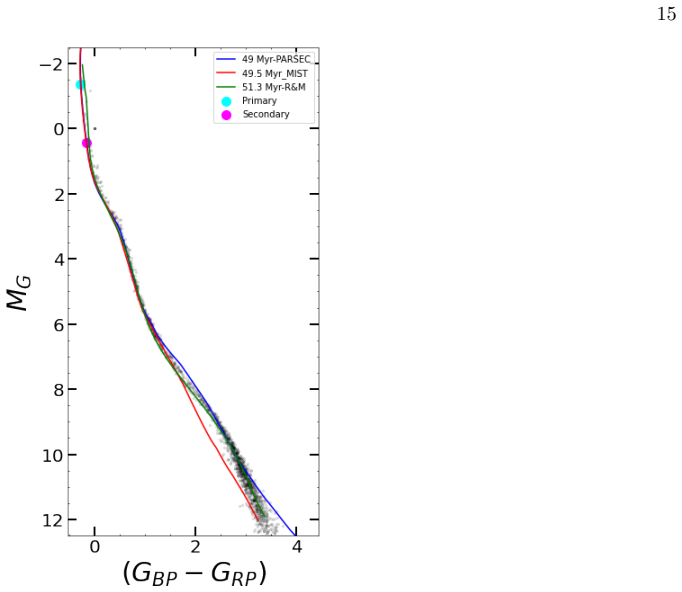
- [4.1 and Appendix A] The paper presents two mutually inconsistent ages for HD 21278 A. Section 4.1 reports 49 +/- 7 Myr (PARSEC) and 49.5 +/- 6 Myr (MIST) from the 2MASS CAMD positions of both components, while Appendix A's independent SED fit gives Teff = 16410 K and R = 3.75 +/- 0.09 Rsun for the primary and states that 'an age of about 61 Myr is implied' with PARSEC models at the same rotation parameter omega = 0.2. The 12 Myr offset is about 1.7 times the quoted 7 Myr uncertainty and lies in the direction of the 79 Myr lithium depletion boundary age that the paper argues against. Because HD 21278 A is the most evolved and most age-sensitive star used in the fit, this disagreement must be resolved quantitatively; the resolution could involve the photometric flux decomposition, the adopted reddening, or the single-star isochrone assumption.
- [Abstract, Section 3, and Section 5] The final adopted parameters are not uniquely specified. The abstract and Section 3 quote masses 5.381 +/- 0.084 and 3.353 +/- 0.064 Msun, with ages 49 +/- 7 Myr (PARSEC) and 49.5 +/- 6 Myr (MIST), whereas the conclusion quotes masses 5.348 +/- 0.085 and 3.331 +/- 0.062 Msun and ages 51 +/- 7 Myr and 51 +/- 6 Myr. The conclusion says these are the final values, but the isochrone analysis in Section 4.1 is based on the earlier mass values and the paper does not explain which fit produced the conclusion or why the ages shifted by 2 Myr. The reader cannot determine the paper's actual headline result from the text as written.
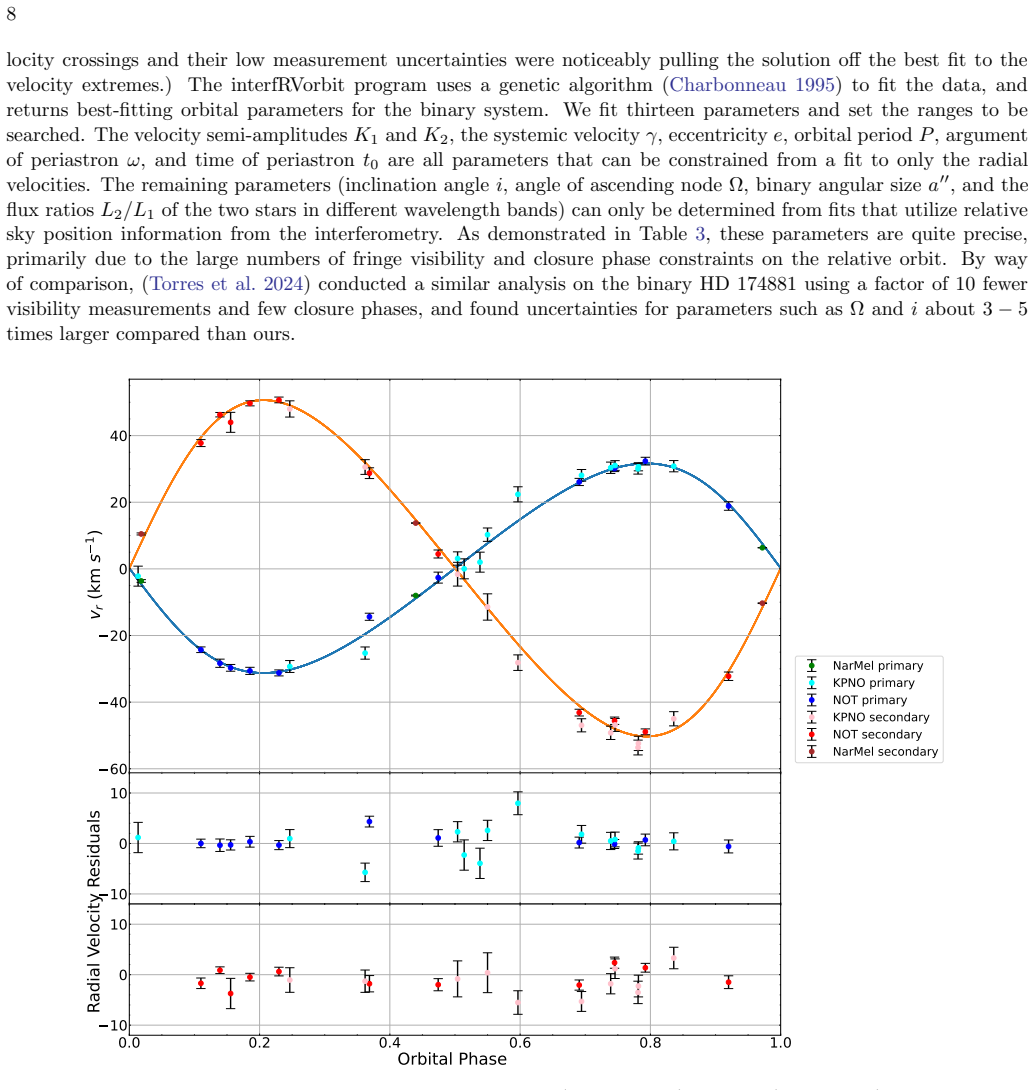
- [Section 3 and Figure 4] The treatment of the Narval and Melchior radial velocities is contradictory. The text in Section 3 says these measurements 'were not included in the final fit' because they sit near velocity crossings and their low uncertainties were pulling the solution, but the caption of Figure 4 states that the Narval and Melchior measurements are included in the best-fit curve. Since the paper identifies the radial velocities as the largest source of mass uncertainty, this is not a cosmetic point; the authors should state definitively whether these data are in the final fit and, if they are excluded, provide a quantitative comparison of fits with and without them.
- [Section 4] The age derivation assumes that both components of HD 21278 evolved as single stars despite the paper's own statement that 'the stars had some tidal interaction that slowed their rotation compared to other alpha Per B-type stars' and that 'we will treat them as having evolved as single stars in the remainder of the paper.' This assumption is load-bearing because any significant pre-main-sequence or main-sequence mass transfer would make the current masses and luminosities inconsistent with single-star isochrones. The manuscript should provide a quantitative check based on the current orbital separation, Roche-lobe geometry, and tidal synchronization timescales, or explicitly identify the observational constraints that rule out substantial mass exchange.
minor comments (5)
- [Section 4.2 and Section 5] The WD 1 exclusion argument contains inconsistent arithmetic. Section 4.2 says the 45 +/- 4 Myr cooling time combined with the 51 +/- 7 Myr cluster age gives the progenitor 'at max a 17 Myr lifespan,' but 51 - 45 = 6 Myr; the conclusion instead says the progenitor had only 13 Myr before leaving the main sequence. Please recompute and quote the correct value.
- [References] The reference for the PARSEC models is cited as 'Nguyen, C. T., & et al. 2022' with an incomplete author list; please provide the full citation or a proper abbreviated format.
- [Table 7 and Section 2.1] Table 7 lists HD 21278 A as B3V with Teff = 16410 K, while the text in Section 2.1 says the primary is 'most likely a B5 star'; please reconcile the spectral type classification.
- [Section 1 and 2.1] There is a typo in 'photometic' in the introduction, and the text in Section 2.1 says 'Narval spectra' while elsewhere the instrument is called 'Narval'; please standardize the spelling.
- [Figure 9] The caption for the right panel of Figure 9 states that the MIST isochrone uses omega = 0.4 because a model with omega = 0.2 is unavailable, but the text in Section 4.1 says the MIST age was obtained by interpolating between omega = 0.0 and omega = 0.4; please clarify whether the plotted isochrone or the interpolated value is used for the quoted 49.5 Myr age.
Circularity Check
No circularity: component masses come from independent Keplerian fits, and the cluster age is read from external PARSEC/MIST isochrones; the Appendix A SED tension is a consistency issue, not a circular step.
full rationale
The central derivation chain is not circular. The component masses (5.381 ± 0.084 and 3.353 ± 0.064 Msun) are obtained from a simultaneous fit to independent radial-velocity and interferometric data (Section 3), with no isochrone input. The cluster age is then derived by comparing the components' 2MASS CAMD positions to external PARSEC v2 and MIST isochrones (Section 4.1), using the measured flux ratios and distance; the masses constrain which isochrone points are compared but are not themselves outputs of the isochrones. The white-dwarf initial masses in Section 4.2 are inferred from the same external isochrones using the measured final white-dwarf masses and cooling times from Miller et al. (2022); this is a model-dependent inference, not a fit to the conclusion. Self-citations (Lam et al. 2023, Morales et al. 2022) supply comparison IFMR points only and are not load-bearing for the age or the 7-8.5 Msun Chandrasekhar-mass claim. The Appendix A SED fit implying about 61 Myr for HD 21278A is in tension with the 49 ± 7 Myr headline age, and the body/conclusion masses and ages differ slightly; these are internal-consistency and correctness concerns, but they do not constitute a circular reduction of any derived quantity to its inputs. The paper also states the single-star evolution assumption for the binary and flags the unknown WD progenitor rotation as a source of uncertainty, both of which are stated limitations rather than circular steps.
Assumptions & free parameters
free parameters (3)
- Primary star rotation rate omega in PARSEC isochrones =
0.2
- Reddening E(B-V) for HD 21278 =
0.076 (Table 7)
- RV and interferometric uncertainty scaling factors =
not specified
assumptions (4)
- domain assumption HD 21278 components have evolved as single stars, with no significant mass transfer or tidal disruption of their internal evolution.
- domain assumption PARSEC and MIST isochrones accurately model the evolution of these B-type stars at the assumed metallicity and rotation.
- domain assumption The cluster is a single-age stellar population and HD 21278 is a coeval member.
- domain assumption The Milky Way extinction law of Cardelli et al. (1989) and the STILISM reddening map are adequate for dereddening cluster members.
Cite this review
Pith. "Pith review of Precise Age For The Binary HD 21278 In The Young Alpha Persei Cluster." pith.science (2026). https://pith.science/paper/W2AP24ER
@misc{pith2026250608241,
  author       = {Pith},
  title        = {Pith review of: Precise Age For The Binary HD 21278 In The Young Alpha Persei Cluster},
  year         = {2026},
  howpublished = {\url{https://pith.science/paper/W2AP24ER}},
  note         = {Machine review of arXiv:2506.08241}
}
abstract
We present a study of the double-lined spectroscopic binary HD 21278 that contains one of the brightest main sequence stars in the young $\alpha$ Persei open cluster. We analyzed new spectra and reanalyzed archived spectra to measure precise new radial velocity curves for the binary. We also obtained interferometric data using the CHARA Array at Mount Wilson to measure the sky positions of the two stars and the inclination of the $\sim$ 2 milliarcsecond orbit. We determine that the two stars have masses of $5.381 \pm 0.084 M_{\odot}$ and $3.353 \pm 0.064 M_{\odot}$. From isochrone fits, we find the cluster's age to be $49 \pm 7$ Myr (using PARSEC models) or $49.5 \pm 6$ Myr (MIST models). Finally, we revisit the massive white dwarfs that are candidate escapees from the $\alpha$ Persei cluster to try to better characterize the massive end of the white dwarf initial-final mass relation. The implied progenitor masses challenge the idea that Chandrasekhar-mass white dwarfs are made by single stars with masses near $8 \msun$.
Figures


Figures from the paper (16 more)




Reference graph
Works this paper leans on
-
[1]
, " * write output.state after.block = add.period write newline
ENTRY address archivePrefix author booktitle chapter doi edition editor eprint howpublished institution journal key month number organization pages publisher school series title misctitle type volume year version url label extra.label sort.label short.list INTEGERS output.state before.all mid.sentence after.sentence after.block FUNCTION init.state.consts ...
-
[2]
write newline
" write newline "" before.all 'output.state := FUNCTION format.url url empty "" new.block "" url * "" * if FUNCTION format.eprint eprint empty "" archivePrefix empty "" archivePrefix "arXiv" = new.block " " eprint * " " * new.block " " eprint * " " * if if if FUNCTION format.doi doi empty "" " " doi * " " * if FUNCTION format.pid doi empty eprint empty ur...
-
[3]
Vg TV2 ` ???U zMNкukp D J ˏ` x ̙3yי4iR> L20 X
thebibliography [1] 20pt to REFERENCES 6pt =0pt -12pt 10pt plus 3pt =0pt =0pt =1pt plus 1pt =0pt =0pt -12pt =13pt plus 1pt =20pt =13pt plus 1pt \@M =10000 =-1.0em =0pt =0pt 0pt =0pt =1.0em @enumiv\@empty 10000 10000 `\.\@m \@noitemerr \@latex@warning Empty `thebibliography' environment \@ifnextchar \@reference \@latexerr Missing key on reference command E...
arXiv 2021
-
[4]
Abt , H. A. 1970, , 19, 387, 10.1086/190215
- [5]
-
[6]
Andrews , J. J., Curtis , J. L., Chanam \'e , J., et al. 2022, , 163, 275, 10.3847/1538-3881/ac6952
-
[7]
Anugu , N., Le Bouquin , J.-B., Monnier , J. D., et al. 2020 a , , 160, 158, 10.3847/1538-3881/aba957
-
[8]
2020 b , MIRCX\_Pipeline
Anugu , N., Le Bouquin , J.-B., Monnier , J., et al. 2020 b , MIRCX\_Pipeline. https://gitlab.chara.gsu.edu/lebouquj/mircx_pipeline.git
2020
Show all 130 references
-
[9]
1976, ApJ, 210, 642
Avni , Y. 1976, ApJ, 210, 642
1976
-
[11]
2021 b , , 161, 147, 10.3847/1538-3881/abd806
---. 2021 b , , 161, 147, 10.3847/1538-3881/abd806
2021 doi
-
[12]
Bertone , E., Buzzoni , A., Ch \'a vez , M., & Rodr \' guez-Merino , L. H. 2008, , 485, 823, 10.1051/0004-6361:20078923
2008 doi
-
[13]
S., Castelli , F., & Plez , B
Bessell , M. S., Castelli , F., & Plez , B. 1998, , 333, 231
1998
- [14]
-
[15]
2012, , 427, 127, 10.1111/j.1365-2966.2012.21948.x
Bressan , A., Marigo , P., Girardi , L., et al. 2012, , 427, 127, 10.1111/j.1365-2966.2012.21948.x
2012
-
[16]
A., Williams , K
Canton , P. A., Williams , K. A., Kilic , M., & Bolte , M. 2021, , 161, 169, 10.3847/1538-3881/abe1ad
2021 doi
-
[17]
L., Elyajouri , M., & Monreal-Ibero , A
Capitanio , L., Lallement , R., Vergely , J. L., Elyajouri , M., & Monreal-Ibero , A. 2017, , 606, A65, 10.1051/0004-6361/201730831
2017 doi
-
[18]
A., Clayton , G
Cardelli , J. A., Clayton , G. C., & Mathis , J. S. 1989, in IAU Symposium, Vol. 135, Interstellar Dust, ed. L. J. Allamandola & A. G. G. M. Tielens , 5--10
1989
-
[19]
Castelli , F., & Kurucz , R. L. 2003, in IAU Symposium, Vol. 210, Modelling of Stellar Atmospheres, ed. N. Piskunov , W. W. Weiss , & D. F. Gray , A20. astro-ph/0405087
2003 arXiv
- [20]
- [21]
-
[22]
2015, in IAU General Assembly, Vol
Chen , Y., Bressan , A., Girardi , L., & Marigo , P. 2015, in IAU General Assembly, Vol. 29, 2257534
2015
-
[23]
2014, , 444, 2525, 10.1093/mnras/stu1605
Chen , Y., Girardi , L., Bressan , A., et al. 2014, , 444, 2525, 10.1093/mnras/stu1605
2014 doi
-
[24]
2016, ApJ, 823, 102
Choi , J., Dotter , A., Conroy , C., et al. 2016, ApJ, 823, 102
2016
-
[25]
1997, , 114, 699, 10.1086/118504
Clampitt , L., & Burstein , D. 1997, , 114, 699, 10.1086/118504
1997 doi
-
[26]
D., Holm , A
Code , A. D., Holm , A. V., & Bottemiller , R. L. 1980, , 43, 501, 10.1086/190680
1980 doi
-
[27]
A., & Megeath , S
Cohen , M., Wheaton , W. A., & Megeath , S. T. 2003, , 126, 1090, 10.1086/376474
2003 doi
-
[28]
Colavita , M. M. 1999, , 111, 111, 10.1086/316302
1999 doi
-
[29]
M., Wallace , J
Colavita , M. M., Wallace , J. K., Hines , B. E., et al. 1999, , 510, 505, 10.1086/306579
1999 doi
-
[30]
Cote , J., & van Kerkwijk , M. H. 1993, , 274, 870
1993
-
[31]
D., & Kalirai , J
Cummings , J. D., & Kalirai , J. S. 2018, , 156, 165, 10.3847/1538-3881/aad5df
2018 doi
-
[32]
D., Kalirai , J
Cummings , J. D., Kalirai , J. S., Tremblay , P. E., Ramirez-Ruiz , E., & Choi , J. 2018, , 866, 21, 10.3847/1538-4357/aadfd6
2018 doi
-
[33]
O'Brien , M
Cunningham , T., Tremblay , P.-E., & W. O'Brien , M. 2024, , 527, 3602, 10.1093/mnras/stad3275
2024 doi
-
[34]
M., Skrutskie , M
Cutri , R. M., Skrutskie , M. F., van Dyk , S., et al. 2003, VizieR Online Data Catalog: 2MASS All-Sky Catalog of Point Sources (Cutri+ 2003) , VizieR On-line Data Catalog: II/246. Originally published in: University of Massachusetts and Infrared Processing and Analysis Center...
2003
-
[35]
Dahm , S. E. 2015, , 813, 108, 10.1088/0004-637X/813/2/108
2015 doi
-
[36]
J., & Hillenbrand , L
David , T. J., & Hillenbrand , L. A. 2015, , 804, 146, 10.1088/0004-637X/804/2/146
2015 doi
-
[37]
J., Deutschman , W
Davis , R. J., Deutschman , W. A., & Haramundanis , K. L. 1973, Celescope catalog of ultraviolet stellar observations; 5068 objects measured by the Smithsonian experiment aboard the Orbiting Astronomical Observatory (OAO-2)
1973
- [38]
-
[39]
2011, , 529, A87, 10.1051/0004-6361/201015639
Delaa , O., Stee , P., Meilland , A., et al. 2011, , 529, A87, 10.1051/0004-6361/201015639
2011 doi
-
[40]
V., Blair , W
Dixon , W. V., Blair , W. P., Kruk , J. W., & Romelfanger , M. L. 2013, , 125, 431, 10.1086/670227
2013 doi
-
[41]
D., Casewell , S
Dobbie , P. D., Casewell , S. L., Burleigh , M. R., & Boyce , D. D. 2009, , 395, 1591, 10.1111/j.1365-2966.2009.14645.x
2009
-
[42]
2016, ApJS, 222, 8
Dotter , A. 2016, ApJS, 222, 8
2016
-
[43]
F., Richmond , M
Droege , T. F., Richmond , M. W., Sallman , M. P., & Creager , R. P. 2006, , 118, 1666, 10.1086/510197
2006 doi
-
[44]
1994, Baltic Astronomy, 3, 348, 10.1515/astro-1994-0404
Dzervitis , U., Paupers , O., & Vansevicius , V. 1994, Baltic Astronomy, 3, 348, 10.1515/astro-1994-0404
1994 doi
-
[45]
2008, , 478, 467, 10.1051/0004-6361:20078095
Ekstr \"o m , S., Meynet , G., Maeder , A., & Barblan , F. 2008, , 478, 467, 10.1051/0004-6361:20078095
2008 doi
-
[46]
El-Badry , K., Rix , H.-W., & Weisz , D. R. 2018, , 860, L17, 10.3847/2041-8213/aaca9c
2018 doi
-
[47]
1987, , 71, 275
Fehrenbach , C., Duflot , M., Burnage , R., et al. 1987, , 71, 275
1987
- [48]
-
[49]
B., Barrett , S
Frost , E. B., Barrett , S. B., & Struve , O. 1926, , 64, 1, 10.1086/142986
1926 doi
-
[50]
2018, A&A, 616, A10
Gaia Collaboration . 2018, A&A, 616, A10
2018
-
[51]
L., Sarro , L
Gaia Collaboration , Smart , R. L., Sarro , L. M., et al. 2021, , 649, A6, 10.1051/0004-6361/202039498
2021 doi
-
[52]
J., Barrado , D., Bouy , H., et al
Galindo-Guil , F. J., Barrado , D., Bouy , H., et al. 2022, , 664, A70, 10.1051/0004-6361/202141114
2022 doi
-
[53]
D., Fekel , F
Gardner , T., Monnier , J. D., Fekel , F. C., et al. 2021, , 161, 40, 10.3847/1538-3881/abcf4e
2021 doi
-
[54]
P., Tremblay , P
Gentile Fusillo , N. P., Tremblay , P. E., Cukanovaite , E., et al. 2021, , 508, 3877, 10.1093/mnras/stab2672
2021 doi
-
[55]
K., Apparao , K
Ghosh , K. K., Apparao , K. M. V., & Pukalenthi , S. 1999, , 134, 359, 10.1051/aas:1999144
1999 doi
- [56]
-
[57]
F., & Levato , H
Gonz \'a lez , J. F., & Levato , H. 2006, , 448, 283, 10.1051/0004-6361:20053177
2006 doi
-
[58]
D., Clayton , G
Gordon , K. D., Clayton , G. C., Decleir , M., et al. 2023, , 950, 86, 10.3847/1538-4357/accb59
2023 doi
-
[59]
D., Gies , D
Gordon , K. D., Gies , D. R., Schaefer , G. H., Huber , D., & Ireland , M. 2019, , 873, 91, 10.3847/1538-4357/ab04b2
2019 doi
-
[60]
Gray , R. O. 1998, , 116, 482, 10.1086/300397
1998 doi
-
[61]
Henden , A. A. 2019, , 47, 130
2019
-
[62]
Heyl , J., Caiazzo , I., Richer , H., & Miller , D. R. 2021, arXiv 2110.04296
2021 arXiv
-
[63]
Heyl , J., Caiazzo , I., & Richer , H. B. 2022, , 926, 132, 10.3847/1538-4357/ac45fc
2022 doi
-
[64]
V., et al
H g , E., Fabricius , C., Makarov , V. V., et al. 2000, , 355, L27
2000
-
[65]
2010, , 514, A1, 10.1051/0004-6361/200913811
Ishihara , D., Onaka , T., Kataza , H., et al. 2010, , 514, A1, 10.1051/0004-6361/200913811
2010 doi
-
[66]
1976, Ultraviolet bright-star spectrophotometric catalogue
Jamar , C., Macau-Hercot , D., Monfils , A., et al. 1976, Ultraviolet bright-star spectrophotometric catalogue
1976
-
[67]
L., & Mitchell , R
Johnson , H. L., & Mitchell , R. I. 1975, , 1, 299
1975
-
[68]
E., Sigut , T
Jones , C. E., Sigut , T. A. A., Grzenia , B. J., Tycner , C., & Zavala , R. T. 2017, , 843, 24, 10.3847/1538-4357/aa72e4
2017 doi
-
[69]
V., Piskunov , A
Kharchenko , N. V., Piskunov , A. E., Schilbach , E., R \"o ser , S., & Scholz , R. D. 2012, , 543, A156, 10.1051/0004-6361/201118708
2012 doi
-
[70]
C., Rivinius , T., et al
Klement , R., Carciofi , A. C., Rivinius , T., et al. 2017, , 601, A74, 10.1051/0004-6361/201629932
2017 doi
-
[71]
R., et al
Klement , R., Rivinius , T., Gies , D. R., et al. 2024, , 962, 70, 10.3847/1538-4357/ad13ec
2024 doi
-
[72]
L., et al
Kluska , J., Kraus , S., Davies , C. L., et al. 2018, , 855, 44, 10.3847/1538-4357/aaacd3
2018 doi
-
[73]
1971, , 23, 159
Kodaira , K. 1971, , 23, 159
1971
-
[74]
G., Volkov , I
Kornilov , V. G., Volkov , I. M., Zakharov , A. I., et al. 1991, Trudy Gosudarstvennogo Astronomicheskogo Instituta, 63, 1
1991
-
[75]
2018, , 616, A132, 10.1051/0004-6361/201832832
Lallement , R., Capitanio , L., Ruiz-Dern , L., et al. 2018, , 616, A132, 10.1051/0004-6361/201832832
2018 doi
-
[76]
L., Schaefer , G
Lam , R., Sandquist , E. L., Schaefer , G. H., et al. 2023, , 166, 29, 10.3847/1538-3881/accddb
2023 doi
-
[77]
Lawson , P. R., ed. 2000, Principles of Long Baseline Stellar Interferometry
2000
-
[78]
L., & Silvotti , R
Lodieu , N., P \'e rez-Garrido , A., Smart , R. L., & Silvotti , R. 2019, A&A, 628
2019
-
[79]
L., Zhao , Y
Luo , A. L., Zhao , Y. H., Zhao , G., & et al. 2022, VizieR Online Data Catalog: LAMOST DR7 catalogs (Luo+, 2019) , VizieR On-line Data Catalog: V/156. Originally published in: 2019RAA..in.prep..L
2022
-
[80]
2018, VizieR Online Data Catalog: Sloan magnitudes for the brightest stars, V2 (Mallama, 2018) , VizieR On-line Data Catalog: II/355
Mallama , A. 2018, VizieR Online Data Catalog: Sloan magnitudes for the brightest stars, V2 (Mallama, 2018) , VizieR On-line Data Catalog: II/355. Originally published in: 2018arXiv180509324M
2018
- [81]
-
[82]
2017, , 835, 77, 10.3847/1538-4357/835/1/77
Marigo , P., Girardi , L., Bressan , A., et al. 2017, , 835, 77, 10.3847/1538-4357/835/1/77
2017 doi
-
[83]
D., Curtis , J
Marigo , P., Cummings , J. D., Curtis , J. L., et al. 2020, Nature Astronomy, 4, 1102, 10.1038/s41550-020-1132-1
2020 doi
-
[84]
Massa , D., & Fitzpatrick , E. L. 2000, , 126, 517, 10.1086/313298
2000 doi
-
[85]
Meade , M. R. 1999, , 118, 1073, 10.1086/300955
1999 doi
-
[86]
2021, , 645, A84, 10.1051/0004-6361/202038610
Meingast , S., Alves , J., & Rottensteiner , A. 2021, , 645, A84, 10.1051/0004-6361/202038610
2021 doi
-
[87]
Mermilliod , J. C. 2006, VizieR Online Data Catalog: Homogeneous Means in the UBV System (Mermilliod 1991) , VizieR On-line Data Catalog: II/168. Originally published in: Institut d'Astronomie, Universite de Lausanne (1991)
1991
-
[88]
R., Caiazzo , I., Heyl , J., Richer , H
Miller , D. R., Caiazzo , I., Heyl , J., Richer , H. B., & Tremblay , P.-E. 2022, ApJL, 926
2022
-
[89]
D., Zhao , M., Pedretti , E., et al
Monnier , J. D., Zhao , M., Pedretti , E., et al. 2011, , 742, L1, 10.1088/2041-8205/742/1/L1
2011 doi
-
[90]
2024, , 688, A97, 10.1051/0004-6361/202449895
Montesinos , B. 2024, , 688, A97, 10.1051/0004-6361/202449895
2024 doi
-
[91]
M., Sandquist , E
Morales , L. M., Sandquist , E. L., Schaefer , G. H., et al. 2022, , 164, 34, 10.3847/1538-3881/ac7329
2022 doi
-
[92]
1978, , 34, 477
Morel , M., & Magnenat , P. 1978, , 34, 477
1978
-
[93]
Morrell , N., & Abt , H. A. 1992, ApJ, 393, 666
1992
-
[94]
A., Mathieu , R
Morse , J. A., Mathieu , R. D., & Levine , S. E. 1991, , 101, 1495, 10.1086/115782
1991 doi
-
[95]
Negueruela , I., Sim \'o n-D \' az , S., de Burgos , A., Casasbuenas , A., & Beck , P. G. 2024, , 690, A176, 10.1051/0004-6361/202449298
2024 doi
-
[96]
T., & et al
Nguyen , C. T., & et al. 2022, A&A, 665
2022
-
[97]
H., Code , A
Nordsieck , K. H., Code , A. D., Anderson , C. M., et al. 2002, VizieR Online Data Catalog: Wisconsin Ultraviolet Photo-Polarimeter Experiment (WUPPE, 1990-1995) , VizieR On-line Data Catalog: VI/105. Originally published in: 1994SPIE.2010....2N
2002
-
[98]
2019, , 485, 5666, 10.1093/mnras/stz725
Pastorelli , G., Marigo , P., Girardi , L., et al. 2019, , 485, 5666, 10.1093/mnras/stz725
2019 doi
- [99]
-
[100]
2015, , 580, A23, 10.1051/0004-6361/201526413
Paunzen , E. 2015, , 580, A23, 10.1051/0004-6361/201526413
2015 doi
-
[101]
2022, , 661, A89, 10.1051/0004-6361/202142355
---. 2022, , 661, A89, 10.1051/0004-6361/202142355
2022 doi
-
[102]
2013, ApJS, 208, 4
Paxton , B. 2013, ApJS, 208, 4
2013
-
[103]
2015, ApJS, 220, 15
---. 2015, ApJS, 220, 15
2015
-
[104]
2011, ApJS, 192, 3
Paxton , B., Bildsten , L., Dotter , A., et al. 2011, ApJS, 192, 3
2011
-
[105]
H., & Sareyan , J
Pe \ n a , J. H., & Sareyan , J. P. 2006, , 42, 179
2006
-
[106]
2014, , 126, 469, 10.1086/676976
Petit , P., Louge , T., Th \'e ado , S., et al. 2014, , 126, 469, 10.1086/676976
2014 doi
-
[107]
M., & Heard , J
Petrie , R. M., & Heard , J. F. 1969, Publications of the Dominion Astrophysical Observatory Victoria, 13, 329
1969
-
[108]
G., Roman-Lopes , A., Rom \'a n-Z \'u \ n iga , C
Ram \' rez-Preciado , V. G., Roman-Lopes , A., Rom \'a n-Z \'u \ n iga , C. G., et al. 2020, , 894, 5, 10.3847/1538-4357/ab8127
2020 doi
-
[109]
B., Caiazzo , I., Du , H., et al
Richer , H. B., Caiazzo , I., Du , H., et al. 2021, , 912, 165, 10.3847/1538-4357/abdeb7
2021 doi
-
[110]
2024, , 690, A16, 10.1051/0004-6361/202347701
Rottensteiner , A., & Meingast , S. 2024, , 690, A16, 10.1051/0004-6361/202347701
2024 doi
-
[111]
2024, , 681, A107, 10.1051/0004-6361/202346847
Royer , P., Merle , T., Dsilva , K., et al. 2024, , 681, A107, 10.1051/0004-6361/202346847
2024 doi
-
[112]
1999, in Astronomical Society of the Pacific Conference Series, Vol
Rucinski , S. 1999, in Astronomical Society of the Pacific Conference Series, Vol. 185, IAU Colloq. 170: Precise Stellar Radial Velocities, ed. J. B. Hearnshaw & C. D. Scarfe , 82
1999
-
[113]
Rucinski , S. M. 1992, AJ, 104, 1968
1992
-
[114]
H., Hummel , C
Schaefer , G. H., Hummel , C. A., Gies , D. R., et al. 2016, , 152, 213, 10.3847/0004-6256/152/6/213
2016 doi
-
[115]
R., Monnier , J
Setterholm , B. R., Monnier , J. D., Le Bouquin , J.-B., et al. 2023, Journal of Astronomical Telescopes, Instruments, and Systems, 9, 025006, 10.1117/1.JATIS.9.2.025006
2023 doi
-
[116]
Sigut , T. A. A., & Ghafourian , N. R. 2023, , 948, 34, 10.3847/1538-4357/ac940c
2023 doi
-
[117]
E., Tycner , C., Sigut , T
Silaj , J., Jones , C. E., Tycner , C., Sigut , T. A. A., & Smith , A. D. 2010, , 187, 228, 10.1088/0067-0049/187/1/228
2010 doi
- [119]
-
[120]
Smartt , S. J. 2009, , 47, 63, 10.1146/annurev-astro-082708-101737
2009 doi
-
[121]
2014, , 445, 4287, 10.1093/mnras/stu2029
Tang , J., Bressan , A., Rosenfield , P., et al. 2014, , 445, 4287, 10.1093/mnras/stu2029
2014 doi
-
[122]
H., Avila , G., Buchhave , L., et al
Telting , J. H., Avila , G., Buchhave , L., et al. 2014, Astronomische Nachrichten, 335, 41, 10.1002/asna.201312007
2014 doi
-
[123]
A., McAlister , H
ten Brummelaar , T. A., McAlister , H. A., Ridgway , S. T., et al. 2005, , 628, 453, 10.1086/430729
2005 doi
-
[124]
A., Gies , D
ten Brummelaar , T. A., Gies , D. G., McAlister , H. A., et al. 2016, in Society of Photo-Optical Instrumentation Engineers (SPIE) Conference Series, Vol. 9907, Optical and Infrared Interferometry and Imaging V, ed. F. Malbet , M. J. Creech-Eakman , & P. G. Tuthill , 990703, 1...
2016 doi
-
[125]
I., Nandy , K., Jamar , C., et al
Thompson , G. I., Nandy , K., Jamar , C., et al. 1978, Catalogue of stellar ultraviolet fluxes : a compilation of absolute stellar fluxes measured by the Sky Survey Telescope (S2/68) aboard the ESRO satellite TD-1 /
1978
-
[126]
F., Monnier , J
Torres , G., Boden , A. F., Monnier , J. D., & van Belle , G. T. 2024, , 977, 43, 10.3847/1538-4357/ad8dcc
2024 doi
-
[127]
J., Beckman , J
Trapero , J., Sempere , M. J., Beckman , J. E., & Hobbs , L. M. 1996, , 457, 731, 10.1086/176767
1996 doi
-
[128]
2007, , 474, 653, 10.1051/0004-6361:20078357
van Leeuwen , F. 2007, , 474, 653, 10.1051/0004-6361:20078357
2007 doi
-
[129]
R., van Duinen , R
Wesselius , P. R., van Duinen , R. J., de Jonge , A. R. W., et al. 1982, , 49, 427
1982
-
[130]
L., Eisenhardt , P
Wright , E. L., Eisenhardt , P. R. M., Mainzer , A. K., et al. 2010, , 140, 1868, 10.1088/0004-6256/140/6/1868
2010 doi
-
[131]
2002, Baltic Astronomy, 11, 75
Zdanavicius , J., & Zdanavicius , K. 2002, Baltic Astronomy, 11, 75
2002
-
[132]
H., Schneider , A., & Song , I
Zuckerman , B., Melis , C., Rhee , J. H., Schneider , A., & Song , I. 2012, ApJ, 752, 58
2012
Reviewed August 7, 2026 · model on record in the stance chip above.
Discussion (0). Sign in to comment.