REVIEW 4 major objections 4 minor 3 cited by
The Jetted Tidal Disruption Event AT2022cmc: Investigating Connections to the Optical Tidal Disruption Event Population and Spectral Subclasses Through Late-Time Follow-up
T0 review · 4 major / 4 minor · reviewed 2026-08-07 · deepseek-v4-flash
Pith's one-line read Jetted TDE's thermal glow joins the featureless class
desk verdict Honest, useful late-time study of AT2022cmc; the featureless-TDE link is plausible but rests on a decomposition that deserves a closer look. read the letter →
The pith
A machine-rendered reading of the paper's core claim, the machinery that carries it, and where it could break.
The reading
What carries the argument
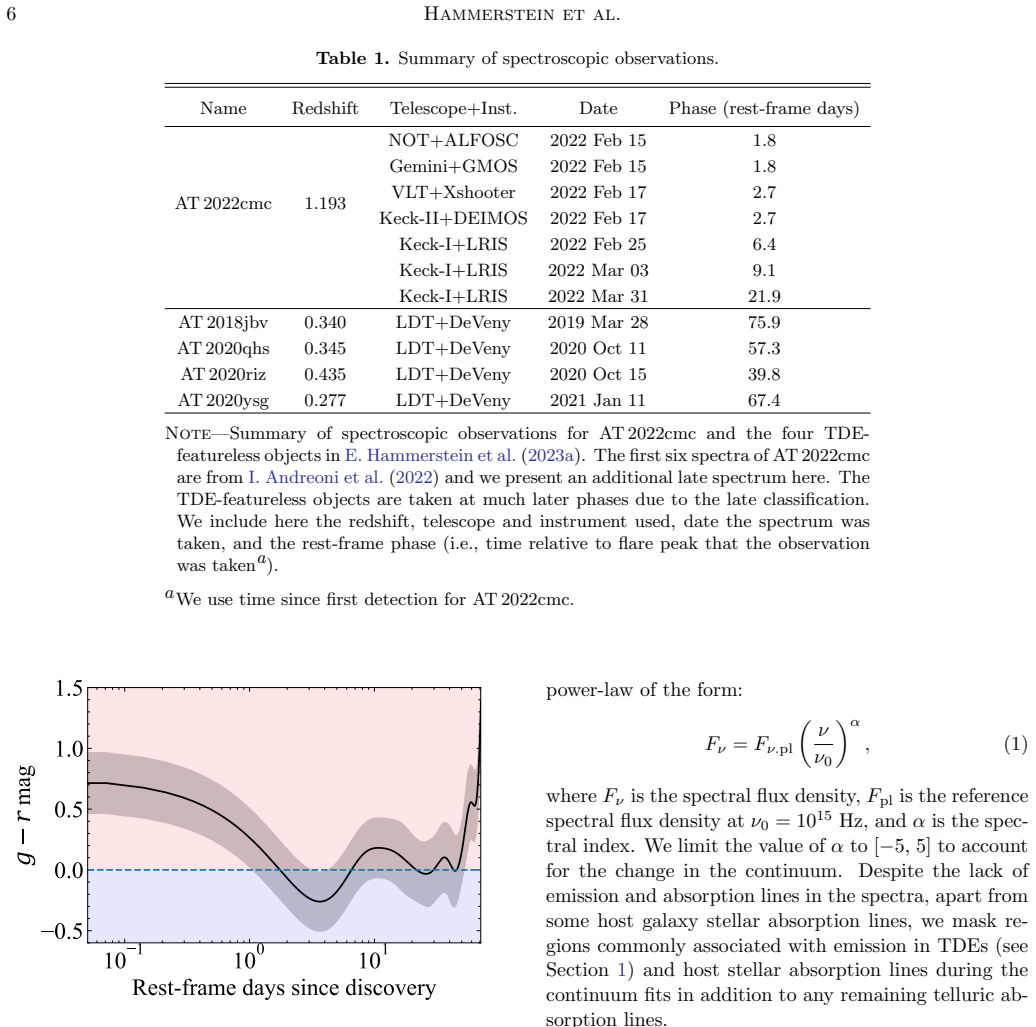
The central tool is a two-component decomposition of the UV/optical SED: a time-dependent power-law (the non-thermal jet emission, fitted with a fixed spectral index) plus a blackbody (the thermal emission). The paper fits three variants of this model to the light curve (a static blackbody, a time-dependent blackbody with constant temperature, and a non-parametric temperature evolution) and also fits blackbody and power-law continua to individual optical spectra. The comparison set is the 30 optically selected thermal TDEs of Hammerstein et al. (2023a), including the four 'featureless' TDEs that show no emission lines.
What would settle it
Deep imaging or spectroscopy that detects the host galaxy and shows it contributes substantially to the $r$-band light after about 60 days (where the photometry already drops below the $m_r > 24.54$ mag host limit) would break the decomposition; alternatively, ultraviolet coverage that constrains the blackbody peak would test whether the apparent temperature decline is real.
Extended reading notes
Core claim
The paper's central claim is that the thermal (blackbody) component of AT2022cmc's UV/optical light curve, once the non-thermal power-law is accounted for, has the same properties as the thermal flares of ordinary TDEs, and specifically matches the featureless subclass. In the model fits, the blackbody luminosity at the reference frequency is around $10^{44.5}\,\mathrm{erg\,s^{-1}\,Hz^{-1}}$ and the mean temperature is around $10^{4.5}\,\mathrm{K}$; the power-law component (spectral index about $-1.3$) dominates early and fades within about 6 days, after which the thermal component takes over. The spectra, from 1.8 to 21.9 rest-frame days, stay featureless and look like the spectra of the four featureless TDEs. The paper also shows that the $r$- and $g$-band light curves steepen at about 52 rest-frame days, roughly 46 days before the X-ray jet shut-off, which it reads as evidence that the optical emission tracks the accretion flow rather than the jet.
Load-bearing premise
The late-time reddening and steep decline of the light curve after about 50 days are interpreted as intrinsic to the transient, not dominated by the still-undetected host galaxy; if the host contributes significantly, the extracted blackbody parameters and the comparison to TDE correlations could change.
Editorial extensions
If this is right
- The thermal component of AT2022cmc is comparable to thermal-only TDEs, and its parameters match the featureless subclass, implying that jetted and featureless flares share a common thermal engine.
- The optical light curve breaks at about 52 rest-frame days, roughly 46 days before the X-ray jet shut-off, so the optical emission is tied to the accretion flow rather than the jet itself.
- Featureless TDEs may be off-axis jetted events, and the paper motivates prompt radio and multi-wavelength follow-up of featureless TDEs to test this possibility.
- The rate of overluminous TDEs is roughly consistent with the estimate that about 1% of all TDEs produce relativistic jets, so hidden jets could account for the featureless class.
Reading between the lines
- If the match is real, a systematic radio survey of featureless TDEs at late times could reveal off-axis jets, turning the roughly 1% jet-production estimate into a directly measured rate.
- The roughly 46-day gap between the optical break and the X-ray shut-off may be a general signature of jet shut-off; tracking it in more events could measure how quickly the accretion flow responds when the jet ceases.
- Detecting AT2022cmc's host galaxy and measuring its stellar mass would directly test whether jetted events live in the same massive, red hosts as featureless TDEs.
- The temperature decline seen in AT2022cmc, unlike the mostly constant or rising temperatures of thermal TDEs, might be a distinguishing feature of jetted events; ultraviolet observations of future jetted TDEs could test this.
Editorial analysis
A structured set of objections, weighed in public.
Referee Report
Summary. This paper presents new late-time optical photometry and spectroscopy of AT2022cmc, the first optically discovered on-axis jetted tidal disruption event, extending coverage to roughly 160 rest-frame days. The authors fit the UV/optical light curve with three two-component models (power-law plus blackbody) and fit the optical spectra with power-law and blackbody continua. After accounting for the non-thermal power-law component, they find that the thermal component has a peak bolometric blackbody luminosity and temperature that are consistent with correlations among optically selected thermal TDEs and that place AT2022cmc near the TDE-featureless subclass of Hammerstein et al. (2023a). They interpret this as support for a connection between jetted and featureless TDEs.
Significance. If the decomposition is robust, the result is a valuable first step in placing jetted TDEs in the parameter space of the optical TDE population and directly connects an on-axis jet to the proposed featureless off-axis population. The paper is generally careful, provides a new late-time dataset, and explicitly acknowledges the main observational limitations (sparse UV coverage, non-detected host). The comparison is not circular, since it places a new object on previously published correlation planes rather than deriving correlations from the same data. However, the blackbody parameters entering that placement are subject to degeneracies in the two-component decomposition that are not fully resolved, so the central claim requires additional robustness tests.
major comments (4)
- [§3.2, Table 2; §4.1, Table 3] The light-curve fits in Models 2 and 3 assume a single, time-independent power-law spectral index and set the prior to α ∈ [−10, 0] in Table 2. However, the spectral continuum fits in Table 3 show α evolving from −0.74 at 1.8 days to +0.44 and +0.46 at 6.4 and 9.1 days, and +0.04 at 21.9 days. With α constrained to be negative, any blue non-thermal component at later epochs cannot be represented by the power-law term and will be absorbed into the blackbody component, directly biasing the log(L_BB,ν0) and log(T0) values that are plotted in Figure 10. The posterior α ≈ −1.1 in Table 4 is inconsistent with the spectroscopically measured positive values at the same epochs. I request a test in which the power-law index is time-dependent, or at least free over a symmetric range (e.g., α ∈ [−5, 5]) for Models 2 and 3, with the resulting blackbody parameters and Figure 10 placement reported.
- [§4.2, Figure 9; §5, Figure 10] The paper states that UV observations are very limited and that the late-time blackbody temperature is not well constrained without them. Since the featureless-class comparison in Figure 10 uses the mean temperature T0 and the peak bolometric luminosity from Model 2, the authors should quantify how the sparse UV sampling and the assumed temperature model affect the uncertainty on these quantities. As it stands, the overlap with the TDE-featureless region in the temperature and luminosity panels of Figure 10 could partly reflect the adopted model priors rather than the data; a quantitative sensitivity test (e.g., re-fitting with the temperature free per epoch and with different UV weightings) is needed to support the central claim.
- [§2.1, Figure 1 caption; §3.2] Figure 1 states that the magnitudes are not corrected for Galactic extinction, while Section 3.1 states that the spectra are corrected for Galactic extinction prior to fitting. The light-curve fitting in Section 3.2 does not mention any dereddening of the photometry. If the UV/optical light-curve fits use uncorrected magnitudes, the derived blackbody temperature and luminosity in Table 4, and hence the placement in Figure 10, will be systematically biased by extinction. Please state the adopted E(B−V) value and either correct the photometry before fitting or demonstrate that the extinction is negligible for the bands used.
- [§2.1, Figure 2 caption; §5] The manuscript acknowledges in the Figure 2 caption that the late-time reddening may be due to a larger host contribution and that the r-band light curve drops below the host limit (m_r > 24.54 mag) around 60 days, making host contamination plausible. Section 5 also notes that it is difficult to discern whether the late-time evolution is intrinsic or host-related. This affects the broken power-law fits in Table 5 and the late-time portions of the Model 2 and 3 fits used for the decay timescale and temperature evolution. I recommend including a host-galaxy template or constant-flux component in the light-curve fits, or explicitly restricting the thermal-parameter comparison to epochs before host contamination becomes significant, to demonstrate that the decay timescale and temperature evolution are robust.
minor comments (4)
- [Table 3] The entry for Keck+LRIS at 21.9 days lists log(F_pl/erg s−1 Hz−1) = 8.896 ± 0.002, while the text and the other entries are around 29.6; this appears to be a typo for 28.896, and should be corrected.
- [Figure 10 caption; §5 text] The Figure 10 caption says the parameters are from Model 1, but the text in Section 5 says they are from Model 2. Since Model 1 has no rise or decay times for the blackbody component, the caption should refer to Model 2.
- [Table 6] The g-band observation at MJD 59767.91 has eMag = 99.0; the manuscript does not state how this value is treated in the light-curve fits (e.g., excluded, clipped, or downweighted), and this should be clarified.
- [Throughout] The paper repeatedly compares AT2022cmc with the Hammerstein et al. (2023a) sample, and several authors are co-authors on both works. A short sentence stating that the comparison uses the published sample and definitions without modification would help avoid any appearance of circularity.
Circularity Check
No significant circularity: AT2022cmc's thermal parameters are fitted and then compared to a published external sample; the featureless-class self-citation is context, not a construction.
full rationale
The paper's central derivation is: (i) new late-time photometry and spectroscopy of AT2022cmc; (ii) two-component light-curve fits (time-dependent power-law plus blackbody) that produce thermal parameters; and (iii) comparison of those parameters with the published ZTF TDE sample and the TDE-featureless subclass. Step (iii) is a placement against external data, not a prediction derived from the correlations: the correlations from Hammerstein et al. (2023a) serve as a reference frame and are not fed back into the light-curve fits. The featureless class was defined in a same-first-author paper, but its definition is independent of AT2022cmc and is corroborated by other works cited here (e.g., Yao et al. 2023; Mummery et al. 2024); the present paper's new spectrum and fits do not re-derive the class from AT2022cmc. The main threats to the thermal-component extraction are model dependence and data limitations, which the paper explicitly acknowledges: the light-curve power-law index is held fixed with a prior alpha in [-10,0] (Table 2), the temperature grid is poorly constrained without UV coverage (Section 4.2 and Figure 9 caption), and the late-time reddening may include an undetected host (Figure 2 caption). These are correctness and robustness concerns, not cases where a claimed result equals an input by construction. No equation in the paper reduces to another by definition, and no fitted parameter is renamed as a prediction. Therefore no concrete circular step meets the quoted-equation standard; the only mild issue is the recurring self-citation to the defining featureless-TDE sample, which is not load-bearing in a circular sense.
Assumptions & free parameters
free parameters (5)
- Power-law spectral index alpha (in light curve fits) =
-1.30 to -1.11 depending on model
- Blackbody temperature T0 (mean temperature in Models 1 and 2) =
log T0/K = 4.53 to 4.57
- Peak blackbody luminosity L_BB,nu0 =
log L_BB,nu0/erg/s = 44.41 to 44.46
- Rise and decay timescales (sigma_BB, tau_BB, beta_rise, beta_decay) =
sigma_BB ~ 10^1.06 days, tau_BB ~ 10^1.48-1.53 days, beta_rise and beta_decay vary
- Broken power-law indices and break time for late-time light curve =
t_break ~ 52 days, alpha_1 ~ 0.9-1.0, alpha_2 ~ 5.1-5.4
assumptions (4)
- domain assumption The UV/optical emission can be decomposed into a power-law (non-thermal) component plus a blackbody (thermal) component.
- domain assumption The host galaxy contribution is negligible for the majority of the light curve.
- standard math The comparison sample light curve parameters from Hammerstein et al. (2023a) are accurate and applicable.
- domain assumption The redshift z=1.193 is correct.
Cite this review
Pith. "Pith review of The Jetted Tidal Disruption Event AT2022cmc: Investigating Connections to the Optical Tidal Disruption Event Population and Spectral Subclasses Through Late-Time Follow-up." pith.science (2026). https://pith.science/paper/D4FJ33MA
@misc{pith2026250608250,
  author       = {Pith},
  title        = {Pith review of: The Jetted Tidal Disruption Event AT2022cmc: Investigating Connections to the Optical Tidal Disruption Event Population and Spectral Subclasses Through Late-Time Follow-up},
  year         = {2026},
  howpublished = {\url{https://pith.science/paper/D4FJ33MA}},
  note         = {Machine review of arXiv:2506.08250}
}
abstract
AT2022cmc is the first on-axis jetted tidal disruption event (TDE) to be discovered at optical wavelengths. The optically bright nature of AT2022cmc presents an unprecedented opportunity to place this jetted TDE in the context of the larger optically selected thermal TDE population and explore potential connections to optical TDE subclasses, particularly the class of luminous TDEs that lack optical spectral features. In this work we present late-time optical observations of AT2022cmc, both imaging and spectroscopy, that extend the optical dataset to $\sim 160$ days from the first detection in the observed frame. The light curve clearly evolves from red to blue, which we interpret as a transition from a non-thermally dominated spectral energy distribution (SED) to thermally dominated SED. By accounting for the non-thermal emission evident in the optical SED at early times, we extract the properties of the thermal emission and compare to a sample of optically selected thermal TDEs. We find that the properties of AT2022cmc are consistent with previous correlations found for the evolution and properties of thermal TDEs, with the thermal properties of AT2022cmc aligning with the class of featureless and luminous TDEs. The confirmation of this similarity motivates the importance of prompt and multi-wavelength follow-up of featureless and luminous TDEs in order to further explore the connection they have with jetted TDEs.
Figures


Figures from the paper (7 more)


Forward citations
Cited by 3 Pith papers
-
The day-long, repeating GRB 250702BDE / EP250702a: A unique extragalactic transient
GRB 250702BDE is the first extragalactic gamma-ray burst observed to repeat, with three triggers spaced by a near-integer interval and a likely low-redshift host galaxy.
-
AT2019ijn: a fast-rising, slow-decaying blue optical transient with exceptionally bright radio emission
AT2019ijn combines LFBOT-like fast optical rise and blue color with slow decay and radio luminosity peaking late at 2e31 erg/s/Hz, best fit as an off-axis jetted IMBH TDE.
-
Optically Overluminous Tidal Disruption Events: Outflow Properties and Implications for Extremely Relativistic Disruptions
Radio observations of eight overluminous tidal disruption events find no off-axis jets, and a 2.1 sigma hint that such events are brighter in radio than fainter TDEs.
Reference graph
Works this paper leans on
-
[1]
, " * write output.state after.block = add.period write newline
ENTRY address archivePrefix author booktitle chapter doi edition editor eprint howpublished institution journal key month number organization pages publisher school series title misctitle type volume year version url label extra.label sort.label short.list INTEGERS output.state before.all mid.sentence after.sentence after.block FUNCTION init.state.consts ...
-
[2]
write newline
" write newline "" before.all 'output.state := FUNCTION format.url url empty "" new.block "" url * "" * if FUNCTION format.eprint eprint empty "" archivePrefix empty "" archivePrefix "arXiv" = new.block " " eprint * " " * new.block " " eprint * " " * if if if FUNCTION format.doi doi empty "" " " doi * " " * if FUNCTION format.pid doi empty eprint empty ur...
-
[3]
i&Fߜ VYZS?=e obd1c E ( G]Ũ b 1ʴ!( q a #^ /CA [fw O[= o: :w,?8 V r|ѝyF LaNrO Q/D?9 E7h)af( 6>
thebibliography [1] 20pt to REFERENCES 6pt =0pt \@twocolumntrue 12pt -12pt 10pt plus 3pt =0pt =0pt =1pt plus 1pt =0pt =0pt -12pt =13pt plus 1pt =20pt =13pt plus 1pt \@M =10000 =-1.0em =0pt =0pt 0pt =0pt =1.0em @enumiv\@empty 10000 10000 `\.\@m \@noitemerr \@latex@warning Empty `thebibliography' environment \@ifnextchar \@reference \@latexerr Missing key o...
arXiv 2012
-
[4]
Andreoni , I., Coughlin , M. W., Perley , D. A., et al. 2022, title A very luminous jet from the disruption of a star by a massive black hole , , 612, 430, 10.1038/s41586-022-05465-8
-
[5]
Barthelmy , S. D., Barbier , L. M., Cummings , J. R., et al. 2005, title The Burst Alert Telescope (BAT) on the SWIFT Midex Mission , , 120, 143, 10.1007/s11214-005-5096-3
-
[6]
Bellm , E. C., Kulkarni , S. R., Graham , M. J., et al. 2019, title The Zwicky Transient Facility: System Overview, Performance, and First Results , , 131, 018002, 10.1088/1538-3873/aaecbe
-
[7]
2011, Astronomical Society of the Pacific Conference Series, Vol
Bertin , E. 2011, Astronomical Society of the Pacific Conference Series, Vol. 442, Automated Morphometry with SExtractor and PSFEx , 435
work page 2011
-
[8]
1996, title SExtractor: Software for source extraction
Bertin , E., & Arnouts , S. 1996, title SExtractor: Software for source extraction. , , 117, 393, 10.1051/aas:1996164
Show all 68 references
-
[9]
2002, Astronomical Society of the Pacific Conference Series, Vol
Bertin , E., Mellier , Y., Radovich , M., et al. 2002, Astronomical Society of the Pacific Conference Series, Vol. 281, The TERAPIX Pipeline , 228
2002
-
[10]
S., Giannios , D., Metzger , B
Bloom , J. S., Giannios , D., Metzger , B. D., et al. 2011, title A Possible Relativistic Jetted Outburst from a Massive Black Hole Fed by a Tidally Disrupted Star , Science, 333, 203, 10.1126/science.1207150
2011 doi
-
[11]
C., Levan , A
Brown , G. C., Levan , A. J., Stanway , E. R., et al. 2015, title Swift J1112.2-8238: a candidate relativistic tidal disruption flare , , 452, 4297, 10.1093/mnras/stv1520
2015 doi
-
[12]
C., Levan , A
Brown , G. C., Levan , A. J., Stanway , E. R., et al. 2017, title Late-time observations of the relativistic tidal disruption flare candidate Swift J1112.2-8238 , , 472, 4469, 10.1093/mnras/stx2193
2017 doi
-
[13]
N., Kennea , J
Burrows , D. N., Kennea , J. A., Ghisellini , G., et al. 2011, title Relativistic jet activity from the tidal disruption of a star by a massive black hole , , 476, 421, 10.1038/nature10374
2011 doi
- [14]
-
[15]
B., Krimm , H
Cenko , S. B., Krimm , H. A., Horesh , A., et al. 2012, title Swift J2058.4+0516: Discovery of a Possible Second Relativistic Tidal Disruption Flare? , , 753, 77, 10.1088/0004-637X/753/1/77
2012 doi
-
[16]
C., Magnier , E
Chambers , K. C., Magnier , E. A., Metcalfe , N., et al. 2016, title The Pan-STARRS1 Surveys , ArXiv e-prints. 1612.05560
2016 arXiv
-
[17]
B., et al
Charalampopoulos , P., Leloudas , G., Malesani , D. B., et al. 2022, title A detailed spectroscopic study of tidal disruption events , , 659, A34, 10.1051/0004-6361/202142122
2022 doi
-
[18]
C., Roth , N., Ramirez-Ruiz , E., & Miller , M
Dai , L., McKinney , J. C., Roth , N., Ramirez-Ruiz , E., & Miller , M. C. 2018, title A Unified Model for Tidal Disruption Events , , 859, L20, 10.3847/2041-8213/aab429
2018 doi
-
[19]
2020, title Jets from Tidal Disruption Events , , 89, 101538, 10.1016/j.newar.2020.101538
De Colle , F., & Lu , W. 2020, title Jets from Tidal Disruption Events , , 89, 101538, 10.1016/j.newar.2020.101538
2020
-
[20]
D., et al
Eftekhari , T., Tchekhovskoy , A., Alexander , K. D., et al. 2024, title Late-time X-Ray Observations of the Jetted Tidal Disruption Event AT2022cmc: The Relativistic Jet Shuts Off , , 974, 149, 10.3847/1538-4357/ad72ea
2024 doi
-
[21]
S., Paris , D., et al
Fontana , A., Dunlop , J. S., Paris , D., et al. 2014, title The Hawk-I UDS and GOODS Survey (HUGS): Survey design and deep K-band number counts , , 570, A11, 10.1051/0004-6361/201423543
2014 doi
-
[22]
W., Lang , D., & Goodman , J
Foreman-Mackey , D., Hogg , D. W., Lang , D., & Goodman , J. 2013, title emcee: The MCMC Hammer , , 125, 306, 10.1086/670067
2013 doi
-
[23]
Frank , J., & Rees , M. J. 1976, title Effects of massive black holes on dense stellar systems. , , 176, 633, 10.1093/mnras/176.3.633
1976 doi
-
[24]
2004, title The Swift Gamma-Ray Burst Mission , , 611, 1005, 10.1086/422091
Gehrels , N., Chincarini , G., Giommi , P., et al. 2004, title The Swift Gamma-Ray Burst Mission , , 611, 1005, 10.1086/422091
2004 doi
-
[25]
2021, title Tidal Disruption Events , arXiv e-prints, arXiv:2104.14580
Gezari , S. 2021, title Tidal Disruption Events , arXiv e-prints, arXiv:2104.14580. 2104.14580
2021 arXiv
-
[26]
2012, title An ultraviolet-optical flare from the tidal disruption of a helium-rich stellar core , , 485, 217, 10.1038/nature10990
Gezari , S., Chornock , R., Rest , A., et al. 2012, title An ultraviolet-optical flare from the tidal disruption of a helium-rich stellar core , , 485, 217, 10.1038/nature10990
2012 doi
-
[27]
J., Kulkarni , S
Graham , M. J., Kulkarni , S. R., Bellm , E. C., et al. 2019, title The Zwicky Transient Facility: Science Objectives , , 131, 078001, 10.1088/1538-3873/ab006c
2019 doi
-
[28]
2014, title PS1-10jh: The Disruption of a Main-sequence Star of Near-solar Composition , , 783, 23, 10.1088/0004-637X/783/1/23
Guillochon , J., Manukian , H., & Ramirez-Ruiz , E. 2014, title PS1-10jh: The Disruption of a Main-sequence Star of Near-solar Composition , , 783, 23, 10.1088/0004-637X/783/1/23
2014 doi
- [29]
-
[30]
2021, title Tidal Disruption Event Hosts Are Green and Centrally Concentrated: Signatures of a Post-merger System , , 908, L20, 10.3847/2041-8213/abdcb4
Hammerstein , E., Gezari , S., van Velzen , S., et al. 2021, title Tidal Disruption Event Hosts Are Green and Centrally Concentrated: Signatures of a Post-merger System , , 908, L20, 10.3847/2041-8213/abdcb4
2021 doi
-
[31]
2023 a , title The Final Season Reimagined: 30 Tidal Disruption Events from the ZTF-I Survey , , 942, 9, 10.3847/1538-4357/aca283
Hammerstein , E., van Velzen , S., Gezari , S., et al. 2023 a , title The Final Season Reimagined: 30 Tidal Disruption Events from the ZTF-I Survey , , 942, 9, 10.3847/1538-4357/aca283
2023 doi
-
[32]
B., Gezari , S., et al
Hammerstein , E., Cenko , S. B., Gezari , S., et al. 2023 b , title Integral Field Spectroscopy of 13 Tidal Disruption Event Hosts from the Zwicky Transient Facility Survey , , 957, 86, 10.3847/1538-4357/acfb84
2023 doi
-
[33]
M., Green , R
Hill , J. M., Green , R. F., Slagle , J. H., et al. 2008, in Society of Photo-Optical Instrumentation Engineers (SPIE) Conference Series, Vol. 7012, Ground-based and Airborne Telescopes II, ed. L. M. Stepp & R. Gilmozzi , 701203, 10.1117/12.790065
2008 doi
-
[34]
Hills , J. G. 1975, title Possible power source of Seyfert galaxies and QSOs , , 254, 295, 10.1038/254295a0
1975 doi
-
[35]
T., Holoien , T
Hinkle , J. T., Holoien , T. W. S., Shappee , B. J., et al. 2020, title Examining a Peak-luminosity/Decline-rate Relationship for Tidal Disruption Events , , 894, L10, 10.3847/2041-8213/ab89a2
2020 doi
-
[36]
2016, title Prompt Radiation and Mass Outflows from the Stream-Stream Collisions of Tidal Disruption Events , , 830, 125, 10.3847/0004-637X/830/2/125
Jiang , Y.-F., Guillochon , J., & Loeb , A. 2016, title Prompt Radiation and Mass Outflows from the Stream-Stream Collisions of Tidal Disruption Events , , 830, 125, 10.3847/0004-637X/830/2/125
2016 doi
-
[37]
1999, title The giant X-ray outbursts in NGC 5905 and IC 3599:() hfill Follow-up observations and outburst scenarios , , 343, 775
Komossa , S., & Bade , N. 1999, title The giant X-ray outbursts in NGC 5905 and IC 3599:() hfill Follow-up observations and outburst scenarios , , 343, 775. astro-ph/9901141
1999 arXiv
-
[38]
C., et al
Kumar , H., Bhalerao , V., Anupama , G. C., et al. 2022 a , title India's First Robotic Eye for Time-domain Astrophysics: The GROWTH-India Telescope , , 164, 90, 10.3847/1538-3881/ac7bea
2022 doi
-
[39]
C., et al
Kumar , H., Bhalerao , V., Anupama , G. C., et al. 2022 b , title GROWTH on S190426c II: GROWTH-India Telescope search for an optical counterpart with a custom image reduction and candidate vetting pipeline , , 516, 4517, 10.1093/mnras/stac2516
2022 doi
-
[40]
L., & Foley , R
Law-Smith , J., Ramirez-Ruiz , E., Ellison , S. L., & Foley , R. J. 2017, title Tidal Disruption Event Host Galaxies in the Context of the Local Galaxy Population , , 850, 22, 10.3847/1538-4357/aa94c7
2017 doi
-
[41]
J., Tanvir , N
Levan , A. J., Tanvir , N. R., Cenko , S. B., et al. 2011, title An Extremely Luminous Panchromatic Outburst from the Nucleus of a Distant Galaxy , Science, 333, 199, 10.1126/science.1207143
2011 doi
-
[42]
J., Tanvir , N
Levan , A. J., Tanvir , N. R., Brown , G. C., et al. 2016, title Late Time Multi-wavelength Observations of Swift J1644+5734: A Luminous Optical/IR Bump and Quiescent X-Ray Emission , , 819, 51, 10.3847/0004-637X/819/1/51
2016 doi
-
[43]
1997, title Optical Appearance of the Debris of a Star Disrupted by a Massive Black Hole , , 489, 573
Loeb , A., & Ulmer , A. 1997, title Optical Appearance of the Debris of a Star Disrupted by a Massive Black Hole , , 489, 573
1997
-
[44]
2020, title Self-intersection of the fallback stream in tidal disruption events , , 492, 686, 10.1093/mnras/stz3405
Lu , W., & Bonnerot , C. 2020, title Self-intersection of the fallback stream in tidal disruption events , , 492, 686, 10.1093/mnras/stz3405
2020 doi
-
[45]
2012, title The Tidal Disruption of Giant Stars and their Contribution to the Flaring Supermassive Black Hole Population , , 757, 134, 10.1088/0004-637X/757/2/134
MacLeod , M., Guillochon , J., & Ramirez-Ruiz , E. 2012, title The Tidal Disruption of Giant Stars and their Contribution to the Flaring Supermassive Black Hole Population , , 757, 134, 10.1088/0004-637X/757/2/134
2012 doi
-
[46]
Masterson , M., De , K., Panagiotou , C., et al. 2024, title A New Population of Mid-infrared-selected Tidal Disruption Events: Implications for Tidal Disruption Event Rates and Host Galaxy Properties , , 961, 211, 10.3847/1538-4357/ad18bb
2024 doi
-
[47]
2024, title Fundamental scaling relationships revealed in the optical light curves of tidal disruption events , , 527, 2452, 10.1093/mnras/stad3001
Mummery , A., van Velzen , S., Nathan , E., et al. 2024, title Fundamental scaling relationships revealed in the optical light curves of tidal disruption events , , 527, 2452, 10.1093/mnras/stad3001
2024 doi
-
[48]
B., Cohen , J
Oke , J. B., Cohen , J. G., Carr , M., et al. 1995, title The Keck Low-Resolution Imaging Spectrometer , , 107, 375, 10.1086/133562
1995 doi
-
[49]
2022, title ZTF22aaajecp/AT2022cmc: NICER X-ray detection , GRB Coordinates Network, 31601, 1
Pasham , D., Gendreau , K., Arzoumanian , Z., & Cenko , B. 2022, title ZTF22aaajecp/AT2022cmc: NICER X-ray detection , GRB Coordinates Network, 31601, 1
2022
-
[50]
R., Cenko , S
Pasham , D. R., Cenko , S. B., Levan , A. J., et al. 2015, title A Multiwavelength Study of the Relativistic Tidal Disruption Candidate Swift J2058.4+0516 at Late Times , , 805, 68, 10.1088/0004-637X/805/1/68
2015 doi
-
[51]
R., Lucchini , M., Laskar , T., et al
Pasham , D. R., Lucchini , M., Laskar , T., et al. 2023, title The Birth of a Relativistic Jet Following the Disruption of a Star by a Cosmological Black Hole , Nature Astronomy, 7, 88, 10.1038/s41550-022-01820-x
2023 doi
-
[52]
Perley , D. A. 2022, title ZTF22aaajecp/AT2022cmc: VLA radio detection , GRB Coordinates Network, 31592, 1
2022
-
[53]
A., Ho , A
Perley , D. A., Ho , A. Y. Q., Petitpas , G., & Keating , G. 2022, title ZTF22aaajecb/AT2022cmc: Submillimeter Array detection , GRB Coordinates Network, 31627, 1
2022
-
[54]
M., & Shiokawa , H
Piran , T., Svirski , G., Krolik , J., Cheng , R. M., & Shiokawa , H. 2015, title ‧Disk Formation Versus Disk Accretion What Powers Tidal Disruption Events? , , 806, 164, 10.1088/0004-637X/806/2/164
2015 doi
-
[55]
S., Fender , R., et al
Rhodes , L., Bright , J. S., Fender , R., et al. 2023, title Day-time-scale variability in the radio light curve of the Tidal Disruption Event AT2022cmc: confirmation of a highly relativistic outflow , , 521, 389, 10.1093/mnras/stad344
2023 doi
-
[56]
2021, title First tidal disruption events discovered by SRG/eROSITA: X-ray/optical properties and X-ray luminosity function at z < 0.6 , , 508, 3820, 10.1093/mnras/stab2843
Sazonov , S., Gilfanov , M., Medvedev , P., et al. 2021, title First tidal disruption events discovered by SRG/eROSITA: X-ray/optical properties and X-ray luminosity function at z < 0.6 , , 508, 3820, 10.1093/mnras/stab2843
2021 doi
-
[57]
J., Prieto , J
Shappee , B. J., Prieto , J. L., Grupe , D., et al. 2014, title The Man behind the Curtain: X-Rays Drive the UV through NIR Variability in the 2013 Active Galactic Nucleus Outburst in NGC 2617 , , 788, 48, 10.1088/0004-637X/788/1/48
2014 doi
-
[58]
M., Foley , R
Silverman , J. M., Foley , R. J., Filippenko , A. V., et al. 2012, title Berkeley Supernova Ia Program - I. Observations, data reduction and spectroscopic sample of 582 low-redshift Type Ia supernovae , , 425, 1789, 10.1111/j.1365-2966.2012.21270.x
2012
-
[59]
J., Ravi , V., Dong , D
Somalwar , J. J., Ravi , V., Dong , D. Z., et al. 2025, title VLASS Tidal Disruption Events with Optical Flares. I. The Sample and a Comparison to Optically Selected TDEs , , 982, 163, 10.3847/1538-4357/adba4f
2025 doi
-
[60]
2008, in Society of Photo-Optical Instrumentation Engineers (SPIE) Conference Series, Vol
Speziali , R., Di Paola , A., Giallongo , E., et al. 2008, in Society of Photo-Optical Instrumentation Engineers (SPIE) Conference Series, Vol. 7014, Ground-based and Airborne Instrumentation for Astronomy II, ed. I. S. McLean & M. M. Casali , 70144T, 10.1117/12.790132
2008 doi
-
[61]
A., Smith , R
Steele , I. A., Smith , R. J., Rees , P. C., et al. 2004, in Society of Photo-Optical Instrumentation Engineers (SPIE) Conference Series, Vol. 5489, Ground-based Telescopes, ed. J. Oschmann , Jacobus M., 679--692, 10.1117/12.551456
2004 doi
-
[62]
R., de Ugarte Postigo , A., Izzo , L., et al
Tanvir , N. R., de Ugarte Postigo , A., Izzo , L., et al. 2022, title ZTF22aaajecp/AT2022cmc: VLT/X-shooter redshift , GRB Coordinates Network, 31602, 1
2022
-
[63]
D., Giannios , D., & Kelley , L
Tchekhovskoy , A., Metzger , B. D., Giannios , D., & Kelley , L. Z. 2014, title Swift J1644+57 gone MAD: the case for dynamically important magnetic flux threading the black hole in a jetted tidal disruption event , , 437, 2744, 10.1093/mnras/stt2085
2014 doi
-
[64]
2021, title Seventeen Tidal Disruption Events from the First Half of ZTF Survey Observations: Entering a New Era of Population Studies , , 908, 4, 10.3847/1538-4357/abc258
van Velzen , S., Gezari , S., Hammerstein , E., et al. 2021, title Seventeen Tidal Disruption Events from the First Half of ZTF Survey Observations: Entering a New Era of Population Studies , , 908, 4, 10.3847/1538-4357/abc258
2021 doi
-
[65]
2024 a , title The On-axis Jetted Tidal Disruption Event AT2022cmc: X-Ray Observations and Broadband Spectral Modeling , , 965, 39, 10.3847/1538-4357/ad2b6b
Yao , Y., Lu , W., Harrison , F., et al. 2024 a , title The On-axis Jetted Tidal Disruption Event AT2022cmc: X-Ray Observations and Broadband Spectral Modeling , , 965, 39, 10.3847/1538-4357/ad2b6b
2024 doi
-
[66]
Yao , Y., Ravi , V., Gezari , S., et al. 2023, title Tidal Disruption Event Demographics with the Zwicky Transient Facility: Volumetric Rates, Luminosity Function, and Implications for the Local Black Hole Mass Function , , 955, L6, 10.3847/2041-8213/acf216
2023 doi
-
[67]
Yao , Y., Guolo , M., Tombesi , F., et al. 2024 b , title Subrelativistic Outflow and Hours-timescale Large-amplitude X-Ray Dips during Super-Eddington Accretion onto a Low-mass Massive Black Hole in the Tidal Disruption Event AT2022lri , , 976, 34, 10.3847/1538-4357/ad7d93
2024 doi
-
[68]
A., Berger , E., Soderberg , A
Zauderer , B. A., Berger , E., Soderberg , A. M., et al. 2011, title Birth of a relativistic outflow in the unusual -ray transient Swift J164449.3+573451 , , 476, 425, 10.1038/nature10366
2011 doi
Reviewed August 7, 2026 · model on record in the stance chip above.
Discussion (0). Sign in to comment.