REVIEW 4 major objections 6 minor 12 references
Linguine: A Natural-Language Programming Language with Formal Semantics and a Clean Compiler Pipeline
T0 review · 4 major / 6 minor · reviewed 2026-08-07 · deepseek-v4-flash
Pith's one-line read Linguine claims a controlled-English programming language can give every pronoun a single, statically checked antecedent, and backs the claim with typing rules, a small-step semantics, and an abstract-interpretation pass that rejects…
desk verdict Promising controlled-English pronoun design undermined by a real contradiction between the resolution rule and the claimed ambiguity detection. read the letter →
The pith
A machine-rendered reading of the paper's core claim, the machinery that carries it, and where it could break.
The reading
What carries the argument
The load-bearing mechanism is the coupling of the referent store $\rho$ with the typing context $\Gamma$: $\rho$ maps each permitted pronoun to an antecedent while $\Gamma$ assigns types, and the typing rule T-Pronoun accepts a pronoun only when $\rho(p)$ is defined and that antecedent is well-typed. Around this pair, the paper builds the flat abstract lattice $\{\bot\} \cup \mathrm{Ref} \cup \{\top\}$ whose join operation yields $\top$ when two live bindings conflict, converting ambiguity into a compile-time error. A deterministic LL($k$) grammar desugars into a typed SSA intermediate representation whose single-assignment property gives every resolved pronoun a unique binding, connecting the natural-language surface to the formal semantics.
What would settle it
Once the compiler is available, compiling 'Let x be 1. Let y be 2. Print it.' is a direct test: the paper's rules make 'it' ambiguous after two consecutive bindings, so the abstract interpreter must reject it; if the tool accepts and runs the program, the central claim fails. Within the formal system, the decisive check is the missing rule for false conditions: the Progress proof invokes E-IfFalse, which the appendix never defines, and if no such rule can be added consistently the theorem's If case is unsupported.
Extended reading notes
Core claim
On the paper's own terms, the discovery is that pronoun resolution can be an entirely static, deterministic compilation phase rather than a runtime or statistical feature. Pronoun binding follows a fixed protocol against a referent stack: bindings push a referent, a pronoun resolves to the top of the stack, the type rule T-Pronoun validates the antecedent's type, and pronouns themselves do not create new bindings. The abstract interpreter runs over the lattice $\{\bot\} \cup \mathrm{Ref} \cup \{\top\}$, so an undefined reference produces $\bot$ and a conflicting control-flow join produces $\top$, both reported before code generation. Theorems 2 and 3 then state that well-typed programs always step and preserve their types, and Theorem 4 states that a fixpoint with no $\bot$ or $\top$ at any pronoun site guarantees every runtime pronoun has a unique, well-typed antecedent.
Load-bearing premise
The headline guarantee rests on the unverified assumption, stated in Section 4.5, that the formal semantics exactly mirror the prototype compiler; the paper announces but does not release the source code needed to check that correspondence.
Editorial extensions
If this is right
- Every program accepted by the compiler has all pronouns resolved to a single binding before execution, so a statement like 'Print it.' can never refer to nothing or to two different things at runtime.
- Type soundness follows from Progress and Preservation: no well-typed program reaches a stuck state during evaluation.
- Ambiguity is detected statically: any control-flow join that makes a pronoun's antecedent $\top$ stops compilation with a diagnostic instead of letting the error reach the user.
- Because the surface desugars to a small typed SSA core, the semantic guarantees are independent of the chosen back end, and adding targets such as LLVM IR or WebAssembly does not change the resolution story.
Reading between the lines
- Beyond the paper: if the compiler–calculus correspondence were verified, the same $\bot$/ $\top$ referent lattice could be extended to other natural-language devices such as definite descriptions ('the list') or possessive references ('its length'), widening the set of resolvable phrases while keeping deterministic resolution; the paper does not formalize these extensions.
- Beyond the paper: the accept/reject signal of the referent analysis is a deterministic, executable check, which suggests it could serve as a reward or filter for language models that generate controlled-English code; the paper reports a preliminary reduction in compilation errors with such a model but does not develop the training loop.
- Beyond the paper: the guarantee as proved applies to the single-block, module-free core; extending resolution to cross-file programs will require the block-indexed scoping the paper lists as future work, so the practical reach of the headline claim is narrower than the current theorem statements.
Editorial analysis
A structured set of objections, weighed in public.
Referee Report
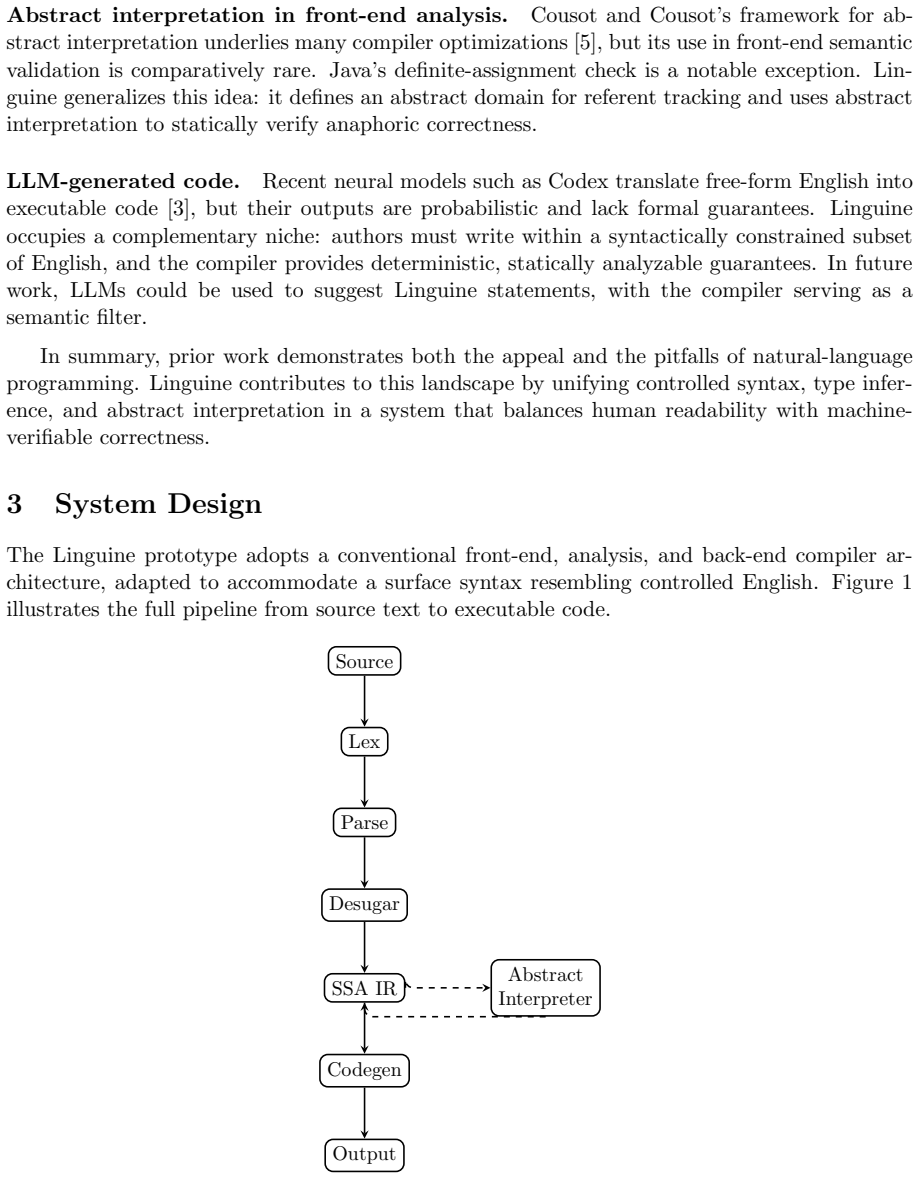
Summary. The paper presents Linguine, a controlled-English programming language in which pronouns such as "it" and "them" are resolved statically through a referent-tracking stack, combined with Hindley-Milner-style type inference and an abstract-interpretation pass. The compiler pipeline is described as lexing, parsing, clause-graph construction, desugaring, SSA translation, type inference, abstract interpretation, and Python/LLVM code generation. The paper claims that every pronoun is guaranteed to be unambiguous and well-typed at compile time, proves type-safety and pronoun-resolution theorems, and reports a small evaluation consisting of nine micro-benchmarks, 27 injected pronoun faults, and a QuickCheck-style type-soundness stress test. The appendix provides a grammar, typing rules, a referent lattice, and an annotated example program.
Significance. If the central guarantees were fully established, Linguine would be a useful demonstration that a controlled natural-language surface can be combined with conventional compiler analyses, and the concrete description of a referent-tracking lattice and pipeline is a worthwhile contribution. The paper is also commendable for reporting fault-injection and differential-execution tests, and for explicitly connecting the abstract analysis to a deterministic resolution protocol. However, the formal core is incomplete and the headline ambiguity guarantee is not currently supported: the pass ordering appears to make the abstract-interpretation check vacuous, key theorems are asserted or proved with missing rules, and the evaluation cannot be independently checked without released code. The significance is therefore conditional on substantial revision; the underlying idea is plausible, but the paper as written does not make its case.
major comments (4)
- [§3.4, §4.4, Theorem 4] The pass ordering contradicts the ambiguity guarantee. Section 3.4 states that "all pronoun references are statically resolved to exact SSA bindings" during translation to the IR, while Section 4.4 says a forward analysis runs "over SSA" to detect unresolved or ambiguous pronouns. If pronouns are already replaced by fixed bindings before analysis, the abstract interpreter sees no pronoun sites, making Theorem 4 vacuously true rather than a substantive guarantee. If pronouns survive into the IR, then Section 3.4 is inaccurate and the abstract interpreter's handling of pronoun sites is never defined. This is load-bearing for the abstract's central claim, and the manuscript must clarify which description is correct.
- [§3.5, §5.2] Protocol A2 in Section 3.5 resolves a pronoun to the top of the referent stack r1 without any ambiguity check. Under this protocol, a program of the form "Let a be 1. Let b be 2. Print it." resolves "it" to b and is unambiguous by definition. Section 5.2, however, reports that an "ambiguous antecedent created by consecutive Let statements followed by Print it." is "correctly rejected." These two statements are inconsistent as written. The paper needs to define what counts as ambiguity and how the abstract interpreter distinguishes it from the default last-referent resolution.
- [§4.4, Theorem 4; §4.1, Theorem 1] Theorem 4, the formal basis for the paper's central soundness claim, is stated without proof. The abstract and Section 1.4 claim that the paper "proves the soundness of its pronoun resolution mechanism," but Section 4.4 only asserts the theorem. Similarly, Theorem 1 (Principal Type Property) is asserted with no proof, despite the claim that Algorithm W infers principal types. The authors should either supply the missing proofs or explicitly mark these as conjectures, and they should connect the abstract-interpretation fixpoint to the operational semantics of pronouns.
- [§4.2, §4.3, Appendix A.1] The operational semantics are incomplete. The Progress proof in Section 4.3 invokes an E-IfFalse rule that is never defined, and it considers a case "S = p" for a pronoun p, although the grammar in Appendix A.1 treats pronouns as expressions, not statements. No evaluation rules are given for Print or While even though both appear in the grammar and in the benchmarks. The E-Pronoun rule in Section 4.2 uses a big-step judgment ⇓ inside a system defined with small-step transitions, and it is an expression rule rather than a statement rule. These gaps mean the stated Progress and Preservation theorems are not supported by the formal material as written.
minor comments (6)
- [§4.1, Appendix A.2] The T-Pronoun rule in the main text uses ρ(p)=e with Γ⊢e:τ, while the appendix uses ρ(p)=x with x:τ∈Γ; these formulations should be unified because they differ in whether the referent is an expression or a variable.
- [§3.1, Appendix A.1] The surface grammar in Section 3.1 lists Pronoun ::= it | them | this, but the appendix grammar also includes that; the paper should reconcile these two definitions.
- [§4.2] The E-Pronoun rule is written with the big-step arrow ⇓, but the rest of the dynamic semantics uses the small-step arrow ⇝; please use a consistent judgment form.
- [§4.1, Theorem 1] Section 4.1 says inference is "currently monomorphic," while Theorem 1 states a principal-type property in the Hindley-Milner sense, which usually implies polymorphism; the type language and the intended notion of principality should be clarified.
- [§5.2] The QuickCheck-style stress test is described as comparing the Python code generator to "an interpreter for the formal core calculus," but no such interpreter is defined and no code is released, so this evidence cannot be independently reproduced.
- [§7] The paper says the source code "will soon be available" but provides no artifact or repository snapshot; for a paper whose evaluation depends on a specific compiler pipeline, a release or a permanent DOI would be needed for verifiability.
Circularity Check
No significant circularity: Linguine's formal results are stated about its own definitions, with no fitted inputs or load-bearing self-citations.
full rationale
The paper's derivation chain is self-contained in the sense relevant to circularity. Theorem 2 and Theorem 3 are type-soundness statements about the paper's own typing and small-step semantics; Theorem 4 is a soundness claim for the paper's own referent lattice. None of these results is produced by fitting a parameter to a subset of data and then 'predicting' a related quantity, and no empirical constant or benchmark result is fed back into the formal claims. The references are all external (COBOL, AppleScript, Milner, Cousot-Cousot, etc.); there are no author self-citations carrying a uniqueness or ansatz assumption. Two concerns raised by the text do not rise to circularity: (1) Section 4.5 asserts the semantics 'closely follow the implementation,' but the implementation is unreleased, so the formal system is its own only witness—this is a verification gap, not a logical circle; (2) Section 3.4 says pronouns are statically resolved to SSA bindings before the Section 4.4 abstract interpretation runs, which may make the ambiguity check vacuous and conflicts with Section 5.2's rejection of 'ambiguous antecedent' programs. Even if true, that is an internal consistency or soundness defect, not a case of the paper deriving Y from an X that is defined in terms of Y. The headline guarantee is therefore not circular, though it may be under-supported.
Assumptions & free parameters
assumptions (5)
- ad hoc to paper The last-referent stack protocol (A1-A4) is the intended resolution semantics for pronouns.
- ad hoc to paper The abstract interpretation lattice D = {⊥} ∪ Ref ∪ {⊤} with join producing ⊤ on differing referents is a sound approximation of all runtime referent behavior (Theorem 4).
- domain assumption The small-step semantics, with E-Let, E-IfTrue, and E-Pronoun, is the complete operational semantics of the core calculus.
- domain assumption The Algorithm W variant is monomorphic and complete for the core language, yielding a principal type for every expression.
- domain assumption The LL(k) grammar of 140-150 rules parses all supported sentences deterministically.
invented entities (1)
-
referent memory ρ and first-class pronoun variables (it, them, this, that)
Cite this review
Pith. "Pith review of Linguine: A Natural-Language Programming Language with Formal Semantics and a Clean Compiler Pipeline." pith.science (2026). https://pith.science/paper/BG5FXHDM
@misc{pith2026250608396,
  author       = {Pith},
  title        = {Pith review of: Linguine: A Natural-Language Programming Language with Formal Semantics and a Clean Compiler Pipeline},
  year         = {2026},
  howpublished = {\url{https://pith.science/paper/BG5FXHDM}},
  note         = {Machine review of arXiv:2506.08396}
}
read the original abstract
Linguine is a natural-language-inspired programming language that enables users to write programs in a fluent, controlled subset of English while preserving formal semantics. The language introduces anaphoric constructs, such as pronoun variables (e.g., "it", "them"), that are statically resolved through referent-tracking analysis combined with a Hindley-Milner-style type system. Each pronoun is guaranteed to be unambiguous and well-typed at compile time. The Linguine compiler pipeline includes lexing, parsing, clause graph construction, desugaring into a typed intermediate representation, type inference, and abstract interpretation. This enables the early detection of semantic errors, such as undefined or type-inconsistent references. A lightweight backend currently generates Python code. This paper formalizes the core language, defines its typing and operational semantics, and proves the soundness of its pronoun resolution mechanism. An initial evaluation shows that Linguine allows the expression of concise and readable programs while supporting static verification. Linguine represents a step toward programming systems that prioritize human linguistic intuition while remaining grounded in formal methods and type-theoretic rigor.
Figures
Reference graph
Works this paper leans on
-
[1]
Apple Inc. AppleScript Language Guide . Apple Developer Documentation Archive, 2010
work page 2010
-
[2]
Allen W. Biermann, Bruce W. Ballard, and Anne H. Sigmon. An experimental study of natural language programming. In International Journal of Man-Machine Studies , pages 71–87, 1983
work page 1983
-
[3]
Evaluating large language models trained on code
Mark Chen, Jared Kaplan, and Heidy Khlaaf et al. Evaluating large language models trained on code. https://arxiv.org/abs/2107.03374, 2021
arXiv 2021
-
[4]
COBOL - Initial Specifications for a COmmon Business Oriented Language
Conference/Committee on Data Systems Languages. COBOL - Initial Specifications for a COmmon Business Oriented Language . U.S. Department of Defense, 1960
work page 1960
-
[5]
Patrick Cousot and Radhia Cousot. Abstract interpretation: A unified lattice model for static analysis of programs by construction or approximation of fixpoints. In Proceedings of the 4th ACM SIGACT-SIGPLAN symposium on Principles of programming language , pages 238–252, 1977
work page 1977
-
[6]
A theory of type polymorphism in programming
Robin Milner. A theory of type polymorphism in programming. Journal of Computer and System Sciences, 17(3):348–375, 1978. 15
work page 1978
-
[7]
Natural language, semantic analysis, and interactive fiction
Graham Nelson. Natural language, semantic analysis, and interactive fiction. IEEE Com- puter, 2005
work page 2005
-
[8]
Naturaljava: a natu- ral language interface for programming in java
David Price, Ellen Rilofff, Joseph Zachary, and Brandon Harvey. Naturaljava: a natu- ral language interface for programming in java. In Proceedings of the 5th international conference on Intelligent user interfaces , pages 207–211, 2000
work page 2000
Show all 12 references
-
[9]
Proebsting and Benjamin G
Todd A. Proebsting and Benjamin G. Zorn. Computer programming language pronouns,
-
[10]
Jean E. Sammet. Programming Languages: History and Fundamentals . Prentice–Hall, 1969
1969
-
[11]
Learn AppleScript: The Comprehensive Guide to Scripting and Automation on Mac OS X
Hamish Sanderson and Hanaan Rosenthal. Learn AppleScript: The Comprehensive Guide to Scripting and Automation on Mac OS X . Apress, 2010. 16
2010
-
[2000]
US Patent US67478585B2
Reviewed August 7, 2026 · model on record in the stance chip above.
Discussion (0). Sign in to comment.