REVIEW 4 major objections 6 minor 30 references
Compact Amplified Laser Power Stabilization Using Robust Active Disturbance Rejection Control with Sensor Noise Decoupling
T0 review · 4 major / 6 minor · reviewed 2026-08-07 · deepseek-v4-flash
Pith's one-line read A two-loop active disturbance rejection controller stabilizes compact amplified-laser power with one photodetector, cutting 1-hour instability by over 85.7% and improving long-term Allan variance tenfold versus standard ADRC.
desk verdict The hardware results are believable, but the paper's main theoretical claim — sensor noise decoupling — isn't supported by its own L∞ bounds, which actually predict amplification. read the letter →
The pith
A machine-rendered reading of the paper's core claim, the machinery that carries it, and where it could break.
The reading
What carries the argument
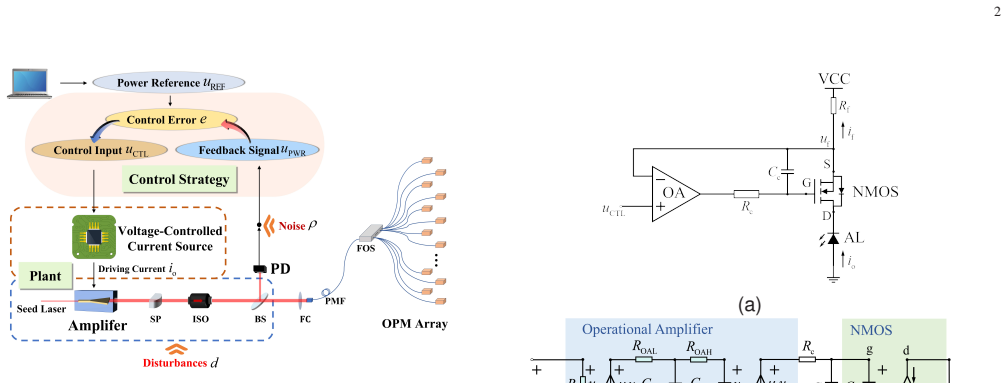
The load-bearing mechanism is the dual-loop ADRC topology: a supplemental inner-loop extended state observer (ESO) that estimates generalized disturbance from model mismatches, combined with an outer cascade of $p$ ESOs whose bandwidths form a geometric sequence $\omega_{oj} = \alpha^{j-1}\omega_{o1}$ to progressively filter sensor noise. The analysis machinery is a set of Lyapunov-functional estimates (Theorems 1 through 5) that convert the coupled error dynamics into explicit exponential bounds, for instance $|\tilde{z}_j(t)| \le c_9 \omega_{op}^{j-1}\{e^{-c_4\omega_{op}t}\|\tilde{z}_p(0)\| + \sum_{i=1}^{p-1}\|\tilde{z}_i(0)\| + \|\rho\|_\infty\}$, showing how steady-state observation and control errors scale with the noise bound $\|\rho\|_\infty$ and with the observer and control bandwidths.
What would settle it
Run the same DLADRC controller at a fixed power while injecting broadband drive-current ripple whose spectrum overlaps the photodetector noise band, and compare the 1-hour Allan variance with standard ADRC; if the tenfold long-term improvement vanishes or the instability reduction drops below 85.7%, the noise-decoupling premise is false.
Extended reading notes
Core claim
The central claim is that a dual-loop ADRC architecture can simultaneously reject unknown disturbances and decouple sensor noise in amplified laser power control, something a single extended state observer cannot do because raising its bandwidth to track disturbances also amplifies measurement noise. The paper establishes this by constructing an inner loop whose ESO compensates for plant-model parameter variations, and an outer cascade of $p$ ESOs whose bandwidths start low and increase geometrically, so the first stage low-pass filters the photodetector noise while later stages correct estimation residuals. On the theory side it derives explicit time-decay estimates for the observation error of every ESO and for the closed-loop tracking error, showing that steady-state bounds scale with the noise bound and with ratios of observer bandwidths. On the experimental side it reports that DLADRC lowers 1-hour power instability by more than 57% at every tested operating point from 1 W to 2 W compared with standard ADRC, and by over 85.7% once the cascade outer loop is used, with Allan variance improved by an order of magnitude at correlation times of $10^2$ to $10^3$ seconds.
Load-bearing premise
The load-bearing premise is that photodetector noise sits at higher frequencies than external disturbances and model variations; if the two spectra overlap, the cascade's first observer cannot filter the sensor noise without also rejecting real disturbances, and the reported gains would not generalize.
Editorial extensions
If this is right
- A compact amplified laser with a single photodetector can hold 1-hour power instability below 0.05% at 1.5 W, removing the need for the electro-optic or acousto-optic modulator chains used in conventional active stabilization.
- With three cascade levels the closed-loop performance becomes nearly insensitive to the first-level observer bandwidth, so the controller can be commissioned without delicate bandwidth tuning.
- The exponential-decay estimates predict that convergence speed is governed mainly by the control bandwidth $\omega_c$; step experiments confirm this by matching decay coefficients across different set-point changes.
- The inner loop absorbs model variation across the 1 W to 2 W range, so one fixed tuning holds at all tested power levels, whereas standard ADRC develops persistent oscillations away from its design point.
- The quantitative observation-error framework extends to any ADRC-based system with spectrally separated disturbances and sensor noise, as the paper's note to practitioners states.
Reading between the lines
- If external disturbances ever occupy the same frequency band as photodetector noise, the first cascade ESO cannot low-pass one without also rejecting the other; the paper's central premise, stated in its experiment design, would fail and the reported advantage over standard ADRC should shrink.
- The same cascade-ESO arrangement could be tried on other single-sensor precision systems, such as frequency locking of lasers or interferometric displacement sensing, whenever the sensor noise is broadband and the target signal is low-frequency.
- A direct power-spectral-density comparison before and after the first cascade stage would separate the noise-filtering contribution from the disturbance-rejection contribution; the paper reports time-domain and Allan-variance data but not that spectral decomposition.
- The bounds require only boundedness of the disturbance derivative and noise, so the controller should port to lower sampling rates if the geometric bandwidth spacing $\alpha$ is scaled down to respect the Nyquist limit.
Editorial analysis
A structured set of objections, weighed in public.
Referee Report
Summary. This paper proposes a dual-loop active disturbance rejection control (DLADRC) architecture for stabilizing the output power of an amplified laser (AL) used in optically pumped magnetometer (OPM) arrays. The inner loop uses a supplemental ESO to handle model uncertainties, while the outer loop uses a cascade of ESOs intended to decouple photodetector noise. The authors derive explicit exponential-decay bounds for ESO observation errors and control errors (Theorems 1–5) and validate the approach with three hardware experiments (E1–E3) comparing DLADRC with standard ADRC. The headline claims are an 85.7% reduction in 1-hour power instability and a tenfold improvement in Allan variance at long correlation times. The experimental results show qualitative improvements, and E1's decay-rate ratio matches the theoretical dependence on the controller bandwidth ω_c.
Significance. If the claims are fully substantiated, the proposed compact single-photodetector controller could be a practical improvement for OPM-array laser power stabilization. The paper's strengths include a transparent hardware description, a layered theoretical framework, and direct experimental comparison with standard ADRC. E1's exponential decay rates and their consistency with the ω_c-dependence in Eq. (35) provide a valuable quantitative check; E2 demonstrates robustness across the 1–2 W operating range. However, the advertised 'sensor noise decoupling' mechanism is not proven by the L∞ bounds in Theorems 4–5, and the headline 85.7% figure is measured at a single operating point without repeated trials. The paper's value to the OPM community is potentially high, but the analytical support for the key mechanism and the statistical support for the headline quantitative claim need significant revision.
major comments (4)
- [Section III-C, Eq. (34) and Eq. (38)] There is a sign and index error in the derivation of the control-error dynamics. From the plant (4), dot z_n = -u_out, so with the control law (9), dot ǫ_n = -u_out = -ω_c^n(ǫ_1+ρ) - Σ_{q=1}^{n-1} K_out^{q+1} ǫ_q + K_out \tilde{z}_p. The printed Eq. (38) omits the minus sign, and Eq. (34) has +ω_c^n ρ and the summation over ǫ_{q+1} instead of ǫ_q. Although the absolute-value bounds in (36) are unaffected because they use |ρ|, the proof as written does not correctly represent the closed-loop system and must be corrected.
- [Theorem 5 and Eq. (36)] The bound ls∞|ǫ_q| ≤ c10 ω_op^n ω_c^{q-1} ||ρ||∞ grows with the p-th-level ESO bandwidth ω_op to the n-th power. With n=3 and the experimental values ω_op=250–1000, this predicts a noise amplification factor of 10^7–10^9, which is the opposite of 'sensor noise decoupling.' Theorems 2–5 use only L∞ bounds on ρ and never encode the spectral-separation assumption stated in Section IV-A. Therefore the claimed low-pass filtering behavior of the cascade is not a consequence of the theorems. To support the headline mechanism, the authors need a frequency-domain or stochastic analysis, or a revised bound showing attenuation as ω_o1 decreases or as p increases.
- [Section III-A and E3] The qualitative statement that the first-level ESO 'acts as a low-pass filter' is not reflected in Theorem 4, which gives ls∞|\tilde{z}_p^j| ≤ c8 ω_op^{j-1}||ρ||∞, independent of the first-level bandwidth ω_o1 and growing with the highest bandwidth. The experimental E3 indeed shows improved Allan variance, but only at 1.5 W, with no error bars or repeated trials. The conclusion that the 85.7% reduction holds 'throughout the 1 W–2 W range' is not supported: E2 (Table III) reports 57–67% improvements at other operating points with p=1, and E3's 85.7% is a single point. Please clarify the scope of the headline claim and add statistical replicates or error bars.
- [Theorem 5 derivation, Eq. (35)] The bound ||K_out|| ≤ ω_c^n used in the proof is loose: from Eq. (10), K_out's nonzero entries scale as ω_c^{n-1} at most. Recomputing the constants with the correct scaling would make the dependence on ω_c and ω_op transparent and would likely change the form of (36). As written, the inflated bound obscures the actual noise-dependence of the control error.
minor comments (6)
- [Theorem 1 proof, Eq. (15)] The step 'dividing both sides of (15) by m(P) exp{...} N(t)' is not fully justified: one needs a comparison lemma, and the case N(t)=0 must be handled separately. Please rewrite this step for rigor.
- [Theorem 4 proof] In the definition of c8, the index i in ω_{oi} is not defined; it should presumably be p. Please fix this typo.
- [Section II-B, notation] The symbols c, d, and b are overloaded: c is used both as a vector and as constants c1, c2, ...; d is used both as the disturbance and as the vector d in Eq. (3). Consider renaming the vectors (e.g., e_1, e_n) to avoid confusion.
- [Section IV-B, E1] Please state explicitly which variable (e.g., ǫ_1 or the output error) was exponentially fitted, the number of data points, and the fitting procedure. Also clarify that the 'decay rate' refers to the exponent in (35).
- [Abstract and Conclusion] The abstract says 'tenfold decrease in Allan variance for correlation times 10^2 s–10^3 s', while the conclusion says '10^1 s–10^3 s'. Please unify the stated timescales; the data in Figs. 7 and 8 appear to cover 10^-1 s to 10^3 s.
- [Conclusion] The phrase 'spanning 10^1 s–10^3 s' in the conclusion should be checked against the actual Allan-variance curves; some curves in Fig. 7(b) show long-term behavior up to 10^3 s, but the abstract's 10^2–10^3 s may be more consistent with the reported factor-of-ten improvement.
Circularity Check
No significant circularity: the stability theorems are derived from Lyapunov arguments without fitted constants, the E1 exponential fit corroborates rather than defines the theoretical predictions, and the headline performance numbers are direct hardware measurements.
full rationale
Walking the claimed derivation chain: the plant model (1)-(2) is built from circuit parameters, the DLADRC law (5)-(9) is an explicit controller parameterized by bandwidths, and Theorems 1-5 are proved from Lyapunov inequalities (11)-(15) without invoking any fitted constants or the experimental data. The bounds (28)-(36) are consequences of the model and observer/controller definitions, not restatements of those definitions. Experiment E1 fits exponentials to measured step responses and compares the fitted decay rates with the omega_c dependence predicted by (35); the fit is used only as corroboration and is not used to define or tune the theoretical bound. Experiments E2 and E3 are direct hardware comparisons against SADRC, so the claimed 85.7% reduction in 1-hour instability and the tenfold Allan variance improvement are measured outputs, not encoded inputs. I found no self-citation chain carrying a load-bearing premise, no parameter fitted to a target and then renamed as a prediction, and no definition that presupposes the result. The reviewer-flagged sign inconsistency in Eq. (34)/(38) and the resulting omega_op^n scaling in (36) is a possible correctness defect in the theoretical support for the noise-decoupling claim, but it is not circular reasoning: the bound is derived rather than assumed, and the hardware result stands independently of that bound.
Assumptions & free parameters
free parameters (2)
- Controller bandwidth choices (omega_c, omega_in, omega_o1, alpha, p) =
Controller bandwidths: chosen from Table II per experiment, e.g., omega_c=150/300, omega_in=800, omega_o1=150…
- E1 exponential decay fit coefficients =
0.335, 0.336 for omega_c=150; 0.617, 0.616 for omega_c=300.
assumptions (5)
- domain assumption Assumption 1: all AL physical quantities, including disturbance d(t) and system states, are bounded and continuously differentiable.
- domain assumption The circuit-derived third-order plant model in Eqs (1)-(2), with constant optical gain phi_AL, accurately describes the amplified laser across the 1-2 W range.
- domain assumption Photodetector measurement noise rho occupies higher frequency bands than external disturbances and model parameter variations.
- domain assumption The disturbance-compensated inner loop behaves as a nominal integrator chain for the outer loop.
- standard math For the companion matrix Gamma defined in Theorem 2, there exists a positive definite P solving Gamma^T P + P Gamma = -I.
Cite this review
Pith. "Pith review of Compact Amplified Laser Power Stabilization Using Robust Active Disturbance Rejection Control with Sensor Noise Decoupling." pith.science (2026). https://pith.science/paper/FQMPZG3Z
@misc{pith2026250608404,
  author       = {Pith},
  title        = {Pith review of: Compact Amplified Laser Power Stabilization Using Robust Active Disturbance Rejection Control with Sensor Noise Decoupling},
  year         = {2026},
  howpublished = {\url{https://pith.science/paper/FQMPZG3Z}},
  note         = {Machine review of arXiv:2506.08404}
}
read the original abstract
Laser power instability, encompassing random jitter and slow drift, severely limits the performance of optically pumped magnetometers (OPMs) in detecting ultra-weak magnetic fields, especially in large-scale OPM arrays for magnetoencephalography. Although a unified amplified laser (AL) architecture improves integration, fluctuations in the pump beam progressively degrade performance across all channels, exacerbated by environmental disturbances and system uncertainties. To address this challenge, this paper presents a compact AL power stabilization approach based on an innovative dual-loop active disturbance rejection control (DLADRC) strategy, while integrating a comprehensive quantitative stability analysis through novel exponential decay estimates for extended state observers (ESOs) and control error dynamics. As validated through physical experimental results, the proposed method significantly improves AL's long-term stability with sensor noise decoupling, achieving an over 85.7% reduction in 1-hour power instability and a tenfold decrease in Allan variance for correlation times 10^2 s--10^3 s, compared to standard ADRC. Crucially, the strategy demonstrates robust effectiveness across diverse operating scenarios, enabling AL-based OPM systems to achieve their full potential in high-sensitivity biomagnetic field detection.
Figures


Figures from the paper (3 more)


Reference graph
Works this paper leans on
-
[1]
M. J. Brookes et al. , “Magnetoencephalography with optically pumped magnetometers (OPM-MEG): The next generation of functiona l neu- roimaging,” Trends in Neurosciences, vol. 45, no. 8, pp. 621–634, Aug. 2022
work page 2022
-
[2]
Magnetic source imaging using a pulsed optically pumped ma gnetome- ter array,
A. Borna, T. R. Carter, P . DeRego, C. D. James, and P . D. D. S chwindt, “Magnetic source imaging using a pulsed optically pumped ma gnetome- ter array,” IEEE Transactions on Instrumentation and Measurement , vol. 68, no. 2, pp. 493–501, Feb. 2019
work page 2019
-
[3]
Moving magnetoencephalography towards real-world applications with a wearable system,
E. Boto et al. , “Moving magnetoencephalography towards real-world applications with a wearable system,” Nature, vol. 555, no. 7698, pp. 657,, Mar. 2018
work page 2018
-
[4]
A 90-channel triaxial magnetoencephalography sys- tem using optically pumped magnetometers,
M. Rea et al. , “A 90-channel triaxial magnetoencephalography sys- tem using optically pumped magnetometers,” Annals of the New York Academy of Sciences , vol. 1517, no. 1, pp. 107–124, Nov. 2022
work page 2022
-
[5]
A review of fiber-coupled atomic magnetometer,
X. Liu et al. , “A review of fiber-coupled atomic magnetometer,” Mi- crowave and Optical Technology Letters , vol. 65, no. 5, SI, pp. 1516– 1524, May 2023
work page 2023
-
[6]
Four-channel optically pumped atomic magne- tometer for magnetoencephalography,
A. P . Colombo et al. , “Four-channel optically pumped atomic magne- tometer for magnetoencephalography,” Optics Express , vol. 24, no. 14, pp. 15 403–15 416, Jul. 2016
work page 2016
-
[7]
T. Long, X. Song, B. Han, Y . Suo, and L. Jia, “In situ magnet ic field compensation method for optically pumped magnetomete rs under three-axis nonorthogonality,” IEEE Transactions on Instrumentation and Measurement, vol. 73, no. 9502112, 2024
work page 2024
-
[8]
Improvements of optical power scale realizat ion with a CCD-based laser stabilization system,
M. Durak, “Improvements of optical power scale realizat ion with a CCD-based laser stabilization system,” Optics & Laser Technology , vol. 39, no. 1, pp. 174–178, Feb. 2007
work page 2007
Show all 30 references
-
[9]
Laser power stabilization via radiation pre ssure,
M. T. Nery, “Laser power stabilization via radiation pre ssure,” Nature Reviews Physics , vol. 3, no. 10, p. 677, Oct. 2021
2021
-
[10]
Active stabilization of multi-parameter in AMO experiments with a single digital servo,
X.-L. Zhou et al. , “Active stabilization of multi-parameter in AMO experiments with a single digital servo,” Optics & Laser Technology , vol. 167, no. 109791, Dec. 2023
2023
-
[11]
Compact optically pu mped mag- netometer light source stabilization with regulated feedb acks,
Y . Niu, Z. Zou, L. Cheng, and C. Y e, “Compact optically pu mped mag- netometer light source stabilization with regulated feedb acks,” Sensors and Actuators, A: Physical , vol. 365, no. 114869, Jan. 2024
2024
-
[12]
III-v/si hybrid laser stabilization using micro-ring feedback control,
J.-H. Lee et al. , “III-v/si hybrid laser stabilization using micro-ring feedback control,” IEEE Photonics Journal , vol. 8, no. 1503507, Oct. 2016
2016
-
[13]
Passive laser power stabilization via an optical spring,
T. Cullen et al., “Passive laser power stabilization via an optical spring, ” Optics Letters , vol. 47, no. 11, pp. 2746–2749, Jun. 2022
2022
-
[14]
Passive laser power stabilization in a broadband noise spectrum via a second-harmonic generator,
N. Jiao et al. , “Passive laser power stabilization in a broadband noise spectrum via a second-harmonic generator,” Optics Letters , vol. 49, no. 13, Jul. 2024
2024
-
[15]
From PID to active disturbance rejection contr ol,
J. Han, “From PID to active disturbance rejection contr ol,” IEEE Transactions on Industrial Electronics, vol. 56, no. 3, pp. 900–906, Mar. 2009
2009
-
[16]
Disturbance ob server-based robust control and its applications: 35th anniversary over view,
E. Sariyildiz, R. Oboe, and K. Ohnishi, “Disturbance ob server-based robust control and its applications: 35th anniversary over view,” IEEE Transactions on Industrial Electronics , vol. 67, no. 3, pp. 2042–2053, Mar. 2020
2020
-
[17]
Time-delay active disturbance rejection control of wet electrostatic precipitator in pow er plants,
Y . Sun, Z.-G. Su, L. Sun, and G. Zhao, “Time-delay active disturbance rejection control of wet electrostatic precipitator in pow er plants,” IEEE Transactions on Automation Science and Engineering , vol. 20, no. 4, pp. 2748–2760, Oct. 2023
2023
-
[18]
Enhancement in robust performance of boost converte r-based distributed generations utilizing active disturbance rej ection controller,
H. Aliamooei-Lakeh, S. Aliamooei-Lakeh, M. Toulabi, a nd T. Am- raee, “Enhancement in robust performance of boost converte r-based distributed generations utilizing active disturbance rej ection controller,” IEEE Transactions on Automation Science and Engineering , vol. 21, no...
2024
-
[19]
High-gain observers in nonli near feedback control,
H. K. Khalil and L. Praly, “High-gain observers in nonli near feedback control,” International Journal of Robust and Nonlinear Control , vol. 24, no. 6, SI, pp. 993–1015, Apr. 2014
2014
-
[20]
Robust active disturbance rejection control of induction motor systems based on additional sliding-mode component,
F. Alonge, M. Cirrincione, F. D’Ippolito, M. Pucci, and A. Sferlazza, “Robust active disturbance rejection control of induction motor systems based on additional sliding-mode component,” IEEE Transactions on Industrial Electronics, vol. 64, no. 7, pp. 5608–5621, Jul. 2017
2017
-
[21]
A time delay estimation interpretation of extended state observer-based controller with applicat ion to structural vibration suppression,
J. Li, L. Zhang, S. Li, and J. Su, “A time delay estimation interpretation of extended state observer-based controller with applicat ion to structural vibration suppression,” IEEE Transactions on Automation Science and Engineering, vol. 21, no. 2, pp. 1965–1973, Apr. 2024
1965
-
[22]
Pred ictor- based active disturbance rejection control of wet flue gas de sulfurization system with delay robustness and simplified tuning,
Z. Chen, Y .-S. Hao, Z.-G. Su, G. Zhao, and K. Y . Lee, “Pred ictor- based active disturbance rejection control of wet flue gas de sulfurization system with delay robustness and simplified tuning,” IEEE Transactions on Automation Science and Engineering , vol. 22, pp. 3731–3742, 2025
2025
-
[23]
Robust distributed average tracking with disturbance observer control,
L. Gao et al. , “Robust distributed average tracking with disturbance observer control,” IEEE Transactions on Automation Science and Engi- neering, vol. 22, pp. 970–983, 2025. 10
2025
-
[24]
Cascade active disturban ce rejection control-based double closed-loop speed tracking control f or automo- tive engine,
M. Feng, X. Jiao, and Z. Wang, “Cascade active disturban ce rejection control-based double closed-loop speed tracking control f or automo- tive engine,” International Journal of Engine Research , vol. 21, no. 1468087418819555, pp. 1541–1554, Oct. 2020
2020
-
[25]
Superheated steam temperature control based on modified active disturbance rejection control,
Z. Wu et al., “Superheated steam temperature control based on modified active disturbance rejection control,” Control Engineering Practice , vol. 83, pp. 83–97, Feb. 2019
2019
-
[26]
A nonlinear high-gain obs erver for systems with measurement noise in a feedback control framew ork,
A. A. Prasov and H. K. Khalil, “A nonlinear high-gain obs erver for systems with measurement noise in a feedback control framew ork,” IEEE Transactions on Automatic Control , vol. 58, no. 3, pp. 569–580, Mar. 2013
2013
-
[27]
On active disturbance rejection co ntrol for a class of uncertain systems with measurement uncertainty,
S. Chen and Z. Chen, “On active disturbance rejection co ntrol for a class of uncertain systems with measurement uncertainty,” IEEE Transactions on Industrial Electronics , vol. 68, no. 2, pp. 1475–1485, Feb. 2021
2021
-
[28]
Scaling and bandwidth-parameterization base d controller tun- ing,
Z. Gao, “Scaling and bandwidth-parameterization base d controller tun- ing,” in Proceedings of The 2003 American Control Conference, V ols 1 - 6, ser. Proceedings of the American Control Conference. Amer Automat Control Council; IFAC, 2003, pp. 4989–4996
2003
-
[29]
Analysis and tuning of general linea r active disturbance rejection controllers,
R. Zhou and W. Tan, “Analysis and tuning of general linea r active disturbance rejection controllers,” IEEE Transactions on Industrial Elec- tronics, vol. 66, no. 7, pp. 5497–5507, Jul. 2019
2019
-
[30]
Explicit solutions of linear matrix equ ations,
P . Lancaster, “Explicit solutions of linear matrix equ ations,” SIAM Review, vol. 12, no. 4, pp. 544–566, 1970. [Online]. Available: htt p:// www.jstor.org/stable/2028490
1970
Reviewed August 7, 2026 · model on record in the stance chip above.
Discussion (0). Sign in to comment.