REVIEW 4 major objections 5 minor 52 references
Non-Equilibrium Origin of Native Ring Anisotropy in Amorphous Systems
T0 review · 4 major / 5 minor · reviewed 2026-08-07 · deepseek-v4-flash
Pith's one-line read This paper claims that ring anisotropy in amorphous networks is a chemistry-independent, non-equilibrium signature of quenching, reproducible by a two-parameter Markov folding model.
desk verdict A genuinely new stochastic model for ring anisotropy, but the MD agreement is fit, not predicted, so the universality claim needs an out-of-sample test before it carries weight. read the letter →
The pith
A machine-rendered reading of the paper's core claim, the machinery that carries it, and where it could break.
The reading
What carries the argument
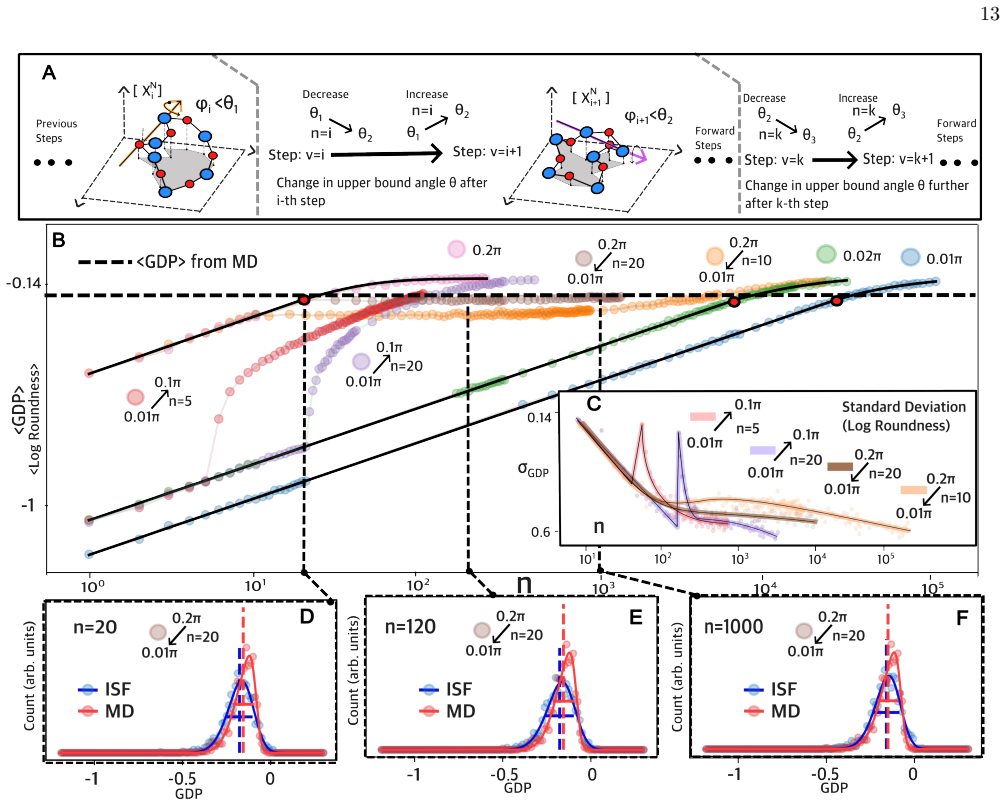
The load-bearing object is the ISF sequence: starting from an ideal circle of $N$ atoms, at each Markov step two atoms are chosen uniformly at random to define a rotation axis, and a random angle $\varphi\le\theta$ rotates the intervening atoms while preserving covalent bond lengths; after $N$ steps, configurations with overlapping atoms are rejected. This turns anisotropy into a random variable whose logarithm is the GDP. The proof machinery is the stochastic GDP equation $I(n_0,n)=\int(\mu_n - \epsilon_n A_n\,\mathrm{Sgn}[\epsilon_n] + \Gamma_n)\,dn'$, where $\mu_n$ is the deterministic drift, $A_n\ge 0$ comes from $\partial_n R(X,n)\ge 0$ (a growing entropy production rate), and $\Gamma_n$ is a diffusion term. Modeling $A_n$ and $\Gamma_n$ as Wiener processes yields the skew-normal law. The two physical parameters, the step count $n$ (mean collision time) and maximum angle $\theta$ (deformation magnitude per event), map onto the adiabatic and rapid quenching limits.
What would settle it
Run molecular dynamics on amorphous silica at two cooling rates differing by an order of magnitude and on a second chemistry such as GeO$_2$ at an equivalent reduced quench protocol, then measure the log-roundness distribution for $N=10$ rings. ISF predicts the constituent-independent part is skew-normal with shape set only by the step count and maximum angle, so it should be identical across chemistries and change systematically with cooling rate. Observing a non-skew-normal GDP, or a chemistry-dependent skewness at matched quenching, would falsify the universality claim.
Extended reading notes
Core claim
The central discovery is that the universal, chemistry-independent component of native-ring anisotropy is generated by stochastic deformation accumulation during annealing-quenching. After sampling N-member native ring structures (N-NRSs) from molecular-dynamics-generated amorphous silica, the authors compare their structural anisotropy statistics, namely log-RDFs and global deformation parameters (GDPs), the logarithms of roundness, roughness, deformation distance, and nearest-neighbor distances, with ensembles produced by the ISF Markov chain. They find that ISF-generated statistics reproduce the MD statistics once the atom-specific peaks are removed, at a particular mean-collision-time step near $n=3\times 10^4$ and maximum rotation angle $\theta=0.005\pi$. Mathematically, they argue that under Wiener-process assumptions every GDP is a skew-normal random variable with skewness set by the ratio of a nonnegative entropy-production growth term to a diffusion term; this is stated as a universal consequence for any ISF-like Markov chain with growing entropy production.
Load-bearing premise
The whole ISF match rests on treating thermal fluctuations during quenching as memoryless random rotations of ring fragments with no atom-specific forces and a single maximum angle; if real ring deformations are correlated or chemically dependent, the match is coincidental.
Editorial extensions
If this is right
- If the central claim is correct, the constituent-independent part of ring anisotropy in any amorphous network can be generated from ISF with just two parameters, removing the need for force-field simulations for that component.
- The GDP universality means every positive anisotropy measure tested, roundness, roughness, deformation distance, and nearest-neighbor distances, should follow the same skew-normal mechanism, giving a common fingerprint for comparing simulations, experiments, and different materials.
- Rapid quenching should lock rings into metastable anisotropic configurations that persist across many later steps, predicting that cooling history, not chemistry, dominates the local dopant-environment statistics.
- Because the nonnegative drift term is tied to entropy production growth, the measured skewness parameter of a GDP distribution can serve as an indirect probe of the quenching rate.
- Adiabatic and rapid quenching regimes are distinguished by which ISF parameter dominates the entropy-production rate, meaning the observed anisotropy statistics can be used to infer which regime a real synthesis protocol belongs to.
Reading between the lines
- Editorial extension: because ISF ignores chemistry entirely, the claim predicts that N-NRS anisotropy distributions for chemically different glasses, for example GeO$_2$ versus SiO$_2$, at equivalent reduced cooling rates should coincide after removing pair-specific peaks; this is a directly testable cross-material prediction.
- Editorial extension: the skew-normal GDP law suggests a thermodynamic-style statement that quenched disorder in ring geometry is the outcome of a Markov chain with nondecreasing entropy production, which may connect to broader maximum-entropy-production treatments of glass formation.
- Editorial extension: one could invert the model and fit ISF parameters to experimental data such as pair-distribution functions or Raman defect-line intensities, turning ISF from a forward simulation tool into a diagnostic for quenching history.
- Editorial extension: the same random-rotation Markov mechanism should apply to deformable ring polymers and lattice ring models mentioned in the paper, so the skew-normal GDP prediction could be tested on those systems without any chemistry.
Editorial analysis
A structured set of objections, weighed in public.
Referee Report
Summary. The paper proposes a minimal stochastic model, Indistinguishable Simulated Folding (ISF), to explain structural anisotropy in amorphous networks. ISF generates N-member native ring structures (N-NRSs) by applying random bond-preserving rotations about randomly chosen atomic pairs, with two parameters: the number of Markov steps n and a maximum rotation angle θ. The authors claim that (i) ISF-generated N-NRS statistics match the constituent-independent contribution of molecular-dynamics-generated N-NRS statistics in amorphous silica, and (ii) the logarithm of any positively defined anisotropy measure generated by ISF follows a universal skew-normal distribution. The paper also interprets the Markov step as a mean collision time, links the results to entropy production, and discusses adiabatic versus rapid quenching regimes.
Significance. If the central claim holds, the paper would establish a surprisingly universal, chemistry-independent mechanism for a measurable structural feature of amorphous materials, with potential practical value as a cheap alternative to full MD simulations for constituent-independent features. The paper has clear strengths: the ISF model is simple and explicitly defined; the authors provide open-source code and demo data; the skew-normality of the three GDPs is demonstrated numerically across several ring sizes; and the quenching-regime analysis in Fig. 6 offers a concrete, falsifiable qualitative prediction. However, the physical significance hinges on whether the ISF-to-MD agreement is a genuine prediction or a post-hoc reconstruction, and the current manuscript does not yet establish that distinction.
major comments (4)
- [Section VII, Eq. (30)] The transition from the retarded stochastic equation (Eq. 29) to the Wiener-process form (Eq. 30) is the load-bearing step for the universal skew-normal claim, but it is introduced only by assertion: the text says 'we propose the following form,' and the appendix proof (Eq. 44) merely rearranges definitions of μ_n, A_n, and Γ_n. A derivation or at least a precise statement of the conditions under which the noise terms converge to independent Wiener processes is needed; without it, Eq. (31) is a model assumption rather than a proven universality result.
- [Figs. 3 and 4, Section VII] The comparison between ISF and MD is made after selecting n=3×10^4 and θ=0.005π, values that are read off from the ISF heatmap at the point where the GDP standard deviation matches the MD vertical line. No independent derivation of these parameters from the LAMMPS cooling schedule via Eq. (13) is given. Since both parameters can be tuned, the close agreement in Figs. 3 and 4 does not yet distinguish a universal quenching mechanism from a flexible model fitted to one silica dataset.
- [Appendix, Eq. (48) and Figs. 7–8] The 'constituent-independent contribution' is operationalized through a three-component mixture with fitted weights α and β, and the MD N-NRS set is additionally modified by Gaussian fluctuations with scale ε≈0.05 d_iso. These coefficients and the noise scale are not derived from stoichiometry, from the MD force field, or from any independent screening rule. Because the quantity that ISF is claimed to reproduce is itself defined by these fitted ingredients, the agreement in Figs. 8–9 is partly built into the comparison.
- [Section VII, Fig. 12] The second-nearest-neighbor log-RDF is excluded with the statement that O–O and Si–Si many-body peaks remain dominant. This is the most prominent structural peak in the RDF after the first neighbor, and excluding it post hoc removes a strong constituent-dependent feature from the comparison. The claim that ISF captures the structural anisotropy of amorphous networks would be substantially stronger if the model predicted, rather than excluded, the behavior of this peak.
minor comments (5)
- [Notation throughout] The symbol N is used both for ring size (N-NRS) and for the number of Markov steps (e.g., Eq. 15 says 'after N steps' while the step variable is elsewhere called n). This conflation makes several derivations harder to follow; please use distinct symbols consistently.
- [Eq. (29)] Eq. (29) writes I(n0,n)=I(n0,n)+... with the same symbol on both sides; this appears to be a typo for the expectation value, and should be corrected.
- [Eq. (33) and Eq. (48)] The mixture models are said to hold 'up to normalization,' but the normalization constants are never specified, and it is unclear whether the equality is of probability densities or of unnormalized histograms. Please state the normalization convention explicitly.
- [Fig. 10 caption] Fig. 10 uses θ=0.1π while the main comparison figures (Figs. 3–4) use θ=0.005π; the caption should explain why a different θ is used for the peak-shift analysis and how the conclusions are affected by this choice.
- [Section II] The MD simulation protocol is described only as 'Tersoff based molecular dynamics via LAMMPS'; the specific Tersoff parameter set, the initial zeolite structure, and the annealing/quenching temperature schedule are not given. These details are needed to assess whether the chosen n and θ could in principle be derived from Eq. (13).
Circularity Check
ISF-MD agreement is calibrated rather than predicted: n, θ, mixture weights α/β, and noise scale ε are fixed at the comparison point; the skew-normal theorem is independent but the central physical claim reduces to a fit.
-
fitted input called prediction
[Section VII, text near Eqs. 31-32 and Fig. 3B-D]
"At representative steps n=40, 3×10^4, 1.3×10^5, GDP statistics generated via ISF (vertical slice) are compared to the GDP statistics sampled from MD simulations in Fig. 2. To second order (first and second cumulants), close agreement (highlighted in red boxes) around step n=3×10^4 suggests correspondence in the anisotropy statistics between the ISF and MD-generated distributions. ... At step n=3×10^4 and upper bound angle θ=0.005π, we further compare individual nearest neighbor log-RDFs of the N-NRS set (N=10), generated via ISF and MD simulations, in Fig. 4."
The ISF 'prediction' is evaluated at the step n=3×10^4 precisely where the ISF heatmap intersects the MD expectation lines; the paper's own Fig. 3B-D scans over n and uses the MD mean as the target. The upper bound angle θ=0.005π is fixed for the comparison. No independent derivation of either parameter from the LAMMPS cooling schedule via Eq. 13 is given. The agreement is therefore a calibration point, not a parameter-free prediction.
-
fitted input called prediction
[Appendix, Eq. 48 and text after Fig. 7]
"The mixture model is drawn from the noise-modified N-NRS set above, and is expressed as (up to normalization): ˜g(X)∼α˜g([O-O]) +β˜g([Si-Si]) + (1−α−β)˜g([C]), where α, β are mixture constituent-dependent coefficients. ... We numerically reconstruct the N-NRS log-RDF and log-RDFs and demonstrate consistency between the ISF-generated and the constituent-independent portions of the MD-generated statistics."
The 'constituent-independent contribution' that ISF is claimed to match is itself a weighted mixture of MD-generated [O-O], [Si-Si], and [C] log-RDFs with coefficients α,β. These coefficients are not derived from stoichiometry or from a first-principles screening rule; they are adjusted to the noise-modified MD data. The match between ISF and this mixture is thus a fit of the target, not an independent confirmation of a universal mechanism.
1 more flagged steps
-
fitted input called prediction
[Appendix, text near Eq. 46 and Figs. 7-8]
"By introducing Gaussian structural fluctuations with variance ϵ∼0.05 d_iso, as seen in Fig. 8E, the constituent-dependent contributions are averaged out. The third (odd) noise-modified nearest-neighbor log-RDF (orange) closely aligns with the ISF-derived statistics (blue)."
The Gaussian noise scale ϵ≈0.05 d_iso is added to the MD coordinates to suppress MD-specific peaks before comparing with ISF. This is a smoothing parameter chosen at the point of comparison; no first-principles derivation fixes its value. The resulting alignment is a consequence of the smoothing, so it cannot independently establish that ISF captures the constituent-independent part of the anisotropy statistics.
full rationale
The skew-normal derivation in Section VII is mathematically self-contained: under the stated Wiener-process assumptions, the GDP in Eq. 31 is skew-normal, so that part is not circular. The circularity is in the validation of the central physical claim. The ISF step n=3×10^4 is selected in Fig. 3 because the ISF GDP heatmap intersects the MD expectation lines; θ=0.005π is fixed for the comparison without derivation from the LAMMPS schedule. The target itself, the 'constituent-independent contribution', is constructed from MD partial log-RDFs through the fitted mixture of Eq. 48 with coefficients α,β, and through Gaussian smoothing of MD coordinates with ϵ≈0.05 d_iso. The paper then reports close agreement with this constructed target. Each of these controls is set after seeing the MD data, so the agreement is a calibration rather than an independent prediction. The post-hoc exclusion of the second-nearest-neighbor log-RDF (Fig. 12) further removes the most prominent discrepancy, though this is a data-selection issue rather than a circular reduction. Score 6 reflects that the skew-normal mathematics survives, but the paper's load-bearing physical conclusion rests on a fitted comparison.
Assumptions & free parameters
free parameters (4)
- Markov step count n =
3e4 (adiabatic regime)
- Upper bound angle theta =
0.005 pi for main comparison; 0.1 pi in Fig. 10
- Mixture weights alpha, beta =
not explicitly given in text
- Gaussian noise epsilon =
0.05 d_iso
assumptions (5)
- ad hoc to paper Thermal fluctuations can be modeled as memoryless random rotations about randomly chosen axes, preserving bond lengths, with a uniform angle distribution on [0, theta].
- ad hoc to paper The constituent-dependent contributions in MD can be separated out by an indistinguishable mixture model with fitted weights, and the remainder is what ISF captures.
- domain assumption Tersoff-potential MD on a 96-atom zeolite with 1000 quenching cycles yields representative amorphous silica statistics.
- ad hoc to paper The retarded stochastic rate function with zero-mean gamma can be approximated by independent Wiener processes with slow-varying coefficients.
- domain assumption The ISF Markov chain is irreducible and aperiodic, so a non-equilibrium stationary distribution exists.
Cite this review
Pith. "Pith review of Non-Equilibrium Origin of Native Ring Anisotropy in Amorphous Systems." pith.science (2026). https://pith.science/paper/YO5F6FDY
@misc{pith2026250608491,
  author       = {Pith},
  title        = {Pith review of: Non-Equilibrium Origin of Native Ring Anisotropy in Amorphous Systems},
  year         = {2026},
  howpublished = {\url{https://pith.science/paper/YO5F6FDY}},
  note         = {Machine review of arXiv:2506.08491}
}
read the original abstract
Native ring structures within amorphous networks play a critical role in determining structural and optical properties, in part due to their ability to host dopants such as rare earth ions in silicate systems. In this work, we demonstrate that the universal features of structural anisotropy in amorphous networks can be efficiently simulated using a model based on stochastically deformed, edge sharing N member native ring structures. This model isolates and characterizes the structural anisotropy generated during the annealing quenching process that is independent of any constituent specific interactions. We refer to this computational framework as Indistinguishable Simulated Folding (ISF), a stochastic process that mimics a simulated annealing quenching procedure. Formulated as a Markov process, ISF is governed by two physically meaningful parameters: the number of Markov steps, representing the mean duration of each ring folding event, and the stochastic deformation magnitude, which quantifies thermally induced structural changes per event. Furthermore, we show that the logarithm of any positive valued anisotropy measure generated by ISF is a skewed random variable, reflecting the growing entropy production rate during the Markov evolution. ISF provides both a conceptual framework for understanding the universal stochastic origin of structural anisotropy in amorphous networks and a practical tool for simulating constituent independent features, without requiring full scale molecular dynamics simulations.
Figures


Figures from the paper (9 more)




Reference graph
Works this paper leans on
-
[1]
R. M. Valladarest, A. G. Calles, A. Valladares, and A. A. Valladares, The influence of 5- and 6-atom rings on the optical properties of amorphous silicon nitride. a cluster simulation, MRS Online Proceedings Library579, 103 (1999)
work page 1999
-
[2]
E. El Hayek, B. Harbuzaru, J. A. Martens, and C. Chiza- llet, Ab initio investigation of the relative stability of sil- icogermanates and their (alumino)silicates counterparts, Microporous and Mesoporous Materials306, 110425 (2020)
work page 2020
-
[3]
L. Guttman, Ring structure of the crystalline and amor- phous forms of silicon dioxide, Journal of Non-Crystalline Solids116, 145 (1990)
work page 1990
-
[4]
R. Kerner, Model of rings in the amorphous sio2: Frank galeener’s legacy, Journal of Non-Crystalline Solids182, 9 (1995)
work page 1995
-
[5]
P. S. Salmon, A. Zeidler, M. Shiga, Y. Onodera, and S. Kohara, Ring compaction as a mechanism of densi- fication in amorphous silica, Phys. Rev. B107, 144203 (2023)
work page 2023
-
[6]
A. Pasquarello and R. Car, Identification of raman defect lines as signatures of ring structures in vitreous silica, Phys. Rev. Lett.80, 5145 (1998)
work page 1998
- [7]
- [8]
Show all 52 references
-
[9]
D. I. Grimley, A. C. Wright, and R. N. Sinclair, Neutron scattering from vitreous silica iv. time-of-flight diffrac- tion, Journal of Non-Crystalline Solids119, 49 (1990)
1990
-
[11]
F. V. Grigoriev, Force fields for molecular dynamics sim- ulation of the deposition of a silicon dioxide film, Moscow University Physics Bulletin70, 521 (2015)
2015
-
[12]
M. T. Dove and G. Li, Review: Pair distribution func- tions from neutron total scattering for the study of lo- cal structure in disordered materials, Nuclear Analysis 1, 100037 (2022)
2022
-
[13]
Vollmayr, W
K. Vollmayr, W. Kob, and K. Binder, Cooling-rate effects in amorphous silica: A computer-simulation study, Phys. Rev. B54, 15808 (1996)
1996
-
[14]
R. K. Biswas, P. Khan, S. Mukherjee, A. K. Mukhopad- hyay, J. Ghosh, and K. Muraleedharan, Study of short range structure of amorphous silica from pdf using ag radiation in laboratory xrd system, raman and nexafs, Journal of Non-Crystalline Solids488, 1 (2018)
2018
-
[15]
Y. Wang, Y. Sohn, L. An, Y. Fan, and L. Zhang, Oxygen diffusion through al-doped amorphous sio2, Journal of Phase Equilibria and Diffusion27, 671 (2006)
2006
-
[16]
L. An, Y. Wang, L. Bharadwaj, L. Zhang, Y. Fan, D. Jiang, Y. Sohn, V. Desai, J. Kapat, and L. Chow, Silicoaluminum carbonitride with anomalously high re- sistance to oxidation and hot corrosion, Advanced Engi- neering Materials6, 337 (2004)
2004
-
[17]
S. Sun, B. Jia, H. Hu, et al., Geometric and optical prop- erties of cluster model of yb-doped silica optical fiber, 16 Journal of Cluster Science30, 1205 (2019)
2019
-
[18]
G. Liu, J. Cao, B. Jia, S. Sun, D. Xu, X. Guan, B. Yan, and P. Lu, First-principles study of local structure and optical properties of yb/f co-doped silica glass for optical fiber applications, Optical Materials128, 112388 (2022)
2022
-
[19]
G. Liu, F. Wang, X. Guan, B. Jia, L. Han, B. Yan, G.- D. Peng, and P. Lu, Geometric and optical properties of bi/er co-doped silica optical fiber, Optical Materials107, 110030 (2020)
2020
-
[20]
Funabiki, T
F. Funabiki, T. Kamiya, and H. Hosono, Doping effects in amorphous oxides, Journal of the Ceramic Society of Japan120, 447 (2012)
2012
-
[21]
Khant, A
S. Khant, A. Patel, and P. Prajapati, Effective optical amplification using erbium doped fiber amplifier for high speed networking system, AIP Conference Proceedings 2856, 040022 (2023)
2023
-
[22]
Z. Zhou, Z. Wang, W. Huang, et al., Towards high-power mid-ir light source tunable from 3.8 to 4.5µm by hbr- filled hollow-core silica fibres, Light: Science & Applica- tions11, 10.1038/s41377-021-00703-6 (2022)
2022 doi
-
[23]
Serrano, S
D. Serrano, S. K. Kuppusamy, B. Heinrich, et al., Ultra- narrow optical linewidths in rare-earth molecular crys- tals, Nature603, 241 (2022)
2022
-
[24]
C. M. Phenicie, P. Stevenson, S. Welinski, B. C. Rose, A. T. Asfaw, R. J. Cava, S. A. Lyon, N. P. de Leon, and J. D. Thompson, Narrow optical line widths in erbium implanted in tio2, Nano Letters19, 8928 (2019)
2019
-
[25]
D. Ding, L. Pereira, J. Bauters, et al., Multidimensional purcell effect in an ytterbium-doped ring resonator, Na- ture Photonics10, 385 (2016)
2016
-
[26]
Shiga, A
M. Shiga, A. Hirata, Y. Onodera, and H. Masai, Ring- originated anisotropy of local structural ordering in amorphous and crystalline silicon dioxide, Communica- tions Materials4, 91 (2023)
2023
-
[27]
L. J. Lewis, Fifty years of amorphous silicon models : the end of the story?, Journal of Non-Crystalline Solids580, 121383 (2022)
2022
-
[28]
Hirata, Local structure analysis of amorphous mate- rials by angstrom-beam electron diffraction, Microscopy 70, 171 (2020)
A. Hirata, Local structure analysis of amorphous mate- rials by angstrom-beam electron diffraction, Microscopy 70, 171 (2020)
2020
-
[29]
M. W. Terban and S. J. L. Billinge, Structural analysis of molecular materials using the pair distribution function, Chemical Reviews122, 1208 (2022)
2022
-
[30]
A. P. Thompson, H. M. Aktulga, R. Berger, D. S. Bolin- tineanu, W. M. Brown, P. S. Crozier, P. J. in ’t Veld, A. Kohlmeyer, S. G. Moore, T. D. Nguyen, R. Shan, M. J. Stevens, J. Tranchida, C. Trott, and S. J. Plimpton, LAMMPS - a flexible simulation tool for particle-based mat...
2022
-
[31]
Baerlocher, D
C. Baerlocher, D. Brouwer, B. Marler, and L. B. Mc- Cusker, Database of zeolite structures,https://www. iza-structure.org/databases/(2024)
2024
-
[32]
J. Wang, A. M. Rajendran, and A. M. Dongare, Atomic scale modeling of shock response of fused silica andα- quartz, Journal of Materials Science50, 8128 (2015)
2015
-
[33]
Le Roux and P
S. Le Roux and P. Jund, Ring statistics analysis of topo- logical networks: New approach and application to amor- phous ges2 and sio2 systems, Computational Materials Science49, 70 (2010)
2010
-
[34]
Yuan and A
X. Yuan and A. Cormack, Efficient algorithm for prim- itive ring statistics in topological networks, Computa- tional Materials Science24, 343 (2002)
2002
-
[35]
King, Ring configurations in a random network model of vitreous silica, Nature213, 1112 (1967)
S. King, Ring configurations in a random network model of vitreous silica, Nature213, 1112 (1967)
1967
-
[36]
D. S. Franzblau, Computation of ring statistics for net- work models of solids, Phys. Rev. B44, 4925 (1991)
1991
-
[37]
Stephan, M
S. Stephan, M. Thol, J. Vrabec, and H. Hasse, Thermo- physical properties of the lennard-jones fluid: Database and data assessment, Journal of Chemical Information and Modeling59, 4248 (2019)
2019
-
[38]
Metropolis, A
N. Metropolis, A. W. Rosenbluth, M. N. Rosenbluth, A. H. Teller, and E. Teller, Equation of state calculations by fast computing machines, The Journal of Chemical Physics21, 1087 (1953)
1953
-
[39]
Martyushev and V
L. Martyushev and V. Seleznev, Maximum entropy pro- duction principle in physics, chemistry and biology, Physics Reports426, 1 (2006)
2006
-
[40]
D. P. Landau and K. Binder, A Guide to Monte Carlo Simulations in Statistical Physics, 4th ed. (Cambridge University Press, 2014)
2014
-
[41]
G. A. Pavliotis, Stochastic Processes and Applications: Diffusion Processes, the Fokker-Planck and Langevin Equations (Springer, 2014)
2014
-
[42]
G. F. Lawler and V. Limic, Random Walk: A Modern In- troduction, Cambridge Studies in Advanced Mathemat- ics (Cambridge University Press, 2010)
2010
-
[43]
W. H. Steeb, The Nonlinear Workbook: Chaos, Frac- tals, Cellular Automata, Neural Networks, Genetic Algo- rithms, Gene Expression Programming, Support Vector Machine, Wavelets, Hidden Markov Models, Fuzzy Logic with C++, Java and SymbolicC Programs (Springer, 1997)
1997
-
[44]
Evans, An Introduction to Stochastic Differential Equations (American Mathematical Society, 2012)
L. Evans, An Introduction to Stochastic Differential Equations (American Mathematical Society, 2012)
2012
-
[45]
K. L. Chung and R. J. Williams, Introduction to Stochas- tic Integration, 2nd ed., Modern Birkh¨ auser Classics (Birkh¨ auser, Boston, 1990)
1990
-
[46]
AZZALINI and A
A. AZZALINI and A. D. V ALLE, The multivariate skew- normal distribution, Biometrika83, 715 (1996),
1996
-
[47]
M. A. Pamungkas, M. Joe, B.-H. Kim, and K.-R. Lee, Reactive molecular dynamics simulation of early stage of dry oxidation of si (100) surface, Journal of Applied Physics110, 053513 (2011)
2011
-
[48]
R. L. Mozzi and B. E. Warren, The structure of vitreous silica, Journal of Applied Crystallography2, 164 (1969)
1969
-
[49]
Cohen and D
M. Cohen and D. Turnbull, Metastability of amorphous structures, Nature203, 964 (1964)
1964
-
[50]
Poier, C
P. Poier, C. N. Likos, A. J. Moreno, and R. Blaak, An anisotropic effective model for the simulation of semiflex- ible ring polymers, Macromolecules48, 4983 (2015)
2015
-
[51]
P. K. Roy, P. Chaudhuri, and S. Vemparala, Bidisperse ring polymers: Topological glass to stacking, Phys. Rev. Mater.8, 045601 (2024)
2024
-
[52]
Rubinstein, Dynamics of ring polymers in the pres- ence of fixed obstacles, Phys
M. Rubinstein, Dynamics of ring polymers in the pres- ence of fixed obstacles, Phys. Rev. Lett.57, 3023 (1986)
1986
-
[53]
Z. Wang, Source code archive: Nonequilibrium ori- gin of native ring anisotropy in amorphous sys- tems.,https://github.com/zhwangs/public-archive- Nonequilibrium-origin-of-native-ring-anisotropy-in- amorphous-systems (2025) 17 APPENDIX Noninteger coordination number and temper...
2025
Reviewed August 7, 2026 · model on record in the stance chip above.
Discussion (0). Sign in to comment.