REVIEW 1 major objections 3 minor 1 cited by
Localization sequences for logarithmic topological cyclic homology
T0 review · 1 major / 3 minor · reviewed 2026-08-07 · deepseek-v4-flash
Pith's one-line read The paper proves repletion–residue cofiber sequences for logarithmic THH and p-completed log TC of prelog E2-rings, filling the terms missing from ordinary localization sequences.
desk verdict A technically formidable and genuinely new construction of log TC with the missing localization sequences; the flagged TC exactness worry is not a real flaw, though the authors should spell it out. read the letter →
The pith
A machine-rendered reading of the paper's core claim, the machinery that carries it, and where it could break.
The reading
What carries the argument
The machinery is the Picard-graded Thom $R$-algebra functor $\mathrm{Th}_R$, which builds ring spectra from $E_k$-maps into the space of invertible $R$-modules, together with the replete bar construction: a graded pullback of the cyclic bar construction of the group completion that produces a canonical repletion map from THH of the Thom ring to its logarithmic version. Weight-graded THH with the $L_p$-twisted Tate diagonal, taken from a graded refinement of the cyclotomic-spectrum formalism, supplies the cyclotomic structure, and the 'cyclotomically good' property of a base pair $(R,\xi_*)$ controls when the repletion fiber is literally ordinary $\mathrm{THH}(R)$. This combination is what converts a fiber computation into a cofiber sequence of cyclotomic modules and then into a TC statement.
What would settle it
Take the repletion-residue cofiber sequence of Proposition 9.9 for the sphere base and the non-negative even-periodic sphere spectrum, compute the equalizer defining p-completed TC on it, and check whether the result is the predicted cofiber sequence with last term $\Sigma\mathrm{TC}(\mathbb{S})_p$; any deviation would disprove the exactness premise used to pass from THH to TC.
Extended reading notes
Core claim
The main structural theorem states: for a prelog $E_2$-ring $(A,\xi_{2d},\bar\alpha(a))$ of the form built from the Thom spectrum $\mathrm{Th}_{\mathbb{S}}(\xi_{2d})$, there are cofiber sequences $$\mathrm{THH}(A) \xrightarrow{\rho} \mathrm{THH}(A,\xi_{2d},\bar\$\alpha$(a)) \xrightarrow{\mathrm{res}} \Sigma\,\mathrm{THH}(A/\!/\bar\$\alpha$(a))$$ of cyclotomic $\mathrm{THH}(A)$-modules, and the same pattern with $\mathrm{TC}(A)_p$ in place of $\mathrm{THH}(A)$. The residue quotient $A/\!/\bar\alpha(a)$ is obtained by collapsing the prelog generator to zero, and the logarithmic theories fill exactly the term between $A$ and its localization that was previously missing. When the monoid has $r$ generators the result is an $r$-dimensional cube of cofiber sequences, and in the even-periodic sphere example the terms are identified explicitly.
Load-bearing premise
The step that converts the THH-level localization sequence into a TC-level one assumes that p-completed topological cyclic homology preserves the cofiber structure of these specific module sequences; this exactness is invoked without proof, and TC is known not to be exact on arbitrary cofiber sequences.
Editorial extensions
If this is right
- For the Adams summand $\ell$ with its $v_1$-prelog structure, the sequence specializes to $\mathrm{THH}(\ell) \to \mathrm{THH}(\ell,\langle v_1\rangle) \to \Sigma\mathrm{THH}(H\mathbb{Z}_{(p)})$, and the same after applying $\mathrm{TC}(-)_p$, matching the localization pattern known for algebraic $K$-theory of the periodic theory.
- For connective complex $K$-theory with its Bott element, the same theorem supplies the missing terms in the localization sequence between $ku$ and $KU$.
- For truncated Brown-Peterson spectra $BP\langle n\rangle$ with the prelog structure generated by $p, v_1, \dots, v_n$, an $n$-dimensional cube of cofiber sequences is obtained, so log THH and log TC decompose according to the residue quotients such as $k(n)$ and related spectra.
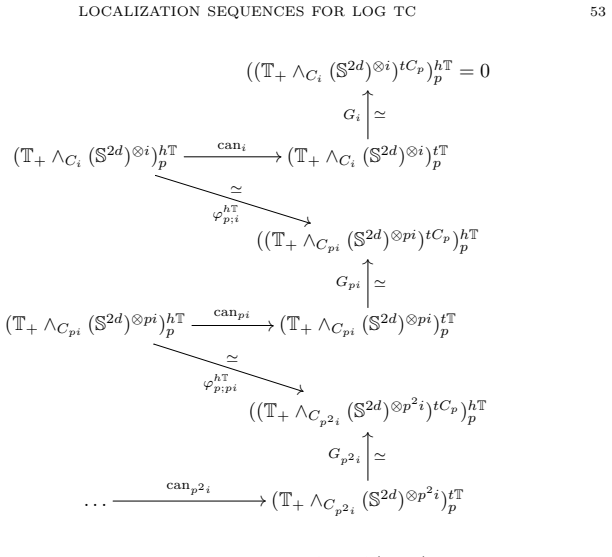
- For the non-negative even-periodic sphere spectrum $S[x]$ with its canonical prelog structure, the $p$-completed log TC is explicitly $\mathrm{TC}(\mathbb{S})_p[S^1] \vee \bigvee_{i>0} \Sigma((S^{2d})^{\otimes i})_{hC_i}$, making the invariants computationally accessible.
Reading between the lines
- Should the TC exactness premise hold generally, the cube construction would give localization sequences for every prelog $E_2$-ring over a cyclotomically good base, including examples built over $MU$ and over perfect fields; the paper proves the cyclotomic-good criterion only for a limited list, so this is an extension rather than a stated result.
- The identification of log THH as a Thom spectrum over the replete bar construction points toward a logarithmic prismatic cohomology via the even or motivic filtration; the paper names this as a future direction, so treating it as a consequence is an editorial extrapolation.
- The multi-generator example $\ell$ with $\langle p, v_1\rangle$ is cast as a model for the fraction field of topological $K$-theory; a natural next test is whether trace maps from algebraic $K$-theory into the log TC of that model reproduce the localization behavior conjectured from earlier calculations, a comparison the paper defers.
Editorial analysis
A structured set of objections, weighed in public.
Referee Report
Summary. The paper introduces R-based prelog E_k-rings using Picard-graded Thom spectrum functors, defines logarithmic topological Hochschild homology and logarithmic topological cyclic homology in this framework, and proves repletion–residue cofiber sequences relating THH(A) (respectively TC(A)_p) to the corresponding theories of the residue A//αbar. It establishes a multi-generator cube version, proves logification invariance, compares the new constructions with the authors' earlier point-set models, and computes the log THH and log TC of non-negative even-periodic sphere spectra. The main advertised applications are prelog structures on ku, ℓ, and BP⟨n⟩, and a model for the fraction field of topological K-theory.
Significance. If correct, the paper fills the missing localization terms for log TC, giving the first cyclotomic localization sequences in this context and extending the earlier non-cyclotomic results of [RSS15, RSS18]. The Picard-graded Thom spectrum framework is a genuine new construction rather than a repackaging, and the explicit log THH/log TC calculation for S[x] provides concrete, checkable output. The paper is very detailed: Thom spectrum adjunctions, weight-graded cyclotomic structures, and comparisons with point-set models are treated in depth, with the point-set comparisons relegated to appendices. The central TC exactness step is omitted from the text but is in fact valid; the reader's main concern therefore does not invalidate the claims, though it must be addressed in revision.
major comments (1)
- [Corollary 9.5 and Theorem 1.4] The TC repletion–residue sequence is obtained from Theorem 9.3 by the phrase 'Passing to TC', with no proof or citation of an exactness theorem. This is not immediate from the definition of TC as an equalizer, and the reader's concern is legitimate. The claim is nevertheless correct in the present ∞-categorical setting: by Definition 6.1, TC(−)_p is the equalizer of the two maps X^{hT}_p → (X^{tC_p})^{hT}_p, hence is the fiber of a natural transformation between exact functors on the stable ∞-category of p-cyclotomic spectra. The functor (−)^{hT} is a right adjoint, (−)^{tC_p} is the cofiber of the norm transformation between exact functors, and p-completion is a Bousfield localization, so the composite functors are exact. Since this exactness is the load-bearing premise for the main new TC statement, the paper should state and prove it, or give a precise reference, before Corollary 9.5 and in Example 10.8.
minor comments (3)
- [Theorem 11.7] The notation TC(S)[S^1] should be defined explicitly as TC(S) ∧ (S^1)_+ with S^1 carrying the trivial T-action; without this, the reader may confuse it with the circle action underlying TC.
- [Section 8.15 / Theorem 8.15] The proof of logification invariance refers to [RSS15, Thm. 4.24] and only sketches the modifications needed in the present ∞-categorical and Picard-graded setting; a fuller proof or a more precise statement of the transferred argument would improve clarity, although this comparison is not needed for the main localization theorem.
- [Introduction, diagram (1.2)] The statement that the lower right-hand square anti-commutes is announced only informally; since the same diagram reappears in Example 10.8, the sign convention should be recorded once in the formal statement as well.
Circularity Check
No significant circularity: the repletion–residue sequences for log THH and log TC are derived from new cofiber analyses and explicitly verified cyclotomic-good hypotheses, not from fitted inputs or author-forced uniqueness.
full rationale
The central repletion–residue cofiber sequence (Theorem 9.3) is not a repackaging of the paper's inputs. The repletion fiber THH_ξ(R) is introduced as the fiber of the weight-0 repletion map ρ0 (Definition 9.1), and Theorem 9.3 is then deduced from Proposition 9.9, whose content is that in positive weights the repletion map is an equivalence via Propositions 7.11 and 7.15 together with the weight decomposition of the cyclic and replete bar constructions, so that the cofiber of the total repletion map is identified with the suspension of the weight-0 fiber. The cyclotomically good condition is not assumed to hold by definition; Proposition 9.2 verifies it for R = S, MU, and perfect fields using external results (Lin80, Gun81, LNR11, HM03) after a T-equivariant identification of the repletion fiber in Proposition 9.21. The passage to TC in Corollary 9.5, though terse, is supported by Definition 6.1: TC(-)_p is displayed as an equalizer of exact functors on cyclotomic spectra, so it preserves cofiber sequences; this is a direct consequence of the equalizer formula rather than an imported self-citation. Citations to the authors' earlier work [Rog09, RSS15, RSS18] are used for comparison statements (Theorem 8.15, Appendix B, Corollary B.3) and for background on replete bar constructions, but the main repletion–residue statement does not reduce to those citations: the weight analysis, the cyclotomic structure of the repletion fiber, and the TC exactness are carried out in the present paper. There are no fitted parameters, no prediction that is forced by construction, and no uniqueness theorem from the authors is invoked to forbid alternatives. I therefore find no significant circularity.
Assumptions & free parameters
assumptions (5)
- standard math Infinity-categorical foundations of Lurie (Higher Algebra and Kerodon), including the theory of E_k-algebras and symmetric monoidal infinity-categories.
- standard math Dunn additivity [Lur17, Thm. 5.1.2.2].
- standard math Segal conjecture for cyclic groups [Lin80, Gun81, Car84, Rav84].
- standard math Bokstedt periodicity for perfect fields [HM03].
- standard math Group completion via reflective localization and the small object argument [Lur25].
Cite this review
Pith. "Pith review of Localization sequences for logarithmic topological cyclic homology." pith.science (2026). https://pith.science/paper/3EBUEZY7
@misc{pith2026250608492,
  author       = {Pith},
  title        = {Pith review of: Localization sequences for logarithmic topological cyclic homology},
  year         = {2026},
  howpublished = {\url{https://pith.science/paper/3EBUEZY7}},
  note         = {Machine review of arXiv:2506.08492}
}
read the original abstract
We introduce the notion of an E_k-ring with prelogarithmic structure, define logarithmic topological Hochschild homology and logarithmic topological cyclic homology in this context, and establish localization sequences for these theories. Our approach is based on Thom R-algebras. It extends and strengthens our earlier work on the subject in several regards. Our examples include the fraction field of topological K-theory, the existence of which was suggested by calculations by Ausoni and the first author. To illustrate the computational accessibility of log THH and log TC, we determine these for non-negative even periodic sphere spectra, with their canonical prelogarithmic structures.
Figures
Forward citations
Cited by 1 Pith paper
-
On the Residue Sequence in Logarithmic Topological Cyclic Homology
Logarithmic THH with a chosen direction is shown to be the same as the abstract cofiber of the transfer map, resolving a conjecture of Rognes.
Reference graph
Works this paper leans on
-
[622]
doi:10.1112/jtopol/jtr015. MR2832570 [LNR12] S. Lunøe-Nielsen and J. Rognes,The topological Singer construction, Doc. Math.17 (2012), 861–909. doi:10.4171/dm/384. MR3007679 [Lun25] T. Lundemo,On the residue sequence in logarithmic topological cyclic homology,
-
[1986]
With contributions by J. E. McClure doi:10.1007/BFb0075778. MR866482 [LNR11] S. Lunøe-Nielsen and J. Rognes,The Segal conjecture for topological Hochschild homology of complex cobordism, J. Topol.4(2011), no. 3, 591–
-
[2025]
Perfect even modules and the even filtration
In preparation. [Lur09] J. Lurie,Higher topos theory, Annals of Mathematics Studies, vol. 170, Princeton University Press, Princeton, NJ, 2009. doi:10.1515/9781400830558. MR2522659 60 JOHN ROGNES, STEFFEN SAGA VE, AND CHRISTIAN SCHLICHTKRULL [Lur15] J. Lurie,Rotation invariance in algebraicK-theory, 2015. Preprint,https://www. math.ias.edu/~lurie/papers/W...
work page Pith review arXiv 2018
Reviewed August 7, 2026 · model on record in the stance chip above.
Discussion (0). Sign in to comment.