REVIEW 3 major objections 6 minor 2 cited by
Catalog of very-high-energy emitting active galactic nuclei at high Galactic latitudes
T0 review · 3 major / 6 minor · reviewed 2026-08-07 · deepseek-v4-flash
Pith's one-line read The paper claims Fermi-LAT's 16-year exposure, searched for clusters of >100 GeV photons around 4FGL sources, yields a 90%-complete catalog of 275 very-high-energy AGN at high Galactic latitudes and an associated BL Lac luminosity…
desk verdict A substantial new VHE AGN catalog from 16 years of Fermi-LAT data, with an under-supported BL Lac luminosity function that needs more work before the population claims land. read the letter →
The pith
A machine-rendered reading of the paper's core claim, the machinery that carries it, and where it could break.
The reading
What carries the argument
The load-bearing object is the photon-cluster statistic: counting E>100 GeV photons within the 68% and 95% PSF containment circles around each 4FGL source, with an analytic chance-coincidence probability p1 ≈ 0.0122 per photon inside 0.1°, so that three photons already give a ~4σ detection. The catalog's population statement then rests on the broken power-law luminosity function dN/dL ∝ $L^{{-κ}}$ of BL Lacs, whose break at L* ≈ $10^{44}$ erg/s separates the flux-limited part of the sample from the intrinsically rare bright end.
What would settle it
Perform the same 16-year Fermi-LAT search without anchoring to 4FGL positions, i.e., look for any clusters of E>100 GeV photons at |b|>10° with no catalog counterpart. A population of such orphan clusters above the claimed 1.3×$10^{-12}$ erg/$cm^{2}$ s completeness limit would show the catalog is not the unbiased census it claims to be.
Extended reading notes
Core claim
Using the public Fermi-LAT data from September 2008 to March 2025, the paper searches for spatial clustering of photons with E>100 GeV around the positions of the 5071 4FGL sources at |b|>10°. A source is retained with high confidence when it has three or more photons inside the 68% PSF containment circle (chance probability ~1.8×$10^{-6}$), or two photons inside 68% plus one inside the 95% circle; weaker criteria select the 3σ sample. This yields 175 sources above 4σ and 100 above 3σ, of which only 71 were previously reported by IACTs. The authors argue the sample is an unbiased sky survey, 90% complete at 1.3×$10^{-12}$ erg/$cm^{2}$ s, and derive from the 233 BL Lacs a luminosity function dN/dL ∝ $L^{{-κ}}$ with a break from κ<2 to κ>2 at L* ≈ $10^{44}$ erg/s, corresponding to a spatial density (6.5±0.5)×$10^{-7}$ $Mpc^{-3}$. They also report seven sources at z>1 whose EBL-corrected spectra harden above 100 GeV, which they attribute either to wrong redshifts or to a factor-of-two overestimate of the high-redshift EBL opacity.
Load-bearing premise
Load-bearing premise: every VHE gamma-ray source in the field is bright enough in the 0.1–100 GeV band to be listed in the 4FGL catalog, since the cluster search is performed only around those positions; a VHE AGN population too faint in GeV would be absent from the survey and from the luminosity function.
Editorial extensions
If this is right
- The 275-source catalog gives current and next-generation IACT arrays a pre-vetted target list; a survey of all sources at about 50 hours each would cost roughly 1.4×10^4 hours, on the scale of a decade of allocated observation time.
- The BL Lac luminosity function implies a total VHE power injection of (1.41±0.11)×10^37 erg/s/Mpc^3, which extrapolated over a Hubble time reproduces the measured extragalactic gamma-ray background at 100 GeV.
- The 63 extreme blazars, 41 of them new, provide a much larger systematic sample for intergalactic magnetic field searches than the handful of sources previously studied in depth.
- The seven z>1 detections show that Fermi-LAT can find VHE sources beyond the gamma-ray horizon probed by current IACTs, and their spectral hardening in EBL-corrected spectra can be removed by halving the EBL optical depth at z≈1.5–2, within the stated uncertainty of the model.
Reading between the lines
- If the catalog is as complete as claimed, the historical IACT source list was strongly biased toward bright, nearby, hard-spectrum blazars; population models built on that anecdotal list would need to be redone with this survey-defined sample.
- The 4FGL-anchored search could miss a hypothetical class of 'orphan' VHE emitters, such as BL Lacs with steep GeV spectra or one-off flares; a blind cluster search would test this directly.
- The luminosity-function break at ~10^44 erg/s coincides with the typical divide between FR I and FR II radio galaxies; if some of the 20 unclassified AGN and blazar candidates are radio galaxies, the total VHE power of the radio-galaxy population, which the paper estimates may rival BL Lacs, could be constrained precisely.
- If the high-z hardening is genuine, VHE spectra of z>1 blazars could serve as a redshift-independent probe of EBL evolution, and the three sources with disputed redshifts (GB6 J0045+2127, Ton 0396, RBS 1432) are the ones to target with optical spectroscopy.
Editorial analysis
A structured set of objections, weighed in public.
Referee Report
Summary. The paper presents a catalog of very-high-energy (VHE, E>100 GeV) AGN at Galactic latitudes |b|>10 deg, constructed by searching for clusters of Fermi-LAT photons around positions of 4FGL sources. It reports 175 sources detected at >4 sigma and 100 additional sources at >3 sigma, with a claimed 90% completeness at a flux of 1.3e-12 erg/cm2/s. The catalog is used to derive a BL Lac luminosity function described as a broken power law with break at L* ~ 1e44 erg/s and normalization (6.5+/-0.5)e-7 Mpc^-3. The paper also discusses subsamples of radio galaxies, FSRQs, extreme blazars, high-redshift sources, and unidentified objects, and suggests applications for CTAO planning and EBL/IGMF studies.
Significance. If the catalog is reliable, it is a valuable resource: it provides a homogeneous, well-defined VHE AGN sample from 16 years of Fermi-LAT data, with explicit false-positive estimates, per-source spectra, and detailed discussion of high-redshift sources. It would be the first systematic VHE AGN catalog from a space-based instrument and could guide CTAO observations and EBL/IGMF studies. The luminosity-function claim, if substantiated, would be an important population measurement. However, the LF analysis is currently underdocumented and the 'unbiased survey' claim is not fully supported, so the quantitative population results should be treated with caution until the analysis is described in detail.
major comments (3)
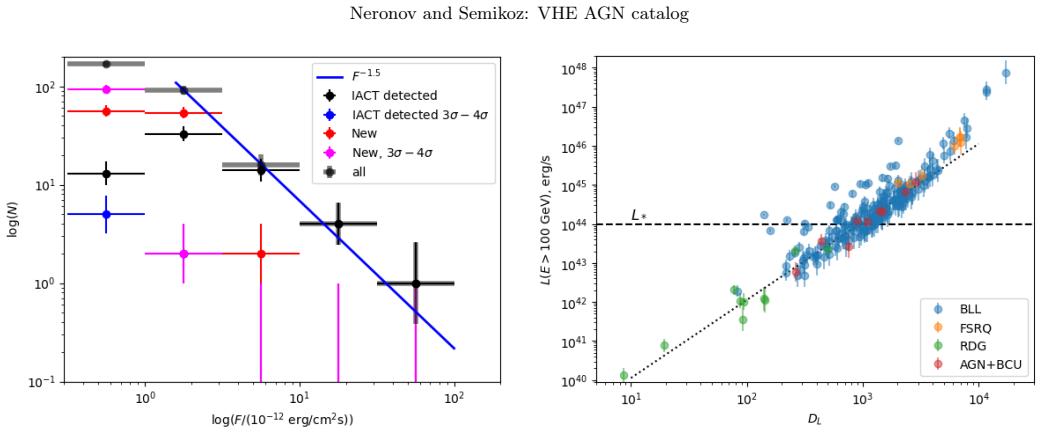
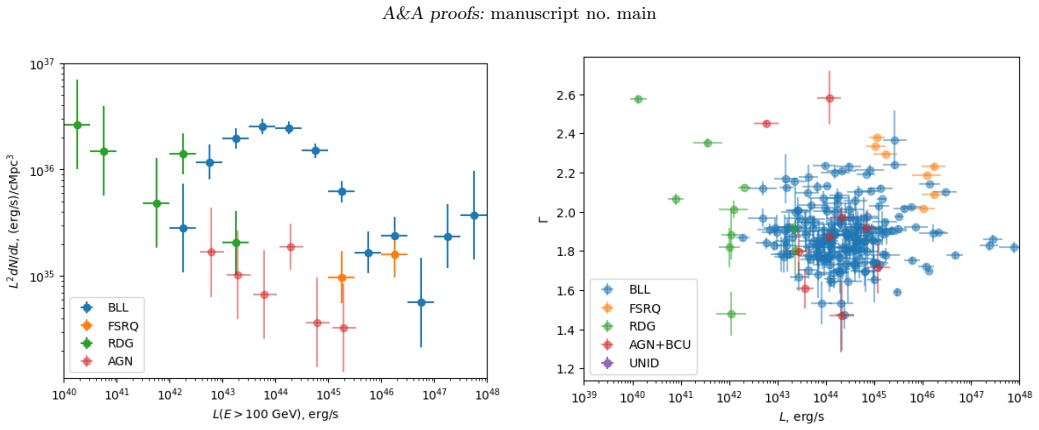
- [Sec. 3.2, Figs. 3 and 4] The broken-power-law BL Lac luminosity function quoted in the abstract and in Sec. 3.2 is not substantiated. The paper gives no LF estimator, no completeness correction, and no treatment of the many sources with z=-1 in Tables 1-4. If missing-redshift sources are omitted from the luminosity-volume bins, the derived normalization (6.5+/-0.5)e-7 Mpc^-3 and the break at L*~1e44 erg/s are biased, because the omitted sources are preferentially fainter or more distant. The argument in the text that the low-luminosity deficit is not a sensitivity effect (based on Fig. 3) applies only to the redshift-known subset. Please provide a quantitative LF derivation, including the redshift-completeness correction, the EBL correction, and the assumed density evolution (or justify the no-evolution assumption).
- [Sec. 2 and Sec. 3.1] The claim in Sec. 3.1 that the catalog provides a sky survey 'not biased by selection effects' is contradicted by the search procedure described in Sec. 2, which uses positions of sources from the 4FGL catalog as priors. The parent sample is GeV-selected, so VHE AGN too faint in the 0.1-100 GeV band to enter 4FGL are missed. This selection effect should be quantified (e.g., by an estimate of the fraction of VHE sources missing from 4FGL, or a comparison with a blind search) and propagated into the completeness and LF claims.
- [Sec. 3.1] The 90% completeness limit at F=1.3e-12 erg/cm2/s is derived from a single average photon count assuming E=100 GeV and simplified Monte Carlo. This does not account for the distribution of spectral indices or the energy dependence of the PSF and effective area. Because the detection thresholds use fixed 0.1 and 0.4 degree apertures, hard-spectrum sources (more photons at high energy, better PSF) are favored over soft-spectrum sources at equal flux. Please quantify the spectral-index dependence of the completeness and the resulting selection function.
minor comments (6)
- [Sec. 2 and Sec. 3.1] Typo: 'probability to fine one photon' should read 'probability to find one photon'; also 'simulaitons' in Sec. 3.1 should be 'simulations'.
- [Sec. 3.3 and Discussion] The number of extreme blazars is given as 63 in the abstract and Sec. 3.3 (22 previously known + 41 new), but the Discussion states 49. Please reconcile.
- [Tables 1-4] The tables use z=-1 for missing redshifts, but this is not explained in the table captions or text. Add a footnote describing the convention and stating the number of sources without redshifts.
- [Sec. 3.2] Fig. 4 does not show error bars or the broken-power-law fit; please show the data with uncertainties and the fit curve, and report the fit parameters (kappa1, kappa2, L*, Phi*) with uncertainties.
- [Sec. 3.5] Typo: 'PSK 0454-234' should be 'PKS 0454-234'.
- [Sec. 3.6] In the paragraph on 4FGL J1955.3-5032, the source name is written 'FGL J1955.3-5032'; the prefix should be '4FGL'.
Circularity Check
No significant circularity: the VHE AGN catalog is an empirical event-clustering sample and the BL Lac luminosity function is a fit to the resulting measured fluxes, not an input to the derivation.
full rationale
The central derivation is empirical. Section 2 constructs the catalog by clustering Fermi-LAT events above 100 GeV around 4FGL source positions using fixed angular radii (0.1 and 0.4 degrees) and Poisson chance probabilities; fluxes are then measured with the Fermi Science Tools using aperture photometry. The completeness estimate is derived from the mean exposure and a Monte Carlo simulation, not from the luminosity function. In Section 3.2, the BL Lac luminosity function is presented as a broken power-law fit to luminosities computed from the measured fluxes, redshifts, Planck 2018 cosmology, and the external EBL model of Saldana-Lopez et al. (2021). No fitted parameter is fed back into the source selection or flux measurement, and no conclusion is forced by a definition. The paper does omit a description of the LF estimator and redshift-incompleteness corrections, which is a methodological or correctness gap rather than circularity: the LF is a descriptive fit to data, not a prediction generated from the same inputs. The sample is GeV-selected because the search is restricted to 4FGL sources, so a population of VHE AGN too faint at lower energies would be missed; this is a selection bias, not a self-referential reduction. Self-citations (e.g., Neronov et al. 2011, 2015; Neronov & Vovk 2010; Neronov & Semikoz 2009) appear as background context for IGMF and neutrino studies and are not load-bearing for the catalog construction or the luminosity function. Therefore no circular step can be exhibited, and the circularity score is 0.
Assumptions & free parameters
free parameters (4)
- L* (characteristic luminosity of BL Lac luminosity function) =
~10^44 erg/s
- kappa1 (LF slope below break) =
not quoted (stated as <2)
- kappa2 (LF slope above break) =
not quoted (stated as >2)
- Phi* (normalization / spatial density) =
6.5e-7 Mpc^-3, statistical error 0.5e-7
assumptions (5)
- domain assumption The 4FGL source catalog provides the complete parent population of VHE AGN in the survey region.
- domain assumption The PSF containment radii R68 and R95 of Fermi-LAT P8R3_SOURCEVETO_V3 are correct and energy-independent in the analysis bins.
- domain assumption The EBL model of Saldana-Lopez et al. (2021) describes the gamma-ray attenuation for luminosity and spectral correction.
- standard math Planck 2018 cosmological parameters are used for luminosity distance.
- domain assumption Source classifications (BLL, FSRQ, RDG) from 4FGL and SIMBAD are correct.
Cite this review
Pith. "Pith review of Catalog of very-high-energy emitting active galactic nuclei at high Galactic latitudes." pith.science (2026). https://pith.science/paper/44UDIUC6
@misc{pith2026250608497,
  author       = {Pith},
  title        = {Pith review of: Catalog of very-high-energy emitting active galactic nuclei at high Galactic latitudes},
  year         = {2026},
  howpublished = {\url{https://pith.science/paper/44UDIUC6}},
  note         = {Machine review of arXiv:2506.08497}
}
read the original abstract
Large number of Active Galactic Nuclei (AGN) producing Very-High-Energy (VHE) gamma-rays (energies above 100~GeV) has been revealed using observations with Imaging Atmospheric Cherenkov Telescopes (IACTs). However, our knowledge of the VHE emitting AGN population is limited in the absence of an unbiased sky survey. We use long exposure of Fermi Large Area Telescope (LAT) to perform a survey of VHE emitting AGN at Galactic latitudes |b|>10 degrees. We consider clustering of gamma-ray events with energies E>100 GeV around positions of AGN from the 4-th LAT source catalog to select sources detected in the VHE range. The VHE AGN catalog produced in this way contains overall 175 sources detected with high confidence and additional 100 sources detected at more than 3-sigma level. It is 90% complete at the flux limit 1.3e-12 erg/cm2s. Less than half of the source sample (71) are previously reported VHE emitters, other sources are new detections in the VHE band. The majority of VHE AGN detectable at the survey flux limit are BL Lac type objects. We find their luminosity function to derive their spatial density (6.5+/-0.5)e-7/ Mpc3 and the characteristic luminosity scale ~1e44 erg/s. Ten sources in the VHE AGN catalog are nearby radio galaxies and seven are flat spectrum radio quasars, while 20 sources are unclassified AGN. We also include in our catalog four unidentified sources that may or may not be VHE AGN. 63 source in the catalog are "extreme" blazars, with 41 of them being new VHE band detections. In spite of the fact that the VHE flux is heavily attenuated by the pair production in interactions with Extragalactic Background Light (EBL), the catalog includes 7 sources at redshift larger than 1. Some of these sources show peculiar hardening of the VHE band spectra that point either to errors in redshift determination, or to limitations of modeling of cosmological evolution of EBL.
Figures

Figures from the paper (5 more)


Forward citations
Cited by 2 Pith papers
-
Fermi-Large Area Telescope Detection of Very High Energy (>100 GeV) Emission from Compton-Dominated Blazars
Systematic Fermi-LAT search detects VHE emission from 14 Compton-dominated blazars (4 new at >5σ) and constrains the emitting region to >1.1–1.4 BLR radii.
-
Revision of conservative lower bound on the intergalactic magnetic field from Fermi and Cherenkov telescope observations of extreme blazars
Non-observation of delayed gamma-ray cascades from seven extreme blazars sets a conservative lower bound B > 2.1 x 10^-17 G on the intergalactic magnetic field, with 1ES 0502+675 giving the tightest constraint.
Reference graph
Works this paper leans on
-
[1]
, " * write output.state after.block = add.period write newline
ENTRY address archiveprefix author booktitle chapter edition editor howpublished institution eprint journal key month note number organization pages publisher school series title type volume year label extra.label sort.label short.list INTEGERS output.state before.all mid.sentence after.sentence after.block FUNCTION init.state.consts #0 'before.all := #1 ...
-
[2]
write newline
" write newline "" before.all 'output.state := FUNCTION n.dashify 't := "" t empty not t #1 #1 substring "-" = t #1 #2 substring "--" = not "--" * t #2 global.max substring 't := t #1 #1 substring "-" = "-" * t #2 global.max substring 't := while if t #1 #1 substring * t #2 global.max substring 't := if while FUNCTION word.in bbl.in " " * FUNCTION format....
-
[3]
Aartsen, M. G. et al. 2017, Astrophys. J., 835, 45
work page 2017
-
[4]
Aartsen, M. G. et al. 2018, Science, 361, 147
work page 2018
-
[5]
Abazajian, K. N. et al. 2009, Astrophys. J. Suppl., 182, 543
2009
-
[6]
A., Agudo , I., Aniello , T., et al
Acciari , V. A., Agudo , I., Aniello , T., et al. 2023, , 670, A145
work page 2023
-
[7]
A., Aliu , E., Arlen , T., et al
Acciari , V. A., Aliu , E., Arlen , T., et al. 2010, , 715, L49
2010
-
[8]
A., Ansoldi , S., Antonelli , L
Acciari , V. A., Ansoldi , S., Antonelli , L. A., et al. 2020, , 247, 16
2020
Show all 63 references
-
[9]
B., Archer , A., et al
Acharyya , A., Adams , C. B., Archer , A., et al. 2023, , 954, 70
2023
-
[10]
2015, , 799, 86
Ackermann , M., Ajello , M., Albert , A., et al. 2015, , 799, 86
2015
-
[11]
2002, , 384, L23
Aharonian , F., Akhperjanian , A., Barrio , J., et al. 2002, , 384, L23
2002
-
[12]
G., Anton , G., et al
Aharonian , F., Akhperjanian , A. G., Anton , G., et al. 2010, , 521, A69
2010
-
[13]
G., Bazer-Bachi , A
Aharonian , F., Akhperjanian , A. G., Bazer-Bachi , A. R., et al. 2006, , 440, 1018
2006
-
[14]
2023, , 950, L16
Aharonian , F., Aschersleben , J., Backes , M., et al. 2023, , 950, L16
2023
-
[15]
2015, , 800, L27
Ajello , M., Gasparrini , D., S \'a nchez-Conde , M., et al. 2015, , 800, L27
2015
-
[16]
D., Allende Prieto , C., Almeida , A., et al
Albareti , F. D., Allende Prieto , C., Almeida , A., et al. 2017, , 233, 25
2017
-
[17]
R., et al
Albert , A., Alvarez , C., Angeles Camacho , J. R., et al. 2021, , 907, 67
2021
-
[18]
B., Abdo , A
Atwood , W. B., Abdo , A. A., Ackermann , M., et al. 2009, , 697, 1071
2009
-
[19]
H., & Lott, B
Ballet, J., Bruel, P., Burnett, T. H., & Lott, B. 2023 [ [arXiv] 2307.12546 ]
2023 arXiv
-
[20]
2011, in International Cosmic Ray Conference, Vol
Benbow , W. 2011, in International Cosmic Ray Conference, Vol. 8, International Cosmic Ray Conference, 51
2011
-
[21]
2024, , 271, 25
Cao , Z., Aharonian , F., An , Q., et al. 2024, , 271, 25
2024
-
[22]
L., Arsioli , B., Giommi , P., Padovani , P., & Brandt , C
Chang , Y. L., Arsioli , B., Giommi , P., Padovani , P., & Brandt , C. H. 2019, , 632, A77
2019
-
[23]
S., Agudo , I., et al
Cherenkov Telescope Array Consortium , Acharya , B. S., Agudo , I., et al. 2019, Science with the Cherenkov Telescope Array
2019
-
[24]
& CTAO LST Collaboration
Cortina , J. & CTAO LST Collaboration . 2023, The Astronomer's Telegram, 16381, 1
2023
-
[25]
Dom\' nguez, A. et al. 2023, Mon. Not. Roy. Astron. Soc., 527, 4632
2023
-
[26]
1998, , 299, 433
Fossati , G., Maraschi , L., Celotti , A., Comastri , A., & Ghisellini , G. 1998, , 299, 433
1998
-
[27]
& Rodighiero , G
Franceschini , A. & Rodighiero , G. 2017, , 603, A34
2017
-
[28]
2019, , 157, 41
Furniss , A., Worseck , G., Fumagalli , M., et al. 2019, , 157, 41
2019
-
[29]
H. E. S. S. Collaboration , Aharonian , F., Ait Benkhali , F., et al. 2025, , 695, A261
2025
-
[30]
2019, in Bulletin of the American Astronomical Society, Vol
Huentemeyer , P., BenZvi , S., Dingus , B., et al. 2019, in Bulletin of the American Astronomical Society, Vol. 51, 109
2019
-
[31]
G., Ackermann , M., et al
IceCube Collaboration , Aartsen , M. G., Ackermann , M., et al. 2018, Science, 361, eaat1378
2018
-
[32]
D., et al
Kerby , S., Kaur , A., Falcone , A. D., et al. 2021, , 923, 75
2021
-
[33]
& Pita , S
Lefaucheur , J. & Pita , S. 2017, , 602, A86
2017
-
[34]
W., Higley , A
Lyke , B. W., Higley , A. N., McLane , J. N., et al. 2020, , 250, 8
2020
-
[35]
Mao , L. S. 2011, , 16, 503
2011
-
[36]
2019, in International Cosmic Ray Conference, Vol
Mart \' nez-Huerta , H., Biteau , J., Lefaucheur , J., et al. 2019, in International Cosmic Ray Conference, Vol. 36, 36th International Cosmic Ray Conference (ICRC2019), 739
2019
-
[37]
2014, The Astronomer's Telegram, 6062, 1
Mirzoyan , R. 2014, The Astronomer's Telegram, 6062, 1
2014
-
[38]
M., & Vovk , I
Neronov , A., Semikoz , D., Taylor , A. M., & Vovk , I. 2015, , 575, A21
2015
-
[39]
2011, , 529, A59
Neronov , A., Semikoz , D., & Vovk , I. 2011, , 529, A59
2011
-
[40]
& Semikoz , D
Neronov , A. & Semikoz , D. V. 2009, , 80, 123012
2009
-
[41]
& Semikoz, D
Neronov, A. & Semikoz, D. V. 2012, Astrophys. J., 757, 61
2012
-
[42]
V., & Ptitsyna, K
Neronov, A., Semikoz, D. V., & Ptitsyna, K. 2017, Astron. Astrophys., 603, A135
2017
-
[43]
& Vovk , I
Neronov , A. & Vovk , I. 2010, Science, 328, 73
2010
-
[44]
Neronov, A. Y. & Semikoz, D. V. 2002, Phys. Rev. D, 66, 123003
2002
-
[45]
2024, , 691, A154
Nilsson , K., Fallah Ramazani , V., Lindfors , E., et al. 2024, , 691, A154
2024
-
[46]
2019, Mon
Oikonomou, F., Murase, K., Padovani, P., Resconi, E., & M\'esz\'aros, P. 2019, Mon. Not. Roy. Astron. Soc., 489, 4347
2019
-
[47]
S., \'A lvarez Crespo , N., et al
Olmo-Garc \' a , A., Paliya , V. S., \'A lvarez Crespo , N., et al. 2022, , 516, 5702
2022
-
[48]
2022, Mon
Padovani, P., Boccardi, B., Falomo, R., & Giommi, P. 2022, Mon. Not. Roy. Astron. Soc., 511, 4697
2022
-
[49]
2019, Mon
Padovani, P., Oikonomou, F., Petropoulou, M., Giommi, P., & Resconi, E. 2019, Mon. Not. Roy. Astron. Soc., 484, L104
2019
-
[50]
2020, , 497, 94
Paiano , S., Falomo , R., Treves , A., & Scarpa , R. 2020, , 497, 94
2020
-
[51]
2017, , 837, 144
Paiano , S., Landoni , M., Falomo , R., et al. 2017, , 837, 144
2017
-
[52]
2017, Astrophys
Paiano, S., Landoni, M., Falomo, R., et al. 2017, Astrophys. J., 837, 144
2017
-
[53]
S., Dom\' nguez, A., Ajello, M., Olmo-Garc\' a, A., & Hartmann, D
Paliya, V. S., Dom\' nguez, A., Ajello, M., Olmo-Garc\' a, A., & Hartmann, D. 2021, Astrophys. J. Suppl., 253, 46
2021
-
[54]
2020, , 641, A6
Planck Collaboration , Aghanim , N., Akrami , Y., et al. 2020, , 641, A6
2020
-
[55]
& Ghisellini , G
Prandini , E. & Ghisellini , G. 2022, Galaxies, 10, 35
2022
-
[56]
2022, Mon
Sahakyan, N., Giommi, P., Padovani, P., et al. 2022, Mon. Not. Roy. Astron. Soc., 519, 1396
2022
-
[57]
G., et al
Saldana-Lopez , A., Dom \' nguez , A., P \'e rez-Gonz \'a lez , P. G., et al. 2021, , 507, 5144
2021
-
[58]
S., Romani, R
Shaw, M. S., Romani, R. W., Cotter, G., et al. 2013, Astrophys. J., 764, 135
2013
-
[59]
Sol, H. et al. 2013, Astropart. Phys., 43, 215
2013
-
[60]
2024, , 530, 4626
Ulgiati , A., Paiano , S., Treves , A., et al. 2024, , 530, 4626
2024
-
[61]
V \'e ron-Cetty , M. P. & V \'e ron , P. 2010, , 518, A10
2010
-
[62]
2022, , 936, 146
Xiao , H., Fan , J., Ouyang , Z., et al. 2022, , 936, 146
2022
-
[63]
2025, Chinese Physics C, 49, 035001
Zhang , Z., Yang , R., Zhang , S., et al. 2025, Chinese Physics C, 49, 035001
2025
Reviewed August 7, 2026 · model on record in the stance chip above.
Discussion (0). Sign in to comment.