REVIEW 4 major objections 6 minor 53 references
Strong coupling and interfering resonances in isolated van der Waals nanoresonators
T0 review · 4 major / 6 minor · reviewed 2026-08-07 · deepseek-v4-flash
Pith's one-line read A single WS2 nanodisk supports a polaritonic quasi-bound state in the continuum and couples to its intrinsic exciton with a Rabi splitting exceeding 310 meV, the largest reported among self-hybridized TMDC systems.
desk verdict A convincing new combination of qBIC and self-hybridized exciton in an isolated WS₂ nanodisk, but the record 310 meV splitting is fitted, not measured, so referee it with a demand for a 3×3 model check. read the letter →
The pith
A machine-rendered reading of the paper's core claim, the machinery that carries it, and where it could break.
The reading
What carries the argument
The load-bearing object is the polaritonic quasi-BIC: a high-Q resonance in a single WS2 nanodisk created by Friedrich–Wintgen interference between two vectorial Mie modes, which then strongly couples to the disk's in-plane A exciton. The quantitative engine is the non-Hermitian coupled-oscillator Hamiltonian of Eq. (1), with coherent coupling $g$ and a cross-damping term $\gamma_c$; the cross-damping, related to $g$ by a Kramers–Kronig relation, produces subradiant and superradiant hybrid modes, and the subradiant high-Q branch is the qBIC. The same 2x2 Hamiltonian, applied separately to the HQ–exciton and LQ–exciton pairs with couplings of 150 and 140 meV, reproduces the simulated dispersions and linewidths, and the fitted Fano formula extracts the Q-factors from the scattering spectra.
What would settle it
Take a fabricated WS2 disk with radius near 140 nm and record scattering spectra at fine wavelength steps under azimuthally polarized excitation; fit the two polariton branches with a single three-mode non-Hermitian Hamiltonian (two Mie modes plus the A exciton) and report parameter uncertainties. If the best-fit Rabi splitting deviates from 310 meV by more than the fit uncertainty, or if the apparent avoided crossing disappears when the disk radius is swept through the resonance, the headline claim is not established.
Extended reading notes
Core claim
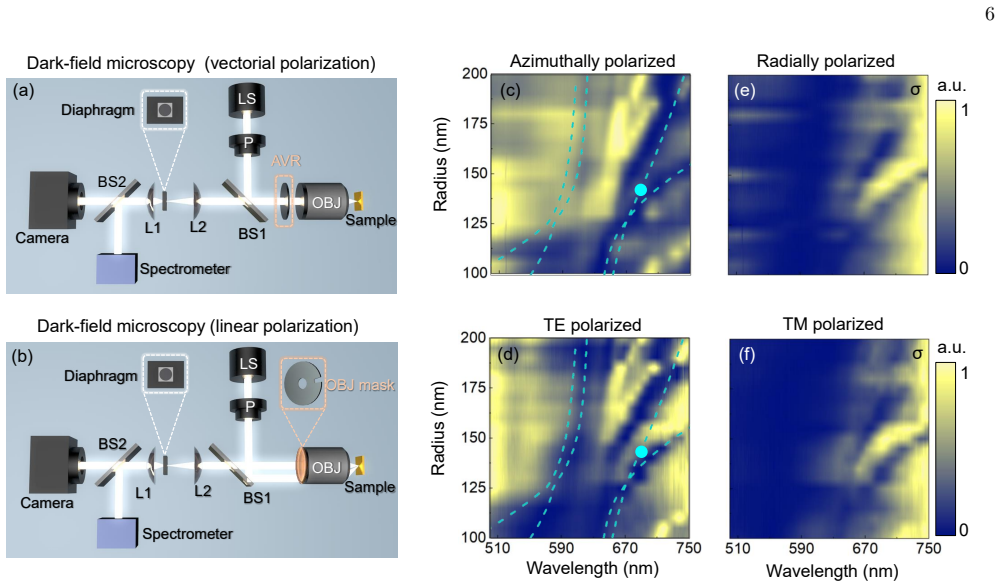
The central claim is that polaritonic quasi-bound states in the continuum exist in isolated WS2 nanodisks and arise from intrinsic, self-hybridized coupling rather than from an externally added cavity. Two vectorial Mie resonances of the disk interfere to form a Friedrich–Wintgen qBIC, a high-Q resonance formed by interference of two broad modes that would otherwise radiate away. That qBIC couples to the material's A exciton (its lowest bound electron-hole pair), and the coupled-oscillator analysis assigns 150 meV coupling to the HQ–exciton pair and 140 meV to the LQ–exciton pair, producing Rabi splittings of 310 and 280 meV, respectively. The larger value is reported as the largest among self-hybridized TMDC systems. Both azimuthally polarized and TE-polarized oblique excitation excite the polaritonic qBIC, while the orthogonal radial and TM polarizations do not, so the incident polarization state selects whether the qBIC appears.
Load-bearing premise
The 310 meV splitting assumes the two independent 2x2 coupled-oscillator fits (150 and 140 meV coupling, with cross-damping) are the correct and unique description; without a quantified three-mode fit or a fully resolved experimental avoided crossing, the reported value could differ.
Editorial extensions
If this is right
- The same platform should reach the strong-coupling regime in a single subwavelength disk without external cavities, making the resonator itself the active material and eliminating transfer-induced interfacial losses.
- Polarization becomes a post-fabrication control knob: azimuthal or TE excitation activates the polaritonic qBIC, while radial or TM excitation suppresses it, enabling switching of the hybrid states' spectral and spatial character without changing the structure.
- Because the qBIC suppresses radiative loss and produces in-plane field enhancement, the hybrid states combine high Q with strong coupling in a compact footprint, which the authors connect to room-temperature polariton lasers, nonlinear switches, and quantum emitters.
- The TE oblique-incidence route offers a simpler experimental geometry than vectorial beams for observing self-hybridized polaritonic qBICs in other labs.
Reading between the lines
- A testable extension: the same two-Mie-mode interference recipe should transfer to other TMDC disks (MoS2, WSe2) by tuning radius and substrate phase to place the qBIC on their exciton lines.
- The reported near-field enhancement (above 40 for electric, above 100 for magnetic) suggests the same disks could boost nonlinear or single-photon processes; a pump-probe or second-harmonic measurement would test this directly.
- Because the paper models the system as two independent 2x2 Hamiltonians, a global three-mode fit to the same spectra could refine or alter the 310 meV value; this check is not present in the paper.
- Polarization-selective qBIC activation could become a dynamical switch if the incident polarization is modulated in time; the static measurements here leave that step open.
Editorial analysis
A structured set of objections, weighed in public.
Referee Report
Summary. The manuscript reports the first observation of polaritonic quasi-bound states in the continuum (qBICs) in isolated WS2 nanodisks, formed by Friedrich–Wintgen interference between two vectorial Mie modes and subsequent self-hybridization with the intrinsic A exciton. The authors present full-wave simulations showing an avoided crossing between high-Q and low-Q photonic branches, a maximum Q factor of about 160 at r=140 nm, and simulated scattering maps with four hybrid branches under azimuthal and TE excitation. They fit these branches with independent 2x2 coupled-oscillator Hamiltonians and claim Rabi splittings of 310 meV and 280 meV for the HQ-exciton and LQ-exciton pairs, respectively. Dark-field scattering measurements under azimuthal, radial, TE, and TM excitation are compared with the theoretical dispersion curves. The central quantitative claim is that the system exhibits a measured Rabi splitting exceeding 310 meV, the largest reported among TMDC self-hybridized systems, with polarization-selective excitation of the polaritonic qBIC.
Significance. If the central claim is correct, the paper would establish a new platform for self-hybridized strong coupling in isolated subwavelength resonators and a record splitting for TMDC systems. The paper has several concrete strengths: the full-wave simulations are systematic in radius and polarization, the qBIC interpretation is supported by a clear avoided crossing and a high-Q branch, the non-Hermitian Hamiltonian including a cross-damping term is explicit, and the experimental section includes polarization-resolved dark-field measurements of fabricated nanodisks. The main value of the result, however, depends on whether the 310 meV splitting is a robust, model-independent observable. As presented, that number is an output of fitted 2x2 Hamiltonians and is not directly extracted from the measured spectra with quantified uncertainty. The structural observation of polaritonic qBICs is credible; the record-number claim needs additional support.
major comments (4)
- [II (Results), Eq. (1) and Fig. 3(c)] The 310 meV Rabi splitting is not a directly measured observable. It is obtained from the coupled-oscillator Hamiltonian in Eq. (1) with coupling energies hbar*g = 150 meV and 140 meV that are fitted to the simulated scattering spectra, and the statement that the calculated dispersion 'aligns well' with the simulated branches is circular in the operational sense: the same data set supplied the fitted parameters. Please provide a quantitative goodness-of-fit, parameter uncertainties, and an independent consistency check (for example, direct extraction of the upper and lower branch separation at zero detuning from the simulated spectra, or a comparison with a different observable such as extinction or near-field spectra) before retaining the wording 'measured Rabi splitting exceeding 310 meV' in the abstract and conclusions.
- [II (Results), paragraph after Fig. 3(b)] The assertion that the LQ and HQ modes couple separately to the A exciton, rather than forming a three-mode hybridization among two Mie modes and the exciton, is not proven. The text states this conclusion and then supports it by reproducing the branches with two independent 2x2 Hamiltonians, but two 2x2 models can always be made to follow two selected branches. The absence of a third branch in the simulations needs to be demonstrated, for example by fitting the simulated spectra with the full 3x3 non-Hermitian Hamiltonian that includes both Mie modes, the exciton, and the cross-damping terms, and by showing that the lower two branches and the extracted splittings are unchanged. If the 3x3 model gives a materially different splitting, the headline number would be model-dependent and would require revision.
- [IV (Methods) and Fig. 4] The experimental validation is qualitative. The measured scattering maps in Fig. 4(c,d) are compared visually with the overlaid theoretical dispersion curves; no measured peak positions are fitted, no confidence intervals or error bars are given, and the Methods section explicitly states that simulated and measured peak positions differ because of fabrication imperfections such as inclined disk walls. The experiments are therefore consistent with the existence of hybridized branches, but they do not currently quantify a 'measured Rabi splitting exceeding 310 meV.' Either present a quantitative fit of the measured anti-crossing with uncertainties, or reformulate the experimental claim as a consistency check and assign the 310 meV value to the simulation-based model.
- [Supporting Information, Sec. 2] The input parameters for the photonic part of the Hamiltonian are not derived from an independent calculation. The Supporting Information states that the Mie-mode resonance wavelengths are approximated by fitting the spectra at detunings far from zero and that the linewidths are assumed to vary linearly with radius. These assumptions directly affect the extracted coupling energies, yet their influence on hbar*g and on the resulting Rabi splitting is not discussed. Please state how the extracted 150 meV and 140 meV values change under reasonable alternative parametrizations of the Mie-mode dispersions and damping rates.
minor comments (6)
- [Fig. 1 caption] The word 'penel' should be 'panel' in the Fig. 1(b) caption.
- [Title page and abstract] The title contains a spacing artifact: 'nanore sonators' should read 'nanoresonators'; please correct the title and check the metadata for similar artifacts.
- [Fig. 4 caption] The caption states that dashed cyan lines in panels (a) and (b) indicate theoretical calculations, but the theoretical overlays appear in the experimental panels (c) and (d); please correct the panel references.
- [II (Results), Sec. IV (Methods)] The text refers to 'isolated' nanodisks, while the Supporting Information shows arrays of nanodisks. Please clarify whether the optical measurements were performed on individual nanodisks from the arrays or on arrays, and state the relevant array period if the latter applies.
- [IV (Methods), optical characterization] The two experimental setups are described in detail, but no calibration or uncertainty analysis is given for the scattering normalization procedure; a sentence on the reproducibility of the measured spectra across nominally identical nanodisks would be useful for judging the experimental scatter.
- [Abstract and Conclusions] The abstract says the Rabi splitting is 'measured,' whereas the body text says the splitting is obtained from the coupled-oscillator model fitted to simulations; please make the wording consistent throughout.
Circularity Check
The 310 meV 'measured' Rabi splitting is a fitted 2x2-model parameter, and the no-three-mode-hybridization conclusion is validated by a model that assumes it.
-
fitted input called prediction
[Section II, Fig. 3(c) and following text]
"Figure 3(c) demonstrates that when the HQ-exciton and LQ-exciton coupling strengths were set to 150 meV and 140 meV respectively, the calculated dispersion relations (solid lines) align well with the simulated scattering spectrum obtained from numerical fitting (dots). In this case, the corresponding Rabi splittings reach ℏΩ1 = 310 meV and ℏΩ2 = 280 meV, respectively, with the formation of a polaritonic qBIC on HQ-exciton hybrid branch (the cyan dot)."
The coupling strengths g=150 and 140 meV are not derived or predicted; they are 'set' so that the model aligns with the already-fitted simulated branches. The Rabi splittings Ω1=310 meV and Ω2=280 meV are then read out of the diagonalized 2x2 Hamiltonians. Thus the headline number is an algebraic transform of the fit parameter, not an independent output. Calling it 'measured' in the abstract and conclusions transfers a fitted simulation parameter to an experimental claim. The same fit-then-reproduce pattern is admitted for the Mie-Mie couplings: 'By solving Eq. 1 with optimized coupling energy ℏg = 30 meV and the cross-damping term ℏγc= 36 meV, we excellently reproduce both the dispersion and the spectral width of the two branches obtained by the above mentioned fitting procedure.'
-
self definitional
[Section II, paragraph before Fig. 3(c) and coupled-resonator model]
"We emphasize that, regardless of whether vectorial light or linearly polarized light is used, the LQ mode and HQ mode couple separately with the A excitons, rather than forming a three-mode hybridization between two vectorial Mie modes and the exciton (which would exhibit three branches). Our conclusion is further validated by a coupled resonator model, which employs two 2 ×2 coupled Hamiltonians (Eq. 1)."
The validating model is constructed as two independent 2x2 Hamiltonians, i.e., it assumes by construction exactly the conclusion being tested: that LQ and HQ couple separately to the exciton and no three-mode hybridization occurs. Reproducing the fitted simulated branches with this model therefore cannot be independent evidence for the claim. A 3x3 non-Hermitian model containing cross-couplings among both Mie modes and the exciton is never formulated or fitted, so the paper does not rule out the alternative it dismisses. The conclusion is an input of the model, not a result of it.
1 more flagged steps
-
fitted input called prediction
[Abstract; Section IV.C and Fig. 4]
"The system exhibits exceptionally strong light-matter interaction with a measured Rabi splitting exceeding 310 meV - the largest reported value among all transition metal dichalcogenide (TMDC) self-hybridized systems to date."
The only 310 meV value produced in the paper is the coupled-oscillator output of the fitted 150 meV coupling strength (Fig. 3c). The experimental section does not independently fit the measured spectra; it states that 'the theoretical dispersion relations derived from the coupled-resonator model (cyan curves) were overlaid onto the measured scattering spectra, revealing a quantitative agreement between measured spectral features and calculated eigenmode solutions.' Since no experimental splitting is extracted from the data, presenting the model-fit value as a 'measured Rabi splitting' renames the fitted parameter as an observable.
full rationale
Two load-bearing reductions are present. First, the quantitative centerpiece (310 meV record) is a fitted parameter of an effective Hamiltonian: the coupling strengths are set to match simulated branches, and the Rabi splitting is read from the same Hamiltonian. The experimental spectra are compared only by overlay, so 'measured' is a label applied to a fit output; this is fitted-input-called-prediction. Second, the paper's defense of its two-2x2 model against the 3-mode alternative is self-definitional: the model that 'validates' the conclusion is built to contain that conclusion, and no 3x3 model is tested. These issues make the record claim conditional rather than self-contained. However, the core observations of polaritonic qBIC excitation, four-branch anti-crossing, and polarization-selective activation are supported by simulations and dark-field measurements and are not themselves circular. Self-citations (Refs. 16-18, 20, 27, 37-39) are used for context and comparison, not as the load-bearing proof of the qBIC mechanism, so they do not raise the score further. Score 6 reflects partial circularity: the headline number reduces by construction to fitted inputs while the qualitative phenomenology retains independent content.
Assumptions & free parameters
free parameters (4)
- Coherent coupling energy hbar*g between Mie modes =
30 meV
- Cross-damping term hbar*gamma_c =
36 meV
- HQ-exciton coupling strength =
150 meV
- LQ-exciton coupling strength =
140 meV
assumptions (4)
- domain assumption Two vectorial Mie modes in the WS2 nanodisk interfere to form a Friedrich-Wintgen BIC, with the phase difference tuned by the gold reflector.
- standard math The coupled modes are described by a 2x2 non-Hermitian Hamiltonian with coherent coupling g and cross-damping gamma_c.
- ad hoc to paper The HQ and LQ modes couple independently to the A exciton, so two 2x2 Hamiltonians suffice instead of a single 3x3 Hamiltonian.
- domain assumption The A exciton of bulk WS2 is a single Lorentzian oscillator with parameters obtained from ellipsometry.
Cite this review
Pith. "Pith review of Strong coupling and interfering resonances in isolated van der Waals nanoresonators." pith.science (2026). https://pith.science/paper/IOVZI5SN
@misc{pith2026250608510,
  author       = {Pith},
  title        = {Pith review of: Strong coupling and interfering resonances in isolated van der Waals nanoresonators},
  year         = {2026},
  howpublished = {\url{https://pith.science/paper/IOVZI5SN}},
  note         = {Machine review of arXiv:2506.08510}
}
abstract
The study of strong light-matter interaction in van der Waals materials is at the forefront of current research in physics and chemistry, and it can be enhanced dramatically by employing resonances. Here we present the first observation of quasi-bound states in the continuum (qBICs) realized via polaritonic interfering resonances in isolated WS$_2$ nanodisks. We experimentally validate the existence of polaritonic qBICs driven by intrinsic coupling of Mie resonances and excitons. The system exhibits exceptionally strong light-matter interaction with a measured Rabi splitting exceeding 310 meV - the largest reported value among all transition metal dichalcogenide (TMDC) self-hybridized systems to date. The giant coupling strength stems from qBIC-induced in-plane field enhancement, which strongly interacts with in-plane excitonic dipoles while suppressing radiative losses. Polarization-controlled measurements further demonstrate selective excitation of qBIC through switching incident polarization to specific orthogonal configurations. The observed polarization-dependent coupling provides an additional degree of freedom to control over the hybrid states' spectral characteristics and spatial field distributions. Our demonstrations provide a pathway for engineering high-quality light-matter hybrid states in compact nanostructures, with potential applications in on-chip photonics, polaritonics, and quantum optics.
Figures


Figures from the paper (1 more)
Reference graph
Works this paper leans on
-
[1]
author author M. Hertzog , author M. Wang , author J. Mony ,\ and\ author K. Borjesson ,\ title title Strong light-matter interactions: a new direction within chemistry ,\ https://doi.org/10.1039/c8cs00193f journal journal Chemical Society Reviews \ volume 48 ,\ pages 937 ( year 2019 ) NoStop
-
[2]
author author A. M. \ Berhe , author K. As’ham , author I. Al-Ani , author H. T. \ Hattori ,\ and\ author A. E. \ Miroshnichenko ,\ title title Strong coupling and catenary field enhancement in the hybrid plasmonic metamaterial cavity and tmdc monolayers ,\ https://doi.org/10.29026/oea.2024.230181 journal journal Opto‐Electron Adv \ volume 7 ,\ pages 2301...
-
[3]
author author P. Xie , author Y. Wu , author Y. Li , author P. Chang , author H. Zhang ,\ and\ author W. Wang ,\ title title Strong light-matter interactions in hybrid nanostructures with transition metal dichalcogenides ,\ https://doi.org/10.1088/2040-8986/ac8493 journal journal Journal of Optics \ volume 24 ,\ pages 093001 ( year 2022 ) NoStop
-
[4]
author author S. Li , author Y. Fang ,\ and\ author J. Wang ,\ title title Control of light–matter interactions in two-dimensional materials with nanoparticle-on-mirror structures ,\ https://doi.org/10.29026/oes.2024.240011 journal journal Opto-Electronic Science \ volume 3 ,\ pages 240011 ( year 2024 ) NoStop
-
[5]
author author C. W. \ Hsu , author B. Zhen , author A. D. \ Stone , author J. D. \ Joannopoulos ,\ and\ author M. Soljačić ,\ title title Bound states in the continuum ,\ https://doi.org/10.1038/natrevmats.2016.48 journal journal Nature Reviews Materials \ volume 1 ,\ pages 16048 ( year 2016 ) NoStop
-
[6]
author author K. Wang , author K. Sun , author Q. Ding , author L. Zeng , author J. Du , author Z. Han , author L. Huang ,\ and\ author W. Wang ,\ title title High-q resonance engineering in momentum space for highly coherent and rainbow-free thermal emission ,\ https://doi.org/10.1021/acs.nanolett.4c06565 journal journal Nano Letters \ volume 25 ,\ pages...
-
[7]
author author J. Fan , author Z. Li , author Z. Xue , author H. Xing , author D. Lu , author G. Xu , author J. Gu , author J. Han ,\ and\ author L. Cong ,\ title title Hybrid bound states in the continuum in terahertz metasurfaces ,\ https://doi.org/10.29026/oes.2023.230006 journal journal Opto-Electronic Science \ volume 2 ,\ pages 230006 ( year 2023 ) NoStop
-
[8]
author author L. Nan , author A. Mancini , author T. Weber , author G. L. \ Seah , author E. Cortés , author A. Tittl ,\ and\ author S. A. \ Maier ,\ title title Angular dispersion suppression in deeply subwavelength phonon polariton bound states in the continuum metasurfaces ,\ journal journal Nature Photonics \ https://doi.org/10.1038/s41566-025-01670-9...
Show all 53 references
-
[9]
Sortino , author J
author author L. Sortino , author J. Biechteler , author L. Lafeta , author L. Kühner , author A. Hartschuh , author L. d. S. \ Menezes , author S. A. \ Maier ,\ and\ author A. Tittl ,\ title title Atomic-layer assembly of ultrathin optical cavities in van der waals heterostru...
-
[10]
Munkhbat , author D
author author B. Munkhbat , author D. G. \ Baranov , author M. Stührenberg , author M. Wersäll , author A. Bisht ,\ and\ author T. Shegai ,\ title title Self-hybridized exciton-polaritons in multilayers of transition metal dichalcogenides for efficient light absorption ,\ http...
-
[11]
Verre , author D
author author R. Verre , author D. G. \ Baranov , author B. Munkhbat , author J. Cuadra , author M. Kall ,\ and\ author T. Shegai ,\ title title Transition metal dichalcogenide nanodisks as high-index dielectric mie nanoresonators ,\ https://doi.org/10.1038/s41565-019-0442-x j...
-
[12]
Shen , author Z
author author F. Shen , author Z. Zhang , author Y. Zhou , author J. Ma , author K. Chen , author H. Chen , author S. Wang , author J. Xu ,\ and\ author Z. Chen ,\ title title Transition metal dichalcogenide metaphotonic and self-coupled polaritonic platform grown by chemical ...
-
[13]
author author P. G. \ Zotev , author Y. Wang , author D. Andres‐Penares , author T. Severs‐Millard , author S. Randerson , author X. Hu , author L. Sortino , author C. Louca , author M. Brotons‐Gisbert , author T. Huq , author S. Vezzoli , author R. Sapienza , author T. F. \ K...
-
[14]
Weber , author L
author author T. Weber , author L. Kühner , author L. Sortino , author A. Ben Mhenni , author N. P. \ Wilson , author J. Kühne , author J. J. \ Finley , author S. A. \ Maier ,\ and\ author A. Tittl ,\ title title Intrinsic strong light-matter coupling with self-hybridized boun...
-
[15]
You , author Y
author author S. You , author Y. Zhang , author M. Fan , author S. Luo ,\ and\ author C. Zhou ,\ title title Strong light-matter interactions of exciton in bulk ws(2) and a toroidal dipole resonance ,\ https://doi.org/10.1364/OL.481063 journal journal Optics Letters \ volume 4...
-
[16]
Ding , author R
author author Q. Ding , author R. Zhang , author W. Bao , author P. Xie , author L. Yue , author S. Shen , author H. Zhang ,\ and\ author W. Wang ,\ title title Tunable intrinsic strong light–matter coupling in transition metal dichalcogenide nanoresonators ,\ https://doi.org/...
-
[17]
Shen , author P
author author S. Shen , author P. Xie , author Q. Ding , author L. Yue , author J. Du , author H. Zhang ,\ and\ author W. Wang ,\ title title Manipulation of intrinsic light-matter interaction in a single self-hybridizing ws2 nanodisk ,\ https://doi.org/10.1103/PhysRevB.110.15...
-
[18]
Shen , author H
author author S. Shen , author H. Zhou , author P. Xie , author Q. Ding , author L. Yue , author J. Du , author H. Zhang ,\ and\ author W. Wang ,\ title title Directional light emission from ws2 monolayer driven by self-hybridized van der waals nanoresonator ,\ https://doi.org...
-
[19]
Zhou , author M
author author H. Zhou , author M. Qin , author H. Xu , author G. Wei , author H. Li , author W. Gao , author J. Liu ,\ and\ author F. Wu ,\ title title Photonic spin-controlled self-hybridized exciton-polaritons in ws2 metasurfaces driven by chiral quasibound states in the con...
-
[20]
Yue , author P
author author L. Yue , author P. Xie , author Q. Ding , author X. Zhou , author S. Shen ,\ and\ author W. Wang ,\ title title Intrinsic strong self-hybrid coupling empowered by brillouin zone folding-induced high-q quasibound modes in van der waals metasurfaces ,\ https://doi....
-
[21]
author author M. V. \ Rybin , author K. L. \ Koshelev , author Z. F. \ Sadrieva , author K. B. \ Samusev , author A. A. \ Bogdanov , author M. F. \ Limonov ,\ and\ author Y. S. \ Kivshar ,\ title title High-q supercavity modes in subwavelength dielectric resonators ,\ https://...
-
[22]
author author A. A. \ Bogdanov , author K. L. \ Koshelev , author P. V. \ Kapitanova , author M. V. \ Rybin , author S. A. \ Gladyshev , author Z. F. \ Sadrieva , author K. B. \ Samusev , author Y. S. \ Kivshar ,\ and\ author M. F. \ Limonov ,\ title title Bound states in the ...
-
[23]
Mercad e , author a
author author L. Mercad e , author a. Barreda ,\ and\ author A. Mart i nez ,\ title title Dispersive optomechanics of supercavity modes in high-index disks ,\ https://doi.org/10.1364/ol.402398 journal journal Optics Letters \ volume 45 ,\ pages 5238 ( year 2020 ) NoStop
-
[24]
Odit , author K
author author M. Odit , author K. Koshelev , author S. Gladyshev , author K. Ladutenko , author Y. Kivshar ,\ and\ author A. Bogdanov ,\ title title Observation of supercavity modes in subwavelength dielectric resonators ,\ https://doi.org/10.1002/adma.202003804 journal journa...
-
[25]
Huang , author L
author author L. Huang , author L. Xu , author M. Rahmani , author D. Neshev ,\ and\ author A. E. \ Miroshnichenko ,\ title title Pushing the limit of high-q mode of a single dielectric nanocavity ,\ https://doi.org/10.1117/1.Ap.3.1.016004 journal journal Advanced Photonics \ ...
-
[26]
author author M. R. \ Nurrahman , author D. Kim , author K.-Y. \ Jeong , author K.-H. \ Kim , author C.-H. \ Lee ,\ and\ author M.-K. \ Seo ,\ title title Broadband generation of quasi bound-state-in-continuum modes using subwavelength truncated cone resonators ,\ https://doi....
-
[27]
Ding , author X
author author Q. Ding , author X. Zhou , author P. Xie , author S. Shen , author L. Yue , author H. Zhang ,\ and\ author W. Wang ,\ title title Strong coupling of excitons in a two-dimensional atomic crystal with quasi-bound state in the continuum supported by a single nanopar...
-
[28]
Mylnikov , author S
author author V. Mylnikov , author S. T. \ Ha , author Z. Pan , author V. Valuckas , author R. Paniagua-Domínguez , author H. V. \ Demir ,\ and\ author A. I. \ Kuznetsov ,\ title title Lasing action in single subwavelength particles supporting supercavity modes ,\ https://doi....
-
[29]
Jia , author Z
author author S. Jia , author Z. Li ,\ and\ author J. Chen ,\ title title Brightening single-photon emitters by combining an ultrathin metallic antenna and a silicon quasi-bic antenna ,\ https://doi.org/10.1088/1674-1056/ac248c journal journal Chinese Physics B \ volume 31 ,\ ...
-
[30]
Liu , author R
author author L. Liu , author R. Wang , author X. Zhao , author W. Yu , author Y. Jin , author Q. Gong ,\ and\ author A. Wu ,\ title title Heterogeneously integrated quantum-dot emitters efficiently driven by a quasi-bic-supporting dielectric nanoresonator ,\ https://doi.org/1...
-
[31]
Koshelev , author S
author author K. Koshelev , author S. Kruk , author E. Melik-Gaykazyan , author J.-H. \ Choi , author A. Bogdanov , author H.-G. \ Park ,\ and\ author Y. Kivshar ,\ title title Subwavelength dielectric resonators for nonlinear nanophotonics ,\ https://doi.org/10.1126/science.a...
-
[32]
Zalogina , author L
author author A. Zalogina , author L. Carletti , author A. Rudenko , author J. V. \ Moloney , author A. Tripathi , author H.-C. \ Lee , author I. Shadrivov , author H.-G. \ Park , author Y. Kivshar ,\ and\ author S. S. \ Kruk ,\ title title High-harmonic generation from a subw...
-
[33]
Carletti , author S
author author L. Carletti , author S. S. \ Kruk , author A. A. \ Bogdanov , author C. De Angelis ,\ and\ author Y. Kivshar ,\ title title High-harmonic generation at the nanoscale boosted by bound states in the continuum ,\ https://doi.org/10.1103/PhysRevResearch.1.023016 jour...
-
[34]
Volkovskaya , author L
author author I. Volkovskaya , author L. Xu , author L. Huang , author A. I. \ Smirnov , author A. E. \ Miroshnichenko ,\ and\ author D. Smirnova ,\ title title Multipolar second-harmonic generation from high-q quasi-bic states in subwavelength resonators ,\ https://doi.org/10...
-
[35]
Panmai , author J
author author M. Panmai , author J. Xiang , author S. Li , author X. He , author Y. Ren , author M. Zeng , author J. She , author J. Li ,\ and\ author S. Lan ,\ title title Highly efficient nonlinear optical emission from a subwavelength crystalline silicon cuboid mediated by ...
-
[36]
Melik-Gaykazyan , author K
author author E. Melik-Gaykazyan , author K. Koshelev , author J. H. \ Choi , author S. S. \ Kruk , author A. Bogdanov , author H. G. \ Park ,\ and\ author Y. Kivshar ,\ title title From fano to quasi-bic resonances in individual dielectric nanoantennas ,\ https://doi.org/10.1...
-
[37]
Xie , author Y
author author P. Xie , author Y. Deng , author Q. Ding , author X. Zheng , author Z. Zhou , author Y. Kivshar ,\ and\ author W. Wang ,\ title title Strong coupling of resonant metasurfaces with epsilon-near-zero guided modes ,\ https://doi.org/10.1021/acs.nanolett.4c02158 jour...
-
[38]
Wang , author P
author author W. Wang , author P. Vasa , author R. Pomraenke , author R. Vogelgesang , author A. De Sio , author E. Sommer , author M. Maiuri , author C. Manzoni , author G. Cerullo ,\ and\ author C. Lienau ,\ title title Interplay between strong coupling and radiative damping...
-
[39]
Xie , author Z
author author P. Xie , author Z. Liang , author T. Jia , author D. Li , author Y. Chen , author P. Chang , author H. Zhang ,\ and\ author W. Wang ,\ title title Strong coupling between excitons in a two-dimensional atomic crystal and quasibound states in the continuum in a two...
-
[40]
Akram , author Z
author author U. Akram , author Z. Ficek ,\ and\ author S. Swain ,\ title title Decoherence and coherent population transfer between two coupled systems ,\ https://doi.org/10.1103/PhysRevA.62.013413 journal journal Physical Review A \ volume 62 ,\ pages 013413 ( year 2000 ) NoStop
-
[41]
author author R. G. \ DeVoe \ and\ author R. G. \ Brewer ,\ title title Observation of superradiant and subradiant spontaneous emission of two trapped ions ,\ https://doi.org/10.1103/PhysRevLett.76.2049 journal journal Physical Review Letters \ volume 76 ,\ pages 2049 ( year 1...
-
[42]
\ Lim , author T
author author S.-H. \ Lim , author T. G. \ Bjorklund , author F. C. \ Spano ,\ and\ author C. J. \ Bardeen ,\ title title Exciton delocalization and superradiance in tetracene thin films and nanoaggregates ,\ https://doi.org/10.1103/PhysRevLett.92.107402 journal journal Physic...
-
[43]
author author Y. N. \ Chen , author D. S. \ Chuu ,\ and\ author T. Brandes ,\ title title Current detection of superradiance and induced entanglement of double quantum dot excitons ,\ https://doi.org/10.1103/PhysRevLett.90.166802 journal journal Physical Review Letters \ volum...
-
[44]
H\"ubner , author J
author author M. H\"ubner , author J. Kuhl , author T. Stroucken , author A. Knorr , author S. W. \ Koch , author R. Hey ,\ and\ author K. Ploog ,\ title title Collective effects of excitons in multiple-quantum-well bragg and anti-bragg structures ,\ https://doi.org/10.1103/Ph...
-
[45]
Ropers , author D
author author C. Ropers , author D. J. \ Park , author G. Stibenz , author G. Steinmeyer , author J. Kim , author D. S. \ Kim ,\ and\ author C. Lienau ,\ title title Femtosecond light transmission and subradiant damping in plasmonic crystals ,\ https://doi.org/10.1103/PhysRevL...
-
[46]
Martín-Cano , author L
author author D. Martín-Cano , author L. Martín-Moreno , author F. J. \ García-Vidal ,\ and\ author E. Moreno ,\ title title Resonance energy transfer and superradiance mediated by plasmonic nanowaveguides ,\ https://doi.org/10.1021/nl101876f journal journal Nano Letters \ vol...
-
[47]
author author A. D. \ Raki\' c , author A. B. \ Djuri s i\' c , author J. M. \ Elazar ,\ and\ author M. L. \ Majewski ,\ title title Optical properties of metallic films for vertical-cavity optoelectronic devices ,\ https://doi.org/10.1364/AO.37.005271 journal journal Applied ...
-
[48]
A.; Koshelev, K
Bogdanov, A. A.; Koshelev, K. L.; Kapitanova, P. V.; Rybin, M. V.; Gladyshev, S. A.; Sadrieva, Z. F.; Samusev, K. B.; Kivshar, Y. S.; Limonov, M. F. Bound states in the continuum and Fano resonances in the strong mode coupling regime . Advanced Photonics 2019, 1, 016001
2019
-
[49]
H.; Kruk, S
Melik-Gaykazyan, E.; Koshelev, K.; Choi, J. H.; Kruk, S. S.; Bogdanov, A.; Park, H. G.; Kivshar, Y. From Fano to Quasi-BIC Resonances in Individual Dielectric Nanoantennas. Nano Lett. 2021, 21, 1765--1771
2021
-
[50]
Quasinormal-Mode Expansion of the Scattering Matrix
Alpeggiani, F.; Parappurath, N.; Verhagen, E.; Kuipers, L. Quasinormal-Mode Expansion of the Scattering Matrix. Phys. Rev. X 2017, 7, 021035
2017
-
[51]
A.; Genet, C.; Samori, P.; Ebbesen, T
Wang, S.; Li, S.; Chervy, T.; Shalabney, A.; Azzini, S.; Orgiu, E.; Hutchison, J. A.; Genet, C.; Samori, P.; Ebbesen, T. W. Coherent Coupling of WS2 Monolayers with Metallic Photonic Nanostructures at Room Temperature. Nano Lett. 2016, 16, 4368--74
2016
-
[52]
M.; van der Zande, A
Li, Y.; Chernikov, A.; Zhang, X.; Rigosi, A.; Hill, H. M.; van der Zande, A. M.; Chenet, D. A.; Shih, E.-M.; Hone, J.; Heinz, T. F. Measurement of the optical dielectric function of monolayer transition-metal dichalcogenides: MoS _ 2 , MoS e _ 2 , WS _ 2 , and WS e _ 2 . Phys....
2014
-
[53]
a t M\" u nchen, 80539 Munich, Germany Thomas Weber Chair in Hybrid Nanosystems, Nano-Institute Munich, Faculty of Physics, Ludwig-Maximilians-Universit\
Xie, P.; Liang, Z.; Jia, T.; Li, D.; Chen, Y.; Chang, P.; Zhang, H.; Wang, W. Strong coupling between excitons in a two-dimensional atomic crystal and quasibound states in the continuum in a two-dimensional all-dielectric asymmetric metasurface. Phys. Rev. B 2021, 104, 125446 ...
2021
Reviewed August 7, 2026 · model on record in the stance chip above.
Discussion (0). Sign in to comment.