REVIEW 5 major objections 6 minor 30 references
Noise Analysis and Hierarchical Adaptive Body State Estimator For Biped Robot Walking With ESVC Foot
T0 review · 5 major / 6 minor · reviewed 2026-08-07 · deepseek-v4-flash
Pith's one-line read This paper claims that a two-stage adaptive estimator, seeded with a measured time profile of process noise, lets a biped with a curved ESVC foot converge to a new walking speed in four steps instead of six.
desk verdict A sensible noise-analysis plus adaptive-EKF paper whose central convergence claim is thinner than the abstract admits; the noise regression is the real contribution. read the letter →
The pith
A machine-rendered reading of the paper's core claim, the machinery that carries it, and where it could break.
The reading
What carries the argument
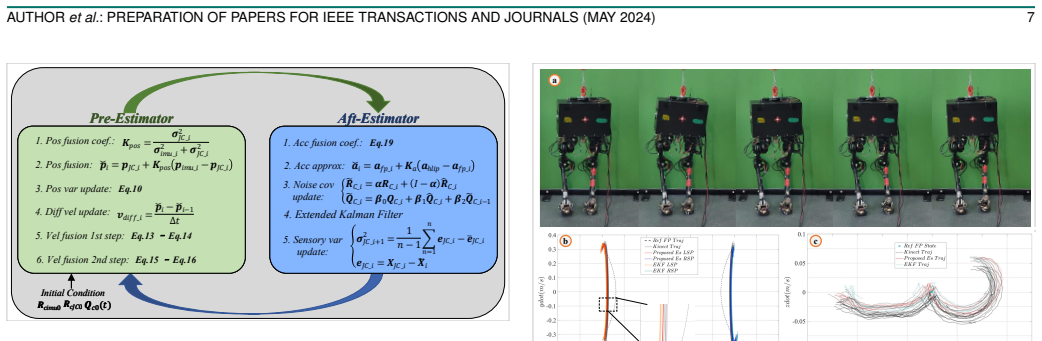
The carrying mechanism is a hierarchical estimator with two stages. The pre-estimator fuses joint-kinematic sensory state $X_{JC}$ with IMU state $X_{imu}$: positions are fused with a variance-optimal gain, and velocities are fused in two steps using a differentiated-position velocity as an intermediate signal. The post-estimator first estimates CoM acceleration by blending the HLIP (Hybrid Linear Inverted Pendulum) model acceleration with the IMU acceleration at a fixed point, using a Gaussian-kernel gain that trusts the model more as the CoM nears its desired state. It then runs an EKF whose measurement and process covariances are updated by a recursion in which the regression model supplies the initial estimate $\hat{R}_C$, $\hat{Q}_C$, the squared residuals update it, and the previous process covariance is carried forward; the regression model itself is a piecewise cubic fit to smoothed, time-windowed error variances (Eqs. 5-6). This is what lets the estimator treat process noise as a predictable time profile rather than a constant.
What would settle it
Run the variable-speed lateral-walking test with the regression-seeded covariance replaced by a constant initial covariance while keeping the same adaptive update; if the four-step convergence disappears, the regression model is doing the work, and if it persists, the speed advantage belongs to the adaptive loop rather than the noise model.
Extended reading notes
Core claim
The discovery is that the modeling error introduced by the ESVC foot's elliptical contact is not unstructured noise that a fixed-covariance EKF must tolerate; it is a gait-phase-dependent process whose variance can be measured, regressed, and used as the starting point for online adaptation. Over sixteen open-loop marking-time trials, CoM position and velocity errors remained approximately Gaussian while their variances drifted smoothly within a step, and weighted cubic regression with continuity constraints captured that drift. The resulting time profile of $Q_C(t)$ seeds the adaptive covariance update, and in the variable-speed lateral walking experiment the seeded estimator completes the speed transition in four steps versus six for EKF and AEKF. The paper's more cautious conclusion states that steady-state accuracy is comparable to the adaptive EKF and slightly better than the EKF, while the clear advantage is convergence speed during gait changes.
Load-bearing premise
The key assumption is that the noise pattern measured while the robot stands and marks time still holds when it walks sideways at 0.1 to 0.2 meters per second.
Editorial extensions
If this is right
- If the claim holds, biped controllers using curved or rollover feet can treat process noise as a learned time profile, shortening the transients when gait speed changes.
- The two-stage design separates sensor fusion from model-based filtering, so the covariance-adaptation layer can be reused for different foot geometries after re-fitting the noise profile.
- Faster convergence during acceleration and deceleration means a robot can switch between standing, marking time, and lateral walking more responsively, which matters in confined or dynamic environments.
- Marking-time accuracy comparable to or slightly better than the EKF indicates that the adaptive machinery does not sacrifice steady-state precision for its faster transients.
Reading between the lines
- A natural next test is to fit the noise regression separately for lateral walking at 0.1–0.2 m/s and check whether convergence improves beyond four steps; that would isolate how much of the gain comes from the transferable noise profile.
- Because the adaptation weights $\alpha$ and $\beta_0,\beta_1,\beta_2$ are fixed and their values are not reported, the advantage over AEKF could partly reflect tuning; reporting them and varying them would separate the regression model's contribution from the adaptive loop's.
- The same strategy should transfer to other non-flat feet, such as arc, semi-elliptical, or prosthetic feet, whose contact kinematics also create structured model error rather than white noise.
Editorial analysis
A structured set of objections, weighed in public.
Referee Report
Summary. This paper studies state estimation for a biped robot equipped with an ellipse-based segmental varying curvature (ESVC) foot. It first analyzes measurement and process noise from physical experiments (fixed-point trajectory tracking and marking time), fits a time-varying process-noise covariance model via weighted cubic regression with a sliding window, and proposes a two-stage hierarchical estimator: a data-fusion pre-estimator that fuses IMU and joint-sensor body states, and an adaptive EKF post-estimator that uses the regression model as an initial covariance prior and recursively updates the noise covariances. The estimator is evaluated in marking time and in variable-speed lateral walking on the TT II robot, comparing against EKF and an adaptive EKF (AEKF). The paper claims higher precision and faster convergence, but the reported experiments support a more modest statement: precision comparable to AEKF and slightly better than EKF, with a possible speed advantage in one acceleration phase.
Significance. If the claims are adequately supported, the paper contributes a useful experimental noise characterization for a curved-foot biped robot, a concrete noise-regression pipeline, and a hierarchical estimator architecture that is plausible and clearly described. Strengths include real-hardware validation on the TT II robot, an explicit two-stage design, and a supplementary data link (ref. [26]). However, the in-sample fitting of the process-noise model, the lack of repeated dynamic-walking trials, and undocumented tuning parameters currently limit the evidence for the advertised precision and convergence advantages. The work is of interest to the legged-robotics and sensor-fusion communities, but the central empirical claims need strengthening before publication.
major comments (5)
- [Sec. II.B.2-B.3 / Sec. III.B / Sec. IV.B] The process-noise regression model in Eqs. (5)-(6) is fitted to the error variance of the marking-time motion (Sec. II.B.2-B.3, using a subset of 'better performance' steps from 16 experiments) and is then used as the initial Q_C(t) in the adaptive EKF of Eq. (19) for the same marking-time task evaluated in Sec. IV.B. The marking-time validation is therefore in-sample: the estimator's process-noise prior is tailored to the very motion class on which it is tested. Please separate the data used for fitting the noise model from the data used for estimator evaluation, or provide an explicit sensitivity analysis showing that the precision comparison is not an artifact of this in-sample choice.
- [Sec. IV.C] The faster-convergence claim over AEKF rests on a single variable-speed lateral-walking experiment with no ground-truth reference. The paper states that 'the EKF-based estimation is adopted as the reference baseline' and uses 'the number of steps required for the robot to reach stable walking' as the criterion, but 'stable' is not quantified, the step-count criterion mixes estimator performance with the closed-loop controller, and no repeated trials or dispersion measures are reported. Moreover, in the deceleration phase the proposed estimator and AEKF both converge in four steps, so the only evidence for an advantage over AEKF is one un-replicated acceleration phase (four steps vs. six).
- [Sec. III.B / Eq. (19), Eq. (18), Eq. (4)] The adaptive weights α, β0, β1, β2, the smoothing parameters τ_w and τ_a, and the initial variances σ²_imu0 and σ²_JC0 are never reported. The behavior of Eq. (19) and the convergence results therefore depend on undocumented hand-set parameters, and the paper cannot be reproduced from the text. Please report all parameter values and, ideally, a sensitivity analysis for the step-count comparisons.
- [Abstract / Sec. V] The abstract claims the estimator 'provides higher precision than both EKF and Adaptive EKF,' but the conclusion (Sec. V) states that in marking time the method is 'comparable to that of the AEKF and slightly better than the EKF,' and the convergence advantage over AEKF is limited to one acceleration phase. The abstract is stronger than the evidence and should be revised to match the body.
- [Sec. II.B / Sec. III.B] The regression model fitted to marking-time process noise is transferred, without validation, to lateral walking at 0.1-0.2 m/s as the initial covariance prior (Sec. III.B). Although the adaptive update in Eq. (19) can in principle compensate for mismatch, the fixed β coefficients are unreported, so the transferability assumption is not tested. Please provide evidence that the marking-time noise statistics are representative of lateral walking, or treat the lateral-walking result as only a qualitative demonstration.
minor comments (6)
- [Eq. (5)] The last coefficient in the cubic polynomial is printed as a_j3 twice; it should be a_j4, consistent with the definition a_j = [a_j1, a_j2, a_j3, a_j4]^T.
- [Eq. (18)] The exponent of the Gaussian kernel lacks the negative sign; as written K_{a x,i} is larger than one and not a Gaussian. This is likely a typo but should be corrected.
- [Eq. (14)] The notation in the second fusion step is unclear: the expression mixes ¯v_{JC i} and v_{JC i}, and the fusion gain is written as ˇK_vel while the text refers to ¯K_vel. Please rewrite the equation with consistent variables.
- [Sec. II.B.2 / II.B.3] The number of selected steps is inconsistent: Sec. II.B.2 says 'five steps with better performance' while Sec. II.B.3 says 'six selected steps.' Please clarify the actual number used for the regression.
- [Author affiliation / template] The affiliation contains 'Harbing' instead of 'Harbin,' and the template header 'AUTHOR et al.: PREPARATION OF PAPERS FOR IEEE TRANSACTIONS AND JOURNALS' remains on page 2.
- [Reference [12]] Reference [12] is given only as 'Our previous paper ...' without a proper citation; it should be listed with full bibliographic details.
Circularity Check
No significant circularity: the estimator's noise model is fitted in one task and tested on an out-of-sample variable-speed walk, and the cited prior work supplies premises rather than conclusions.
full rationale
The derivation chain is not circular. The process-noise regression model (Eqs. 5-6) is fitted to open-loop marking-time error variances (Sec. II.B.2-3) and then used to initialize Q_C0 in the adaptive update (Eq. 19), which is in-sample when the same marking-time task is used for validation in Sec. IV.B; however, the adaptive residual terms (Eq. 19, beta1 and beta2 terms) and the separate variable-speed lateral-walking experiment (Sec. IV.C) provide out-of-sample content, so the marking-time Q prior does not force the claimed results. The faster-convergence claim rests on Sec. IV.C, where the estimator uses the HLIP target acceleration (Eq. 17) as a model input; this is a legitimate model-informed filter design rather than a definitional equivalence, because the evaluation criterion is closed-loop step counts to stable walking and the EKF/AEKF baselines are run in the same loop. Section IV.C itself notes the lack of ground truth and the use of EKF as a reference baseline, which is an empirical limitation on the strength of the convergence claim, not circularity. Citations to prior work [12] supply the ESVC foot kinematics and approximate contact model as premises; the current paper's estimator and noise analysis do not reduce to those citations. No self-citation chain is load-bearing. Therefore the central derivation is self-contained against an external benchmark, and no circular step can be exhibited with a specific equation-to-equation reduction.
Assumptions & free parameters
free parameters (6)
- tau_w =
not reported
- tau_a =
not reported
- alpha =
not reported (6x6 matrix)
- beta0, beta1, beta2 =
not reported (matrices summing to I6)
- per-segment cubic regression coefficients a_j =
not reported (9 segments x 4 coefficients)
- sigma^2_imu0, sigma^2_JC0 =
not reported numerically
assumptions (7)
- domain assumption Measurement and process noise are Gaussian with finite covariance.
- domain assumption The ESVC forward-kinematic contact model from prior work [12] provides correct body-state sensory data up to the fitted noise.
- domain assumption URDF model and depth-camera marker tracking provide ground truth for FP trajectories and CoM state.
- ad hoc to paper HLIP model acceleration approximates the true CoM acceleration during walking.
- ad hoc to paper The regression model of process noise transfers from marking time to other walking gaits as an initial covariance prior.
- domain assumption Measurement errors from IMU-based and joint-configuration sensory data are mutually independent.
- standard math EKF linearization error is small enough for the constant-acceleration transition model in Eq. 16.
Cite this review
Pith. "Pith review of Noise Analysis and Hierarchical Adaptive Body State Estimator For Biped Robot Walking With ESVC Foot." pith.science (2026). https://pith.science/paper/TVVKU47L
@misc{pith2026250608578,
  author       = {Pith},
  title        = {Pith review of: Noise Analysis and Hierarchical Adaptive Body State Estimator For Biped Robot Walking With ESVC Foot},
  year         = {2026},
  howpublished = {\url{https://pith.science/paper/TVVKU47L}},
  note         = {Machine review of arXiv:2506.08578}
}
read the original abstract
The ESVC(Ellipse-based Segmental Varying Curvature) foot, a robot foot design inspired by the rollover shape of the human foot, significantly enhances the energy efficiency of the robot walking gait. However, due to the tilt of the supporting leg, the error of the contact model are amplified, making robot state estimation more challenging. Therefore, this paper focuses on the noise analysis and state estimation for robot walking with the ESVC foot. First, through physical robot experiments, we investigate the effect of the ESVC foot on robot measurement noise and process noise. and a noise-time regression model using sliding window strategy is developed. Then, a hierarchical adaptive state estimator for biped robots with the ESVC foot is proposed. The state estimator consists of two stages: pre-estimation and post-estimation. In the pre-estimation stage, a data fusion-based estimation is employed to process the sensory data. During post-estimation, the acceleration of center of mass is first estimated, and then the noise covariance matrices are adjusted based on the regression model. Following that, an EKF(Extended Kalman Filter) based approach is applied to estimate the centroid state during robot walking. Physical experiments demonstrate that the proposed adaptive state estimator for biped robot walking with the ESVC foot not only provides higher precision than both EKF and Adaptive EKF, but also converges faster under varying noise conditions.
Figures


Figures from the paper (2 more)

Reference graph
Works this paper leans on
-
[26]
Supplyment Data, Available: https://github.com/cby-gh/Estimation-ESVC-FOOT
-
[1]
Available: https://www.unitree.com/cn/g1
G1 Biped Robot. Available: https://www.unitree.com/cn/g1
-
[2]
Available: https://bostondynamics.com/atlas
Atlas Biped Robot. Available: https://bostondynamics.com/atlas
-
[3]
Available: https://www.agilityrobotics.com/solution
Digit Biped Robot. Available: https://www.agilityrobotics.com/solution
-
[4]
R. H. Crompton, W. Sellers, K. Davids, J. McClymont, ”Biomechanics and the origins of human bipedal walking: The last 50 years.” Journal of biomechanics, vol. 157, p. 111701, 2023
work page 2023
-
[5]
Humanoids’ feet: State-of-the-art & future directions,
I. Frizza, K. Ayusawa, A. Cherubini, H. Kaminaga, P. Fraisse, and G. Venture, “Humanoids’ feet: State-of-the-art & future directions,” International Journal of Humanoid Robotics, vol. 19, no. 1, Mar. 2022, Art. no. 2250001
work page 2022
-
[6]
On the effect of semielliptical foot shape on the energetic efficiency of passive bipedal gait,
A. Smyrli, M. Ghiassi, A. Kecskem ´ethy, and E. Papadopoulos, “On the effect of semielliptical foot shape on the energetic efficiency of passive bipedal gait,” IEEE/RSJ International Conference on Intelligent Robots and Systems (IROS), Macau, China, pp. 6302–6307, Nov. 2019
work page 2019
-
[7]
A. Smyrli and E. Papadopoulos, ”Modeling, Validation, and Design Investigation of a Passive Biped Walker with Knees and Biomimetic Feet,” 2022 International Conference on Robotics and Automation (ICRA), Philadelphia, PA, USA, pp. 193-199, 2022
work page 2022
Show all 30 references
-
[8]
Foot shape for passive dynamic kneed biped robot,
J. Li, Y . Tian, X. Huang, and L. Wang, “Foot shape for passive dynamic kneed biped robot,” IEEE International Conference on Robotics and Biomimetics(ROBIO), pp. 1281–1286, Dec. 2010
2010
-
[9]
Trajectory-free dynamic locomotion using key trend states for biped robots with point feet,
L. Han, X. Chen, Z. Yu, X. Zhu, K. Hashimoto, and Q. Huang, “Trajectory-free dynamic locomotion using key trend states for biped robots with point feet,” Science China Information Sciences, vol. 66, Aug. 2023, Art. no. 189201
2023
-
[10]
Complex dynamics of the passive biped robot with flat feet: Gait bifurcation, intermittency and crisis,
Z. Liu, J. Gao, X. Rao, S. Ding, and D. Liu, “Complex dynamics of the passive biped robot with flat feet: Gait bifurcation, intermittency and crisis,” Mechanism and Machine Theory, vol. 191, Jan. 2024, Art. no. 105500. Available: http://www.bookref.com
2024
-
[11]
MPC-based locomotion con- trol of bipedal robots with line-feet contact using centroidal dynam- ics,
G. Garc ´ıa, R. Griffin, and J. Pratt, “MPC-based locomotion con- trol of bipedal robots with line-feet contact using centroidal dynam- ics,”Humanoids, Munich, Germany, pp. 1–8, Jul. 2021
2021
-
[12]
Our previous paper Model Analysis And Design Of Ellipse Based Segmented Varying Curved Foot For Biped Robot Walking
-
[13]
B. Li, G. Xu, Z. Teng, et al., ”Intelligent ankle–foot prosthesis based on human structure and motion bionics,” Journal of NeuroEngineering and Rehabilitation, vol. 21, no. 1, Jan. 2024, Art. no. 119
2024
-
[14]
Toward an adaptive foot for natural walking,
C. Piazza, C. Della Santina, G. M. Gasparri, and A. Bicchi, “Toward an adaptive foot for natural walking,” in Proceedings of the 2016 IEEE- RAS 16th International Conference on Humanoid Robots (Humanoids), Cancun, Mexico, pp. 1204–1210, Nov. 2016
2016
-
[15]
A generic analytical foot rollover model for predicting translational ankle kinematics in gait simulation studies,
L. Ren, D. Howard, L. Ren, C. Nester, and L. Tian, “A generic analytical foot rollover model for predicting translational ankle kinematics in gait simulation studies,” Journal of Biomechanics, vol. 43, no. 2, pp. 194–202, Jan. 2010
2010
-
[16]
Modelling the effect of ‘heel to toe’ roll-over contact on the walking dynamics of passive biped robots,
P. Mahmoodi, R. S. Ransing, and M. I. Friswell, “Modelling the effect of ‘heel to toe’ roll-over contact on the walking dynamics of passive biped robots,” Applied Mathematical Modelling, vol. 37, no. 12–13, pp. 7352–7373, Jun. 2013
2013
-
[17]
Toward improved understanding of foot shape, foot posture, and foot biomechanics during running: A narrative review,
Q. Mei, H. K. Kim, L. Xiang, V . Shim, A. Wang, J. S. Baker, Y . Gu, and J. Fernandez, “Toward improved understanding of foot shape, foot posture, and foot biomechanics during running: A narrative review,” Frontiers in Physiology, vol. 13, pp. 1–12, Dec. 2022, Art. no. 1062598
2022
-
[18]
Recent advances in bipedal walking robots: Review of gait, drive, sensors and control systems,
T. Mikolajczyk, E. Mikołajewska, H. F. N. Al-Shuka, T. Malinowski, A. Kłodowski, D. Y . Pimenov, T. Paczkowski, F. Hu, K. Giasin, D. Mikołajewski, and M. Macko, “Recent advances in bipedal walking robots: Review of gait, drive, sensors and control systems,” Sensors, vol. 22, n...
2022
-
[19]
Sensor data fusion for body state estimation in a bipedal robot and its feedback control application for stable walking,
C.-P. Chen, J.-Y . Chen, C.-K. Huang, J.-C. Lu, and P.-C. Lin, “Sensor data fusion for body state estimation in a bipedal robot and its feedback control application for stable walking,” Sensors, vol. 15, no. 3, pp. 4925–4946, Feb. 2015
2015
-
[20]
Fast decentralized state estimation for legged robot locomotion via EKF and MHE,
J. Kang, Y . Wang, and X. Xiong, “Fast decentralized state estimation for legged robot locomotion via EKF and MHE,” IEEE Robotics and Automation Letters, vol. 9, no. 12, pp. 1–8, Dec. 2024, Art. no. 3483043
2024
-
[21]
Legged robot state estimation using invariant Kalman filtering and learned contact events,
T.-Y . Lin, R. Zhang, J. Yu, and M. Ghaffari, “Legged robot state estimation using invariant Kalman filtering and learned contact events,” arXiv preprint arXiv:2106.15713, Jun. 2021
2021 arXiv
-
[22]
Adaptive robust invariant extended Kalman filtering for biped robot,
C. Gao, Y . Xie, S. Zhu, and Y . Wang, “Adaptive robust invariant extended Kalman filtering for biped robot,” in Proceedings of the 2022 IEEE International Conference on Robotics and Biomimetics (ROBIO), Xishuangbanna, China, pp. 1885–1891, Dec. 2022
2022
-
[23]
Legged robot state estimation with dynamic contact event information,
H. Kim, S. Hong, G. Ji, S. Jeon, J. Hwangbo, J.-H. Oh, and H.-W. Park, “Legged robot state estimation with dynamic contact event information,” AUTHORet al.: PREP ARA TION OF P APERS FOR IEEE TRANSACTIONS AND JOURNALS (MA Y 2024) 9 IEEE Robotics and Automation Letters, vol. 6, ...
2024
-
[24]
Legged robot state estimation with invariant extended Kalman filter using neural measurement network,
D. Youm, H. Oh, S. Choi, H. Kim, and J. Hwangbo, “Legged robot state estimation with invariant extended Kalman filter using neural measurement network,” arXiv preprint arXiv:2402.00366, Feb. 2024
2024 arXiv
-
[25]
3-d underactuated bipedal walking via h-lip based gait synthesis and stepping stabilization
X. Xiong, A. Ames, “3-d underactuated bipedal walking via h-lip based gait synthesis and stepping stabilization”. IEEE Transactions on Robotics, vol. 38, no. 4, pp. 2405-2425, Aug. 2022
2022
-
[27]
A non-flat terrain biped gait planner based on DIRCON,
B. Chen, X. Zang, Y . Zhang, L. Gao, Y . Zhu, and J. Zhao, “A non-flat terrain biped gait planner based on DIRCON,” Biomimetics, vol. 7, no. 4, pp. 1–18, Nov. 2022, Art. no. 203
2022
-
[28]
Joint Actuator,Available: https://www.cubemars.com/cn/goods-1143-AK80-64.html
-
[29]
IMU & Inclinometer, Available: https://www.wit-motion.com/
-
[30]
Drake, Available: https://drake.mit.edu/
Reviewed August 7, 2026 · model on record in the stance chip above.
Discussion (0). Sign in to comment.