REVIEW 2 major objections 4 minor 21 references
Metaconcepts of rooted tree balance
T0 review · 2 major / 4 minor · reviewed 2026-08-07 · deepseek-v4-flash
Pith's one-line read Summing a strictly increasing function over balance values always yields a valid imbalance index; the same recipe over clade sizes or leaf depths yields many more.
desk verdict Solid unifying framework for rooted-tree balance indices; Theorem 3.6 is the real result, and it holds. read the letter →
The pith
A machine-rendered reading of the paper's core claim, the machinery that carries it, and where it could break.
The reading
What carries the argument
The load-bearing object is the first-order metaconcept $\Phi^{\mathrm{Seq}}_f(T) = \sum_{s \in \mathrm{Seq}(T)} f(s)$, a sum over one of three vertex- or leaf-value sequences: the balance value sequence $B(T)$ (the absolute clade-size differences $|n_{v_1} - n_{v_2}|$ at each inner vertex of a binary tree), the clade size sequence $N(T)$, or the leaf depth sequence $\Delta(T)$. The argument hinges on a sequence-comparison lemma (Lemma 3.4): if one tree's sorted sequence is entry-wise no larger than another's, then the first tree attains the smaller $\Phi^{\mathrm{Seq}}_f$ for every increasing $f$, with strict inequality in at least one position giving uniqueness. The extremal theorems then reduce to entry-wise comparisons — the caterpillar's $B$- and $N$-sequences dominate those of every other tree, while the fully balanced tree's all-zero balance sequence is minimal — plus cherry-relocation arguments for the leaf-depth metaconcept.
What would settle it
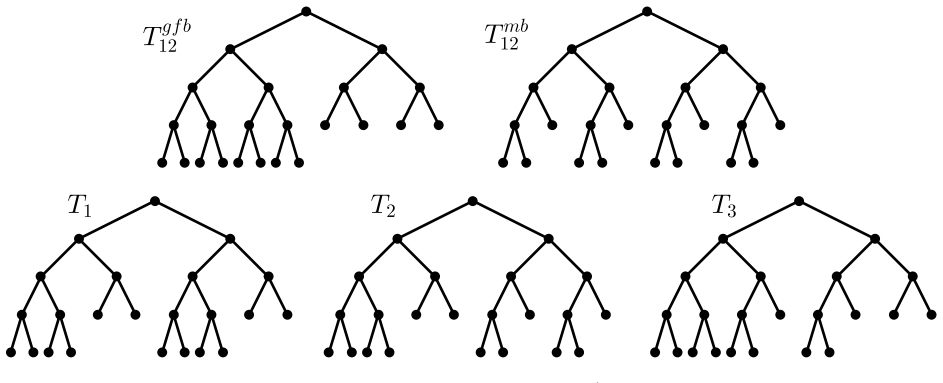
Exhaustively enumerate all rooted binary trees with $n \leq 12$ leaves and evaluate the balance-value metaconcept $\Phi^B_f$ for a battery of strictly increasing functions (e.g., $f(x) = x^c$ with $c > 0$, $\log(1+x)$, $2^x$); Theorem 3.6 predicts the caterpillar is the unique maximizer for every such $f$ and the fully balanced tree the unique minimizer whenever $n$ is a power of two, so any single violation would refute the central claim, and the predicted minimizers of the clade-size metaconcept (the gfb-tree for concave $f$, the mb-tree for convex $f$) can be checked in the same enumeration.
Extended reading notes
Core claim
On the paper's own terms, the discovery is that tree (im)balance indices are not a scattered zoo but instances of a single object: the metaconcept $\Phi^{\mathrm{Seq}}_f(T) = \sum_{s \in \mathrm{Seq}(T)} f(s)$, where $\mathrm{Seq}(T)$ is one of three shape sequences of a rooted tree — the balance value sequence $B(T)$, the clade size sequence $N(T)$, or the leaf depth sequence $\Delta(T)$ — each sorted in ascending order. The central result (Theorem 3.6) states that for any strictly increasing function $f$, the balance-value metaconcept is a binary imbalance index: the caterpillar $T^{\mathrm{cat}}_n$ is the unique maximizer on $\mathrm{BT}^*_n$, and the fully balanced tree $T^{\mathrm{fb}}_h$ is the unique minimizer whenever $n = 2^h$. The paper characterizes the functions for which the clade-size metaconcept is an imbalance index (strictly concave, strictly convex, or affine, with 2-positivity or non-negative intercept conditions on arbitrary trees), and likewise shows the leaf-depth metaconcept works for strictly increasing convex and affine functions. It computes the extremal values in each case, shows that the balance- and clade-size metaconcepts are local for all $f$ while the leaf-depth metaconcept is local only for affine $f$, and provides recursion formulas and decision trees for selecting an index.
Load-bearing premise
The conclusions inherit a definitional commitment: an imbalance index is required to be uniquely maximized by the caterpillar and uniquely minimized by the fully balanced tree when the leaf number is a power of two — a community that anchored 'most balanced' to different extremal trees would not inherit any of the imbalance-index conclusions.
Editorial extensions
If this is right
- Every strictly increasing function $f$ yields a new binary imbalance index $\Phi^B_f$, unifying the Colless, corrected Colless, and quadratic Colless indices as special cases.
- For affine $f$ the balance-value metaconcept is equivalent to the Colless index, so its minimizing trees are exactly the Colless-minimizing trees already characterized in the literature.
- The clade-size metaconcept flips between two canonical minimizers depending on curvature: strictly concave $f$ gives the greedy-from-the-bottom tree as the unique minimizer, while strictly convex $f$ gives the maximally balanced tree — a sensitive threshold at the affine identity function, where several trees minimize.
- The leaf-depth metaconcept with strictly increasing convex $f$ is a family of imbalance indices with no previously known index as a member, and its binary minimizers coincide with the Sackin minimizers.
- The decision trees translate the theorems into a practical selection procedure: choose the domain (binary or arbitrary), the shape aspect, and the desired most-balanced tree, and the paper specifies a function class $f$ that delivers an index with exactly those extremal trees.
Reading between the lines
- Because the theorems fix only the extremal trees, the choice among functions within one class (say, all strictly increasing convex $f$) remains open for ranking intermediate trees; two indices built from the same class can disagree on non-extremal rankings, so a systematic comparison of resolution across the family would be a natural next step.
- A full classification of the balance-value metaconcept's minimizers for leaf numbers that are not powers of two is left open; the paper's own $n = 5$ example shows the minimizer can depend on $f$, and an enumeration-driven conjecture for each convexity class would sharpen Theorem 3.8.
- The framework suggests a selection strategy for practitioners that the paper does not pursue: choose $f$ to match the null model of tree growth under which the index will be used, then compare how well different members of the family separate balanced from unbalanced histories.
Editorial analysis
A structured set of objections, weighed in public.
Referee Report
Summary. The paper introduces 'metaconcepts' of rooted tree balance: for a tree shape sequence Seq (balance values, clade sizes, or leaf depths) and a function f, it studies the functional Φ_f(Seq) = Σ f(s). For three metaconcepts (BVM, CSM, LDM), the authors determine conditions on f under which the metaconcept is a (binary) imbalance index in the sense of Fischer et al. [11], identify the extremal trees and extremal values, and analyze locality and recursiveness. The main positive results are Theorem 3.6 (BVM is a binary imbalance index for every strictly increasing f, with the caterpillar as unique maximizer and the fully balanced tree as unique minimizer when n is a power of two), Theorem 3.17 (CSM is uniquely minimized by the mb-tree for strictly increasing strictly convex f), Proposition 3.30 (LDM is a binary imbalance index for strictly increasing convex f), and the affine/concave counterparts that recover and extend results of Cleary et al. [5]. The paper also provides decision trees and R code for computing the metaconcepts.
Significance. If the results are correct, this is a valuable unifying contribution. Theorem 3.6 is a clean, general statement that simultaneously covers the Colless, corrected Colless, and quadratic Colless indices, and the extension of the clade-size results from concave to convex and affine functions goes beyond the recent Cleary et al. preprint. The conceptual framework, the systematic extremal-tree analysis, and the practical decision trees and code make the paper useful for applied users of tree balance indices. The proofs of the main extremal-tree theorems are largely self-contained, and the dependence on prior work by overlapping authors is explicitly acknowledged. The main caveat is that every 'is an imbalance index' conclusion is conditional on the specific extremal-benchmark definition imported from Fischer et al. [11], which is a scope boundary rather than a circularity.
major comments (2)
- [Appendix B, Lemma 3.35] Lemma 3.35 is false as stated. The condition f(x+z) - f(y+z) = f(x) - f(y) for all real x, y, z is satisfied by every function of the form f = g + c with g additive, including discontinuous non-linear additive functions (Cauchy's equation), and such f need not be affine. The proof only uses z = 1, which gives constant unit increments and does not imply affinity on R. The intended application in Proposition 3.34(2) only requires the identity for natural-number arguments, because leaf depths are integers; on N the condition does imply that f is affine. Please restate the lemma for the discrete domain actually needed, or add a regularity assumption, and correct the proof accordingly.
- [Section 3.2.3, Proposition 3.30] The proof that the caterpillar uniquely maximizes and the fully balanced tree uniquely minimizes the LDM for strictly increasing convex f relies on repeated cherry relocations, but the termination and reachability of the construction is only asserted ('the caterpillar can be constructed in this manner from any other binary tree'; 'the fb-tree can be constructed step by step using this cherry relocation procedure'). No formal argument shows that repeated application of the forward operation always reaches the caterpillar, or that repeated application of the reverse operation always reaches the fully balanced tree when n = 2^h. Because these uniqueness claims are load-bearing for the LDM imbalance-index result, please add a formal justification, for example via a strictly monotone potential such as the total leaf depth together with a characterization of the terminal trees.
minor comments (4)
- [Section 3.2.4, Proposition 3.36] The statement that the LDM is recursive only for affine functions with intercept a = 0 is unnecessarily restrictive. The displayed recurrence also works for f(x) = mx + a with a ≠ 0 by setting λ1 = a and r1 = Σ r1(Ti) + m·Σ n_i; please correct or clarify the statement.
- [Section 3.2.4, proof of Proposition 3.34(2)] The step labelled 'Lem. 3.35' should be expanded: the cancellation of the constant depth shift uses the fact that the two competing subtrees have the same number of leaves, and the 'only if' direction of locality should be explicitly derived from the validity of the identity for all choices of subtrees.
- [Section 3.2.2.2, Proposition 3.27(2)] In the displayed formula for the minimum value on BT*_n, the symbol h is used ('n·(h+1)') but only hn has been defined; this should be hn.
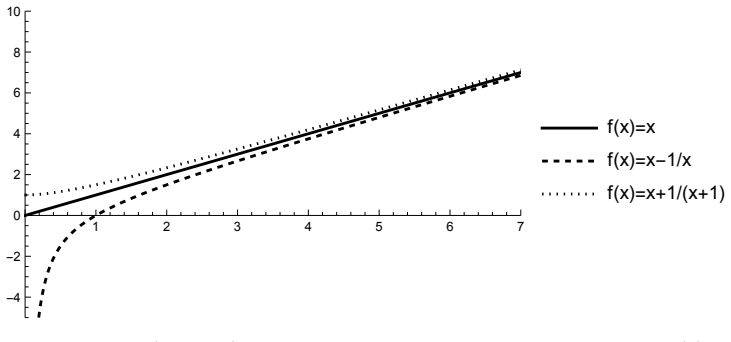
- [Figure 9 caption] The caption's description of the strictly convex approximations is not fully consistent with the displayed formula (x + 1/(x+1)) and the following sentence about (x + 1/(x+1))^a; please harmonize the notation.
Circularity Check
No significant circularity: the metaconcept theorems are proved from sequence orderings, not from the imbalance-index definition they verify.
full rationale
The central derivation chain is self-contained. Theorem 3.6, the main load-bearing claim, is proved by induction: for every binary tree T, the sorted balance-value sequence satisfies B(T)_i <= B(T_cat_n)_i for all i, with strict inequality at index 2 for every non-caterpillar (because every such tree has at least two cherries), and Lemma 3.4 converts this componentwise dominance into unique maximization for every strictly increasing f. The minimization part for n = 2^h uses the characterization B(T) = (0,...,0) iff T = T_fb_h, cited to Coronado et al. [7, Corollary 1]; even though some authors overlap with the present paper, this is an externally published, parameter-free mathematical result and is not assumed as the target conclusion. Definition 2.1 is a scope condition, not an input that forces the theorem: the proof actually establishes the two extremal requirements. Overlapping-author citations, such as Cleary et al. [5] for the concave clade-size minimizer and tree-subtree counts, are honestly attributed; the concave CSM case is explicitly labeled as adapted rather than claimed as new, and the new BVM/LDM/CSM contributions are proved independently. Lemma 3.4's proof is reproduced in full, and the LDM and convex-CSM proofs use self-contained cherry-relocation and subtree-swap arguments adapted from Mir et al. [16] with the needed lemmas included. No parameter is fitted, no prediction is a renamed input, and no uniqueness conclusion rests solely on a self-citation. Therefore no circular step is present.
Assumptions & free parameters
assumptions (5)
- domain assumption Definition 2.1 of a (binary) imbalance index, which requires the caterpillar to be the unique maximizer and the fully balanced tree (when n is a power of two) to be the unique minimizer.
- domain assumption Prior results of Cleary et al. [5]: strictly increasing and concave f make the clade-size metaconcept a binary imbalance index with gfb-tree unique minimizer; caterpillar uniquely maximizes for increasing f; gfb subtree counts (Theorem 2.12).
- domain assumption Prior results on Colless and Sackin extremal behavior (Coronado et al. [7], Fischer [9]): mb/gfb minimize Colless, characterization of Sackin minimizers, and extremal values.
- standard math Standard real-analysis facts about convex and concave functions: increments are monotone, and affine functions are characterized by constant differences.
- standard math Binary trees with n leaves have exactly n-1 inner vertices, and balance, clade-size, and leaf-depth sequences have fixed lengths; non-binary clade-size sequences vary in length.
Cite this review
Pith. "Pith review of Metaconcepts of rooted tree balance." pith.science (2026). https://pith.science/paper/RFUGBMGE
@misc{pith2026250608614,
  author       = {Pith},
  title        = {Pith review of: Metaconcepts of rooted tree balance},
  year         = {2026},
  howpublished = {\url{https://pith.science/paper/RFUGBMGE}},
  note         = {Machine review of arXiv:2506.08614}
}
abstract
Measures of tree balance play an important role in many different research areas such as mathematical phylogenetics or theoretical computer science. Typically, tree balance is quantified by a single number which is assigned to the tree by a balance or imbalance index, of which several exist in the literature. Most of these indices are based on structural aspects of tree shape, such as clade sizes or leaf depths. For instance, indices like the Sackin index, total cophenetic index, and $\widehat{s}$-shape statistic all quantify tree balance through clade sizes, albeit with different definitions and properties. In this paper, we formalize the idea that many tree (im)balance indices are functions of similar underlying tree shape characteristics by introducing metaconcepts of tree balance. A metaconcept is a function $\Phi_f$ that depends on a function $f$ capturing some aspect of tree shape, such as balance values, clade sizes, or leaf depths. These metaconcepts encompass existing indices but also provide new means of measuring tree balance. The versatility and generality of metaconcepts allow for the systematic study of entire families of (im)balance indices, providing deeper insights that extend beyond index-by-index analysis.
Figures


Figures from the paper (11 more)





Reference graph
Works this paper leans on
-
[5]
Sean Cleary, Mareike Fischer, and Katherine St. John. Th e gfb tree and tree imbalance indices. arXiv:2502.12854, 2025. doi: https://doi.org/10.48550/arXiv.2502.12854
-
[11]
Tree Balance Indices: A Comprehensive Survey
Mareike Fischer, Lina Herbst, Sophie Kersting, Luise K ühn, and Kristina Wicke. Tree Balance Indices: A Comprehensive Survey . Springer Cham, Cham, 2023. doi: https://doi.org/10.1007 / 978-3-031-39800-1
work page 2023
-
[1]
Balanced search trees made simple
Arne Andersson. Balanced search trees made simple. In Fr ank Dehne, Jörg-Rüdiger Sack, Nicola Santoro, and Sue Whitesides, editors, Algorithms and Data Structures , pages 60–71, Berlin, Hei- delberg, 1993. Springer Berlin Heidelberg. ISBN 978-3-540 -47918-5. doi: https://doi.org/10.1007/ 3-540-57155-8_236
work page 1993
-
[2]
Coronado, Arnau Mir, and F rancesc Rosselló
Krzysztof Bartoszek, Tomás M. Coronado, Arnau Mir, and F rancesc Rosselló. Squaring within the Colless index yields a better balance index. Mathematical Biosciences, 331:108503, 2021. doi: 10.1016/ j.mbs.2020.108503. 38
-
[3]
Michael G.B. Blum and Olivier François. On statistical t ests of phylogenetic tree imbalance: The Sackin and other indices revisited. Mathematical Biosciences, 195(2):141–153, 2005. doi: 10.1016/j.mbs.2005. 03.003
-
[4]
Michael GB Blum and Olivier François. Which random proce sses describe the tree of life? A large-scale study of phylogenetic tree imbalance. Systematic Biology , 55(4):685–691, 2006. doi: doi.org/10.1080/ 10635150600889625
work page 2006
-
[6]
Phylogenetics: The theory and pra ctice of phylogenetic systematics
D. Colless. Review of “Phylogenetics: The theory and pra ctice of phylogenetic systematics” . Systematic Zoology, 31(1):100–104, 1982. doi: 10.2307/2413420
doi:10.2307/2413420 1982
-
[7]
Coronado, Mareike Fischer, Lina Herbst, France sc Rosselló, and Kristina Wicke
Tomás M. Coronado, Mareike Fischer, Lina Herbst, France sc Rosselló, and Kristina Wicke. On the minimum value of the Colless index and the bifurcating trees that achieve it. Journal of Mathematical Biology, 80(7):1993–2054, 2020. doi: 10.1007/s00285-020-01488- 9
Show all 21 references
-
[8]
On the distribution of binary search tr ees under the random permutation model
James Allen Fill. On the distribution of binary search tr ees under the random permutation model. Random Structures and Algorithms , 8(1):1–25, 1996. doi: 10.1002/(sici)1098-2418(199601) 8:1<1:: aid-rsa1>3.0.co;2-1
1996 doi
-
[9]
Extremal values of the Sackin tree bala nce index
Mareike Fischer. Extremal values of the Sackin tree bala nce index. Annals of Combinatorics , 25(2): 515–541, 2021. doi: 10.1007/s00026-021-00539-2
2021 doi
-
[10]
On the balance o f unrooted trees
Mareike Fischer and Volkmar Liebscher. On the balance o f unrooted trees. Journal of Graph Algorithms and Applications, 25(1):133–150, 2021. doi: 10.7155/jgaa.00553
2021 doi
-
[12]
Stephen B. Heard. Patterns in tree balance among cladis tic, phenetic, and randomly generated phylo- genetic trees. Evolution, 46(6):1818–1826, 1992. doi: 10.1111/j.1558-5646.1992. tb01171.x
1992
-
[13]
Searching fo r evolutionary patterns in the shape of a phylogenetic tree
Mark Kirkpatrick and Montgomery Slatkin. Searching fo r evolutionary patterns in the shape of a phylogenetic tree. Evolution, 47(4):1171–1181, 1993. doi: 10.1111/j.1558-5646.1993. tb02144.x
1993
-
[14]
The art of computer programming, volume 3: (2nd ed.) sorting and searching
Donald Ervin Knuth. The art of computer programming, volume 3: (2nd ed.) sorting and searching . Addison Wesley Longman Publishing Co., Inc., USA, 1998. ISB N 0201896850
1998
-
[15]
The weighted total cophenetic index: A novel balance index for phylogenetic networks
Linda Knüver, Mareike Fischer, Marc Hellmuth, and Kris tina Wicke. The weighted total cophenetic index: A novel balance index for phylogenetic networks. Discrete Applied Mathematics , 359:89–142,
-
[16]
A new ba lance index for phylogenetic trees
Arnau Mir, Francesc Rosselló, and Lucía Rotger. A new ba lance index for phylogenetic trees. Mathe- matical Biosciences, 241(1):125–136, 2013. doi: 10.1016/j.mbs.2012.10.005
2013 doi
-
[17]
ape 5.0: an environ ment for modern phylogenetics and evolu- tionary analyses in R
Emmanuel Paradis and Klaus Schliep. ape 5.0: an environ ment for modern phylogenetics and evolu- tionary analyses in R. Bioinformatics, 35:526–528, 2019. doi: 10.1093/bioinformatics/bty633
2019 doi
-
[18]
Good” and “bad
M. J. Sackin. “Good” and “bad” phenograms. Systematic Biology, 21(2):225–226, 1972. doi: 10.1093/ sysbio/21.2.225
1972
-
[19]
Kwang-Tsao Shao and Robert R. Sokal. Tree balance. Systematic Zoology , 39(3):266, 1990. doi: 10.2307/2992186. 39 Appendix A Additional figures All inner vertices v of all trees in Figure 10-14 are labeled by a pair ( bv, nv) containing its balance value bv and its clade size n...
1990 doi
-
[21]
⇒” Let f : R → R be affine and x, y, z ∈ R. Then, f (x + z) − f (y + z) = m · (x + z) + a − (m · (y + z) + a) = m · x + a − (m · y + a) = f (x) − f (y). “⇐
Thus, layers hn − 1 and hn − 2 in this case together induce 2 hn−2 − rn hn−2 + rn hn−1 many subtrees of size 2, which proves the fourth statement of the theorem. So only the third statement of the theorem remains. We are sti ll in the case where n < 2hn, and we now have that o...
-
[2024]
doi: https://doi.org/10.1016/j.da m.2024.07.037
ISSN 0166-218X. doi: https://doi.org/10.1016/j.da m.2024.07.037
2024 doi
Reviewed August 7, 2026 · model on record in the stance chip above.
Discussion (0). Sign in to comment.