REVIEW 3 major objections 3 minor 17 references
Boundary Control for Wildfire Mitigation
T0 review · 3 major / 3 minor · reviewed 2026-08-07 · deepseek-v4-flash
Pith's one-line read This paper proves that a Neumann-type boundary feedback using only boundary temperature measurements drives the L2 norm of the temperature deviation in a protected region to zero exponentially when wind is known, and asymptotically under…
desk verdict Known-wind Lyapunov controller for a wildfire heat-fuel model is plausible; the adaptive theorem's convergence proof fails on a false boundary trace inequality. read the letter →
The pith
A machine-rendered reading of the paper's core claim, the machinery that carries it, and where it could break.
The reading
What carries the argument
The argument is carried by the Lyapunov functional $B(\widetilde T) := \frac{1}{2}|\widetilde T|^2_{L^2(W)}$ together with a chain of four estimates: integration by parts for the diffusion term; a Friedrichs-Poincaré trace inequality with explicit constants $\sup_W|x|^2$ and $2\sup_{\partial W}|x|$; a divergence identity for the advection term that introduces $V := \sup_W|\nabla\cdot v|$; and the scalar bound $s e^{-\gamma/s} \le e^{-1}\gamma^{-1}s^2$ for the Arrhenius reaction term. These combine into inequality (17), and the feedback law (7) is chosen so that all boundary terms collapse to $-k|\widetilde T|^2_{L^2(\partial W)}$, yielding $\dot B \le -\alpha B - k|\widetilde T|^2_{L^2(\partial W)}$.
What would settle it
Compute the ratio $|\widetilde T|^2_{L^2(\partial W)}/|\widetilde T|^2_{L^2(W)}$ for a constant function on the unit square: it equals 4, contradicting the bound $\le 2$ used in Theorem 2's proof, so a corrected proof must replace that step or restrict the geometry; alternatively, run the proposed controller on a thin or non-star-shaped domain and check whether the claimed Lyapunov decay bound still holds.
Extended reading notes
Core claim
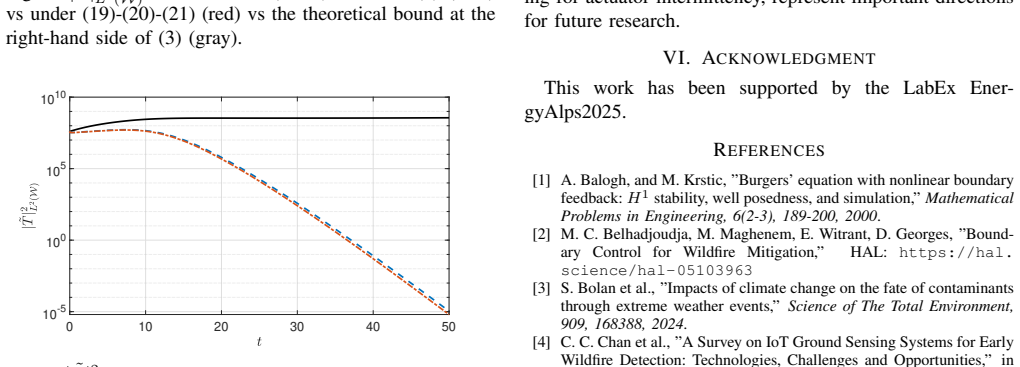
The central result is Theorem 1: under Assumption 1, the feedback law (7), which combines an advection-cancelling term proportional to $n\cdot v/(2\varepsilon)$ with a damping term, makes $|\widetilde T|^2_{L^2(W)}$ decay exponentially with rate $\alpha := 2AC + 2\varepsilon/\sup_{x\in W}|x|^2 - V - 2A e^{-1}\sup_{x\in W}|S_o|/\gamma$. Theorem 2 replaces the known wind term with a boundary-distributed estimate $\hat v$ adapted by (20), and proves that $|\widetilde T|_{L^2(W)}$ converges asymptotically to zero. Both controllers are Neumann type, depend only on boundary temperature, and are decentralized in the sense that the control value at each boundary point uses only local information.
Load-bearing premise
The proof relies on the Friedrichs-Poincaré trace inequality with explicit constants for a merely connected region with piecewise $C^1$ boundary, and on the boundary estimate $|\widetilde T|^2_{L^2(\partial W)} \le 2|\widetilde T|^2_{L^2(W)}$ in the last step of Theorem 2; if either geometric inequality fails for the chosen protected region, the decay argument does not go through.
Editorial extensions
If this is right
- If Theorem 1 is correct, a boundary-only water-spray actuation system can isolate a protected region from a wildfire with an explicit exponential decay rate given by (8).
- If Theorem 2 is correct, no wind model is needed: the adaptive boundary law recovers asymptotic convergence whenever the wind is bounded along the boundary, even though its upper bound is unknown.
- The controller is decentralized, so it can be implemented by local sensor-actuator pairs along the boundary without global state information.
- The explicit rate formula identifies which physical parameters, such as thermal diffusivity, heat-loss coefficient, and fuel-consumption rate, most directly determine the achievable protection level.
- Numerical simulations, including a case with $C=0$ where Assumption 1 fails, indicate that the stated sufficient condition may not be necessary for asymptotic convergence.
Reading between the lines
- An extension the authors leave implicit: the guaranteed rate $\alpha$ in (8) does not depend on the control gain $k$, so increasing $k$ improves transient boundary behavior but not the exponential rate; a gain-optimized design would require a different Lyapunov construction.
- A testable practical extension would couple the boundary law to a finite water budget by treating the heat flux as a constrained input; the paper's framework assumes ideal, unlimited actuation.
- If the construction transfers to three-dimensional protected volumes, the same boundary-only structure should work, but the explicit trace constants would need to be recomputed for volume domains.
Editorial analysis
A structured set of objections, weighed in public.
Referee Report
Summary. The paper studies boundary feedback control for a two-dimensional reaction-diffusion-advection PDE model of wildfire heat propagation and fuel depletion. A protected subdomain W ⊂ Ω is considered, and the control acts through a Neumann boundary condition on ∂W using only boundary temperature measurements. For known wind velocity, the authors propose a feedback law (7) and prove, via a Lyapunov argument, exponential decay in L^2(W) of the temperature deviation from ambient temperature, under Assumption 1 on the model parameters. For unknown wind velocity, they propose an adaptive feedback law (19)–(21) and claim asymptotic convergence to zero in L^2(W). The theorems are supported by numerical simulations on a square domain. The analysis is built on three lemmas estimating the diffusion, advection, and Arrhenius reaction terms, and the paper is self-contained in the sense that no constants are fitted to the simulations.
Significance. The problem is relevant and well motivated: a boundary-measured, boundary-actuated controller that can isolate a protected region from a wildfire would be practically valuable. The paper gives explicit controller formulas, explicit Lyapunov-based decay rates, and numerical demonstrations, and it does not tune parameters to force the predicted behavior. If the proof gaps described below are repaired, the contribution would be a useful addition to the PDE-control literature on wildfire mitigation. The numerical simulations support the qualitative claims, but they cannot compensate for the invalid steps in the theoretical proofs.
major comments (3)
- [Section III-B, proof of Theorem 2 (last paragraph)] The chain ˙B ≤ (v̄/2)|T̃|²_{L²(∂W)} ≤ v̄B uses the trace bound |T̃|²_{L²(∂W)} ≤ 2|T̃|²_{L²(W)}, which is false in general: for W = [0,1]² and T̃ ≡ 1 it gives 4 ≤ 2. The Barbalat step as written is therefore invalid. The theorem is nevertheless repairable: if the statement of Theorem 2 requires k > 0, then (23) yields ∫₀^∞ |T̃|²_{L²(∂W)} dt < ∞; together with ˙B ≤ (v̄/2)|T̃|²_{L²(∂W)} and B ≥ 0, B(t) ∈ L¹(0,∞), the convergence B(t) → 0 follows by taking a subsequence s_n → ∞ with B(s_n) → 0 and writing B(t) ≤ B(s_n) + (v̄/2)∫_{s_n}^t |T̃|²_{L²(∂W)} ds for t > s_n. Please state k > 0 in Theorem 2 and replace the false trace inequality with this argument.
- [Section III-A, Lemma 1, Eq. (11)] The proof invokes a Friedrichs–Poincaré inequality with explicit constants 2 sup_{∂W}|x| and sup_W|x|² for every connected piecewise-C¹ domain W, but no proof or geometric condition is given. These constants enter Assumption 1, the rate α in (8), and the controller gains in (7) and (19), so the validity of both theorems rests on this inequality. The authors should either prove the inequality under the stated assumptions or state a precise geometric hypothesis, and update all formulas and assumptions if the constants need to be changed.
- [Definition 1 and proofs of Lemmas 1–3] The Lyapunov computations require differentiating B(t) = (1/2)|T̃|²_{L²(W)} and applying integration by parts on W. Definition 1 gives T̃ ∈ L²_loc(0,∞; H²(Ω)), but it does not state the regularity of the wind v needed for ∇·v and for the normal trace v·n used in Lemma 2, nor does it establish that the feedback laws (7) and (19) generate a solution in the sense of Definition 1. Please add explicit regularity hypotheses on v (for example v ∈ L^∞_loc(0,∞; W^{1,∞}(Ω)) with a well-defined trace on ∂W) and state the well-posedness result that is being assumed.
minor comments (3)
- [Eq. (8), Eq. (15), Eq. (16)] The notation `2 exp^{-1}/γ` is ambiguous. If it means 2e^{-1}/γ, please write it as `2 e^{-1}/γ` or `2 exp(-1)/γ`; the numerical check in Section IV confirms this reading, but the typography should be unambiguous.
- [Assumption 1 and Eq. (8)] Assumption 1 and the rate α depend on the coordinate origin through sup_W|x| and sup_{∂W}|x|, although the PDE model is translation-invariant. A translation-invariant formulation in terms of, for example, the diameter of W or the best Friedrichs constant would make the condition intrinsic.
- [References] Reference [12] is listed as “L. S. Jan Mandel et al.”; the author list or initials appear incorrect and should be checked against the published article.
Circularity Check
No circularity found: Theorem 1 and Theorem 2 are direct Lyapunov arguments, and the self-citations are not load-bearing.
full rationale
The paper's claimed derivation chain is self-contained against the stated PDE model. The exponential-decay result in Theorem 1 is obtained by differentiating the Lyapunov functional B = (1/2)|Ttilde|^2_{L2(W)}, bounding the diffusion term via Lemma 1 using an external Friedrichs-Poincaré inequality [14], the advection term via Lemma 2 using integration by parts, and the reaction term via Lemma 3 using an elementary function bound, and then selecting the boundary gain (7) to cancel the boundary terms. The decay rate alpha in (8) is exactly the coefficient that makes the Lyapunov inequality (18) hold; no parameter is fitted to simulation output or to observed data, and Assumption 1 is a stated sufficient condition, not an input-derived prediction. The adaptive result in Theorem 2 uses an independent Lyapunov functional (22) and the Barbalat lemma from [11], with the adaptation law (20) constructed so that the unknown boundary wind term is canceled; the adaptive gains k and lambda are free control parameters and are not tuned to force the claimed convergence. The self-citations [6] and [7], by a co-author, are used only to situate prior estimation work and do not enter the stability proofs; the self-citation [2] is a report of the numerical simulation method, not evidence for the theorems. The questionable boundary-trace step in Theorem 2, namely |Ttilde|^2_{L2(dW)} <= 2|Ttilde|^2_{L2(W)}, is a potential mathematical correctness gap, not a circularity: it does not make the stated result equivalent to its input by construction, and no fitted quantity is renamed as a prediction. Therefore no circularity step can be exhibited, and the appropriate finding is no significant circularity.
Assumptions & free parameters
free parameters (2)
- Control gain k =
k = 1 in simulations; arbitrary k >= 0 in theorems
- Adaptation gain lambda =
lambda = 0.1 in simulations; arbitrary lambda > 0 in theorem
assumptions (4)
- domain assumption The two-field wildfire model Sigma from [12] is an adequate description of wildfire dynamics.
- domain assumption Solutions to Sigma under the Robin/Neumann boundary feedback exist and have the regularity in Definition 1.
- ad hoc to paper The Friedrichs-Poincare inequality (11) holds with constants 2 sup_{dW}|x| and sup_W|x|^2 for every connected piecewise C1 domain W.
- ad hoc to paper In Theorem 2, the boundary trace inequality |Ttilde|^2_{L2(dW)} <= 2|Ttilde|^2_{L2(W)} holds.
Cite this review
Pith. "Pith review of Boundary Control for Wildfire Mitigation." pith.science (2026). https://pith.science/paper/MNMCY4IB
@misc{pith2026250608631,
  author       = {Pith},
  title        = {Pith review of: Boundary Control for Wildfire Mitigation},
  year         = {2026},
  howpublished = {\url{https://pith.science/paper/MNMCY4IB}},
  note         = {Machine review of arXiv:2506.08631}
}
abstract
In this paper, we propose a feedback control strategy to protect vulnerable areas from wildfires. We consider a system of coupled partial differential equations (PDEs) that models heat propagation and fuel depletion in wildfires and study two cases. First, when the wind velocity is known, we design a Neumann-type boundary controller guaranteeing that the temperature of some protected region converges exponentially, in the $L^2$ norm, to the ambient temperature. Second, when the wind velocity is unknown, we design an adaptive Neumann-type boundary controller guaranteeing the asymptotic convergence, in the $L^2$ norm, of the temperature of the protected region to the ambient temperature. In both cases, the controller acts along the boundary of the protected region and relies solely on temperature measurements along that boundary. Our results are supported by numerical simulations.
Figures


Reference graph
Works this paper leans on
-
[1]
A. Balogh, and M. Krstic, ”Burgers’ equation with nonlinear boundary feedback: H 1 stability, well posedness, and simulation,” Mathematical Problems in Engineering, 6(2-3), 189-200, 2000
work page 2000
-
[2]
M. C. Belhadjoudja, M. Maghenem, E. Witrant, D. Georges, ”Bound- ary Control for Wildfire Mitigation,” HAL: https://hal. science/hal-05103963
-
[3]
S. Bolan et al., ”Impacts of climate change on the fate of contaminants through extreme weather events,” Science of The Total Environment, 909, 168388, 2024
work page 2024
-
[4]
C. C. Chan et al., ”A Survey on IoT Ground Sensing Systems for Early Wildfire Detection: Technologies, Challenges and Opportunities,” in IEEE Access, vol. 12, pp. 172785-172819, 2024
work page 2024
-
[5]
L. C. Evans, ”Partial differential equations,” (Vol. 19). American Mathematical Society, 1998
work page 1998
-
[6]
D. Georges, ”A Variational Calculus Approach to Wildfire Monitoring Using a Low-Discrepancy Sequence-Based Deployment of Sensors,” In Proceedings of the 2019 IEEE 58th Conference on Decision and Control (CDC), pp. 5912-5917
work page 2019
-
[7]
D. Georges, ”Towards optimal architectures for hazard monitoring based on sensor networks and crowdsensing,” Integrated disaster risk management journal, 10(1), 104-146, 2020
work page 2020
-
[8]
M. H ¨ogberg, and T. R. Bewley, ”Spatially localized convolution kernels for decentralized control and estimation of plane channel flow,” In Optimal Control of Boundary Layer Transition:123, 2001
work page 2001
Show all 17 references
-
[9]
Jain et al., ”A review of machine learning applications in wildfire science and management,” Environ
P. Jain et al., ”A review of machine learning applications in wildfire science and management,” Environ. Reviews, 28(4), 478-505, 2020
2020
-
[10]
Knorr et al., ”Air quality impacts of European wildfire emissions in a changing climate,” Atmospheric Chemistry and Physics, 16(9), 5685-5703, 2016
W. Knorr et al., ”Air quality impacts of European wildfire emissions in a changing climate,” Atmospheric Chemistry and Physics, 16(9), 5685-5703, 2016
2016
-
[11]
W. J. Liu, and M. Krstic, ”Adaptive control of Burgers’ equation with unknown viscosity,” International Journal of Adaptive Control and Signal Processing, 15(7), 745-766, 2001
2001
-
[12]
L. S. Jan Mandel et al., ”A wildland fire model with data assimilation,” Mathematics and Computers in Simulation, 79 (2008) 584–606
2008
-
[13]
Mansoor et al., ”Elevation in wildfire frequencies with respect to the climate change,” Journal of Environ
S. Mansoor et al., ”Elevation in wildfire frequencies with respect to the climate change,” Journal of Environ. man., 301, 113769, 2022
2022
-
[14]
Rektorys, ”The Friedrichs inequality
K. Rektorys, ”The Friedrichs inequality. The Poincar ´e inequality,” In Variational Methods in Mathematics, Science and Engineering (pp. 188-198). Dordrecht: Springer Netherlands, 1977
1977
-
[15]
Sero-Guillaume, and J
O. Sero-Guillaume, and J. Margerit, ”Modelling forest fires. Part I: A complete set of equations derived by extended irreversible thermodynamics,” International Journal of Heat and Mass Transfer, 2002, 45(8):1705–1722
2002
-
[16]
A. L. Sullivan, ”Wildland surface fire spread modelling, 1990–2007. 1: Physical and quasi-physical models,” International Journal of Wildland Fire, 2009, 18, 349–368
1990
-
[17]
D. A. Z. Vazquez, F. Qiu, N. Fan and K. Sharp, ”Wildfire Mitigation Plans in Power Systems: A Literature Review,” in IEEE Transactions on Power Systems, vol. 37, no. 5, pp. 3540-3551, 2022
2022
Reviewed August 7, 2026 · model on record in the stance chip above.
Discussion (0). Sign in to comment.