REVIEW 2 major objections 3 minor 10 references
The CN matrix of a pure braid projection
T0 review · 2 major / 3 minor · reviewed 2026-08-07 · deepseek-v4-flash
Pith's one-line read For six strands, a matrix is the crossing-number matrix of a pure braid projection exactly when it is even, symmetric, and T0.
desk verdict Solid n=6 extension of the CN/OU/crossing matrix characterization, let down only by an unreproducible computer check in the key exhaustive step. read the letter →
The pith
A machine-rendered reading of the paper's core claim, the machinery that carries it, and where it could break.
The reading
What carries the argument
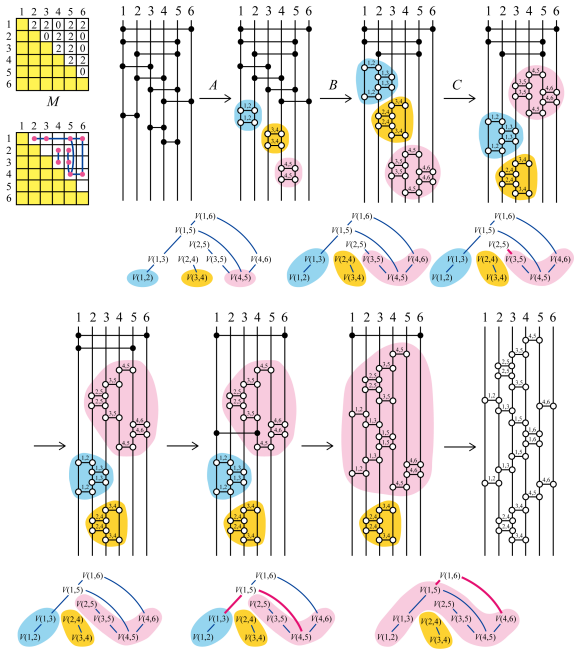
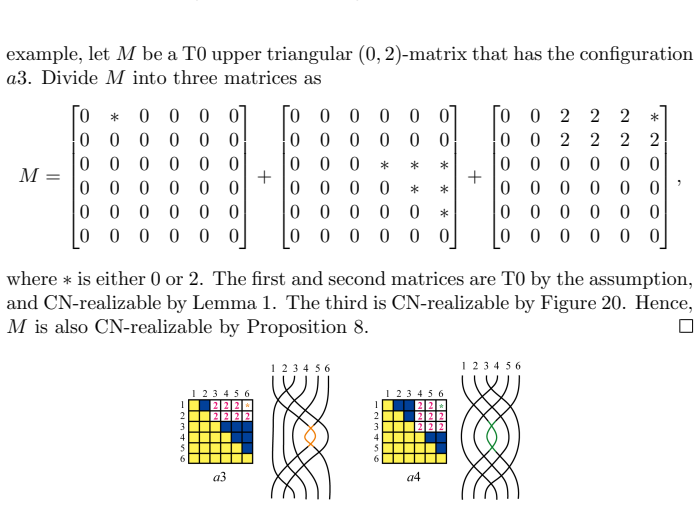
The BW-ladder diagram carries the argument. For a $(0,2)$-matrix $M$, one draws a black edge between strands $i$ and $j$ whenever the entry is 2; the ladder moves $L_1$ through $L_9$ are local rewrites that move black and white edges past each other. If a B-ladder diagram can be transformed into a W-ladder diagram, then $M$ is CN-realizable, because the white edges are the crossings of a braid projection. Section 4 catalogues formations—snake, hang-glider, and loupe—each with explicit ladder-move proofs of CN-realizability, and Section 5 packages them into the 128 configurations used in the exhaustive 6x6 check. The $T_0$ condition is the necessary side: it forbids the pattern of two zero entries forcing a non-zero entry.
What would settle it
Re-run the elimination of the 4,824 $T_0$ $(0,2)$-matrices: if any one of them lacks all of the configurations a1-a4, b1-b3, c1-c100, and d1-d21 and their reverses, and its B-ladder diagram cannot be transformed into a W-ladder diagram by the ladder moves, then the characterization of CN-realizable 6x6 matrices is false. A single 6x6 even symmetric $T_0$ matrix whose B-ladder diagram provably admits no ladder-move reduction would also disprove Proposition 25.
Extended reading notes
Core claim
Proposition 24 is the central claim: a 6x6 upper triangular $(0,2)$-matrix—one with entries only 0 or 2 above the diagonal—is CN-realizable if and only if it is $T_0$. Proposition 25 then states the consequence on the paper's own terms: a non-negative integer 6x6 matrix $M$ is the CN matrix of some pure 6-braid projection if and only if $M$ is even, symmetric, and $T_0$. From this, Corollary 4 characterizes the OU matrix of a pure 6-braid diagram by the condition that $M+M^{T}$ is even and $T_0$, and Corollary 5 characterizes the crossing matrix of a positive pure 6-braid as a non-negative integer $T_0$ symmetric matrix. Together these prove Theorem 1: Conjectures 1, 2, and 3 are true for $n \le 6$.
Load-bearing premise
The load-bearing step is the computer check that every one of the 4,824 six-by-six matrices with entries 0 or 2 that satisfy the $T_0$ condition contains at least one of the listed realizable configurations or its reverse; if that exhaustive check missed a case, Proposition 24 and Theorem 1 would fail.
Editorial extensions
If this is right
- Every 6x6 even symmetric $T_0$ matrix is realized by some pure 6-braid projection, so for six strands the geometric existence question has a purely algebraic answer.
- A 6x6 non-negative integer matrix $M$ is the OU matrix of a pure 6-braid diagram exactly when $M+M^{T}$ is even and $T_0$.
- A 6x6 integer matrix is the crossing matrix of a positive pure 6-braid exactly when it is non-negative, $T_0$, and symmetric.
- Because the same characterization was already known for $n \le 5$, the result gives a uniform statement for all braid projections with at most six strands.
Reading between the lines
- As an extension beyond the paper's own claims, the same finite configuration-check could be attempted for $n=7$: the paper counts 96,428 $T_0$ $(0,2)$-matrices of size 7, so a larger catalogue might settle the conjecture before a general proof is available.
- If Conjecture 4, the T-structure condition, is true, the snake, hang-glider, and loupe formations would all be instances of one graph-theoretic sufficient condition, potentially opening an inductive proof for all $n$.
- The paper proves that the crossing-matrix conjecture follows from the CN conjecture at any fixed $n$; a future proof of Conjecture 3 for arbitrary $n$ would therefore settle all three conjectures at once.
Editorial analysis
A structured set of objections, weighed in public.
Referee Report
Summary. The paper studies CN matrices of pure braid projections, the symmetric integer matrices whose (i,j) entry counts crossings between the i-th and j-th strands. It introduces several explicit formation types (snake, hang-glider, loupe) and proves via BW-ladder moves that matrices with these formations are CN-realizable. It then defines a large family of CN-realizable configurations for 6x6 T0 (0,2)-matrices and states the main theorem: for n <= 6, the CN matrix conjecture, the OU matrix conjecture, and the positive pure braid crossing matrix conjecture all hold. The proof of the n=6 case rests on Proposition 24, whose sufficiency direction is justified by the assertion that a computer check confirmed that all 4,824 T0 (0,2)-matrices contain at least one of the listed configurations or their reverses.
Significance. If the result is fully supported, the paper settles the three conjectures for n <= 6, extending the previously known n <= 5 cases. The individual formation proofs via ladder moves are explicit and appear checkable, and the reductions in Section 6.2 and 6.3 from a CN-matrix characterization to the OU and crossing matrix characterizations are clean. However, the decisive exhaustive step is not independently verifiable: the paper does not provide the computer program, the data, or a machine-checkable certificate, and the configuration list is given only as human-readable figures. The significance of the paper is therefore conditional on filling this reproducibility gap.
major comments (2)
- [§6.1, Proposition 24] The proof of Proposition 24 relies entirely on the assertion that all 4,824 6x6 upper triangular T0 (0,2)-matrices contain at least one of the listed CN-realizable configurations or their reverses, and that this was "confirmed by eliminating the matrices ... by computer". No code, data, or certificate is provided, and the count 4,824 alone does not establish coverage. If even one T0 matrix were missed by the configuration list, Proposition 24 would be false, and with it Proposition 25, Corollaries 4 and 5, and Theorem 1 would fall. This is a load-bearing exhaustive claim that cannot be replayed from the manuscript as written; a reproducible computer program, the elimination output, or an explicit certificate (for example, a list assigning to each matrix a witnessing configuration) is needed.
- [§5, Propositions 22 and 23] The configurations c1-c100 and d1-d21 are presented only as figures, with no formal specification in a machine-readable form. Since the computer elimination in Proposition 24 must test whether a matrix "has at least one of the CN-realizable configurations", the absence of a precise specification makes the exhaustive step even harder to verify. A machine-readable list of the configurations, or at least a precise coordinate description, should accompany the paper so that the claimed elimination can be independently checked.
minor comments (3)
- [§2, Lemma 1] The statement of Lemma 1 says M(i,j) = 0 when i < I or j > I - m - 1, but Proposition 9 and the surrounding text indicate the intended condition is j > I + m - 1. As printed, the lemma is trivial for many parameter choices; please correct this apparent typo.
- [Throughout] There are several typographical errors that should be fixed: "edegs" in the proof of Proposition 14, "confugurations" in the caption of Figure 20, "exsist" in the footnote to Conjecture 4, "fromation" in the captions of Figures 25 and 26, and "calcurated" in Remark 1.
- [§4.4, Conjecture 4] The assertion that "all the matrices of a snake, hang-glider or loupe formation have a T-structure" is stated without proof. It would be helpful to add a brief justification or to mark it explicitly as an observation, since Section 4.4 is otherwise somewhat detached from the main theorem.
Circularity Check
No significant circularity: the n=6 characterization is built from explicit ladder-move realizations and a brute-force coverage check, with no fitted parameter or definitional equivalence forcing the conclusion.
full rationale
The paper's central claim, Proposition 24, is that every 6x6 upper triangular T0 (0,2)-matrix is CN-realizable. The necessity direction is Proposition 5 from [6]; the sufficiency direction is a finite exhaustive computer check: 'All the 6 x 6 upper triangular T0 (0,2)-matrices, whose number is 4,824, have at least one of the CN-realizable configurations or their reverses of Examples 5, 6 or Propositions 22, 23. It was confirmed by eliminating the matrices that have the CN-realizable configurations from the list of the 4,824 T0 matrices by computer.' The individual configurations are proven CN-realizable by explicit ladder-move arguments (Propositions 13-20 and Examples 5-6), not by assuming the target characterization. The reduction from the (0,2) case to arbitrary even matrices uses Proposition 7 of [6], and the reductions from Conjecture 3 to Conjectures 2 and 1 in Propositions 26 and 27 are formal implications with proofs supplied here. Earlier results from [6] are used as lemmas, including Theorem 2 for n<=5; this is a legitimate prior theorem, not an import of the n=6 conclusion. The main weakness is that the exhaustive coverage assertion in Proposition 24 is not accompanied by code or data, and the footnote notes that the previous arXiv version used a different configuration set, so the enumeration cannot be replayed from the paper alone. That is a reproducibility and verification gap, not circularity: no matrix class is defined in terms of the target result, no fitted parameter is relabeled as a prediction, and no uniqueness claim is imported from the authors' prior work to force the choice.
Assumptions & free parameters
assumptions (2)
- ad hoc to paper Computer verification result: Every 6x6 upper triangular T0 (0,2)-matrix has at least one of the CN-realizable configurations a1-a4, b1-b3, c1-c100, d1-d21 (or their reverses).
- domain assumption Results from the authors' earlier work [6] are valid, including Propositions 5, 7, 8, 10, 11, 12 and Corollary 1 on CN matrices, ladder moves, and the OU matrix.
Cite this review
Pith. "Pith review of The CN matrix of a pure braid projection." pith.science (2026). https://pith.science/paper/FHEUUOZW
@misc{pith2026250608659,
  author       = {Pith},
  title        = {Pith review of: The CN matrix of a pure braid projection},
  year         = {2026},
  howpublished = {\url{https://pith.science/paper/FHEUUOZW}},
  note         = {Machine review of arXiv:2506.08659}
}
abstract
The CN matrix of an $n$-braid projection $B$ is an $n \times n$ matrix such that each $(i,j)$ entry indicates the number of crossings between $i^{th}$ and $j^{th}$ strands of $B$. In this paper, several patterns of an $n \times n$ matrix to be a CN matrix are discussed, and the CN matrix of a pure 6-braid projection is characterized. As an application, the OU matrix of a pure 6-braid diagram and the crossing matrix of a positive pure 6-braid are also characterized.
Figures


Figures from the paper (25 more)





Reference graph
Works this paper leans on
-
[6]
Kawauchi, Lectures on knot theory (in Japanese), Kyoritsu Shuppan Co
A. Kawauchi, Lectures on knot theory (in Japanese), Kyoritsu Shuppan Co. Ltd, 2007
work page 2007
-
[1]
E. Artin, Theory of braids, Ann. Math. 48 (1947), 101--126
work page 1947
-
[2]
J. Burillo, M. Gutierrez, S. Krsti\' c and Z. Nitecki, Crossing matrices and Thurston's normal form for braids, Topl. Appl. 118 (2002), 293--308
work page 2002
-
[3]
E. Elrifai, H. Morton, Algorithms for positive braids, Quart. J. Math. Oxford 45 (2)(1994), 479 497
work page 1994
-
[4]
F. A. Garside, The braid group and other groups, Quart J. Math. Oxford Ser. 20 (1969), 235–254
work page 1969
-
[5]
Crossing Matrices of Positive Braids
M. Gutierrez and Z. Nitecki, Crossing matrix of positive braids, arXiv:1805.12189
-
[7]
A. Shimizu, A. Gill and S. Joshi, A note on the unknotting number and the region nuknotting number of weaving knots, arXiv:2408.14938
-
[8]
Characterization of the OU matrix of a braid diagram
A. Shimizu and Y. Yaguchi, Characterization of the OU matrix of a braid diagram, to appear in Topol. Appl. (arXiv:2502.16035)
Show all 10 references
-
[9]
Shimizu and Y
A. Shimizu and Y. Yaguchi, Determinant of the OU matrix of a braid diagram, J. Knot Theory Ramifications 34 (2025), 2550005
2025
-
[10]
Thurston, Finite state algorithms for the braid group: Chapter 9 of Word processing in groups, D
W. Thurston, Finite state algorithms for the braid group: Chapter 9 of Word processing in groups, D. B. A. Epstein, J. W. Cannon, D. F. Holt, S. V. F. Levy, M. S. Patterson and W. P. Thurston. Jones and Bartlett, Boston and London 1992
1992
Reviewed August 7, 2026 · model on record in the stance chip above.
Discussion (0). Sign in to comment.